Athira Shynne B. Nanda Kumar
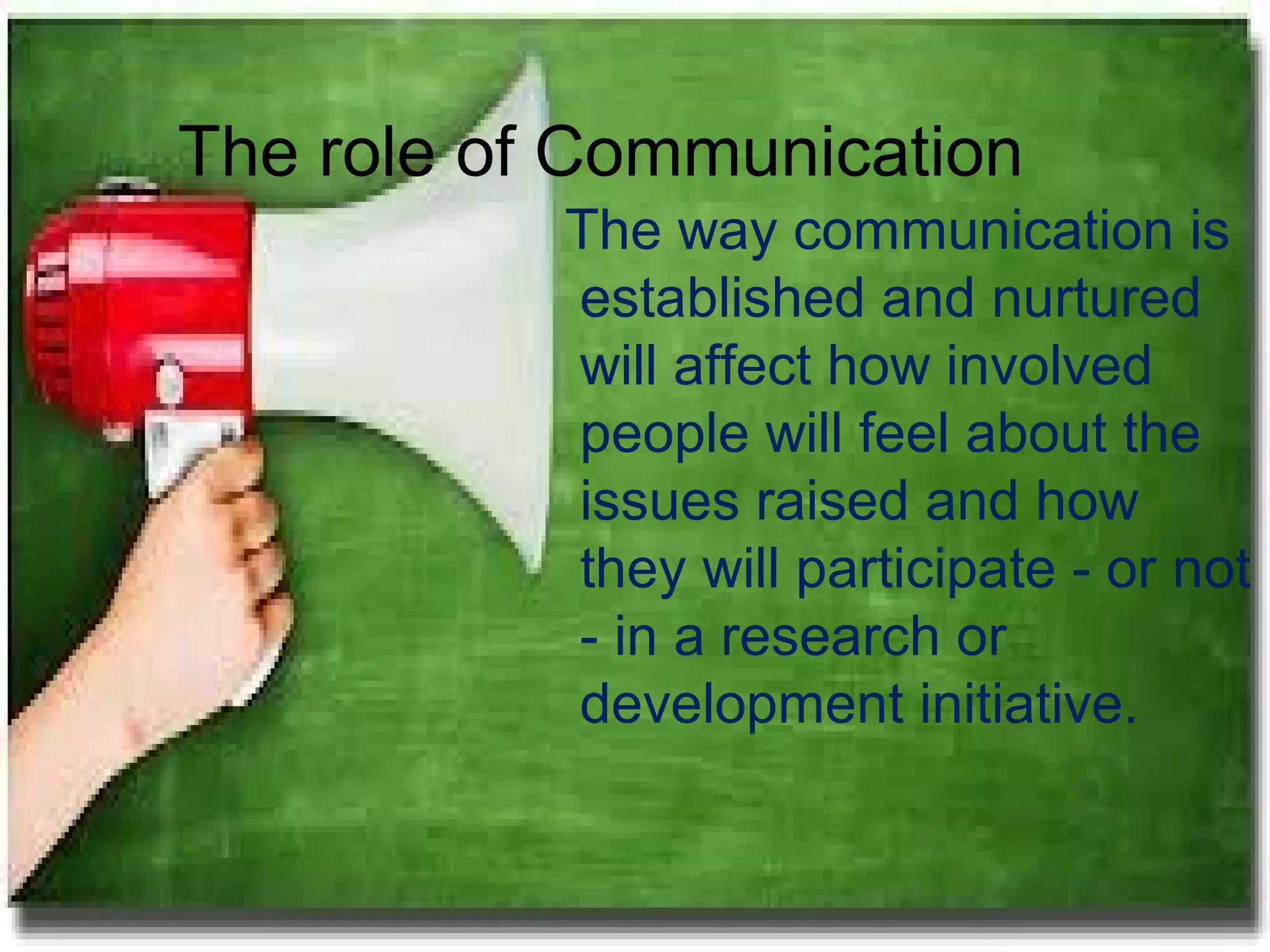
The role of Communication
The way communication is
established and nurtured
will affect how involved
people will feel about the
issues raised and how
they will participate - or not
- in a research or
development initiative.
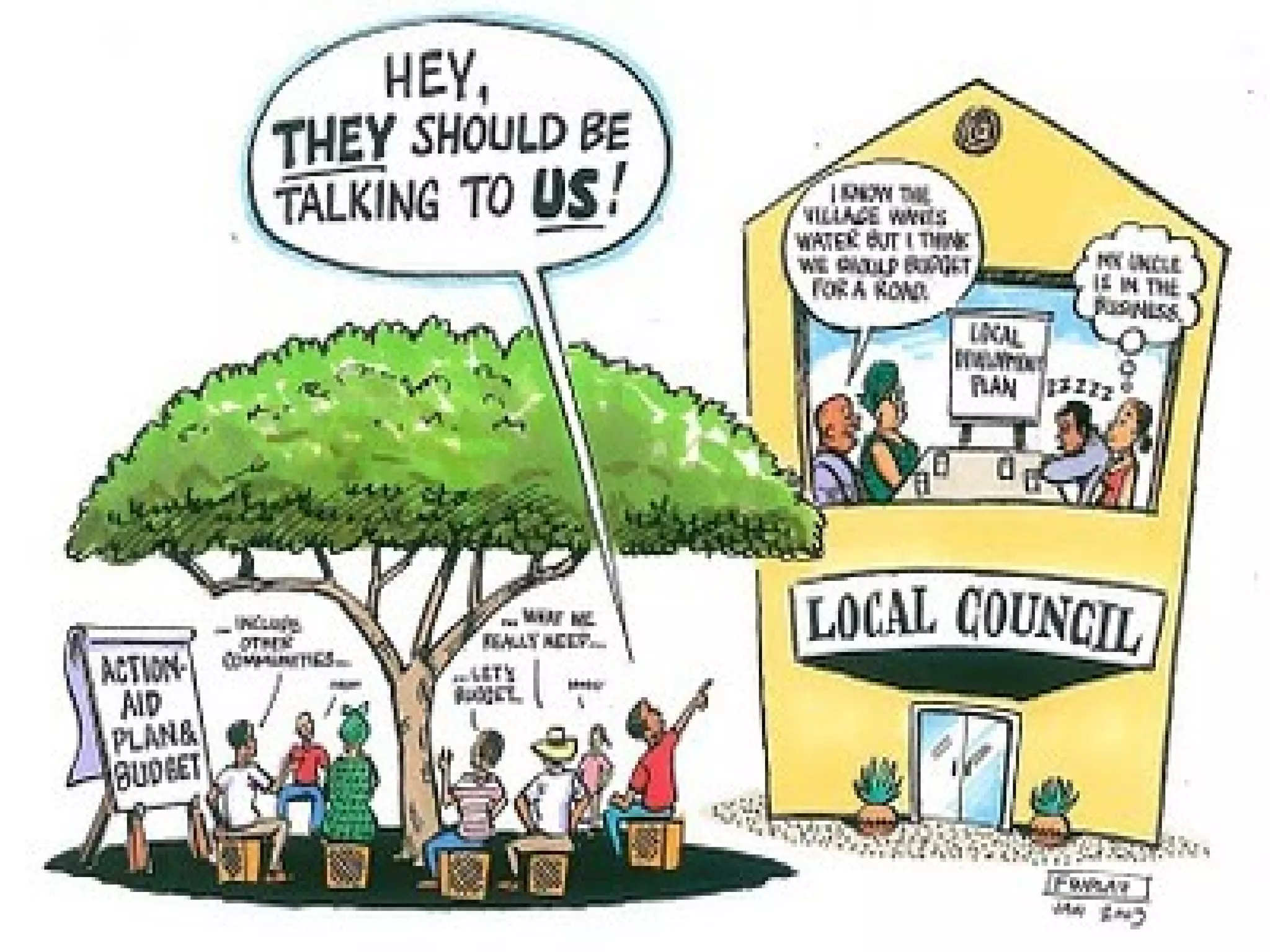
PARTICIPATORY COMMUNICATION
participatory communication is
an approach capable of facilitating
people's involvement in decisionmaking about issues impacting
their lives - a process capable of
addressing specific needs and
priorities relevant to people and at
the same time assisting in their
empowerment


Participatory Development
communication
Participatory communication has been defined
as “a dynamic, interactional, and transformative
process of dialogue between people, groups,
and institutions that enables people, both
individually and collectively, to realize their full
potential and be engaged in their own
welfare. ”
background
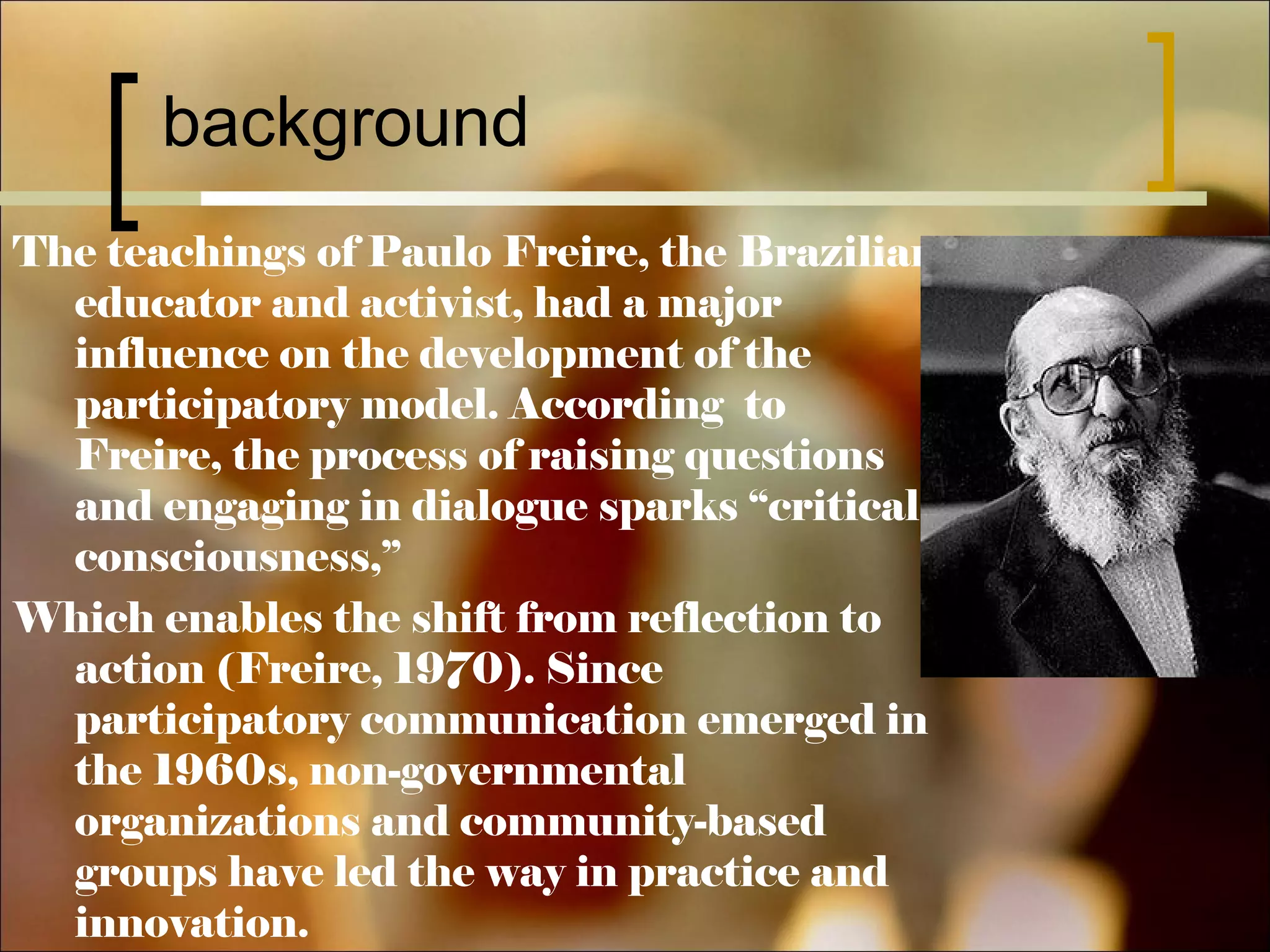
The teachings of Paulo Freire, the Brazilian
educator and activist, had a major
influence on the development of the
participatory model. According to
Freire, the process of raising questions
and engaging in dialogue sparks “critical
consciousness,”
Which enables the shift from reflection to
action (Freire, 1970). Since
participatory communication emerged in
the 1960s, non-governmental
organizations and community-based
groups have led the way in practice and
innovation.
Six phases of participatory
communication planning









Preliminary situation assessment
Communication strategy design
Participatory design of messages and
discussion themes
Communication methods and
materials development
Implementation
Evaluation
Preliminary situation
assessment
could be done most effectively in a participatory manner
through PRCA or participatory rural communication
appraisal.
Three kinds of analysis are done in PRCA:
1. Audience analysis is essentially "listening" to what potential
users of information need. They are the ones whom the
communication program intends to reach. Users of
information are also referred to as
stakeholders(Beneficiaries) of a communication program.
Collecting baseline information about these stakeholders is
an essential preliminary step towards developing a
communication strategy.
2. Situation
analysis In doing
situation analysis,
planners look at
both the possible
problem to be
addressed by the
communication
program and the
conditions
surrounding such
problem.

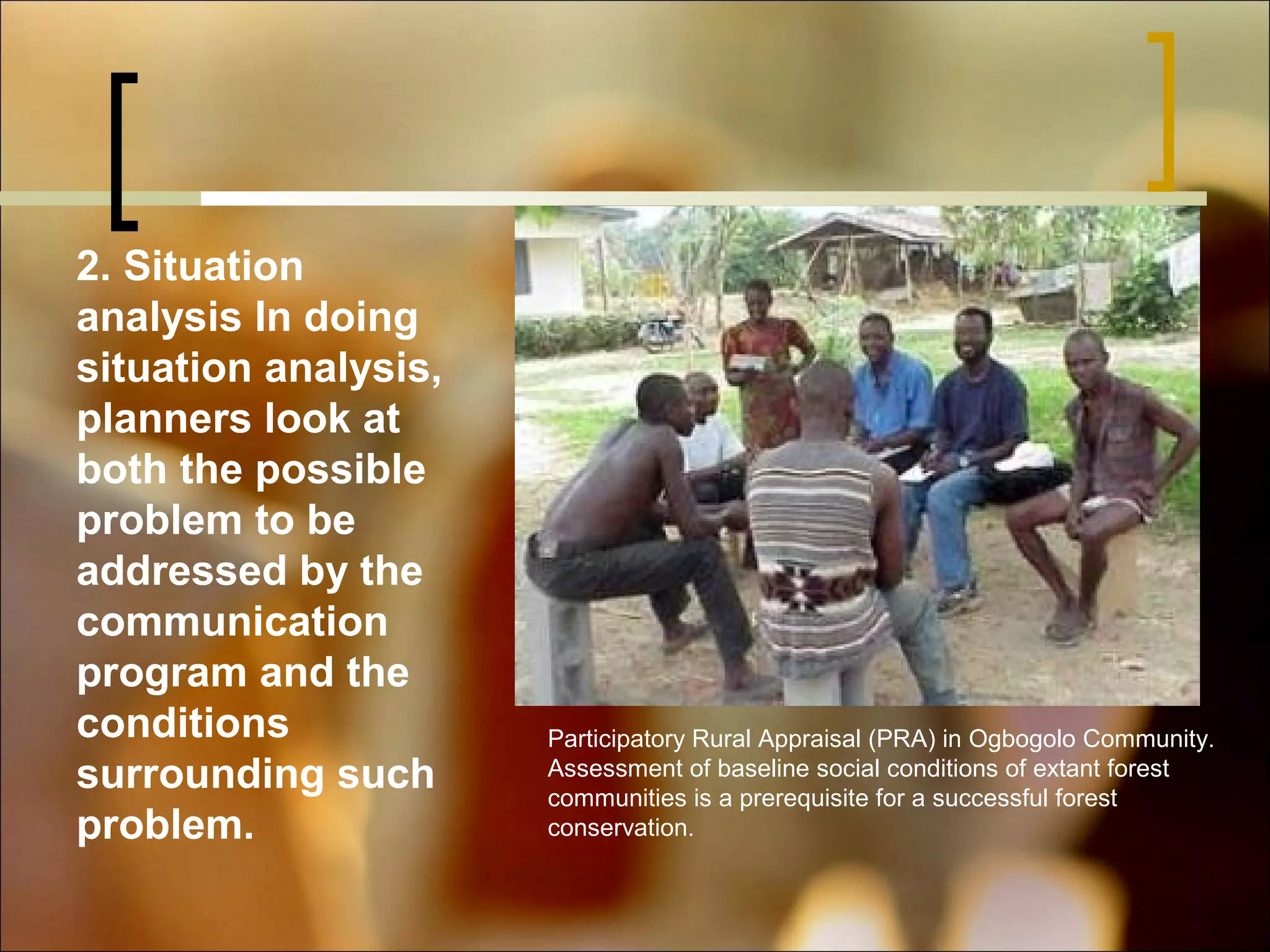
Participatory Rural Appraisal (PRA) in Ogbogolo Community.
Assessment of baseline social conditions of extant forest
communities is a prerequisite for a successful forest
conservation.
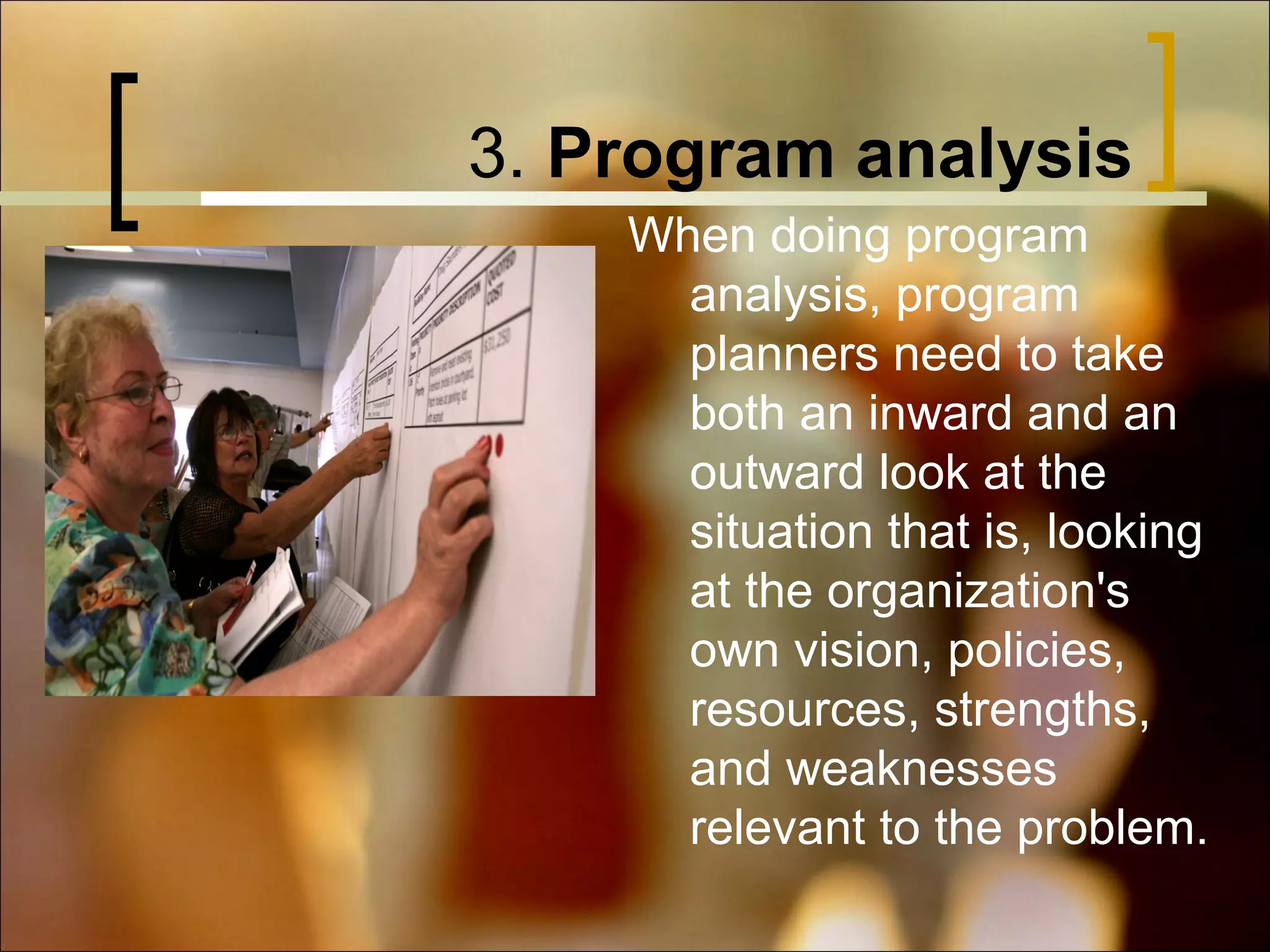
3. Program analysis
When doing program
analysis, program
planners need to take
both an inward and an
outward look at the
situation that is, looking
at the organization's
own vision, policies,
resources, strengths,
and weaknesses
relevant to the problem.
Communication strategy
design
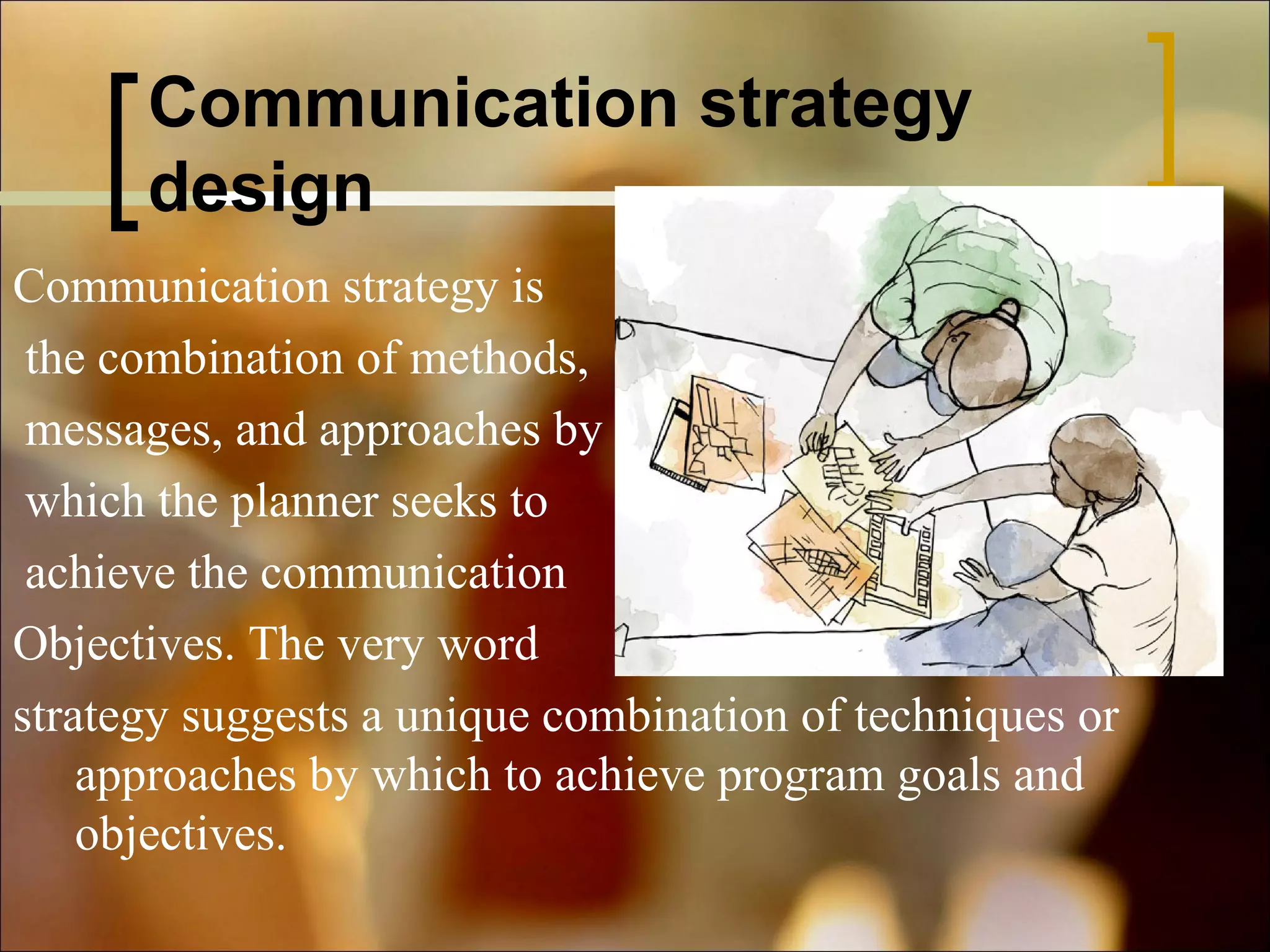
Communication strategy is
the combination of methods,
messages, and approaches by
which the planner seeks to
achieve the communication
Objectives. The very word
strategy suggests a unique combination of techniques or
approaches by which to achieve program goals and
objectives.
Participatory design of
messages and discussion
themes
This phase are selection of message
appeals and approaches and selection
of communication channels and
media. The big challenge at this stage
is the development of the big idea or
the creative concept around which the
whole communication program would
revolve.
Communication methods
and materials development


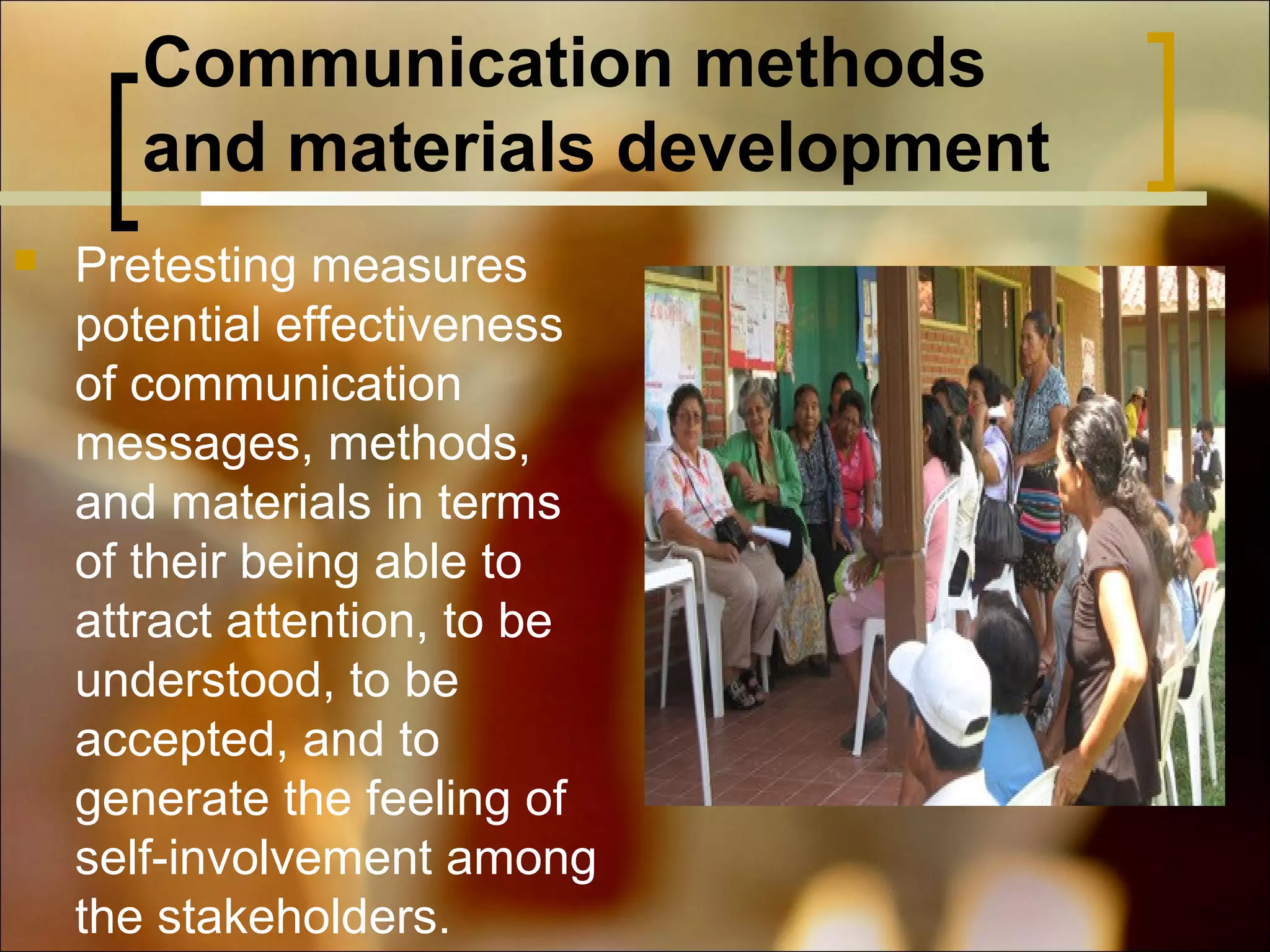
Pretesting measures
potential effectiveness
of communication
messages, methods,
and materials in terms
of their being able to
attract attention, to be
understood, to be
accepted, and to
generate the feeling of
self-involvement among
the stakeholders.
Management and
implementation
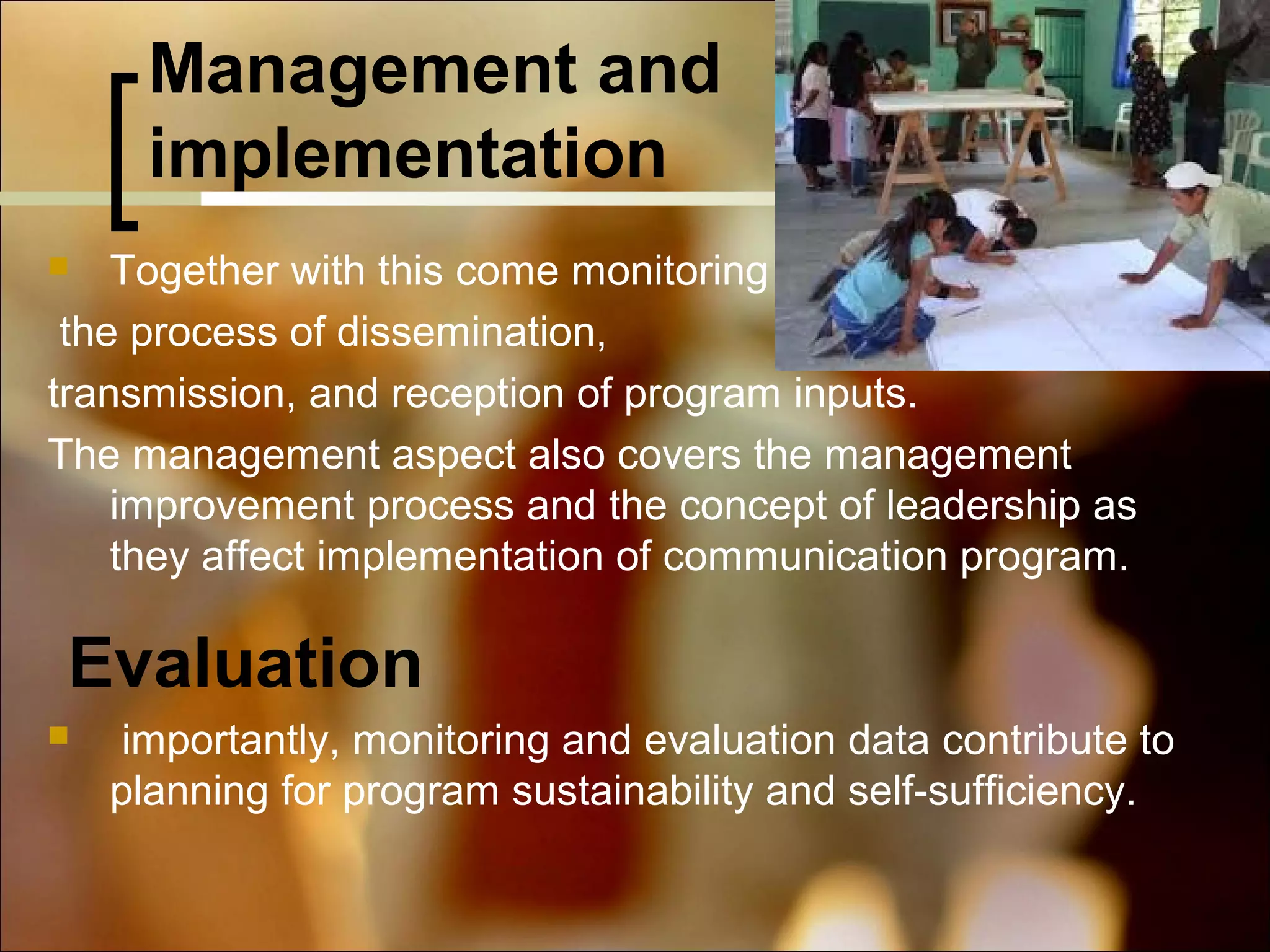
Together with this come monitoring
the process of dissemination,
transmission, and reception of program inputs.
The management aspect also covers the management
improvement process and the concept of leadership as
they affect implementation of communication program.


Evaluation


importantly, monitoring and evaluation data contribute to
planning for program sustainability and self-sufficiency.
four different ways of participation can be
observed in most development projects


Participation in implementation:
People are actively encouraged and
mobilized to take part in the
actualization of projects. They are
given certain responsibilities and set
certain tasks or required to contribute
specified resources.
Participation in evaluation:
Upon completion of a project, people are
invited to critique the success or failure
of it.

Participation in benefit:
People take part in enjoying the fruits of a
project, this maybe water from a handpump, medical care by a "bare-foot
doctor", a truck to transport produce to
market, or village meetings in the new
community hall.
Participation in decisionmaking:


People initiate, discuss, conceptualize and plan
activities they will all do as a community. Some of this
may be related to more common development areas
such as building schools etc.

(Most will agree that participation in decision-making is
the most important form to promote.)


Some development initiatives provide people with
opportunities to all these four ways of participation.
Many do not, and restrict participation to one or two
ways.
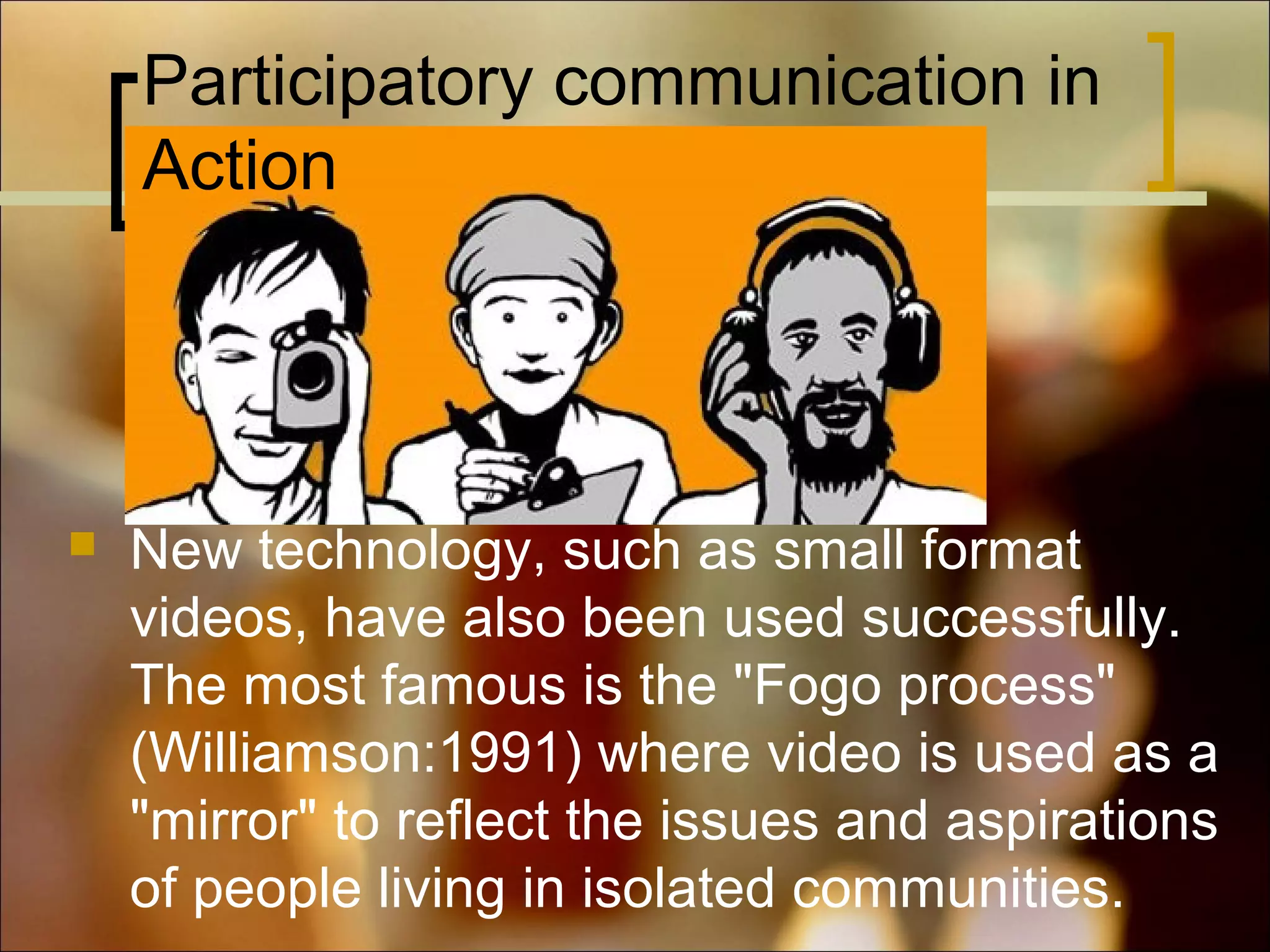
Participatory communication in
Action



New technology, such as small format
videos, have also been used successfully.
The most famous is the "Fogo process"
(Williamson:1991) where video is used as a
"mirror" to reflect the issues and aspirations
of people living in isolated communities.
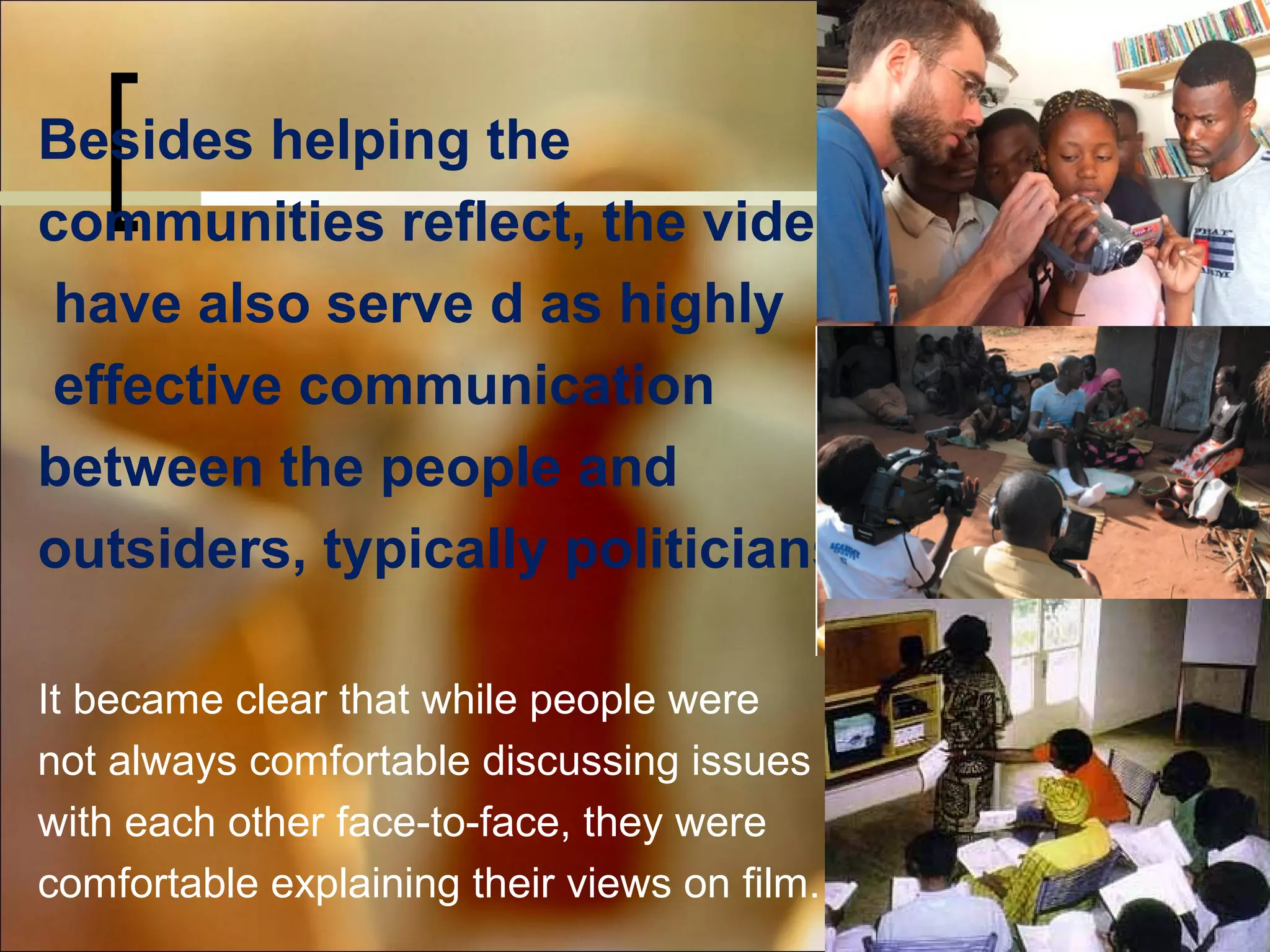
Besides helping the
communities reflect, the videos
have also serve d as highly
effective communication
between the people and
outsiders, typically politicians
It became clear that while people were
not always comfortable discussing issues
with each other face-to-face, they were
comfortable explaining their views on film.
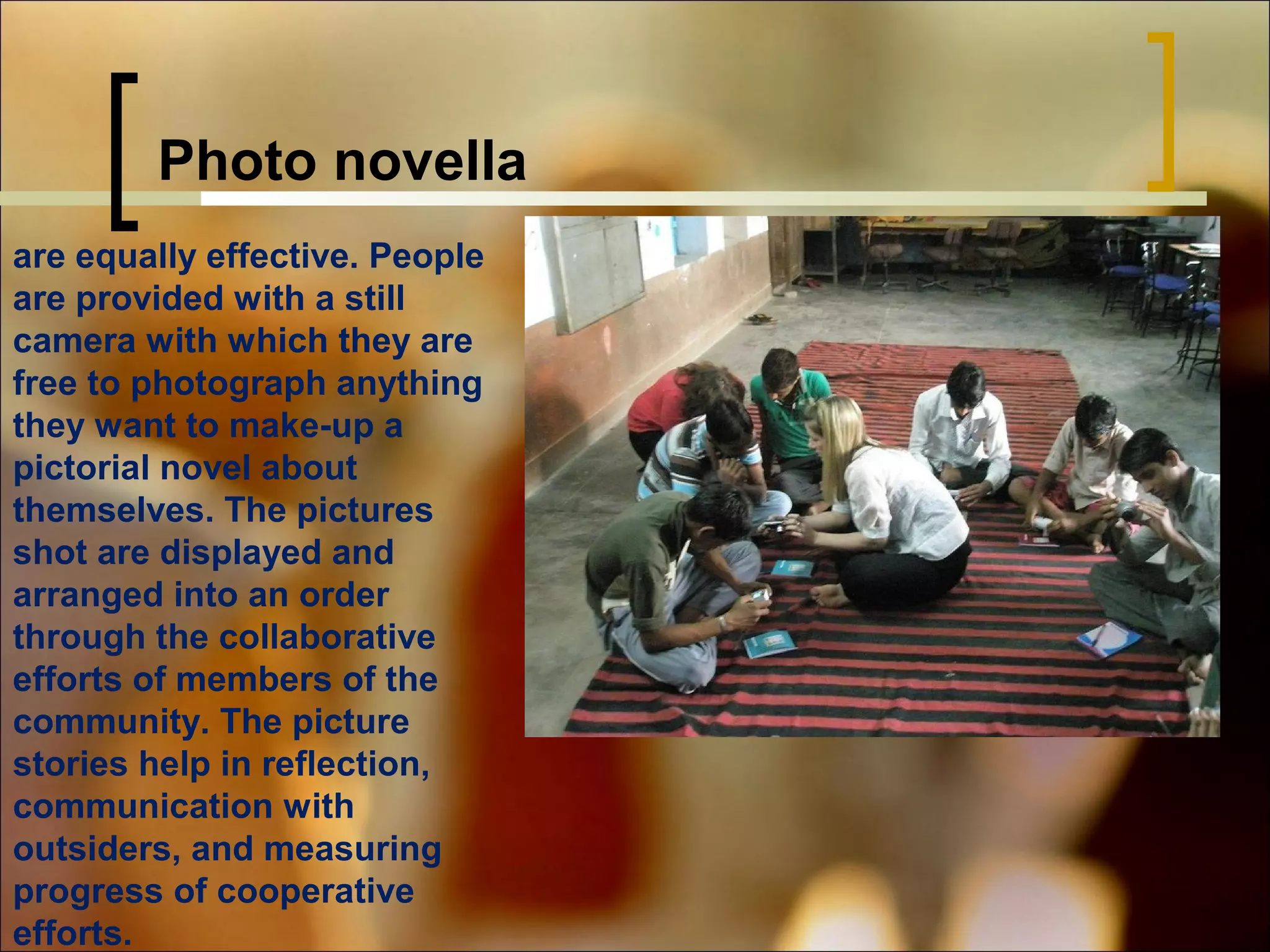
Photo novella
are equally effective. People
are provided with a still
camera with which they are
free to photograph anything
they want to make-up a
pictorial novel about
themselves. The pictures
shot are displayed and
arranged into an order
through the collaborative
efforts of members of the
community. The picture
stories help in reflection,
communication with
outsiders, and measuring
progress of cooperative
efforts.
In the Philippines…


A some what surprising success is a
method called CIPS--Community
Information and Planning System.
Surprising because it is a method based
on scientific research which many people
had first thought alien and not useful to
rural communities.
In this method villagers who have heard about
CIPS invite the University where CIPS was
developed, to send a trainer to work with the
community. The course is taught in the local dialect
and presents the research process in a simple, easy
to implement way. The people begin their research
immediately after the course. They collect data and
analyze them as a group. The results of the
research are displayed on large charts, in the form
of easy to understand graphics and presented to the
community during a village meeting.
After members of the community
have understood the findings of
the research, they move on to
prioritize problems and plan action
to address these problems. The
action is usually written-up in the
form of a proposal to a local
government agency.
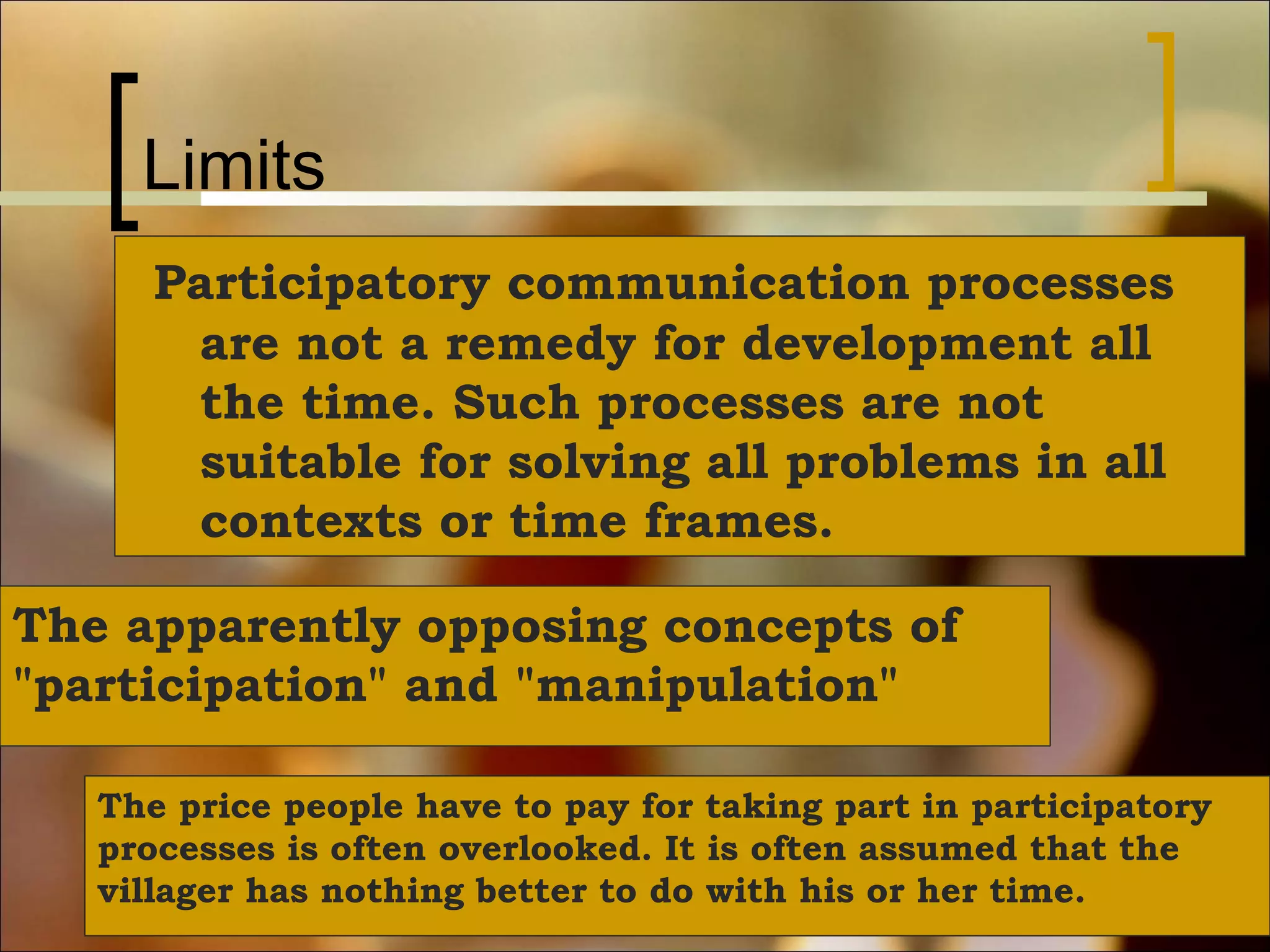
Limits
Participatory communication processes
are not a remedy for development all
the time. Such processes are not
suitable for solving all problems in all
contexts or time frames.
The apparently opposing concepts of
"participation" and "manipulation"
The price people have to pay for taking part in participatory
processes is often overlooked. It is often assumed that the
villager has nothing better to do with his or her time.
If the response to any of these
questions is “yes,”
then it is very likely that participatory
communication approaches can help
revitalize community engagement
and advance program goals.
Sources:
Involving the Community
by Guy Bessette
(http://idlbnc.idrc.ca/dspace/bitstream/10625/31476/33/
119952.pdf)




http://www.southbound.com.my/communication/parcom.htm



Participatory Development Communication: A West
African Agenda Editors: Guy Bessette and C.V.
Rajasunderam

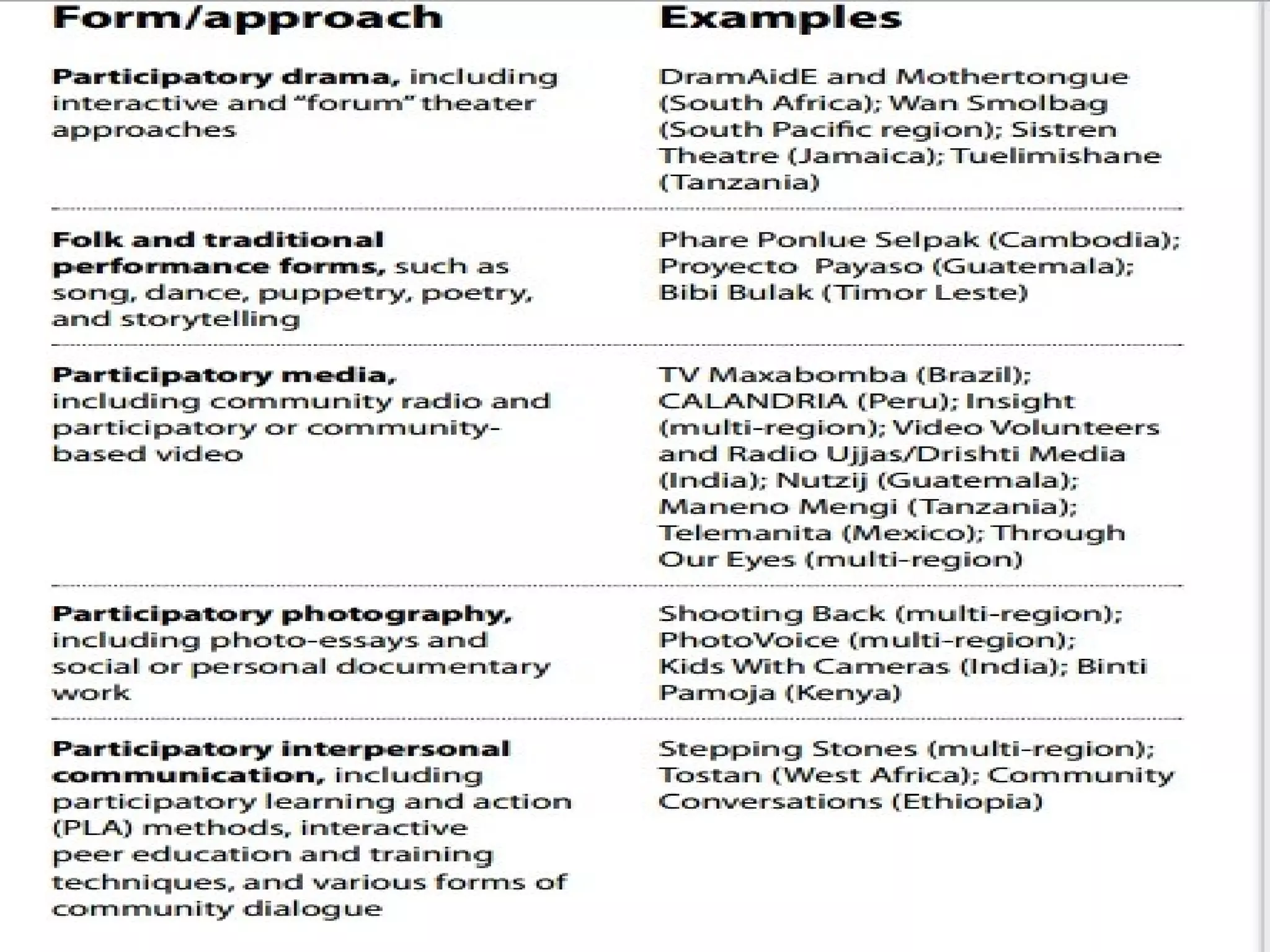
Participatory approach

  • 1.
    Athira Shynne B.Nanda Kumar
  • 2.
    The role ofCommunication The way communication is established and nurtured will affect how involved people will feel about the issues raised and how they will participate - or not - in a research or development initiative.
  • 3.
    PARTICIPATORY COMMUNICATION participatory communicationis an approach capable of facilitating people's involvement in decisionmaking about issues impacting their lives - a process capable of addressing specific needs and priorities relevant to people and at the same time assisting in their empowerment 
  • 5.
    Participatory Development communication Participatory communicationhas been defined as “a dynamic, interactional, and transformative process of dialogue between people, groups, and institutions that enables people, both individually and collectively, to realize their full potential and be engaged in their own welfare. ”
  • 6.
    background The teachings ofPaulo Freire, the Brazilian educator and activist, had a major influence on the development of the participatory model. According to Freire, the process of raising questions and engaging in dialogue sparks “critical consciousness,” Which enables the shift from reflection to action (Freire, 1970). Since participatory communication emerged in the 1960s, non-governmental organizations and community-based groups have led the way in practice and innovation.
  • 7.
    Six phases ofparticipatory communication planning       Preliminary situation assessment Communication strategy design Participatory design of messages and discussion themes Communication methods and materials development Implementation Evaluation
  • 8.
    Preliminary situation assessment could bedone most effectively in a participatory manner through PRCA or participatory rural communication appraisal. Three kinds of analysis are done in PRCA: 1. Audience analysis is essentially "listening" to what potential users of information need. They are the ones whom the communication program intends to reach. Users of information are also referred to as stakeholders(Beneficiaries) of a communication program. Collecting baseline information about these stakeholders is an essential preliminary step towards developing a communication strategy.
  • 9.
    2. Situation analysis Indoing situation analysis, planners look at both the possible problem to be addressed by the communication program and the conditions surrounding such problem. Participatory Rural Appraisal (PRA) in Ogbogolo Community. Assessment of baseline social conditions of extant forest communities is a prerequisite for a successful forest conservation.
  • 10.
    3. Program analysis Whendoing program analysis, program planners need to take both an inward and an outward look at the situation that is, looking at the organization's own vision, policies, resources, strengths, and weaknesses relevant to the problem.
  • 11.
    Communication strategy design Communication strategyis the combination of methods, messages, and approaches by which the planner seeks to achieve the communication Objectives. The very word strategy suggests a unique combination of techniques or approaches by which to achieve program goals and objectives.
  • 12.
    Participatory design of messagesand discussion themes This phase are selection of message appeals and approaches and selection of communication channels and media. The big challenge at this stage is the development of the big idea or the creative concept around which the whole communication program would revolve.
  • 13.
    Communication methods and materialsdevelopment  Pretesting measures potential effectiveness of communication messages, methods, and materials in terms of their being able to attract attention, to be understood, to be accepted, and to generate the feeling of self-involvement among the stakeholders.
  • 14.
    Management and implementation Together withthis come monitoring the process of dissemination, transmission, and reception of program inputs. The management aspect also covers the management improvement process and the concept of leadership as they affect implementation of communication program.  Evaluation  importantly, monitoring and evaluation data contribute to planning for program sustainability and self-sufficiency.
  • 15.
    four different waysof participation can be observed in most development projects  Participation in implementation: People are actively encouraged and mobilized to take part in the actualization of projects. They are given certain responsibilities and set certain tasks or required to contribute specified resources.
  • 16.
    Participation in evaluation: Uponcompletion of a project, people are invited to critique the success or failure of it. Participation in benefit: People take part in enjoying the fruits of a project, this maybe water from a handpump, medical care by a "bare-foot doctor", a truck to transport produce to market, or village meetings in the new community hall.
  • 17.
    Participation in decisionmaking:  Peopleinitiate, discuss, conceptualize and plan activities they will all do as a community. Some of this may be related to more common development areas such as building schools etc. (Most will agree that participation in decision-making is the most important form to promote.)  Some development initiatives provide people with opportunities to all these four ways of participation. Many do not, and restrict participation to one or two ways.
  • 18.
    Participatory communication in Action  Newtechnology, such as small format videos, have also been used successfully. The most famous is the "Fogo process" (Williamson:1991) where video is used as a "mirror" to reflect the issues and aspirations of people living in isolated communities.
  • 19.
    Besides helping the communitiesreflect, the videos have also serve d as highly effective communication between the people and outsiders, typically politicians It became clear that while people were not always comfortable discussing issues with each other face-to-face, they were comfortable explaining their views on film.
  • 20.
    Photo novella are equallyeffective. People are provided with a still camera with which they are free to photograph anything they want to make-up a pictorial novel about themselves. The pictures shot are displayed and arranged into an order through the collaborative efforts of members of the community. The picture stories help in reflection, communication with outsiders, and measuring progress of cooperative efforts.
  • 22.
    In the Philippines…  Asome what surprising success is a method called CIPS--Community Information and Planning System. Surprising because it is a method based on scientific research which many people had first thought alien and not useful to rural communities.
  • 23.
    In this methodvillagers who have heard about CIPS invite the University where CIPS was developed, to send a trainer to work with the community. The course is taught in the local dialect and presents the research process in a simple, easy to implement way. The people begin their research immediately after the course. They collect data and analyze them as a group. The results of the research are displayed on large charts, in the form of easy to understand graphics and presented to the community during a village meeting.
  • 24.
    After members ofthe community have understood the findings of the research, they move on to prioritize problems and plan action to address these problems. The action is usually written-up in the form of a proposal to a local government agency.
  • 25.
    Limits Participatory communication processes arenot a remedy for development all the time. Such processes are not suitable for solving all problems in all contexts or time frames. The apparently opposing concepts of "participation" and "manipulation" The price people have to pay for taking part in participatory processes is often overlooked. It is often assumed that the villager has nothing better to do with his or her time.
  • 27.
    If the responseto any of these questions is “yes,” then it is very likely that participatory communication approaches can help revitalize community engagement and advance program goals.
  • 29.
    Sources: Involving the Community byGuy Bessette (http://idlbnc.idrc.ca/dspace/bitstream/10625/31476/33/ 119952.pdf)   http://www.southbound.com.my/communication/parcom.htm  Participatory Development Communication: A West African Agenda Editors: Guy Bessette and C.V. Rajasunderam