Software Project Management
Course Instructor
Samana Zehra
(Assistant Professor)
samana.zehra@uettaxila.edu.pk
Course Objective
 To learn the techniques required to
plan, organize, monitor and control
software development projects
Learning aspects in SPM …
 Managing people, process and problems
during a software project
 Relating software metrics with software
projects
 Estimating effort, cost and project duration
 Risk assessment techniques
 Project scheduling
 Project quality management
 Change management during software
development and after delivery to customer
Books
 Text Book:
 Software Engineering: A Practitioner’s Approach
6/e or 7/e – by Roger Pressman
 Reference Material:
 A Guide to The Project Management Body of
Knowledge – PMI Standards Committee (William
R. Duncan)
 Software Engineering Project Management –
Edited by Richard H. Thayer (Original
Contributions by numerous authors)
 Other relevant resources may be included
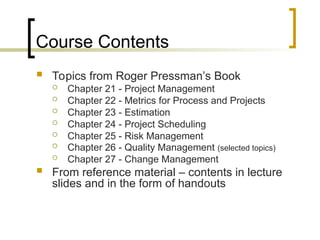
Course Contents
 Topics from Roger Pressman’s Book
 Chapter 21 - Project Management
 Chapter 22 - Metrics for Process and Projects
 Chapter 23 - Estimation
 Chapter 24 - Project Scheduling
 Chapter 25 - Risk Management
 Chapter 26 - Quality Management (selected topics)
 Chapter 27 - Change Management
 From reference material – contents in lecture
slides and in the form of handouts
Course Website
 http://web.uettaxila.edu.pk/CMS/
AUT2010/seSPMbs/index.asp
LECTURE #1
The beginning…
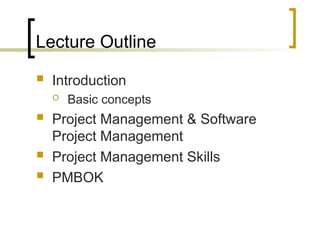
Lecture Outline
 Introduction
 Basic concepts
 Project Management & Software
Project Management
 Project Management Skills
 PMBOK
Introduction
Software Project Management
What is Software?
 Software can be considered a product
of engineering just like an airplane,
automobile, television, or an other
object that requires a high degree of
skill to turn a raw material into a usable
product.
 But software is developed or
engineered, not manufactured!
What is Software? (Contd.)
 Software can be of different types:
 System software
 Application software
 Engg./Scientific software
 Embedded software
 Product-line software
 Web-applications
 Artificial Intelligence software
 etc.
What is a Project ?
 PMI* definition
 It is a temporary endeavor (having
specific start and completion dates)
undertaken to create a unique product or
service
* Project Management Institute
What is a Project ? (Elaboration)
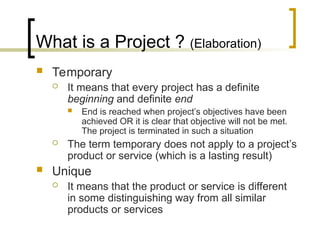
 Temporary
 It means that every project has a definite
beginning and definite end
 End is reached when project’s objectives have been
achieved OR it is clear that objective will not be met.
The project is terminated in such a situation
 The term temporary does not apply to a project’s
product or service (which is a lasting result)
 Unique
 It means that the product or service is different
in some distinguishing way from all similar
products or services
What is a Project ? (Contd.)
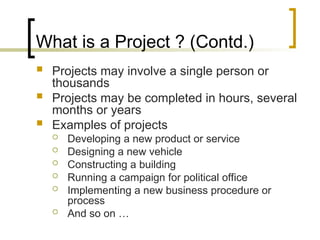
 Projects may involve a single person or
thousands
 Projects may be completed in hours, several
months or years
 Examples of projects
 Developing a new product or service
 Designing a new vehicle
 Constructing a building
 Running a campaign for political office
 Implementing a new business procedure or
process
 And so on …
What is Management?
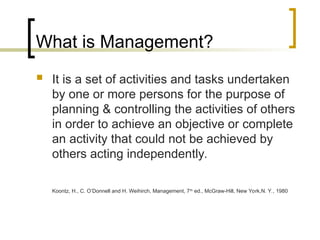
 It is a set of activities and tasks undertaken
by one or more persons for the purpose of
planning & controlling the activities of others
in order to achieve an objective or complete
an activity that could not be achieved by
others acting independently.
Koontz, H., C. O’Donnell and H. Weihirch, Management, 7th
ed., McGraw-Hill, New York,N. Y., 1980
What is Management? (Contd.)
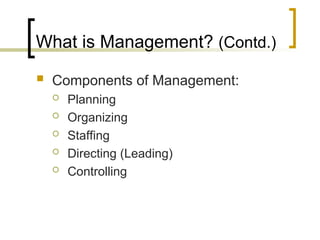
 Components of Management:
 Planning
 Organizing
 Staffing
 Directing (Leading)
 Controlling
What is Management? (Contd.)
 Planning
 Pre-determining course of action to achieve the objectives
 Organizing
 Establishing relationship among work units and granting
responsibility and authority to obtain the objectives
 Staffing
 Selecting and training people
 Directing (Leading)
 Creating an atmosphere that will assist & motivate people
to achieve the desired end results
 Controlling
 Establishing, measuring, and evaluating performance of
activities towards planned objectives
What is Project Management ?
 It is the discipline of planning, organizing,
and managing resources to bring about the
successful completion of specific project
goals and objectives
Project Management (Contd.)
 Following are related to Project Management
 Professional Organizations
 Project Management Institute (PMI) (pmi.org)
 Software Engineering Institute (SEI)
 IEEE Software Engineering Group
 Certifications (offered by PMI)
 PMP (Project Management Professional)
 CAPM (Certified Associate in Project Management)
 PMBOK – Project Management Body of Knowledge,
published by PMI
 Tools
 MS Project
 Primavera Project Manager
Software Project Management
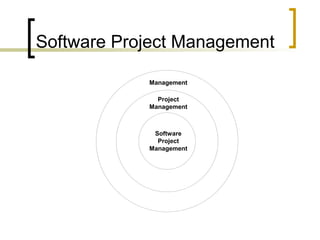
Management
Project
Management
Software
Project
Management
Software Project Management
 A sub-discipline of project
management in which software
projects are planned, monitored and
controlled
Software Project Management
(Contd.)
 Software development is a complex
undertaking particularly when it involves
many people working over a relatively long
time.
 Hence software development projects need
to be managed.
 Everyone involved “manages” to some
extent, but the scope of management
activities varies for every person.
Managerial Skills
 Robert L. Katz identified three kinds of
skills for administrators*. The fourth
may be added to it.
 Technical skills
 Human skills
 Conceptual skills
 Design skills
*in “Skills of an Effective Administration” 1955, and “Retrospective Commentary”, 1974, both printed in Harvard
Business Review
Managerial Skills (Contd.)
 Technical skills
 Knowledge of & proficiency in activities involving
methods, processes & procedures.
 Working with tools & specific techniques.
 Human skills
 Ability to work with people.
 Cooperative effort, team work.
 Creating a conducive environment for people/
workers.
Managerial Skills (Contd.)
 Conceptual skills
 Ability to see the “big picture”.
 Ability to recognize significant elements in a
situation & to understand the relationship among
them.
 Design skills
 Ability to solve problems that will eventually
benefit the enterprise.
 The skill to design effective & practical solutions
to problems rather than becoming “problem
watcher” only.
 Important for upper level managers.
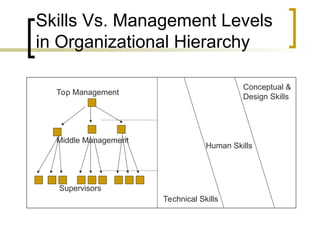
Skills Vs. Management Levels
in Organizational Hierarchy
Top Management
Middle Management
Supervisors
Conceptual &
Design Skills
Human Skills
Technical Skills
Project Management Skills
 Project Management Skills (in simple words)
 Leadership
 Communications
 Problem Solving
 Negotiating
 Influencing the Organization
 Mentoring
 Process and technical expertise
PMBOK
 The Project Management Body of
Knowledge (PMBOK) is a collection of
processes and knowledge areas generally
accepted as best practice within the project
management discipline.
 Generally accepted means that it is
applicable to most of the projects most of
the time.
 It is an internationally recognized standard
(IEEE Std 1490-2003).
PMBOK (Contd.)
 PMBOK recognizes 5 basic process groups
and 9 knowledge areas typical of almost all
projects.
 The five basic process groups are:
 Initiating
 Planning
 Executing
 Monitoring and Controlling
 Closing
PMBOK (Contd.)
 The nine suggested Knowledge Areas are:
 Project Integration Management
 Project Scope Management
 Project Time Management
 Project Cost Management
 Project Quality Management
 Project Human Resource Management
 Project Communications Management
 Project Risk Management
 Project Procurement Management
Knowledge areas in Detail
References
 Today’s lecture has been taken from:
 Software Engineering: A Practitioner’s
Approach – Roger Pressman
 Software Engineering Project
Management – Richard H. Thayer
 PMBOK-2000.pdf
End of the Lecture!

Introduction to Project management and project planning

  • 1.
    Software Project Management CourseInstructor Samana Zehra (Assistant Professor) samana.zehra@uettaxila.edu.pk
  • 2.
    Course Objective  Tolearn the techniques required to plan, organize, monitor and control software development projects
  • 3.
    Learning aspects inSPM …  Managing people, process and problems during a software project  Relating software metrics with software projects  Estimating effort, cost and project duration  Risk assessment techniques  Project scheduling  Project quality management  Change management during software development and after delivery to customer
  • 4.
    Books  Text Book: Software Engineering: A Practitioner’s Approach 6/e or 7/e – by Roger Pressman  Reference Material:  A Guide to The Project Management Body of Knowledge – PMI Standards Committee (William R. Duncan)  Software Engineering Project Management – Edited by Richard H. Thayer (Original Contributions by numerous authors)  Other relevant resources may be included
  • 5.
    Course Contents  Topicsfrom Roger Pressman’s Book  Chapter 21 - Project Management  Chapter 22 - Metrics for Process and Projects  Chapter 23 - Estimation  Chapter 24 - Project Scheduling  Chapter 25 - Risk Management  Chapter 26 - Quality Management (selected topics)  Chapter 27 - Change Management  From reference material – contents in lecture slides and in the form of handouts
  • 6.
  • 7.
  • 8.
    Lecture Outline  Introduction Basic concepts  Project Management & Software Project Management  Project Management Skills  PMBOK
  • 9.
  • 10.
    What is Software? Software can be considered a product of engineering just like an airplane, automobile, television, or an other object that requires a high degree of skill to turn a raw material into a usable product.  But software is developed or engineered, not manufactured!
  • 11.
    What is Software?(Contd.)  Software can be of different types:  System software  Application software  Engg./Scientific software  Embedded software  Product-line software  Web-applications  Artificial Intelligence software  etc.
  • 12.
    What is aProject ?  PMI* definition  It is a temporary endeavor (having specific start and completion dates) undertaken to create a unique product or service * Project Management Institute
  • 13.
    What is aProject ? (Elaboration)  Temporary  It means that every project has a definite beginning and definite end  End is reached when project’s objectives have been achieved OR it is clear that objective will not be met. The project is terminated in such a situation  The term temporary does not apply to a project’s product or service (which is a lasting result)  Unique  It means that the product or service is different in some distinguishing way from all similar products or services
  • 14.
    What is aProject ? (Contd.)  Projects may involve a single person or thousands  Projects may be completed in hours, several months or years  Examples of projects  Developing a new product or service  Designing a new vehicle  Constructing a building  Running a campaign for political office  Implementing a new business procedure or process  And so on …
  • 15.
    What is Management? It is a set of activities and tasks undertaken by one or more persons for the purpose of planning & controlling the activities of others in order to achieve an objective or complete an activity that could not be achieved by others acting independently. Koontz, H., C. O’Donnell and H. Weihirch, Management, 7th ed., McGraw-Hill, New York,N. Y., 1980
  • 16.
    What is Management?(Contd.)  Components of Management:  Planning  Organizing  Staffing  Directing (Leading)  Controlling
  • 17.
    What is Management?(Contd.)  Planning  Pre-determining course of action to achieve the objectives  Organizing  Establishing relationship among work units and granting responsibility and authority to obtain the objectives  Staffing  Selecting and training people  Directing (Leading)  Creating an atmosphere that will assist & motivate people to achieve the desired end results  Controlling  Establishing, measuring, and evaluating performance of activities towards planned objectives
  • 18.
    What is ProjectManagement ?  It is the discipline of planning, organizing, and managing resources to bring about the successful completion of specific project goals and objectives
  • 19.
    Project Management (Contd.) Following are related to Project Management  Professional Organizations  Project Management Institute (PMI) (pmi.org)  Software Engineering Institute (SEI)  IEEE Software Engineering Group  Certifications (offered by PMI)  PMP (Project Management Professional)  CAPM (Certified Associate in Project Management)  PMBOK – Project Management Body of Knowledge, published by PMI  Tools  MS Project  Primavera Project Manager
  • 20.
  • 21.
    Software Project Management A sub-discipline of project management in which software projects are planned, monitored and controlled
  • 22.
    Software Project Management (Contd.) Software development is a complex undertaking particularly when it involves many people working over a relatively long time.  Hence software development projects need to be managed.  Everyone involved “manages” to some extent, but the scope of management activities varies for every person.
  • 23.
    Managerial Skills  RobertL. Katz identified three kinds of skills for administrators*. The fourth may be added to it.  Technical skills  Human skills  Conceptual skills  Design skills *in “Skills of an Effective Administration” 1955, and “Retrospective Commentary”, 1974, both printed in Harvard Business Review
  • 24.
    Managerial Skills (Contd.) Technical skills  Knowledge of & proficiency in activities involving methods, processes & procedures.  Working with tools & specific techniques.  Human skills  Ability to work with people.  Cooperative effort, team work.  Creating a conducive environment for people/ workers.
  • 25.
    Managerial Skills (Contd.) Conceptual skills  Ability to see the “big picture”.  Ability to recognize significant elements in a situation & to understand the relationship among them.  Design skills  Ability to solve problems that will eventually benefit the enterprise.  The skill to design effective & practical solutions to problems rather than becoming “problem watcher” only.  Important for upper level managers.
  • 26.
    Skills Vs. ManagementLevels in Organizational Hierarchy Top Management Middle Management Supervisors Conceptual & Design Skills Human Skills Technical Skills
  • 27.
    Project Management Skills Project Management Skills (in simple words)  Leadership  Communications  Problem Solving  Negotiating  Influencing the Organization  Mentoring  Process and technical expertise
  • 28.
    PMBOK  The ProjectManagement Body of Knowledge (PMBOK) is a collection of processes and knowledge areas generally accepted as best practice within the project management discipline.  Generally accepted means that it is applicable to most of the projects most of the time.  It is an internationally recognized standard (IEEE Std 1490-2003).
  • 29.
    PMBOK (Contd.)  PMBOKrecognizes 5 basic process groups and 9 knowledge areas typical of almost all projects.  The five basic process groups are:  Initiating  Planning  Executing  Monitoring and Controlling  Closing
  • 30.
    PMBOK (Contd.)  Thenine suggested Knowledge Areas are:  Project Integration Management  Project Scope Management  Project Time Management  Project Cost Management  Project Quality Management  Project Human Resource Management  Project Communications Management  Project Risk Management  Project Procurement Management
  • 31.
  • 32.
    References  Today’s lecturehas been taken from:  Software Engineering: A Practitioner’s Approach – Roger Pressman  Software Engineering Project Management – Richard H. Thayer  PMBOK-2000.pdf
  • 33.
    End of theLecture!

Editor's Notes

  • #11 System software Drivers, operating system components, compilers, editors, etc. Application software Stand-alone software for specific business need, transaction processing system Scientific software Stress analysis software, simulation software Embedded software Reside within a product or system, keypad control for microwave, dashboard display, digital systems for auto fuel control. Product-line software Word-processing, spread sheets, database management Artificial Intelligence software Game playing, expert systems