First Steps in Project Planning
for Libraries
Emily Clasper
is For…
roject lanning
roject
 Temporary
 Unique
 Goal Driven
 Cooperative*
http://pmi.org
roject
Success =
 On Time
 On Budget
 On Specs
roject
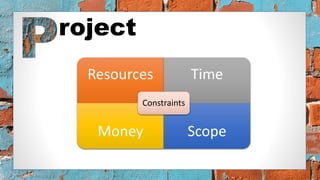
Resources Time
Money Scope
Constraints
roject
Library Projects
roject Manager
Responsible for Project:
 Planning
 Execution
 Control
 Success
roject Manager
Traits and Skills of a Good
Project Manager
lanning
lanning
What’s so important about
planning?
lanning
Initiate Plan Execute Control Close
*
http://flylib.com/books/en/3.170.1.32/1/
lanning rocess
lanning
 Define Project
 Detail Work
 Determine Resources
 Develop Schedule
urpose
urpose
What are you trying to do,
and Why?
urpose
 Mission
 Goals
 Objectives
 Requirements
yramid
Mission
Goal 1
Objective
Req 1
Req2
Req3
Objective
Req 1
Req2
Req3
Objective
Req 1
Req2
Req3
Goal 2
Objective
Req 1
Req2
Req3
Objective
Req 1
Req2
Req3
Goal 3
Objective
Req 1
Req2
Req3
Objective
Req 1
Req2
Req3
Objective
Req 1
Req2
Req3
urpose Replace the Carpet in the
Children’s room by November
30th with minimal disruption
to staff and patrons.
Maintain all Children’s
Department Services
Relocate Programming planned
between November 25th and 30th
Alternate Space for programs with:
ADA accessibility
Room for program requirements
Low/no cost
Move collection to alternate
spaces within the library
Space must be accessible to staff
New Books and media must be
accessible to patrons
Relocation must be done by
November 25th
urpose
Defining the Purpose of
your Project
eople
roduct
rocess
is For…
Purpose
People
ProcessProduct
eople
eople
 Who are my Stakeholders?
 How are they involved?
 How are they impacted?
 What are their
communication needs?
eople
Managing Expectations
eople
 Stakeholder Register
 RACI Matrix
 Involvement/Impacts
 Communication Charts
eople
n*(n-1)/2=
Communication paths
eople
Communication Plans are
Essential!
roduct
roduct
Go Back to Your
Purpose!
Mission
Goals
Objectives
Requirements
& Deliverables
roduct
What do we want to end up with?
How do we know it accomplishes
our Goals?
roduct
Defining Requirements & Deliverables
• Quality Indicators
• Evaluation Methods
• Minimums for Acceptance
• Quality Assurance Planning
• Documentation and Communication
roduct
Tools for Requirements Management
• Formal Requirements Statement
• Requirements Checklists
• Requirements Traceability Matrix (RTM)
rocess
rocess Mission
Goals
Objectives
Requirements
& Deliverables
Activities
How do we get
this done?
rocess
Activities Register
rocess
Project SCOPE
NO MORE, NO LESS
rocess
rocess
 Activities Register
 Project Scope
 Work Breakdown
Structure (WBS)
rocess
rocess
Gantt
Chart
https://www.teamgantt.com/guide-to-project-management/how_to_estimate_projects/
rocess
 Estimate Timeline
 Estimate Costs
 Identify Risk Points
 Develop Schedule
 Define Task Assignments
A Gantt Chart Allow You To:
roject lan
The
lan
Purpose
People
ProcessProduct
Combine the
People, Process,
and Product
Considerations to
best serve your
Purpose
lan
What goes into a Project
Plan?
lan
 Stakeholder Register
 Communication Plan
 Statement of Goals and
Objectives
 List of Requirements
 Scope Statement
 Project Schedule
 Project Timeline
 Project Constraints
 Risk Assessment
 Quality Assurance Plan
 Resource Management
Plan
 Procurement Plan
 Change Management
Plan
 Budgeting and Expense
Documentation
lan
Planning for Failure
lan
What are some major risk
factors that could impact
your plan’s execution?
roceed
roceed
 Get the plan approved
 Communicate the Plan
 Put the Plan into Action
roceed
Communication of the Plan
should be part of the Plan!
roceed
Changing the Plan
 Why?
 How?
 Impacts?
roject
Management
roject Management
Resources
• Resources Compiled by Me: http://www.eclasper.com/?page_id=150
• Project Management Institute: http://pmi.org
• Project Management Podcast: http://www.project-management-
podcast.com/
• All About Project Management:
http://managementhelp.org/projectmanagement/index.htm
• Project Management Docs:
http://www.projectmanagementdocs.com/#axzz4O6wR72iT
roject Management
Tools
Capterra:
http://www.capterra.com/project-
management-software/
http://www.capterra.com/project-management-software/#infographic
*MP
• Project Management Professional Certification through the
Project Management Institute, International CAPM Another
alternative
• Information at http://pmi.org
• Coursera Project Management Classes
• Lynda.com Courses
• University Programs and Certifications (Colorado State -
http://www.online.colostate.edu/certificates/project-
management-online/)
Emily Clasper
http://eclasper.com
@eclasper
http://www.slideshare.net/eclasper1

First Steps in Project Planning for Libraries

Editor's Notes

  • #2 Good morning! Today we’re going to dive right in to some of the basic concepts involved in Project Management. Teaching a group all of PM in one morning would be like asking someone to teach people all of cataloging in 2 hours… So today we’re going to focus on just the initial steps to the Planning process We’re going to go quickly, so rest assured that everything I talk about today will be online later on Slideshare… eclasper1 Including
  • #3 This presentation was brought to you by the letter P Many of the basics you need to remember for starting out your projects are P words
  • #4 What is a project?
  • #5 What makes a project a success? ALL THREE This does not mean you can’t adjust your plan…
  • #6 Every project has Project Constraints that have to be considered in order to reach project success Usually three “Triple Constraint” – here expanded to include Scope – quality and completeness The trick is to figure out which of these three is the Driving Constraint – the one that is set in stone (Hint - not always $)
  • #7 Now that we have an idea of what I’m talking about with projects, What kinds of things constitute projects in libraries? Things you have tackled? What makes projects hard to do in a library setting? Caveats about PM literature when working in a library environment: Not profit driven, so equations sometimes not as meaningful Substitute “Profit” with “Value to Patrons” (subjective!!) Measurement harder Non-profit PM is notoriously harder (funding, regulations, etc)
  • #8 All of these considerations need to be handled by the PM Are you a Project Manager?
  • #9 What makes a good project manager? List traits and skills Command authority “Quick Sifting” abilities - prioritizing Goal/outcomes oriented Communication skills Detail oriented Motivator Change Positive Delegation Big Picture translated to Little for getting things done Documentation Adherence to plans Logic Organization Empathy Analytical Creative Problem Solver Problem Anticipator Resourcefulness Circle the traits that make a good reference librarian Who should be assigned as a PM? Choose the right PM and give them authority
  • #10 Focus for today: PLANNING The most important stage in the PM process IMHO Get the plan in place, and FOLLOW IT Plans should include plans to change it Advocate for a formal process with written documentation
  • #11 What happens without a solid plan for your project? RISK
  • #12 Project Lifecycle Phases Concentrating on the Planning part makes the rest easier and sets up for success
  • #13 Not linear, though. Lots of overlap Things to notice: Planning represents the most amount of work FOR THE PM Does not end when the Execution starts Shifts into closing processes near end Planning begins in initiation
  • #14 So where do we start DO NOT JUST START DOING THINGS OR ASSIGNING STUFF I tend to begin by etting as much info as I can about the project and then locking myself in my office
  • #15 What does good project planning entail? – this and more, but these are the bare bones basics IN THIS ORDER Know what you need done Know what needs to be done to get there Know what you need to have on hand to do this Know how this will lay out in terms of getting it all done Common mistakes: Starting with resources Starting with Schedule Always begin with the Project Definition! >>>>>
  • #16 Always begin with your PURPOSE
  • #17 Do not take this for granted – it is the basis for EVERYTHING
  • #18 This is where we begin any project – define what we need to do Mission = Purpose – Can be a one line statement Goals – Outcome we want to strive for, longer term, broader ideas of what should be accomplished. Can be realized in many ways Objectives – Specific ways to meet the stated goals. Deliverables, measureable outcomes
  • #19  Goals – Outcome we want to strive for, longer term, broader ideas of what should be accomplished. Can be realized in many ways Objectives – Specific ways to meet the stated goals. Deliverables, measureable outcomes
  • #20 Here is a tiny slice of what that might look like. Many more Goals, Objectives, requirements in the real situation… Goals are the main things you NEED to happen Objectives are the way you plan to reach the goals SMART – Specific Measureable, Attainable, Relevant, Time Bound Requirements are the things that must be done to realize the objectives Get more and more specific These are later broken into tasks – which can then be assigned resources…
  • #21 Activity – Defining Purpose Select a sample project Small groups of 4/5 WORKSHEET State the purpose of the project. One sentence. Define One GOAL for your project Define 2 OBJECTIVES for that goal Just a few rough ideas for your Req’s Discuss what the groups came up with - this is the basis of your project Once you have this, it can be written into a document for the approval of the boss… approval of this document gives the PM AUTHORITY to get these things done. BREAK
  • #22 Once you have that initial project charter approved, you now have permission and authority to DO IT. But there’s a lot more to be planned. The rest of the planning revolves around 3 P’s: People, Product, and Process
  • #23 You have a well defined purpose. The other 3 Ps always serve the Purpose, and must each be accounted for carefully.
  • #24 We’re a people based business
  • #25 Questions to ask Use the example project to discuss this List the stakeholders up front for discussion
  • #26 For everyone, managing expectations is the real underlying factor Everyone involved has expectations of how a project will impact them, and the PM needs to make sure that these expectations are reasonable, correct, and addressed Deliver on expectations
  • #27 Ways to do this Activity – Brainstorm a Stakeholder List for our sample project Convert into a RACI Matrix up front with a few things that we know will need to be done Add Involvement and impact levels – involved/impacted, positive/negative, degree, considerations Use these to develop Communication Charts – Who, What info, what format, how often, etc. EXPECTATIONS Templates online
  • #28 Communication is complicated Do the yarn thing – communication within a project team. Extend to the “public” in the rest of the room lol This is why you need a communication plan
  • #29 Communication plan – defines who gets info, how it’s delivered, level of detail, frequency, communication milestones, tool used ALL ABOUT MANAGING EXPECTATIONS
  • #30 Moving on to thinking about the product – We’ve already started this!!
  • #31 Fleshing out the Requirements to include some definition of what Deliverables will be included
  • #33 With the basic idea approved, you can take some time to define clearly what will need to be in place for the COMPLETED PRODUCT to be acceptable. Requirements are based on what is necessary for the Goals and Objectives to be Reached Deliverables are the concrete things you end up with at the end of a project. Take time to define these carefully – what is necessary for a deliverable to be accepted as complete? What are the minimums for accepting a deliverable?
  • #34 Use these to maintain expectations with vendors, sponsors, stakeholders Checklists good for product acceptance of simple stuff Traceability matrix takes it further, and relates requirements to specific goals and objectives, showing interconnections – helps prioritize
  • #35 Moving from the WHO of People and the WHAT or Product to the HOW of process Many people in libraries skip right to this part… NO!
  • #37 Activities Register – What tasks need to be done to get to these requirements Write them all down! For our sample project – what’s going to be on the activities register? Call them out!! Have people write them on the reverse of their handout Do some on post its This is your scope of work
  • #38 Activities defined as necessary to fulfill the requirements No “While we’re at it” No “Wouldn’t it be even better if” No “above and beyond”
  • #39 A word about scope creep This will kill your project, increasing budget, time, etc. Find ways to handle “creep” requests diplomatically Account for ways to add activities without adding creep Always refer back to requirements. If it’s not required to reach a goal, don’t do it.
  • #40 Put the activities in order. Can you do this with your list? What things need to be sequenced? Put some post its in sequence to show
  • #41 WBS gives sequence & divides into work packages Adding time and resources to the sequence gives you
  • #42 What does a Gantt chart do for you? Takes a sequence of activities Gives them a temporal element Establishes dependencies Allows assignment of resources Estimation tool that allows you to???
  • #44 Your roadmap for getting the project done with success
  • #48 Don’t forget the contingency plans! How to make failures into opportunities How are you going to address these kinds of things
  • #49 Ask yourself about the potential risks you may face and how you’ll deal with them Identify areas prone to risk, and you can plan for it
  • #50 The plan is the key – then move ahead
  • #53 Have a well defined process in place to avoid creep