Designing
and
Developing
Lesson
Plan
Lesson Plan
-is the teachers blueprint
-a statement of achievements to be
realized and the specific means by
which these are to be attained as a
result of the activities engaged in
day to day under the guidance of
the teacher.
Importance of a Lesson Plan
1.A pupils educational growth depends on the
selection of subject
matter,activities,experiences and methods
adapted to his interest,needs,abilities and level
of maturity.
2.Includes framing objectives and choosing
subject matter,materials and evaluation
techniques
3.It involves fore seeing what is likely to
happen and choosing experiences that will
change for the the better.
4.It serves as a guide to the apprentice
teacher.
5.Planning prevents waste of time that
usually accompanies organized or
haphazard teaching.
3.It involves fore seeing what is likely to
happen and choosing experiences that will
change for the the better.
4.It serves as a guide to the apprentice
teacher.
5.Planning prevents waste of time that
usually accompanies organized or
haphazard teaching.
6.It preventswondering away from the
subject matter by making the teacher
conscious of what he has to accomplish for
the day.
7.It gives a feelingof security especially to the
beginning teacher.
8.The principle of self-activity to the
learning of both teachers and pupils.
9.Are of use not only to teacher but also to
principles and supervisors.
10.Past lesson plans will be use to a
substitute teacher.
Basic Parts of a Lesson Plan
 Objectives -provides goals to be attained,give
direction to the class discussions,and call for
what outcomes
 Subject Matter-the specific subject matter and
its sources textbooks,library references should
be stated in the lesson plan.
 Materials-are necessary aids to teaching and
should includedin a lesson plan.It includes
teaching aids and devices.
Basic Parts of a Lesson Plan
 Procedure-this includes both teacher and pupil
activity in the detailed lesson plan.
 Assignment-a good assignment insures a good
recitation because it tells definitely what is to be
done,how is to be done and why it must be done.
 Motivation- to arouse the interes t of the
pupils.
 Generalization- the summary of the
topics.
 Evaluation-measurement of the pupils
really understand the lesson.
Types of Lesson Plan
 Detailed and Elaborate Lesson Plan (student
teacher)- is anticipatory teaching.it puts down
in writing the classroom activities that may
occur.
-the teacher tries to visualize how thw children
will react,what difficulties they are likely to
encounter and how they may be guided
toachieve desired results.
 Semi-detailed Lesson Plan(beginning
teacher)omits pupils activity.It contains only
the lesson,the procedure or the steps of the
lessons.
Types of Lesson Plan
 Skeletal outline/Brief Lesson Plan(expert
teacher)-teacher who have taught the same
subject for years usually make brief lesson
plan.
-time thus saved may be devoted to the
preparation of materials and other teaching
aids.
Taxonomy of Objectives
.
1.Cognitive Domain-the objectives classified as
cognitive emphasize intellectual learning
and problem-solving task.
Taxonomy of educational objectives for the
cognitive.
a.Knowledge- involves the recall of
specifics and universals,the recall of
methods and process, or the recall of a
pattern,structure or setting.
b.Comprehension- refers to the type of
understanding that the individual can make
use of the material or idea being
communicated w/o necessarily relating it to
other materials or seeing its fullest
implications.
c.Application-the use of abstractions which
may be technical priciples,ideas and
theories.
d.Analysis-the breaking up of comunications
or text into its constituents elements
e.Synthesis- the putting together of elements
and parts to form a whole.
2.Affective Domain-contains behaviors and
objectives that have some emotional over
tones.It encompasses likes and
dislikes,attitudes,values and beliefs.
Taxonomy of educational objectives for the
affective.
a.Receiving-concern is for the learner to be
sensitive to the existence of certain
phenomena and stimuli.
b.Responding-the concern is with responses that
go beyond merely attending to the phenomena.
c.Valuing-not motivated by the desire to comply
or obey but by the individual's commitment to
the underlying values that guide the behavior.
d.Organization-as the learner continuously
internalizes values,he encounters situations for
which there are several relevant values.
e.Characterization by Values or Value
Complex- values already have a place in
the individual's values hierarchy.
3.Psychomotor Domain-complexity with
attention to the sequence involved in the
performance of a motor act.
Taxonomy of educational objectives for the
pychomotor.
a.Perception- process of becoming aware of
objects,qualities or relations by using the
sense organs.
b.Set-a preparatory adjustment of readiness for
a particular kind of.
c.Guided response-the overt behavioral act of
an individual under the guidance of an
individual under the guidance of an
instructor.
d.Mechanism- the learner has achieved a
certain confidence and degree of proficiency
in the preformance of the act.
e.Complex overt response-the act can be caried
out smoothly and efficiently.
f.Adaptation-motor activities are altered to
meet the demands of a new problematic
situation requiring physical response.
g.Organization-this involves creating new
motor acts or ways of manipulating
materials based on understandaing,abilities
and skills developed in the psychomotor
area.
CHAPTER II
MODELS OF INTEGRATION
AND SAMPLE LESSON
PLANS
26/07/2014
26/07/2014
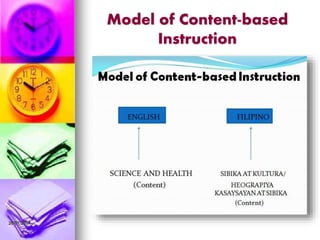
Content-Based Instruction
 It is the integration of the content of
learning areas like Sibika at
Kultura(SK);
Heograpiya/Kasaysayan/Sibika (HKS)
and Science and Health in language
teaching. It means that the content of
SK; HKS will be used as vehicle for the
development of language skills in
Filipino. In developing the skills in
English the content of Science and
Health will be used.
26/07/2014
Model of Content-based
Instruction
26/07/2014
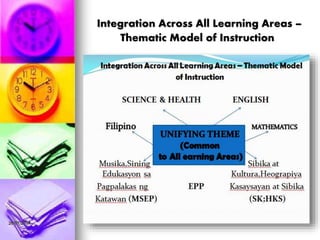
Integration Across All Learning Areas –
Thematic Model of Instruction
26/07/2014
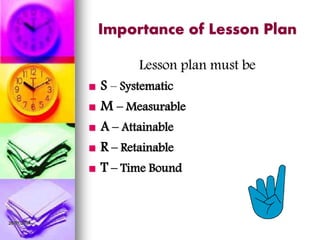
Importance of Lesson Plan
Lesson plan must be
 S – Systematic
 M – Measurable
 A – Attainable
 R – Retainable
 T – Time Bound
26/07/2014
CHAPTER III
A Sample Lesson Plan In Content-
Based Integration-Filipino
26/07/2014
Integrated Approach
- is the process or practice of
combining different elements and
presenting them as one unifying
whole
26/07/2014
Integration
- is the process or practice of
combining different elements and
presenting them as one unifying
whole
26/07/2014
26/07/2014
26/07/2014
What is thematic units?
• units of instruction that address a
central theme.
•Instructional units lead to
development of integrated study
26/07/2014
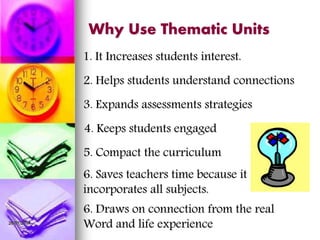
Why Use Thematic Units
2. Helps students understand connections
3. Expands assessments strategies
4. Keeps students engaged
1. It Increases students interest.
5. Compact the curriculum
6. Saves teachers time because it
incorporates all subjects.
6. Draws on connection from the real
Word and life experience
26/07/2014
Key Components of
Thematic Unit.
2. Goals and Objectives
3. Grade Level
4. Learning Activities
1. Theme
5. Resources and materials
6. Evaluation
26/07/2014
Tips for creating Thematic
Units
1. Find an engaging theme
2. Create fun activities
3. Evaluate Student Learning
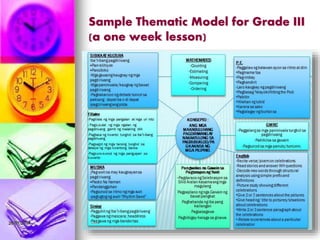
Sample Thematic Model for Grade III
(a one week lesson)
26/07/2014
26/07/2014

DEVELOPING LESSON PLAN - EDUC 5

  • 1.
  • 2.
    Lesson Plan -is theteachers blueprint -a statement of achievements to be realized and the specific means by which these are to be attained as a result of the activities engaged in day to day under the guidance of the teacher.
  • 3.
    Importance of aLesson Plan 1.A pupils educational growth depends on the selection of subject matter,activities,experiences and methods adapted to his interest,needs,abilities and level of maturity. 2.Includes framing objectives and choosing subject matter,materials and evaluation techniques
  • 4.
    3.It involves foreseeing what is likely to happen and choosing experiences that will change for the the better. 4.It serves as a guide to the apprentice teacher. 5.Planning prevents waste of time that usually accompanies organized or haphazard teaching.
  • 5.
    3.It involves foreseeing what is likely to happen and choosing experiences that will change for the the better. 4.It serves as a guide to the apprentice teacher. 5.Planning prevents waste of time that usually accompanies organized or haphazard teaching.
  • 6.
    6.It preventswondering awayfrom the subject matter by making the teacher conscious of what he has to accomplish for the day. 7.It gives a feelingof security especially to the beginning teacher. 8.The principle of self-activity to the learning of both teachers and pupils. 9.Are of use not only to teacher but also to principles and supervisors. 10.Past lesson plans will be use to a substitute teacher.
  • 7.
    Basic Parts ofa Lesson Plan  Objectives -provides goals to be attained,give direction to the class discussions,and call for what outcomes  Subject Matter-the specific subject matter and its sources textbooks,library references should be stated in the lesson plan.  Materials-are necessary aids to teaching and should includedin a lesson plan.It includes teaching aids and devices.
  • 8.
    Basic Parts ofa Lesson Plan  Procedure-this includes both teacher and pupil activity in the detailed lesson plan.  Assignment-a good assignment insures a good recitation because it tells definitely what is to be done,how is to be done and why it must be done.
  • 9.
     Motivation- toarouse the interes t of the pupils.  Generalization- the summary of the topics.  Evaluation-measurement of the pupils really understand the lesson.
  • 10.
    Types of LessonPlan  Detailed and Elaborate Lesson Plan (student teacher)- is anticipatory teaching.it puts down in writing the classroom activities that may occur. -the teacher tries to visualize how thw children will react,what difficulties they are likely to encounter and how they may be guided toachieve desired results.  Semi-detailed Lesson Plan(beginning teacher)omits pupils activity.It contains only the lesson,the procedure or the steps of the lessons.
  • 11.
    Types of LessonPlan  Skeletal outline/Brief Lesson Plan(expert teacher)-teacher who have taught the same subject for years usually make brief lesson plan. -time thus saved may be devoted to the preparation of materials and other teaching aids.
  • 12.
    Taxonomy of Objectives . 1.CognitiveDomain-the objectives classified as cognitive emphasize intellectual learning and problem-solving task. Taxonomy of educational objectives for the cognitive. a.Knowledge- involves the recall of specifics and universals,the recall of methods and process, or the recall of a pattern,structure or setting.
  • 13.
    b.Comprehension- refers tothe type of understanding that the individual can make use of the material or idea being communicated w/o necessarily relating it to other materials or seeing its fullest implications. c.Application-the use of abstractions which may be technical priciples,ideas and theories. d.Analysis-the breaking up of comunications or text into its constituents elements
  • 14.
    e.Synthesis- the puttingtogether of elements and parts to form a whole. 2.Affective Domain-contains behaviors and objectives that have some emotional over tones.It encompasses likes and dislikes,attitudes,values and beliefs. Taxonomy of educational objectives for the affective. a.Receiving-concern is for the learner to be sensitive to the existence of certain phenomena and stimuli.
  • 15.
    b.Responding-the concern iswith responses that go beyond merely attending to the phenomena. c.Valuing-not motivated by the desire to comply or obey but by the individual's commitment to the underlying values that guide the behavior. d.Organization-as the learner continuously internalizes values,he encounters situations for which there are several relevant values.
  • 16.
    e.Characterization by Valuesor Value Complex- values already have a place in the individual's values hierarchy. 3.Psychomotor Domain-complexity with attention to the sequence involved in the performance of a motor act. Taxonomy of educational objectives for the pychomotor. a.Perception- process of becoming aware of objects,qualities or relations by using the sense organs.
  • 17.
    b.Set-a preparatory adjustmentof readiness for a particular kind of. c.Guided response-the overt behavioral act of an individual under the guidance of an individual under the guidance of an instructor. d.Mechanism- the learner has achieved a certain confidence and degree of proficiency in the preformance of the act. e.Complex overt response-the act can be caried out smoothly and efficiently.
  • 18.
    f.Adaptation-motor activities arealtered to meet the demands of a new problematic situation requiring physical response. g.Organization-this involves creating new motor acts or ways of manipulating materials based on understandaing,abilities and skills developed in the psychomotor area.
  • 19.
    CHAPTER II MODELS OFINTEGRATION AND SAMPLE LESSON PLANS 26/07/2014
  • 20.
    26/07/2014 Content-Based Instruction  Itis the integration of the content of learning areas like Sibika at Kultura(SK); Heograpiya/Kasaysayan/Sibika (HKS) and Science and Health in language teaching. It means that the content of SK; HKS will be used as vehicle for the development of language skills in Filipino. In developing the skills in English the content of Science and Health will be used.
  • 21.
  • 22.
    26/07/2014 Integration Across AllLearning Areas – Thematic Model of Instruction
  • 23.
    26/07/2014 Importance of LessonPlan Lesson plan must be  S – Systematic  M – Measurable  A – Attainable  R – Retainable  T – Time Bound
  • 24.
  • 25.
    CHAPTER III A SampleLesson Plan In Content- Based Integration-Filipino 26/07/2014
  • 26.
    Integrated Approach - isthe process or practice of combining different elements and presenting them as one unifying whole 26/07/2014
  • 27.
    Integration - is theprocess or practice of combining different elements and presenting them as one unifying whole 26/07/2014
  • 28.
  • 29.
    26/07/2014 What is thematicunits? • units of instruction that address a central theme. •Instructional units lead to development of integrated study
  • 30.
    26/07/2014 Why Use ThematicUnits 2. Helps students understand connections 3. Expands assessments strategies 4. Keeps students engaged 1. It Increases students interest. 5. Compact the curriculum 6. Saves teachers time because it incorporates all subjects. 6. Draws on connection from the real Word and life experience
  • 31.
    26/07/2014 Key Components of ThematicUnit. 2. Goals and Objectives 3. Grade Level 4. Learning Activities 1. Theme 5. Resources and materials 6. Evaluation
  • 32.
    26/07/2014 Tips for creatingThematic Units 1. Find an engaging theme 2. Create fun activities 3. Evaluate Student Learning
  • 33.
    Sample Thematic Modelfor Grade III (a one week lesson) 26/07/2014
  • 34.