DETERMINANTS OF PRICE
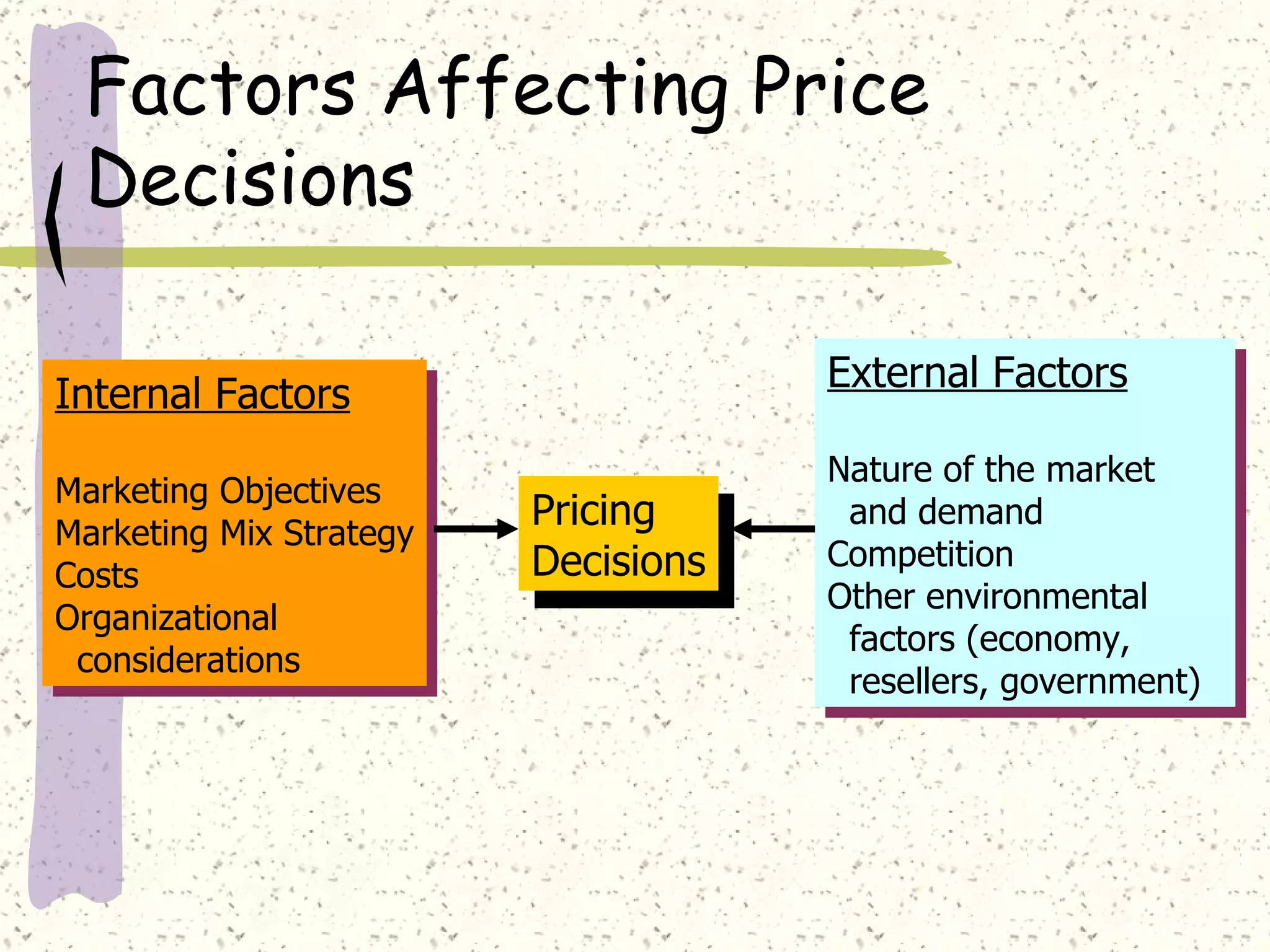
Factors Affecting Price
 Decisions

                                     External Factors
Internal Factors
                                     Nature of the market
Marketing Objectives
Marketing Mix Strategy
                         Pricing      and demand
                         Decisions   Competition
Costs
                                     Other environmental
Organizational
                                      factors (economy,
 considerations
                                      resellers, government)
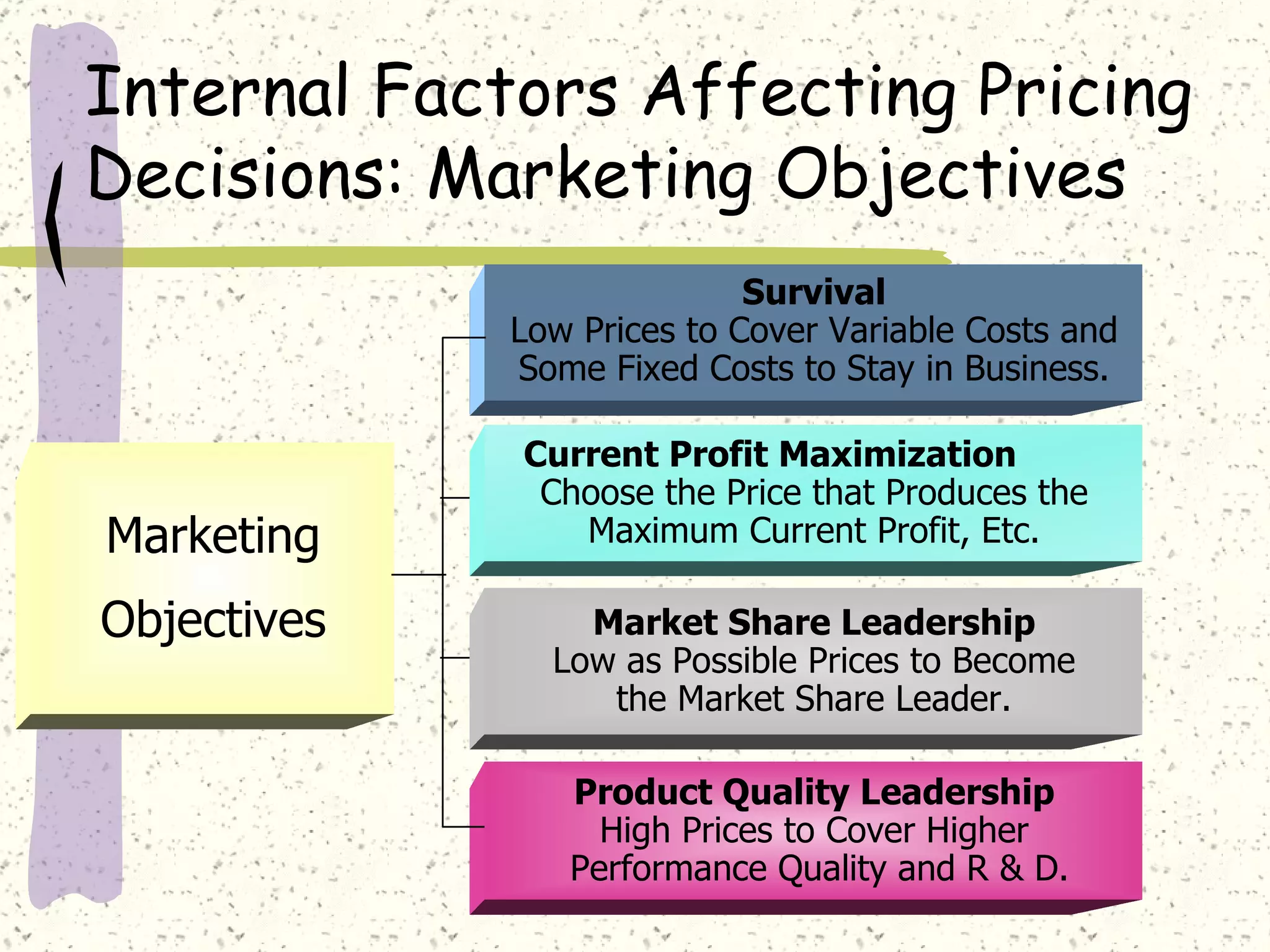
Internal Factors Affecting Pricing
Decisions: Marketing Objectives
                            Survival
             Low Prices to Cover Variable Costs and
             Some Fixed Costs to Stay in Business.

             Current Profit Maximization
              Choose the Price that Produces the
Marketing       Maximum Current Profit, Etc.

Objectives       Market Share Leadership
               Low as Possible Prices to Become
                  the Market Share Leader.

                Product Quality Leadership
                  High Prices to Cover Higher
                Performance Quality and R & D.
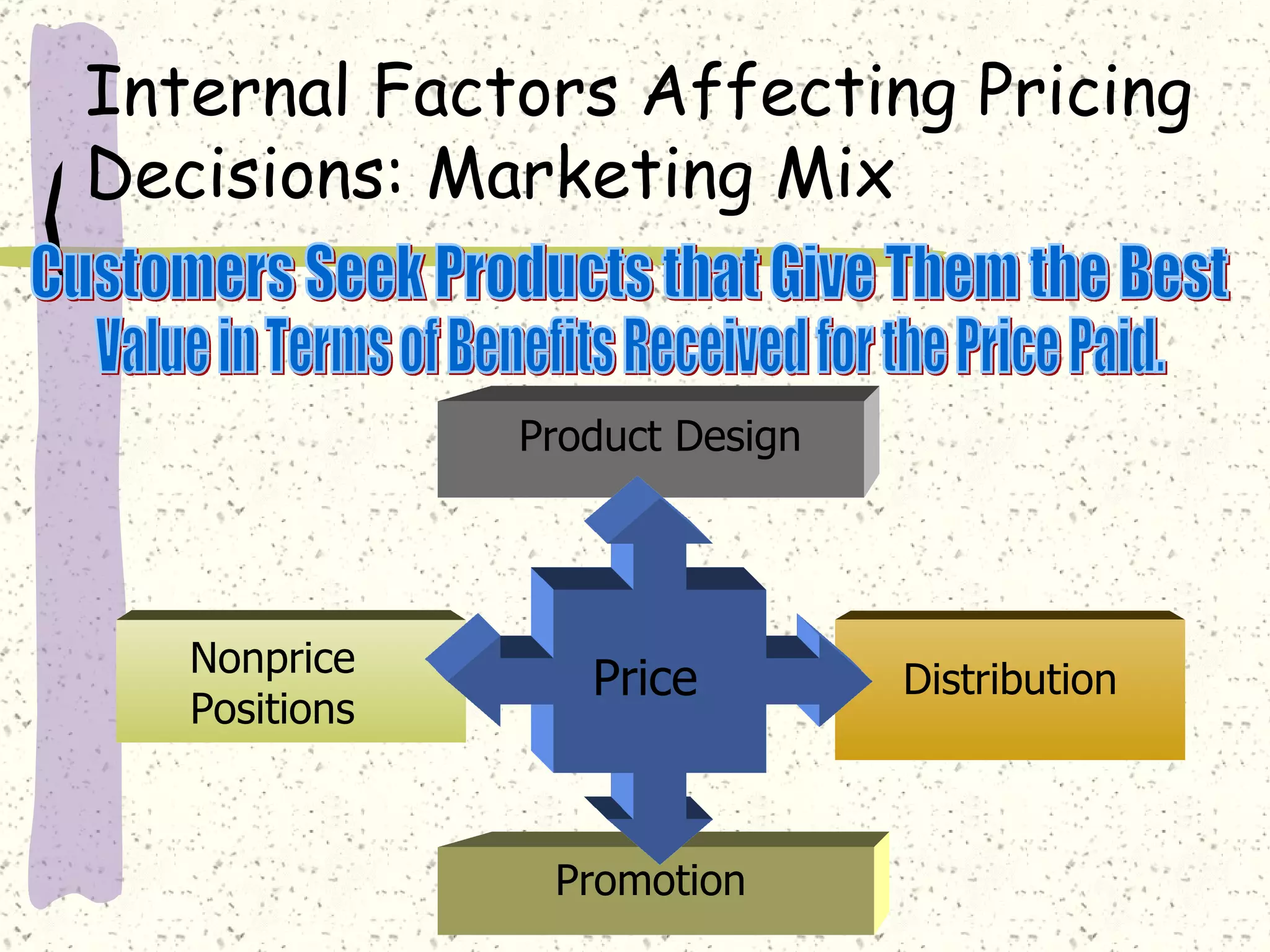
Internal Factors Affecting Pricing
Decisions: Marketing Mix


               Product Design


   Nonprice
                  Price         Distribution
   Positions


                Promotion
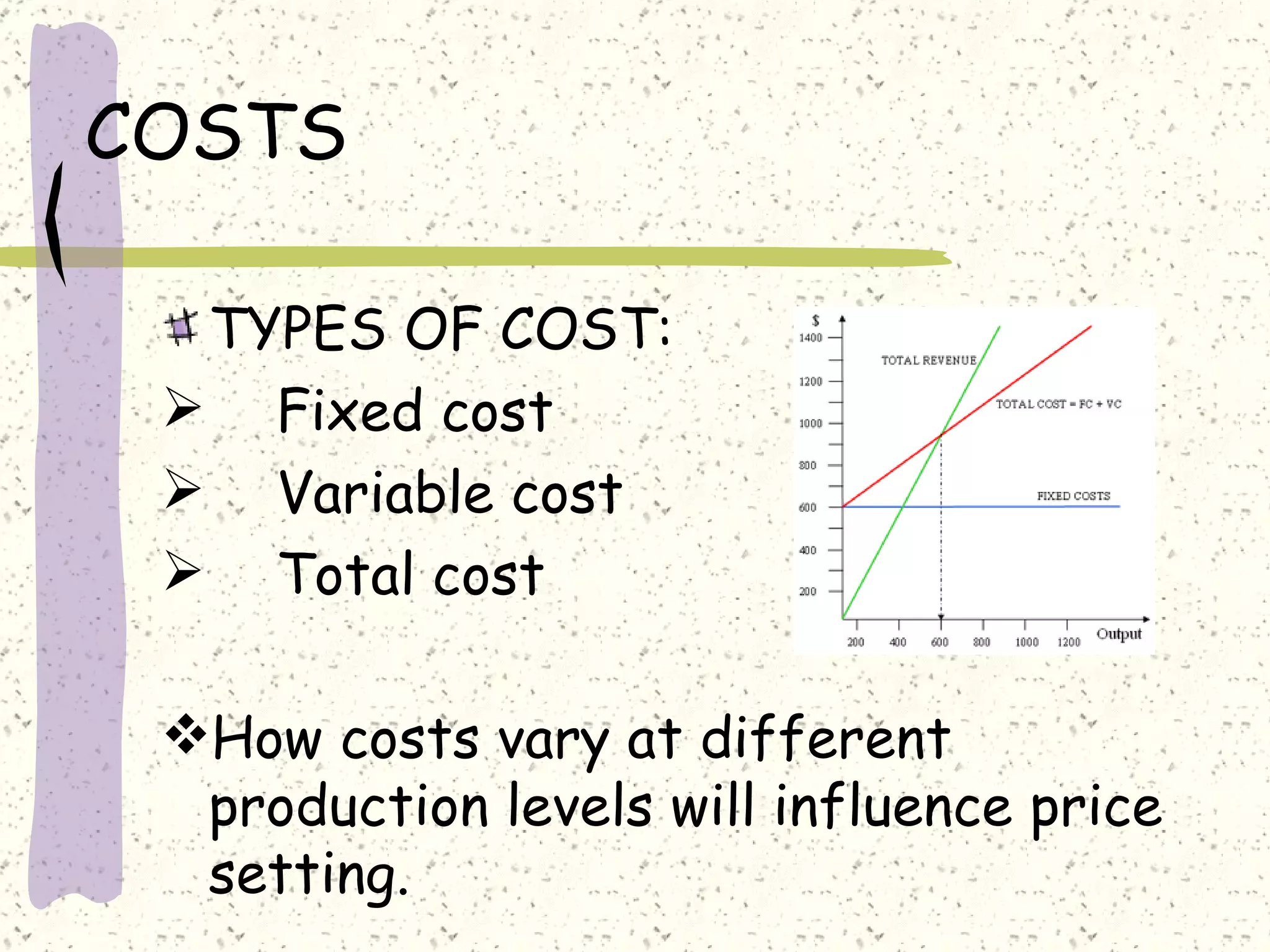
COSTS

  TYPES OF COST:
  Fixed cost
  Variable cost
  Total cost

 How costs vary at different
  production levels will influence price
  setting.
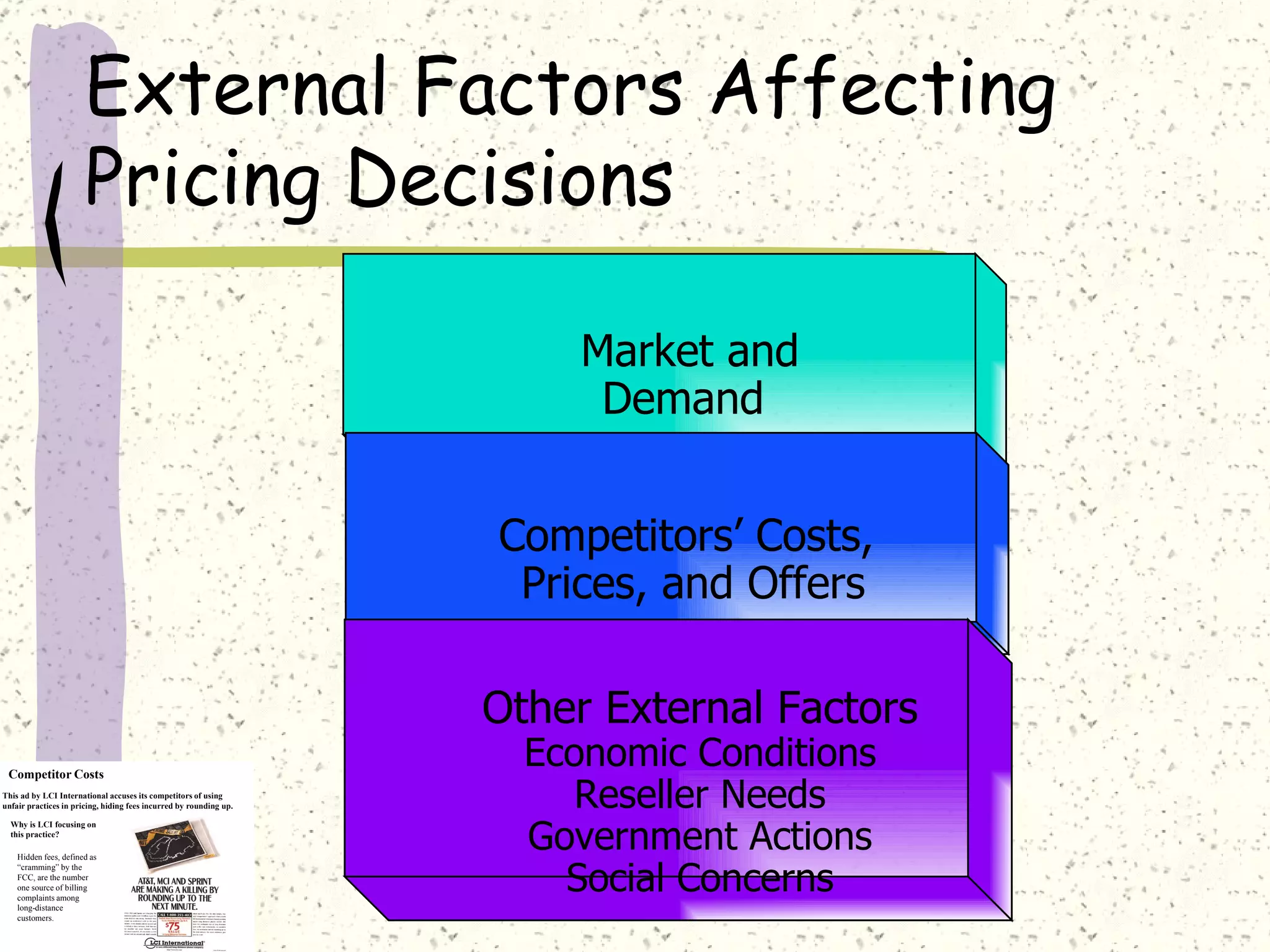
External Factors Affecting
                       Pricing Decisions

                                                                         Market and
                                                                          Demand


                                                                    Competitors’ Costs,
                                                                     Prices, and Offers

                                                                    Other External Factors
 Competitor Costs
                                                                      Economic Conditions
This ad by LCI International accuses its competitors of using
unfair practices in pricing, hiding fees incurred by rounding up.        Reseller Needs
                                                                      Government Actions
  Why is LCI focusing on
  this practice?

    Hidden fees, defined as


                                                                        Social Concerns
    “cramming” by the
    FCC, are the number
    one source of billing
    complaints among
    long-distance
    customers.
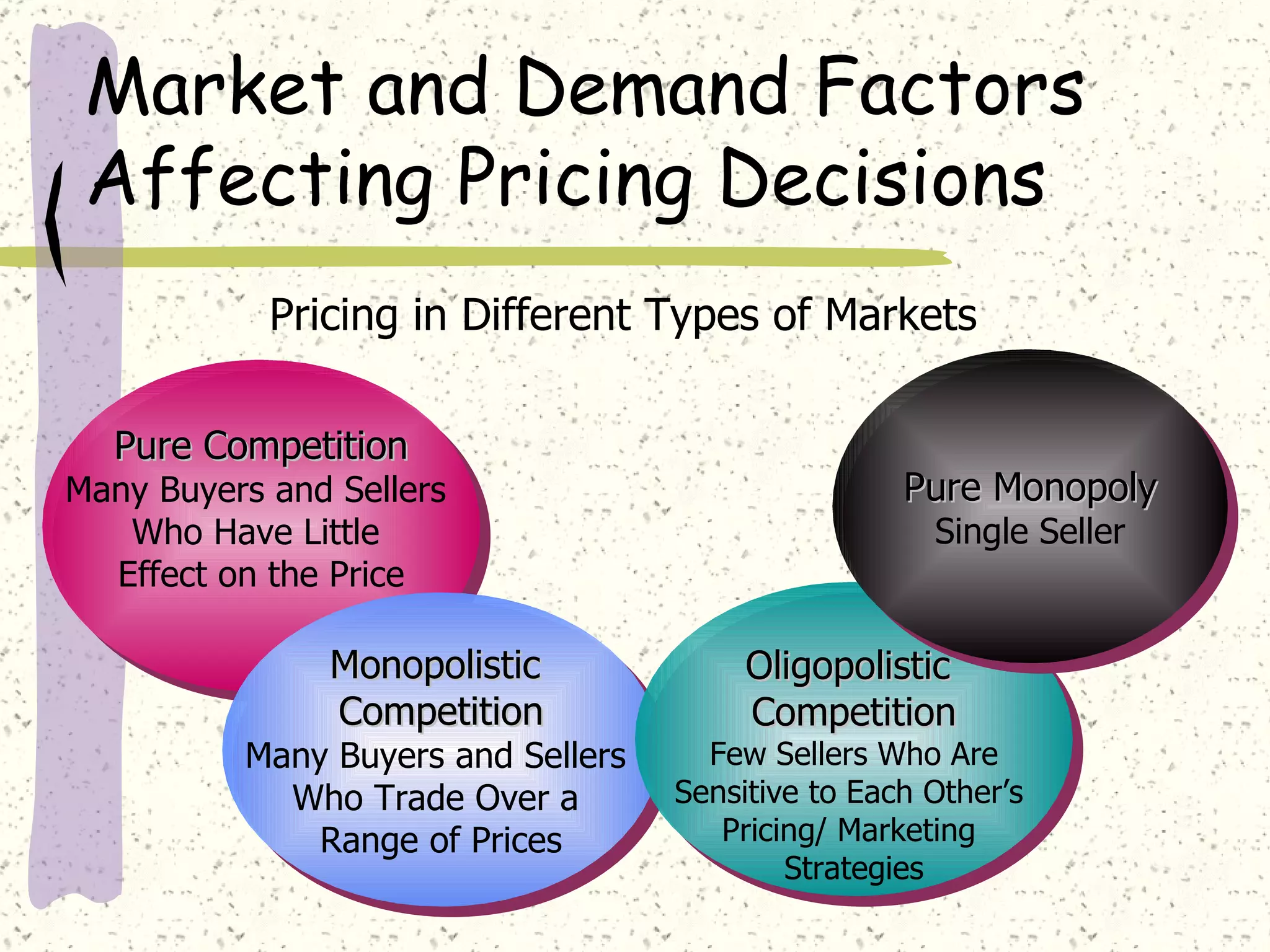
Market and Demand Factors
 Affecting Pricing Decisions
            Pricing in Different Types of Markets

  Pure Competition
Many Buyers and Sellers                             Pure Monopoly
   Who Have Little                                    Single Seller
  Effect on the Price

               Monopolistic              Oligopolistic
               Competition               Competition
          Many Buyers and Sellers     Few Sellers Who Are
            Who Trade Over a        Sensitive to Each Other’s
              Range of Prices          Pricing/ Marketing
                                            Strategies
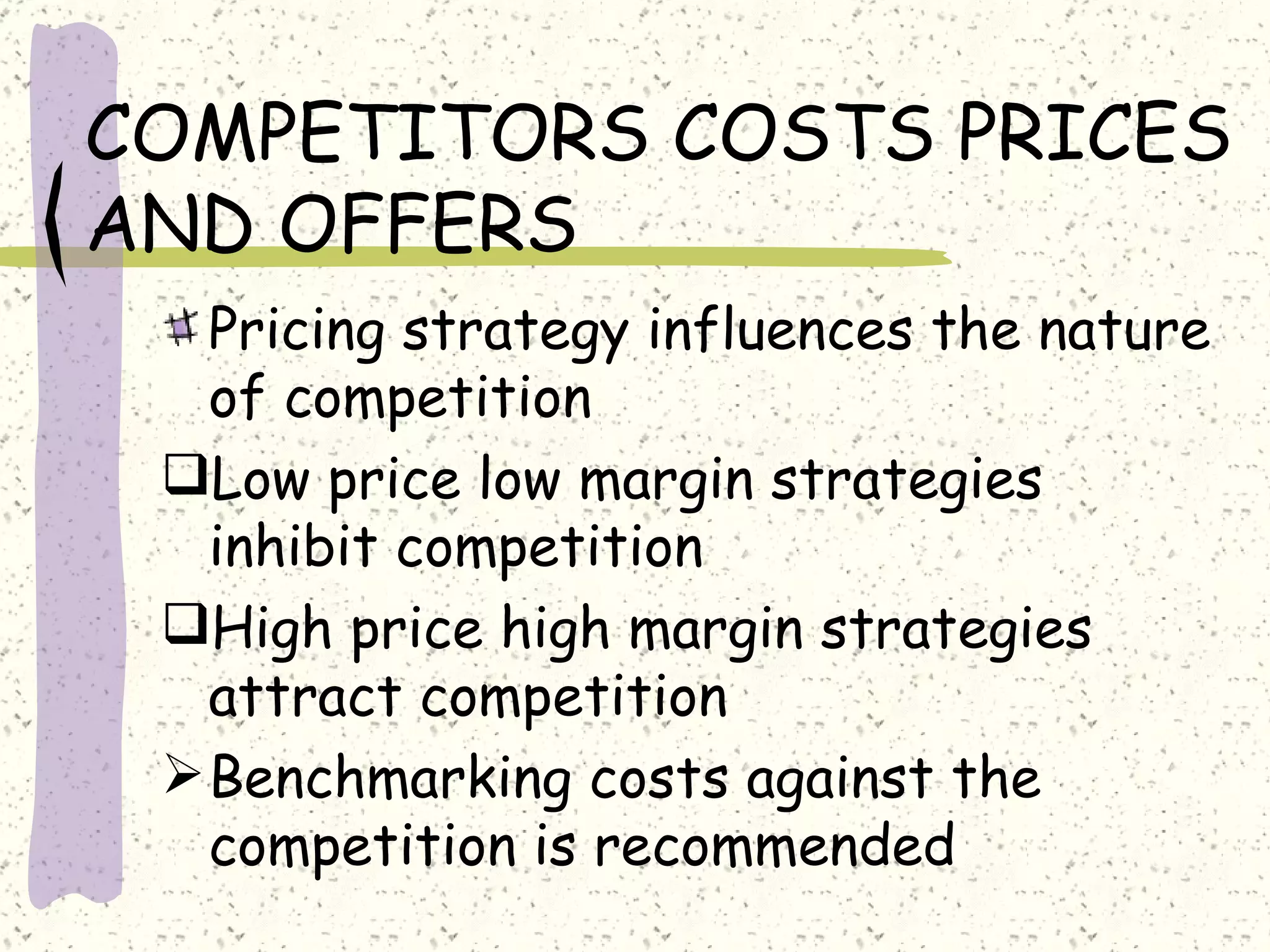
COMPETITORS COSTS PRICES
AND OFFERS
   Pricing strategy influences the nature
   of competition
 Low price low margin strategies
   inhibit competition
 High price high margin strategies
   attract competition
  Benchmarking costs against the
   competition is recommended
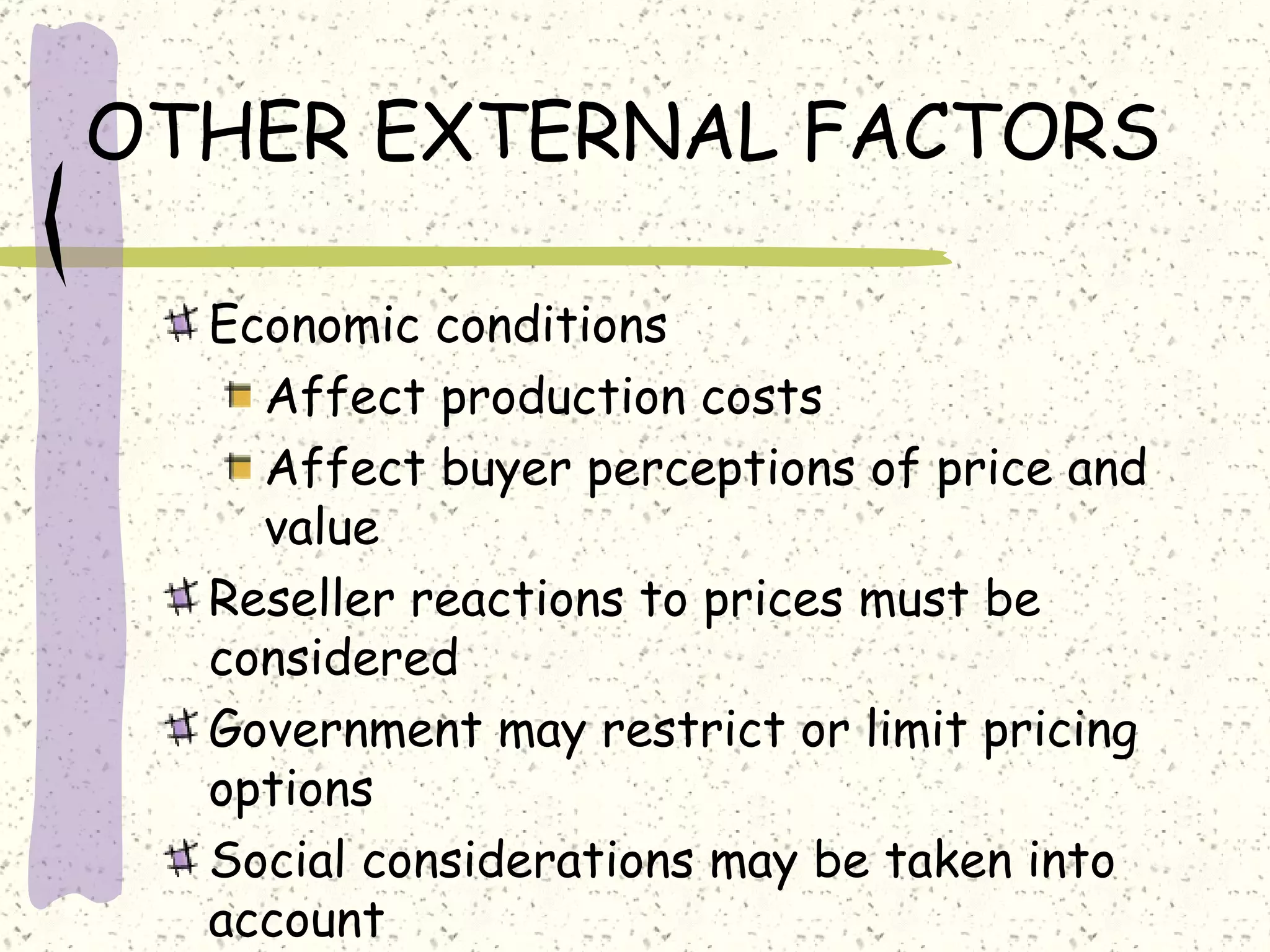
OTHER EXTERNAL FACTORS

  Economic conditions
    Affect production costs
    Affect buyer perceptions of price and
    value
  Reseller reactions to prices must be
  considered
  Government may restrict or limit pricing
  options
  Social considerations may be taken into
  account
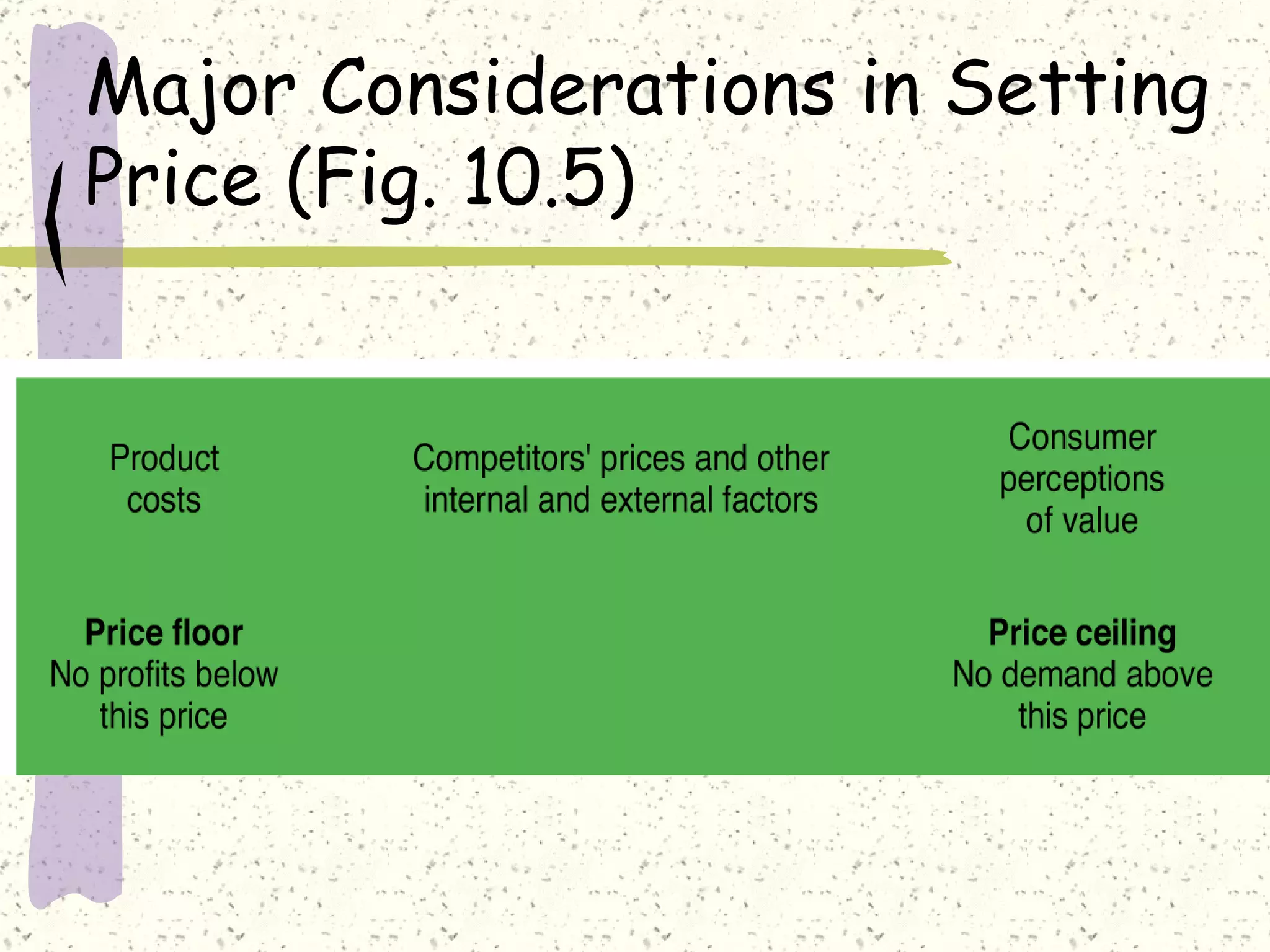
Major Considerations in Setting
Price (Fig. 10.5)
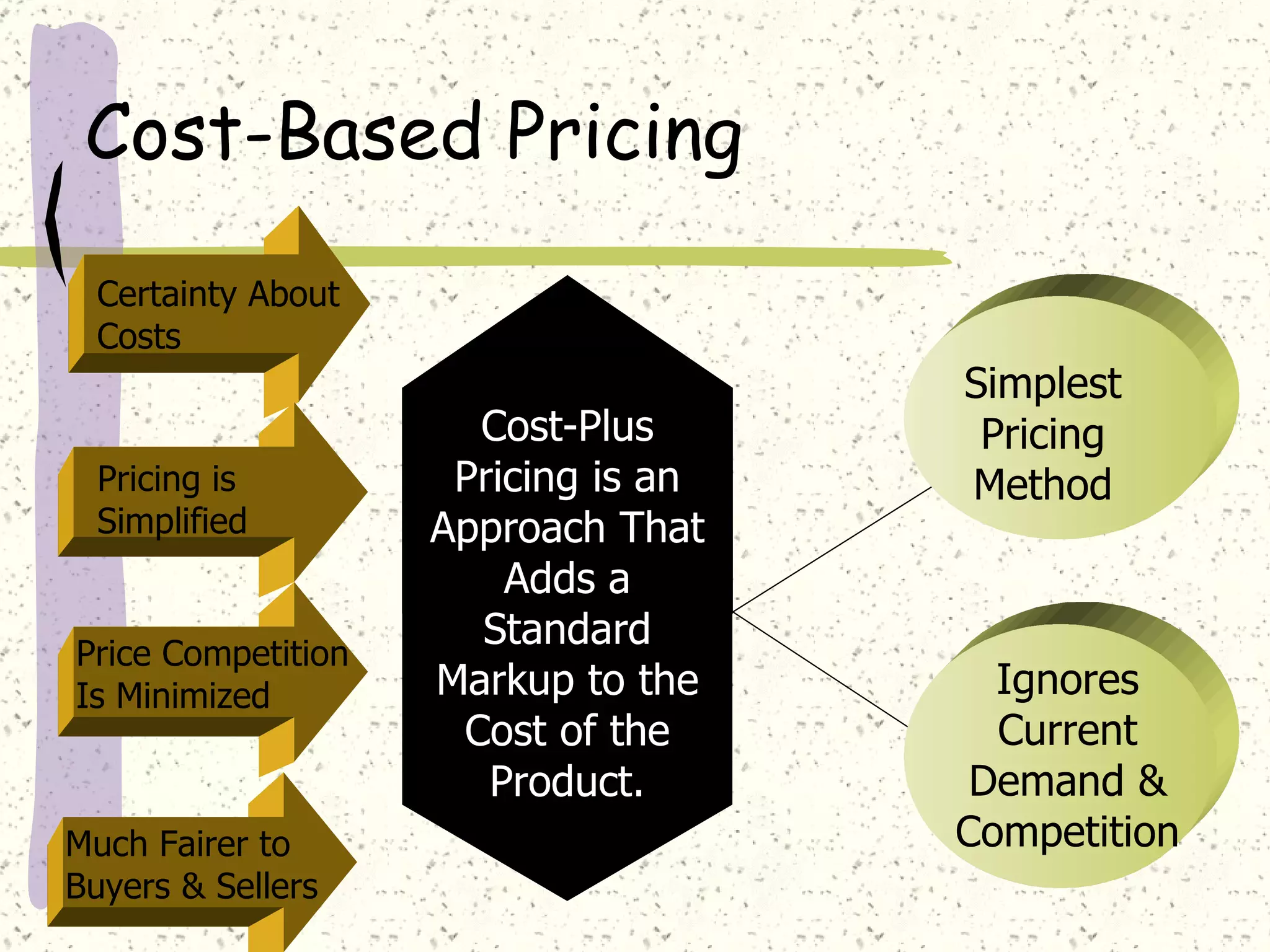
Cost-Based Pricing
  Certainty About
  Costs
                                      Simplest
                        Cost-Plus
                    Ethical
                        Factors        Pricing
  Pricing is          Pricing is an
                      Situational     Method
  Simplified         Approach That
                      Unexpected
                         Adds a
                        Standard
Price Competition
Is Minimized         Markup to the
                        Attitudes       Ignores
                       Costof the
                             of         Current
                         Others
                        Product.       Demand &
Much Fairer to                        Competition
Buyers & Sellers
Cost-Based Versus Value-Based
Pricing
 Cost-Based Pricing   Value-Based Pricing
      Product             Customer


        Cost                Value


        Price                Price

       Value                 Cost

     Customers             Product
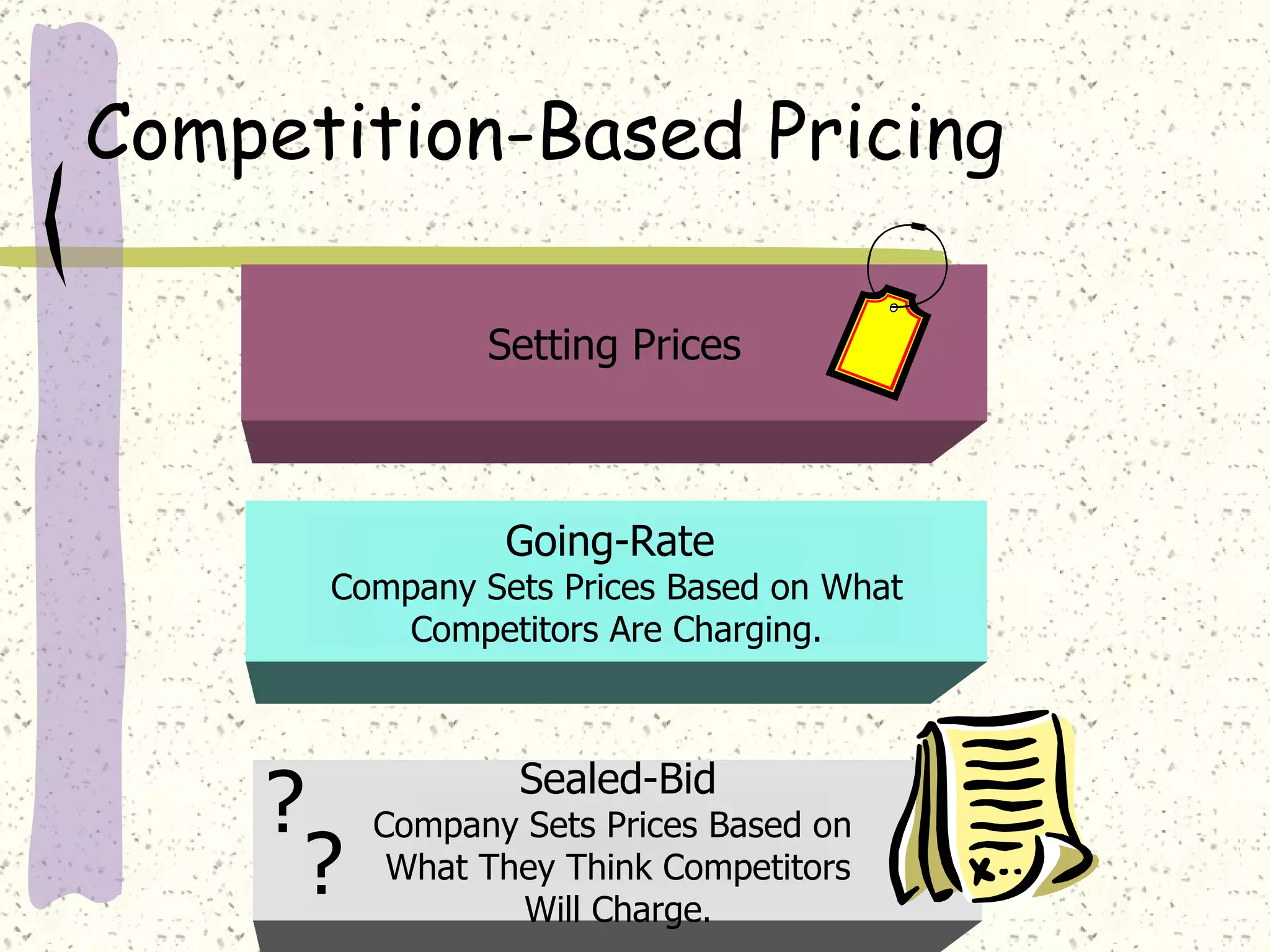
Competition-Based Pricing

               Setting Prices


                Going-Rate
      Company Sets Prices Based on What
          Competitors Are Charging.


    ?            Sealed-Bid
         Company Sets Prices Based on
     ?    What They Think Competitors
                 Will Charge.
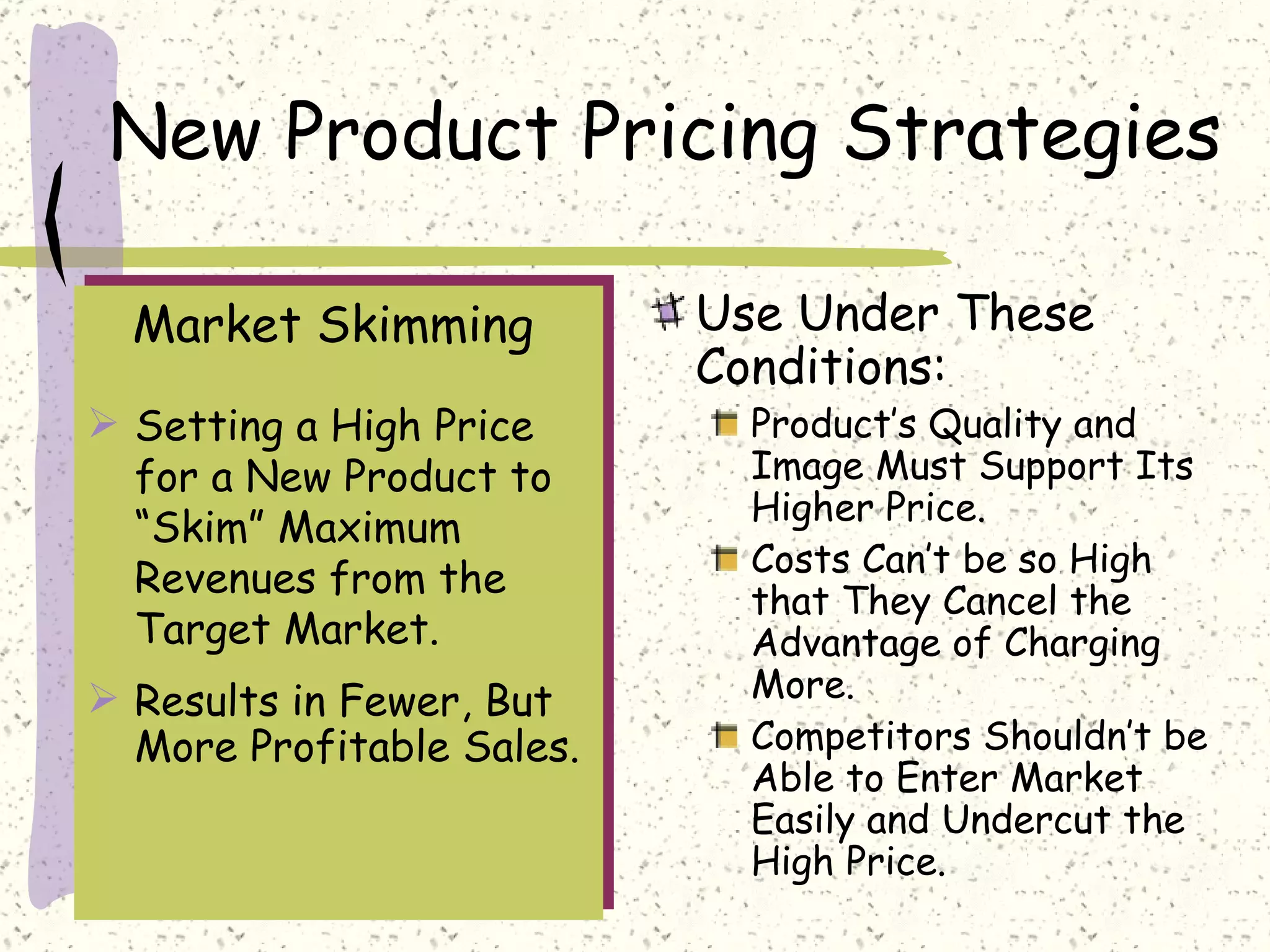
New Product Pricing Strategies

  Market Skimming          Use Under These
                           Conditions:
 Setting a High Price       Product’s Quality and
  for a New Product to       Image Must Support Its
                             Higher Price.
  “Skim” Maximum
                             Costs Can’t be so High
  Revenues from the
                             that They Cancel the
  Target Market.             Advantage of Charging
 Results in Fewer, But      More.
  More Profitable Sales.     Competitors Shouldn’t be
                             Able to Enter Market
                             Easily and Undercut the
                             High Price.
New Product Pricing Strategies

Use Under These                Market Penetration
Conditions:
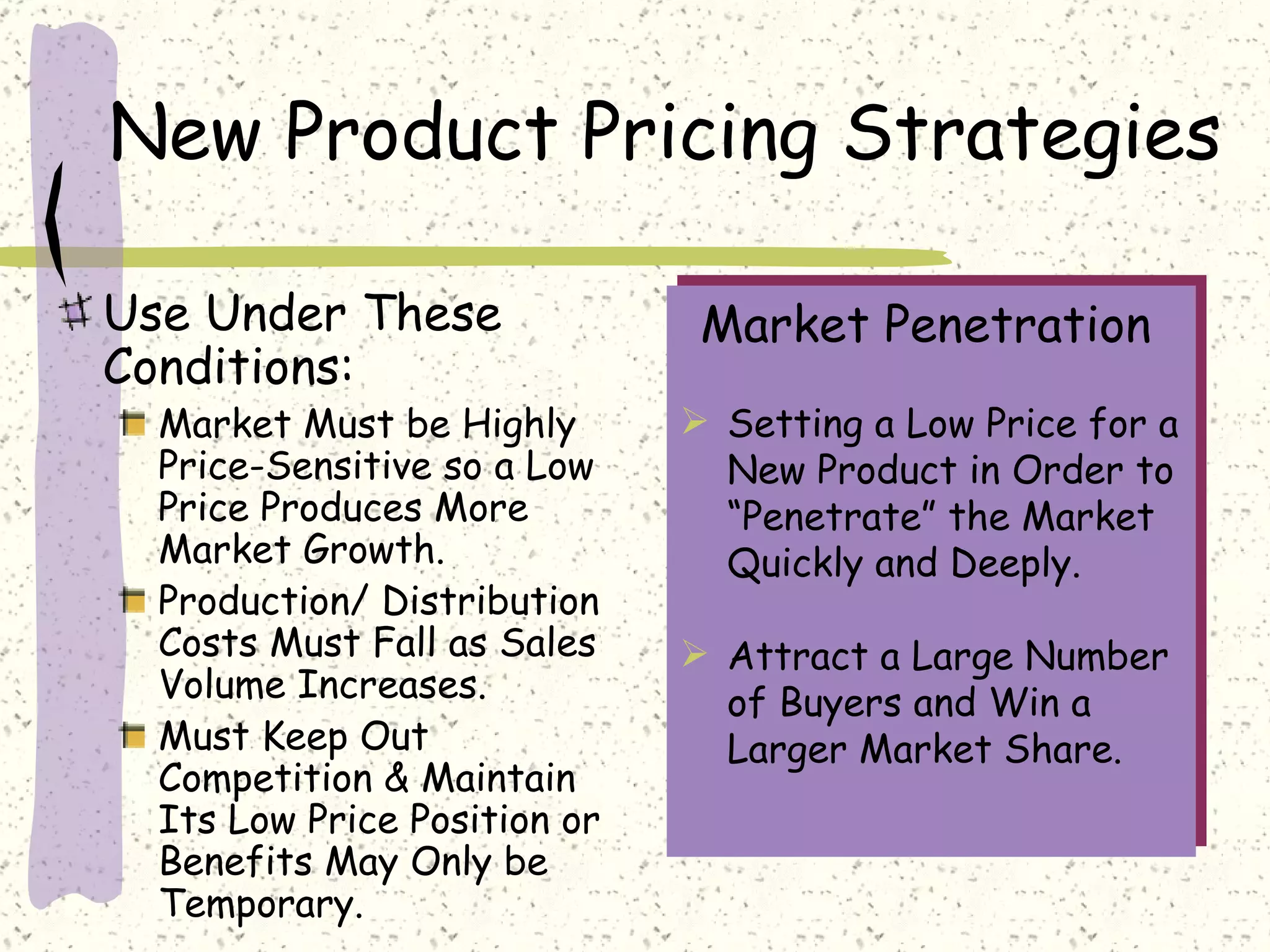
  Market Must be Highly        Setting a Low Price for a
  Price-Sensitive so a Low      New Product in Order to
  Price Produces More           “Penetrate” the Market
  Market Growth.                Quickly and Deeply.
  Production/ Distribution
  Costs Must Fall as Sales     Attract a Large Number
  Volume Increases.             of Buyers and Win a
  Must Keep Out                 Larger Market Share.
  Competition & Maintain
  Its Low Price Position or
  Benefits May Only be
  Temporary.
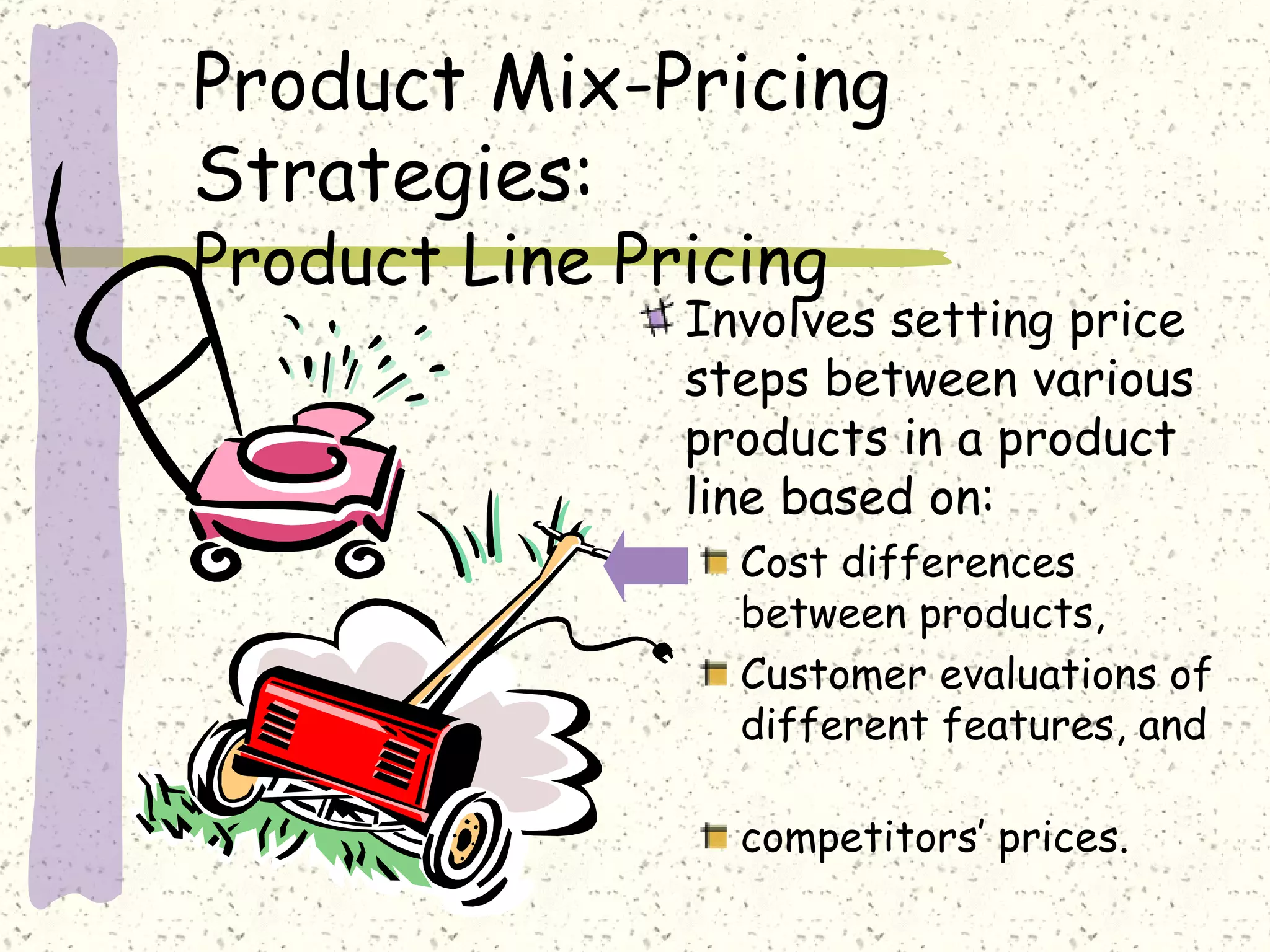
Product Mix-Pricing
Strategies:
Product Line Pricing
               Involves setting price
               steps between various
               products in a product
               line based on:
                 Cost differences
                 between products,
                 Customer evaluations of
                 different features, and

                 competitors’ prices.
Product Mix- Pricing Strategies

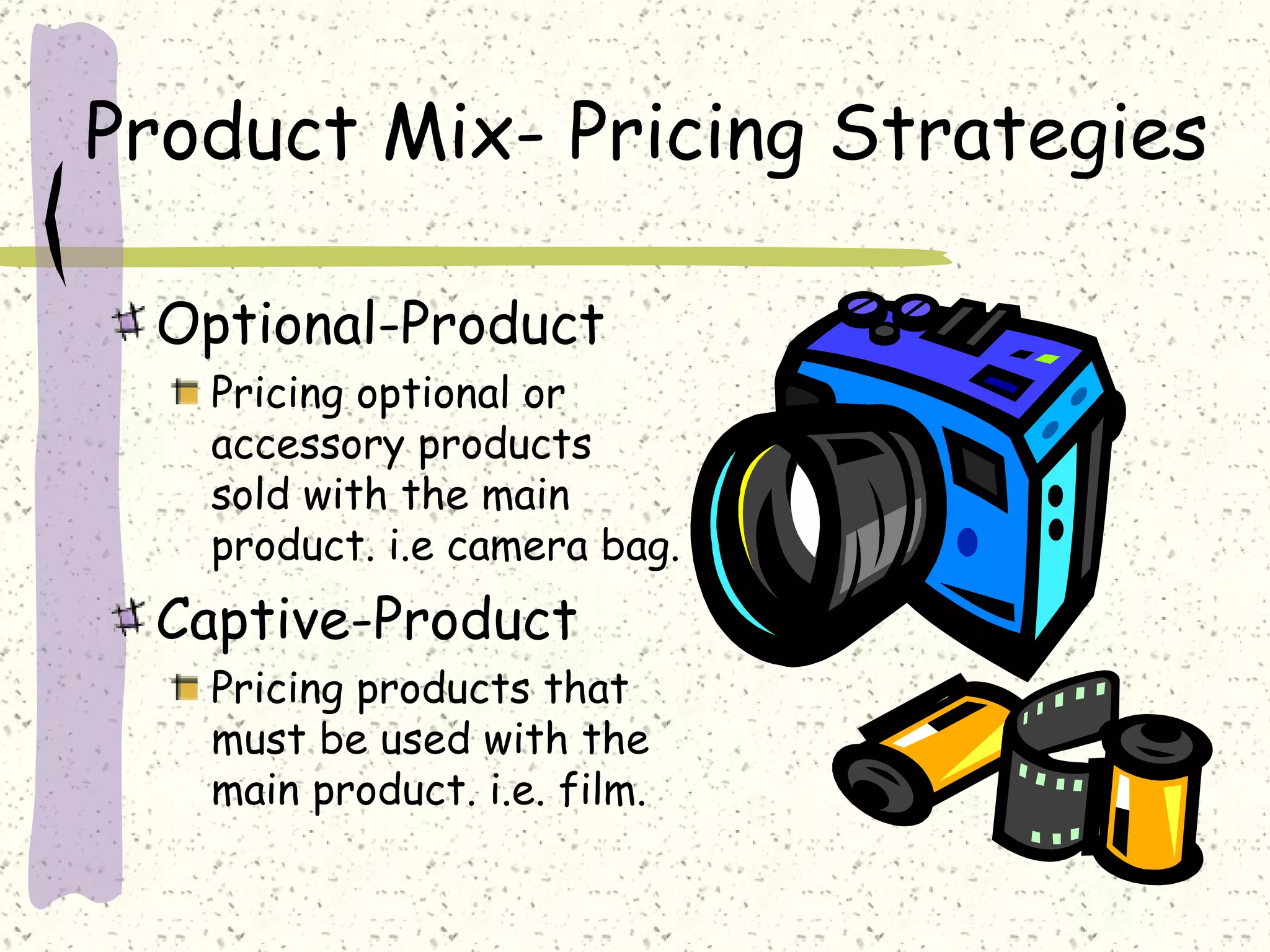
 Optional-Product
   Pricing optional or
   accessory products
   sold with the main
   product. i.e camera bag.
 Captive-Product
   Pricing products that
   must be used with the
   main product. i.e. film.
Product Mix- Pricing
 Strategies

By-Product             Product-Bundling
  Pricing low-value      Combining several
  by-products to get     products and
  rid of them and        offering the
  make the main          bundle at a
  product’s price        reduced price.
  more competitive.      i.e. theater season
  i.e. sawdust, Zoo      tickets.
  Doo
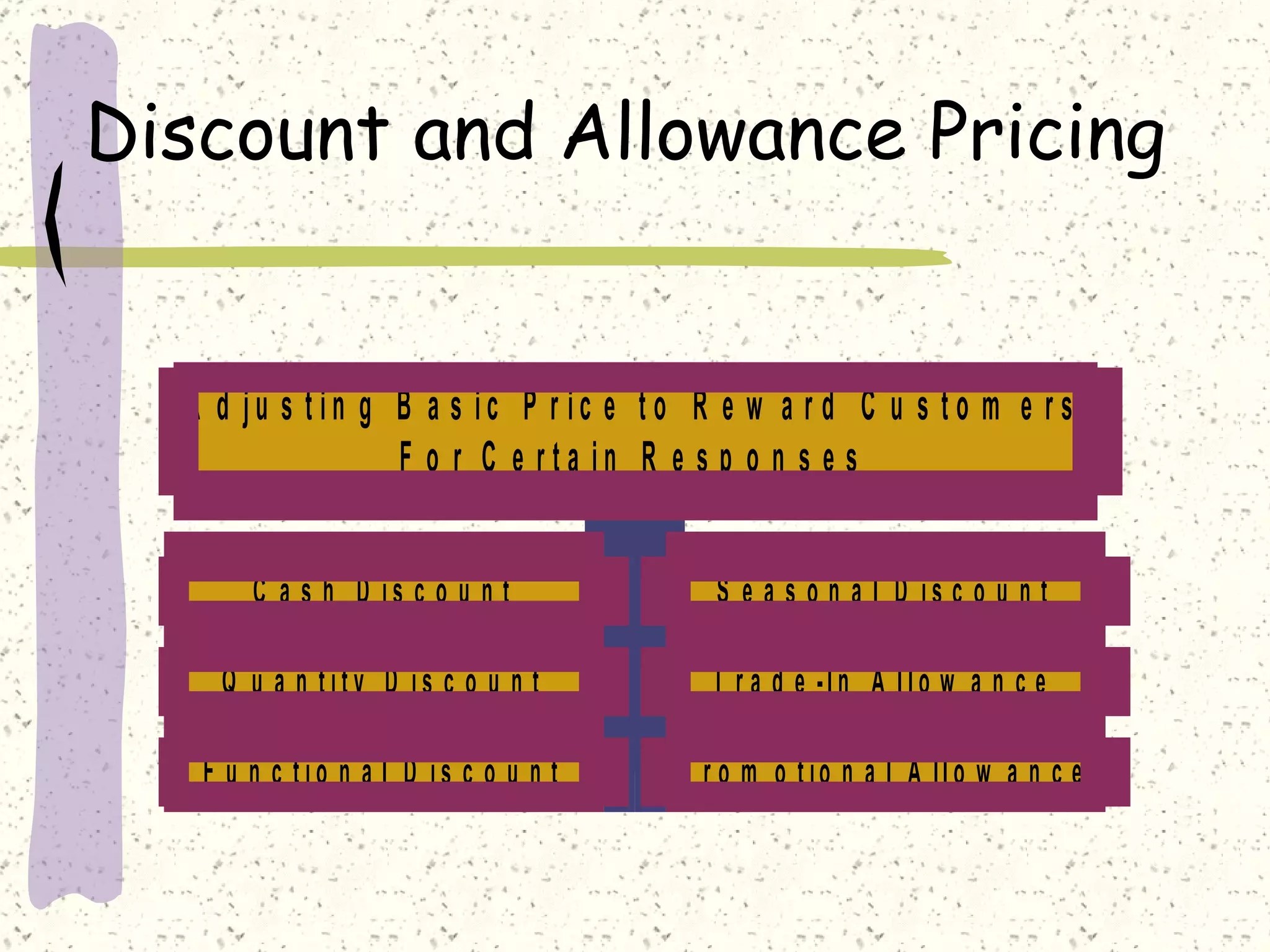
Discount and Allowance Pricing


  A d ju s tin g B a s ic P r ic e to R e w a r d C u s to m e r s
                 F o r C e rta in R e s p o n s e s


       C a s h D is c o u n t            S e a s o n a l D is c o u n t

    Q u a n tity D is c o u n t          T r a d e -In A llo w a n c e

   F u n c tio n a l D is c o u n t   P r o m o t io n a l A ll o w a n c e
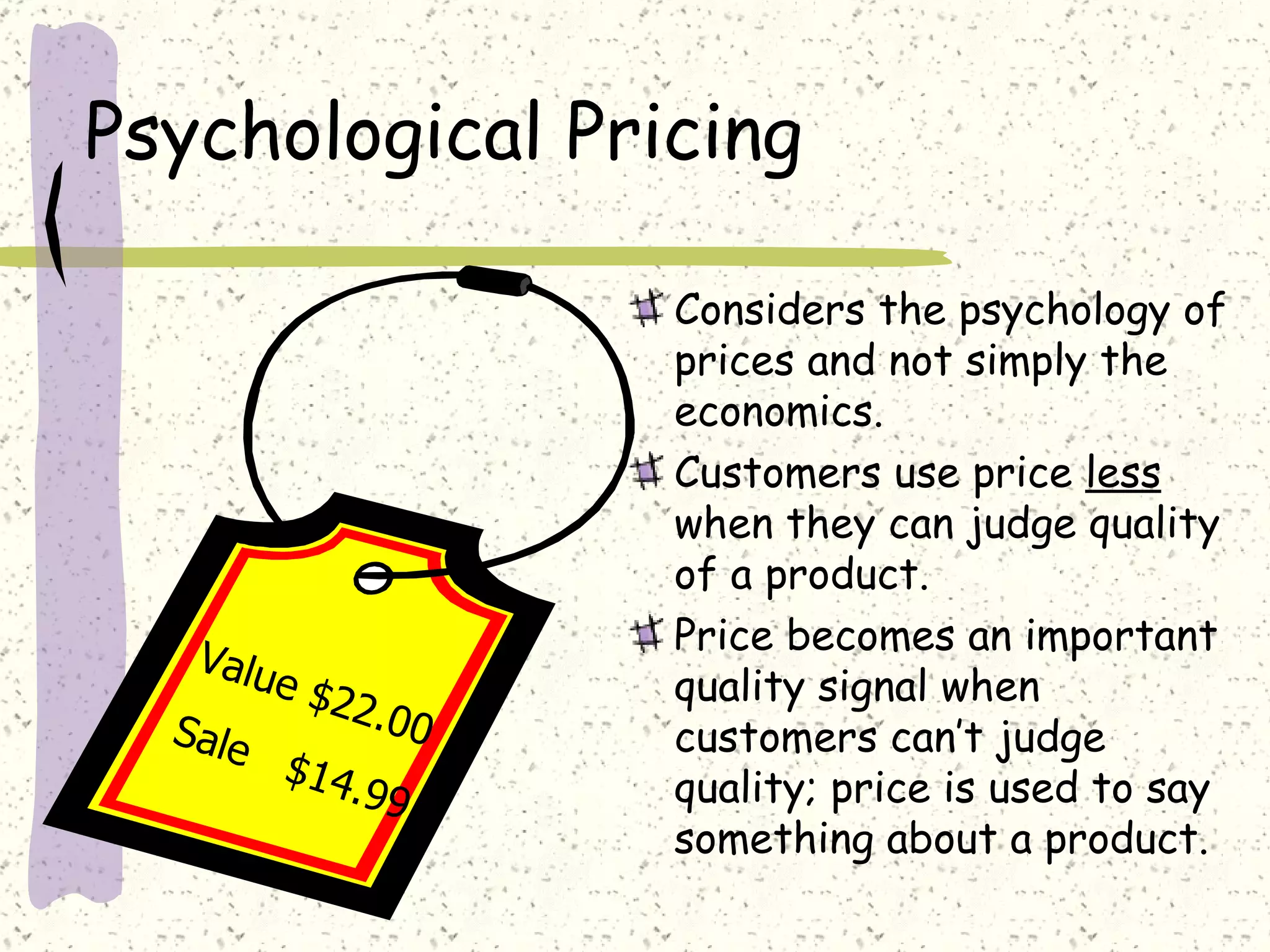
Psychological Pricing

                          Considers the psychology of
                          prices and not simply the
                          economics.
                          Customers use price less
                          when they can judge quality
                          of a product.
   Valu                   Price becomes an important
        e   $22           quality signal when
  Sale          .0    0   customers can’t judge
         $14
             .9   9       quality; price is used to say
                          something about a product.
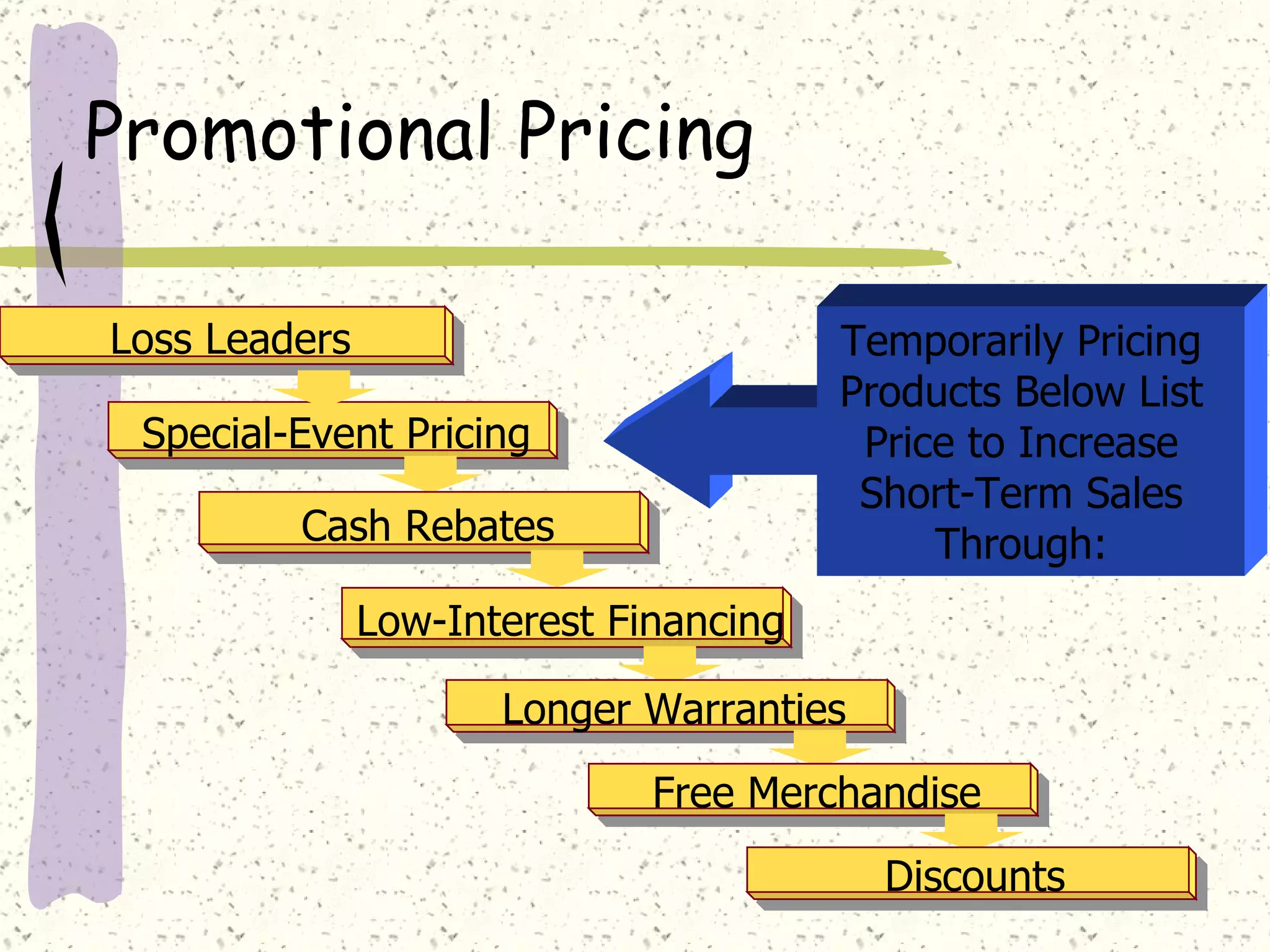
Promotional Pricing

Loss Leaders                            Temporarily Pricing
                                        Products Below List
 Special-Event Pricing                   Price to Increase
                                         Short-Term Sales
         Cash Rebates                        Through:
               Low-Interest Financing

                      Longer Warranties
                              Free Merchandise
                                          Discounts

Determinants of price

  • 1.
  • 2.
    Factors Affecting Price Decisions External Factors Internal Factors Nature of the market Marketing Objectives Marketing Mix Strategy Pricing and demand Decisions Competition Costs Other environmental Organizational factors (economy, considerations resellers, government)
  • 3.
    Internal Factors AffectingPricing Decisions: Marketing Objectives Survival Low Prices to Cover Variable Costs and Some Fixed Costs to Stay in Business. Current Profit Maximization Choose the Price that Produces the Marketing Maximum Current Profit, Etc. Objectives Market Share Leadership Low as Possible Prices to Become the Market Share Leader. Product Quality Leadership High Prices to Cover Higher Performance Quality and R & D.
  • 4.
    Internal Factors AffectingPricing Decisions: Marketing Mix Product Design Nonprice Price Distribution Positions Promotion
  • 5.
    COSTS TYPESOF COST:  Fixed cost  Variable cost  Total cost How costs vary at different production levels will influence price setting.
  • 6.
    External Factors Affecting Pricing Decisions Market and Demand Competitors’ Costs, Prices, and Offers Other External Factors Competitor Costs Economic Conditions This ad by LCI International accuses its competitors of using unfair practices in pricing, hiding fees incurred by rounding up. Reseller Needs Government Actions Why is LCI focusing on this practice? Hidden fees, defined as Social Concerns “cramming” by the FCC, are the number one source of billing complaints among long-distance customers.
  • 7.
    Market and DemandFactors Affecting Pricing Decisions Pricing in Different Types of Markets Pure Competition Many Buyers and Sellers Pure Monopoly Who Have Little Single Seller Effect on the Price Monopolistic Oligopolistic Competition Competition Many Buyers and Sellers Few Sellers Who Are Who Trade Over a Sensitive to Each Other’s Range of Prices Pricing/ Marketing Strategies
  • 8.
    COMPETITORS COSTS PRICES ANDOFFERS Pricing strategy influences the nature of competition Low price low margin strategies inhibit competition High price high margin strategies attract competition  Benchmarking costs against the competition is recommended
  • 9.
    OTHER EXTERNAL FACTORS Economic conditions Affect production costs Affect buyer perceptions of price and value Reseller reactions to prices must be considered Government may restrict or limit pricing options Social considerations may be taken into account
  • 10.
    Major Considerations inSetting Price (Fig. 10.5)
  • 11.
    Cost-Based Pricing Certainty About Costs Simplest Cost-Plus Ethical Factors Pricing Pricing is Pricing is an Situational Method Simplified Approach That Unexpected Adds a Standard Price Competition Is Minimized Markup to the Attitudes Ignores Costof the of Current Others Product. Demand & Much Fairer to Competition Buyers & Sellers
  • 12.
    Cost-Based Versus Value-Based Pricing Cost-Based Pricing Value-Based Pricing Product Customer Cost Value Price Price Value Cost Customers Product
  • 13.
    Competition-Based Pricing Setting Prices Going-Rate Company Sets Prices Based on What Competitors Are Charging. ? Sealed-Bid Company Sets Prices Based on ? What They Think Competitors Will Charge.
  • 14.
    New Product PricingStrategies Market Skimming Use Under These Conditions:  Setting a High Price Product’s Quality and for a New Product to Image Must Support Its Higher Price. “Skim” Maximum Costs Can’t be so High Revenues from the that They Cancel the Target Market. Advantage of Charging  Results in Fewer, But More. More Profitable Sales. Competitors Shouldn’t be Able to Enter Market Easily and Undercut the High Price.
  • 15.
    New Product PricingStrategies Use Under These Market Penetration Conditions: Market Must be Highly  Setting a Low Price for a Price-Sensitive so a Low New Product in Order to Price Produces More “Penetrate” the Market Market Growth. Quickly and Deeply. Production/ Distribution Costs Must Fall as Sales  Attract a Large Number Volume Increases. of Buyers and Win a Must Keep Out Larger Market Share. Competition & Maintain Its Low Price Position or Benefits May Only be Temporary.
  • 16.
    Product Mix-Pricing Strategies: Product LinePricing Involves setting price steps between various products in a product line based on: Cost differences between products, Customer evaluations of different features, and competitors’ prices.
  • 17.
    Product Mix- PricingStrategies Optional-Product Pricing optional or accessory products sold with the main product. i.e camera bag. Captive-Product Pricing products that must be used with the main product. i.e. film.
  • 18.
    Product Mix- Pricing Strategies By-Product Product-Bundling Pricing low-value Combining several by-products to get products and rid of them and offering the make the main bundle at a product’s price reduced price. more competitive. i.e. theater season i.e. sawdust, Zoo tickets. Doo
  • 19.
    Discount and AllowancePricing A d ju s tin g B a s ic P r ic e to R e w a r d C u s to m e r s F o r C e rta in R e s p o n s e s C a s h D is c o u n t S e a s o n a l D is c o u n t Q u a n tity D is c o u n t T r a d e -In A llo w a n c e F u n c tio n a l D is c o u n t P r o m o t io n a l A ll o w a n c e
  • 20.
    Psychological Pricing Considers the psychology of prices and not simply the economics. Customers use price less when they can judge quality of a product. Valu Price becomes an important e $22 quality signal when Sale .0 0 customers can’t judge $14 .9 9 quality; price is used to say something about a product.
  • 21.
    Promotional Pricing Loss Leaders Temporarily Pricing Products Below List Special-Event Pricing Price to Increase Short-Term Sales Cash Rebates Through: Low-Interest Financing Longer Warranties Free Merchandise Discounts

Editor's Notes

  • #5 1.Pricing must be carefully coordinated with other marketing mix elements. 2.Target costing is often used to support product positioning stategies based on price 3.Non price positioning can also be used.