




By PresenterMedia.com
1. To indicate the importance and complexity of
price decisions for marketing managers.
2. To consider what is „price‟.
3. To identify factors internal to the firm that
influence price decisions.
4. To identify the factors external to the firm that
influence price decisions.
5. To know when to cut price, when to increase, and
when to sell below cost.
PRICE -It is the amount
of money charged for
“something”.
    PRICING- It is the
twin brother of product
quality which when
combined make up of what
is called product value.
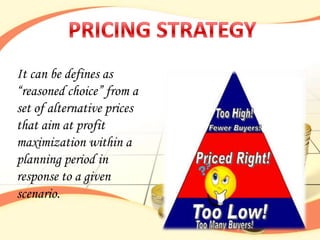
It can be defines as
“reasoned choice” from a
set of alternative prices
that aim at profit
maximization within a
planning period in
response to a given
scenario.
Pricing has the dual marketing
function:

•Making products affordable to its
target market

•Reflecting the value of the
product
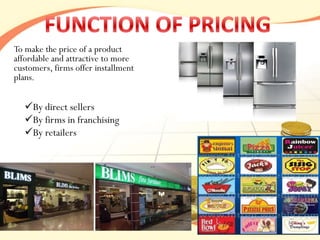
To make the price of a product
affordable and attractive to more
customers, firms offer installment
plans.


   By direct sellers
   By firms in franchising
   By retailers
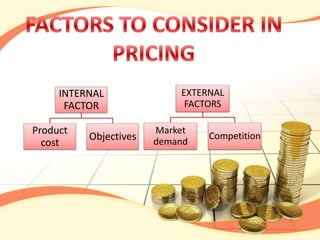
INTERNAL              EXTERNAL
      FACTOR                FACTORS

Product                Market
                                Competition
          Objectives   demand
  cost
Product cost must be broken
down to fixed and variable
cost as most the companies sell
more than one item and fixed
cost must be allocated to
different products in a sensible
way. Most cost-based pricing
are used when there is
relatively little, if any, direct
competition or when buyers are
not price sensitive.
Under cost-based pricing strategy, there are two common types of
setting prices:

•Mark-up, where a standard percentage
based on cost is adopted.
•Target profit, where prices are set
towards attaining satisfactory rate of
return.
The company‟s objectives will have a big effect on
its pricing strategy. There is always a need to balance
between profit and the marketing shares objectives, and
regular dividends and growth revenue. For more market
shares a company would have to invest more marketing
money which may affect profit in the short run.
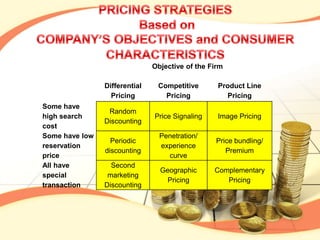
•Differential Pricing strategy- where
the same brand is sold at different prices
to different market segments.
•Competitive Pricing strategy- where
prices are set to exploit a firm‟s
competitive position.
•Product Line Pricing Strategy- where
related brands or products are sold at
prices that exploit mutual dependencies
or balance pricing over product line.
Some have high search cost

Some have low reservation price

All have special transaction
Objective of the Firm

                Differential    Competitive       Product Line
                  Pricing         Pricing           Pricing
Some have
                 Random
high search                    Price Signaling    Image Pricing
                Discounting
cost
Some have low                    Penetration/
                  Periodic                        Price bundling/
reservation                      experience
                discounting                          Premium
price                              curve
All have          Second
                                 Geographic      Complementary
special          marketing
                                   Pricing          Pricing
transaction     Discounting
•Random Discounting
The marketer tries to
maximize the number of
customers informed of the
random discount at his
product‟s low price instead of
at a competitor‟s price.
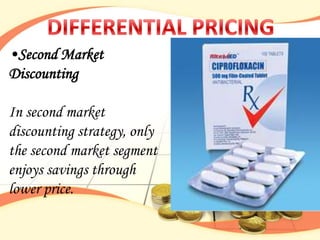
•Second Market
Discounting

In second market
discounting strategy, only
the second market segment
enjoys savings through
lower price.
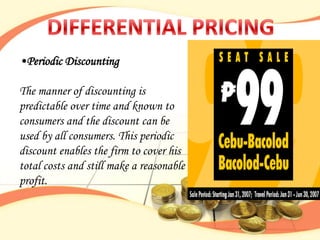
•Periodic Discounting

The manner of discounting is
predictable over time and known to
consumers and the discount can be
used by all consumers. This periodic
discount enables the firm to cover his
total costs and still make a reasonable
profit.
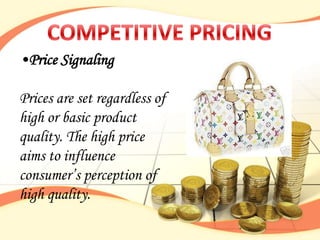
•Price Signaling

Prices are set regardless of
high or basic product
quality. The high price
aims to influence
consumer‟s perception of
high quality.
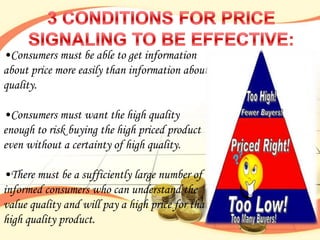
•Consumers must be able to get information
about price more easily than information about
quality.

•Consumers must want the high quality
enough to risk buying the high priced product
even without a certainty of high quality.

•There must be a sufficiently large number of
informed consumers who can understand the
value quality and will pay a high price for that
high quality product.
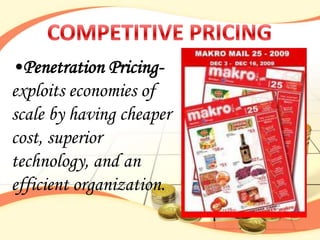
•Penetration Pricing-
exploits economies of
scale by having cheaper
cost, superior
technology, and an
efficient organization.
•Experience Curve Pricing- concept
exploits a firm‟s production experience as
cost decrease due to cumulative volume.
•The use of experience curve pricing
starts by projecting the declining per unit
production cost (inflation adjusted) of a
product and then basing the pricing
strategy on a series of significant price
decreases that come with accumulated
production volume.
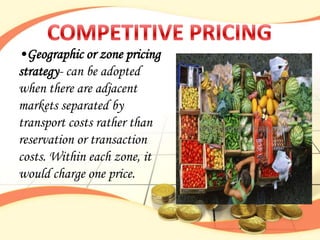
•Geographic or zone pricing
strategy- can be adopted
when there are adjacent
markets separated by
transport costs rather than
reservation or transaction
costs. Within each zone, it
would charge one price.
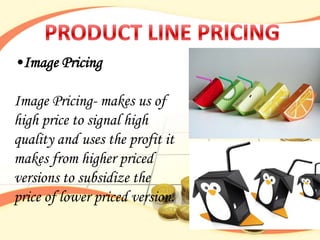
•Image Pricing

Image Pricing- makes us of
high price to signal high
quality and uses the profit it
makes from higher priced
versions to subsidize the
price of lower priced version.
•Price Bundling
-The basic idea of price bundling is
that the whole bundle is cheaper
than the buying the parts
separately.
-The basic requirement for price is
bundling is non- substitution
among products within the bundle
as a strategy to convince consumers
to buy all the products as a
package.
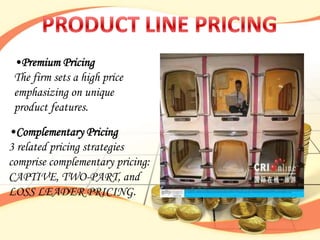
•Premium Pricing
 The firm sets a high price
 emphasizing on unique
 product features.
•Complementary Pricing
3 related pricing strategies
comprise complementary pricing:
CAPTIVE, TWO-PART, and
LOSS LEADER PRICING.
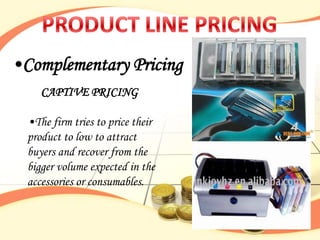
•Complementary Pricing
     CAPTIVE PRICING

  •The firm tries to price their
  product to low to attract
  buyers and recover from the
  bigger volume expected in the
  accessories or consumables.
•Complementary Pricing
 TWO- PART PRICING

 • Two part pricing refers to
 pricing commonly used by service-
 based firms. There is a fixed fee
 plus a variable fee to charge to
 the customers.
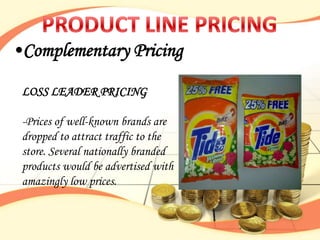
•Complementary Pricing

 LOSS LEADER PRICING

 -Prices of well-known brands are
 dropped to attract traffic to the
 store. Several nationally branded
 products would be advertised with
 amazingly low prices.
Marketers may be tempted to price their
products low during the introductory
period, regardless of product quality and
choices of available distribution methods. The
temporary market shares gained however may
create a permanent price image for the brand
which may be difficult to change over time. A
market reality, is that whenever price
adjustments are needed, increasing prices is
much more difficult than lowering them.
Most common ways in setting prices under the market
demand-based pricing strategy:

•Perceived value, where marketers use the
perception of customers in establishing its
prices.
•Demand differential, where marketers choose
price level that would support their planned
sales volume and profit.
Diagnostic Perception Pricing

   Products have different
features or attributes. These
attributes have different levels
of importance to the
customers.
Competition-based pricing strategy, there are two
common ways in setting prices:
•Going rate, where marketers begin and work
within the prevailing market price. Commodities
like gasoline have smaller prices except for self-
service stations, which charge little less.
•Sealed Bid, where the marketers price their
product or service depending on how competitors
are expected to price theirs. Mostly required by
government offices.
Different companies have different
objectives, different cost structures, and
different strengths. Marketers must
remember that the more unique their
products are, the more flexible they can
be in formulating pricing.
•F.O.B- Free on Board. This means that supplier
pays the freight up to a certain point, usually the
port of origin.
•C & F- Cost and Freight. Means that the
Philippine exporter is quoting a price inclusive of
freight from the Philippines up to Busan in South
Korea, the port of destination.
•C.I.F- Cost, Insurance, and Freight. Price has a
similar meaning with our C & F example except
that it includes the cargo insurance covering the
shipment from the port of origin to the port of
destination.
•Also called “Noticeable price
 Difference”, this technique is used
 most specially in supermarkets and
 department stores to create an
 impression of “good value”.


•The term Elasticity connects the relationship
between changes in price and quantity of sales.
•Price elasticity means that demand will change
if change in pricing occurs. Measurement allows
companies to evaluate how price changes will
affect total revenue.
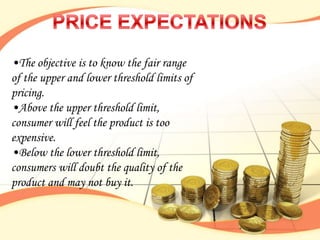
•The objective is to know the fair range
of the upper and lower threshold limits of
pricing.
•Above the upper threshold limit,
consumer will feel the product is too
expensive.
•Below the lower threshold limit,
consumers will doubt the quality of the
product and may not buy it.
General guideline as to when to increase or decrease price:
•When to Increase Price
The firm will have to absorb the cost, and look for
ways to increase customer base, purchase volume, and
minimize wastage.
•When to Cut Price
In general, a price reduction is perceived as a sign that
something is wrong and needs correcting.

•   When to Sell Below Cost
    The bad news for all is when a firm not only has to
decrease price but also has to sell below cost.
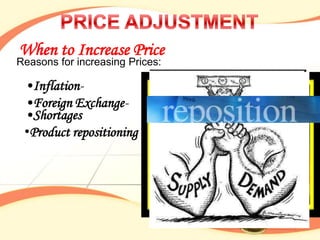
When to Increase Price
Reasons for increasing Prices:

 •Inflation-
 •Foreign Exchange-
 •Shortages
 •Product repositioning
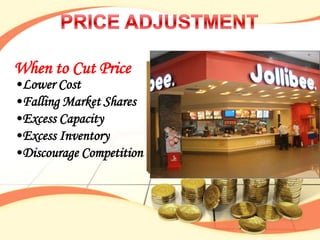
When to Cut Price
•Lower Cost
•Falling Market Shares
•Excess Capacity
•Excess Inventory
•Discourage Competition
When to Cut Price
•Socialized Pricing
•New Market Segment
•Availability of New Substitutes
•Subsequent Sales
•Competitive Trends
•Increase Competitive
Vulnerability
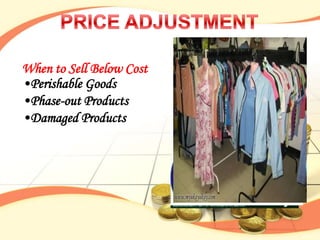
When to Sell Below Cost
•Perishable Goods
•Phase-out Products
•Damaged Products
In a free economy, marketers will having deal
with lower prices from competitors sooner and later.
There are price and non-price responses to price
attacks of the competition. Each of the alternatives
must be weight carefully considering the option that
will maximize its gain and preserve its longevity in
the marketplace.
Examples of price responses are:
•Flanker brand
•Fight
•Selective Response
•Quality
•Alliance
•Cost Advantage
This chapter is designed to give students a fundamental but
comprehensive insight into pricing. It sets out in a logical
order the key
factors that affect price and how it can be used strategically
and tactically. It starts, in the first section, by looking at a
number of key issues relating to price, what it means, and its
importance in terms of marketing and the other elements of
the marketing mix. It also sets the theme for the
chapter - that a systematic approach to pricing should
always be adopted.

Golden coins graph

  • 1.
  • 2.
    1. To indicatethe importance and complexity of price decisions for marketing managers. 2. To consider what is „price‟. 3. To identify factors internal to the firm that influence price decisions. 4. To identify the factors external to the firm that influence price decisions. 5. To know when to cut price, when to increase, and when to sell below cost.
  • 3.
    PRICE -It isthe amount of money charged for “something”. PRICING- It is the twin brother of product quality which when combined make up of what is called product value.
  • 5.
    It can bedefines as “reasoned choice” from a set of alternative prices that aim at profit maximization within a planning period in response to a given scenario.
  • 6.
    Pricing has thedual marketing function: •Making products affordable to its target market •Reflecting the value of the product
  • 7.
    To make theprice of a product affordable and attractive to more customers, firms offer installment plans. By direct sellers By firms in franchising By retailers
  • 8.
    INTERNAL EXTERNAL FACTOR FACTORS Product Market Competition Objectives demand cost
  • 9.
    Product cost mustbe broken down to fixed and variable cost as most the companies sell more than one item and fixed cost must be allocated to different products in a sensible way. Most cost-based pricing are used when there is relatively little, if any, direct competition or when buyers are not price sensitive.
  • 10.
    Under cost-based pricingstrategy, there are two common types of setting prices: •Mark-up, where a standard percentage based on cost is adopted. •Target profit, where prices are set towards attaining satisfactory rate of return.
  • 11.
    The company‟s objectiveswill have a big effect on its pricing strategy. There is always a need to balance between profit and the marketing shares objectives, and regular dividends and growth revenue. For more market shares a company would have to invest more marketing money which may affect profit in the short run.
  • 12.
    •Differential Pricing strategy-where the same brand is sold at different prices to different market segments. •Competitive Pricing strategy- where prices are set to exploit a firm‟s competitive position. •Product Line Pricing Strategy- where related brands or products are sold at prices that exploit mutual dependencies or balance pricing over product line.
  • 13.
    Some have highsearch cost Some have low reservation price All have special transaction
  • 14.
    Objective of theFirm Differential Competitive Product Line Pricing Pricing Pricing Some have Random high search Price Signaling Image Pricing Discounting cost Some have low Penetration/ Periodic Price bundling/ reservation experience discounting Premium price curve All have Second Geographic Complementary special marketing Pricing Pricing transaction Discounting
  • 15.
    •Random Discounting The marketertries to maximize the number of customers informed of the random discount at his product‟s low price instead of at a competitor‟s price.
  • 16.
    •Second Market Discounting In secondmarket discounting strategy, only the second market segment enjoys savings through lower price.
  • 17.
    •Periodic Discounting The mannerof discounting is predictable over time and known to consumers and the discount can be used by all consumers. This periodic discount enables the firm to cover his total costs and still make a reasonable profit.
  • 18.
    •Price Signaling Prices areset regardless of high or basic product quality. The high price aims to influence consumer‟s perception of high quality.
  • 19.
    •Consumers must beable to get information about price more easily than information about quality. •Consumers must want the high quality enough to risk buying the high priced product even without a certainty of high quality. •There must be a sufficiently large number of informed consumers who can understand the value quality and will pay a high price for that high quality product.
  • 20.
    •Penetration Pricing- exploits economiesof scale by having cheaper cost, superior technology, and an efficient organization.
  • 21.
    •Experience Curve Pricing-concept exploits a firm‟s production experience as cost decrease due to cumulative volume. •The use of experience curve pricing starts by projecting the declining per unit production cost (inflation adjusted) of a product and then basing the pricing strategy on a series of significant price decreases that come with accumulated production volume.
  • 22.
    •Geographic or zonepricing strategy- can be adopted when there are adjacent markets separated by transport costs rather than reservation or transaction costs. Within each zone, it would charge one price.
  • 23.
    •Image Pricing Image Pricing-makes us of high price to signal high quality and uses the profit it makes from higher priced versions to subsidize the price of lower priced version.
  • 24.
    •Price Bundling -The basicidea of price bundling is that the whole bundle is cheaper than the buying the parts separately. -The basic requirement for price is bundling is non- substitution among products within the bundle as a strategy to convince consumers to buy all the products as a package.
  • 25.
    •Premium Pricing Thefirm sets a high price emphasizing on unique product features. •Complementary Pricing 3 related pricing strategies comprise complementary pricing: CAPTIVE, TWO-PART, and LOSS LEADER PRICING.
  • 26.
    •Complementary Pricing CAPTIVE PRICING •The firm tries to price their product to low to attract buyers and recover from the bigger volume expected in the accessories or consumables.
  • 27.
    •Complementary Pricing TWO-PART PRICING • Two part pricing refers to pricing commonly used by service- based firms. There is a fixed fee plus a variable fee to charge to the customers.
  • 28.
    •Complementary Pricing LOSSLEADER PRICING -Prices of well-known brands are dropped to attract traffic to the store. Several nationally branded products would be advertised with amazingly low prices.
  • 29.
    Marketers may betempted to price their products low during the introductory period, regardless of product quality and choices of available distribution methods. The temporary market shares gained however may create a permanent price image for the brand which may be difficult to change over time. A market reality, is that whenever price adjustments are needed, increasing prices is much more difficult than lowering them.
  • 30.
    Most common waysin setting prices under the market demand-based pricing strategy: •Perceived value, where marketers use the perception of customers in establishing its prices. •Demand differential, where marketers choose price level that would support their planned sales volume and profit.
  • 31.
    Diagnostic Perception Pricing Products have different features or attributes. These attributes have different levels of importance to the customers.
  • 32.
    Competition-based pricing strategy,there are two common ways in setting prices: •Going rate, where marketers begin and work within the prevailing market price. Commodities like gasoline have smaller prices except for self- service stations, which charge little less. •Sealed Bid, where the marketers price their product or service depending on how competitors are expected to price theirs. Mostly required by government offices.
  • 33.
    Different companies havedifferent objectives, different cost structures, and different strengths. Marketers must remember that the more unique their products are, the more flexible they can be in formulating pricing.
  • 34.
    •F.O.B- Free onBoard. This means that supplier pays the freight up to a certain point, usually the port of origin. •C & F- Cost and Freight. Means that the Philippine exporter is quoting a price inclusive of freight from the Philippines up to Busan in South Korea, the port of destination. •C.I.F- Cost, Insurance, and Freight. Price has a similar meaning with our C & F example except that it includes the cargo insurance covering the shipment from the port of origin to the port of destination.
  • 35.
    •Also called “Noticeableprice Difference”, this technique is used most specially in supermarkets and department stores to create an impression of “good value”. •The term Elasticity connects the relationship between changes in price and quantity of sales. •Price elasticity means that demand will change if change in pricing occurs. Measurement allows companies to evaluate how price changes will affect total revenue.
  • 36.
    •The objective isto know the fair range of the upper and lower threshold limits of pricing. •Above the upper threshold limit, consumer will feel the product is too expensive. •Below the lower threshold limit, consumers will doubt the quality of the product and may not buy it.
  • 37.
    General guideline asto when to increase or decrease price: •When to Increase Price The firm will have to absorb the cost, and look for ways to increase customer base, purchase volume, and minimize wastage. •When to Cut Price In general, a price reduction is perceived as a sign that something is wrong and needs correcting. • When to Sell Below Cost The bad news for all is when a firm not only has to decrease price but also has to sell below cost.
  • 38.
    When to IncreasePrice Reasons for increasing Prices: •Inflation- •Foreign Exchange- •Shortages •Product repositioning
  • 39.
    When to CutPrice •Lower Cost •Falling Market Shares •Excess Capacity •Excess Inventory •Discourage Competition
  • 40.
    When to CutPrice •Socialized Pricing •New Market Segment •Availability of New Substitutes •Subsequent Sales •Competitive Trends •Increase Competitive Vulnerability
  • 41.
    When to SellBelow Cost •Perishable Goods •Phase-out Products •Damaged Products
  • 42.
    In a freeeconomy, marketers will having deal with lower prices from competitors sooner and later. There are price and non-price responses to price attacks of the competition. Each of the alternatives must be weight carefully considering the option that will maximize its gain and preserve its longevity in the marketplace.
  • 43.
    Examples of priceresponses are: •Flanker brand •Fight •Selective Response •Quality •Alliance •Cost Advantage
  • 44.
    This chapter isdesigned to give students a fundamental but comprehensive insight into pricing. It sets out in a logical order the key factors that affect price and how it can be used strategically and tactically. It starts, in the first section, by looking at a number of key issues relating to price, what it means, and its importance in terms of marketing and the other elements of the marketing mix. It also sets the theme for the chapter - that a systematic approach to pricing should always be adopted.