MARKETING MANAGEMENT

         Developing Pricing
             Strategies and
                  Programs
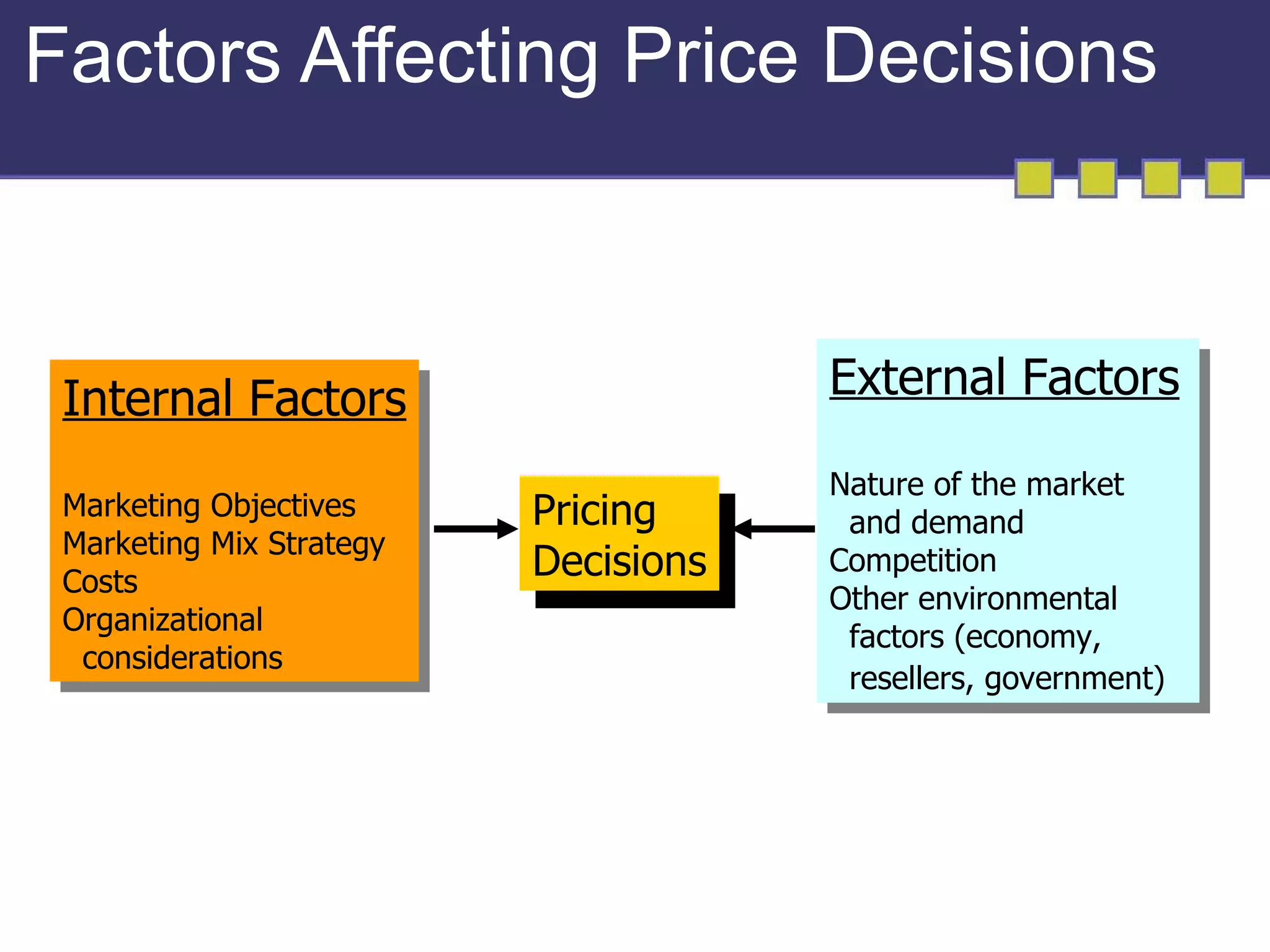
Factors Affecting Price Decisions


 Internal Factors                     External Factors

                                      Nature of the market
 Marketing Objectives     Pricing      and demand
 Marketing Mix Strategy
 Costs
                          Decisions   Competition
                                      Other environmental
 Organizational
                                       factors (economy,
  considerations
                                       resellers, government)
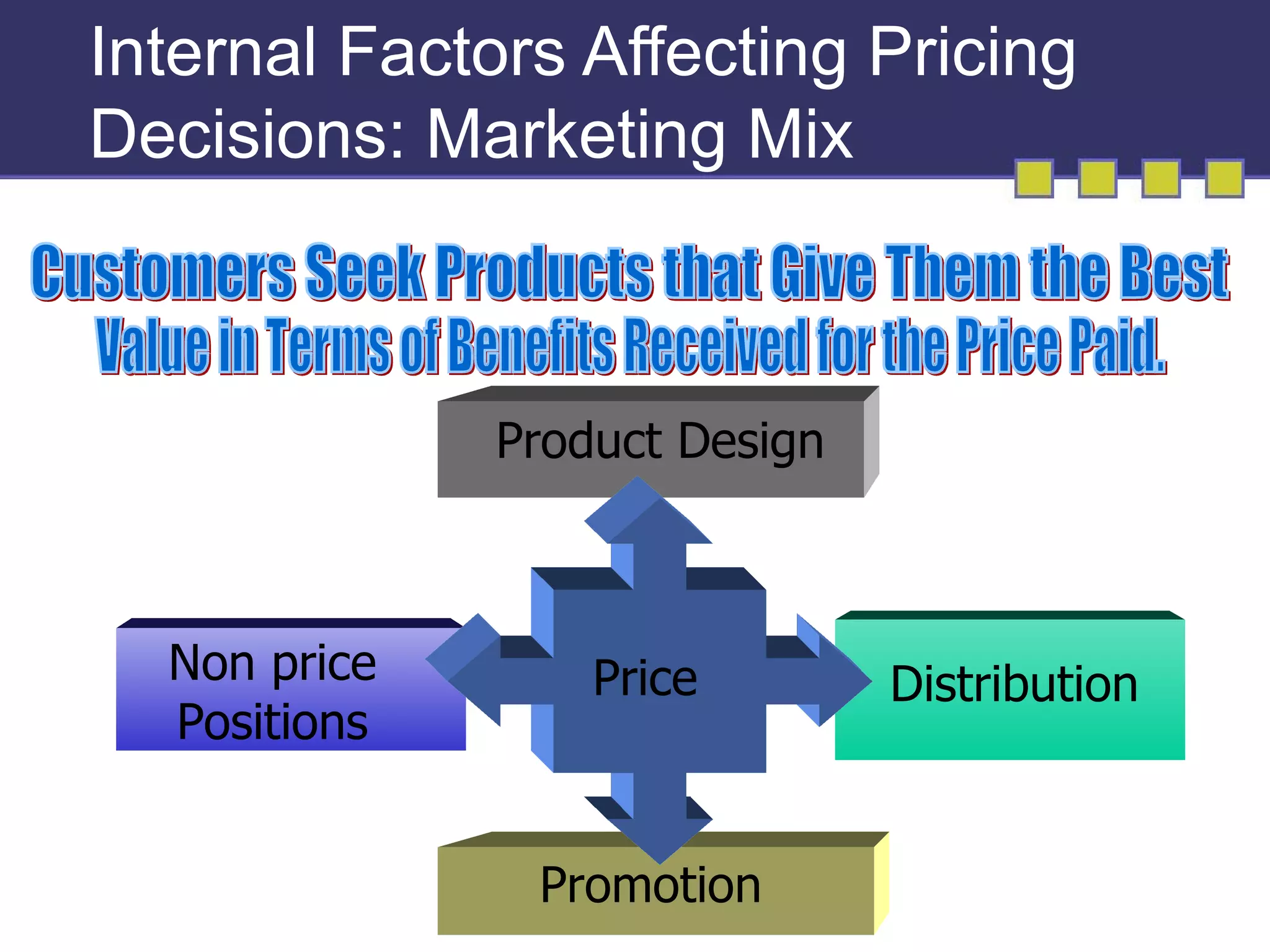
Internal Factors Affecting Pricing
Decisions: Marketing Objectives

                                Survival
                 Low Prices to Cover Variable Costs and
                 Some Fixed Costs to Stay in Business.

                  Current Profit Maximization
                   Choose the Price that Produces the
  Marketing          Maximum Current Profit, Etc.

  Objectives         Market Share Leadership
                   Low as Possible Prices to Become
                      the Market Share Leader.

                    Product Quality Leadership
                      High Prices to Cover Higher
                    Performance Quality and R & D.
Internal Factors Affecting Pricing
Decisions: Marketing Mix


              Product Design


  Non price       Price        Distribution
  Positions


               Promotion
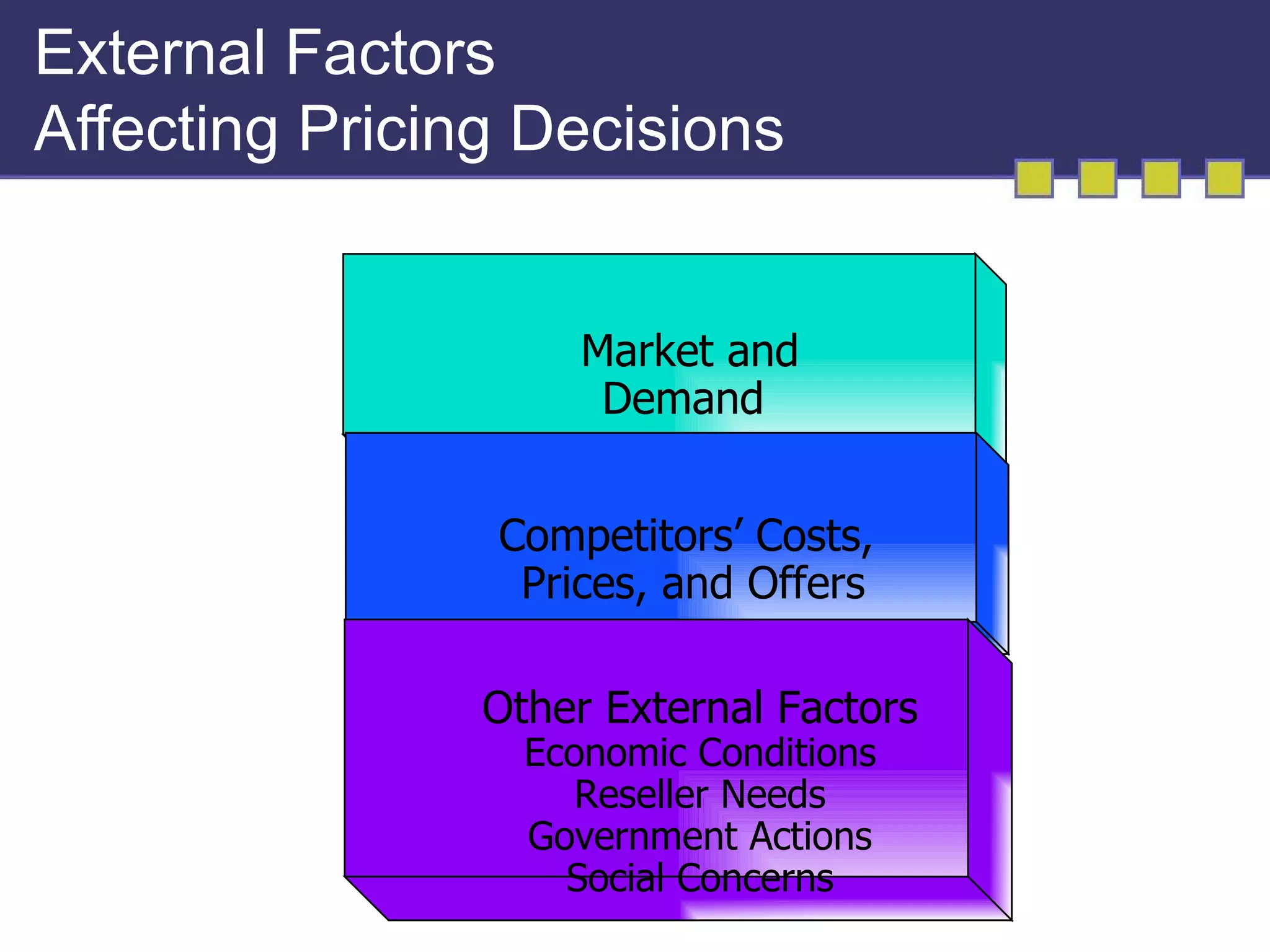
External Factors
Affecting Pricing Decisions


                     Market and
                      Demand


                Competitors’ Costs,
                 Prices, and Offers

                Other External Factors
                  Economic Conditions
                     Reseller Needs
                  Government Actions
                    Social Concerns
Market and Demand Factors
Affecting Pricing Decisions

            Pricing in Different Types of Markets

  Pure Competition
Many Buyers and Sellers                             Pure Monopoly
   Who Have Little                                    Single Seller
  Effect on the Price

               Monopolistic              Oligopolistic
               Competition               Competition
          Many Buyers and Sellers     Few Sellers Who Are
            Who Trade Over a        Sensitive to Each Other’s
              Range of Prices          Pricing/ Marketing
                                            Strategies
External Factors
Government Regulations
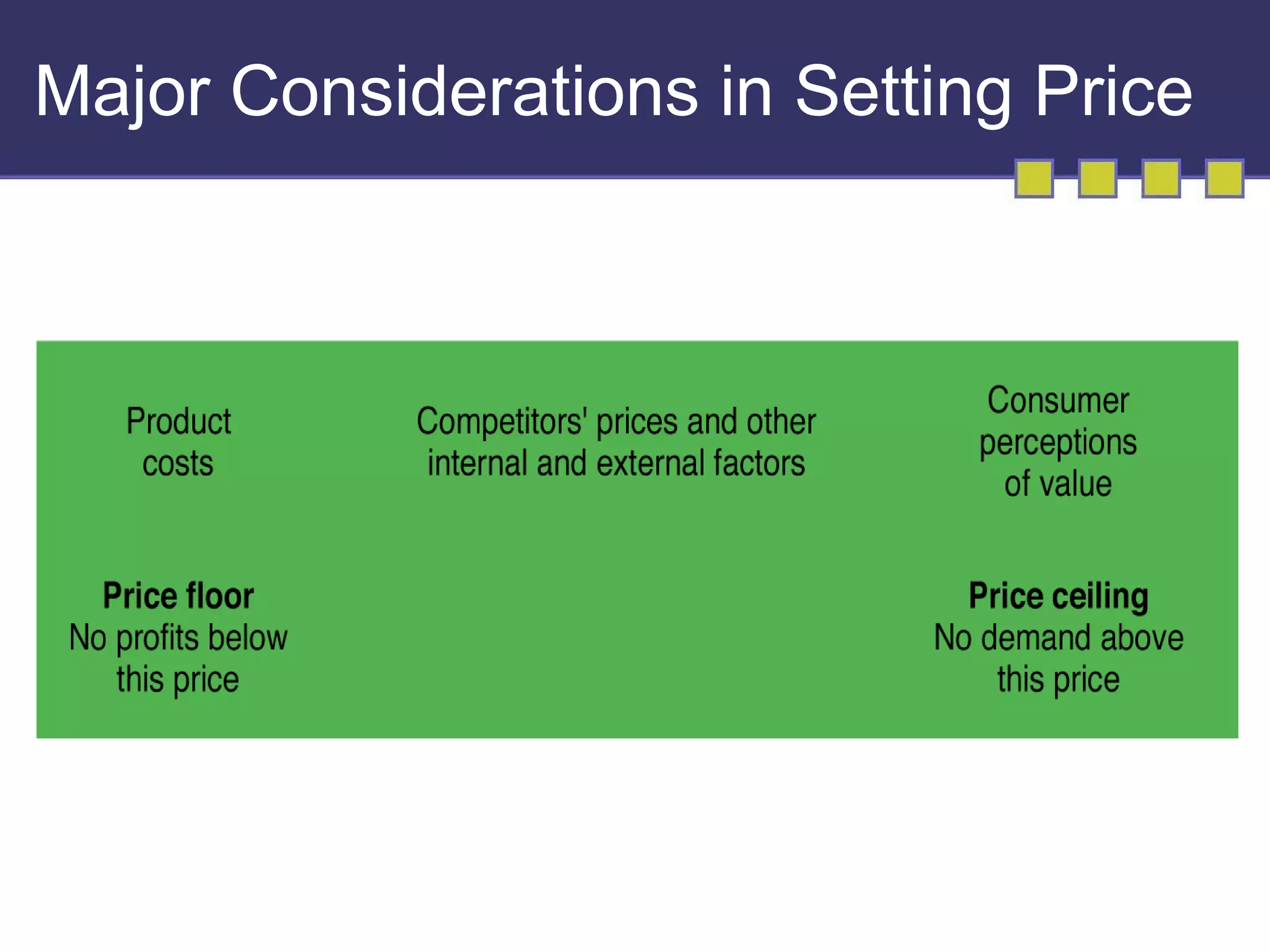
Major Considerations in Setting Price
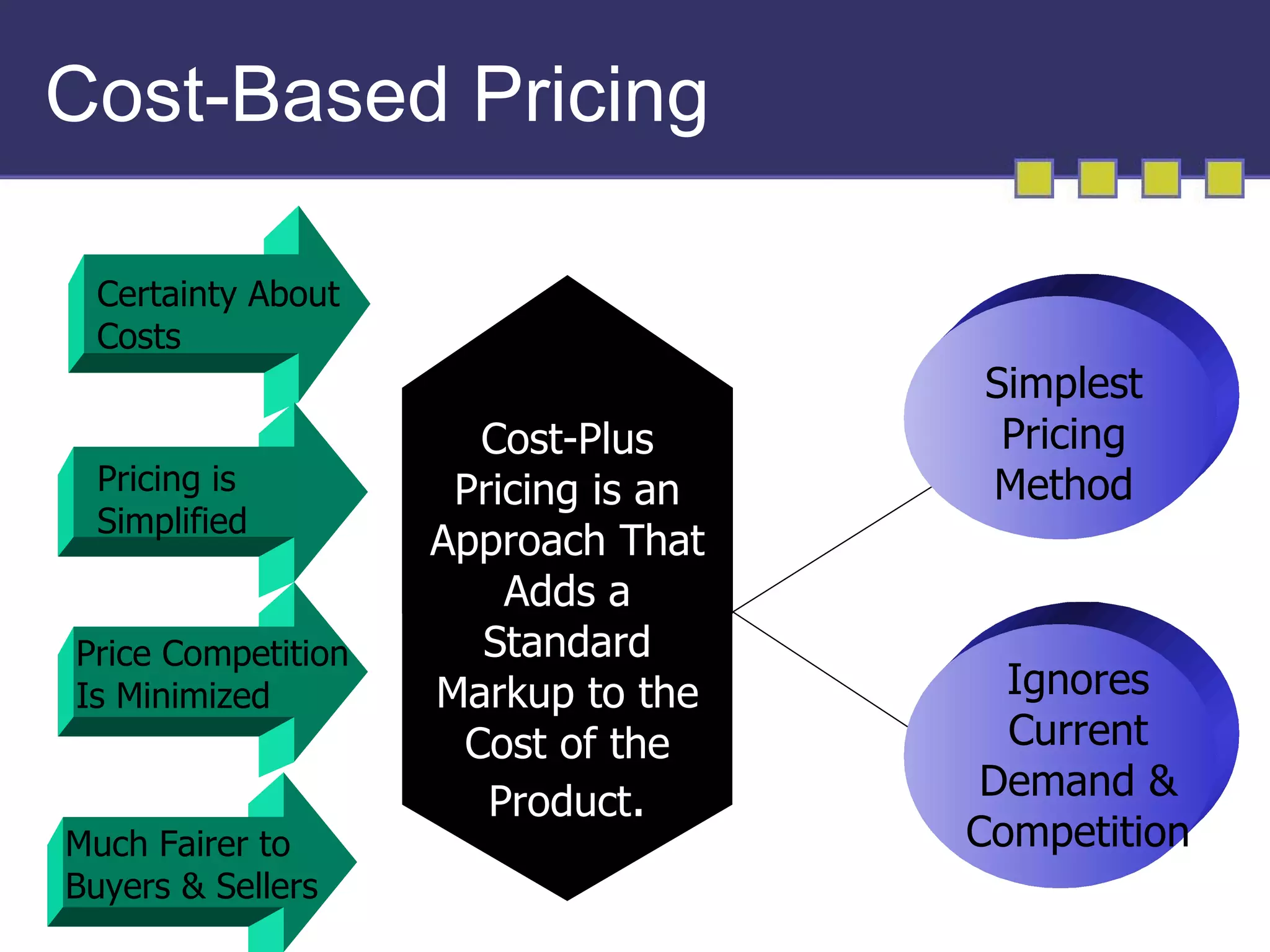
Cost-Based Pricing

  Certainty About
  Costs
                                     Simplest
                    Ethical
                       Cost-Plus
                        Factors       Pricing
  Pricing is         Pricing is an
                      Situational    Method
  Simplified
                    Approach That
                      Unexpected

                        Adds a
Price Competition     Standard
Is Minimized           Attitudes
                    Markup to the      Ignores
                     Costof the
                            of         Current
                        Others        Demand &
                       Product.
Much Fairer to                       Competition
Buyers & Sellers
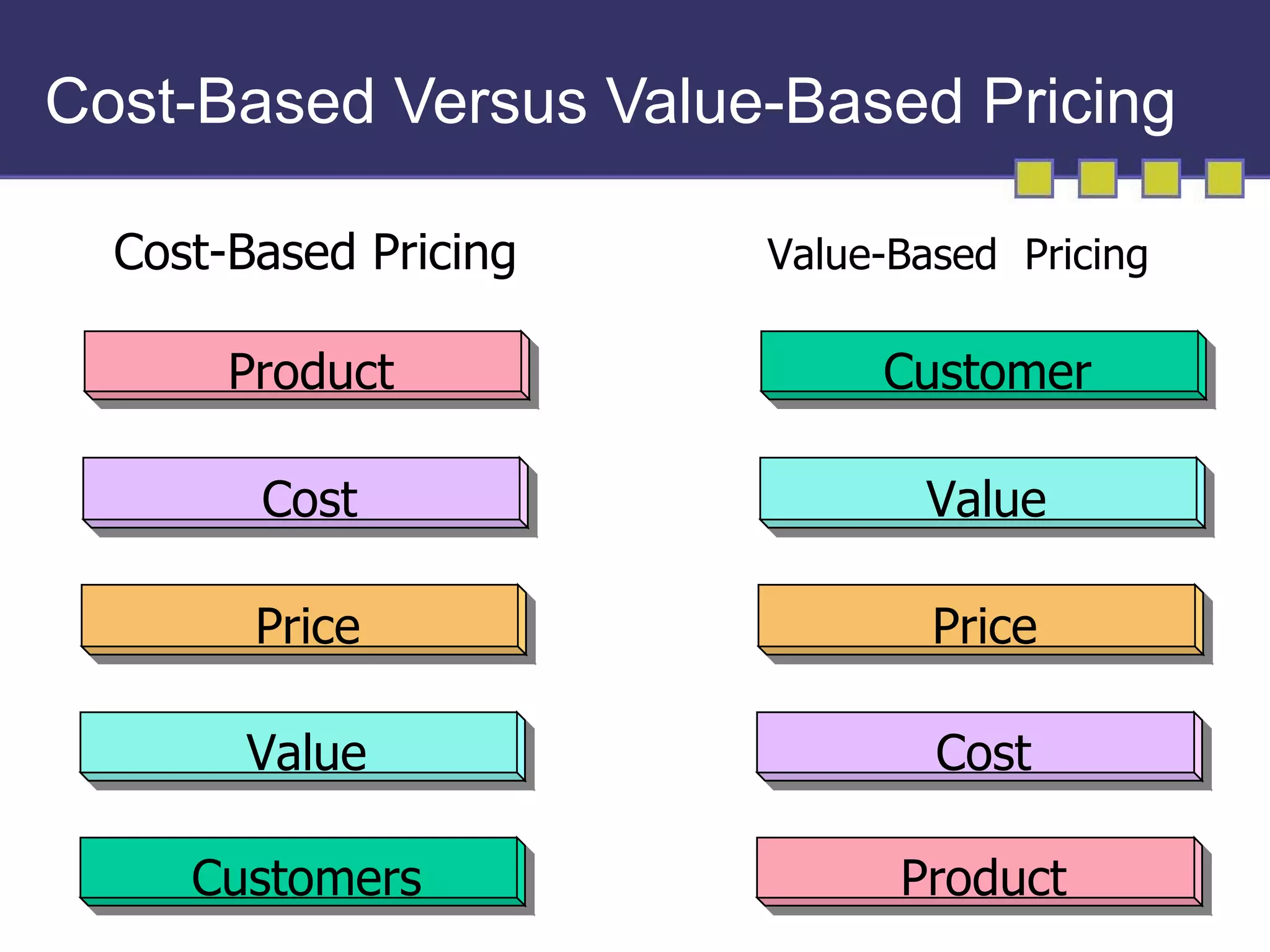
Cost-Based Versus Value-Based Pricing

  Cost-Based Pricing   Value-Based Pricing

       Product              Customer

        Cost                  Value

        Price                  Price

       Value                   Cost

     Customers               Product
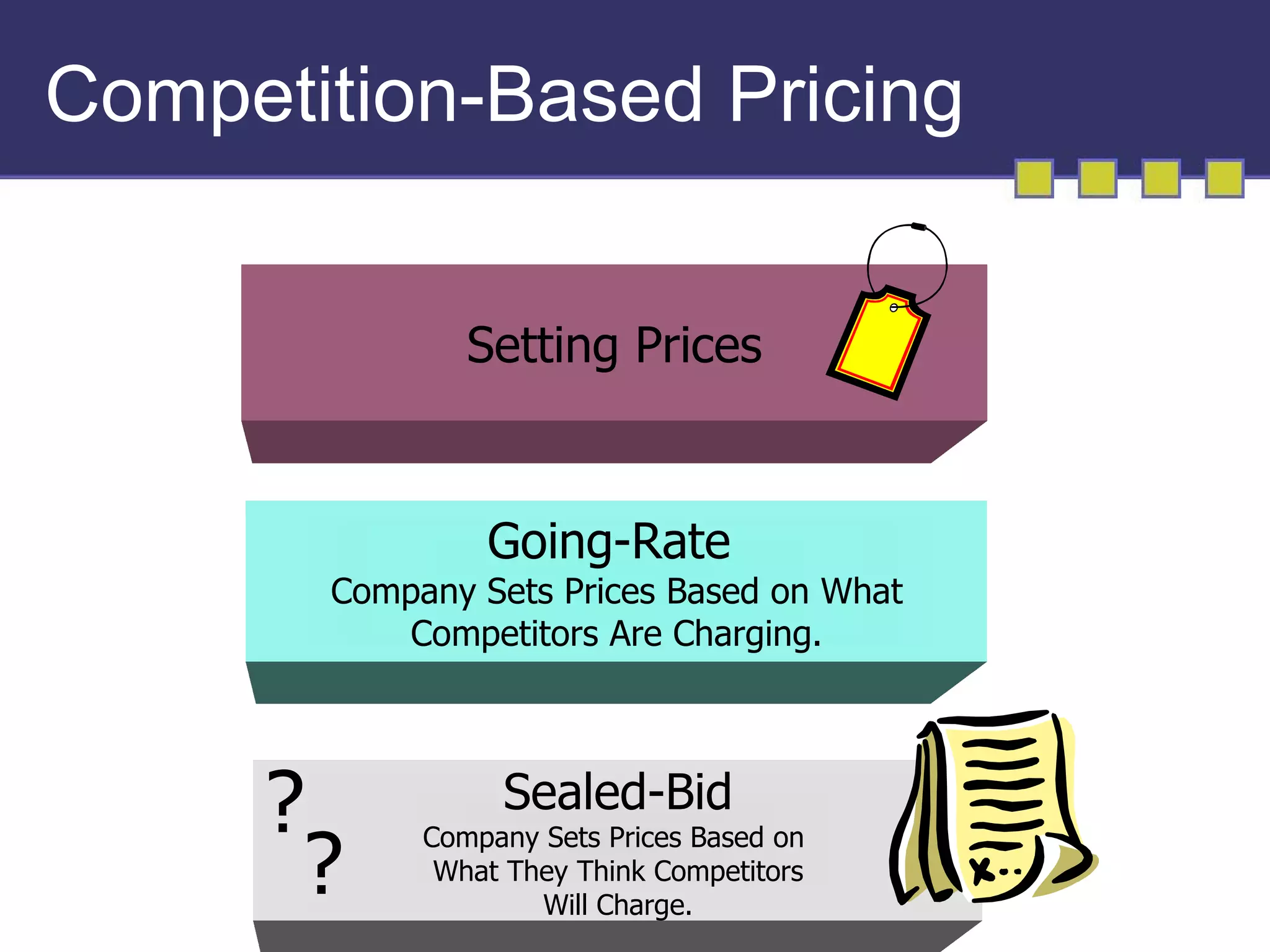
Competition-Based Pricing


               Setting Prices


                Going-Rate
       Company Sets Prices Based on What
           Competitors Are Charging.


     ?           Sealed-Bid
      ?
            Company Sets Prices Based on
             What They Think Competitors
                    Will Charge.
New Product Pricing Strategies

    Market Skimming             • Use Under These
                                  Conditions:
  Setting a High Price for a     – Product’s Quality and
   New Product to “Skim”            Image Must Support Its
   Maximum Revenues from            Higher Price.
   the Target Market.             – Costs Can’t be so High that
                                    They Cancel the
  Results in Fewer, But            Advantage of Charging
   More Profitable Sales.           More.
                                  – Competitors Shouldn’t be
                                    Able to Enter Market Easily
                                    and Undercut the High
                                    Price.
New Product Pricing Strategies

• Use Under These                  Market Penetration
  Conditions:
  – Market Must be Highly         Setting a Low Price for a
    Price-Sensitive so a Low       New Product in Order to
    Price Produces More            “Penetrate” the Market
    Market Growth.                 Quickly and Deeply.
  – Production/ Distribution
    Costs Must Fall as Sales      Attract a Large Number of
    Volume Increases.              Buyers and Win a Larger
  – Must Keep Out                  Market Share.
    Competition & Maintain Its
    Low Price Position or
    Benefits May Only be
    Temporary.
Product Mix-Pricing Strategies:
Product Line Pricing


                       • Involves setting price
                         steps between various
                         products in a product
                         line based on:
                          – Cost differences between
                            products,
                          – Customer evaluations of
                            different features, and

                          – competitors’ prices.
Product Mix- Pricing Strategies

 • Optional-Product
   – Pricing optional or
     accessory products sold
     with the main product.
     i.e camera bag.
 • Captive-Product
   – Pricing products that
     must be used with the
     main product. i.e. film.
Product Mix- Pricing Strategies


  • By-Product             • Product-Bundling

    – Pricing low-value       – Combining several
      by-products to get        products and
      rid of them & make        offering the bundle
      the main product’s        at a reduced price.
      price more              – i.e. theater season
      competitive.              tickets.
    – i.e. sawdust,
Discount and Allowance Pricing


   A d ju s tin g B a s ic P r ic e to R e w a r d C u s to m e r s
                  F o r C e rta in R e s p o n s e s


        C a s h D is c o u n t            S e a s o n a l D is c o u n t

     Q u a n tity D is c o u n t          T r a d e -In A llo w a n c e

    F u n c tio n a l D is c o u n t   P r o m o t io n a l A ll o w a n c e
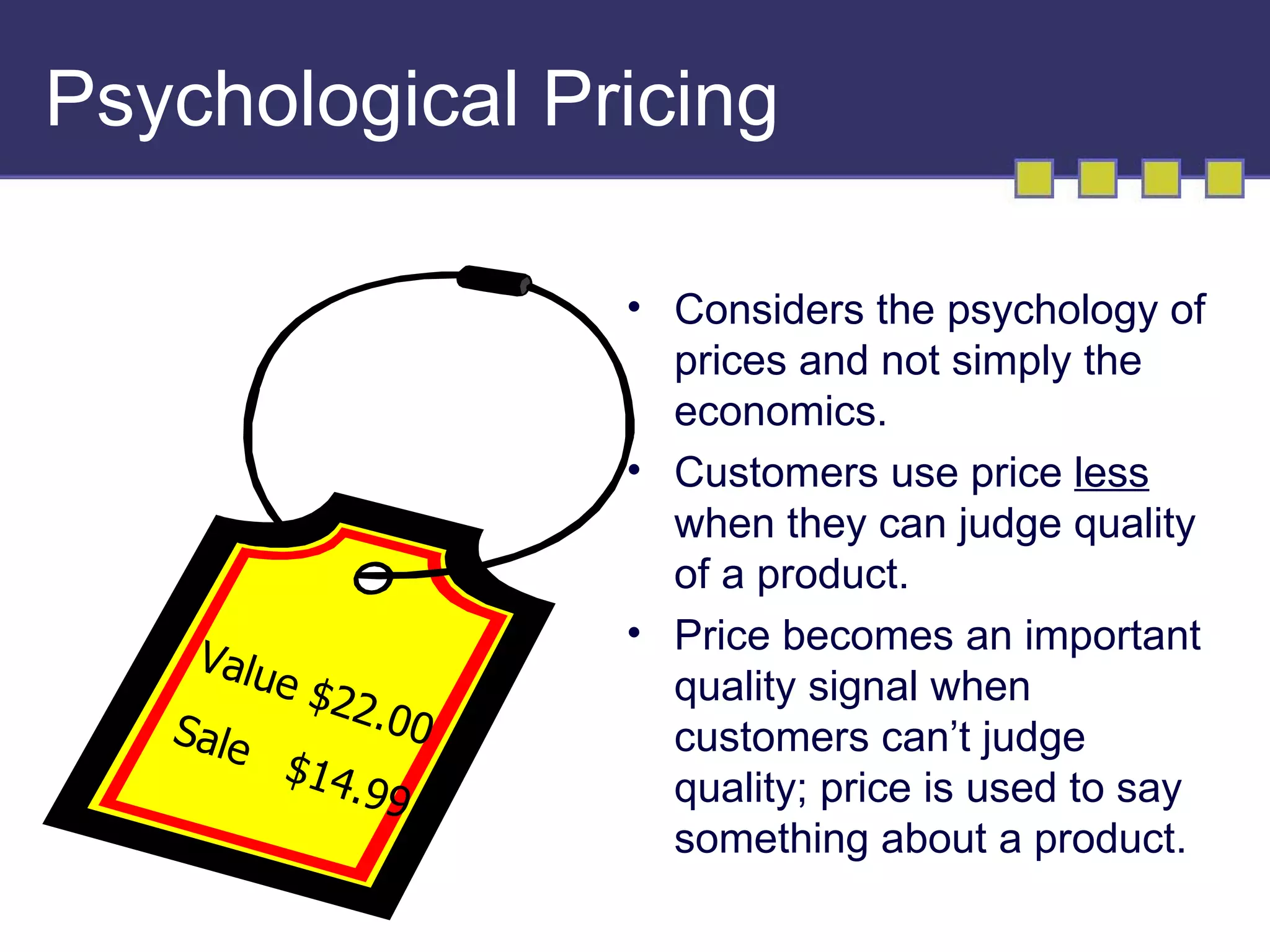
Psychological Pricing

                     • Considers the psychology of
                       prices and not simply the
                       economics.
                     • Customers use price less
                       when they can judge quality
                       of a product.
                     • Price becomes an important
    Valu
        e $2           quality signal when
             2. 00
   Sale                customers can’t judge
         $14
             . 99      quality; price is used to say
                       something about a product.
Promotional Pricing


 Loss Leaders                            Temporarily Pricing
                                         Products Below List
 Special-Event Pricing                    Price to Increase
                                          Short-Term Sales
         Cash Rebates                         Through:
                Low-Interest Financing

                     Longer Warranties
                              Free Merchandise
                                          Discounts

Pricing stratergies

  • 1.
    MARKETING MANAGEMENT Developing Pricing Strategies and Programs
  • 2.
    Factors Affecting PriceDecisions Internal Factors External Factors Nature of the market Marketing Objectives Pricing and demand Marketing Mix Strategy Costs Decisions Competition Other environmental Organizational factors (economy, considerations resellers, government)
  • 3.
    Internal Factors AffectingPricing Decisions: Marketing Objectives Survival Low Prices to Cover Variable Costs and Some Fixed Costs to Stay in Business. Current Profit Maximization Choose the Price that Produces the Marketing Maximum Current Profit, Etc. Objectives Market Share Leadership Low as Possible Prices to Become the Market Share Leader. Product Quality Leadership High Prices to Cover Higher Performance Quality and R & D.
  • 4.
    Internal Factors AffectingPricing Decisions: Marketing Mix Product Design Non price Price Distribution Positions Promotion
  • 5.
    External Factors Affecting PricingDecisions Market and Demand Competitors’ Costs, Prices, and Offers Other External Factors Economic Conditions Reseller Needs Government Actions Social Concerns
  • 6.
    Market and DemandFactors Affecting Pricing Decisions Pricing in Different Types of Markets Pure Competition Many Buyers and Sellers Pure Monopoly Who Have Little Single Seller Effect on the Price Monopolistic Oligopolistic Competition Competition Many Buyers and Sellers Few Sellers Who Are Who Trade Over a Sensitive to Each Other’s Range of Prices Pricing/ Marketing Strategies
  • 7.
  • 8.
  • 9.
    Cost-Based Pricing Certainty About Costs Simplest Ethical Cost-Plus Factors Pricing Pricing is Pricing is an Situational Method Simplified Approach That Unexpected Adds a Price Competition Standard Is Minimized Attitudes Markup to the Ignores Costof the of Current Others Demand & Product. Much Fairer to Competition Buyers & Sellers
  • 10.
    Cost-Based Versus Value-BasedPricing Cost-Based Pricing Value-Based Pricing Product Customer Cost Value Price Price Value Cost Customers Product
  • 11.
    Competition-Based Pricing Setting Prices Going-Rate Company Sets Prices Based on What Competitors Are Charging. ? Sealed-Bid ? Company Sets Prices Based on What They Think Competitors Will Charge.
  • 12.
    New Product PricingStrategies Market Skimming • Use Under These Conditions:  Setting a High Price for a – Product’s Quality and New Product to “Skim” Image Must Support Its Maximum Revenues from Higher Price. the Target Market. – Costs Can’t be so High that They Cancel the  Results in Fewer, But Advantage of Charging More Profitable Sales. More. – Competitors Shouldn’t be Able to Enter Market Easily and Undercut the High Price.
  • 13.
    New Product PricingStrategies • Use Under These Market Penetration Conditions: – Market Must be Highly  Setting a Low Price for a Price-Sensitive so a Low New Product in Order to Price Produces More “Penetrate” the Market Market Growth. Quickly and Deeply. – Production/ Distribution Costs Must Fall as Sales  Attract a Large Number of Volume Increases. Buyers and Win a Larger – Must Keep Out Market Share. Competition & Maintain Its Low Price Position or Benefits May Only be Temporary.
  • 14.
    Product Mix-Pricing Strategies: ProductLine Pricing • Involves setting price steps between various products in a product line based on: – Cost differences between products, – Customer evaluations of different features, and – competitors’ prices.
  • 15.
    Product Mix- PricingStrategies • Optional-Product – Pricing optional or accessory products sold with the main product. i.e camera bag. • Captive-Product – Pricing products that must be used with the main product. i.e. film.
  • 16.
    Product Mix- PricingStrategies • By-Product • Product-Bundling – Pricing low-value – Combining several by-products to get products and rid of them & make offering the bundle the main product’s at a reduced price. price more – i.e. theater season competitive. tickets. – i.e. sawdust,
  • 17.
    Discount and AllowancePricing A d ju s tin g B a s ic P r ic e to R e w a r d C u s to m e r s F o r C e rta in R e s p o n s e s C a s h D is c o u n t S e a s o n a l D is c o u n t Q u a n tity D is c o u n t T r a d e -In A llo w a n c e F u n c tio n a l D is c o u n t P r o m o t io n a l A ll o w a n c e
  • 18.
    Psychological Pricing • Considers the psychology of prices and not simply the economics. • Customers use price less when they can judge quality of a product. • Price becomes an important Valu e $2 quality signal when 2. 00 Sale customers can’t judge $14 . 99 quality; price is used to say something about a product.
  • 19.
    Promotional Pricing LossLeaders Temporarily Pricing Products Below List Special-Event Pricing Price to Increase Short-Term Sales Cash Rebates Through: Low-Interest Financing Longer Warranties Free Merchandise Discounts

Editor's Notes

  • #3 Internal Factors - When setting price, marketers must take into consideration several factors which are the result of company decisions and actions. To a large extent these factors are controllable by the company and, if necessary, can be altered. However, while the organization may have control over these factors making a quick change is not always realistic. For instance, product pricing may depend heavily on the productivity of a manufacturing facility (e.g., how much can be produced within a certain period of time). The marketer knows that increasing productivity can reduce the cost of producing each product and thus allow the marketer to potentially lower the product’s price. But increasing productivity may require major changes at the manufacturing facility that will take time (not to mention be costly) and will not translate into lower price products for a considerable period of time. External Factors - There are a number of influencing factors which are not controlled by the company but will impact pricing decisions. Understanding these factors requires the marketer conduct research to monitor what is happening in each market the company serves since the effect of these factors can vary by market
  • #4 Return on Investment (ROI) – A firm may set as a marketing objective the requirement that all products attain a certain percentage return on the organization’s spending on marketing the product. This level of return along with an estimate of sales will help determine appropriate pricing levels needed to meet the ROI objective. Cash Flow – Firms may seek to set prices at a level that will insure that sales revenue will at least cover product production and marketing costs. This is most likely to occur with new products where the organizational objectives allow a new product to simply meet its expenses while efforts are made to establish the product in the market. This objective allows the marketer to worry less about product profitability and instead directs energies to building a market for the product. Market Share – The pricing decision may be important when the firm has an objective of gaining a hold in a new market or retaining a certain percent of an existing market. For new products under this objective the price is set artificially low in order to capture a sizeable portion of the market and will be increased as the product becomes more accepted by the target market (we will discuss this marketing strategy in further detail in our next tutorial). For existing products, firms may use price decisions to insure they retain market share in instances where there is a high level of market competition and competitors who are willing to compete on price. Maximize Profits – Older products that appeal to a market that is no longer growing may have a company objective requiring the price be set at a level that optimizes profits. This is often the case when the marketer has little incentive to introduce improvements to the product (e.g., demand for product is declining) and will continue to sell the same product at a price premium for as long as some in the market is willing to buy.
  • #5 It should be noted that not all companies view price as a key selling feature. Some firms, for example those seeking to be viewed as market leaders in product quality, will deemphasize price and concentrate on a strategy that highlights non-price benefits (e.g., quality, durability, service, etc.). Such non-price competition can help the company avoid potential price wars that often break out between competitive firms that follow a market share objective and use price as a key selling feature.
  • #8 Marketers must be aware of regulations that impact how price is set in the markets in which their products are sold. These regulations are primarily government enacted meaning that there may be legal ramifications if the rules are not followed. Price regulations can come from any level of government and vary widely in their requirements. For instance, in some industries, government regulation may set price ceilings (how high price may be set) while in other industries there may be price floors (how low price may be set). Additional areas of potential regulation include: deceptive pricing, price discrimination, predatory pricing and price fixing. Finally, when selling beyond their home market, marketers must recognize that local regulations may make pricing decisions different for each market. This is particularly a concern when selling to international markets where failure to consider regulations can lead to severe penalties. Consequently marketers must have a clear understanding of regulations in each market they serve.
  • #10 Marketers should never rest on their marketing decisions. They must continually use market research and their own judgment to determine whether marketing decisions need to be adjusted. When it comes to adjusting price, the marketer must understand what effect a change in price is likely to have on target market demand for a product. Understanding how price changes impact the market requires the marketer have a firm understanding of the concept economists call elasticity of demand, which relates to how purchase quantity changes as prices change. Elasticity is evaluated under the assumption that no other changes are being made (i.e., “all things being equal”) and only price is adjusted. The logic is to see how price by itself will affect overall demand. Obviously, the chance of nothing else changing in the market but the price of one product is often unrealistic. For example, competitors may react to the marketer’s price change by changing the price on their product. Despite this, elasticity analysis does serve as a useful tool for estimating market reaction. Elasticity deals with three types of demand scenarios: Elastic Demand – Products are considered to exist in a market that exhibits elastic demand when a certain percentage change in price results in a larger and opposite percentage change in demand. For example, if the price of a product increases (decreases) by 10%, the demand for the product is likely to decline (rise) by greater than 10%. Inelastic Demand – Products are considered to exist in an inelastic market when a certain percentage change in price results in a smaller and opposite percentage change in demand. For example, if the price of a product increases (decreases) by 10%, the demand for the product is likely to decline (rise) by less than 10%. Unitary Demand – This demand occurs when a percentage change in price results in an equal and opposite percentage change in demand. For example, if the price of a product increases (decreases) by 10%, the demand for the product is likely to decline (rise) by 10%. For marketers the important issue with elasticity of demand is to understand how it impacts company revenue. In general the following scenarios apply to making price changes for a given type of market demand: For elastic markets – increasing price lowers total revenue while decreasing price increases total revenue. For inelastic markets – increasing price raises total revenue while decreasing price lowers total revenue. For unitary markets – there is no change in revenue when price is changed.
  • #11 External Factors: Customer Expectations Possibly the most obvious external factors that influence price setting are the expectations of customers and channel partners. As we discussed, when it comes to making a purchase decision customers assess the overall “value” of a product much more than they assess the price. When deciding on a price marketers need to conduct customer research to determine what “price points” are acceptable. Pricing beyond these price points could discourage customers from purchasing. Firms within the marketer’s channels of distribution also must be considered when determining price. Distribution partners expect to receive financial compensation for their efforts, which usually means they will receive a percentage of the final selling price. This percentage or margin between what they pay the marketer to acquire the product and the price they charge their customers must be sufficient for the distributor to cover their costs and also earn a desired profit.