MARKETING Concepts
as applied in the Ateneo MBA
Nathania Marija T. Villonco
Ateneo Graduate School of Business
May 10, 2013
www.nathaniavillonco.blogspot.com
Outline
Master 6 Steps in Setting Price
1. Select the price objective
2. Determine demand
3. Estimate costs
4. Analyze competitor price mix
5. Select pricing method
6. Select final price
www.nathaniavillonco.blogspot.com
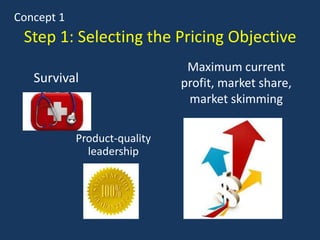
Step 1: Selecting the Pricing Objective
Survival
Concept 1
Maximum current
profit, market share,
market skimming
Product-quality
leadership
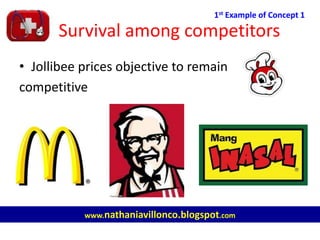
Survival among competitors
1st Example of Concept 1
www.nathaniavillonco.blogspot.com
• Jollibee prices objective to remain
competitive
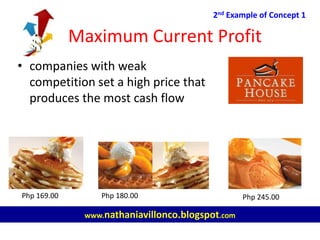
Maximum Current Profit
2nd Example of Concept 1
www.nathaniavillonco.blogspot.com
• companies with weak
competition set a high price that
produces the most cash flow
Php 169.00 Php 180.00 Php 245.00
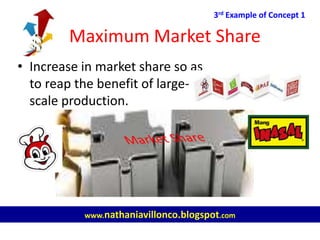
Maximum Market Share
3rd Example of Concept 1
www.nathaniavillonco.blogspot.com
• Increase in market share so as
to reap the benefit of large-
scale production.
Maximum Market Skimming
4th Example of Concept 1
www.nathaniavillonco.blogspot.com
• company sets a higher price to
capture those customers who are
willing to pay more for a product.
Php 75.00 Php 25.00
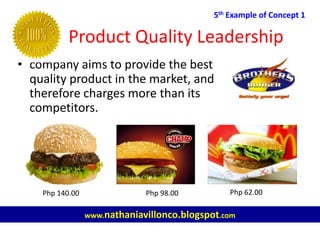
Product Quality Leadership
5th Example of Concept 1
www.nathaniavillonco.blogspot.com
• company aims to provide the best
quality product in the market, and
therefore charges more than its
competitors.
Php 140.00 Php 98.00 Php 62.00
Step 2: Determining Demand
Price
Concept 2
Price Elasticity of
Demand
Estimating
Demand Curves
Price
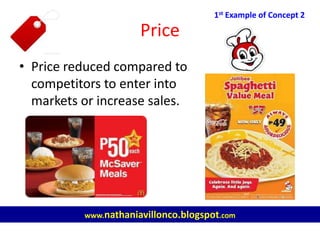
• Price reduced compared to
competitors to enter into
markets or increase sales.
1st Example of Concept 2
www.nathaniavillonco.blogspot.com
Estimating Demand Curves
• relationship between the price
of a certain commodity and
the amount of it that
consumers are willing and able
to purchase at that given price.
2nd Example of Concept 2
www.nathaniavillonco.blogspot.com
Price Elasticity of Demand
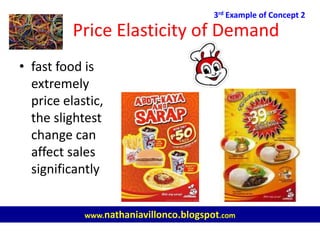
• fast food is
extremely
price elastic,
the slightest
change can
affect sales
significantly
3rd Example of Concept 2
www.nathaniavillonco.blogspot.com
Step 3: Estimating Costs
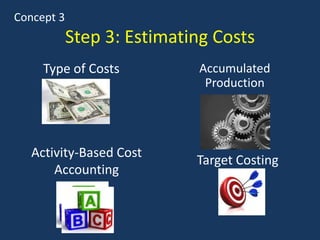
Type of Costs
Concept 3
Activity-Based Cost
Accounting
Accumulated
Production
Target Costing
Type of Costs
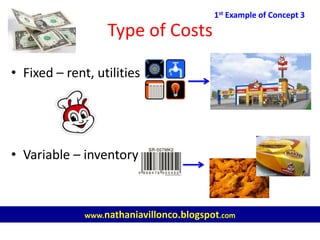
• Fixed – rent, utilities
• Variable – inventory
1st Example of Concept 3
www.nathaniavillonco.blogspot.com
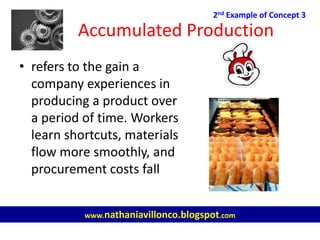
Accumulated Production
• refers to the gain a
company experiences in
producing a product over
a period of time. Workers
learn shortcuts, materials
flow more smoothly, and
procurement costs fall
2nd Example of Concept 3
www.nathaniavillonco.blogspot.com
Activity Based Accounting
• Identifies the costs of producing items or
services.
o Maintenance of the restaurant building.
o Refrigeration of new materials.
o Cardboard boxes for food order.
o Store manager's salary.
o Wages of the employees who clear and clean tables.
o Depreciation on equipment.
o Oil for the deep fat fryer (change every 4 hrs. )
3rd Example of Concept 3
www.nathaniavillonco.blogspot.com
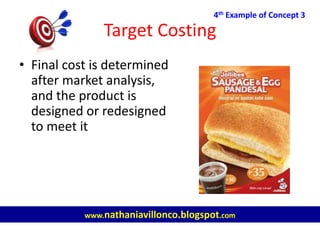
Target Costing
• Final cost is determined
after market analysis,
and the product is
designed or redesigned
to meet it
4th Example of Concept 3
www.nathaniavillonco.blogspot.com
Step 4: Analyze competitor price mix
Concept 4
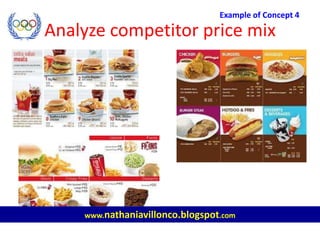
Analyze competitor price mix
Example of Concept 4
www.nathaniavillonco.blogspot.com
Step 5: Selecting a Pricing Method
Concept 5
• Markup
• Target-return
• Perceived-value
• Value
• Going-rate
• Auction-type
Selecting a Pricing Method
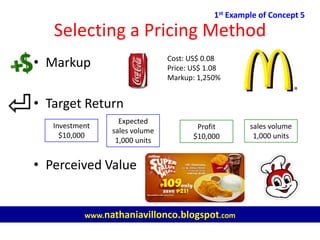
• Markup
• Target Return
• Perceived Value
1st Example of Concept 5
www.nathaniavillonco.blogspot.com
Cost: US$ 0.08
Price: US$ 1.08
Markup: 1,250%
Investment
$10,000
Expected
sales volume
1,000 units
Profit
$10,000
sales volume
1,000 units
Selecting a Pricing Method
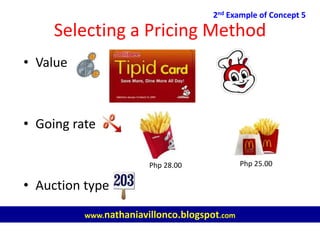
• Value
• Going rate
• Auction type
2nd Example of Concept 5
www.nathaniavillonco.blogspot.com
Php 28.00 Php 25.00
Step 6: Selecting the Final Price
Concept 6
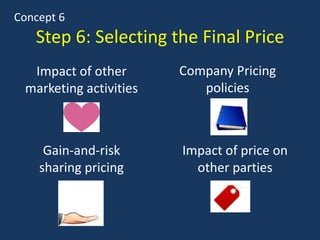
Impact of other
marketing activities
Company Pricing
policies
Gain-and-risk
sharing pricing
Impact of price on
other parties
Selecting the Final Price
• Impact of other marketing activities
• Company pricing policies
“Think global, act local”
1st Example of Concept 6
www.nathaniavillonco.blogspot.com
Selecting the Final Price
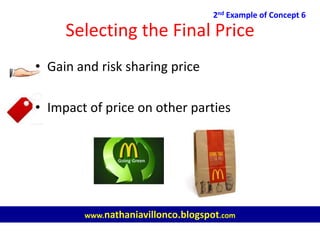
• Gain and risk sharing price
• Impact of price on other parties
2nd Example of Concept 6
www.nathaniavillonco.blogspot.com
1. Select the price objective
2. Determine demand
3. Estimate costs
4. Analyze competitor price mix
5. Select pricing method
6. Select final price
www.nathaniavillonco.blogspot.com
Summary
Master 6 Steps in Setting Price
www.nathaniavillonco.blogspot.com
REMEMBER
This!
Mastering Marketing Concepts
through Stories, Images and Diagrams
Nathania Marija T. Villonco
Ateneo Graduata School of Business
May 10, 2013
www.nathaniavillonco.blogspot.com
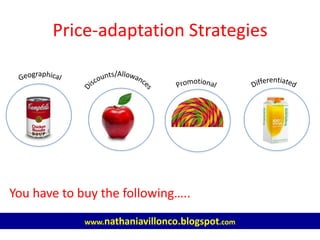
1.) Geographical
2.) Discounts/Allowances
3.) Promotional
4.) Differentiated
Price-adaptation Strategies
www.nathaniavillonco.blogspot.com
Imagine you need to buy grocery for
the nearby supermarket
You have to buy the following…..
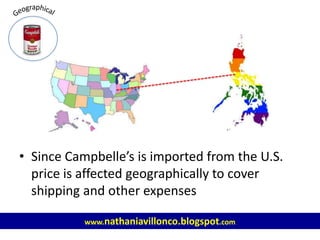
• Since Campbelle’s is imported from the U.S.
price is affected geographically to cover
shipping and other expenses
www.nathaniavillonco.blogspot.com
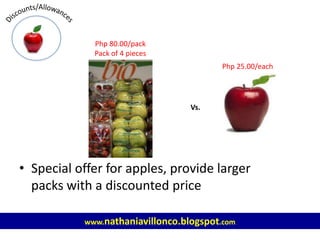
• Special offer for apples, provide larger
packs with a discounted price
www.nathaniavillonco.blogspot.com
Php 25.00/each
Php 80.00/pack
Pack of 4 pieces
Vs.
• Seasonal promotions during holidays such
as Halloween give additional discounts
www.nathaniavillonco.blogspot.com
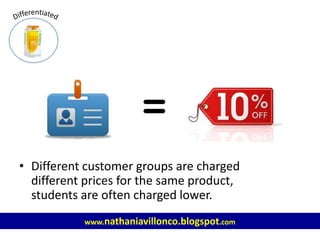
• Different customer groups are charged
different prices for the same product,
students are often charged lower.
www.nathaniavillonco.blogspot.com
You have to buy the following…..
Price-adaptation Strategies
MARKETING Concepts
as applied in the Ateneo MBA
Nathania Marija T. Villonco
Ateneo Graduate School of Business
May 10, 2013
www.nathaniavillonco.blogspot.com

Ch 14 Setting Price

  • 1.
    MARKETING Concepts as appliedin the Ateneo MBA Nathania Marija T. Villonco Ateneo Graduate School of Business May 10, 2013 www.nathaniavillonco.blogspot.com
  • 2.
    Outline Master 6 Stepsin Setting Price 1. Select the price objective 2. Determine demand 3. Estimate costs 4. Analyze competitor price mix 5. Select pricing method 6. Select final price www.nathaniavillonco.blogspot.com
  • 3.
    Step 1: Selectingthe Pricing Objective Survival Concept 1 Maximum current profit, market share, market skimming Product-quality leadership
  • 4.
    Survival among competitors 1stExample of Concept 1 www.nathaniavillonco.blogspot.com • Jollibee prices objective to remain competitive
  • 5.
    Maximum Current Profit 2ndExample of Concept 1 www.nathaniavillonco.blogspot.com • companies with weak competition set a high price that produces the most cash flow Php 169.00 Php 180.00 Php 245.00
  • 6.
    Maximum Market Share 3rdExample of Concept 1 www.nathaniavillonco.blogspot.com • Increase in market share so as to reap the benefit of large- scale production.
  • 7.
    Maximum Market Skimming 4thExample of Concept 1 www.nathaniavillonco.blogspot.com • company sets a higher price to capture those customers who are willing to pay more for a product. Php 75.00 Php 25.00
  • 8.
    Product Quality Leadership 5thExample of Concept 1 www.nathaniavillonco.blogspot.com • company aims to provide the best quality product in the market, and therefore charges more than its competitors. Php 140.00 Php 98.00 Php 62.00
  • 9.
    Step 2: DeterminingDemand Price Concept 2 Price Elasticity of Demand Estimating Demand Curves
  • 10.
    Price • Price reducedcompared to competitors to enter into markets or increase sales. 1st Example of Concept 2 www.nathaniavillonco.blogspot.com
  • 11.
    Estimating Demand Curves •relationship between the price of a certain commodity and the amount of it that consumers are willing and able to purchase at that given price. 2nd Example of Concept 2 www.nathaniavillonco.blogspot.com
  • 12.
    Price Elasticity ofDemand • fast food is extremely price elastic, the slightest change can affect sales significantly 3rd Example of Concept 2 www.nathaniavillonco.blogspot.com
  • 13.
    Step 3: EstimatingCosts Type of Costs Concept 3 Activity-Based Cost Accounting Accumulated Production Target Costing
  • 14.
    Type of Costs •Fixed – rent, utilities • Variable – inventory 1st Example of Concept 3 www.nathaniavillonco.blogspot.com
  • 15.
    Accumulated Production • refersto the gain a company experiences in producing a product over a period of time. Workers learn shortcuts, materials flow more smoothly, and procurement costs fall 2nd Example of Concept 3 www.nathaniavillonco.blogspot.com
  • 16.
    Activity Based Accounting •Identifies the costs of producing items or services. o Maintenance of the restaurant building. o Refrigeration of new materials. o Cardboard boxes for food order. o Store manager's salary. o Wages of the employees who clear and clean tables. o Depreciation on equipment. o Oil for the deep fat fryer (change every 4 hrs. ) 3rd Example of Concept 3 www.nathaniavillonco.blogspot.com
  • 17.
    Target Costing • Finalcost is determined after market analysis, and the product is designed or redesigned to meet it 4th Example of Concept 3 www.nathaniavillonco.blogspot.com
  • 18.
    Step 4: Analyzecompetitor price mix Concept 4
  • 19.
    Analyze competitor pricemix Example of Concept 4 www.nathaniavillonco.blogspot.com
  • 20.
    Step 5: Selectinga Pricing Method Concept 5 • Markup • Target-return • Perceived-value • Value • Going-rate • Auction-type
  • 21.
    Selecting a PricingMethod • Markup • Target Return • Perceived Value 1st Example of Concept 5 www.nathaniavillonco.blogspot.com Cost: US$ 0.08 Price: US$ 1.08 Markup: 1,250% Investment $10,000 Expected sales volume 1,000 units Profit $10,000 sales volume 1,000 units
  • 22.
    Selecting a PricingMethod • Value • Going rate • Auction type 2nd Example of Concept 5 www.nathaniavillonco.blogspot.com Php 28.00 Php 25.00
  • 23.
    Step 6: Selectingthe Final Price Concept 6 Impact of other marketing activities Company Pricing policies Gain-and-risk sharing pricing Impact of price on other parties
  • 24.
    Selecting the FinalPrice • Impact of other marketing activities • Company pricing policies “Think global, act local” 1st Example of Concept 6 www.nathaniavillonco.blogspot.com
  • 25.
    Selecting the FinalPrice • Gain and risk sharing price • Impact of price on other parties 2nd Example of Concept 6 www.nathaniavillonco.blogspot.com
  • 26.
    1. Select theprice objective 2. Determine demand 3. Estimate costs 4. Analyze competitor price mix 5. Select pricing method 6. Select final price www.nathaniavillonco.blogspot.com Summary Master 6 Steps in Setting Price
  • 27.
    www.nathaniavillonco.blogspot.com REMEMBER This! Mastering Marketing Concepts throughStories, Images and Diagrams Nathania Marija T. Villonco Ateneo Graduata School of Business May 10, 2013
  • 28.
    www.nathaniavillonco.blogspot.com 1.) Geographical 2.) Discounts/Allowances 3.)Promotional 4.) Differentiated Price-adaptation Strategies
  • 29.
    www.nathaniavillonco.blogspot.com Imagine you needto buy grocery for the nearby supermarket You have to buy the following…..
  • 30.
    • Since Campbelle’sis imported from the U.S. price is affected geographically to cover shipping and other expenses www.nathaniavillonco.blogspot.com
  • 31.
    • Special offerfor apples, provide larger packs with a discounted price www.nathaniavillonco.blogspot.com Php 25.00/each Php 80.00/pack Pack of 4 pieces Vs.
  • 32.
    • Seasonal promotionsduring holidays such as Halloween give additional discounts www.nathaniavillonco.blogspot.com
  • 33.
    • Different customergroups are charged different prices for the same product, students are often charged lower. www.nathaniavillonco.blogspot.com
  • 34.
    www.nathaniavillonco.blogspot.com You have tobuy the following….. Price-adaptation Strategies
  • 35.
    MARKETING Concepts as appliedin the Ateneo MBA Nathania Marija T. Villonco Ateneo Graduate School of Business May 10, 2013 www.nathaniavillonco.blogspot.com