International Research Journal of Engineering and Technology (IRJET) e-ISSN: 2395 -0056
Volume: 04 Issue: 06 | June -2017 www.irjet.net p-ISSN: 2395-0072
© 2017, IRJET | Impact Factor value: 5.181 | ISO 9001:2008 Certified Journal | Page 440
Detecting and Providing Solutions to Privacy Issues in Social Media
Somanagouda M Moolimani1, A.S.Hiremath2
1Student, CSE dept., BLDEA College, Karnataka, India
2Assistant professor, CSE dept., BLDEA College, Karnataka, India
---------------------------------------------------------------------***---------------------------------------------------------------------
Abstract - Nowadays everyone uses the social media such
as Facebook, twitter to share item with friends, public, groups
— e.g., Images, posts, videos. They have their own concern in
sharing item. Sometime these items example-image with that
depicts multiple clients, comments that includes many users
leads to privacy issue as the priority regarding item will be in
the hand of uploader only.at present, therearelessmechanism
that can handle this type of privacy issues.to provide solution
to privacy issues is very complex mechanism, as the different
user have different preference for item, one may wish to share
with and one may not as it may include some sensitive
information about him. The users will be more involved in
current mechanism. Existing methods are very constrained to
fixed ways of aggregating privacy priorities. So there is need
for mechanism which provide a solution such that it will be
accepted by all users involved in image or post with
satisfaction. We proposeamechanismwhichhelps in detecting
in privacy issues and providing solution to these issues which
will be accepted by the all user involved in item in social
media.it will adapt to various users privacy preferences in
more customized manner compared to present mechanism.
Here we show how solution is provided by comparing various
privacy priorities of different users and decide to whom the
item can be shared and allow them to access the item. We try
to reduce the user’s involvement in our approaches by
allowing System captures userbehavior basedontheirinterest
to allowance/reject right to use specific user for that
uploading item.
Key Words: social media, privacy, Priorities, issues,
user’s involvement upload item.
1. INTRODUCTION
Social media users upload the thing such as image, post,
comments based on their interest. They can have their own
priority with respect to item. But social media best allows
uploader to set his privacy course of action for that item i.e.
who may have get right of entry to the object. This is may
lead to privacy violations that other users who troubled by
that object cant set privacy choices for it. [1]. for example
picture in which a cluster of users are covered andoneofthe
consumer desires to add that image on social media (up
loader) then actual he having rights approximately towhom
he wants to share that picture. But right here the otherusers
in that image can also have privacy issues regarding this
case. The present approach uses negotiation to resolve this
trouble via using e-mail, SMSs, smartphone calls and so on.
But this approaches require extra timetocope withsituation
manually due to the fact there are more than one uploader
and accessor are present on social media. In this paper
scheme introduces a new techniquetoaddresstheseprivacy
issues. Here scheme considering all users personal privacy
options and perceive at the least two rules that having
contradictorychoicesaboutgranting/denyingaccessfor that
unique item i.e. Privacy warfare. Systempresents answer by
modelling get right of entry to manipulate inthiskindof way
that all customers worried in that uploading object receive
that solution and make sure about their privacy.
1.1 Existing System
As cautioned via current studies, negotiationsaboutprivacy
in social media are collaborative maximum of the time. That
is, users would keep in mind different choices when
determining to whom they proportion, so users may be
willing to concede and exchange their initial most preferred
option. Being capable of version the conditions in which
those concessions manifest is of important significance to
suggest the quality strategy to the conflicts found one that
could be desirable by way of all the users involved. We
conducted a consumer have a look at comparing our
mechanism to what users could do themselves in a number
of situations. The effects received advocate that our
mechanism turned into able to fit individual’s concession
behavior drastically extra often than different existing
tactics. This has the capacity to reducetheamountofmanual
user interventions to gain a pleasant solution for all parties
concerned in multi-party privacy conflicts.
1.2 Proposed System
In proposed machine the computational mechanism for
social media that, given the individual privacy choices of
every consumer concerned in an item, is capable of discover
and resolve conflicts by using applying a distinct warfare
resolution technique primarily based at the concessions
customers’ may be willing to make in distinctive situations.
We also gift a consumer take a look at evaluating our
computational mechanism of conflict decision and different
previous methods to what users would do themselves
manually in a number of situations. The consequences
obtained propose our proposed mechanism extensively
outperformed different previously proposed approaches in
terms of the range of instances it matched members’
behavior in the examine. Negotiating customers have their
personal man or woman privacy preferences about the item
— i.e., to whom of their on-line friends they would love to
International Research Journal of Engineering and Technology (IRJET) e-ISSN: 2395 -0056
Volume: 04 Issue: 06 | June -2017 www.irjet.net p-ISSN: 2395-0072
© 2017, IRJET | Impact Factor value: 5.181 | ISO 9001:2008 Certified Journal | Page 441
proportion the item in the event that they have been to
decide it unilaterally. In this paper, we assume negotiating
customers specify their character privacy alternatives the
usage of institution-primarily based get entrytomanipulate,
that is in recent times mainstream in Social Media (e.g.,
Facebook lists or Google+ circles), to spotlight the realistic
applicability of our proposed approach.
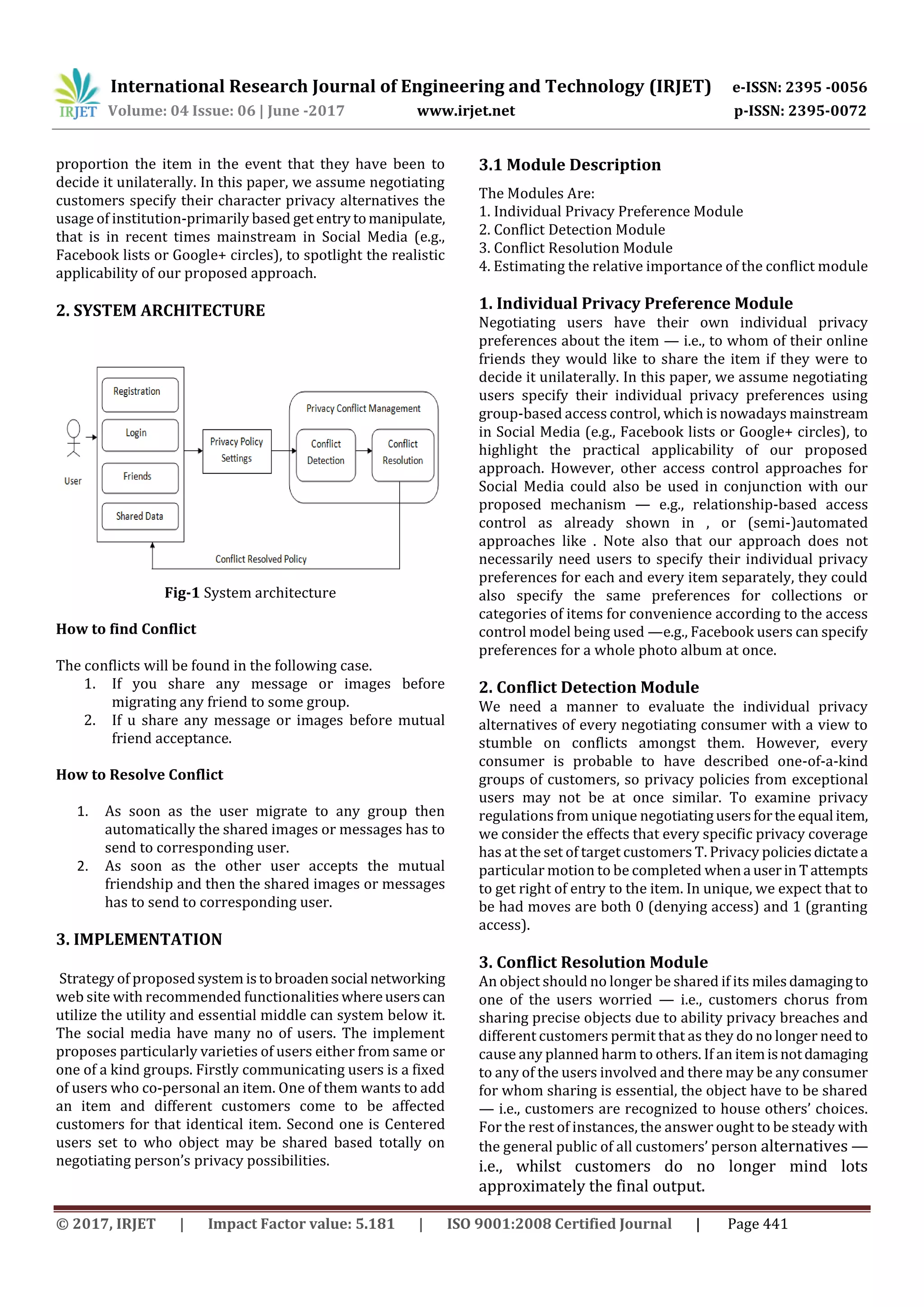
2. SYSTEM ARCHITECTURE
Fig-1 System architecture
How to find Conflict
The conflicts will be found in the following case.
1. If you share any message or images before
migrating any friend to some group.
2. If u share any message or images before mutual
friend acceptance.
How to Resolve Conflict
1. As soon as the user migrate to any group then
automatically the shared images or messages has to
send to corresponding user.
2. As soon as the other user accepts the mutual
friendship and then the shared images or messages
has to send to corresponding user.
3. IMPLEMENTATION
Strategy of proposedsystem istobroadensocial networking
web site with recommended functionalities whereuserscan
utilize the utility and essential middle can system below it.
The social media have many no of users. The implement
proposes particularly varieties of users either from same or
one of a kind groups. Firstly communicating users is a fixed
of users who co-personal an item. One of them wants to add
an item and different customers come to be affected
customers for that identical item. Second one is Centered
users set to who object may be shared based totally on
negotiating person’s privacy possibilities.
3.1 Module Description
The Modules Are:
1. Individual Privacy Preference Module
2. Conflict Detection Module
3. Conflict Resolution Module
4. Estimating the relative importance of the conflict module
1. Individual Privacy Preference Module
Negotiating users have their own individual privacy
preferences about the item — i.e., to whom of their online
friends they would like to share the item if they were to
decide it unilaterally. In this paper, we assume negotiating
users specify their individual privacy preferences using
group-based access control, which is nowadays mainstream
in Social Media (e.g., Facebook lists or Google+ circles), to
highlight the practical applicability of our proposed
approach. However, other access control approaches for
Social Media could also be used in conjunction with our
proposed mechanism — e.g., relationship-based access
control as already shown in , or (semi-)automated
approaches like . Note also that our approach does not
necessarily need users to specify their individual privacy
preferences for each and every item separately, they could
also specify the same preferences for collections or
categories of items for convenience according to the access
control model being used —e.g., Facebook users can specify
preferences for a whole photo album at once.
2. Conflict Detection Module
We need a manner to evaluate the individual privacy
alternatives of every negotiating consumer with a view to
stumble on conflicts amongst them. However, every
consumer is probable to have described one-of-a-kind
groups of customers, so privacy policies from exceptional
users may not be at once similar. To examine privacy
regulations from unique negotiatingusersforthe equal item,
we consider the effects that every specific privacy coverage
has at the set of target customers T. Privacy policiesdictatea
particular motion to be completed whena userin Tattempts
to get right of entry to the item. In unique, we expect that to
be had moves are both 0 (denying access) and 1 (granting
access).
3. Conflict Resolution Module
An object should no longer be shared if its milesdamagingto
one of the users worried — i.e., customers chorus from
sharing precise objects due to ability privacy breaches and
different customers permit that as they do no longer need to
cause any planned harm to others. If an itemisnotdamaging
to any of the users involved and there may be any consumer
for whom sharing is essential, the object have to be shared
— i.e., customers are recognized to house others’ choices.
For the rest of instances, the answer ought to be steady with
the general public of all customers’ person alternatives —
i.e., whilst customers do no longer mind lots
approximately the final output.
International Research Journal of Engineering and Technology (IRJET) e-ISSN: 2395 -0056
Volume: 04 Issue: 06 | June -2017 www.irjet.net p-ISSN: 2395-0072
© 2017, IRJET | Impact Factor value: 5.181 | ISO 9001:2008 Certified Journal | Page 442
4. Estimating the relative significance of the
struggle module
Now the focus is on the precise conflictinggoal person —i.e.,
the target consumer for which one-of-a-kind negotiating
users pick a different motion (denying/granting get
admission to the object)[5]. The mediator estimates how
critical a conflicting target consumer isfora negotiatinguser
by means of thinking about both tie energy with the
conflicting target user andtheinstitution(relationshipkind)
the conflicting goal user belongs to , which are
acknowledged to play a critical roleforprivacymanagement.
For instance, Alice may additionally determine she does no
longer need to share a celebration image together with her
mom, who has a completely close courting to Alice (i.e., tie
energy among Alice and her mother is excessive).Thisalerts
that not sharing the photograph along with her mom could
be very important to Alice, e.g., young adults are known to
hide from their dad and mom in social media. Another
example would be a picture in which Alice is depicted
collectively with a few buddies a good way to a monument
that she desires to share with all her friends. If a number of
her buddies that seem in the monument photo additionally
need to consist of Alice’s pals, it's far possibly she mighttake
delivery of as she already desires to share with all her pals
(whether close or distant). Thus, the mediator estimates the
relative significance of a selected conflicting consumer
thinking about both the tie electricity with this consumer in
well-knownandinsidethepreciseorganization(relationship
type) she belongs to. In unique, the mediator estimates the
relative importance a conflicting target person has for a
negotiating user because the difference among the tie
electricity with the conflicting user and the strictness of the
coverage for the group the conflicting person belongs to. If
the conflicting target user does no longer belong to any
organization of the negotiator; then the relative importance
is estimated thinking about the item sensitivity as a
substitute as there may be no institution information.
3.2 IMPLEMENTATION DETAILS
3.2.1 Conflict Detection Algorithm:
System compares all negotiatingperson’sprivacyoptions for
uploading item as a way to detect conflicts among them. It
discover outs at least conflicted policies in which one
coverage giving supply to the focused consumer for object
and any other one denying for the identical.
Figure 2: Conflict Detection Algorithm:
3.2.2 Conflict Resolution Algorithm:
The conflicted user is given as input to the set of rules.
System locate outs consumer’s willingness to alternatetheir
preferred movement (furnish/deny) for particularcentered
person. Based on that system fashions concession rules and
sooner or later consumer gets the answer as a battle
resolved policy.
Figure 3: Conflict Resolution Algorithm:
4. CONCLUSIONS
In this paper, we gift the first mechanism for detecting and
resolving privacy conflicts in Social Media that is based on
cutting-edge empirical evidence about privacy negotiations
and disclosure using elements in Social Media andiscapable
of adapt the struggle decision approach based totally at the
specific situation. In a nutshell, the mediator firstly inspects
the person privacy rules of all customersworriedlookingfor
viable conflicts. If conflicts are observed, the mediator
proposes a solution for each battle in keeping with a set of
concession regulations that model how users could
absolutely negotiate in this domain. We conducted a user
take a look at evaluating our mechanism to what customers
would do themselves in some of situations. The results
International Research Journal of Engineering and Technology (IRJET) e-ISSN: 2395 -0056
Volume: 04 Issue: 06 | June -2017 www.irjet.net p-ISSN: 2395-0072
© 2017, IRJET | Impact Factor value: 5.181 | ISO 9001:2008 Certified Journal | Page 443
acquired endorse that our mechanismturnedintocapableof
match contributors’ concession behavior significantly more
regularly than different current tactics.Thishastheabilityto
lessen the amount of manual person interventions to reap a
pleasant solution for all events worried in multi-celebration
privacy conflicts. Moreover, the examine also confirmed the
advantages that an adaptive mechanism just like the one we
presented in this paper can offer with recognize to extra
static methods of aggregating users’ individual privacy
possibilities, which can be not able to conform to one-of-a-
kind situations and had been far from what the customers
did themselves. The research supplied in this paper is a
stepping stone towards extra computerized decision of
conflicts in multi-party privacy control for Social Media. As
destiny paintings, we plan to preserve studying on what
makes customers concede or no longer while fixing conflicts
in this area. In specific, we are also inquisitive about
exploring if there are other elements that would also play a
role in this, like for example if concessions can be stimulated
via previous negotiations with the equal negotiating
customers or the relationships among negotiators
themselves.
5. AKNOWLDENENT
I would like to take this opportunity to express my thanks to
my guide Prof.A.S.Hiremath for his esteemed guidance and
encouragement. His guidance always helps me to succeed in
this work. I am also very grateful for his guidance and
comments while designing part of my research paper and
learnt many things under his leadership.
REFERENCES
[1] “A survey on privacy conflicts detection and
resolution in online social networks “from
miss.patare Tanuja, Prof.N.G.Pardesh IJARIIE-ISSN
(O)-2395-4396.
[2] “Resolving multiparty privacy conflicts in social
media” by Jose M. Natalia Criado, IEEE Transactions
on knowledge and data engineering, 2016.
[3] “unfriendly: multiparty privacy risks in social
networks” by K.Thomas,C.Grier, and D.M.Nicol
privacy Enhancing Technology”
[4] ”Multiparty access control for online social
networks: Models and Mechanics” by H.hu, G.Ahn
ND Jorgensen, and IEEE Trans Knowledge data Eng.
Vol 25, No: 7, PP 1614-1627, July 2013.
[5] “Privacy Policy negotiation in Social media” by
J.M.Such and M.Rovatsos, ACM Trans auton,
Adaptive System, Vol.11, No1, ART.NO 4, Feb 2016.

Detecting and Providing Solutions to Privacy Issues in Social Media

  • 1.
    International Research Journalof Engineering and Technology (IRJET) e-ISSN: 2395 -0056 Volume: 04 Issue: 06 | June -2017 www.irjet.net p-ISSN: 2395-0072 © 2017, IRJET | Impact Factor value: 5.181 | ISO 9001:2008 Certified Journal | Page 440 Detecting and Providing Solutions to Privacy Issues in Social Media Somanagouda M Moolimani1, A.S.Hiremath2 1Student, CSE dept., BLDEA College, Karnataka, India 2Assistant professor, CSE dept., BLDEA College, Karnataka, India ---------------------------------------------------------------------***--------------------------------------------------------------------- Abstract - Nowadays everyone uses the social media such as Facebook, twitter to share item with friends, public, groups — e.g., Images, posts, videos. They have their own concern in sharing item. Sometime these items example-image with that depicts multiple clients, comments that includes many users leads to privacy issue as the priority regarding item will be in the hand of uploader only.at present, therearelessmechanism that can handle this type of privacy issues.to provide solution to privacy issues is very complex mechanism, as the different user have different preference for item, one may wish to share with and one may not as it may include some sensitive information about him. The users will be more involved in current mechanism. Existing methods are very constrained to fixed ways of aggregating privacy priorities. So there is need for mechanism which provide a solution such that it will be accepted by all users involved in image or post with satisfaction. We proposeamechanismwhichhelps in detecting in privacy issues and providing solution to these issues which will be accepted by the all user involved in item in social media.it will adapt to various users privacy preferences in more customized manner compared to present mechanism. Here we show how solution is provided by comparing various privacy priorities of different users and decide to whom the item can be shared and allow them to access the item. We try to reduce the user’s involvement in our approaches by allowing System captures userbehavior basedontheirinterest to allowance/reject right to use specific user for that uploading item. Key Words: social media, privacy, Priorities, issues, user’s involvement upload item. 1. INTRODUCTION Social media users upload the thing such as image, post, comments based on their interest. They can have their own priority with respect to item. But social media best allows uploader to set his privacy course of action for that item i.e. who may have get right of entry to the object. This is may lead to privacy violations that other users who troubled by that object cant set privacy choices for it. [1]. for example picture in which a cluster of users are covered andoneofthe consumer desires to add that image on social media (up loader) then actual he having rights approximately towhom he wants to share that picture. But right here the otherusers in that image can also have privacy issues regarding this case. The present approach uses negotiation to resolve this trouble via using e-mail, SMSs, smartphone calls and so on. But this approaches require extra timetocope withsituation manually due to the fact there are more than one uploader and accessor are present on social media. In this paper scheme introduces a new techniquetoaddresstheseprivacy issues. Here scheme considering all users personal privacy options and perceive at the least two rules that having contradictorychoicesaboutgranting/denyingaccessfor that unique item i.e. Privacy warfare. Systempresents answer by modelling get right of entry to manipulate inthiskindof way that all customers worried in that uploading object receive that solution and make sure about their privacy. 1.1 Existing System As cautioned via current studies, negotiationsaboutprivacy in social media are collaborative maximum of the time. That is, users would keep in mind different choices when determining to whom they proportion, so users may be willing to concede and exchange their initial most preferred option. Being capable of version the conditions in which those concessions manifest is of important significance to suggest the quality strategy to the conflicts found one that could be desirable by way of all the users involved. We conducted a consumer have a look at comparing our mechanism to what users could do themselves in a number of situations. The effects received advocate that our mechanism turned into able to fit individual’s concession behavior drastically extra often than different existing tactics. This has the capacity to reducetheamountofmanual user interventions to gain a pleasant solution for all parties concerned in multi-party privacy conflicts. 1.2 Proposed System In proposed machine the computational mechanism for social media that, given the individual privacy choices of every consumer concerned in an item, is capable of discover and resolve conflicts by using applying a distinct warfare resolution technique primarily based at the concessions customers’ may be willing to make in distinctive situations. We also gift a consumer take a look at evaluating our computational mechanism of conflict decision and different previous methods to what users would do themselves manually in a number of situations. The consequences obtained propose our proposed mechanism extensively outperformed different previously proposed approaches in terms of the range of instances it matched members’ behavior in the examine. Negotiating customers have their personal man or woman privacy preferences about the item — i.e., to whom of their on-line friends they would love to
  • 2.
    International Research Journalof Engineering and Technology (IRJET) e-ISSN: 2395 -0056 Volume: 04 Issue: 06 | June -2017 www.irjet.net p-ISSN: 2395-0072 © 2017, IRJET | Impact Factor value: 5.181 | ISO 9001:2008 Certified Journal | Page 441 proportion the item in the event that they have been to decide it unilaterally. In this paper, we assume negotiating customers specify their character privacy alternatives the usage of institution-primarily based get entrytomanipulate, that is in recent times mainstream in Social Media (e.g., Facebook lists or Google+ circles), to spotlight the realistic applicability of our proposed approach. 2. SYSTEM ARCHITECTURE Fig-1 System architecture How to find Conflict The conflicts will be found in the following case. 1. If you share any message or images before migrating any friend to some group. 2. If u share any message or images before mutual friend acceptance. How to Resolve Conflict 1. As soon as the user migrate to any group then automatically the shared images or messages has to send to corresponding user. 2. As soon as the other user accepts the mutual friendship and then the shared images or messages has to send to corresponding user. 3. IMPLEMENTATION Strategy of proposedsystem istobroadensocial networking web site with recommended functionalities whereuserscan utilize the utility and essential middle can system below it. The social media have many no of users. The implement proposes particularly varieties of users either from same or one of a kind groups. Firstly communicating users is a fixed of users who co-personal an item. One of them wants to add an item and different customers come to be affected customers for that identical item. Second one is Centered users set to who object may be shared based totally on negotiating person’s privacy possibilities. 3.1 Module Description The Modules Are: 1. Individual Privacy Preference Module 2. Conflict Detection Module 3. Conflict Resolution Module 4. Estimating the relative importance of the conflict module 1. Individual Privacy Preference Module Negotiating users have their own individual privacy preferences about the item — i.e., to whom of their online friends they would like to share the item if they were to decide it unilaterally. In this paper, we assume negotiating users specify their individual privacy preferences using group-based access control, which is nowadays mainstream in Social Media (e.g., Facebook lists or Google+ circles), to highlight the practical applicability of our proposed approach. However, other access control approaches for Social Media could also be used in conjunction with our proposed mechanism — e.g., relationship-based access control as already shown in , or (semi-)automated approaches like . Note also that our approach does not necessarily need users to specify their individual privacy preferences for each and every item separately, they could also specify the same preferences for collections or categories of items for convenience according to the access control model being used —e.g., Facebook users can specify preferences for a whole photo album at once. 2. Conflict Detection Module We need a manner to evaluate the individual privacy alternatives of every negotiating consumer with a view to stumble on conflicts amongst them. However, every consumer is probable to have described one-of-a-kind groups of customers, so privacy policies from exceptional users may not be at once similar. To examine privacy regulations from unique negotiatingusersforthe equal item, we consider the effects that every specific privacy coverage has at the set of target customers T. Privacy policiesdictatea particular motion to be completed whena userin Tattempts to get right of entry to the item. In unique, we expect that to be had moves are both 0 (denying access) and 1 (granting access). 3. Conflict Resolution Module An object should no longer be shared if its milesdamagingto one of the users worried — i.e., customers chorus from sharing precise objects due to ability privacy breaches and different customers permit that as they do no longer need to cause any planned harm to others. If an itemisnotdamaging to any of the users involved and there may be any consumer for whom sharing is essential, the object have to be shared — i.e., customers are recognized to house others’ choices. For the rest of instances, the answer ought to be steady with the general public of all customers’ person alternatives — i.e., whilst customers do no longer mind lots approximately the final output.
  • 3.
    International Research Journalof Engineering and Technology (IRJET) e-ISSN: 2395 -0056 Volume: 04 Issue: 06 | June -2017 www.irjet.net p-ISSN: 2395-0072 © 2017, IRJET | Impact Factor value: 5.181 | ISO 9001:2008 Certified Journal | Page 442 4. Estimating the relative significance of the struggle module Now the focus is on the precise conflictinggoal person —i.e., the target consumer for which one-of-a-kind negotiating users pick a different motion (denying/granting get admission to the object)[5]. The mediator estimates how critical a conflicting target consumer isfora negotiatinguser by means of thinking about both tie energy with the conflicting target user andtheinstitution(relationshipkind) the conflicting goal user belongs to , which are acknowledged to play a critical roleforprivacymanagement. For instance, Alice may additionally determine she does no longer need to share a celebration image together with her mom, who has a completely close courting to Alice (i.e., tie energy among Alice and her mother is excessive).Thisalerts that not sharing the photograph along with her mom could be very important to Alice, e.g., young adults are known to hide from their dad and mom in social media. Another example would be a picture in which Alice is depicted collectively with a few buddies a good way to a monument that she desires to share with all her friends. If a number of her buddies that seem in the monument photo additionally need to consist of Alice’s pals, it's far possibly she mighttake delivery of as she already desires to share with all her pals (whether close or distant). Thus, the mediator estimates the relative significance of a selected conflicting consumer thinking about both the tie electricity with this consumer in well-knownandinsidethepreciseorganization(relationship type) she belongs to. In unique, the mediator estimates the relative importance a conflicting target person has for a negotiating user because the difference among the tie electricity with the conflicting user and the strictness of the coverage for the group the conflicting person belongs to. If the conflicting target user does no longer belong to any organization of the negotiator; then the relative importance is estimated thinking about the item sensitivity as a substitute as there may be no institution information. 3.2 IMPLEMENTATION DETAILS 3.2.1 Conflict Detection Algorithm: System compares all negotiatingperson’sprivacyoptions for uploading item as a way to detect conflicts among them. It discover outs at least conflicted policies in which one coverage giving supply to the focused consumer for object and any other one denying for the identical. Figure 2: Conflict Detection Algorithm: 3.2.2 Conflict Resolution Algorithm: The conflicted user is given as input to the set of rules. System locate outs consumer’s willingness to alternatetheir preferred movement (furnish/deny) for particularcentered person. Based on that system fashions concession rules and sooner or later consumer gets the answer as a battle resolved policy. Figure 3: Conflict Resolution Algorithm: 4. CONCLUSIONS In this paper, we gift the first mechanism for detecting and resolving privacy conflicts in Social Media that is based on cutting-edge empirical evidence about privacy negotiations and disclosure using elements in Social Media andiscapable of adapt the struggle decision approach based totally at the specific situation. In a nutshell, the mediator firstly inspects the person privacy rules of all customersworriedlookingfor viable conflicts. If conflicts are observed, the mediator proposes a solution for each battle in keeping with a set of concession regulations that model how users could absolutely negotiate in this domain. We conducted a user take a look at evaluating our mechanism to what customers would do themselves in some of situations. The results
  • 4.
    International Research Journalof Engineering and Technology (IRJET) e-ISSN: 2395 -0056 Volume: 04 Issue: 06 | June -2017 www.irjet.net p-ISSN: 2395-0072 © 2017, IRJET | Impact Factor value: 5.181 | ISO 9001:2008 Certified Journal | Page 443 acquired endorse that our mechanismturnedintocapableof match contributors’ concession behavior significantly more regularly than different current tactics.Thishastheabilityto lessen the amount of manual person interventions to reap a pleasant solution for all events worried in multi-celebration privacy conflicts. Moreover, the examine also confirmed the advantages that an adaptive mechanism just like the one we presented in this paper can offer with recognize to extra static methods of aggregating users’ individual privacy possibilities, which can be not able to conform to one-of-a- kind situations and had been far from what the customers did themselves. The research supplied in this paper is a stepping stone towards extra computerized decision of conflicts in multi-party privacy control for Social Media. As destiny paintings, we plan to preserve studying on what makes customers concede or no longer while fixing conflicts in this area. In specific, we are also inquisitive about exploring if there are other elements that would also play a role in this, like for example if concessions can be stimulated via previous negotiations with the equal negotiating customers or the relationships among negotiators themselves. 5. AKNOWLDENENT I would like to take this opportunity to express my thanks to my guide Prof.A.S.Hiremath for his esteemed guidance and encouragement. His guidance always helps me to succeed in this work. I am also very grateful for his guidance and comments while designing part of my research paper and learnt many things under his leadership. REFERENCES [1] “A survey on privacy conflicts detection and resolution in online social networks “from miss.patare Tanuja, Prof.N.G.Pardesh IJARIIE-ISSN (O)-2395-4396. [2] “Resolving multiparty privacy conflicts in social media” by Jose M. Natalia Criado, IEEE Transactions on knowledge and data engineering, 2016. [3] “unfriendly: multiparty privacy risks in social networks” by K.Thomas,C.Grier, and D.M.Nicol privacy Enhancing Technology” [4] ”Multiparty access control for online social networks: Models and Mechanics” by H.hu, G.Ahn ND Jorgensen, and IEEE Trans Knowledge data Eng. Vol 25, No: 7, PP 1614-1627, July 2013. [5] “Privacy Policy negotiation in Social media” by J.M.Such and M.Rovatsos, ACM Trans auton, Adaptive System, Vol.11, No1, ART.NO 4, Feb 2016.