Designing solutions to wicked
problems
GIAN Lecture NIT Silchar, October 2018. Dr Gavin Melles
Initial Questions: problem framing and
problem solving
 What is the difference between simple, complicated, complex and chaotic problems
 What properties do wicked problems have?
 Few people address the issue of scale and scope, e.g. is an enterprise a (controllable)
contribution to solving a wicked problem?
 How do theory of change, design thinking and wicked problems combine?
 Theories of Change are most suited to complicated and complex problems. Why?
 Why is a design thinking approach relevant to solving social problems?
 One key question is how to operationalize wicked problem solving
 Social impact, social business models and other reduction strategies are related to but distinct
from wicked problem solving. (How?)
Problem framing and
problem solving in design
thinking
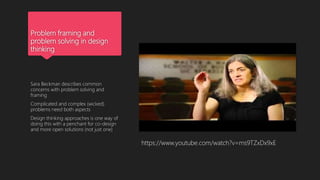
Sara Beckman describes common
concerns with problem solving and
framing
Complicated and complex (wicked)
problems need both aspects
Design thinking approaches is one way of
doing this with a penchant for co-design
and more open solutions (not just one)
https://www.youtube.com/watch?v=ms9TZxDx9xE
A list of original criteria
 There is no definitive formulation of a wicked problem.
 Wicked problems have no stopping rule.
 Solutions to wicked problems are not true-or-false, but good or bad.
 There is no immediate and no ultimate test of a solution to a wicked problem.
 Every solution to a wicked problem is a "one-shot operation"
 Wicked problems do not have an enumerable set of potential solutions,
 Every wicked problem is essentially unique.
 Every wicked problem can be considered to be a symptom of another problem.
 The choice of explanation determines the nature of the problem's resolution.
 The social planner has no right to be wrong
Rittel, H. W. J., & Webber, M. M. (1973). Dilemmas in a
general theory of planning. Policy Sciences, 4(2), 155–
169. http://doi.org/10.1007/BF01405730
A more detailed typology?
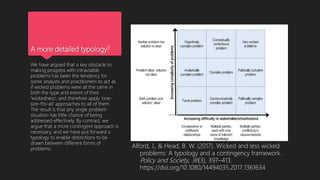
We have argued that a key obstacle to
making progress with intractable
problems has been the tendency for
some analysts and practitioners to act as
if wicked problems were all the same in
both the type and extent of their
‘wickedness’, and therefore apply ‘one-
size-fits-all’ approaches to all of them.
The result is that any single problem
situation has little chance of being
addressed effectively. By contrast, we
argue that a more contingent approach is
necessary, and we have put forward a
typology to enable distinctions to be
drawn between different forms of
problems. Alford, J., & Head, B. W. (2017). Wicked and less wicked
problems: A typology and a contingency framework.
Policy and Society, 36(3), 397–413.
https://doi.org/10.1080/14494035.2017.1361634
Distinguishing Simple-
Chaotic Problems in relation
to theories of change
The discussion identifies four types of
problem (Cynefin Analysis)
Theories of Change are best suited to two
of them
Design Thinking is also relevant to these
to particular mysteries
Can you think of problems which fit into
each category?
Describing wicked problems
What examples of wicked problems are
given?
What are the five characteristics
identified?
How do you think that design thinking
might be relevant?
Do you have an example of a wicked
problem?
Two Australian examples
 Indigenous disadvantage is an ongoing,
seemingly intractable issue but it is clear that
the motivation and behaviour of individuals
and communities lies at the heart of
successful approaches. The need for
coordination and an overarching strategy
among the services and programmes
supported by the various levels of
government and NGOs is also a key
ingredient.
 Obesity is a complex and serious health
problem with multiple factors contributing to
its rapid growth over recent decades. How to
successfully address obesity is subject to
debate but depends significantly on the
motivation and behaviour of individuals and,
to a lesser degree, on the quality of
secondary health care. Successful
interventions will require coordinated efforts
at the federal, state and local government
levels and the involvement of a range of
NGOsAustralian Public Service Commission. (2007). Tackling
wicked problems: A public policy perspective.
Commonwealth of Australia. Canberra, ACT.
Buchanan, R. (1992). Wicked
Problems in Design Thinking.
Design Issues, 8(2), 5–21.  Design problems are "indeterminate" and "wicked" because
design has no special subject matter of its own apart from
what a designer conceives it to be. The subject matter of
design is potentially universal in scope, because design
thinking may be applied to any area of human experience. But
in the process of application, the designer must discover or
invent a particular subject out of the problems and issues of
specific circumstances. This sharply contrasts with the
disciplines of science, which are concerned with understanding
the principles, laws, rules, or structures that are necessarily
embodied in existing subject matters.
Maybe designers are wicked problem
solvers by training?
Is this an idea you have experienced,
seen or heard?
Is the gap between design and science as
described?
Can science and design complement
each other?
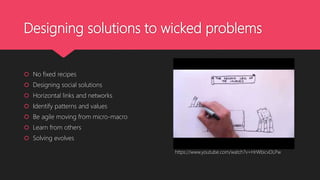
Designing solutions to wicked problems
 No fixed recipes
 Designing social solutions
 Horizontal links and networks
 Identify patterns and values
 Be agile moving from micro-macro
 Learn from others
 Solving evolves
https://www.youtube.com/watch?v=HrWbicvDLPw
Summary notes
 Wicked describes the nature of the problem not whether it is social or not. The original wicked
problem formulation even where social planning was discussed did not include participation or
co-design as an essential strategy
 A social innovation, e.g. microfinance, fair trade, etc. is a sustainable response to a complicated
or complex problem in so far as it is based on a articulated theory of change (assumptions
included) and has a viable social business model.
 The design thinking approach to developing a project or potentially programmatic response to a
wicked problem in so far as it is adaptive, viable, participatory and motivated by a ToC can
succeed
 Other approaches that have the above properties but are not called design thinking may also
succeed. This indicates either 1) design thinking is another name for methods already in existence
or 2) successful social innovation is more than a creative issue

Designing solutions to wicked problems

  • 1.
    Designing solutions towicked problems GIAN Lecture NIT Silchar, October 2018. Dr Gavin Melles
  • 2.
    Initial Questions: problemframing and problem solving  What is the difference between simple, complicated, complex and chaotic problems  What properties do wicked problems have?  Few people address the issue of scale and scope, e.g. is an enterprise a (controllable) contribution to solving a wicked problem?  How do theory of change, design thinking and wicked problems combine?  Theories of Change are most suited to complicated and complex problems. Why?  Why is a design thinking approach relevant to solving social problems?  One key question is how to operationalize wicked problem solving  Social impact, social business models and other reduction strategies are related to but distinct from wicked problem solving. (How?)
  • 3.
    Problem framing and problemsolving in design thinking Sara Beckman describes common concerns with problem solving and framing Complicated and complex (wicked) problems need both aspects Design thinking approaches is one way of doing this with a penchant for co-design and more open solutions (not just one) https://www.youtube.com/watch?v=ms9TZxDx9xE
  • 4.
    A list oforiginal criteria  There is no definitive formulation of a wicked problem.  Wicked problems have no stopping rule.  Solutions to wicked problems are not true-or-false, but good or bad.  There is no immediate and no ultimate test of a solution to a wicked problem.  Every solution to a wicked problem is a "one-shot operation"  Wicked problems do not have an enumerable set of potential solutions,  Every wicked problem is essentially unique.  Every wicked problem can be considered to be a symptom of another problem.  The choice of explanation determines the nature of the problem's resolution.  The social planner has no right to be wrong Rittel, H. W. J., & Webber, M. M. (1973). Dilemmas in a general theory of planning. Policy Sciences, 4(2), 155– 169. http://doi.org/10.1007/BF01405730
  • 5.
    A more detailedtypology? We have argued that a key obstacle to making progress with intractable problems has been the tendency for some analysts and practitioners to act as if wicked problems were all the same in both the type and extent of their ‘wickedness’, and therefore apply ‘one- size-fits-all’ approaches to all of them. The result is that any single problem situation has little chance of being addressed effectively. By contrast, we argue that a more contingent approach is necessary, and we have put forward a typology to enable distinctions to be drawn between different forms of problems. Alford, J., & Head, B. W. (2017). Wicked and less wicked problems: A typology and a contingency framework. Policy and Society, 36(3), 397–413. https://doi.org/10.1080/14494035.2017.1361634
  • 6.
    Distinguishing Simple- Chaotic Problemsin relation to theories of change The discussion identifies four types of problem (Cynefin Analysis) Theories of Change are best suited to two of them Design Thinking is also relevant to these to particular mysteries Can you think of problems which fit into each category?
  • 7.
    Describing wicked problems Whatexamples of wicked problems are given? What are the five characteristics identified? How do you think that design thinking might be relevant? Do you have an example of a wicked problem?
  • 8.
    Two Australian examples Indigenous disadvantage is an ongoing, seemingly intractable issue but it is clear that the motivation and behaviour of individuals and communities lies at the heart of successful approaches. The need for coordination and an overarching strategy among the services and programmes supported by the various levels of government and NGOs is also a key ingredient.  Obesity is a complex and serious health problem with multiple factors contributing to its rapid growth over recent decades. How to successfully address obesity is subject to debate but depends significantly on the motivation and behaviour of individuals and, to a lesser degree, on the quality of secondary health care. Successful interventions will require coordinated efforts at the federal, state and local government levels and the involvement of a range of NGOsAustralian Public Service Commission. (2007). Tackling wicked problems: A public policy perspective. Commonwealth of Australia. Canberra, ACT.
  • 9.
    Buchanan, R. (1992).Wicked Problems in Design Thinking. Design Issues, 8(2), 5–21.  Design problems are "indeterminate" and "wicked" because design has no special subject matter of its own apart from what a designer conceives it to be. The subject matter of design is potentially universal in scope, because design thinking may be applied to any area of human experience. But in the process of application, the designer must discover or invent a particular subject out of the problems and issues of specific circumstances. This sharply contrasts with the disciplines of science, which are concerned with understanding the principles, laws, rules, or structures that are necessarily embodied in existing subject matters. Maybe designers are wicked problem solvers by training? Is this an idea you have experienced, seen or heard? Is the gap between design and science as described? Can science and design complement each other?
  • 10.
    Designing solutions towicked problems  No fixed recipes  Designing social solutions  Horizontal links and networks  Identify patterns and values  Be agile moving from micro-macro  Learn from others  Solving evolves https://www.youtube.com/watch?v=HrWbicvDLPw
  • 11.
    Summary notes  Wickeddescribes the nature of the problem not whether it is social or not. The original wicked problem formulation even where social planning was discussed did not include participation or co-design as an essential strategy  A social innovation, e.g. microfinance, fair trade, etc. is a sustainable response to a complicated or complex problem in so far as it is based on a articulated theory of change (assumptions included) and has a viable social business model.  The design thinking approach to developing a project or potentially programmatic response to a wicked problem in so far as it is adaptive, viable, participatory and motivated by a ToC can succeed  Other approaches that have the above properties but are not called design thinking may also succeed. This indicates either 1) design thinking is another name for methods already in existence or 2) successful social innovation is more than a creative issue

Editor's Notes

  • #9 But in fact of course this policy view on behaviour ad good policy also omits multiple historical, political and cultural factors also