Copyright © 2018, Peter Jones
Design Thinking with Simplexity:
As a Design process
Peter Jones, PhD
Redesign & OCAD University, Toronto
Copyright © 2018, Peter Jones
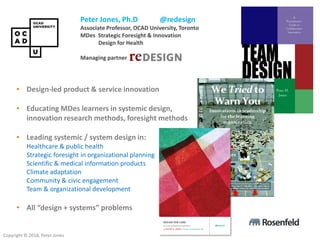
Peter Jones, Ph.D @redesign
Associate Professor, OCAD University, Toronto
MDes Strategic Foresight & Innovation
Design for Health
Managing partner Redesign Network
• Design-led product & service innovation
• Educating MDes learners in systemic design,
innovation research methods, foresight methods
• Leading systemic / system design in:
Healthcare & public health
Strategic foresight in organizational planning
Scientific & medical information products
Climate adaptation
Community & civic engagement
Team & organizational development
• All “design + systems” problems
Copyright © 2018, Peter Jones
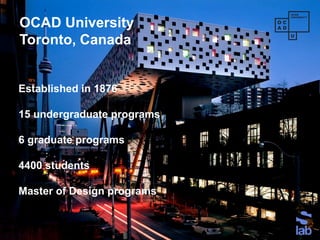
OCAD University
Toronto, Canada
Established in 1876
15 undergraduate programs
6 graduate programs
4400 students
Master of Design programs
Copyright © 2018, Peter Jones
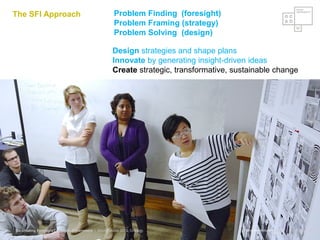
Greg Van Alstyne | sLab | OCAD UniversityCo-creating Foresight Culture in Government | WorldFutures 2013, Chicago
Problem Finding (foresight)
Problem Framing (strategy)
Problem Solving (design)
Design strategies and shape plans
Innovate by generating insight-driven ideas
Create strategic, transformative, sustainable change
The SFI Approach
Copyright © 2018, Peter Jones
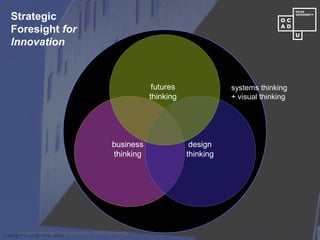
Strategic Foresight and Innovation OCAD University
systems thinking
+ visual thinking
Strategic
Foresight for
Innovation
futures
thinking
design
thinking
business
thinking
Copyright © 2018, Peter Jones
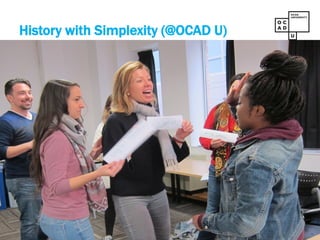
History with Simplexity (@OCAD U)
Copyright © 2018, Peter Jones
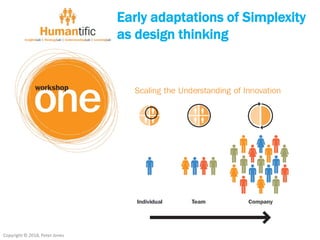
Early adaptations of Simplexity
as design thinking
Copyright © 2018, Peter Jones
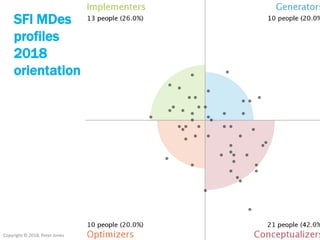
SFI MDes
profiles
2018
orientation
Copyright © 2018, Peter Jones
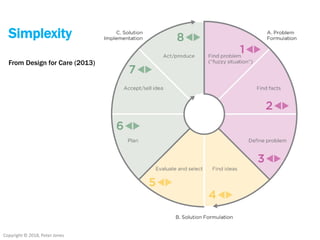
Simplexity
From Design for Care (2013)
Copyright © 2018, Peter Jones
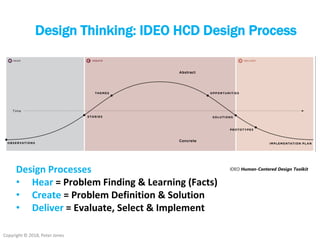
Design Thinking: IDEO HCD Design Process
Design Processes
• Hear = Problem Finding & Learning (Facts)
• Create = Problem Definition & Solution
• Deliver = Evaluate, Select & Implement
IDEO Human-Centered Design Toolkit
Copyright © 2018, Peter Jones
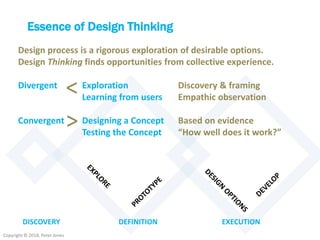
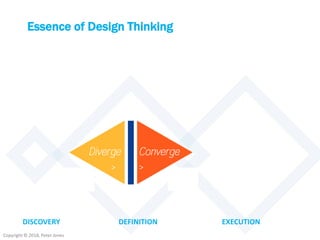
Essence of Design Thinking
Design process is a rigorous exploration of desirable options.
Design Thinking finds opportunities from collective experience.
Divergent Exploration Discovery & framing
Learning from users Empathic observation
Convergent Designing a Concept Based on evidence
Testing the Concept “How well does it work?”
<
<
DISCOVERY DEFINITION EXECUTION
Copyright © 2018, Peter Jones
Essence of Design Thinking
DISCOVERY DEFINITION EXECUTION
Copyright © 2018, Peter Jones
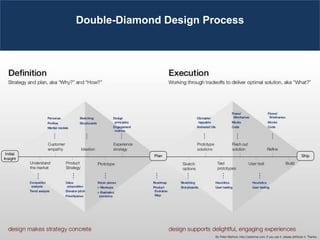
Double-Diamond Design Process
Each diamond combines a long stage of Divergence <
with a complementary stage of Convergence >
Frame Discover Design Develop
Deliver
Double Diamond is a well-known design process defined by the UK Design Council, 2005.
Copyright © 2018, Peter Jones
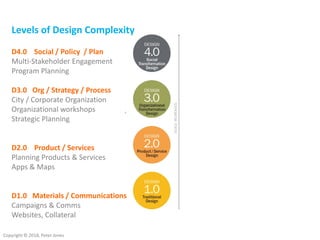
Levels of Design Complexity
D4.0 Social / Policy / Plan
Multi-Stakeholder Engagement
Program Planning
D3.0 Org / Strategy / Process
City / Corporate Organization
Organizational workshops
Strategic Planning
D2.0 Product / Services
Planning Products & Services
Apps & Maps
D1.0 Materials / Communications
Campaigns & Comms
Websites, Collateral
Copyright © 2018, Peter Jones
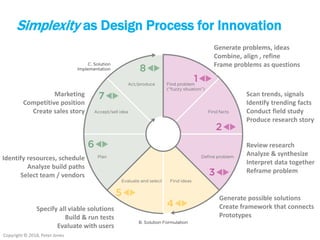
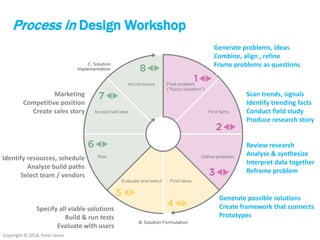
Simplexity as Design Process for Innovation
Generate problems, ideas
Combine, align , refine
Frame problems as questions
Scan trends, signals
Identify trending facts
Conduct field study
Produce research story
Review research
Analyze & synthesize
Interpret data together
Reframe problem
Generate possible solutions
Create framework that connects
Prototypes
Specify all viable solutions
Build & run tests
Evaluate with users
Identify resources, schedule
Analyze build paths
Select team / vendors
Marketing
Competitive position
Create sales story
Copyright © 2018, Peter Jones
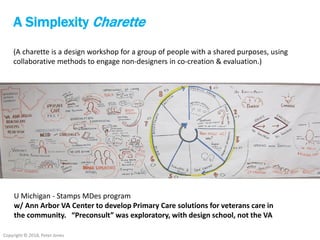
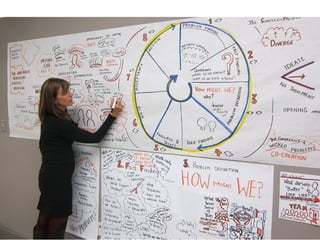
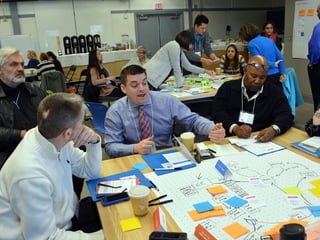
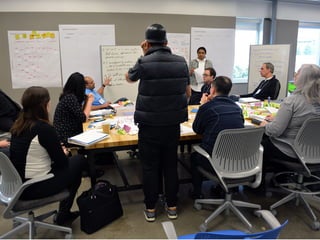
A Simplexity Charette
(A charette is a design workshop for a group of people with a shared purposes, using
collaborative methods to engage non-designers in co-creation & evaluation.)
U Michigan - Stamps MDes program
w/ Ann Arbor VA Center to develop Primary Care solutions for veterans care in
the community. “Preconsult” was exploratory, with design school, not the VA
Copyright © 2018, Peter Jones
Simplexity in the Design Studio
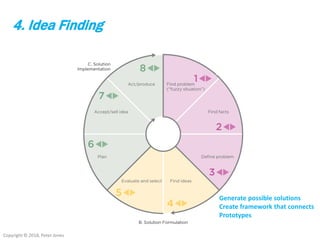
1. Problem Finding – Also called framing. Its speculative,
generative, iterative, agreement on “problem space.”
2. Fact Finding – We might have research. If not, we build on
what we know about people in the problem area.
3. Problem Definition: Ever do visual challenge mapping?
4. Idea Finding - Generate ideas & models to co-create it.
Here we jump into modeling & sketch prototypes.
5. Evaluation with real users / people. And plan…
Or its all just for fun.
Copyright © 2018, Peter Jones
Process in Design Workshop
Generate problems, ideas
Combine, align , refine
Frame problems as questions
Scan trends, signals
Identify trending facts
Conduct field study
Produce research story
Review research
Analyze & synthesize
Interpret data together
Reframe problem
Generate possible solutions
Create framework that connects
Prototypes
Specify all viable solutions
Build & run tests
Evaluate with users
Identify resources, schedule
Analyze build paths
Select team / vendors
Marketing
Competitive position
Create sales story
Copyright © 2018, Peter Jones
Form Groups – Workshop Purposes
1. City Renewal in Rust Belt towns
2. Local Climate Change Planning
3. Rethinking Higher Education for Gen Z
4. Healthcare – “Hospitals to Homes”
5. Other complex situations?
Today we are called upon to cocreate responses to complex social challenges
outside our knowledge or comfort zone.
Copyright © 2018, Peter Jones
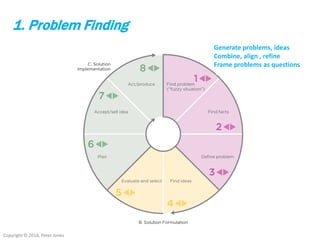
1. Problem Finding
Generate problems, ideas
Combine, align , refine
Frame problems as questions
Copyright © 2018, Peter Jones
1. Start with Problem Finding
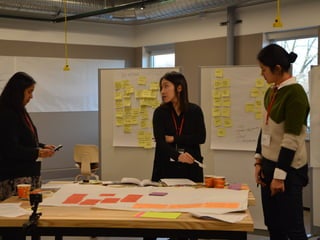
• Framing: Divide into teams by Challenge area
• Find initial Challenges – Within groups create a list of
challenge questions (text & visual):
1. Problem Finding: What are the most significant
challenges experienced here (in this context)?
Name this challenge & define a boundary.
2. Who are the stakeholders & users today?
Rapid generation of stakeholders & roles.
20 min
Copyright © 2018, Peter Jones
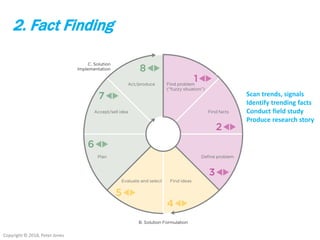
2. Fact Finding
Scan trends, signals
Identify trending facts
Conduct field study
Produce research story
Copyright © 2018, Peter Jones
2. Fact Finding / Research
• “What do we know about this fuzzy situation?”
• What is of value / pain points for stakeholders?
• Generate for 10 minutes
Then converge on 3 issues, find priorities (+ 5 min)
• Identify human needs:
Where is value realized in the context here?
• Who is the “user” among your stakeholders?
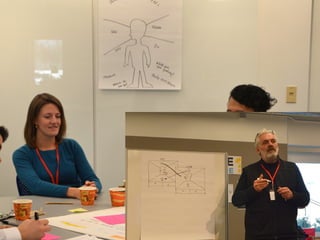
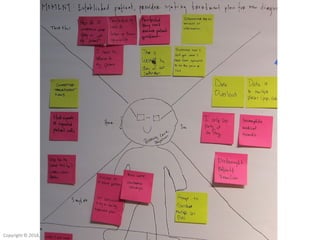
Full-body empathy map process for 1-2 “end users.”
Review and share in dialogue
20 min
Copyright © 2018, Peter Jones
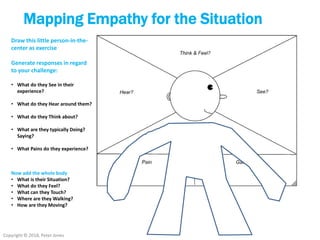
Mapping Empathy for the Situation
Draw this little person-in-the-
center as exercise
Generate responses in regard
to your challenge:
• What do they See in their
experience?
• What do they Hear around them?
• What do they Think about?
• What are they typically Doing?
Saying?
• What Pains do they experience?
Now add the whole body
• What is their Situation?
• What do they Feel?
• What can they Touch?
• Where are they Walking?
• How are they Moving?
Copyright © 2018, Peter Jones
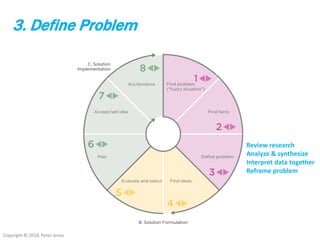
3. Define Problem
Review research
Analyze & synthesize
Interpret data together
Reframe problem
Copyright © 2018, Peter Jones
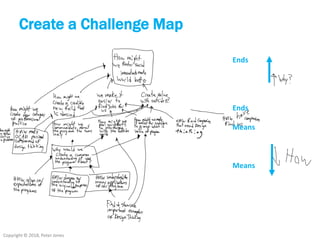
Create a Challenge Map
Ends
Ends
Means
Means
Copyright © 2018, Peter Jones
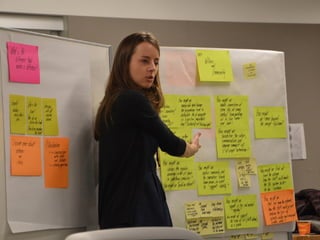
Problem Definition: Challenge Mapping
• What is the core problem as experienced by users?
Go back to the empathy map
HOW MIGHT WE …
• Choose 1-3 HMW Challenges & converge on a map:
• Arrange answers by higher-lower purposes or functions.
• Ask Why? Push to top.
Ask How? (What’s Stopping Us?)
10 min
Copyright © 2018, Peter Jones
4. Idea Finding
Generate possible solutions
Create framework that connects
Prototypes
Copyright © 2018, Peter Jones
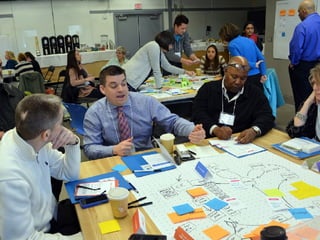
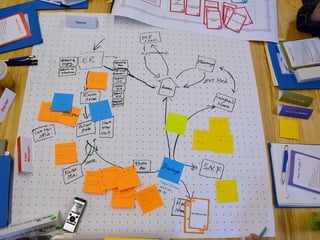
Idea Finding
• Converge & box priorities from your Challenge Map
• Generate ideas in response to the selected HMW
• Select (as table) key ideas that respond to the challenge
• Develop these ideas with either/and:
Visual sketching or storyboarding of a narrative
Sketch (or sticky note) a user journey of the idea
Prototype a concept, e.g. Lego, mock-up sketch, collage.
This is where the design process lives. The embodiment
of the idea we test in Step 5.
15 min
Copyright © 2018, Peter Jones
Discussion
• How does Design Thinking extend Simplexity?
• What methods do you use today? Where do they fit?
• Where are your entry points for such a process?
• How might this change your innovation processes?

How Might We: Simplexity in Design Charrettes

  • 1.
    Copyright © 2018,Peter Jones Design Thinking with Simplexity: As a Design process Peter Jones, PhD Redesign & OCAD University, Toronto
  • 2.
    Copyright © 2018,Peter Jones Peter Jones, Ph.D @redesign Associate Professor, OCAD University, Toronto MDes Strategic Foresight & Innovation Design for Health Managing partner Redesign Network • Design-led product & service innovation • Educating MDes learners in systemic design, innovation research methods, foresight methods • Leading systemic / system design in: Healthcare & public health Strategic foresight in organizational planning Scientific & medical information products Climate adaptation Community & civic engagement Team & organizational development • All “design + systems” problems
  • 3.
    Copyright © 2018,Peter Jones OCAD University Toronto, Canada Established in 1876 15 undergraduate programs 6 graduate programs 4400 students Master of Design programs
  • 4.
    Copyright © 2018,Peter Jones Greg Van Alstyne | sLab | OCAD UniversityCo-creating Foresight Culture in Government | WorldFutures 2013, Chicago Problem Finding (foresight) Problem Framing (strategy) Problem Solving (design) Design strategies and shape plans Innovate by generating insight-driven ideas Create strategic, transformative, sustainable change The SFI Approach
  • 5.
    Copyright © 2018,Peter Jones Strategic Foresight and Innovation OCAD University systems thinking + visual thinking Strategic Foresight for Innovation futures thinking design thinking business thinking
  • 6.
    Copyright © 2018,Peter Jones History with Simplexity (@OCAD U)
  • 7.
    Copyright © 2018,Peter Jones Early adaptations of Simplexity as design thinking
  • 8.
    Copyright © 2018,Peter Jones SFI MDes profiles 2018 orientation
  • 9.
    Copyright © 2018,Peter Jones Simplexity From Design for Care (2013)
  • 10.
    Copyright © 2018,Peter Jones Design Thinking: IDEO HCD Design Process Design Processes • Hear = Problem Finding & Learning (Facts) • Create = Problem Definition & Solution • Deliver = Evaluate, Select & Implement IDEO Human-Centered Design Toolkit
  • 11.
    Copyright © 2018,Peter Jones Essence of Design Thinking Design process is a rigorous exploration of desirable options. Design Thinking finds opportunities from collective experience. Divergent Exploration Discovery & framing Learning from users Empathic observation Convergent Designing a Concept Based on evidence Testing the Concept “How well does it work?” < < DISCOVERY DEFINITION EXECUTION
  • 12.
    Copyright © 2018,Peter Jones Essence of Design Thinking DISCOVERY DEFINITION EXECUTION
  • 13.
    Copyright © 2018,Peter Jones Double-Diamond Design Process Each diamond combines a long stage of Divergence < with a complementary stage of Convergence > Frame Discover Design Develop Deliver Double Diamond is a well-known design process defined by the UK Design Council, 2005.
  • 14.
    Copyright © 2018,Peter Jones Levels of Design Complexity D4.0 Social / Policy / Plan Multi-Stakeholder Engagement Program Planning D3.0 Org / Strategy / Process City / Corporate Organization Organizational workshops Strategic Planning D2.0 Product / Services Planning Products & Services Apps & Maps D1.0 Materials / Communications Campaigns & Comms Websites, Collateral
  • 15.
    Copyright © 2018,Peter Jones Simplexity as Design Process for Innovation Generate problems, ideas Combine, align , refine Frame problems as questions Scan trends, signals Identify trending facts Conduct field study Produce research story Review research Analyze & synthesize Interpret data together Reframe problem Generate possible solutions Create framework that connects Prototypes Specify all viable solutions Build & run tests Evaluate with users Identify resources, schedule Analyze build paths Select team / vendors Marketing Competitive position Create sales story
  • 16.
    Copyright © 2018,Peter Jones A Simplexity Charette (A charette is a design workshop for a group of people with a shared purposes, using collaborative methods to engage non-designers in co-creation & evaluation.) U Michigan - Stamps MDes program w/ Ann Arbor VA Center to develop Primary Care solutions for veterans care in the community. “Preconsult” was exploratory, with design school, not the VA
  • 17.
    Copyright © 2018,Peter Jones
  • 18.
    Copyright © 2018,Peter Jones
  • 19.
    Copyright © 2018,Peter Jones
  • 20.
    Copyright © 2018,Peter Jones Simplexity in the Design Studio 1. Problem Finding – Also called framing. Its speculative, generative, iterative, agreement on “problem space.” 2. Fact Finding – We might have research. If not, we build on what we know about people in the problem area. 3. Problem Definition: Ever do visual challenge mapping? 4. Idea Finding - Generate ideas & models to co-create it. Here we jump into modeling & sketch prototypes. 5. Evaluation with real users / people. And plan… Or its all just for fun.
  • 21.
    Copyright © 2018,Peter Jones Process in Design Workshop Generate problems, ideas Combine, align , refine Frame problems as questions Scan trends, signals Identify trending facts Conduct field study Produce research story Review research Analyze & synthesize Interpret data together Reframe problem Generate possible solutions Create framework that connects Prototypes Specify all viable solutions Build & run tests Evaluate with users Identify resources, schedule Analyze build paths Select team / vendors Marketing Competitive position Create sales story
  • 22.
    Copyright © 2018,Peter Jones Form Groups – Workshop Purposes 1. City Renewal in Rust Belt towns 2. Local Climate Change Planning 3. Rethinking Higher Education for Gen Z 4. Healthcare – “Hospitals to Homes” 5. Other complex situations? Today we are called upon to cocreate responses to complex social challenges outside our knowledge or comfort zone.
  • 23.
    Copyright © 2018,Peter Jones 1. Problem Finding Generate problems, ideas Combine, align , refine Frame problems as questions
  • 24.
    Copyright © 2018,Peter Jones 1. Start with Problem Finding • Framing: Divide into teams by Challenge area • Find initial Challenges – Within groups create a list of challenge questions (text & visual): 1. Problem Finding: What are the most significant challenges experienced here (in this context)? Name this challenge & define a boundary. 2. Who are the stakeholders & users today? Rapid generation of stakeholders & roles. 20 min
  • 25.
    Copyright © 2018,Peter Jones
  • 26.
    Copyright © 2018,Peter Jones 2. Fact Finding Scan trends, signals Identify trending facts Conduct field study Produce research story
  • 27.
    Copyright © 2018,Peter Jones 2. Fact Finding / Research • “What do we know about this fuzzy situation?” • What is of value / pain points for stakeholders? • Generate for 10 minutes Then converge on 3 issues, find priorities (+ 5 min) • Identify human needs: Where is value realized in the context here? • Who is the “user” among your stakeholders? Full-body empathy map process for 1-2 “end users.” Review and share in dialogue 20 min
  • 28.
    Copyright © 2018,Peter Jones Mapping Empathy for the Situation Draw this little person-in-the- center as exercise Generate responses in regard to your challenge: • What do they See in their experience? • What do they Hear around them? • What do they Think about? • What are they typically Doing? Saying? • What Pains do they experience? Now add the whole body • What is their Situation? • What do they Feel? • What can they Touch? • Where are they Walking? • How are they Moving?
  • 29.
    Copyright © 2018,Peter Jones
  • 30.
    Copyright © 2018,Peter Jones
  • 31.
    Copyright © 2018,Peter Jones 3. Define Problem Review research Analyze & synthesize Interpret data together Reframe problem
  • 32.
    Copyright © 2018,Peter Jones Create a Challenge Map Ends Ends Means Means
  • 33.
    Copyright © 2018,Peter Jones Problem Definition: Challenge Mapping • What is the core problem as experienced by users? Go back to the empathy map HOW MIGHT WE … • Choose 1-3 HMW Challenges & converge on a map: • Arrange answers by higher-lower purposes or functions. • Ask Why? Push to top. Ask How? (What’s Stopping Us?) 10 min
  • 34.
    Copyright © 2018,Peter Jones
  • 35.
    Copyright © 2018,Peter Jones 4. Idea Finding Generate possible solutions Create framework that connects Prototypes
  • 36.
    Copyright © 2018,Peter Jones Idea Finding • Converge & box priorities from your Challenge Map • Generate ideas in response to the selected HMW • Select (as table) key ideas that respond to the challenge • Develop these ideas with either/and: Visual sketching or storyboarding of a narrative Sketch (or sticky note) a user journey of the idea Prototype a concept, e.g. Lego, mock-up sketch, collage. This is where the design process lives. The embodiment of the idea we test in Step 5. 15 min
  • 37.
    Copyright © 2018,Peter Jones
  • 38.
    Copyright © 2018,Peter Jones
  • 39.
    Copyright © 2018,Peter Jones Discussion • How does Design Thinking extend Simplexity? • What methods do you use today? Where do they fit? • Where are your entry points for such a process? • How might this change your innovation processes?