Many public sector problems are “wicked”
problems
There are “tame problems”
Some problems need just operations research solutions
And then there are “wicked problems”3
Problems that have a strong social, legal, and political
components
Many stakeholders, incomplete, contradictory, and changing
requirements that are often difficult to recognize
Russell Ackoff: “Every problem interacts with other problems and is
therefore part of a set of interrelated problems, a system of
problems...I choose to call such a system a mess.”
3
Rittel and Webber 1973
Prof. L. Albert McLay (UW-Madison) ISyE823 26 Jan 2016 15 / 21
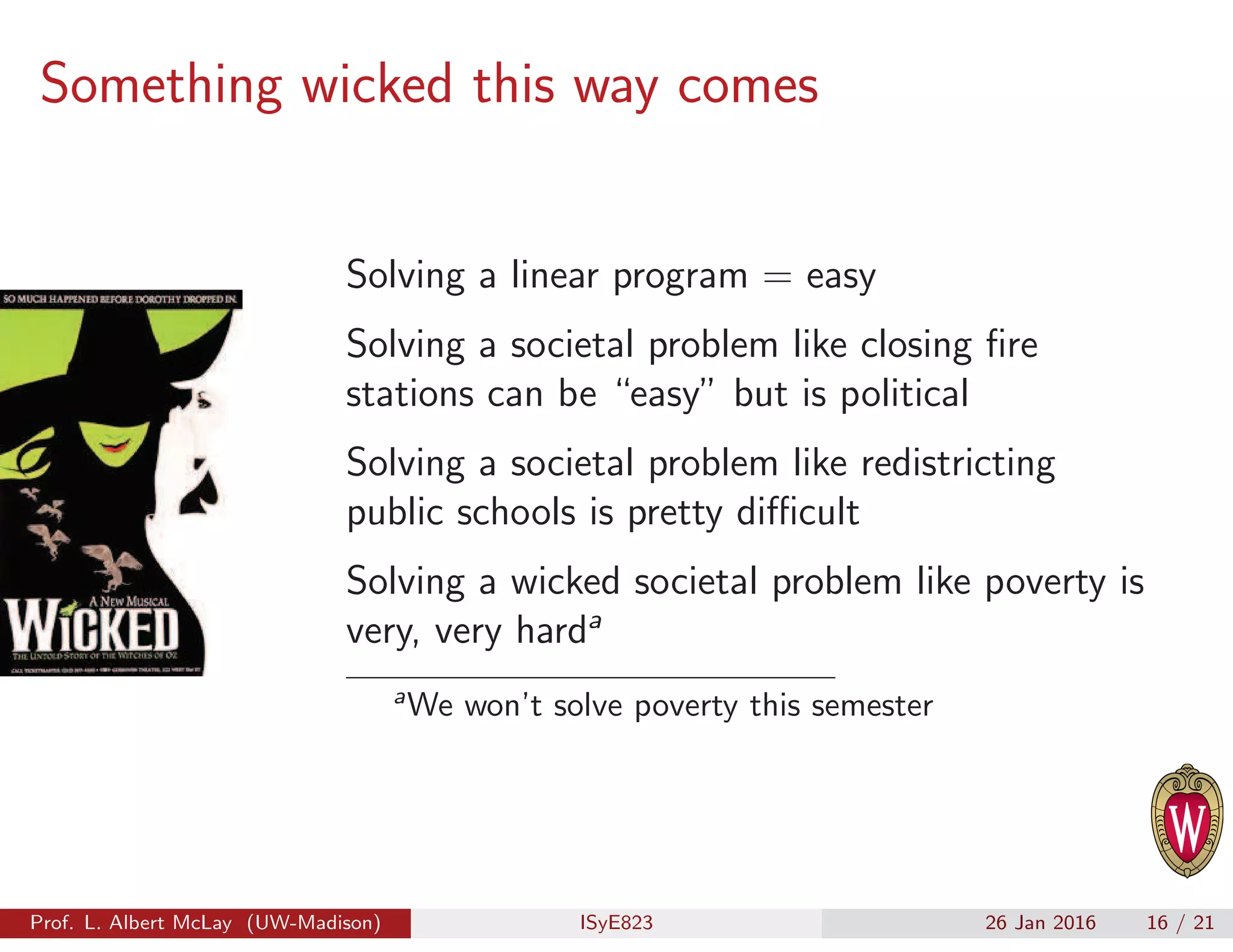
Something wicked this way comes
Solving a linear program = easy
Solving a societal problem like closing fire
stations can be “easy” but is political
Solving a societal problem like redistricting
public schools is pretty difficult
Solving a wicked societal problem like poverty is
very, very harda
a
We won’t solve poverty this semester
Prof. L. Albert McLay (UW-Madison) ISyE823 26 Jan 2016 16 / 21
Wicked problems
1. There is no definitive formulation of a wicked problem.
You cannot state an exhaustive formulation containing all the
information a decision-maker needs for understanding the problem.
OR attempts to “tame” a problem by making several important
decisions to tackle a problem in distinct phases.
2. Wicked problems have no stopping rule
In solving a chess problem or a linear program, there are criteria to
tell you when you are done. Not so with public planning problems.
Prof. L. Albert McLay (UW-Madison) ISyE823 26 Jan 2016 17 / 21
Wicked problems
3. Solutions to wicked problems are not true-or-false.
There are no conventional criteria or for independently checking if the
solution worked.
4. There is no immediate and no ultimate test of a solution to a
wicked problem.
The solution will generate waves of consequences over an extended
period of time.
Prof. L. Albert McLay (UW-Madison) ISyE823 26 Jan 2016 18 / 21
Wicked problems
5. Every solution to a wicked problem is a “one shot operation”
because there is no opportunity to learn by trial and error, every
attempt counts significantly4
6. Every wicked problem is essentially unique5
7. Wicked problems do not have an enumerable (or an exhaustively
describable) set of potential solutions, nor is there a well-described
set of permissible operations that may be incorporated into the plan.
4
I’m skeptical of this one
5
this one too
Prof. L. Albert McLay (UW-Madison) ISyE823 26 Jan 2016 19 / 21
Wicked problems
8. Every wicked problem can be considered to be a symptom of
another problem
Everything is interconnected.
9. The existence of a discrepancy representing a wicked problem can
be explained in numerous ways. The choice of explanation determines
the nature of the problem’s resolution
10. The planner has no right to be wrong
“The aim is not to find the truth, but to improve some
characteristics of the world where people live”
Prof. L. Albert McLay (UW-Madison) ISyE823 26 Jan 2016 20 / 21
Public Sector OR is optimistic
“Planning and the emerging policy sciences are among the more
optimistic of those professions. Their representatives refuse to believe
that planning for betterment is impossible, however grave their
misgivings about the appropriateness of past and present modes of
planning. They have not abandoned the hope that the instruments of
perfectability can be perfected.”2
2
Rittel and Webber 1973
Prof. L. Albert McLay (UW-Madison) ISyE823 26 Jan 2016 14 / 21

Wicked problems in operations research

  • 1.
    Many public sectorproblems are “wicked” problems There are “tame problems” Some problems need just operations research solutions And then there are “wicked problems”3 Problems that have a strong social, legal, and political components Many stakeholders, incomplete, contradictory, and changing requirements that are often difficult to recognize Russell Ackoff: “Every problem interacts with other problems and is therefore part of a set of interrelated problems, a system of problems...I choose to call such a system a mess.” 3 Rittel and Webber 1973 Prof. L. Albert McLay (UW-Madison) ISyE823 26 Jan 2016 15 / 21
  • 2.
    Something wicked thisway comes Solving a linear program = easy Solving a societal problem like closing fire stations can be “easy” but is political Solving a societal problem like redistricting public schools is pretty difficult Solving a wicked societal problem like poverty is very, very harda a We won’t solve poverty this semester Prof. L. Albert McLay (UW-Madison) ISyE823 26 Jan 2016 16 / 21
  • 3.
    Wicked problems 1. Thereis no definitive formulation of a wicked problem. You cannot state an exhaustive formulation containing all the information a decision-maker needs for understanding the problem. OR attempts to “tame” a problem by making several important decisions to tackle a problem in distinct phases. 2. Wicked problems have no stopping rule In solving a chess problem or a linear program, there are criteria to tell you when you are done. Not so with public planning problems. Prof. L. Albert McLay (UW-Madison) ISyE823 26 Jan 2016 17 / 21
  • 4.
    Wicked problems 3. Solutionsto wicked problems are not true-or-false. There are no conventional criteria or for independently checking if the solution worked. 4. There is no immediate and no ultimate test of a solution to a wicked problem. The solution will generate waves of consequences over an extended period of time. Prof. L. Albert McLay (UW-Madison) ISyE823 26 Jan 2016 18 / 21
  • 5.
    Wicked problems 5. Everysolution to a wicked problem is a “one shot operation” because there is no opportunity to learn by trial and error, every attempt counts significantly4 6. Every wicked problem is essentially unique5 7. Wicked problems do not have an enumerable (or an exhaustively describable) set of potential solutions, nor is there a well-described set of permissible operations that may be incorporated into the plan. 4 I’m skeptical of this one 5 this one too Prof. L. Albert McLay (UW-Madison) ISyE823 26 Jan 2016 19 / 21
  • 6.
    Wicked problems 8. Everywicked problem can be considered to be a symptom of another problem Everything is interconnected. 9. The existence of a discrepancy representing a wicked problem can be explained in numerous ways. The choice of explanation determines the nature of the problem’s resolution 10. The planner has no right to be wrong “The aim is not to find the truth, but to improve some characteristics of the world where people live” Prof. L. Albert McLay (UW-Madison) ISyE823 26 Jan 2016 20 / 21
  • 7.
    Public Sector ORis optimistic “Planning and the emerging policy sciences are among the more optimistic of those professions. Their representatives refuse to believe that planning for betterment is impossible, however grave their misgivings about the appropriateness of past and present modes of planning. They have not abandoned the hope that the instruments of perfectability can be perfected.”2 2 Rittel and Webber 1973 Prof. L. Albert McLay (UW-Madison) ISyE823 26 Jan 2016 14 / 21