Research and design: a changing
relationship and the influence of Ethnography
DR GAVIN MELLES
1
A Prompt: Ethno What?
http://www.methods.manchester.ac.uk/methods/ethnography/
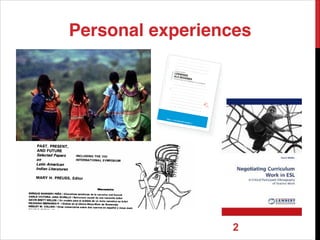
Personal experiences
2
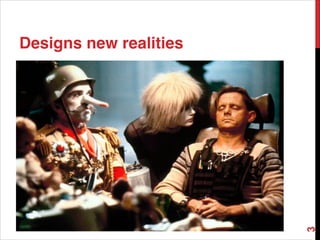
Designs new realities
3
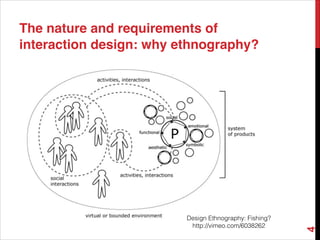
The nature and requirements of
interaction design: why ethnography?
4
Design Ethnography: Fishing?
http://vimeo.com/6038262
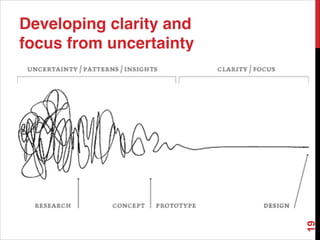
Developing clarity and
focus from uncertainty
19
Perspectives on the role
of anthropology in design
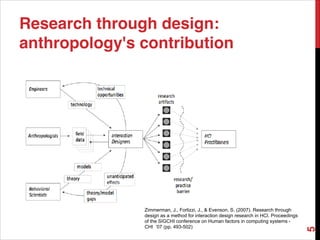
Research through design:
anthropology's contribution
Zimmerman, J., Forlizzi, J., & Evenson, S. (2007). Research through
design as a method for interaction design research in HCI. Proceedings
of the SIGCHI conference on Human factors in computing systems -
CHI ’07 (pp. 493-502)
5
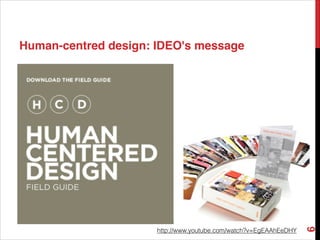
Human-centred design: IDEO's message
6
http://www.youtube.com/watch?v=EgEAAhEeDHY
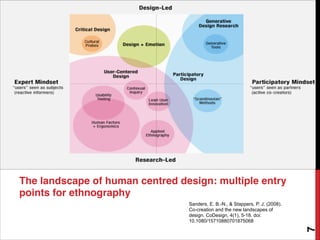
The landscape of human centred design: multiple entry
points for ethnography
Sanders, E. B.-N., & Stappers, P. J. (2008).
Co-creation and the new landscapes of
design. CoDesign, 4(1), 5-18. doi:
10.1080/15710880701875068
7
A little bit of history
Developments in Ethnography
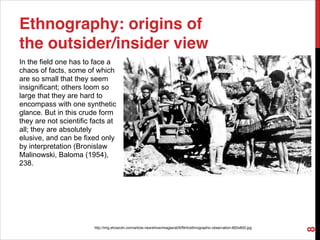
In the field one has to face a
chaos of facts, some of which
are so small that they seem
insignificant; others loom so
large that they are hard to
encompass with one synthetic
glance. But in this crude form
they are not scientific facts at
all; they are absolutely
elusive, and can be fixed only
by interpretation (Bronislaw
Malinowski, Baloma (1954),
238.
Ethnography: origins of
the outsider/insider view
http://img.ehowcdn.com/article-new/ehow/images/a05/f9/rk/ethnographic-observation-800x800.jpg
8
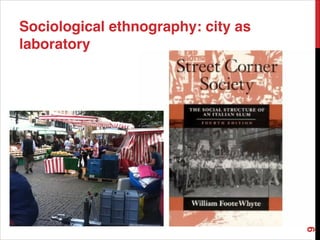
Sociological ethnography: city as
laboratory
9
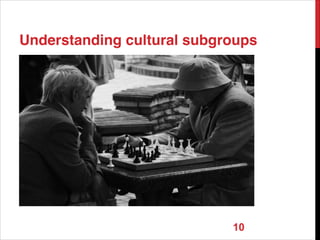
Understanding cultural subgroups
10
Visual ethnography: a
picture worth 1000 words
11
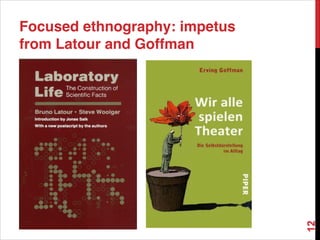
Focused ethnography: impetus
from Latour and Goffman
12
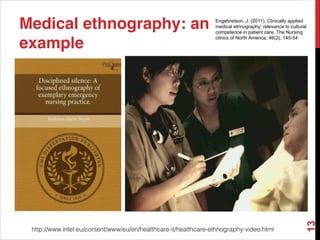
Medical ethnography: an
example
Engebretson, J. (2011). Clinically applied
medical ethnography: relevance to cultural
competence in patient care. The Nursing
clinics of North America, 46(2), 145-54
13
http://www.intel.eu/content/www/eu/en/healthcare-it/healthcare-ethnography-video.html
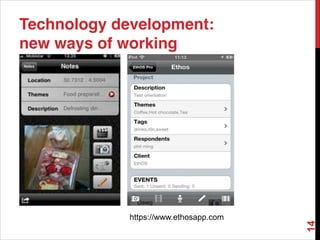
Technology development:
new ways of working
https://www.ethosapp.com
14
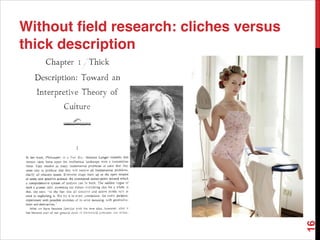
Without field research: cliches versus
thick description
16
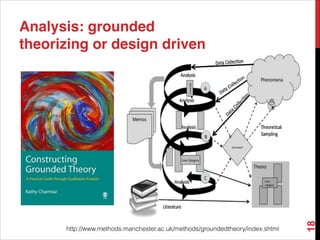
Analysis: grounded
theorizing or design driven
18
http://www.methods.manchester.ac.uk/methods/groundedtheory/index.shtml
Crucial questions
• Should I take an overt or covert role in the field?
• How much should my prior reading and analysis dictate the
field study?
• How long should or can I remain in the field?
• What is the effect of my presence on results and can I
intervene in situations?
• Should I take photographs or film in the field?
• Can I use cultural probes to get users to gather their own
evidence?
17
Conclusion
• Ethnography has its own history of developments
• Applied ethnography represents a practical application
• There is a critical discussion between applied and
traditional approaches
• The application into design puts an emphasis on stories
and people's own perceptions
20

Linköping ethnography lecture

  • 1.
    Research and design:a changing relationship and the influence of Ethnography DR GAVIN MELLES 1 A Prompt: Ethno What? http://www.methods.manchester.ac.uk/methods/ethnography/
  • 2.
  • 3.
  • 4.
    The nature andrequirements of interaction design: why ethnography? 4 Design Ethnography: Fishing? http://vimeo.com/6038262
  • 5.
    Developing clarity and focusfrom uncertainty 19
  • 6.
    Perspectives on therole of anthropology in design
  • 7.
    Research through design: anthropology'scontribution Zimmerman, J., Forlizzi, J., & Evenson, S. (2007). Research through design as a method for interaction design research in HCI. Proceedings of the SIGCHI conference on Human factors in computing systems - CHI ’07 (pp. 493-502) 5
  • 8.
    Human-centred design: IDEO'smessage 6 http://www.youtube.com/watch?v=EgEAAhEeDHY
  • 9.
    The landscape ofhuman centred design: multiple entry points for ethnography Sanders, E. B.-N., & Stappers, P. J. (2008). Co-creation and the new landscapes of design. CoDesign, 4(1), 5-18. doi: 10.1080/15710880701875068 7
  • 10.
    A little bitof history Developments in Ethnography
  • 11.
    In the fieldone has to face a chaos of facts, some of which are so small that they seem insignificant; others loom so large that they are hard to encompass with one synthetic glance. But in this crude form they are not scientific facts at all; they are absolutely elusive, and can be fixed only by interpretation (Bronislaw Malinowski, Baloma (1954), 238. Ethnography: origins of the outsider/insider view http://img.ehowcdn.com/article-new/ehow/images/a05/f9/rk/ethnographic-observation-800x800.jpg 8
  • 12.
  • 13.
  • 14.
    Visual ethnography: a pictureworth 1000 words 11
  • 15.
    Focused ethnography: impetus fromLatour and Goffman 12
  • 16.
    Medical ethnography: an example Engebretson,J. (2011). Clinically applied medical ethnography: relevance to cultural competence in patient care. The Nursing clinics of North America, 46(2), 145-54 13 http://www.intel.eu/content/www/eu/en/healthcare-it/healthcare-ethnography-video.html
  • 17.
    Technology development: new waysof working https://www.ethosapp.com 14
  • 18.
    Without field research:cliches versus thick description 16
  • 19.
    Analysis: grounded theorizing ordesign driven 18 http://www.methods.manchester.ac.uk/methods/groundedtheory/index.shtml
  • 20.
    Crucial questions • ShouldI take an overt or covert role in the field? • How much should my prior reading and analysis dictate the field study? • How long should or can I remain in the field? • What is the effect of my presence on results and can I intervene in situations? • Should I take photographs or film in the field? • Can I use cultural probes to get users to gather their own evidence? 17
  • 21.
    Conclusion • Ethnography hasits own history of developments • Applied ethnography represents a practical application • There is a critical discussion between applied and traditional approaches • The application into design puts an emphasis on stories and people's own perceptions 20