
Lecture 9 & 10
What is design Collaboration?
 “Collaborative” means you'll learn how to creatively
solve problems and engage in project activities,
management and coordination in both public and
private organizations. ...
 “Design” means you'll graduate with a deep
understanding of the process of design.
Collaboration
 Collaborations depending on their goals setting,
teams and resources.
 Yet all collaborations are a human activity, and the
following six elements play an important role in all of
them.
o Motivation
o Diversity
o Sharing
o Communication
o Support
o Problem Solving
Key Elements of Collaboration
Motivation
 Everyone involved
needs to feel that they
gain something from the
collaboration
 Feel that they are doing
a meaningful thing and
working towards a
valuable end result.
Diversity
 Collaboration benefits
from a wide range of
skills and expertise in
the pool of participants.
 A diverse group of
participants is often the
best way to ensure that
this is achieved.
Key Elements of Collaboration
Communication
 In order to find the right
people to collaborate
with, the project needs
to be communicated
clearly.
 Giving information
about the project and its
goals helps people
decide whether to
participate or not.
Sharing
 it is important to be
flexible with the
ownership of ideas.
 This does not mean that
a team should not give
credit to individuals
where credit is due,
 But any issues of
ownership of ideas or
concepts need to be
agreed at the onset.
Key Elements of Collaboration
Support
 The support of the other
collaborators in the
process is important,
especially at times of
crisis or unforeseen
difficulties.
 The collaborative group
needs to work on the
basis of the trust that if
someone were to need
the support of others in
the group, that support
would be available.
Problem Solving
 The group must be able
to solve problems
together.
 High tolerance for
uncertainty is needed
when the project
changes direction or
something does not go
as planned.
Design Process
 Discover
o the beginning of the design process
o an idea or a need to do something new or develop
existing products or services
o exploring and gathering inspirations
o identifying the problem
 Define
o filtering and analysing the findings
o brainstorming
o visualisation
o prototyping and testing
o selecting ideas for development
Design Process
 Develop
o prototyping and testing
o gathering feedback
o further visualisation, brainstorming
o narrowing down offered concepts
 Deliver
o testing and refining
o stakeholder approval / rejection
o presenting or launching the product or looping back
to an earlier stage
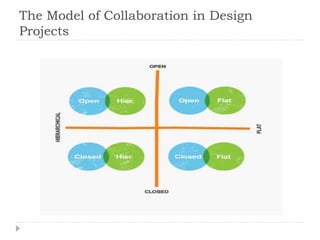
The Model of Collaboration in Design
Projects
The Model of Collaboration
 Open & Hierarchical
Anyone can contribute but the person, company or
organization in charge of the project decides which ideas
or solutions to develop.
 Open & flat
There is not an authority who decides which innovations
will be taken further because anyone can contribute in
the process and use delivered results.
 Closed & Hierarchical
The participants have been chosen by the authority who
also decides which ideas will be chosen and developed.
 Closed & Flat
The group of participants chosen by an authority, share
ideas and make the decisions and contributions together.
Social Networking
 Communication technologies
 Cell phones, PDAs, etc.
 Web-based services
 Information sharing, content creation (e.g., music, videos,
photos, news)
 Blogs & wikis
 Virtual spaces (Myspace, Facebook, Second Life)
Social Mechanisms
 Mechanisms
 Rules
 Procedures
 Conventions
 Used to maintain social order
 Inform people how to behave in social context
Conversational Mechanism
 Talking
 How do we start a conversation?
 How do we end a conversation?
 Are there cues (implicit and explicit) for starting and
ending conversations?
 Good conversational mechanisms enable people to
coordinate their talk and achieve its purpose
collaboratively.
Designing Collaborative Technologies
 Focus
 Design collaborative technologies that support
communication among people at a distance
 Collaborative virtual environments
 Email, text-messaging, videoconferencing, chat rooms…
Coordination Mechanisms
 Interaction among a group of people to achieve
something collectively
 Require coordination among people (e.g., basketball
team, class project team)
 Decisions as to how to interact to progress with
various activities
Designing for Coordination
 Consider how socially acceptable (rules, schedules,
conventions) are to people
 Too much system control -> user dislike
 Too little control -> system may break down
 Flexibility is a key.
 https://www.youtube.com/watch?v=K-pJxlChXKw
Collaborative Ethnography
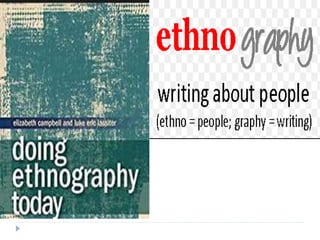
 What is ethnography?
 Ethnography focus on the close observation of social
practices and interactions.
 These qualitative methods enable the researcher to
interpret and build theories about how and why a
social process occurs.
Collaborative Ethnography
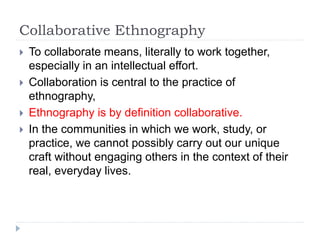
 To collaborate means, literally to work together,
especially in an intellectual effort.
 Collaboration is central to the practice of
ethnography,
 Ethnography is by definition collaborative.
 In the communities in which we work, study, or
practice, we cannot possibly carry out our unique
craft without engaging others in the context of their
real, everyday lives.
Collaborative Ethnography
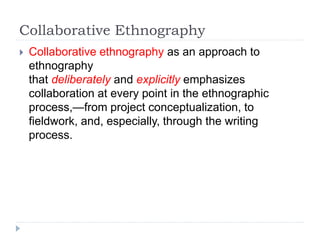
 Collaborative ethnography as an approach to
ethnography
that deliberately and explicitly emphasizes
collaboration at every point in the ethnographic
process,—from project conceptualization, to
fieldwork, and, especially, through the writing
process.
End of Lecture

Hci design collaboration lec 9 10

  • 1.
  • 2.
    What is designCollaboration?  “Collaborative” means you'll learn how to creatively solve problems and engage in project activities, management and coordination in both public and private organizations. ...  “Design” means you'll graduate with a deep understanding of the process of design.
  • 4.
    Collaboration  Collaborations dependingon their goals setting, teams and resources.  Yet all collaborations are a human activity, and the following six elements play an important role in all of them. o Motivation o Diversity o Sharing o Communication o Support o Problem Solving
  • 5.
    Key Elements ofCollaboration Motivation  Everyone involved needs to feel that they gain something from the collaboration  Feel that they are doing a meaningful thing and working towards a valuable end result. Diversity  Collaboration benefits from a wide range of skills and expertise in the pool of participants.  A diverse group of participants is often the best way to ensure that this is achieved.
  • 6.
    Key Elements ofCollaboration Communication  In order to find the right people to collaborate with, the project needs to be communicated clearly.  Giving information about the project and its goals helps people decide whether to participate or not. Sharing  it is important to be flexible with the ownership of ideas.  This does not mean that a team should not give credit to individuals where credit is due,  But any issues of ownership of ideas or concepts need to be agreed at the onset.
  • 7.
    Key Elements ofCollaboration Support  The support of the other collaborators in the process is important, especially at times of crisis or unforeseen difficulties.  The collaborative group needs to work on the basis of the trust that if someone were to need the support of others in the group, that support would be available. Problem Solving  The group must be able to solve problems together.  High tolerance for uncertainty is needed when the project changes direction or something does not go as planned.
  • 8.
    Design Process  Discover othe beginning of the design process o an idea or a need to do something new or develop existing products or services o exploring and gathering inspirations o identifying the problem  Define o filtering and analysing the findings o brainstorming o visualisation o prototyping and testing o selecting ideas for development
  • 9.
    Design Process  Develop oprototyping and testing o gathering feedback o further visualisation, brainstorming o narrowing down offered concepts  Deliver o testing and refining o stakeholder approval / rejection o presenting or launching the product or looping back to an earlier stage
  • 10.
    The Model ofCollaboration in Design Projects
  • 11.
    The Model ofCollaboration  Open & Hierarchical Anyone can contribute but the person, company or organization in charge of the project decides which ideas or solutions to develop.  Open & flat There is not an authority who decides which innovations will be taken further because anyone can contribute in the process and use delivered results.  Closed & Hierarchical The participants have been chosen by the authority who also decides which ideas will be chosen and developed.  Closed & Flat The group of participants chosen by an authority, share ideas and make the decisions and contributions together.
  • 12.
    Social Networking  Communicationtechnologies  Cell phones, PDAs, etc.  Web-based services  Information sharing, content creation (e.g., music, videos, photos, news)  Blogs & wikis  Virtual spaces (Myspace, Facebook, Second Life)
  • 13.
    Social Mechanisms  Mechanisms Rules  Procedures  Conventions  Used to maintain social order  Inform people how to behave in social context
  • 14.
    Conversational Mechanism  Talking How do we start a conversation?  How do we end a conversation?  Are there cues (implicit and explicit) for starting and ending conversations?  Good conversational mechanisms enable people to coordinate their talk and achieve its purpose collaboratively.
  • 15.
    Designing Collaborative Technologies Focus  Design collaborative technologies that support communication among people at a distance  Collaborative virtual environments  Email, text-messaging, videoconferencing, chat rooms…
  • 16.
    Coordination Mechanisms  Interactionamong a group of people to achieve something collectively  Require coordination among people (e.g., basketball team, class project team)  Decisions as to how to interact to progress with various activities
  • 17.
    Designing for Coordination Consider how socially acceptable (rules, schedules, conventions) are to people  Too much system control -> user dislike  Too little control -> system may break down  Flexibility is a key.  https://www.youtube.com/watch?v=K-pJxlChXKw
  • 19.
    Collaborative Ethnography  Whatis ethnography?  Ethnography focus on the close observation of social practices and interactions.  These qualitative methods enable the researcher to interpret and build theories about how and why a social process occurs.
  • 20.
    Collaborative Ethnography  Tocollaborate means, literally to work together, especially in an intellectual effort.  Collaboration is central to the practice of ethnography,  Ethnography is by definition collaborative.  In the communities in which we work, study, or practice, we cannot possibly carry out our unique craft without engaging others in the context of their real, everyday lives.
  • 22.
    Collaborative Ethnography  Collaborativeethnography as an approach to ethnography that deliberately and explicitly emphasizes collaboration at every point in the ethnographic process,—from project conceptualization, to fieldwork, and, especially, through the writing process.
  • 23.