building design knowledge 
creating and disseminating design precedent 
colin m. gray, phd 
OCT 09 2014
about me 
EDUCATION EXPERIENCE 
graydesign
research focus 
HCI 
DESIGN 
ISD
research focus 
HCI 
DESIGN 
ISD
my role at IJDL 
Assistant Editor (2012-2014) 
Author (Gray et al., 2012) 
Reviewer (2011-2014) 
Special Issue Co-Editor (2014, Vol. 5, Issue 2)
my plan for tonight
my plan for tonight 
Introduce design as a way of knowing
my plan for tonight 
Introduce design as a way of knowing 
Explore the design case as a specific form of design knowledge
my plan for tonight 
Introduce design as a way of knowing 
Explore the design case as a specific form of design knowledge 
Briefly outline the writing and review process for IJDL
my plan for tonight 
Introduce design as a way of knowing 
Explore the design case as a specific form of design knowledge 
Briefly outline the writing and review process for IJDL 
[+ plenty of time for questions]
Tawfik, Trueman, & Lorz, 2013
DESIGNS FOR LEARNING SPACES 
SPECIAL ISSUE | GUEST EDITOR, JILL PABLE | FALL 2013 | VOLUME 4, ISSUE 2
SPECIAL ISSUE ON HISTORIC DESIGN CASES 
GUEST EDITORS COLIN M. GRAY & CRAIG D. HOWARD | FALL 2014 | VOLUME 5, ISSUE 2
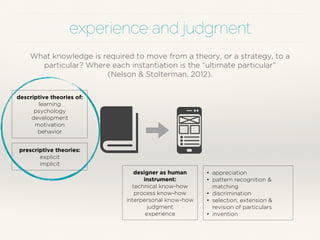
experience and judgment 
What knowledge is required to move from a theory, or a strategy, to a 
particular? Where each instantiation is the “ultimate particular” 
(Nelson & Stolterman, 2012).
experience and judgment 
What knowledge is required to move from a theory, or a strategy, to a 
particular? Where each instantiation is the “ultimate particular” 
(Nelson & Stolterman, 2012). 
descriptive theories of: 
learning 
psychology 
development 
motivation 
behavior 
prescriptive theories: 
explicit 
implicit
experience and judgment 
What knowledge is required to move from a theory, or a strategy, to a 
particular? Where each instantiation is the “ultimate particular” 
(Nelson & Stolterman, 2012). 
designer as human 
instrument: 
technical know-how 
process know-how 
interpersonal know-how 
judgment 
experience 
descriptive theories of: 
learning 
psychology 
development 
motivation 
behavior 
prescriptive theories: 
explicit 
implicit
experience and judgment 
What knowledge is required to move from a theory, or a strategy, to a 
particular? Where each instantiation is the “ultimate particular” 
(Nelson & Stolterman, 2012). 
designer as human 
instrument: 
technical know-how 
process know-how 
interpersonal know-how 
judgment 
experience 
• appreciation 
• pattern recognition & 
matching 
• discrimination 
• selection, extension & 
revision of particulars 
• invention 
descriptive theories of: 
learning 
psychology 
development 
motivation 
behavior 
prescriptive theories: 
explicit 
implicit
experience and judgment 
What knowledge is required to move from a theory, or a strategy, to a 
particular? Where each instantiation is the “ultimate particular” 
(Nelson & Stolterman, 2012). 
designer as human 
instrument: 
technical know-how 
process know-how 
interpersonal know-how 
judgment 
experience 
• appreciation 
• pattern recognition & 
matching 
• discrimination 
• selection, extension & 
revision of particulars 
• invention 
descriptive theories of: 
learning 
psychology 
development 
motivation 
behavior 
prescriptive theories: 
explicit 
implicit
experience and judgment 
What knowledge is required to move from a theory, or a strategy, to a 
particular? Where each instantiation is the “ultimate particular” 
(Nelson & Stolterman, 2012). 
designer as human 
instrument: 
technical know-how 
process know-how 
interpersonal know-how 
judgment 
experience 
• appreciation 
• pattern recognition & 
matching 
• discrimination 
• selection, extension & 
revision of particulars 
• invention 
descriptive theories of: 
learning 
psychology 
development 
motivation 
behavior 
prescriptive theories: 
explicit 
implicit
experience and judgment 
What knowledge is required to move from a theory, or a strategy, to a 
particular? Where each instantiation is the “ultimate particular” 
(Nelson & Stolterman, 2012). 
designer as human 
instrument: 
technical know-how 
process know-how 
interpersonal know-how 
judgment 
experience 
• appreciation 
• pattern recognition & 
matching 
• discrimination 
• selection, extension & 
revision of particulars 
• invention 
descriptive theories of: 
learning 
psychology 
development 
motivation 
behavior 
prescriptive theories: 
explicit 
implicit
design precedent 
In most fields of design, the special form of design knowledge called 
precedent is produced at all levels of expertise, and its dissemination is 
supported by the entire community in multiple forms.
design precedent 
In most fields of design, the special form of design knowledge called 
precedent is produced at all levels of expertise, and its dissemination is 
supported by the entire community in multiple forms. 
medical design 
event design 
interior design 
game design 
art direction 
engineering design 
software design 
architecture 
trade show design 
publication design 
lighting design 
graphic design 
event design
S1 
the same end or serving the same purpose and in situ they are 
truly unique and an ultimate particular. 
Design is a process of moving from the universal, general, and particular 
to the ultimate particular—the specific design (see figure 1.2) (a related 
• universal 
absolute truths 
• general 
contingent truths 
• particular 
• full particular 
• ultimate particular 
increasing level 
of complexity 
increasing 
level of 
abstraction 
protocols—rules of relationship/interrelationship 
and performance specifications 
duals—patterns of relationships/interrelationships 
and prescriptive specifications 
connections, composition 
and form 
the true 
the real 
increasing 
level of 
concreteness 
increasing level 
of simplicity 
Figure 1.2 
Universal to ultimate particular 
Nelson & Stolterman, 2012, p. 31
S1 
the same end or serving the same purpose and in situ they are 
truly unique and an ultimate particular. 
Design is a process of moving from the universal, general, and particular 
to the ultimate particular—the specific design (see figure 1.2) (a related 
• universal 
absolute truths 
• general 
contingent truths 
• particular 
• full particular 
• ultimate particular 
increasing level 
of complexity 
increasing 
level of 
abstraction 
protocols—rules of relationship/interrelationship 
and performance specifications 
duals—patterns of relationships/interrelationships 
and prescriptive specifications 
connections, composition 
and form 
the true 
the real 
increasing 
level of 
concreteness 
increasing level 
of simplicity 
Figure 1.2 
Universal to ultimate particular 
Nelson & Stolterman, 2012, p. 31
what is a design case?
what is a design case? 
“[a] design case is a description of a real artifact or experience that 
has been intentionally designed” (Boling, 2010, p. 2)
what is a design case? 
“[a] design case is a description of a real artifact or experience that 
has been intentionally designed” (Boling, 2010, p. 2) 
AND
what is a design case? 
“[a] design case is a description of a real artifact or experience that 
has been intentionally designed” (Boling, 2010, p. 2) 
AND 
how it came to be as it is
what is a design case? 
“[a] design case is a description of a real artifact or experience that 
has been intentionally designed” (Boling, 2010, p. 2) 
AND 
how it came to be as it is
what is a design case? 
“[a] design case is a description of a real artifact or experience that 
has been intentionally designed” (Boling, 2010, p. 2) 
AND 
how it came to be as it is 
❖ Representation of the design: what is the expected/real experience of the design
what is a design case? 
“[a] design case is a description of a real artifact or experience that 
has been intentionally designed” (Boling, 2010, p. 2) 
AND 
how it came to be as it is 
❖ Representation of the design: what is the expected/real experience of the design 
❖ Context of the design: new design, redesign, presenting problem, redefined problem
what is a design case? 
“[a] design case is a description of a real artifact or experience that 
has been intentionally designed” (Boling, 2010, p. 2) 
AND 
how it came to be as it is 
❖ Representation of the design: what is the expected/real experience of the design 
❖ Context of the design: new design, redesign, presenting problem, redefined problem 
❖ Stakeholders/designers: philosophy, bias and/or theoretical stance
what is a design case? 
“[a] design case is a description of a real artifact or experience that 
has been intentionally designed” (Boling, 2010, p. 2) 
AND 
how it came to be as it is 
❖ Representation of the design: what is the expected/real experience of the design 
❖ Context of the design: new design, redesign, presenting problem, redefined problem 
❖ Stakeholders/designers: philosophy, bias and/or theoretical stance 
❖ Design process: resources, participants, core ideas & influences
what is a design case? 
“[a] design case is a description of a real artifact or experience that 
has been intentionally designed” (Boling, 2010, p. 2) 
AND 
how it came to be as it is 
❖ Representation of the design: what is the expected/real experience of the design 
❖ Context of the design: new design, redesign, presenting problem, redefined problem 
❖ Stakeholders/designers: philosophy, bias and/or theoretical stance 
❖ Design process: resources, participants, core ideas & influences 
❖ Design failures: what went wrong, or opportunities to go another direction
precedent as design knowledge 
❖ Precedent is created for other designers, not to build generally-applicable 
knowledge or guidelines for researchers. 
❖ Precedent may be useful for different reasons to different designers—and 
for different reasons, over time, to the same designer. 
❖ This kind of knowledge building must be continuously renewed. It does not 
build step-by-step toward truths, and is not created in order to provide the 
basis for later meta-analysis. 
❖ Precedent is not used by designers as explicit guidance from one project to 
be applied to another project, but as a contribution to that designer’s store 
of patterns, her ability to discern and appreciate the qualities of patterns, and 
her acts of innovation both in the near and the long term.
where’s the rigor? 
❖ Transparency 
❖ Authors’ assessment of what is interesting about the case 
❖ Explicit statements regarding critical design decisions and their genesis 
❖ Failure and negative case analysis 
❖ Adherence to the particular 
❖ Limit on claims to generalize from the case 
❖ Concrete description/representation of the design 
❖ Absence of claims to validate theory/models
down to writing
down to writing 
❖ Producing a well-written design case is more difficult than it looks 
❖ Documentation is desirable at multiple stages of the design process (e.g., 
sketches, prototypes). 
❖ Making the actors and environment from which the design was produced 
clear to an external audience.
down to writing 
❖ Producing a well-written design case is more difficult than it looks 
❖ Documentation is desirable at multiple stages of the design process (e.g., 
sketches, prototypes). 
❖ Making the actors and environment from which the design was produced 
clear to an external audience. 
❖ Process is important 
❖ Unforeseen obstacles to the creation of the design are valuable 
components of the design case—not mistakes in “following the process” 
to be hidden. 
❖ The effectiveness or “success” of the design itself is not the criteria for 
the quality of a design case.
reviewing the case
reviewing the case 
❖ Reviewing a design case is harder than it looks 
❖ We provide an infrastructure to bring new reviewers onboard who 
understand our unique mission and can provide feedback to authors 
❖ Reviewers address the contribution of the case to design knowledge, points 
of interest, quality of representation, acknowledgement of design failures, 
engaging style, and a full rendering of the complexity of the design process
reviewing the case 
❖ Reviewing a design case is harder than it looks 
❖ We provide an infrastructure to bring new reviewers onboard who 
understand our unique mission and can provide feedback to authors 
❖ Reviewers address the contribution of the case to design knowledge, points 
of interest, quality of representation, acknowledgement of design failures, 
engaging style, and a full rendering of the complexity of the design process 
❖ Sequential reviews focused on development 
❖ There will be value in this precedent that is not foreseeable, so the review is 
about the quality of the representation, not the quality of the project. 
❖ We often assist in helping authors locate the “center of interest” for their case 
❖ Availability of multimedia elements to tell the design story in a rich and 
engaging way
references 
Boling, E. (2010). The need for design cases: Disseminating design knowledge. International Journal of 
Designs for Learning, 1(1), 1-8. 
Howard, C. D. (2011). Writing and rewriting the instructional design case: A view from two sides. 
International Journal of Designs for Learning, 2(1), 40-55. 
Nelson, H. G., & Stolterman, E. (2012). The design way: Intentional change in an unpredictable world 
(2nd ed.). Cambridge, MA: MIT Press. 
Smith, K. M. (2010). Producing the rigorous design case. International Journal of Designs for Learning, 
1(1), 10-20.
contacts at IJDL 
Elizabeth Boling, Editor-in-Chief 
eboling@indiana.edu 
John Baaki, Incoming Assistant Editor 
jwbaaki@gmail.com 
Randa Fathy, Editorial Assistant 
rhassoun@indiana.edu
contacts at IJDL 
Elizabeth Boling, Editor-in-Chief 
eboling@indiana.edu 
John Baaki, Incoming Assistant Editor 
jwbaaki@gmail.com 
Randa Fathy, Editorial Assistant 
rhassoun@indiana.edu 
Colin M. Gray 
cmgray@iastate.edu 
2624 Howe Hall

Building Design Knowledge: Creating and Disseminating Design Precedent

  • 1.
    building design knowledge creating and disseminating design precedent colin m. gray, phd OCT 09 2014
  • 2.
    about me EDUCATIONEXPERIENCE graydesign
  • 3.
    research focus HCI DESIGN ISD
  • 4.
    research focus HCI DESIGN ISD
  • 5.
    my role atIJDL Assistant Editor (2012-2014) Author (Gray et al., 2012) Reviewer (2011-2014) Special Issue Co-Editor (2014, Vol. 5, Issue 2)
  • 6.
    my plan fortonight
  • 7.
    my plan fortonight Introduce design as a way of knowing
  • 8.
    my plan fortonight Introduce design as a way of knowing Explore the design case as a specific form of design knowledge
  • 9.
    my plan fortonight Introduce design as a way of knowing Explore the design case as a specific form of design knowledge Briefly outline the writing and review process for IJDL
  • 10.
    my plan fortonight Introduce design as a way of knowing Explore the design case as a specific form of design knowledge Briefly outline the writing and review process for IJDL [+ plenty of time for questions]
  • 11.
  • 12.
  • 13.
    DESIGNS FOR LEARNINGSPACES SPECIAL ISSUE | GUEST EDITOR, JILL PABLE | FALL 2013 | VOLUME 4, ISSUE 2
  • 14.
    SPECIAL ISSUE ONHISTORIC DESIGN CASES GUEST EDITORS COLIN M. GRAY & CRAIG D. HOWARD | FALL 2014 | VOLUME 5, ISSUE 2
  • 15.
    experience and judgment What knowledge is required to move from a theory, or a strategy, to a particular? Where each instantiation is the “ultimate particular” (Nelson & Stolterman, 2012).
  • 16.
    experience and judgment What knowledge is required to move from a theory, or a strategy, to a particular? Where each instantiation is the “ultimate particular” (Nelson & Stolterman, 2012). descriptive theories of: learning psychology development motivation behavior prescriptive theories: explicit implicit
  • 17.
    experience and judgment What knowledge is required to move from a theory, or a strategy, to a particular? Where each instantiation is the “ultimate particular” (Nelson & Stolterman, 2012). designer as human instrument: technical know-how process know-how interpersonal know-how judgment experience descriptive theories of: learning psychology development motivation behavior prescriptive theories: explicit implicit
  • 18.
    experience and judgment What knowledge is required to move from a theory, or a strategy, to a particular? Where each instantiation is the “ultimate particular” (Nelson & Stolterman, 2012). designer as human instrument: technical know-how process know-how interpersonal know-how judgment experience • appreciation • pattern recognition & matching • discrimination • selection, extension & revision of particulars • invention descriptive theories of: learning psychology development motivation behavior prescriptive theories: explicit implicit
  • 19.
    experience and judgment What knowledge is required to move from a theory, or a strategy, to a particular? Where each instantiation is the “ultimate particular” (Nelson & Stolterman, 2012). designer as human instrument: technical know-how process know-how interpersonal know-how judgment experience • appreciation • pattern recognition & matching • discrimination • selection, extension & revision of particulars • invention descriptive theories of: learning psychology development motivation behavior prescriptive theories: explicit implicit
  • 20.
    experience and judgment What knowledge is required to move from a theory, or a strategy, to a particular? Where each instantiation is the “ultimate particular” (Nelson & Stolterman, 2012). designer as human instrument: technical know-how process know-how interpersonal know-how judgment experience • appreciation • pattern recognition & matching • discrimination • selection, extension & revision of particulars • invention descriptive theories of: learning psychology development motivation behavior prescriptive theories: explicit implicit
  • 21.
    experience and judgment What knowledge is required to move from a theory, or a strategy, to a particular? Where each instantiation is the “ultimate particular” (Nelson & Stolterman, 2012). designer as human instrument: technical know-how process know-how interpersonal know-how judgment experience • appreciation • pattern recognition & matching • discrimination • selection, extension & revision of particulars • invention descriptive theories of: learning psychology development motivation behavior prescriptive theories: explicit implicit
  • 22.
    design precedent Inmost fields of design, the special form of design knowledge called precedent is produced at all levels of expertise, and its dissemination is supported by the entire community in multiple forms.
  • 23.
    design precedent Inmost fields of design, the special form of design knowledge called precedent is produced at all levels of expertise, and its dissemination is supported by the entire community in multiple forms. medical design event design interior design game design art direction engineering design software design architecture trade show design publication design lighting design graphic design event design
  • 24.
    S1 the sameend or serving the same purpose and in situ they are truly unique and an ultimate particular. Design is a process of moving from the universal, general, and particular to the ultimate particular—the specific design (see figure 1.2) (a related • universal absolute truths • general contingent truths • particular • full particular • ultimate particular increasing level of complexity increasing level of abstraction protocols—rules of relationship/interrelationship and performance specifications duals—patterns of relationships/interrelationships and prescriptive specifications connections, composition and form the true the real increasing level of concreteness increasing level of simplicity Figure 1.2 Universal to ultimate particular Nelson & Stolterman, 2012, p. 31
  • 25.
    S1 the sameend or serving the same purpose and in situ they are truly unique and an ultimate particular. Design is a process of moving from the universal, general, and particular to the ultimate particular—the specific design (see figure 1.2) (a related • universal absolute truths • general contingent truths • particular • full particular • ultimate particular increasing level of complexity increasing level of abstraction protocols—rules of relationship/interrelationship and performance specifications duals—patterns of relationships/interrelationships and prescriptive specifications connections, composition and form the true the real increasing level of concreteness increasing level of simplicity Figure 1.2 Universal to ultimate particular Nelson & Stolterman, 2012, p. 31
  • 26.
    what is adesign case?
  • 27.
    what is adesign case? “[a] design case is a description of a real artifact or experience that has been intentionally designed” (Boling, 2010, p. 2)
  • 28.
    what is adesign case? “[a] design case is a description of a real artifact or experience that has been intentionally designed” (Boling, 2010, p. 2) AND
  • 29.
    what is adesign case? “[a] design case is a description of a real artifact or experience that has been intentionally designed” (Boling, 2010, p. 2) AND how it came to be as it is
  • 30.
    what is adesign case? “[a] design case is a description of a real artifact or experience that has been intentionally designed” (Boling, 2010, p. 2) AND how it came to be as it is
  • 31.
    what is adesign case? “[a] design case is a description of a real artifact or experience that has been intentionally designed” (Boling, 2010, p. 2) AND how it came to be as it is ❖ Representation of the design: what is the expected/real experience of the design
  • 32.
    what is adesign case? “[a] design case is a description of a real artifact or experience that has been intentionally designed” (Boling, 2010, p. 2) AND how it came to be as it is ❖ Representation of the design: what is the expected/real experience of the design ❖ Context of the design: new design, redesign, presenting problem, redefined problem
  • 33.
    what is adesign case? “[a] design case is a description of a real artifact or experience that has been intentionally designed” (Boling, 2010, p. 2) AND how it came to be as it is ❖ Representation of the design: what is the expected/real experience of the design ❖ Context of the design: new design, redesign, presenting problem, redefined problem ❖ Stakeholders/designers: philosophy, bias and/or theoretical stance
  • 34.
    what is adesign case? “[a] design case is a description of a real artifact or experience that has been intentionally designed” (Boling, 2010, p. 2) AND how it came to be as it is ❖ Representation of the design: what is the expected/real experience of the design ❖ Context of the design: new design, redesign, presenting problem, redefined problem ❖ Stakeholders/designers: philosophy, bias and/or theoretical stance ❖ Design process: resources, participants, core ideas & influences
  • 35.
    what is adesign case? “[a] design case is a description of a real artifact or experience that has been intentionally designed” (Boling, 2010, p. 2) AND how it came to be as it is ❖ Representation of the design: what is the expected/real experience of the design ❖ Context of the design: new design, redesign, presenting problem, redefined problem ❖ Stakeholders/designers: philosophy, bias and/or theoretical stance ❖ Design process: resources, participants, core ideas & influences ❖ Design failures: what went wrong, or opportunities to go another direction
  • 36.
    precedent as designknowledge ❖ Precedent is created for other designers, not to build generally-applicable knowledge or guidelines for researchers. ❖ Precedent may be useful for different reasons to different designers—and for different reasons, over time, to the same designer. ❖ This kind of knowledge building must be continuously renewed. It does not build step-by-step toward truths, and is not created in order to provide the basis for later meta-analysis. ❖ Precedent is not used by designers as explicit guidance from one project to be applied to another project, but as a contribution to that designer’s store of patterns, her ability to discern and appreciate the qualities of patterns, and her acts of innovation both in the near and the long term.
  • 37.
    where’s the rigor? ❖ Transparency ❖ Authors’ assessment of what is interesting about the case ❖ Explicit statements regarding critical design decisions and their genesis ❖ Failure and negative case analysis ❖ Adherence to the particular ❖ Limit on claims to generalize from the case ❖ Concrete description/representation of the design ❖ Absence of claims to validate theory/models
  • 38.
  • 39.
    down to writing ❖ Producing a well-written design case is more difficult than it looks ❖ Documentation is desirable at multiple stages of the design process (e.g., sketches, prototypes). ❖ Making the actors and environment from which the design was produced clear to an external audience.
  • 40.
    down to writing ❖ Producing a well-written design case is more difficult than it looks ❖ Documentation is desirable at multiple stages of the design process (e.g., sketches, prototypes). ❖ Making the actors and environment from which the design was produced clear to an external audience. ❖ Process is important ❖ Unforeseen obstacles to the creation of the design are valuable components of the design case—not mistakes in “following the process” to be hidden. ❖ The effectiveness or “success” of the design itself is not the criteria for the quality of a design case.
  • 41.
  • 42.
    reviewing the case ❖ Reviewing a design case is harder than it looks ❖ We provide an infrastructure to bring new reviewers onboard who understand our unique mission and can provide feedback to authors ❖ Reviewers address the contribution of the case to design knowledge, points of interest, quality of representation, acknowledgement of design failures, engaging style, and a full rendering of the complexity of the design process
  • 43.
    reviewing the case ❖ Reviewing a design case is harder than it looks ❖ We provide an infrastructure to bring new reviewers onboard who understand our unique mission and can provide feedback to authors ❖ Reviewers address the contribution of the case to design knowledge, points of interest, quality of representation, acknowledgement of design failures, engaging style, and a full rendering of the complexity of the design process ❖ Sequential reviews focused on development ❖ There will be value in this precedent that is not foreseeable, so the review is about the quality of the representation, not the quality of the project. ❖ We often assist in helping authors locate the “center of interest” for their case ❖ Availability of multimedia elements to tell the design story in a rich and engaging way
  • 44.
    references Boling, E.(2010). The need for design cases: Disseminating design knowledge. International Journal of Designs for Learning, 1(1), 1-8. Howard, C. D. (2011). Writing and rewriting the instructional design case: A view from two sides. International Journal of Designs for Learning, 2(1), 40-55. Nelson, H. G., & Stolterman, E. (2012). The design way: Intentional change in an unpredictable world (2nd ed.). Cambridge, MA: MIT Press. Smith, K. M. (2010). Producing the rigorous design case. International Journal of Designs for Learning, 1(1), 10-20.
  • 45.
    contacts at IJDL Elizabeth Boling, Editor-in-Chief eboling@indiana.edu John Baaki, Incoming Assistant Editor jwbaaki@gmail.com Randa Fathy, Editorial Assistant rhassoun@indiana.edu
  • 46.
    contacts at IJDL Elizabeth Boling, Editor-in-Chief eboling@indiana.edu John Baaki, Incoming Assistant Editor jwbaaki@gmail.com Randa Fathy, Editorial Assistant rhassoun@indiana.edu Colin M. Gray cmgray@iastate.edu 2624 Howe Hall