A SEMINAR ON
DESIGN FOR MANUFACTURING
ASSEMBLY PROCESS
SUBMITTED BY
D.SANTOSH KUMAR
14481D1506
• Design for manufacturing (DFM) is design
based on minimizing the cost of
production and/or time to market for a
product, while maintaining an
appropriate level of quality. The strategy
in DFM involves minimizing the number
of parts in a product and selecting the
appropriate manufacturing process.
Design for Manufacturing
DIFFERENCES:
Design for Assembly (DFA)
• concerned only with reducing product assembly cost
– minimizes number of assembly operations
– individual parts tend to be more complex in design
Design for Manufacturing (DFM)
• concerned with reducing overall part production cost
– minimizes complexity of manufacturing operations
– uses common datum features and primary axes
DESIGN FOR ASSEMBLY
“A PROCESS FOR IMPROVING PRODUCT
DESIGN FOR EASY LOW-COST ASSEMBLY,
FOCUSING ON FUNCTIONALITY AND ON
ASSEMBLABLITY CONCURRENTLY.”
-VINCENT CHAN &FILIPPO.
Design of components taking into account how they will
be assembled together to ensure that assembly costs are
minimized.
DFA is the method of design of the product for ease of
assembly
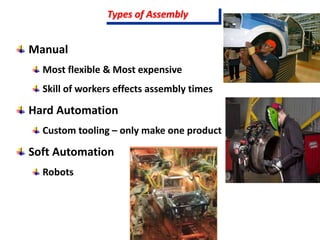
Manual
Most flexible & Most expensive
Skill of workers effects assembly times
Hard Automation
Custom tooling – only make one product
Soft Automation
Robots
Types of Assembly
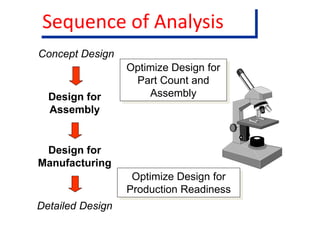
Concept Design
Design for
Assembly
Design for
Manufacturing
Detailed Design
Optimize Design for
Part Count and
Assembly
Optimize Design for
Production Readiness
Sequence of Analysis
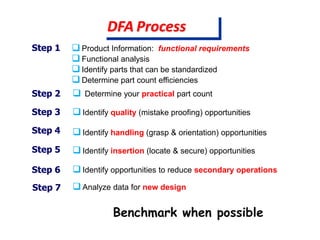
 Product Information: functional requirements
 Functional analysis
 Identify parts that can be standardized
 Determine part count efficiencies
Step 2
Step 1
 Analyze data for new design
Step 3
 Identify handling (grasp & orientation) opportunitiesStep 4
 Identify insertion (locate & secure) opportunitiesStep 5
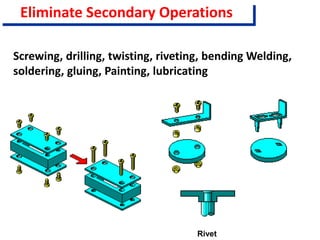
Step 6  Identify opportunities to reduce secondary operations
 Identify quality (mistake proofing) opportunities
Benchmark when possible
 Determine your practical part count
Step 7
DFA Process
1. Reduce number of parts
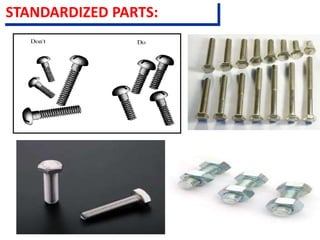
2. Reduce number of different parts - Standardize parts
3. Simplification of assembly
4. Reduction number of processes
5. Less fasteners especially screws & bolts
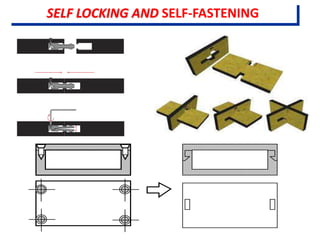
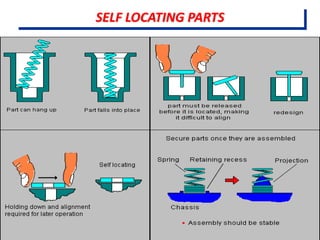
6. Design parts with self-locating features
7. Design parts with self-fastening features.
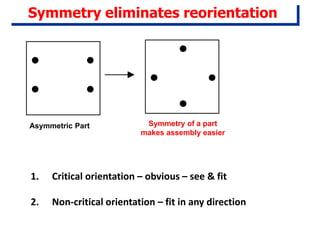
8. Minimize reorientation of parts during assembly
9. Ensure access & visibility
10. Easy part handling
11. Assemble from top
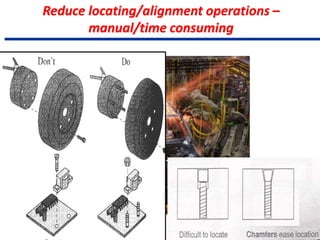
12. Reduce locating/alignment operations – manual/time
consuming
DFA Guidelines
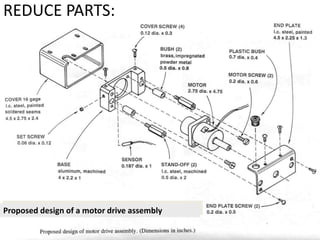
Proposed design of a motor drive assembly
REDUCE PARTS:
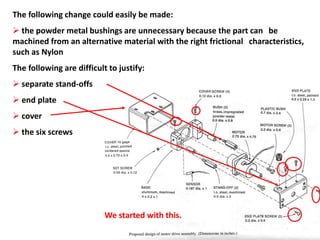
The following change could easily be made:
 the powder metal bushings are unnecessary because the part can be
machined from an alternative material with the right frictional characteristics,
such as Nylon
The following are difficult to justify:
 separate stand-offs
 end plate
 cover
 the six screws
We started with this.
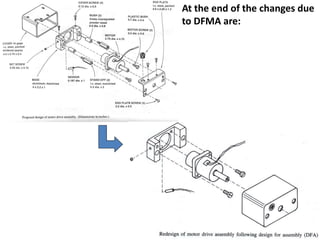
At the end of the changes due
to DFMA are:
STANDARDIZED PARTS:
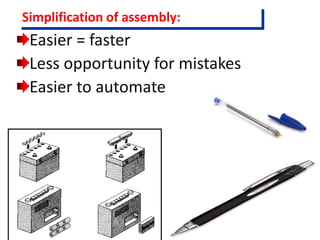
Easier = faster
Less opportunity for mistakes
Easier to automate
Simplification of assembly:
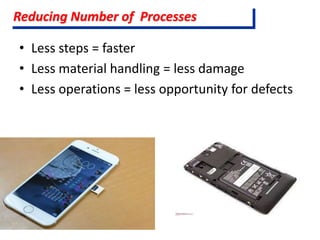
• Less steps = faster
• Less material handling = less damage
• Less operations = less opportunity for defects
Reducing Number of Processes
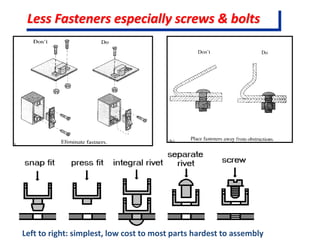
Less Fasteners especially screws & bolts
Left to right: simplest, low cost to most parts hardest to assembly
SELF LOCKING AND SELF-FASTENING
SELF LOCATING PARTS
Asymmetric Part Symmetry of a part
makes assembly easier
Symmetry eliminates reorientation
1. Critical orientation – obvious – see & fit
2. Non-critical orientation – fit in any direction
Rivet
Eliminate Secondary Operations
Screwing, drilling, twisting, riveting, bending Welding,
soldering, gluing, Painting, lubricating
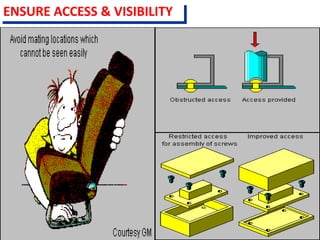
ENSURE ACCESS & VISIBILITY
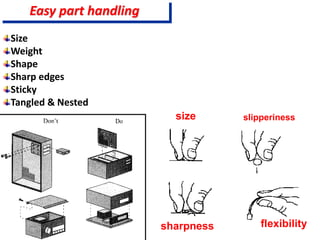
Easy part handling
size slipperiness
sharpness flexibility
Size
Weight
Shape
Sharp edges
Sticky
Tangled & Nested
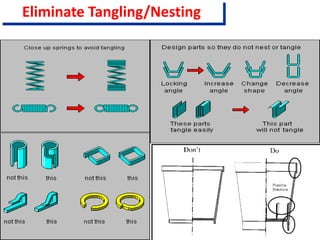
Eliminate Tangling/Nesting
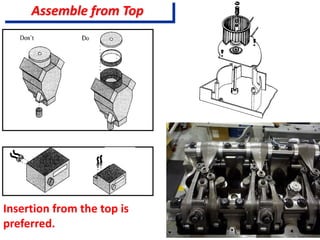
Assemble from Top
Insertion from the top is
preferred.
Reduce locating/alignment operations –
manual/time consuming
Any Queries

DESIGN FOR MANF ASSEMBLY

  • 1.
    A SEMINAR ON DESIGNFOR MANUFACTURING ASSEMBLY PROCESS SUBMITTED BY D.SANTOSH KUMAR 14481D1506
  • 2.
    • Design formanufacturing (DFM) is design based on minimizing the cost of production and/or time to market for a product, while maintaining an appropriate level of quality. The strategy in DFM involves minimizing the number of parts in a product and selecting the appropriate manufacturing process. Design for Manufacturing
  • 3.
    DIFFERENCES: Design for Assembly(DFA) • concerned only with reducing product assembly cost – minimizes number of assembly operations – individual parts tend to be more complex in design Design for Manufacturing (DFM) • concerned with reducing overall part production cost – minimizes complexity of manufacturing operations – uses common datum features and primary axes
  • 4.
    DESIGN FOR ASSEMBLY “APROCESS FOR IMPROVING PRODUCT DESIGN FOR EASY LOW-COST ASSEMBLY, FOCUSING ON FUNCTIONALITY AND ON ASSEMBLABLITY CONCURRENTLY.” -VINCENT CHAN &FILIPPO. Design of components taking into account how they will be assembled together to ensure that assembly costs are minimized. DFA is the method of design of the product for ease of assembly
  • 5.
    Manual Most flexible &Most expensive Skill of workers effects assembly times Hard Automation Custom tooling – only make one product Soft Automation Robots Types of Assembly
  • 6.
    Concept Design Design for Assembly Designfor Manufacturing Detailed Design Optimize Design for Part Count and Assembly Optimize Design for Production Readiness Sequence of Analysis
  • 7.
     Product Information:functional requirements  Functional analysis  Identify parts that can be standardized  Determine part count efficiencies Step 2 Step 1  Analyze data for new design Step 3  Identify handling (grasp & orientation) opportunitiesStep 4  Identify insertion (locate & secure) opportunitiesStep 5 Step 6  Identify opportunities to reduce secondary operations  Identify quality (mistake proofing) opportunities Benchmark when possible  Determine your practical part count Step 7 DFA Process
  • 8.
    1. Reduce numberof parts 2. Reduce number of different parts - Standardize parts 3. Simplification of assembly 4. Reduction number of processes 5. Less fasteners especially screws & bolts 6. Design parts with self-locating features 7. Design parts with self-fastening features. 8. Minimize reorientation of parts during assembly 9. Ensure access & visibility 10. Easy part handling 11. Assemble from top 12. Reduce locating/alignment operations – manual/time consuming DFA Guidelines
  • 9.
    Proposed design ofa motor drive assembly REDUCE PARTS:
  • 10.
    The following changecould easily be made:  the powder metal bushings are unnecessary because the part can be machined from an alternative material with the right frictional characteristics, such as Nylon The following are difficult to justify:  separate stand-offs  end plate  cover  the six screws We started with this.
  • 11.
    At the endof the changes due to DFMA are:
  • 12.
  • 13.
    Easier = faster Lessopportunity for mistakes Easier to automate Simplification of assembly:
  • 14.
    • Less steps= faster • Less material handling = less damage • Less operations = less opportunity for defects Reducing Number of Processes
  • 15.
    Less Fasteners especiallyscrews & bolts Left to right: simplest, low cost to most parts hardest to assembly
  • 16.
    SELF LOCKING ANDSELF-FASTENING
  • 17.
  • 18.
    Asymmetric Part Symmetryof a part makes assembly easier Symmetry eliminates reorientation 1. Critical orientation – obvious – see & fit 2. Non-critical orientation – fit in any direction
  • 19.
    Rivet Eliminate Secondary Operations Screwing,drilling, twisting, riveting, bending Welding, soldering, gluing, Painting, lubricating
  • 20.
    ENSURE ACCESS &VISIBILITY
  • 21.
    Easy part handling sizeslipperiness sharpness flexibility Size Weight Shape Sharp edges Sticky Tangled & Nested
  • 22.
  • 23.
    Assemble from Top Insertionfrom the top is preferred.
  • 24.
    Reduce locating/alignment operations– manual/time consuming
  • 25.

Editor's Notes

  • #7 Question: What do we do first…..Design for Manufacturing or Design for Assembly? Answer: We do DFA first, then DFM. That way you’re not wasting your time optimizing the manufacturing processes on component parts that you might end up eliminating from the assembly.
  • #23 40