Design Consideration for
Powder Metallurgy
➢The shape of the compact must be kept as simple and
uniform as possible.
➢ Provision must be made for ejection of the green
compact without damaging the compact.
➢P/M parts should be made with the widest acceptable
tolerances to maximize tool life.
➢Part walls should not be less than 1.5 mm thick;
thinner walls can be achieved on small parts; walls
with length to thickness ratios above 8:1 are difficult to
press.
➢Steps in parts can be produced if they are simple and their size
doesn’t exceed 15% of the overall part length.
➢Letters can be pressed if oriented perpendicular to the pressing
direction. Raised letters are more susceptible to damage in the
green stage and prevent stacking.
➢Flanges or overhangs can be produced by a step in the die.
➢ A true radius cannot be pressed; instead use a chamfer.
➢Dimensional tolerances are on the order of ±0.05 to 0.1 mm.
Tolerances improve significantly with additional operations such
as sizing, machining and grinding.
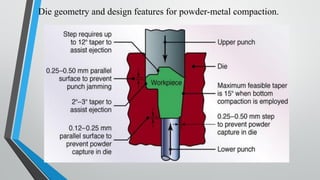
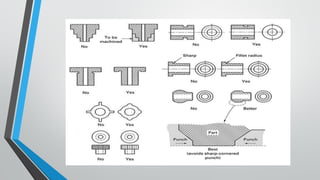
Die geometry and design features for powder-metal compaction.
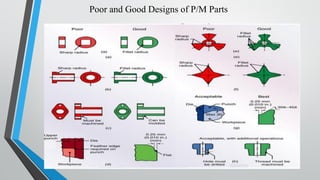
Poor and Good Designs of P/M Parts
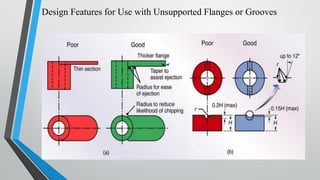
Design Features for Use with Unsupported Flanges or Grooves
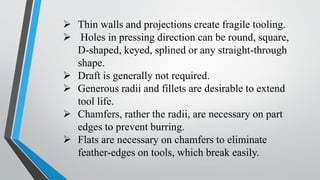
➢ Thin walls and projections create fragile tooling.
➢ Holes in pressing direction can be round, square,
D-shaped, keyed, splined or any straight-through
shape.
➢ Draft is generally not required.
➢ Generous radii and fillets are desirable to extend
tool life.
➢ Chamfers, rather the radii, are necessary on part
edges to prevent burring.
➢ Flats are necessary on chamfers to eliminate
feather-edges on tools, which break easily.
➢Basic rules for the design of P/M parts
– Shape of the part must permit ejection from die
– Powder should not be required to flow into small cavities
– The shape of the part should permit the construction of strong
tooling
– The thickness of the part should be within the range for which
P/M parts can be adequately compacted
– The part should be designed with as few changes in section
thickness as possible
➢Parts can be designed to take advantage of the
fact that certain forms and properties can be
produced by P/M that are impossible, impractical,
or uneconomical by any other method
➢The design should be consistent with available
equipment
➢ Consideration should be made for product
tolerances
➢Design should consider and compensate for
dimensional changes that will occur after pressing
Financial Considerations
Die design
must withstand 700 MPa, requiring specialty designs.
Can be very automated
➢1500 parts per hour not uncommon for average size part
➢60,000 parts per hour achievable for small, low complexity parts in
a rolling press.
Typical size part for automation is 1” cube
– Larger parts may require special machines (larger surface area, same
pressure equals larger forces involved)

Design consideration for powder metallurgy

  • 1.
  • 2.
    ➢The shape ofthe compact must be kept as simple and uniform as possible. ➢ Provision must be made for ejection of the green compact without damaging the compact. ➢P/M parts should be made with the widest acceptable tolerances to maximize tool life. ➢Part walls should not be less than 1.5 mm thick; thinner walls can be achieved on small parts; walls with length to thickness ratios above 8:1 are difficult to press.
  • 3.
    ➢Steps in partscan be produced if they are simple and their size doesn’t exceed 15% of the overall part length. ➢Letters can be pressed if oriented perpendicular to the pressing direction. Raised letters are more susceptible to damage in the green stage and prevent stacking. ➢Flanges or overhangs can be produced by a step in the die. ➢ A true radius cannot be pressed; instead use a chamfer. ➢Dimensional tolerances are on the order of ±0.05 to 0.1 mm. Tolerances improve significantly with additional operations such as sizing, machining and grinding.
  • 4.
    Die geometry anddesign features for powder-metal compaction.
  • 5.
    Poor and GoodDesigns of P/M Parts
  • 6.
    Design Features forUse with Unsupported Flanges or Grooves
  • 7.
    ➢ Thin wallsand projections create fragile tooling. ➢ Holes in pressing direction can be round, square, D-shaped, keyed, splined or any straight-through shape. ➢ Draft is generally not required. ➢ Generous radii and fillets are desirable to extend tool life. ➢ Chamfers, rather the radii, are necessary on part edges to prevent burring. ➢ Flats are necessary on chamfers to eliminate feather-edges on tools, which break easily.
  • 8.
    ➢Basic rules forthe design of P/M parts – Shape of the part must permit ejection from die – Powder should not be required to flow into small cavities – The shape of the part should permit the construction of strong tooling – The thickness of the part should be within the range for which P/M parts can be adequately compacted – The part should be designed with as few changes in section thickness as possible
  • 9.
    ➢Parts can bedesigned to take advantage of the fact that certain forms and properties can be produced by P/M that are impossible, impractical, or uneconomical by any other method ➢The design should be consistent with available equipment ➢ Consideration should be made for product tolerances ➢Design should consider and compensate for dimensional changes that will occur after pressing
  • 11.
    Financial Considerations Die design mustwithstand 700 MPa, requiring specialty designs. Can be very automated ➢1500 parts per hour not uncommon for average size part ➢60,000 parts per hour achievable for small, low complexity parts in a rolling press. Typical size part for automation is 1” cube – Larger parts may require special machines (larger surface area, same pressure equals larger forces involved)