‫الرابعة‬ ‫المحاضرة‬
‫والعشرون‬
Alternatives to Pressing and Sintering
 Conventional press and sinter sequence is the
most widely used shaping technology in
powder metallurgy
 Additional methods for processing PM parts
include:
 Isostatic pressing
 Hot pressing - combined pressing and
sintering
Materials and Products for PM
 Raw materials for PM are more expensive than
for other metalworking because of the
additional energy required to reduce the metal
to powder form
 Accordingly, PM is competitive only in a certain
range of applications
 What are the materials and products that seem
most suited to powder metallurgy?
PM Materials – Elemental Powders
A pure metal in particulate form
 Applications where high purity is important
 Common elemental powders:
 Iron
 Aluminum
 Copper
 Elemental powders can be mixed with other
metal powders to produce alloys that are
difficult to formulate by conventional methods
 Example: tool steels
PM Materials – Pre-Alloyed Powders
Each particle is an alloy comprised of the desired
chemical composition
 Common pre-alloyed powders:
 Stainless steels
 Certain copper alloys
 High speed steel
PM Products
 Gears, bearings, sprockets, fasteners,
electrical contacts, cutting tools, and various
machinery parts
 Advantage of PM: parts can be made to near
net shape or net shape
 When produced in large quantities, gears and
bearings are ideal for PM because:
 The geometry is defined in two
dimensions
 There is a need for porosity in the part to
serve as a reservoir for lubricant
PM Parts Classification System
 The Metal Powder Industries Federation
(MPIF) defines four classes of powder
metallurgy part designs, by level of difficulty in
conventional pressing
 Useful because it indicates some of the
limitations on shape that can be achieved
with conventional PM processing
Figure 16.16 (a) Class I Simple thin shapes, pressed from one
direction; (b) Class II Simple but thicker shape requires
pressing from two directions; (c) Class III Two levels of
thickness, pressed from two directions; and (d) Class IV
Multiple levels of thickness, pressed from two directions,
with separate controls for each level.
Four Classes of PM Parts
Design Guidelines for PM Parts - I
 Economics usually require large quantities to
justify cost of equipment and special tooling
 Minimum quantities of 10,000 units are
suggested
 PM is unique in its capability to fabricate parts
with a controlled level of porosity
 Porosities up to 50% are possible
 PM can be used to make parts out of unusual
metals and alloys materials that are difficult if
‑
not impossible to produce by other means
Design Guidelines for PM Parts - II
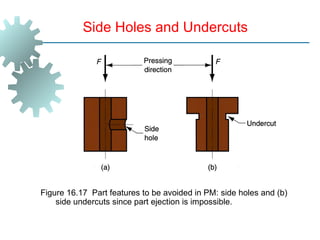
 Part geometry must permit ejection from die
 Part must have vertical or near vertical
‑
sides, although steps are allowed
 Design features like holes and undercuts on
part sides must be avoided
 Vertical undercuts and holes are permissible
because they do not interfere with ejection
 Vertical holes can have cross sectional
‑
shapes other than round without significant
difficulty
Figure 16.17 Part features to be avoided in PM: side holes and (b)
side undercuts since part ejection is impossible.
Side Holes and Undercuts
Design Guidelines for PM Parts - III
 Screw threads cannot be fabricated by PM
 They must be machined into the part
 Chamfers and corner radii are possible in PM
 But problems occur in punch rigidity when
angles are too acute
 Wall thickness should be a minimum of 1.5 mm
(0.060 in) between holes or a hole and outside
wall
 Minimum recommended hole diameter is 1.5
mm (0.060 in)
Figure 16.19 Chamfers and corner radii are accomplished but certain
rules should be observed: (a) avoid acute angles; (b) larger angles
preferred for punch rigidity; (c) inside radius is desirable; (d) avoid full
outside corner radius because punch is fragile at edge; (e) problem
solved by combining radius and chamfer.
Chamfers and Corner Radii
‫النهاية‬

9783المحاضرة رقم 24.ppt PRESENTATION

  • 1.
  • 2.
    Alternatives to Pressingand Sintering  Conventional press and sinter sequence is the most widely used shaping technology in powder metallurgy  Additional methods for processing PM parts include:  Isostatic pressing  Hot pressing - combined pressing and sintering
  • 3.
    Materials and Productsfor PM  Raw materials for PM are more expensive than for other metalworking because of the additional energy required to reduce the metal to powder form  Accordingly, PM is competitive only in a certain range of applications  What are the materials and products that seem most suited to powder metallurgy?
  • 4.
    PM Materials –Elemental Powders A pure metal in particulate form  Applications where high purity is important  Common elemental powders:  Iron  Aluminum  Copper  Elemental powders can be mixed with other metal powders to produce alloys that are difficult to formulate by conventional methods  Example: tool steels
  • 5.
    PM Materials –Pre-Alloyed Powders Each particle is an alloy comprised of the desired chemical composition  Common pre-alloyed powders:  Stainless steels  Certain copper alloys  High speed steel
  • 6.
    PM Products  Gears,bearings, sprockets, fasteners, electrical contacts, cutting tools, and various machinery parts  Advantage of PM: parts can be made to near net shape or net shape  When produced in large quantities, gears and bearings are ideal for PM because:  The geometry is defined in two dimensions  There is a need for porosity in the part to serve as a reservoir for lubricant
  • 7.
    PM Parts ClassificationSystem  The Metal Powder Industries Federation (MPIF) defines four classes of powder metallurgy part designs, by level of difficulty in conventional pressing  Useful because it indicates some of the limitations on shape that can be achieved with conventional PM processing
  • 8.
    Figure 16.16 (a)Class I Simple thin shapes, pressed from one direction; (b) Class II Simple but thicker shape requires pressing from two directions; (c) Class III Two levels of thickness, pressed from two directions; and (d) Class IV Multiple levels of thickness, pressed from two directions, with separate controls for each level. Four Classes of PM Parts
  • 9.
    Design Guidelines forPM Parts - I  Economics usually require large quantities to justify cost of equipment and special tooling  Minimum quantities of 10,000 units are suggested  PM is unique in its capability to fabricate parts with a controlled level of porosity  Porosities up to 50% are possible  PM can be used to make parts out of unusual metals and alloys materials that are difficult if ‑ not impossible to produce by other means
  • 10.
    Design Guidelines forPM Parts - II  Part geometry must permit ejection from die  Part must have vertical or near vertical ‑ sides, although steps are allowed  Design features like holes and undercuts on part sides must be avoided  Vertical undercuts and holes are permissible because they do not interfere with ejection  Vertical holes can have cross sectional ‑ shapes other than round without significant difficulty
  • 11.
    Figure 16.17 Partfeatures to be avoided in PM: side holes and (b) side undercuts since part ejection is impossible. Side Holes and Undercuts
  • 12.
    Design Guidelines forPM Parts - III  Screw threads cannot be fabricated by PM  They must be machined into the part  Chamfers and corner radii are possible in PM  But problems occur in punch rigidity when angles are too acute  Wall thickness should be a minimum of 1.5 mm (0.060 in) between holes or a hole and outside wall  Minimum recommended hole diameter is 1.5 mm (0.060 in)
  • 13.
    Figure 16.19 Chamfersand corner radii are accomplished but certain rules should be observed: (a) avoid acute angles; (b) larger angles preferred for punch rigidity; (c) inside radius is desirable; (d) avoid full outside corner radius because punch is fragile at edge; (e) problem solved by combining radius and chamfer. Chamfers and Corner Radii
  • 14.