The gingival sulcus 
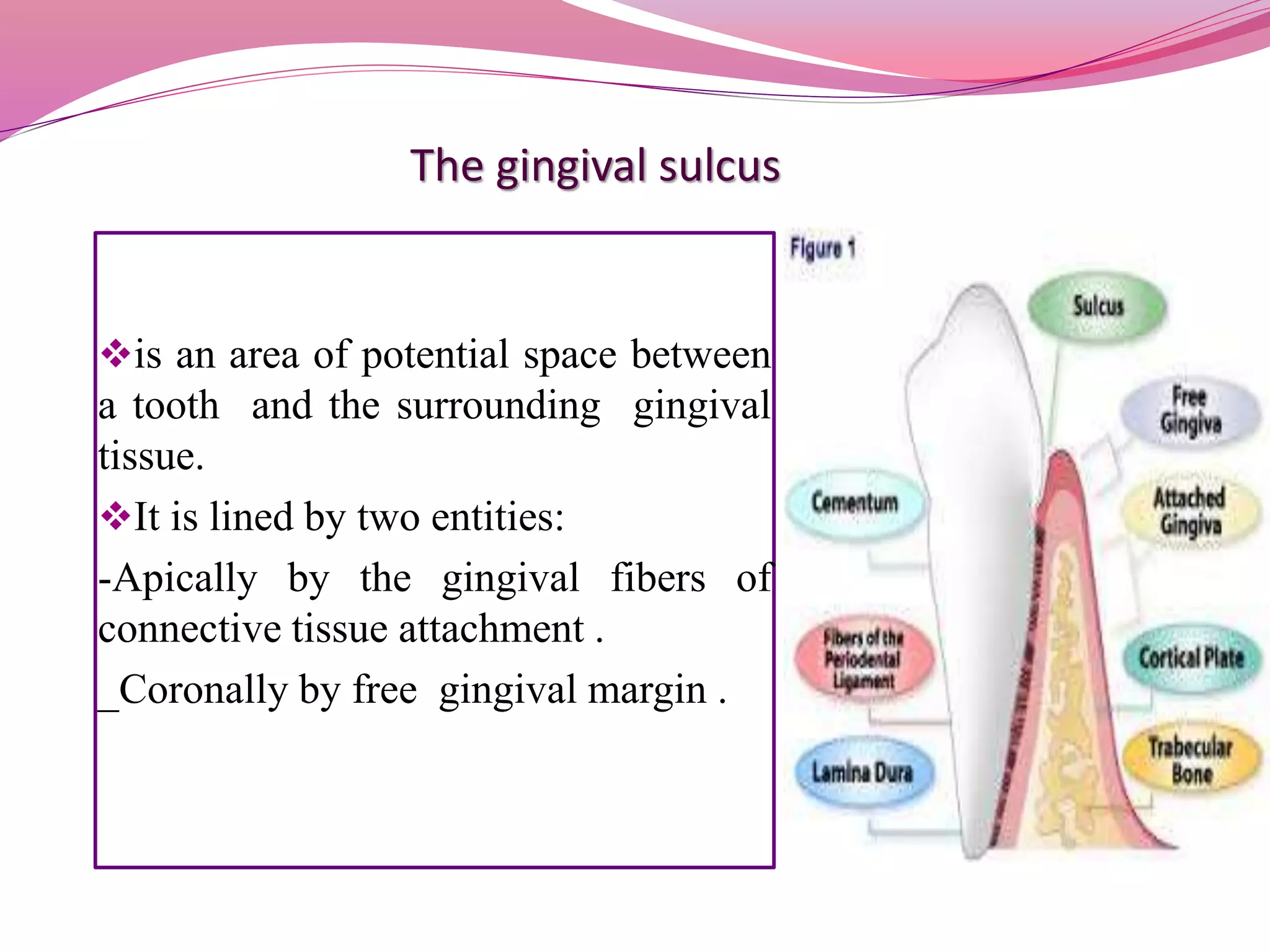
is an area of potential space between 
a tooth and the surrounding gingival 
tissue. 
It is lined by two entities: 
-Apically by the gingival fibers of 
connective tissue attachment . 
_Coronally by free gingival margin .
The gingival sulcus 
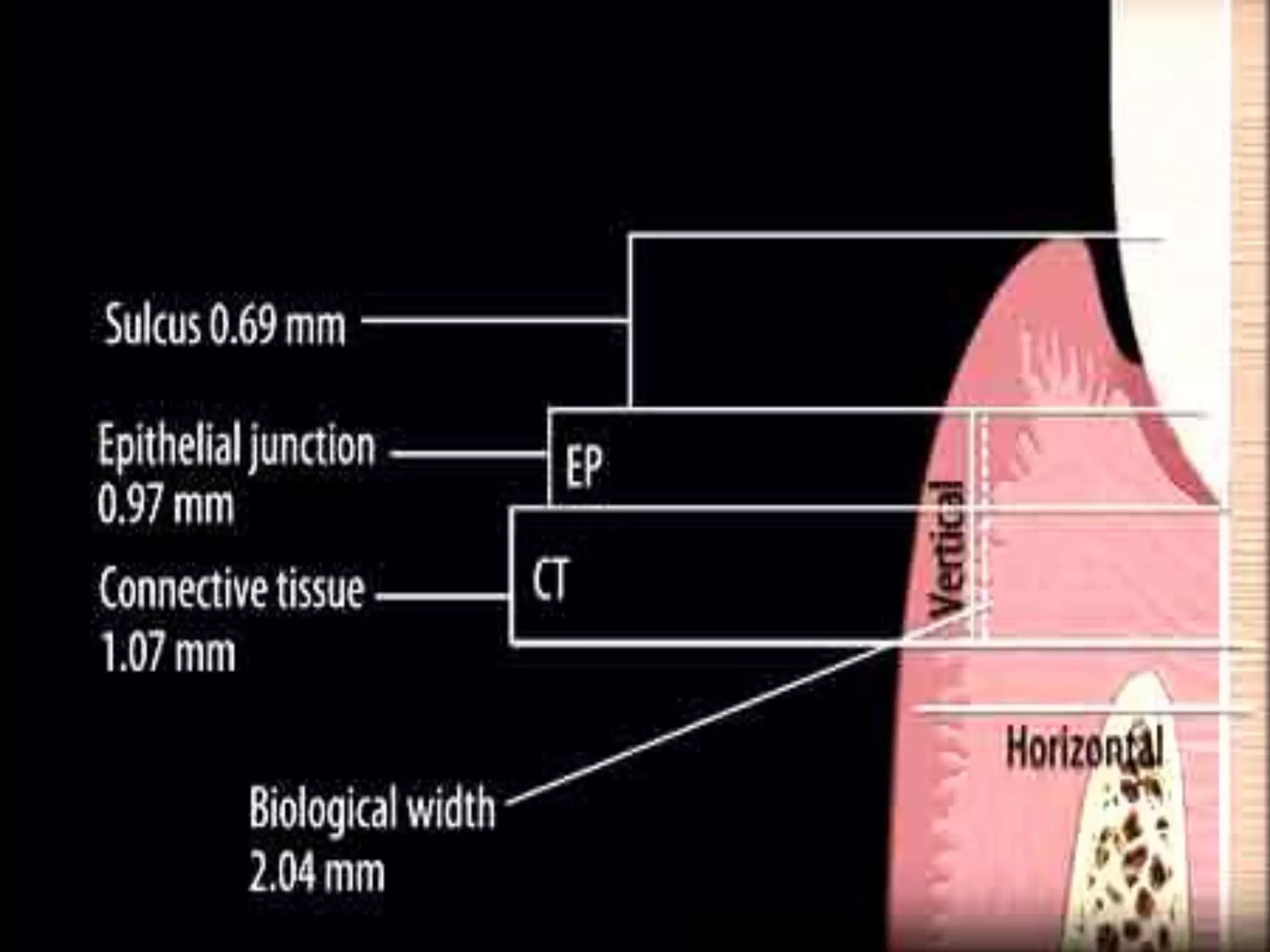
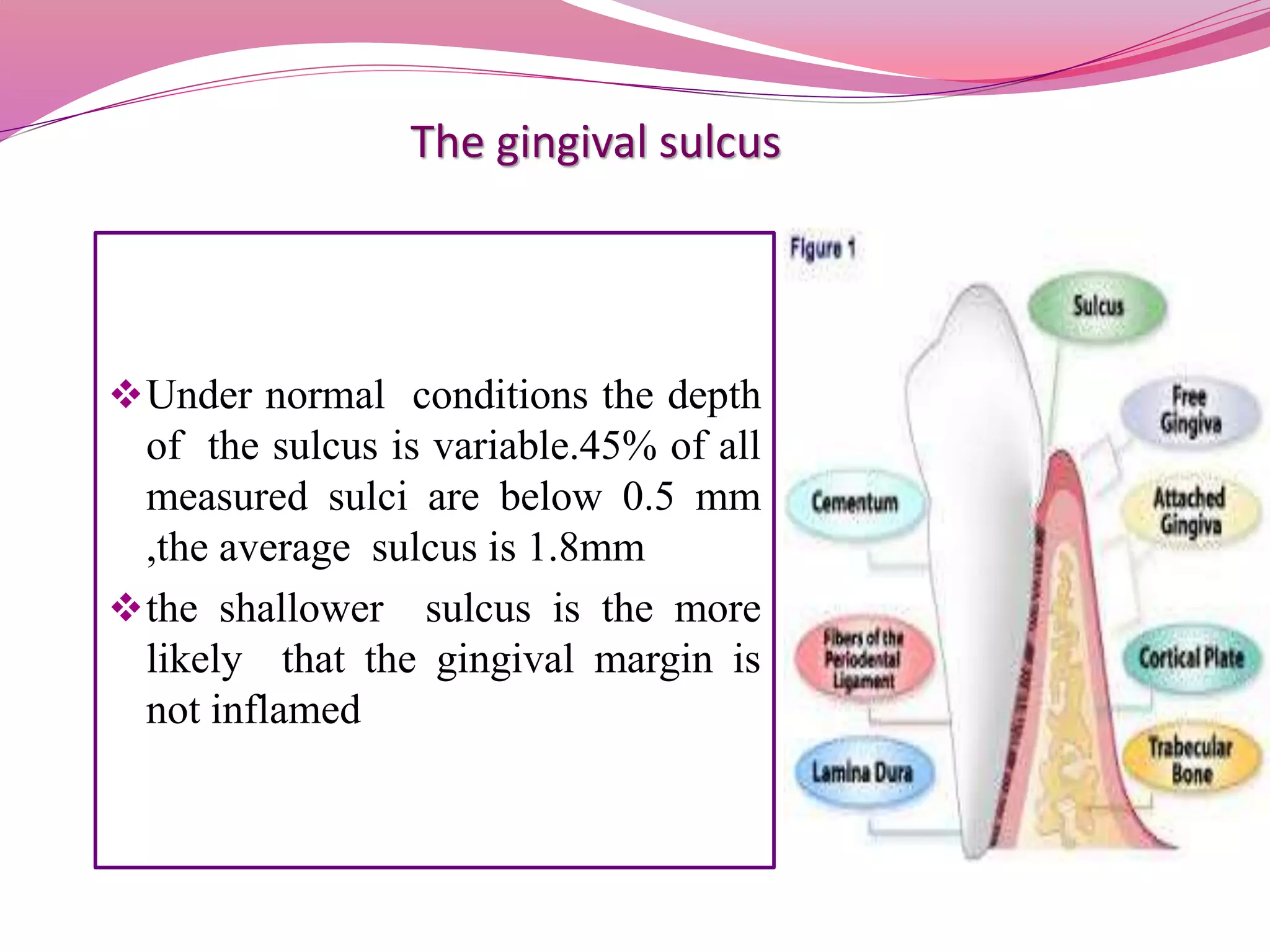
Under normal conditions the depth 
of the sulcus is variable.45% of all 
measured sulci are below 0.5 mm 
,the average sulcus is 1.8mm 
the shallower sulcus is the more 
likely that the gingival margin is 
not inflamed
THE SULCULAR EPITHELIUM 
Its stratified squamous 
epithelium ,non keratinized . 
Para keratinized that is 
continuous with the oral 
epithelium and lines the 
lateral surface of the sulcus . 
Its lacks epithelial ridges so 
forms a smooth contact with 
lamina properia
THE SULCULAR 
EPITHELIUM 
Apically it overlaps the 
coronal border of the 
junctional epithelium 
this epithelium shares many 
of the characteristics of oral 
epithelium including good 
resistance to mechanical 
forces and relative 
impermeability to fluid and 
cells
the junctional epithelium 
Its the stratified non keratinizing 
epithelium that surround the tooth like 
a collar . 
its attached by one broad surface to 
the tooth and by the other to the 
gingival connective tissue 
The junctional epithelium has two 
basal lamina: 
oOne that faces the tooth (internal basal 
lamina ) 
oThe other faces connective tissue 
(external basal lamina)
the junctional epithelium 
The desquamative shedding 
surface of the junctional epithelium 
is located at its coronal end which 
also forms the bottom of the 
gingival sulcus 
The junctional epithelium is more 
permeable than oral or sulcular 
epithelium It serves as the 
perferential route for the passage of 
bacterial products from the sulcus in 
to connective tissue into the sulcus
THE SULCULAR EPITHELIUM THE JUNCTION EPITHELIUM 
1. It is epithelium that surround 
the tooth like a collar . 
2. It is more permeable than oral or 
sulcular epithelium It serves as 
the perferential route for the 
passage of bacterial products 
from the sulcus in to connective 
tissue and fluid and cells from C.T 
into the sulcus 
1. It is continuous with the oral 
epithelium and lines the lateral 
surface of the sulcus . 
2. It characterized by good 
resistance to mechanical forces 
and relative impermeability to 
fluid and cells
Development of the junctioanal epithelium 
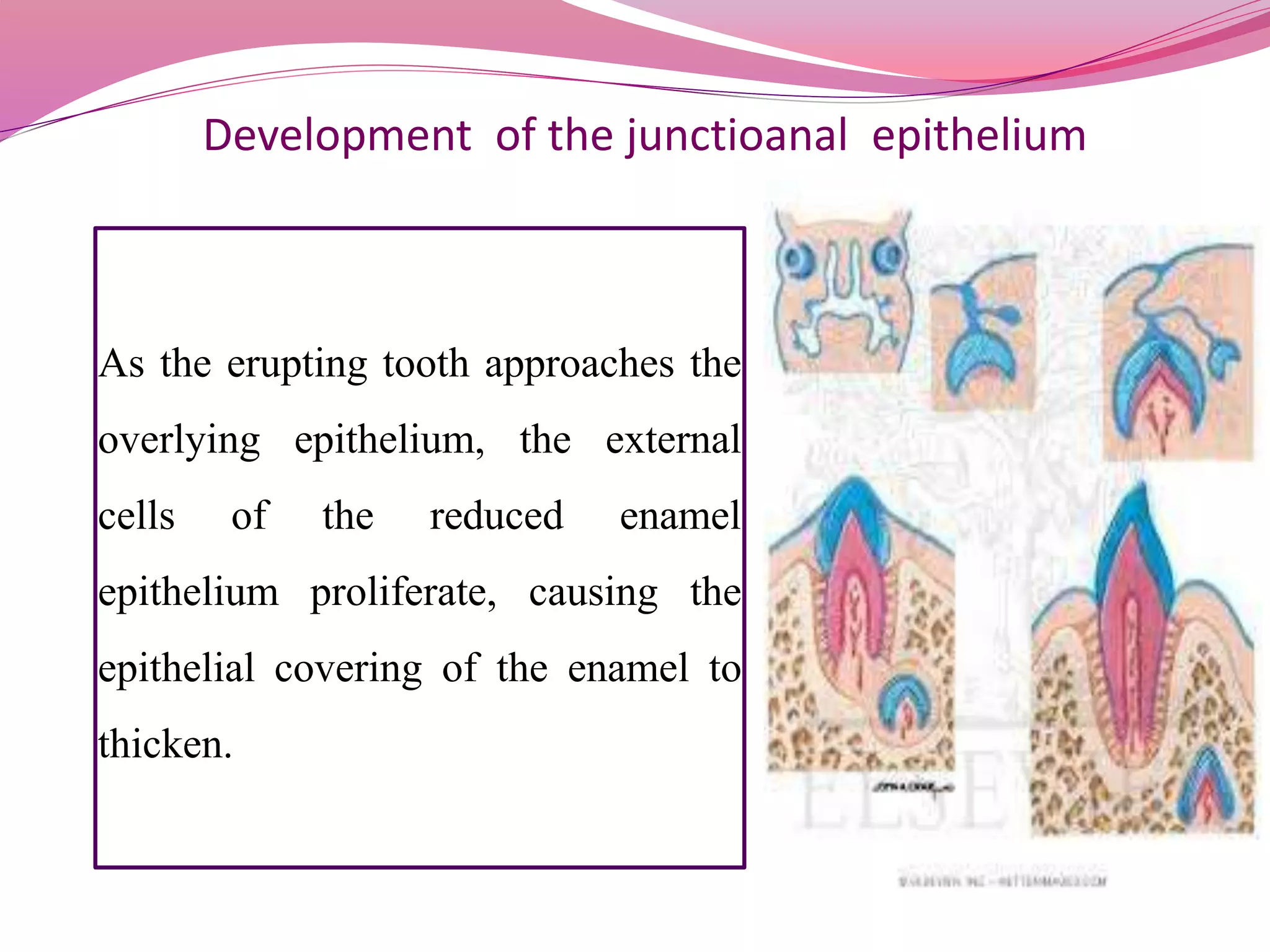
As the erupting tooth approaches the 
overlying epithelium, the external 
cells of the reduced enamel 
epithelium proliferate, causing the 
epithelial covering of the enamel to 
thicken.
Development of the junctioanal epithelium 
 Proliferation of the externel cells 
of the reduced enamel epithelium 
begins around the cusp tips and 
slowly progresses toward the 
cervix of the tooth
Development of the junctioanal epithelium 
proliferating cells eventually displace 
any remaining reduced ameloblasts, thus 
replacing the relatively inert reduced 
enamel epithelium with an epithelial 
collar of cells with a high turnover 
rate. This collar of cells with a high 
turnover rate is the early junctional 
epithelium. 
Eventually, the entire reduced enamel 
epithelium will become replaced by 
junctional epithelium.
Development of the junctioanal epithelium 
After accomplishing of amelogenesis 
(protective stage) the ameloblast secrete 
or leave structure less material on enamel 
surface primary enamel cuticle . 
The enamel organ becomes reduced in 
thickness (reduced enamel epithelium ) 
and function as aprotection against 
contact with connective tissue ,to inhibit 
cementum deposition or enamel 
resorption 
The reduced enamel epi thelium 
consists of two layers 
1-the reduced ameloblast 
2-remnant of the dental organ
Development of the junctioanal epithelium 
The ameloblast develop hemidesmosomes 
to attach the reduced enamel epithelium to 
the surface of the enamel at the time of 
eruption the reduced enamel epithelium 
secrete desmolytic enzymes causing 
degenerating of the of the c.t present 
between it and the oral mucosa (desmolytic 
stage of amelo blasts ) 
The outer layer of the reduced enamel 
epithelium and the cells of the oral 
epithelium proliferate into the degenerated 
c.t. to form amass of cells over the erupting 
tooth the epithelial plug.
Development of the junctioanal epithelium 
Cell death in th middle portion of plug cause formation of epithelial lined canal 
through which tooth will erupt with out hemorrhage 
Once the tip of the crown appear in the oral cavity reduced enamel epithelium will 
be called primary attached epithelium 
And the the shallow groove present between the tooth and the gingiva is called 
GINGIVAL SULCUS 
The cells of primary attached epithelium (PAE) originate from reduced enamel 
epithelium and attached to tooth by primary enamel cuticle 
When primary attachment epithelium is replaced by oral epithelium its called 
secondary attached epithelium that attaches by secondary enamel cuticle.
Primary enamel cuticle Secondary enamel cuticle 
1. Binds secondary attached 
epithelium to the enamel surface 
2. It is formed finally when the teeth 
erupt 
1. Binds primary attached epithelium 
to the enamel surface 
2. It is formed initially at the 
protective stage 
Primary attached epi. Secondary attached epi. 
1. It is Primary attachment 
epithelium replaced by oral 
epithelium 
2. attached by secondary enamel 
cuticle 
1. originate from reduced enamel 
epithelium 
2. attached to tooth by primary 
enamel cuticle
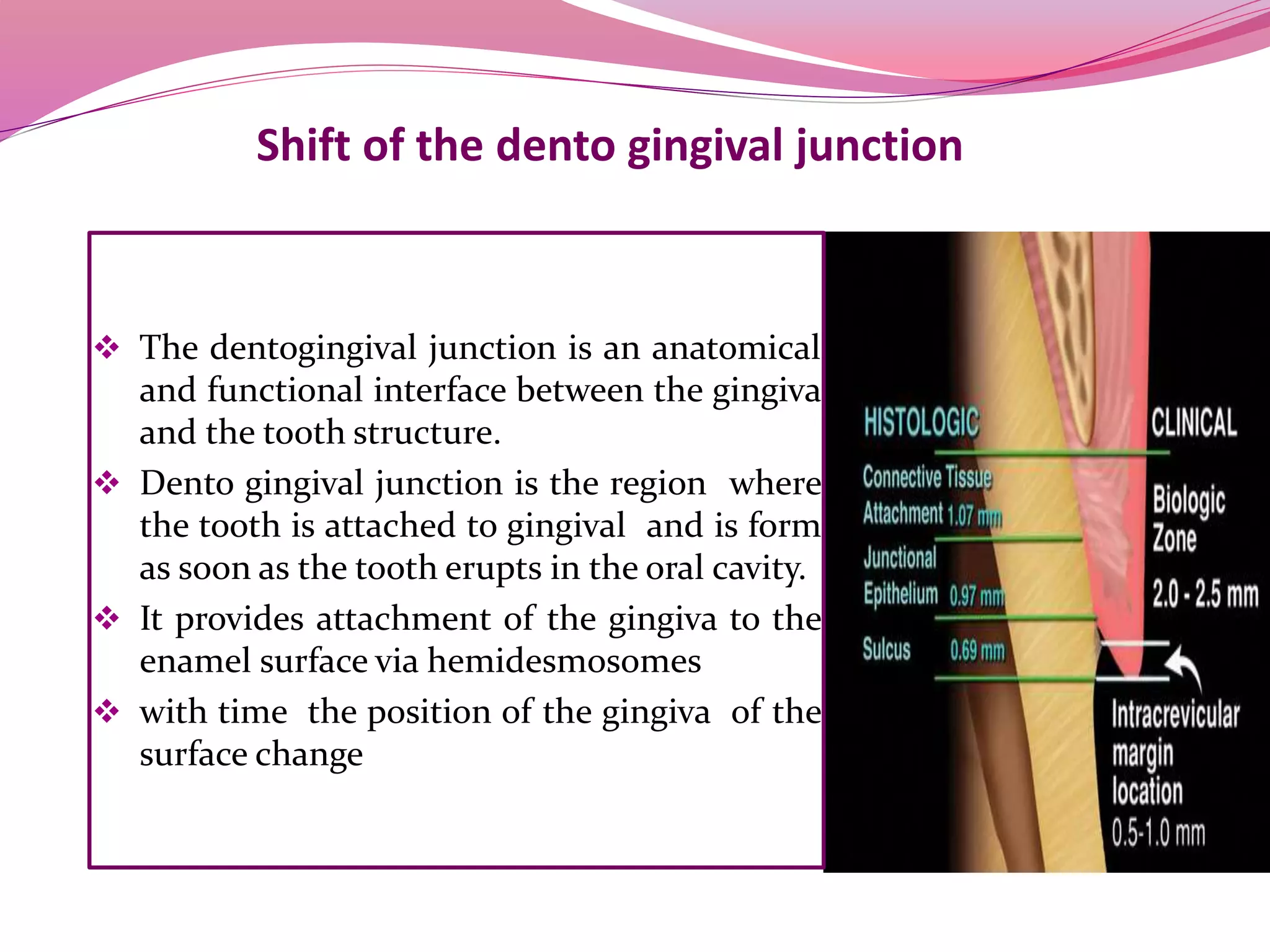
Shift of the dento gingival junction 
 The dentogingival junction is an anatomical 
and functional interface between the gingiva 
and the tooth structure. 
 Dento gingival junction is the region where 
the tooth is attached to gingival and is form 
as soon as the tooth erupts in the oral cavity. 
 It provides attachment of the gingiva to the 
enamel surface via hemidesmosomes 
 with time the position of the gingiva of the 
surface change
Shift of the dento gingival junction 
 Components 
1. Epithelial component is derived from 
reduced dental (enamel) epithelium 
and oral epithelium. 
2. The connective tissue component is 
derived from the lamina propria of the 
oral mucosa. 
 The attachment of the functional 
epithelium to the tooth is reinforced with 
the gingival fibers, which brace the gingival 
against the tooth surface.
Dento gingival junction
Shift of the dento gingival junction 
almost entire enamel is covered by 
epithelium when the tip of the enamel 
first emerge through the mucous 
membrane of the oral cavity . 
the eruption of teeth continuous until it 
reach the plan of occlusion. 
 the firmness strength of the dentino 
gingival junction beacause of connective 
tissue attachment of epithelium to 
enamel is not week as the crown 
continuous on to the oral cavity 
the attachment separate from the enamel 
surface gradually
Shift of the dento gingival junction 
 when the tip of the enamel first emerge through the mucous membrane of 
the oral cavity . one third to one fourth of enamel is still covered by the gingiva 
The actual movement of teeth towards occlusal plane called acitve 
eruption 
The separation of primary attached epithelium from the enamel 
surface called passive eruption
THE SHIFT OF DENTINO GINGIVAL 
JUNCTION INVOLVE 
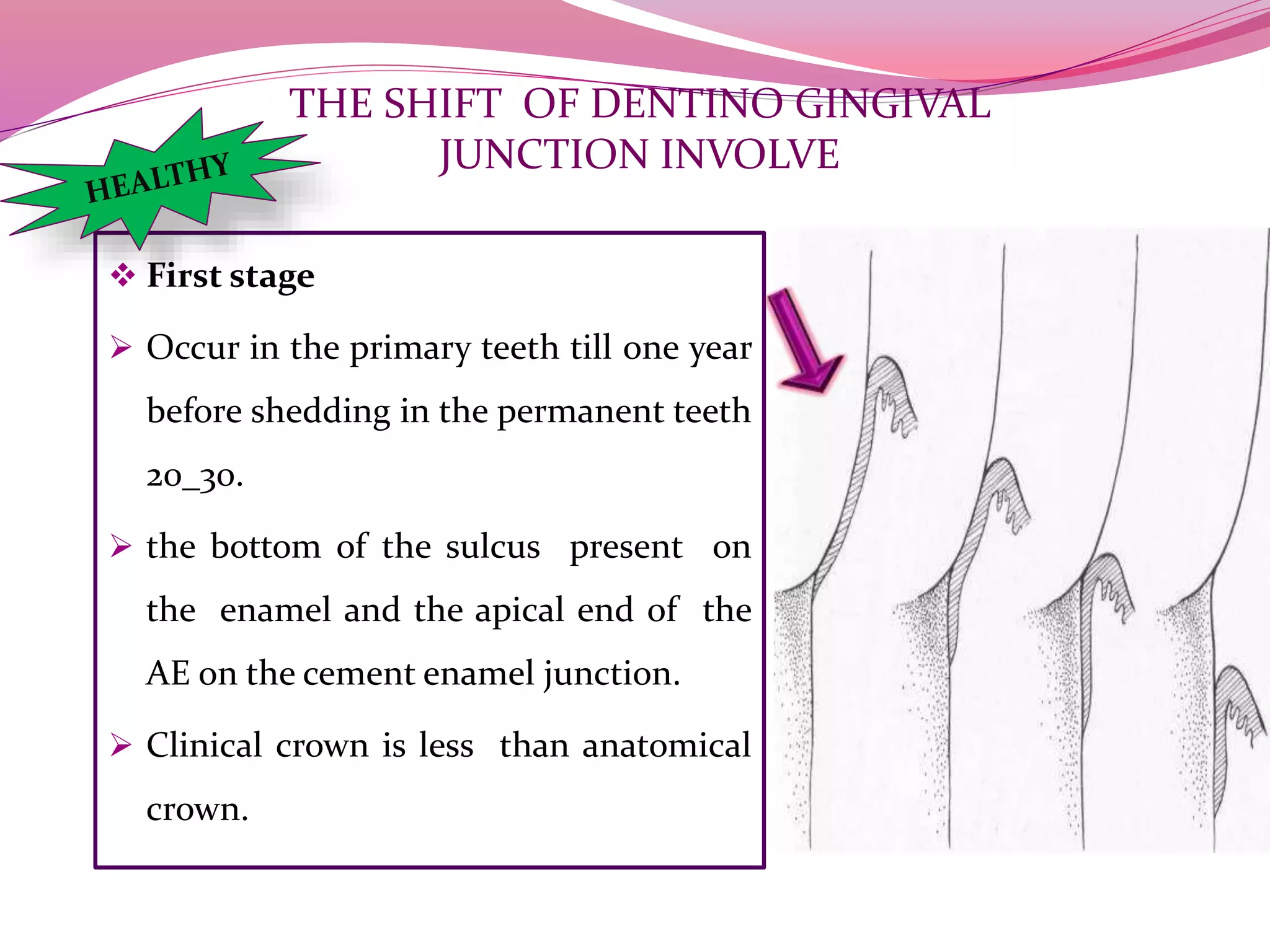
 First stage 
 Occur in the primary teeth till one year 
before shedding in the permanent teeth 
20_30. 
 the bottom of the sulcus present on 
the enamel and the apical end of the 
AE on the cement enamel junction. 
 Clinical crown is less than anatomical 
crown.
THE SHIFT OF DENTINO GINGIVAL 
JUNCTION INVOLVE 
 Second stage 
 Occur till age of the 40 or even later. 
 The bottom of the sulcus still present 
on the enamel and the apical end of the 
AE on cementum. 
 the clinical crown is less than 
anatomical crown.
THE SHIFT OF DENTINO GINGIVAL 
JUNCTION INVOLVE 
 Third stage 
 It is unhealthy condition. 
 The bottom of the sulcus present at the 
CEJ and the apical end at cementum. 
 The clinical crown equal to the 
anatomical crown.
THE SHIFT OF DENTINO GINGIVAL 
JUNCTION INVOLVE 
 Fourth stage 
 It is unhealthy condition. 
 From 60 years later . 
 The bottom of the sulcucs and apical 
end on the cementum. 
 The clinical crown is longer than 
anatomical crown
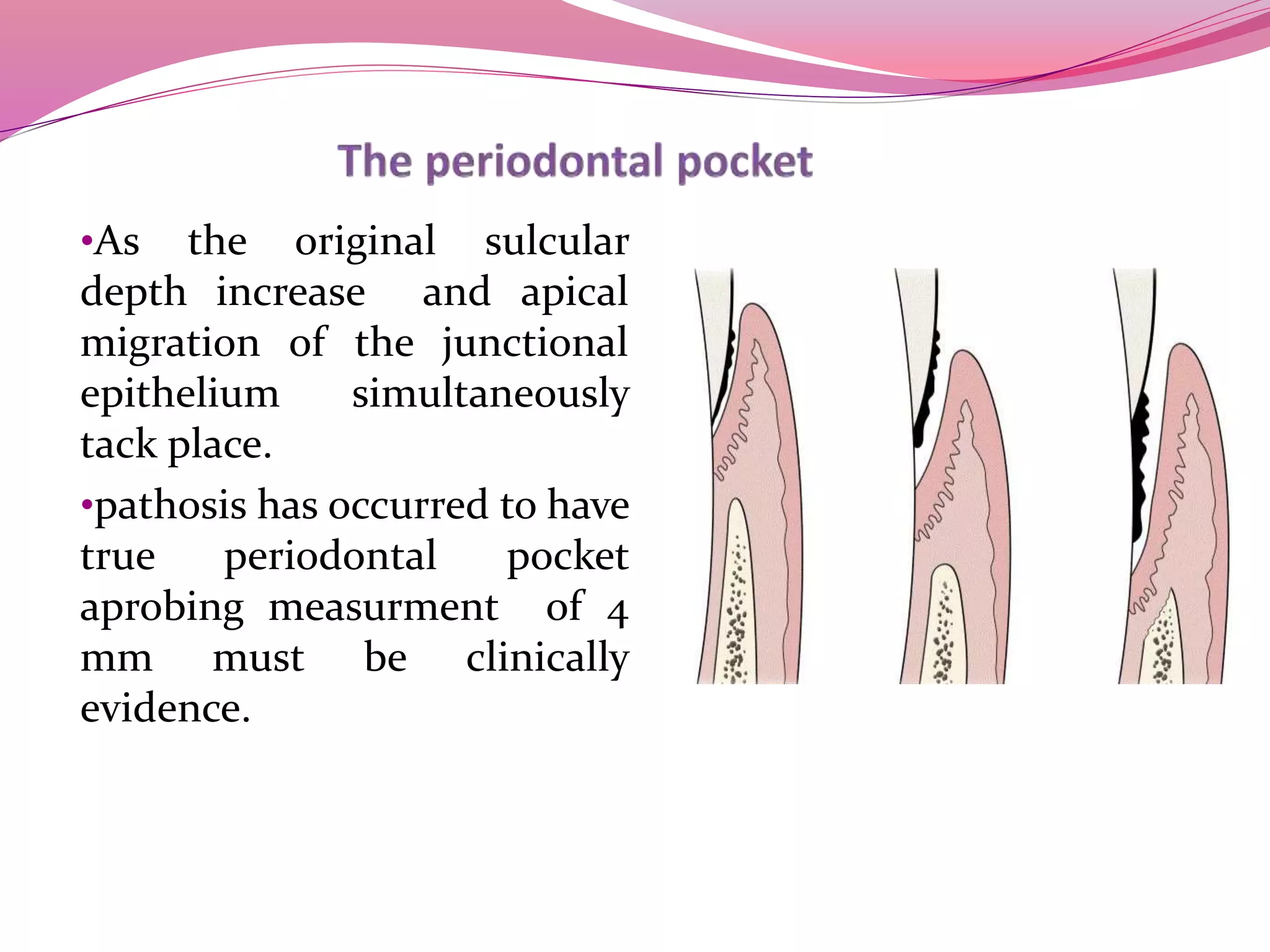
•As the original sulcular 
depth increase and apical 
migration of the junctional 
epithelium simultaneously 
tack place. 
•pathosis has occurred to have 
true periodontal pocket 
aprobing measurment of 4 
mm must be clinically 
evidence.
The periodontal pocket 
 It results in: 
1. A bluish-red vertical zone from 
the gingival margin to the 
alveolar mucosa. 
2. Gingival bleeding. 
3. Suppuration & tooth mobility 
4. And diastema formation. 
 symptoms such as localized 
pain or pain "deep in the bone" 
are suggestive of the presence 
of periodontal pockets
Done by: 
Ban mohammed

Dentinogingival junction

  • 3.
    The gingival sulcus is an area of potential space between a tooth and the surrounding gingival tissue. It is lined by two entities: -Apically by the gingival fibers of connective tissue attachment . _Coronally by free gingival margin .
  • 4.
    The gingival sulcus Under normal conditions the depth of the sulcus is variable.45% of all measured sulci are below 0.5 mm ,the average sulcus is 1.8mm the shallower sulcus is the more likely that the gingival margin is not inflamed
  • 6.
    THE SULCULAR EPITHELIUM Its stratified squamous epithelium ,non keratinized . Para keratinized that is continuous with the oral epithelium and lines the lateral surface of the sulcus . Its lacks epithelial ridges so forms a smooth contact with lamina properia
  • 7.
    THE SULCULAR EPITHELIUM Apically it overlaps the coronal border of the junctional epithelium this epithelium shares many of the characteristics of oral epithelium including good resistance to mechanical forces and relative impermeability to fluid and cells
  • 9.
    the junctional epithelium Its the stratified non keratinizing epithelium that surround the tooth like a collar . its attached by one broad surface to the tooth and by the other to the gingival connective tissue The junctional epithelium has two basal lamina: oOne that faces the tooth (internal basal lamina ) oThe other faces connective tissue (external basal lamina)
  • 10.
    the junctional epithelium The desquamative shedding surface of the junctional epithelium is located at its coronal end which also forms the bottom of the gingival sulcus The junctional epithelium is more permeable than oral or sulcular epithelium It serves as the perferential route for the passage of bacterial products from the sulcus in to connective tissue into the sulcus
  • 12.
    THE SULCULAR EPITHELIUMTHE JUNCTION EPITHELIUM 1. It is epithelium that surround the tooth like a collar . 2. It is more permeable than oral or sulcular epithelium It serves as the perferential route for the passage of bacterial products from the sulcus in to connective tissue and fluid and cells from C.T into the sulcus 1. It is continuous with the oral epithelium and lines the lateral surface of the sulcus . 2. It characterized by good resistance to mechanical forces and relative impermeability to fluid and cells
  • 13.
    Development of thejunctioanal epithelium As the erupting tooth approaches the overlying epithelium, the external cells of the reduced enamel epithelium proliferate, causing the epithelial covering of the enamel to thicken.
  • 14.
    Development of thejunctioanal epithelium  Proliferation of the externel cells of the reduced enamel epithelium begins around the cusp tips and slowly progresses toward the cervix of the tooth
  • 15.
    Development of thejunctioanal epithelium proliferating cells eventually displace any remaining reduced ameloblasts, thus replacing the relatively inert reduced enamel epithelium with an epithelial collar of cells with a high turnover rate. This collar of cells with a high turnover rate is the early junctional epithelium. Eventually, the entire reduced enamel epithelium will become replaced by junctional epithelium.
  • 17.
    Development of thejunctioanal epithelium After accomplishing of amelogenesis (protective stage) the ameloblast secrete or leave structure less material on enamel surface primary enamel cuticle . The enamel organ becomes reduced in thickness (reduced enamel epithelium ) and function as aprotection against contact with connective tissue ,to inhibit cementum deposition or enamel resorption The reduced enamel epi thelium consists of two layers 1-the reduced ameloblast 2-remnant of the dental organ
  • 18.
    Development of thejunctioanal epithelium The ameloblast develop hemidesmosomes to attach the reduced enamel epithelium to the surface of the enamel at the time of eruption the reduced enamel epithelium secrete desmolytic enzymes causing degenerating of the of the c.t present between it and the oral mucosa (desmolytic stage of amelo blasts ) The outer layer of the reduced enamel epithelium and the cells of the oral epithelium proliferate into the degenerated c.t. to form amass of cells over the erupting tooth the epithelial plug.
  • 20.
    Development of thejunctioanal epithelium Cell death in th middle portion of plug cause formation of epithelial lined canal through which tooth will erupt with out hemorrhage Once the tip of the crown appear in the oral cavity reduced enamel epithelium will be called primary attached epithelium And the the shallow groove present between the tooth and the gingiva is called GINGIVAL SULCUS The cells of primary attached epithelium (PAE) originate from reduced enamel epithelium and attached to tooth by primary enamel cuticle When primary attachment epithelium is replaced by oral epithelium its called secondary attached epithelium that attaches by secondary enamel cuticle.
  • 21.
    Primary enamel cuticleSecondary enamel cuticle 1. Binds secondary attached epithelium to the enamel surface 2. It is formed finally when the teeth erupt 1. Binds primary attached epithelium to the enamel surface 2. It is formed initially at the protective stage Primary attached epi. Secondary attached epi. 1. It is Primary attachment epithelium replaced by oral epithelium 2. attached by secondary enamel cuticle 1. originate from reduced enamel epithelium 2. attached to tooth by primary enamel cuticle
  • 22.
    Shift of thedento gingival junction  The dentogingival junction is an anatomical and functional interface between the gingiva and the tooth structure.  Dento gingival junction is the region where the tooth is attached to gingival and is form as soon as the tooth erupts in the oral cavity.  It provides attachment of the gingiva to the enamel surface via hemidesmosomes  with time the position of the gingiva of the surface change
  • 23.
    Shift of thedento gingival junction  Components 1. Epithelial component is derived from reduced dental (enamel) epithelium and oral epithelium. 2. The connective tissue component is derived from the lamina propria of the oral mucosa.  The attachment of the functional epithelium to the tooth is reinforced with the gingival fibers, which brace the gingival against the tooth surface.
  • 24.
  • 25.
    Shift of thedento gingival junction almost entire enamel is covered by epithelium when the tip of the enamel first emerge through the mucous membrane of the oral cavity . the eruption of teeth continuous until it reach the plan of occlusion.  the firmness strength of the dentino gingival junction beacause of connective tissue attachment of epithelium to enamel is not week as the crown continuous on to the oral cavity the attachment separate from the enamel surface gradually
  • 27.
    Shift of thedento gingival junction  when the tip of the enamel first emerge through the mucous membrane of the oral cavity . one third to one fourth of enamel is still covered by the gingiva The actual movement of teeth towards occlusal plane called acitve eruption The separation of primary attached epithelium from the enamel surface called passive eruption
  • 28.
    THE SHIFT OFDENTINO GINGIVAL JUNCTION INVOLVE  First stage  Occur in the primary teeth till one year before shedding in the permanent teeth 20_30.  the bottom of the sulcus present on the enamel and the apical end of the AE on the cement enamel junction.  Clinical crown is less than anatomical crown.
  • 29.
    THE SHIFT OFDENTINO GINGIVAL JUNCTION INVOLVE  Second stage  Occur till age of the 40 or even later.  The bottom of the sulcus still present on the enamel and the apical end of the AE on cementum.  the clinical crown is less than anatomical crown.
  • 30.
    THE SHIFT OFDENTINO GINGIVAL JUNCTION INVOLVE  Third stage  It is unhealthy condition.  The bottom of the sulcus present at the CEJ and the apical end at cementum.  The clinical crown equal to the anatomical crown.
  • 31.
    THE SHIFT OFDENTINO GINGIVAL JUNCTION INVOLVE  Fourth stage  It is unhealthy condition.  From 60 years later .  The bottom of the sulcucs and apical end on the cementum.  The clinical crown is longer than anatomical crown
  • 32.
    •As the originalsulcular depth increase and apical migration of the junctional epithelium simultaneously tack place. •pathosis has occurred to have true periodontal pocket aprobing measurment of 4 mm must be clinically evidence.
  • 33.
    The periodontal pocket  It results in: 1. A bluish-red vertical zone from the gingival margin to the alveolar mucosa. 2. Gingival bleeding. 3. Suppuration & tooth mobility 4. And diastema formation.  symptoms such as localized pain or pain "deep in the bone" are suggestive of the presence of periodontal pockets
  • 34.
    Done by: Banmohammed

Editor's Notes

  • #18 The enamel organ becomes reduced in thickness (reduced enamel epithelium ) and function as aprotection against contact with connective tissue ,to inhibit cementum deposition or enamel resorption