TISSUE CONDITIONERS
Index
Introduction
Composition
Uses of Tissue Conditioners
   Adjuncts for Tissue Healing
   Temporary Obturator
   Stabilization of Baseplates & Surgical Splints or Stents
   Adjunct to an impression or as a Final Impression
   Material
   Adjunct to Determine the Potential Benefits of a
   Treatment Modality
   Procedure for Applying Tissue Conditioners
      oPreparation of dentures
      oMixing and placement of the tissue conditioner
Care and Maintenance
Conclusion
References
Introduction
In 1967 Kydd and Mandley stated that tissue lining materials
permit wider dispersion of forces and hence, aid to decrease the
force per unit area transmitted to the supporting tissues.
For practical purposes, denture base materials are made of
rigid materials.
The dentist must recognize that the prolonged contact of these
bases with the underlying tissues is bound to elicit changes in the
tissues.
Mucosal health may be promoted by hygienic and therapeutic
measures and tissue-conditioning techniques may be applied
when appropriate.
Composition
Tissue conditioners are composed of polyethylmethacrylate and
a mixture of aromatic ester and ethyl alcohol.
Tissue conditioners are available as three component systems
   Polymer(Powder)
   Monomer(Liquid)
   Liquid plasticizer(Flow control)
A gel is formed when these materials are mixed, with the ethyl
alcohol having a greater affinity for the polymer.
Uses of Tissue Conditioners
Tissue treatment
Temporary obturator
Baseplate stabilization
To diagnose the outcome outcome of resilient liners
Liners in surgical splints
Trial denture base
Functional impression material
Adjuncts for Tissue Healing
Advantage of using tissue conditioner is that they prepare the
selected oral structures to withstand all the stress from the
prosthesis.
Tissue conditioners are generally used to preserve the residual
ridge.
Also used to heal irritated hyperemic tissues prior to denture
fabrication.
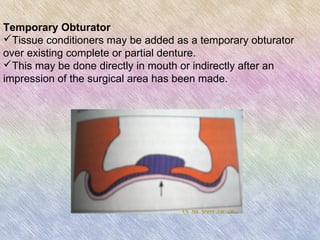
Temporary Obturator
Tissue conditioners may be added as a temporary obturator
over existing complete or partial denture.
This may be done directly in mouth or indirectly after an
impression of the surgical area has been made.
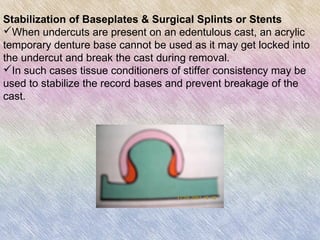
Stabilization of Baseplates & Surgical Splints or Stents
When undercuts are present on an edentulous cast, an acrylic
temporary denture base cannot be used as it may get locked into
the undercut and break the cast during removal.
In such cases tissue conditioners of stiffer consistency may be
used to stabilize the record bases and prevent breakage of the
cast.
Adjuncts to an Impression or as a Final Impression Material
These materials are used when it is difficult to determine the
extent of the denture base due to presence of movable oral
structures.
These materials record the extension of the denture in a
dynamic form that will later help in preparing an impression tray
for the final impression.
Adjunct to determine the
Potential Benefits of a Treatment Modality
Sometimes patients with well constructed dentures develop
chronic soreness and find it difficult to wear the dentures
comfortably.
Tissue conditioners can be used to determine if this problem can
be resolved with the use of resilient liner.
Procedure for Applying Tissue Conditioners
The following steps must be considered while applying
tissue conditioners on a denture.
Preparation of the dentures
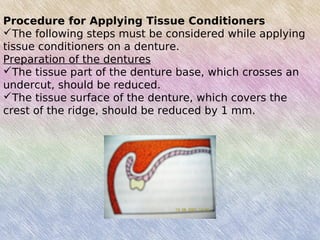
The tissue part of the denture base, which crosses an
undercut, should be reduced.
The tissue surface of the denture, which covers the
crest of the ridge, should be reduced by 1 mm.
It should be remembered that the dentures should allow
sufficient room for the placement of the tissue conditioner in order
to promote the recovery of displaced and traumatized tissues.
Mixing & placement of the tissue conditioner
Tissue conditioners are available as three component systems
    Polymer(Powder)
    Monomer(Liquid)
    Liquid plasticizer(Flow control)
The mixing ratio can be changed according to consistency
required. A ratio of 1.25 parts of polymer, 1 part monomer and
0.5cc plasticizer is usually recommended. The plasticizer should
be added to the monomer.
The ingredients are mixed to form a gel, which is applied in
sufficient thickness to the tissue surface of the denture.
The denture is inserted and border movememts are carried out
to mould the setting material.
Care & maintenance
Tissue conditioners should not be cleaned by scrubbing with a
hard brush in order to prevent tearing of the material. The use of
soft brush under running water is recommended.
The greatest virtue of tissue conditioners is their versatility and
ease of use.
The biggest flaw is that they are also misused.
Their longevity against wear is very limited and they tend to
harden and roughen within 4 to 8 weeks due to the loss of
plasticizer. Hence, they require observation.
Conclusion
Although tissue conditioners can be easily used but the
prolonged contact of these bases may elicit changes in the
underlying tissues, they may traumatize the oral tissues.
References
Boucher’s Prosthodontic Treatment For Edentulous Patients –
George A. Zarb, Charles L. Bolender, Gunnar E. Carlsson
Essentials of Complete Denture Prosthodontics – Sheldon
Winkler
Prosthodontics for Elderly – Ejvind Budtz, Jorgensen, Dr. Odont

Tissue-conditioners

  • 1.
  • 2.
    Index Introduction Composition Uses of TissueConditioners Adjuncts for Tissue Healing Temporary Obturator Stabilization of Baseplates & Surgical Splints or Stents Adjunct to an impression or as a Final Impression Material Adjunct to Determine the Potential Benefits of a Treatment Modality Procedure for Applying Tissue Conditioners oPreparation of dentures oMixing and placement of the tissue conditioner Care and Maintenance Conclusion References
  • 3.
    Introduction In 1967 Kyddand Mandley stated that tissue lining materials permit wider dispersion of forces and hence, aid to decrease the force per unit area transmitted to the supporting tissues. For practical purposes, denture base materials are made of rigid materials. The dentist must recognize that the prolonged contact of these bases with the underlying tissues is bound to elicit changes in the tissues. Mucosal health may be promoted by hygienic and therapeutic measures and tissue-conditioning techniques may be applied when appropriate.
  • 4.
    Composition Tissue conditioners arecomposed of polyethylmethacrylate and a mixture of aromatic ester and ethyl alcohol. Tissue conditioners are available as three component systems Polymer(Powder) Monomer(Liquid) Liquid plasticizer(Flow control) A gel is formed when these materials are mixed, with the ethyl alcohol having a greater affinity for the polymer.
  • 5.
    Uses of TissueConditioners Tissue treatment Temporary obturator Baseplate stabilization To diagnose the outcome outcome of resilient liners Liners in surgical splints Trial denture base Functional impression material
  • 6.
    Adjuncts for TissueHealing Advantage of using tissue conditioner is that they prepare the selected oral structures to withstand all the stress from the prosthesis. Tissue conditioners are generally used to preserve the residual ridge. Also used to heal irritated hyperemic tissues prior to denture fabrication.
  • 7.
    Temporary Obturator Tissue conditionersmay be added as a temporary obturator over existing complete or partial denture. This may be done directly in mouth or indirectly after an impression of the surgical area has been made.
  • 8.
    Stabilization of Baseplates& Surgical Splints or Stents When undercuts are present on an edentulous cast, an acrylic temporary denture base cannot be used as it may get locked into the undercut and break the cast during removal. In such cases tissue conditioners of stiffer consistency may be used to stabilize the record bases and prevent breakage of the cast.
  • 9.
    Adjuncts to anImpression or as a Final Impression Material These materials are used when it is difficult to determine the extent of the denture base due to presence of movable oral structures. These materials record the extension of the denture in a dynamic form that will later help in preparing an impression tray for the final impression.
  • 10.
    Adjunct to determinethe Potential Benefits of a Treatment Modality Sometimes patients with well constructed dentures develop chronic soreness and find it difficult to wear the dentures comfortably. Tissue conditioners can be used to determine if this problem can be resolved with the use of resilient liner.
  • 11.
    Procedure for ApplyingTissue Conditioners The following steps must be considered while applying tissue conditioners on a denture. Preparation of the dentures The tissue part of the denture base, which crosses an undercut, should be reduced. The tissue surface of the denture, which covers the crest of the ridge, should be reduced by 1 mm.
  • 12.
    It should beremembered that the dentures should allow sufficient room for the placement of the tissue conditioner in order to promote the recovery of displaced and traumatized tissues. Mixing & placement of the tissue conditioner Tissue conditioners are available as three component systems Polymer(Powder) Monomer(Liquid) Liquid plasticizer(Flow control) The mixing ratio can be changed according to consistency required. A ratio of 1.25 parts of polymer, 1 part monomer and 0.5cc plasticizer is usually recommended. The plasticizer should be added to the monomer. The ingredients are mixed to form a gel, which is applied in sufficient thickness to the tissue surface of the denture. The denture is inserted and border movememts are carried out to mould the setting material.
  • 13.
    Care & maintenance Tissueconditioners should not be cleaned by scrubbing with a hard brush in order to prevent tearing of the material. The use of soft brush under running water is recommended. The greatest virtue of tissue conditioners is their versatility and ease of use. The biggest flaw is that they are also misused. Their longevity against wear is very limited and they tend to harden and roughen within 4 to 8 weeks due to the loss of plasticizer. Hence, they require observation.
  • 14.
    Conclusion Although tissue conditionerscan be easily used but the prolonged contact of these bases may elicit changes in the underlying tissues, they may traumatize the oral tissues.
  • 15.
    References Boucher’s Prosthodontic TreatmentFor Edentulous Patients – George A. Zarb, Charles L. Bolender, Gunnar E. Carlsson Essentials of Complete Denture Prosthodontics – Sheldon Winkler Prosthodontics for Elderly – Ejvind Budtz, Jorgensen, Dr. Odont