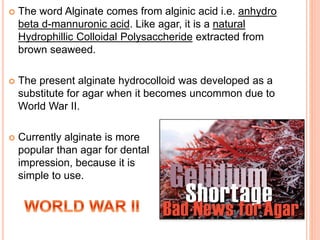
 The word Alginate comes from alginic acid i.e. anhydro
beta d-mannuronic acid. Like agar, it is a natural
Hydrophillic Colloidal Polysaccheride extracted from
brown seaweed.
 The present alginate hydrocolloid was developed as a
substitute for agar when it becomes uncommon due to
World War II.
 Currently alginate is more
popular than agar for dental
impression, because it is
simple to use.
Alginate is supplied as:-
 bulk packing
 Preweighed packets for
individual impression
A plastic scoop is supplied
for taking the bulk powder.
A plastic cylinder is also
supplied for measuring the
water.
In general 16g
of powder ( 2
scoops ) is
mixed with 38
ml of water.
COMPOSITION OF ALGINATE HYDROCOLLOID
Ingredients % by wt. Functions
Soluble alginates
ex.- Sodium or Potassium
or Triethanolamine
alginate
15% Dissolve in water and form a viscous sol
being soluble in nature
Calcium sulphate
( Reactor )
16% Reacts with soluble alginates and form
insoluble calcium alginate
Zinc Oxide 4% Act as a filler particle
Potassium Titanium
Fluoride
3% Act as accelerator for the setting of a
stone to be poured in impression to
ensure hard, dense surface of a cast.
Diatomaceous Earth 60% Also act as a filler , provide strength and
stiffness
Sodium Phosphate
( Retarder )
2% Reacts with calcium sulphate there by
retard the setting of impression
Coloring and flavouring
agent
traces For the comfort of patient
SETTING REACTION / GELATION PROCESS
 When a alginate powder is mixed with water, a sol is
formed which later sets to gel by a chemical reaction.
 Insoluble calcium alginate is produced when soluble
sodium alginate reacts with calcium sulphate.
 However, this reaction is too fast, there is not enough
working time, so a reaction is delayed by addition of a
retarder i.e. sodium phosphate.
 Calcium sulphate prefers to react with retarder first.
 It reacts with sodium or potassium alginates only when
the supply of retarder is over.
 This will delays the reaction and increase the working
time for us.
Retarder Reactor
ReactorSoluble Alginate Insoluble Alginate
CLASSIFICATION
 Type I – Fast Setting
 Type II – Normal Setting
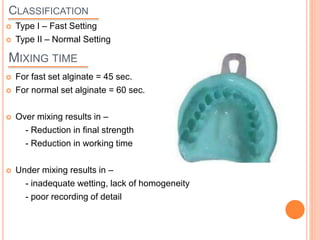
MIXING TIME
 For fast set alginate = 45 sec.
 For normal set alginate = 60 sec.
 Over mixing results in –
- Reduction in final strength
- Reduction in working time
 Under mixing results in –
- inadequate wetting, lack of homogeneity
- poor recording of detail
WORKING TIME
 For fast set alginate – 1 min. 25 sec.
 For normal set alginate – 2 min.
GELATION TIME
 For fast setting alginate – 1.5 to 2.0 min.
 For normal setting alginate – 3 to 4.5 min.
 Ideal gelation time is 3-4 min.
 The dentist can control the setting time by altering the
temperature of water for mixing alginate material.
- colder the water longer is the gelation time
- warmer the water shorter is the gelation time
 Control of setting time by changing w/p ratio is not
recommended in case of alginate.
PROPERTIES OF ALGINATE HYDROCOLLOID
 Taste and Odour –
Alginate has a pleasant taste and smell for the comfort of a patient.
Flavors include strawberry, orange, mint, vanilla.
 Strength –
Alginate has a poor tear strength.
Factors affecting strength are:-
- w/p ratio too much or too little water reduces gel strength
- Mixing time over and under mixing both will reduces strength
- Time of removal of impression strength increases if the time of
removal is delayed for few minutes after setting
 Syneresis and Imbibition –
Like agar, it also exhibit the properties of synresis and imbibition.
 Dimensional stability –
Set alginates have poor dimensional stability due to evaporation,
syneresis and imbibition. Therefore like in case of Agar, cast should be
poured immediately.
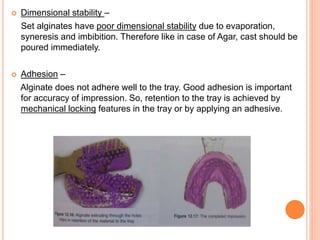
 Adhesion –
Alginate does not adhere well to the tray. Good adhesion is important
for accuracy of impression. So, retention to the tray is achieved by
mechanical locking features in the tray or by applying an adhesive.
1. It is easy to mix and manipulate.
2. Minimum requirement of
equipments.
3. Low cost.
4. Comfortable to patient
5. Accuracy is there if properly
handled.
6. Gives a good surface detail even
in presence of saliva.
1. It cannot be corrected.
2. Poor dimensional stability – it
cannot be store for a long time.
3. Poor tear strength.
4. It is not recommended where a
high degree of accuracy is
required, e.g., RPDs and FPDs
etc.
ADVANTAGES DISADVANTAGES
USES OF ALGINATE HYDROCOLLOID
 It is used for impression making
- when there are undercuts
- in mouth with excessive flow of saliva
- for partial dentures with clasp
 For making a preliminary impression for complete
dentures.
 For duplicating models.
LAMINATE TECHNIQUE
 It is the combined agar-alginate technique.
 In this technique
- Tray material chilled alginate
- syringe material hot agar
 Advantages –
1. water cool tray is not required more convenient
2. syringe agar records the tissue more accurately
3. it sets faster than regular agar technique
 Disadvantages –
1. Agar alginate bond failure.
METHOD OF LAMINATE TECHNIQUE
 After injecting a syringe agar on the area to be recorded, an
impression tray containing a mix of chilled alginate is positioned over
it that will bond with the agar.
 The alginate get solidify by means of chemical reaction whereas agar
solidify through contact with cool alginate rather than the water
circulating through the tray.
 Since the agar, not the alginate is in contact with prepared teeth,
maximum detail is reproduced.
 Because only the syringe material needs to be heated, equipment
cost is lowered and less preparation time is required.
MODIFIED ALGINATES
 Traditional alginate material is used as a two
component system of powder and water in which
no reaction occur until powder is added to water to
initiate the reaction.
 But now we can purchase alginate in a sol form,
containing the water but has no source of calcium
ions. MODIFIED ALGINATE
 Then a reactor of plaster of paris can then be
added to a sol
Alginate Dental Material

Alginate Dental Material

  • 2.
     The wordAlginate comes from alginic acid i.e. anhydro beta d-mannuronic acid. Like agar, it is a natural Hydrophillic Colloidal Polysaccheride extracted from brown seaweed.  The present alginate hydrocolloid was developed as a substitute for agar when it becomes uncommon due to World War II.  Currently alginate is more popular than agar for dental impression, because it is simple to use.
  • 3.
    Alginate is suppliedas:-  bulk packing  Preweighed packets for individual impression A plastic scoop is supplied for taking the bulk powder. A plastic cylinder is also supplied for measuring the water. In general 16g of powder ( 2 scoops ) is mixed with 38 ml of water.
  • 4.
    COMPOSITION OF ALGINATEHYDROCOLLOID Ingredients % by wt. Functions Soluble alginates ex.- Sodium or Potassium or Triethanolamine alginate 15% Dissolve in water and form a viscous sol being soluble in nature Calcium sulphate ( Reactor ) 16% Reacts with soluble alginates and form insoluble calcium alginate Zinc Oxide 4% Act as a filler particle Potassium Titanium Fluoride 3% Act as accelerator for the setting of a stone to be poured in impression to ensure hard, dense surface of a cast. Diatomaceous Earth 60% Also act as a filler , provide strength and stiffness Sodium Phosphate ( Retarder ) 2% Reacts with calcium sulphate there by retard the setting of impression Coloring and flavouring agent traces For the comfort of patient
  • 5.
    SETTING REACTION /GELATION PROCESS  When a alginate powder is mixed with water, a sol is formed which later sets to gel by a chemical reaction.  Insoluble calcium alginate is produced when soluble sodium alginate reacts with calcium sulphate.  However, this reaction is too fast, there is not enough working time, so a reaction is delayed by addition of a retarder i.e. sodium phosphate.
  • 6.
     Calcium sulphateprefers to react with retarder first.  It reacts with sodium or potassium alginates only when the supply of retarder is over.  This will delays the reaction and increase the working time for us. Retarder Reactor ReactorSoluble Alginate Insoluble Alginate
  • 7.
    CLASSIFICATION  Type I– Fast Setting  Type II – Normal Setting MIXING TIME  For fast set alginate = 45 sec.  For normal set alginate = 60 sec.  Over mixing results in – - Reduction in final strength - Reduction in working time  Under mixing results in – - inadequate wetting, lack of homogeneity - poor recording of detail
  • 8.
    WORKING TIME  Forfast set alginate – 1 min. 25 sec.  For normal set alginate – 2 min. GELATION TIME  For fast setting alginate – 1.5 to 2.0 min.  For normal setting alginate – 3 to 4.5 min.  Ideal gelation time is 3-4 min.  The dentist can control the setting time by altering the temperature of water for mixing alginate material. - colder the water longer is the gelation time - warmer the water shorter is the gelation time  Control of setting time by changing w/p ratio is not recommended in case of alginate.
  • 9.
    PROPERTIES OF ALGINATEHYDROCOLLOID  Taste and Odour – Alginate has a pleasant taste and smell for the comfort of a patient. Flavors include strawberry, orange, mint, vanilla.  Strength – Alginate has a poor tear strength. Factors affecting strength are:- - w/p ratio too much or too little water reduces gel strength - Mixing time over and under mixing both will reduces strength - Time of removal of impression strength increases if the time of removal is delayed for few minutes after setting  Syneresis and Imbibition – Like agar, it also exhibit the properties of synresis and imbibition.
  • 10.
     Dimensional stability– Set alginates have poor dimensional stability due to evaporation, syneresis and imbibition. Therefore like in case of Agar, cast should be poured immediately.  Adhesion – Alginate does not adhere well to the tray. Good adhesion is important for accuracy of impression. So, retention to the tray is achieved by mechanical locking features in the tray or by applying an adhesive.
  • 11.
    1. It iseasy to mix and manipulate. 2. Minimum requirement of equipments. 3. Low cost. 4. Comfortable to patient 5. Accuracy is there if properly handled. 6. Gives a good surface detail even in presence of saliva. 1. It cannot be corrected. 2. Poor dimensional stability – it cannot be store for a long time. 3. Poor tear strength. 4. It is not recommended where a high degree of accuracy is required, e.g., RPDs and FPDs etc. ADVANTAGES DISADVANTAGES
  • 12.
    USES OF ALGINATEHYDROCOLLOID  It is used for impression making - when there are undercuts - in mouth with excessive flow of saliva - for partial dentures with clasp  For making a preliminary impression for complete dentures.  For duplicating models.
  • 14.
    LAMINATE TECHNIQUE  Itis the combined agar-alginate technique.  In this technique - Tray material chilled alginate - syringe material hot agar  Advantages – 1. water cool tray is not required more convenient 2. syringe agar records the tissue more accurately 3. it sets faster than regular agar technique  Disadvantages – 1. Agar alginate bond failure.
  • 15.
    METHOD OF LAMINATETECHNIQUE  After injecting a syringe agar on the area to be recorded, an impression tray containing a mix of chilled alginate is positioned over it that will bond with the agar.  The alginate get solidify by means of chemical reaction whereas agar solidify through contact with cool alginate rather than the water circulating through the tray.  Since the agar, not the alginate is in contact with prepared teeth, maximum detail is reproduced.  Because only the syringe material needs to be heated, equipment cost is lowered and less preparation time is required.
  • 16.
    MODIFIED ALGINATES  Traditionalalginate material is used as a two component system of powder and water in which no reaction occur until powder is added to water to initiate the reaction.  But now we can purchase alginate in a sol form, containing the water but has no source of calcium ions. MODIFIED ALGINATE  Then a reactor of plaster of paris can then be added to a sol