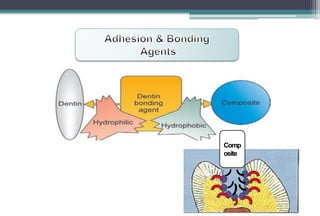

Comp
osite
1. Introduction
2. Definitions
3. History of Adhesive Dentistry
4. Indications for use of adhesive
5. Mechanism of Adhesion
6. Factors affecting Adhesion
7. Enamel Bonding
8. Dentin Bonding
9. Essentials or components
of dentin bonding system
Essentials or components
of dentin bonding system
- Etchant
- Primer
- Bonding agent
10. Classifications Of Modern
Bonding Agents
11. Total etch vs Self-etch
12. Etch and Rinse bonding systems
13. Self-etch bonding systems
14. 8th generation bonding agent
The Traditional “drill and fill” approach is fading now because
of numerous advancements taking
place in restorative dentistry.
For a restorative material, adhesion is the primary
requirement so that restorative
materials can be bonded to
enamel or dentin and without
the need of extensive tooth
preparation.
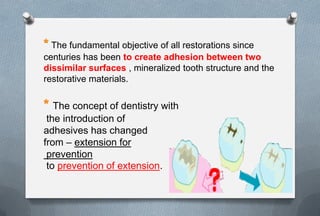
The fundamental objective of all restorations since
centuries has been to create adhesion between two
dissimilar surfaces , mineralized tooth structure and the
restorative materials.
The concept of dentistry with
the introduction of
adhesives has changed
from – extension for
prevention
to prevention of extension.
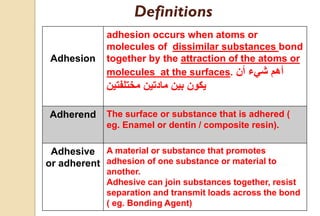
Adhesion
adhesion occurs when atoms or
molecules of dissimilar substances bond
together by the attraction of the atoms or
molecules at the surfaces. ‫أن‬ ‫شيء‬ ‫أهم‬
‫مختلفتين‬ ‫مادتين‬ ‫بين‬ ‫يكون‬
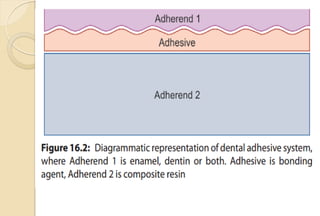
Adherend The surface or substance that is adhered (
eg. Enamel or dentin / composite resin).
Adhesive
or adherent
A material or substance that promotes
adhesion of one substance or material to
another.
Adhesive can join substances together, resist
separation and transmit loads across the bond
( eg. Bonding Agent)
Definitions
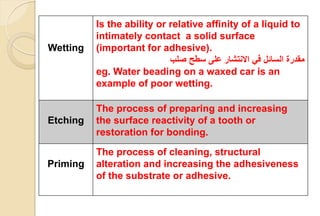
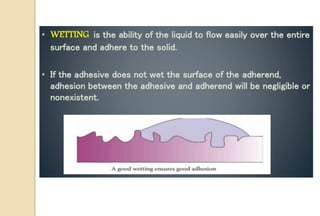
Wetting
Is the ability or relative affinity of a liquid to
intimately contact a solid surface
(important for adhesive).
‫مقدرة‬‫صلب‬ ‫سطح‬ ‫على‬ ‫االنتشار‬ ‫في‬ ‫السائل‬
eg. Water beading on a waxed car is an
example of poor wetting.
Etching
The process of preparing and increasing
the surface reactivity of a tooth or
restoration for bonding.
Priming
The process of cleaning, structural
alteration and increasing the adhesiveness
of the substrate or adhesive.
Bonding
Agent
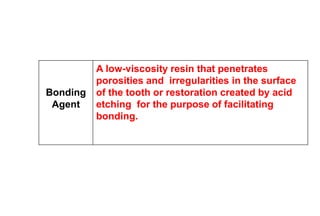
A low-viscosity resin that penetrates
porosities and irregularities in the surface
of the tooth or restoration created by acid
etching for the purpose of facilitating
bonding.
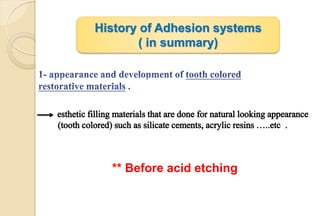
History of Adhesion systems
( in summary)
** Before acid etching
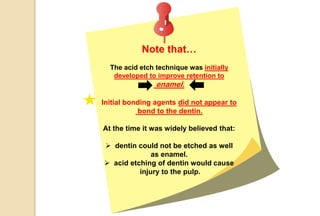
Note that…
The acid etch technique was initially
developed to improve retention to
enamel.
Initial bonding agents did not appear to
bond to the dentin.
At the time it was widely believed that:
 dentin could not be etched as well
as enamel.
 acid etching of dentin would cause
injury to the pulp.
dentin and enamel are etched simultaneously (demonstrated that
dentin could be etched without causing any significant harm to the
pulp) .
**The underlined words will be discussed later on .
Indications For Use Of Adhesives
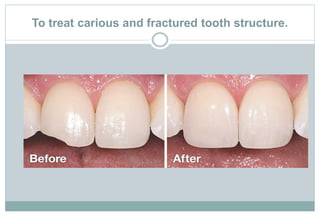
 To treat carious and fractured tooth structure.
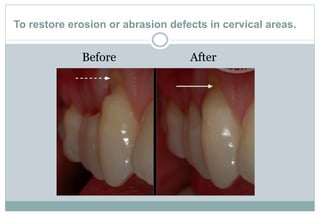
 To restore erosion or abrasion defects in cervical
areas.
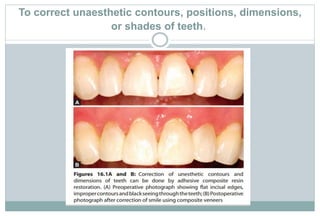
 To correct unaesthetic contours, positions ,
dimensions, or shades of teeth.
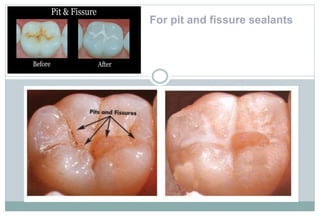
 For pit and fissure sealants
 To bond composite restoration
 To bond amalgam restoration
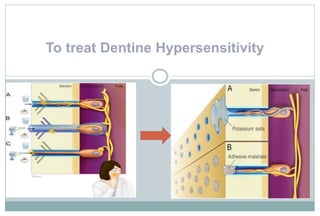
 To treat dentine hypersensitivity
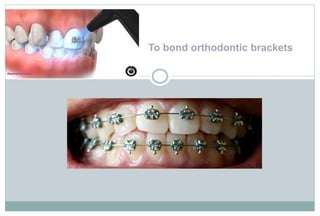
 To bond orthodontic brackets
To treat carious and fractured tooth structure.
To restore erosion or abrasion defects in cervical areas.
Before After
To correct unaesthetic contours, positions, dimensions,
or shades of teeth.
For pit and fissure sealants
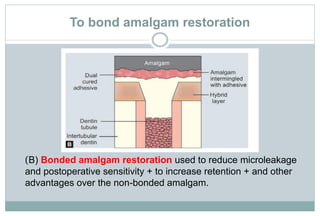
To bond amalgam restoration
To bond composite restoration
(B) Bonded amalgam restoration used to reduce microleakage
and postoperative sensitivity + to increase retention + and other
advantages over the non-bonded amalgam.
To treat Dentine Hypersensitivity
To bond orthodontic brackets
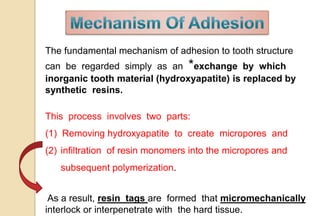
The fundamental mechanism of adhesion to tooth structure
can be regarded simply as an *exchange by which
inorganic tooth material (hydroxyapatite) is replaced by
synthetic resins.
This process involves two parts:
(1) Removing hydroxyapatite to create micropores and
(2) infiltration of resin monomers into the micropores and
subsequent polymerization.
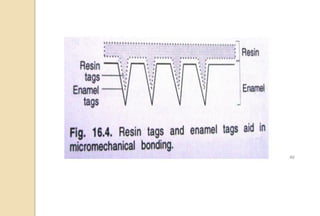
As a result, resin tags are formed that micromechanically
interlock or interpenetrate with the hard tissue.
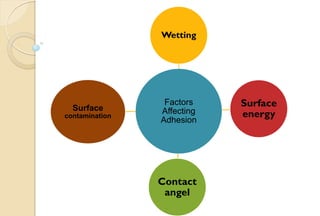
Factors
Affecting
Adhesion
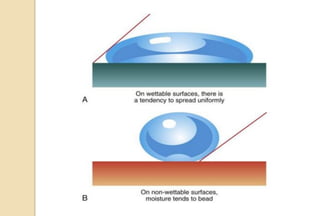
Wetting
Surface
energy
Contact
angel
Surface
contamination
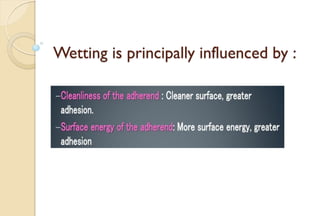
Wetting is principally influenced by :
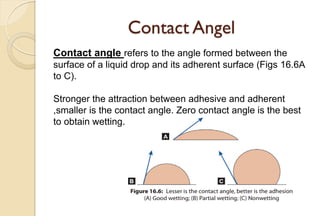
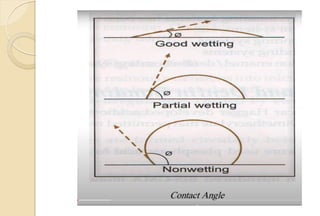
Contact Angel
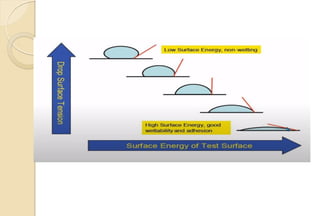
Contact angle refers to the angle formed between the
surface of a liquid drop and its adherent surface (Figs 16.6A
to C).
Stronger the attraction between adhesive and adherent
,smaller is the contact angle. Zero contact angle is the best
to obtain wetting.
Surface Energy
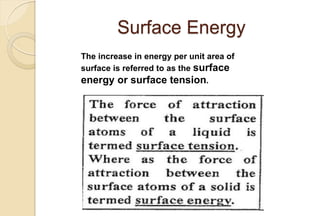
The increase in energy per unit area of
surface is referred to as the surface
energy or surface tension.
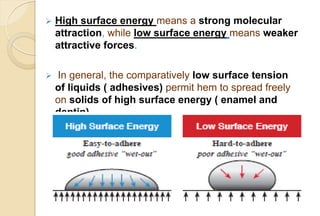
 High surface energy means a strong molecular
attraction, while low surface energy means weaker
attractive forces.
 In general, the comparatively low surface tension
of liquids ( adhesives) permit hem to spread freely
on solids of high surface energy ( enamel and
dentin) .
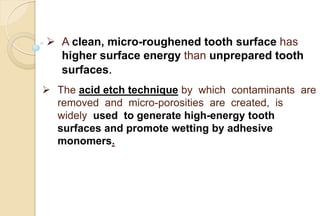
 A clean, micro-roughened tooth surface has
higher surface energy than unprepared tooth
surfaces.
 The acid etch technique by which contaminants are
removed and micro-porosities are created, is
widely used to generate high-energy tooth
surfaces and promote wetting by adhesive
monomers.
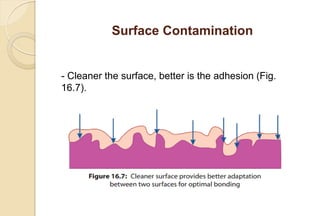
Surface Contamination
- Cleaner the surface, better is the adhesion (Fig.
16.7).
We will focus on the Dentin Bonding
Systems and Agents in more details
rather than Enamel Bonding .
 These were the earliest bond agents. Before the
total-etch technique was adopted, enamel bonding
agents were used only to enhance the wetting and
adaptation of resin to conditioned enamel surfaces.
 The enamel bond agent helped improve the bond by
flowing into all the micro-porosities of the etched
enamel and creating a micro-mechanical retention.
 They are unfilled resins similar to that of the resin matrix of
composite resin, diluted by other monomers to lower the
viscosity (The more viscous composite did not bond well to
the etched enamel). These materials have been replaced
by agents that bond to both enamel and dentin.
 Because enamel can be kept fairly dry, these rather
hydrophobic resins work well as long as they are
restricted to enamel .
Resin Composite”‫ال‬ ‫أو‬enamel bonding agents‫تذوب‬ ‫ال‬ ‫مركبات‬ ‫هي‬ ‫عام‬ ‫بشكل‬
‫الماء‬ ‫في‬(‫للماء‬ ‫كارهه‬),‫به‬ ‫تمسك‬ ‫ولن‬ ‫منه‬ ‫تقترب‬ ‫لن‬ ‫طريقها‬ ‫في‬ ‫الماء‬ ‫وجدت‬ ‫اذا‬ ‫لذلك‬!‫إن‬ ‫الحظ‬ ‫ولحسن‬
‫الـ‬Enamel‫للماء‬ ‫يفتقر‬(‫جدا‬ ‫قليلة‬ ‫كمية‬ ‫على‬ ‫يحتوي‬)‫ال‬ ‫فإن‬ ‫لذلك‬Resin‫منه‬ ‫ويقترب‬ ‫سيقبله‬..
‫يكفي‬ ‫ال‬ ‫وحده‬ ‫االقتراب‬ ‫لكن‬!‫إللتصاق‬ ‫بحاجة‬ ‫نحن‬!‫الحمض‬ ‫وضع‬ ‫بعد‬ ‫أنه‬ ‫حيث‬ ‫ميكانيكي‬ ‫بشكل‬ ‫يتم‬ ‫وهذا‬
Acid Etch‫الـ‬ ‫يزيل‬ ‫و‬ ‫السطح‬ ‫سيتخشن‬Debris‫من‬ ‫كبير‬ ‫عدد‬ ‫فيتكون‬small undercuts‫يدخل‬
‫الـ‬ ‫تحتها‬Resin‫يلتصق‬ ‫يتصلب‬ ‫وعندما‬!“
‫ال‬ ‫الخالصة‬Enamel‫الـ‬ ‫و‬Resin‫بينهم‬ ‫لواسطة‬ ‫بحاجة‬ ‫وليسو‬ ‫أصدقاء‬.
 Resin bonds easily to enamel.
 Bonding to dentin has been proven more difficult and less
reliable and predictable than enamel. This is because of
difference in morphologic, histologic , complex microstructure
and compositional differences between the two.
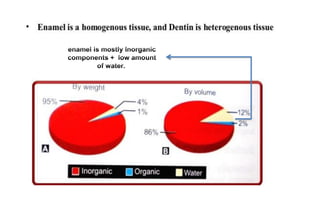
 Dentin is heterogeneous compared to enamel .
 The high water content interferes with bonding
(hydrophilic surface). Its tubular nature provides a
variable area.
 Presence of a smear layer on the cut dentin surface (The
smear layer is the layer of debris which adheres tightly to the
dentin and fills the tubules after cavity cutting).
 Developing agents that will adhere to dentin was
more difficult because:
 It is heterogeneous .
 The high water content interferes with bonding
(hydrophilic surface). Its tubular nature provides
a variable area.
 Presence of a smear layer on the cut dentin surface
(The smear layer is the layer of debris which
adheres tightly to the dentin and fills the tubules
after cavity cutting).
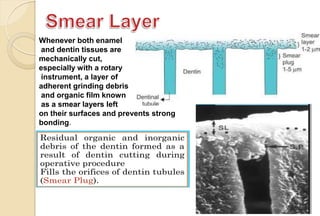
Whenever both enamel
and dentin tissues are
mechanically cut,
especially with a rotary
instrument, a layer of
adherent grinding debris
and organic film known
as a smear layers left
on their surfaces and prevents strong
bonding.
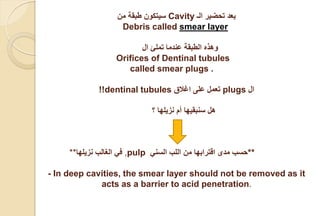
‫الـ‬ ‫تحضير‬ ‫بعد‬Cavity‫من‬ ‫طبقة‬ ‫سيتكون‬
smear layerDebris called
‫ال‬ ‫تملئ‬ ‫عندما‬ ‫الطبقة‬ ‫وهذه‬
Orifices of Dentinal tubules
called smear plugs .
‫ال‬plugs‫اغالق‬ ‫على‬ ‫تعمل‬dentinal tubules!!
‫؟‬ ‫نزيلها‬ ‫أم‬ ‫سنبقيها‬ ‫هل‬
** ‫في‬‫الغالب‬‫نزيلها‬ ,pulp ‫السني‬ ‫اللب‬ ‫من‬ ‫اقترابها‬ ‫مدى‬ ‫**حسب‬
- In deep cavities, the smear layer should not be removed as it
acts as a barrier to acid penetration.
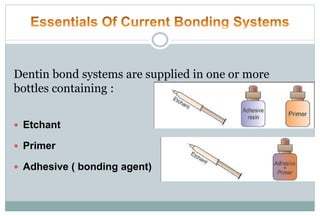
Dentin bond systems are supplied in one or more
bottles containing :
 Etchant
 Primer
 Adhesive ( bonding agent)
Definition:
The etchant is an acid which selectively dissolves the tooth
structure to provide retention for the restoration.
In more details, etchants are relatively strong acids (pH =1–2)
used to remove smear layers and to dissolve the mineral phase
to allow formation of micromechanical interlocking in enamel
and in dentin.
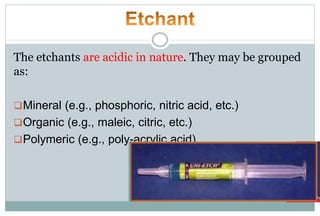
The etchants are acidic in nature. They may be grouped
as:
Mineral (e.g., phosphoric, nitric acid, etc.)
Organic (e.g., maleic, citric, etc.)
Polymeric (e.g., poly-acrylic acid)
 phosphoric acid at a concentration between 30% and
50%, typically 37%, is the preferred etching agent to
produce consistent etching patterns while not
damaging the pulp.
 Concentrations greater than > 50% result in
The deposition of an adherent layer of monocalcium
phosphate monohydrate on the etched surface, which
inhibits further dissolution.
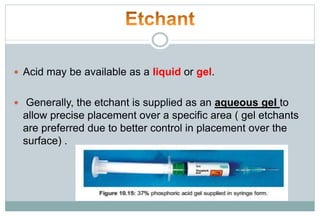
 Acid may be available as a liquid or gel.
 Generally, the etchant is supplied as an aqueous gel to
allow precise placement over a specific area ( gel etchants
are preferred due to better control in placement over the
surface) .
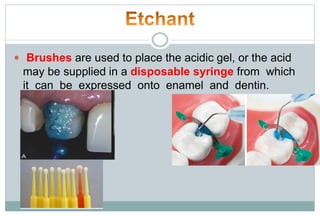
 Brushes are used to place the acidic gel, or the acid
may be supplied in a disposable syringe from which
it can be expressed onto enamel and dentin.
 The first step in the bonding process involves
preparation of the surface of the tooth to receive the
material that will be bonded to it .
 Preparing the tooth surface usually includes removing
plaque and debris and then etching or conditioning the
enamel and dentin with an acid .
 The most frequently used etchant is 37% phosphoric
acid. Acid removes mineral from the surface to create
roughness or microscopic porosity that aids in increasing
the surface energy of the solid surface (enamel and
dentin).
 Conditioning: It is the process of cleaning the surface and
activating the calcium ions, so as to make them more
reactive.
 Etching: It is the process of increasing the surface reactivity
by demineralizing the superficial calcium layer in enamel or
dentin to provide a micro-mechanical surface for the
retention of bonding agents .
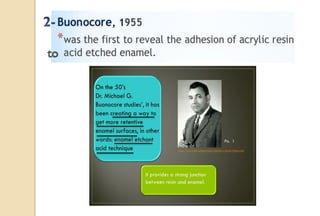
 The first meaningful demonstration of intraoral
adhesion was reported by Buonocore (1955).
 Buonocore etched enamel surfaces with various
acids, placed an acrylic restorative material on the
micromechanically roughened surfaces, and found a
great increase in the resin–enamel bond strength.
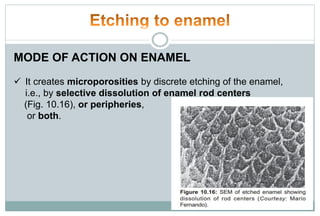
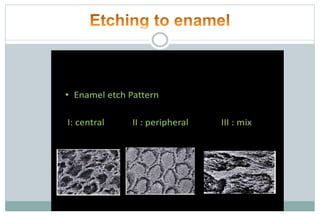
MODE OF ACTION ON ENAMEL
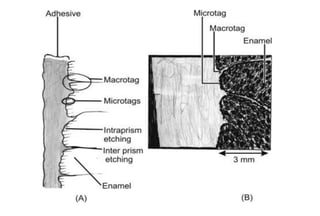
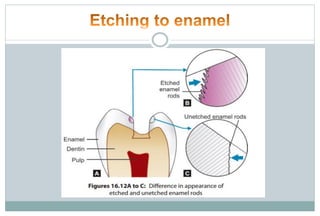
 It creates microporosities by discrete etching of the enamel,
i.e., by selective dissolution of enamel rod centers
(Fig. 10.16), or peripheries,
or both.
MODE OF ACTION ON ENAMEL
 Etching increases or enlarges the surface area ( increases
surface energy).
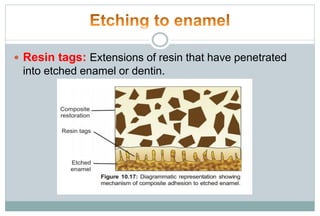
 Etched enamel has a high surface energy, allowing the resin
to wet the tooth surface better and penetrate into the
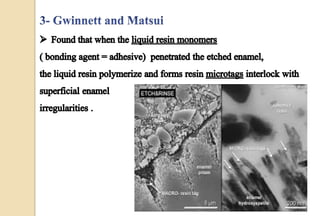
microporosities. When polymerized, it forms resin ‘tags’ which
forms a mechanical bond to the enamel (Fig. 10.17).
 Resin tags: Extensions of resin that have penetrated
into etched enamel or dentin.
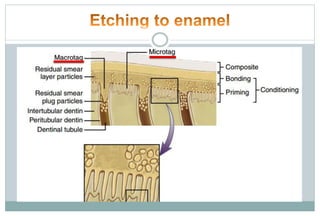
 Two types of resin tags interlock within the etch-pits:
Macrotags: form between enamel prisms peripheries ( in
a space surrounding the enamel prisms).
Microtags: form at the core of enamel (Finer network of
numerous small tags is formed across the end of each rod
where individual hydroxyapatite crystals were dissolved).
These microtags are more important due to their larger
number and greater surface area of contact.
4. Chemical nature of enamel
( whether enamel is fluoridated or demineralized, high fluoride
concentration makes enamel more resistance to etching).
5. Type of dentition, i.e. Primary or permanent
( Deciduous teeth require longer time for etching than permanent
teeth because of the presence of aprismatic enamel in deciduous
teeth) . Aprismatic Enamel is the structureless outer surface of
enamel that is more mineralized than the rest of enamel.
6. The physical state of the solution
( gels are more popular because they stay in place thus achieve wider
and deeper enamel penetration, whereas liquids tend to run without
control).
 Dentin Etching did not gain wide acceptance until Fusayama
introduced the total-etch concept.
 His study demonstrated that not only was restoration
retention substantially increased but also pulp damage did not
occur as had been generally assumed.
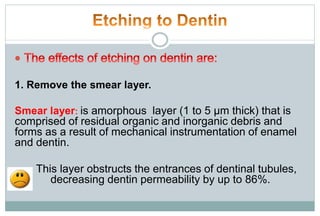
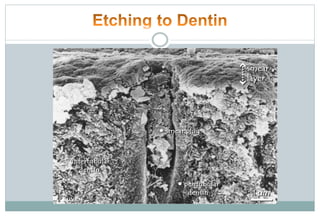
1. Remove the smear layer.
Smear layer: is amorphous layer (1 to 5 μm thick) that is
comprised of residual organic and inorganic debris and
forms as a result of mechanical instrumentation of enamel
and dentin.
This layer obstructs the entrances of dentinal tubules,
decreasing dentin permeability by up to 86%.
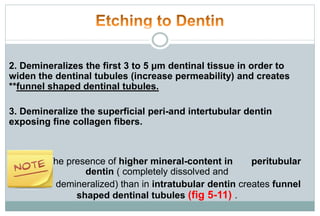
2. Demineralizes the first 3 to 5 μm dentinal tissue in order to
widen the dentinal tubules (increase permeability) and creates
**funnel shaped dentinal tubules.
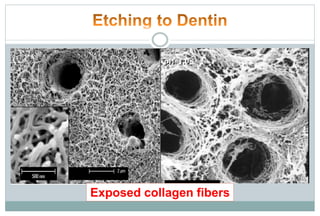
3. Demineralize the superficial peri-and intertubular dentin
exposing fine collagen fibers.
The presence of higher mineral-content in peritubular
dentin ( completely dissolved and
demineralized) than in intratubular dentin creates funnel
shaped dentinal tubules (fig 5-11) .
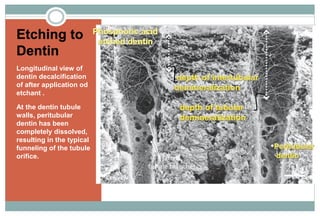
Longitudinal view of
dentin decalcification
of after application od
etchant .
At the dentin tubule
walls, peritubular
dentin has been
completely dissolved,
resulting in the typical
funneling of the tubule
orifice.
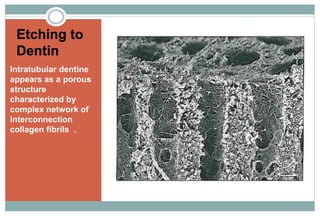
Intratubular dentine
appears as a porous
structure
characterized by
complex network of
interconnection
collagen fibrils .
Exposed collagen fibers
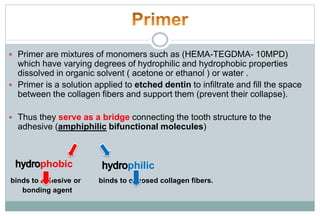
 Primer are mixtures of monomers such as (HEMA-TEGDMA- 10MPD)
which have varying degrees of hydrophilic and hydrophobic properties
dissolved in organic solvent ( acetone or ethanol ) or water .
 Primer is a solution applied to etched dentin to infiltrate and fill the space
between the collagen fibers and support them (prevent their collapse).
 Thus they serve as a bridge connecting the tooth structure to the
adhesive (amphiphilic bifunctional molecules)
binds to adhesive or binds to exposed collagen fibers.
bonding agent
philicphobic
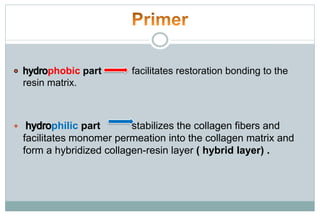
phobic part facilitates restoration bonding to the
resin matrix.
 philic part stabilizes the collagen fibers and
facilitates monomer permeation into the collagen matrix and
form a hybridized collagen-resin layer ( hybrid layer) .
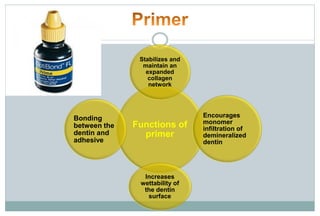
Functions of
primer
Stabilizes and
maintain an
expanded
collagen
network
Encourages
monomer
infiltration of
demineralized
dentin
Increases
wettability of
the dentin
surface
Bonding
between the
dentin and
adhesive
 Solvents (thinning agents) are added to :
reduce the viscosity of co-monomer blends hence increase
wetting and molecular wettability.
volatile solvents displace water (water chasing ability) from
the wet collagen network and dentinal surface
allowing monomers to penetrate the collagen fiber
network.
Water solvent can re-expand the collapsed collagen
network thus helping in better penetration and bonding
between resin and dentin.
 In wet bonding enamel, the primer should be always applied to acid-
etched enamel in order to displace residual moisture .
 In air dried enamel, application of primer is not necessary because the
bonding between enamel and the bonding agent is still effective.
A primer is more important
on dentin than enamel
because the primer contains
hydrophilic groups that penetrate
wet ,etched dentin and keep the
meshwork of collagen fibrils
expanded so that the adhesive
resin can penetrate.
Note that …
 Adhesive are generally hydrophobic monomers. Being
hydrophobic they do not wet the tooth leading to air
entrapment, air inhibition and thereby poor bonding. Thus they
have to be used in combination with primers to form an
effective bond to tooth structure.
Ideal Adhesive
 Considering the hydrophilic nature of the tooth especially dentin (
enamel exhibits low amount of water), it is logical that an adhesive also
should have a *hydrophilic nature when placed*in order to wet the
surface and penetrate the available microstructure.
 A *hydrophobic polymeric layer *is more insoluble and resistant to
erosion and degradation by acids and other components of oral
fluids than a more hydrophilic one.
Thus, the ideal adhesive would have a hydrophilic nature during
placement and would become much more hydrophobic after curing.
Such materials are not readily available to dentistry instead a
combination of hydrophobic and hydrophilic molecules are
used in modern adhesives.
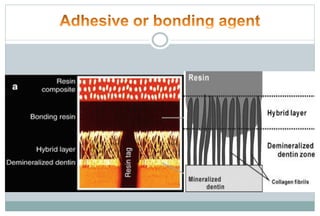
 The primer and adhesive penetrate the inter-tubular
dentin, forming a resin-dentin inter-diffusion zone, or “Hybrid Layer”
and infiltrate the tubules to form resin tags after their polymerization.
 Hybrid layer is an intermediate layer or a zone of material consists
of components of both bonding resin and dentin with the collagen
fibers, that is produced by acid etching of dentin(demineralized
dentin) and infiltration of resin into the etched dentin.
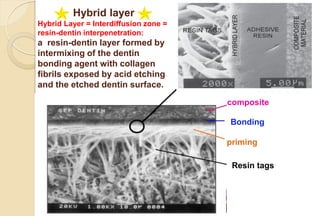
Hybrid layer
Hybrid Layer = Interdiffusion zone =
resin-dentin interpenetration:
a resin-dentin layer formed by
intermixing of the dentin
bonding agent with collagen
fibrils exposed by acid etching
and the etched dentin surface.
composite
Resin tags
priming
Bonding
 Generally, adhesive resins are composed mainly of
hydrophobic monomers such as (bis-GMA,
TEGDMA)
 At the same time, adhesives require a certain
hydrophilicity to diffuse into the hydrophilic, primer-
wetted dentin.
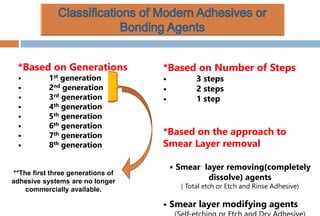
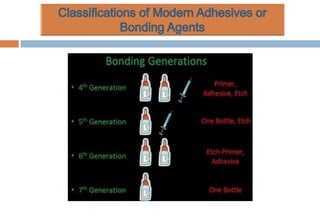
*Based on Generations
• 1st generation
• 2nd generation
• 3rd generation
• 4th generation
• 5th generation
• 6th generation
• 7th generation
• 8th generation
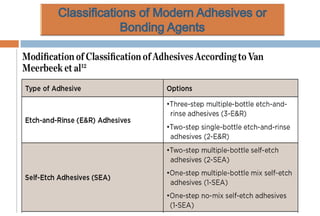
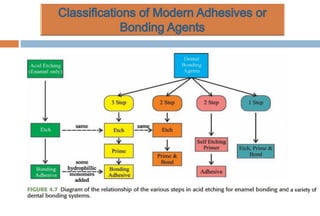
*Based on Number of Steps
• 3 steps
• 2 steps
• 1 step
*Based on the approach to
Smear Layer removal
• Smear layer removing(completely
dissolve) agents
( Total etch or Etch and Rinse Adhesive)
• Smear layer modifying agents
**The first three generations of
adhesive systems are no longer
commercially available.
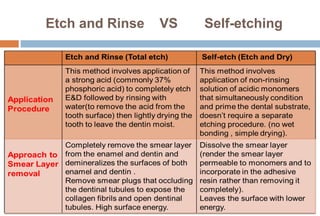
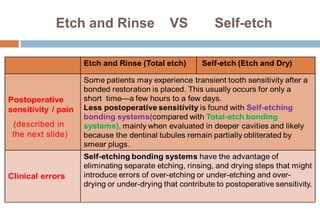
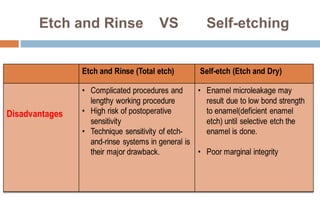
Etch and Rinse VS Self-etching
Etch and Rinse VS Self-etch
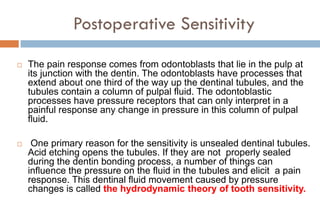
Postoperative Sensitivity
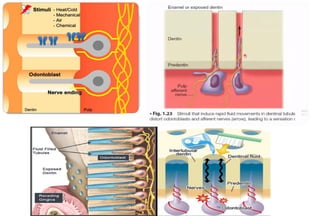
 The pain response comes from odontoblasts that lie in the pulp at
its junction with the dentin. The odontoblasts have processes that
extend about one third of the way up the dentinal tubules, and the
tubules contain a column of pulpal fluid. The odontoblastic
processes have pressure receptors that can only interpret in a
painful response any change in pressure in this column of pulpal
fluid.
 One primary reason for the sensitivity is unsealed dentinal tubules.
Acid etching opens the tubules. If they are not properly sealed
during the dentin bonding process, a number of things can
influence the pressure on the fluid in the tubules and elicit a pain
response. This dentinal fluid movement caused by pressure
changes is called the hydrodynamic theory of tooth sensitivity.
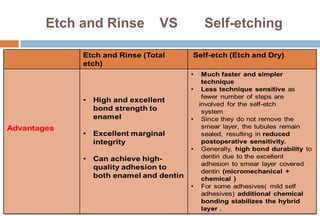
Etch and Rinse VS Self-etching
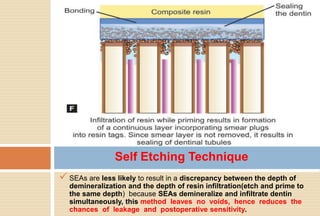
 SEAs are less likely to result in a discrepancy between the depth of
demineralization and the depth of resin infiltration(etch and prime to
the same depth) because SEAs demineralize and infiltrate dentin
simultaneously, this method leaves no voids, hence reduces the
chances of leakage and postoperative sensitivity.
Self Etching Technique
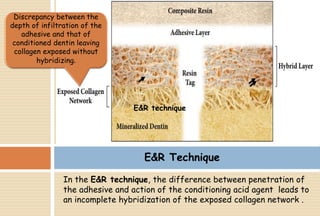
In the E&R technique, the difference between penetration of
the adhesive and action of the conditioning acid agent leads to
an incomplete hybridization of the exposed collagen network .
Discrepancy between the
depth of infiltration of the
adhesive and that of
conditioned dentin leaving
collagen exposed without
hybridizing.
E&R technique
E&R Technique
 Indications of self-etch bonding systems:-
1. Pediatric patients or uncooperative patients(physically and
mentally challenged), where simpler clinical steps are preferred.
2. Class V cavities, especially extending subgingivally, where
isolation is a challenge.
3. In deep class II cavities where isolation in the
gingival seat is difficult.
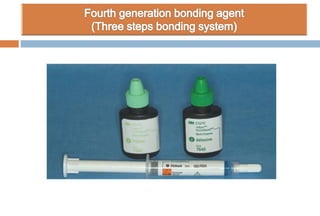
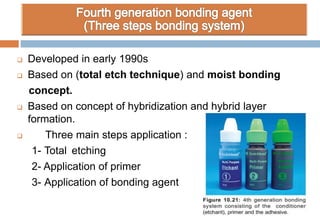
 Developed in early 1990s
 Based on (total etch technique) and moist bonding
concept.
 Based on concept of hybridization and hybrid layer
formation.
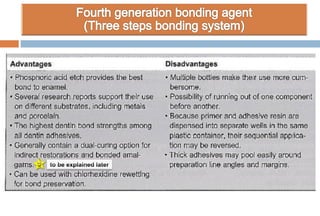
 Three main steps application :
1- Total etching
2- Application of primer
3- Application of bonding agent
 Step by step application of the three-step
etch and rinse adhesives
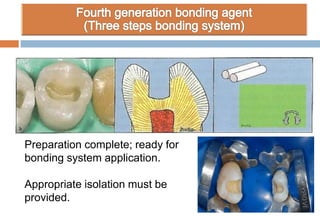
Preparation complete; ready for
bonding system application.
Appropriate isolation must be
provided.
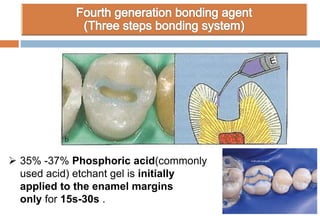
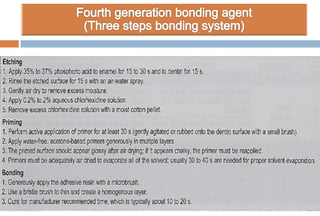
 35% -37% Phosphoric acid(commonly
used acid) etchant gel is initially
applied to the enamel margins
only for 15s-30s .
If enamel is etched for more than required time, it results in deeper etch.
Since a bonding agent has a high viscosity, surface tension effect of agent
does not allow its full penetration into etched enamel.
This results in ‘dead space’ beyond the bonded area. When enamel
bends , or weak resin based bond breaks off, the dead space gets exposed
to oral fluids.
These oral fluids have lower surface tension and thus penetrate into the
dead space
This may result in secondary caries or discoloration of the margins.
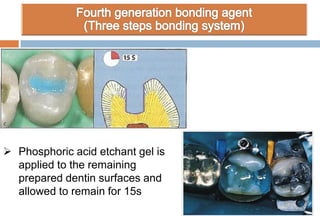
 Phosphoric acid etchant gel is
applied to the remaining
prepared dentin surfaces and
allowed to remain for 15s
Start applying the etchant to the
enamel first , and then to the dentin.
Over-etching dentin will open the tubules too
much and remove too much mineral
(hydroxyapatite) from the dentin surface.
Etching should be limited to superficial dentin
because the viscosity of primers and bonding
agents allows only a few micrometers of
impregnation.
Excessive etching or demineralization
produce weak zone and make the dentin tubules
more susceptible to incomplete infiltration
of resin monomers.
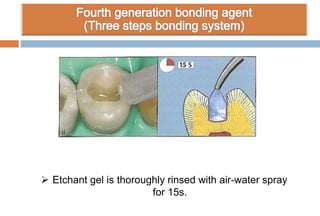
 Etchant gel is thoroughly rinsed with air-water spray
for 15s.
• Particular care should be taken to rinse
all silica and to ensure that is removed
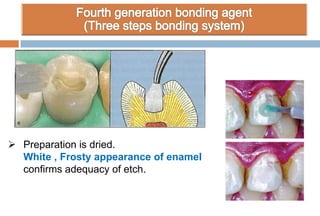
 Preparation is dried.
White , Frosty appearance of enamel
confirms adequacy of etch.
A very important clinical consideration is the application of Wet Bonding
Technique
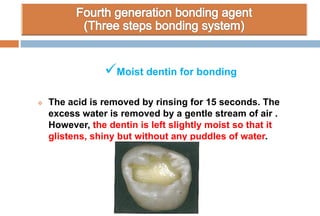
Moist dentin for bonding
 The acid is removed by rinsing for 15 seconds. The
excess water is removed by a gentle stream of air .
However, the dentin is left slightly moist so that it
glistens, shiny but without any puddles of water.
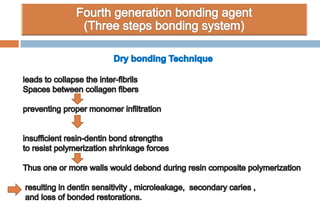
 Desiccation (excessive drying) of the dentin should be
avoided. Desiccation can result in the collapse of the collagen
mesh or network which forms a dense film that is difficult to
penetrate by the bond agent.
A moist cotton pellet can be applied to the dried dentin
surface for 30s to remoisten the dentin surface.
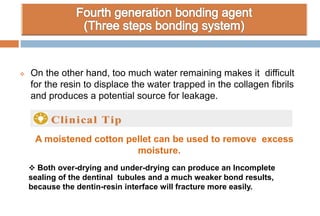
 On the other hand, too much water remaining makes it difficult
for the resin to displace the water trapped in the collagen fibrils
and produces a potential source for leakage.
A moistened cotton pellet can be used to remove excess
moisture.
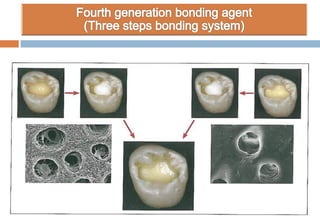
 Both over-drying and under-drying can produce an Incomplete
sealing of the dentinal tubules and a much weaker bond results,
because the dentin-resin interface will fracture more easily.
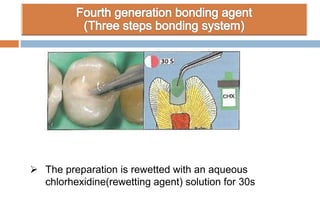
 The preparation is rewetted with an aqueous
chlorhexidine(rewetting agent) solution for 30s
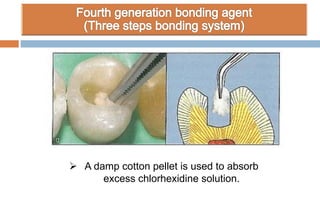
 A damp cotton pellet is used to absorb
excess chlorhexidine solution.
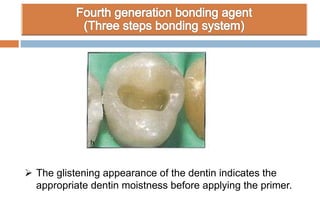
 The glistening appearance of the dentin indicates the
appropriate dentin moistness before applying the primer.
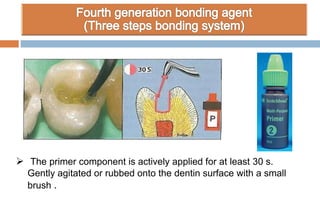
 The primer component is actively applied for at least 30 s.
Gently agitated or rubbed onto the dentin surface with a small
brush .
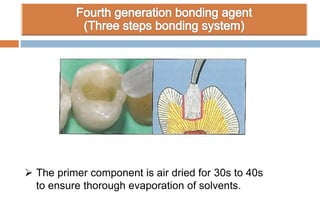
 The primer component is air dried for 30s to 40s
to ensure thorough evaporation of solvents.
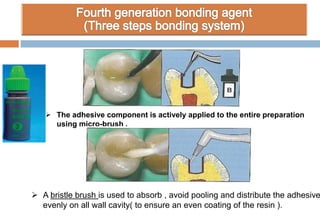
 The adhesive component is actively applied to the entire preparation
using micro-brush .
 A bristle brush is used to absorb , avoid pooling and distribute the adhesive
evenly on all wall cavity( to ensure an even coating of the resin ).
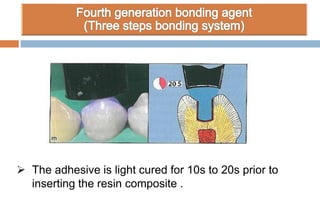
 The adhesive is light cured for 10s to 20s prior to
inserting the resin composite .
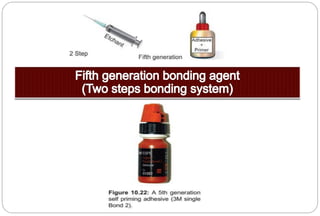
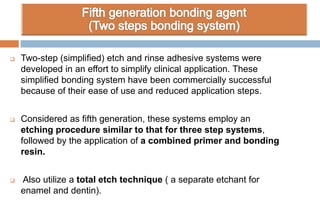
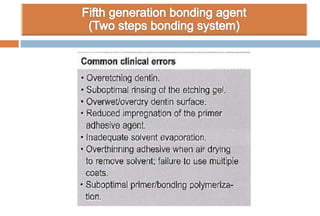
 Two-step (simplified) etch and rinse adhesive systems were
developed in an effort to simplify clinical application. These
simplified bonding system have been commercially successful
because of their ease of use and reduced application steps.
 Considered as fifth generation, these systems employ an
etching procedure similar to that for three step systems,
followed by the application of a combined primer and bonding
resin.
 Also utilize a total etch technique ( a separate etchant for
enamel and dentin).
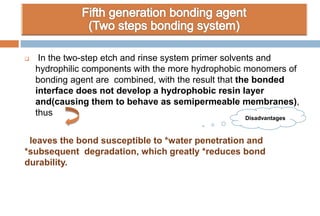
 In the two-step etch and rinse system primer solvents and
hydrophilic components with the more hydrophobic monomers of
bonding agent are combined, with the result that the bonded
interface does not develop a hydrophobic resin layer
and(causing them to behave as semipermeable membranes),
thus
leaves the bond susceptible to *water penetration and
*subsequent degradation, which greatly *reduces bond
durability.
Disadvantages
 The combined primer and bonding resins contain high concentrations
( up to 50%) of solvents that may interfere with adhesive
polymerization.
 Note:
solvent concentrations greater than 20% by weight usually lower the
degree of conversion ?? How ??
by increasing the physical space between reactive species during
polymerization.
 Step by step application of the two-step etch
and rinse adhesives
 Etching
• The considerations discussed for etching with three-step systems
also apply to the use of two-step etch and rinse adhesives.
• The dentinal tissue moisture level is even more critical than with
three-step etch and rinse adhesives ??why??
because two-step etch and rinse systems don’t have the rewetting
ability of primers used in three-step etch and rinse systems.
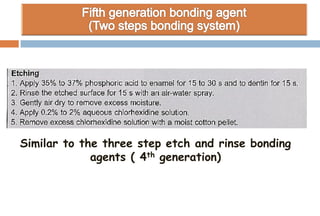
Similar to the three step etch and rinse bonding
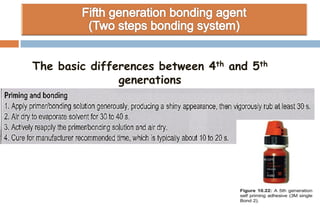
agents ( 4th generation)
The basic differences between 4th and 5th
generations
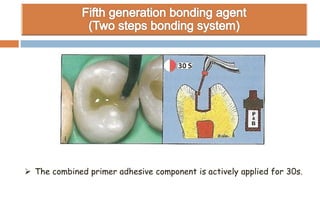
 The combined primer adhesive component is actively applied for 30s.
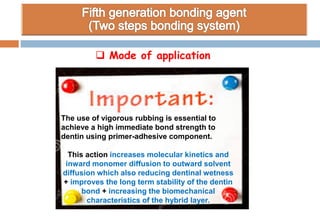
 Mode of application
The use of vigorous rubbing is essential to
achieve a high immediate bond strength to
dentin using primer-adhesive component.
This action increases molecular kinetics and
inward monomer diffusion to outward solvent
diffusion which also reducing dentinal wetness
+ improves the long term stability of the dentin
bond + increasing the biomechanical
characteristics of the hybrid layer.
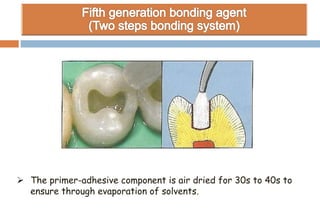
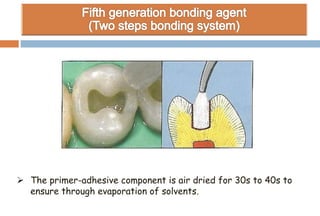
 The primer-adhesive component is air dried for 30s to 40s to
ensure through evaporation of solvents.
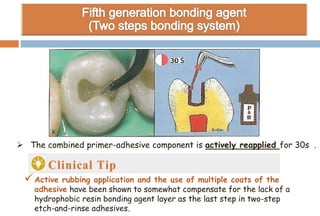
 The combined primer-adhesive component is actively reapplied for 30s .
Active rubbing application and the use of multiple coats of the
adhesive have been shown to somewhat compensate for the lack of a
hydrophobic resin bonding agent layer as the last step in two-step
etch-and-rinse adhesives.
 The primer-adhesive component is air dried for 30s to 40s to
ensure through evaporation of solvents.
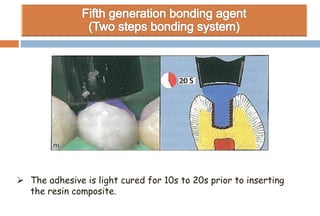
 The adhesive is light cured for 10s to 20s prior to inserting
the resin composite.
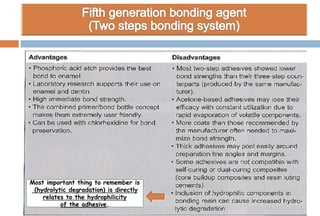
Most important thing to remember is
(hydrolytic degradation) is directly
relates to the hydrophilicity
of the adhesive.
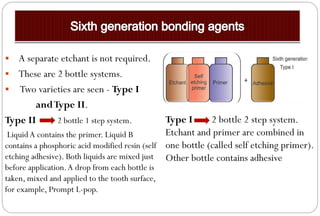
 A separate etchant is not required.
 These are 2 bottle systems.
 Two varieties are seen - Type I
andType II.
Type II 2 bottle 1 step system.
LiquidA contains the primer. Liquid B
contains a phosphoric acid modified resin (self
etching adhesive). Both liquids are mixed just
before application.A drop from each bottle is
taken, mixed and applied to the tooth surface,
for example, Prompt L-pop.
Type I 2 bottle 2 step system.
Etchant and primer are combined in
one bottle (called self etching primer).
Other bottle contains adhesive
 Type 1 2 bottle 2 step system
 Etchant and primer are combined in one bottle (called self etching primer).
Other bottle contains adhesive.
 Two-step self-etch adhesives (SEAs) contain an acidic monomer that
functions as a self-etching primer and a hydrophobic non-solvated bonding
resin.
 The acidic primers include performs two functions simultaneously—etching
and priming of dentin and enamel.
 No rinsing. In contrast to conventional etchants, the acidic primers are not
rinsed off.
 The bonding mechanism of SEAs is based on the simultaneous etching and
priming of enamel and dentin, forming a continuum in the substrate and
incorporating smear plugs into the resin tags.
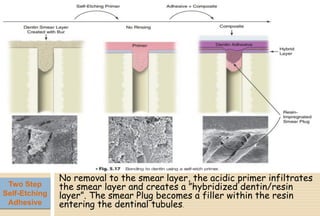
No removal to the smear layer, the acidic primer infiltrates
the smear layer and creates a ”hybridized dentin/resin
layer”. The smear Plug becomes a filler within the resin
entering the dentinal tubules.
Two Step
Self-Etching
Adhesive
 In addition to simplifying the bonding technique, the elimination of rinsing
and drying steps reduces the possibility of over-wetting or over-drying
dentin, either of which can affect adhesion adversely.
 Also, water is always a component of the acidic primer because it is
needed for the monomers to ionize and trigger demineralization
of hard dental tissues;
this makes SEAs less susceptible to variations in the degree of
substrate moisture.
 It has been suggested that the two-step self-etching systems should be
further subdivided by strength into:
 Strong (PH<1)
 Intermediately strong (PH =1 to 2 ≈1.5)
 Mild(PH=2)
 Ultra-mild(PH≥2.5)
 SEAs are less likely to result in a discrepancy between the
depth of demineralization and the depth of resin
infiltration(etch and prime to the same depth) because SEAs
demineralize and infiltrate dentin simultaneously, this
method leaves no voids, hence reduces the chances of
leakage and postoperative sensitivity ( mentioned previously).
Depending on the self-etching
(acidity) or demineralized
intensity
 The self-etching systems don’t involve a rinsing step and thus the
dissolved calcium phosphates remain in the hybrid layer( contribute to
buffering of the acidity of the solution).
 Self-etching and priming of enamel
 Clinically the application of primers that are weakly acidic have weak
bonds to enamel, especially uncut enamel .
 This is likely due to the less retentive enamel-etching pattern that is shallow
resulting in poor micromechanical and insufficient penetration into the
enamel surface.
 Therefore weak acids to enamel cannot produce the same extent of
demineralization and typical frosty appearance obtained by the use of
phosphoric acid .
 Although Some strong self-etching adhesives create demineralized enamel
that morphologically similar to that created by phosphoric acid, mild self
etching adhesives have shown unsatisfactory bonding to enamel(low
bond strength and poor marginal adaptation)
 Thus phosphoric acid should be preferred for enamel etching (selective
etching the enamel) .
To ensure a good bond to enamel, some manufacturers recommend
“selective etching,” meaning that enamel only should be etched with
phosphoric acid before the application of the self-etching bonding materials.
 Self-etching and priming of dentin
 Mild self-etching adhesives are preferred for dentin bonding . Such
adhesives partially demineralize dentin, leaving residual hydroxyapatite
crystals that protect the collagen fibrils.
 The lower the pH (e.g Strong self-etching adhesives), the more intense is
the dissolution process, such that more of calcium phosphates remain
embedded in the hybrid layer. Since these calcium phosphates are rather
soluble, they may leach out and compromise the long-term durability of the
bond to dentine.
 In other words, their high intrinsic acidity doesn’t allow complete
buffering from the dissolved hydroxyapatite, leading to continuous
etching and incomplete polymerization.
 The clinical success of mild two-step self-etching might be a result of its
chemical composition, specially the reactive monomer such as 10-MDP,
which has been shown to bond chemically with mineral component of
dentin(calcium in hydroxyapatite).
 Ionic bonds are formed between carboxylic acid or phosphate groups within
the functional or reactive monomers and the calcium in hydroxyapatite.
 The resulting hybrid layer exhibits both micromechanical interlocking and
chemical interaction.
 Why the selective etch technique ( using phosphoric acid ) isn’t
used on dentin?
Because the removal of smear layer created by the demineralization of dentin
during phosphoric acid etching
depletes most of the hydroxyapatite in dentin that could be available for such
chemical interaction,
which in turn reduces the bond strength created by mild two-step self etching
adhesives.
 That’s why manufactures of mild self etching adhesive
systems recommend that phosphoric acid etching be used
only on enamel .
Step by step application of the two step self etching
adhesives
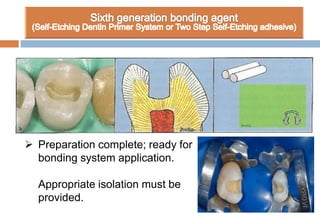
 Preparation complete; ready for
bonding system application.
Appropriate isolation must be
provided.
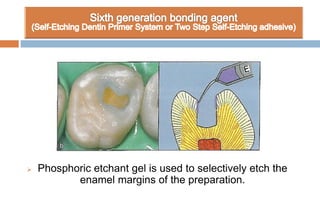
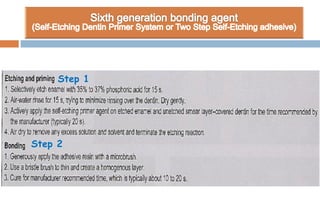
 Phosphoric etchant gel is used to selectively etch the
enamel margins of the preparation.
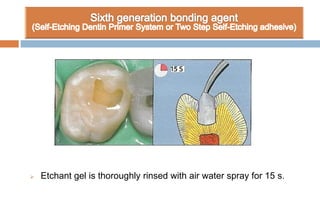
 Etchant gel is thoroughly rinsed with air water spray for 15 s.
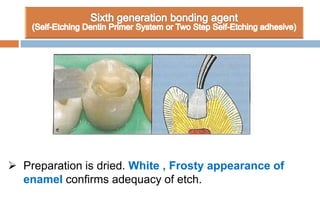
 Preparation is dried. White , Frosty appearance of
enamel confirms adequacy of etch.
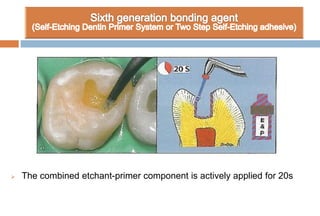
 The combined etchant-primer component is actively applied for 20s
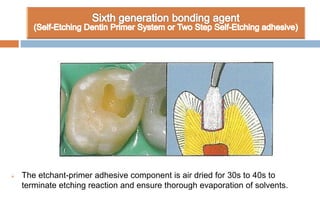
 The etchant-primer adhesive component is air dried for 30s to 40s to
terminate etching reaction and ensure thorough evaporation of solvents.
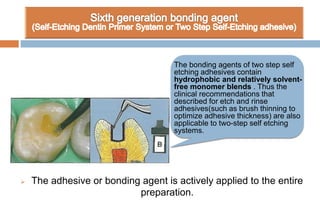
 The adhesive or bonding agent is actively applied to the entire
preparation.
The bonding agents of two step self
etching adhesives contain
hydrophobic and relatively solvent-
free monomer blends . Thus the
clinical recommendations that
described for etch and rinse
adhesives(such as brush thinning to
optimize adhesive thickness) are also
applicable to two-step self etching
systems.
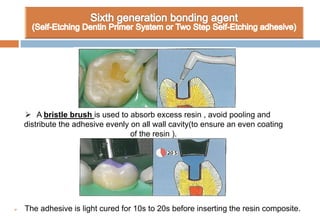
 The adhesive is light cured for 10s to 20s before inserting the resin composite.
 A bristle brush is used to absorb excess resin , avoid pooling and
distribute the adhesive evenly on all wall cavity(to ensure an even coating
of the resin ).
Step 1
Step 2
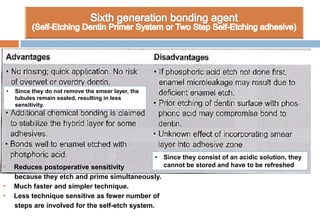
• Reduces postoperative sensitivity
because they etch and prime simultaneously.
• Much faster and simpler technique.
• Less technique sensitive as fewer number of
steps are involved for the self-etch system.
• Since they do not remove the smear layer, the
tubules remain sealed, resulting in less
sensitivity.
• Since they consist of an acidic solution, they
cannot be stored and have to be refreshed
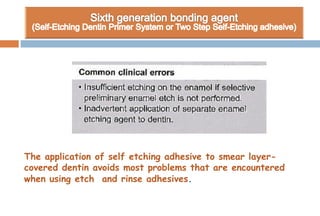
The application of self etching adhesive to smear layer-
covered dentin avoids most problems that are encountered
when using etch and rinse adhesives.
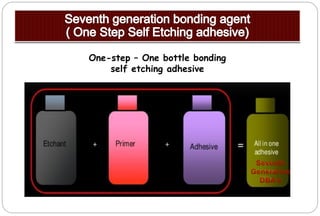
One-step – One bottle bonding
self etching adhesive
 Continuing the trend toward simplification, no-rinse self-etch materials
that incorporate the fundamental steps of etching, priming, and bonding
into one solution have become increasingly popular.
 One-step SEAs, which have etching, priming, and bonding functions
delivered in a single solution or bottle containing complex mixtures of
hydrophilic and hydrophobic resin blends, acid, and water to activate
etching. The chemical complexity has caused shelf-life problems.
 They achieve the same objective as the sixth generation systems
except that they simplified multiple sixth generation materials into a
single component, single bottle one step self etch adhesive, thus
avoiding any mistakes in mixing.
 This class of adhesives has the highest hydrophilic monomer content
and tend to behave as semipermeable membranes, facilitating hydrolytic
degradation of the resin–dentin interface.
 Thus, simplified adhesives demonstrate increased water sorption, which
promotes polymer swelling and other water-mediated degradation
phenomena.
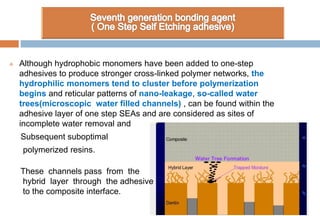
 Although hydrophobic monomers have been added to one-step
adhesives to produce stronger cross-linked polymer networks, the
hydrophilic monomers tend to cluster before polymerization
begins and reticular patterns of nano-leakage, so-called water
trees(microscopic water filled channels) , can be found within the
adhesive layer of one step SEAs and are considered as sites of
incomplete water removal and
Subsequent suboptimal
polymerized resins.
These channels pass from the
hybrid layer through the adhesive
to the composite interface.
Compared with multi-step self-etch and etch-and-rinse
versions, one-step self-etch adhesives consistently
achieve lower bond strengths.
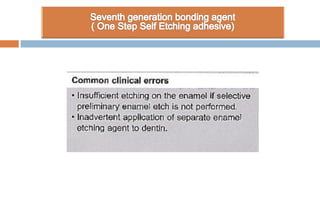
 Application to enamel
Like two step self etching adhesives one step systems have
demonstrated a reduced ability to bond to unabraded enamel.
For this reason, preliminary phosphoric acid etching of
enamel is recommended before the application of one-
step adhesives.
 Application of dentin
One step-self etching adhesives focused on several parameters to
improve the stability of dentin-adhesive interface :-
1) Preliminary etching self etching adhesive products are
intended to eliminate the need for phosphoric acid etching of dentin, thus
simplifying clinical application and reducing operator technique sensitivity.
2) Hydrophobic coating this approach may improve adhesive
performance the application of an additional hydrophobic resin layer has
been shown to improve immediate resin-dentin bond strength and reduce
long term adhesive interface degradation
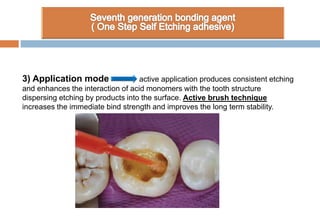
3) Application mode active application produces consistent etching
and enhances the interaction of acid monomers with the tooth structure
dispersing etching by products into the surface. Active brush technique
increases the immediate bind strength and improves the long term stability.
4) Application time and multi-layering the use of multi-
layering technique or prolonged application times during dentin bonding has
been suggested to enhance the uniformity of adhesive infiltration and increase
water and solvent evaporation.
5) Appropriate polymerization the use of extended curing times
that exceed the manufacture recommendations has been found to improve
polymerization and reduce permeability, potentially improving the performance of
one step adhesives.
Step by step application of the one-step self etching
adhesives ( 7th generation)
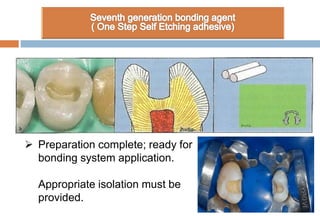
 Preparation complete; ready for
bonding system application.
Appropriate isolation must be
provided.
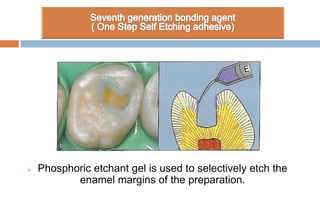
 Phosphoric etchant gel is used to selectively etch the
enamel margins of the preparation.
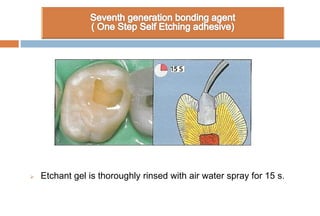
 Etchant gel is thoroughly rinsed with air water spray for 15 s.
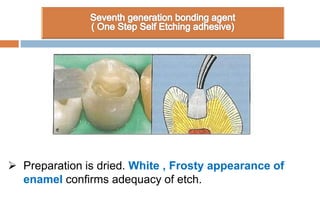
 Preparation is dried. White , Frosty appearance of
enamel confirms adequacy of etch.
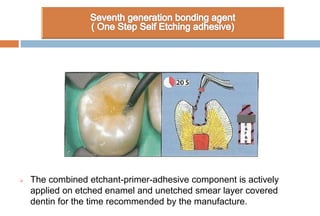
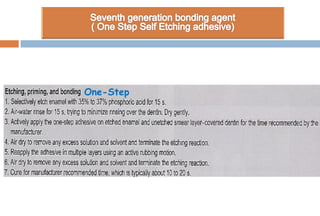
 The combined etchant-primer-adhesive component is actively
applied on etched enamel and unetched smear layer covered
dentin for the time recommended by the manufacture.
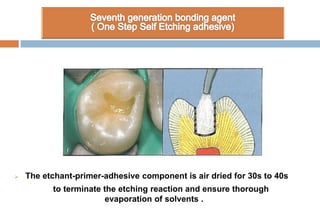
 The etchant-primer-adhesive component is air dried for 30s to 40s
to terminate the etching reaction and ensure thorough
evaporation of solvents .
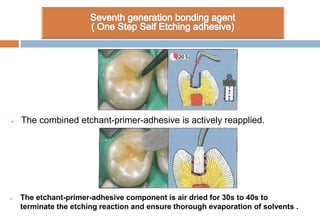
 The combined etchant-primer-adhesive is actively reapplied.
 The etchant-primer-adhesive component is air dried for 30s to 40s to
terminate the etching reaction and ensure thorough evaporation of solvents .
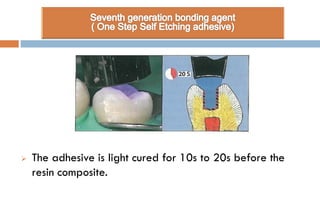
 The adhesive is light cured for 10s to 20s before the
resin composite.
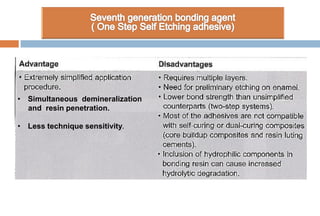
One-Step
• Simultaneous demineralization
and resin penetration.
• Less technique sensitivity.
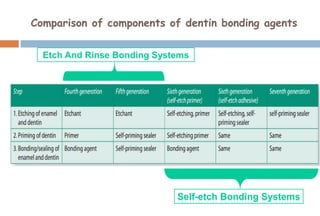
Etch And Rinse Bonding Systems
Self-etch Bonding Systems
Comparison of components of dentin bonding agents
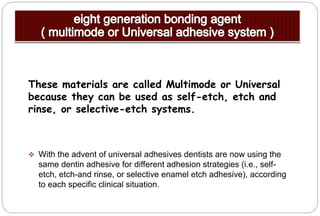
These materials are called Multimode or Universal
because they can be used as self-etch, etch and
rinse, or selective-etch systems.
 With the advent of universal adhesives dentists are now using the
same dentin adhesive for different adhesion strategies (i.e., self-
etch, etch-and rinse, or selective enamel etch adhesive), according
to each specific clinical situation.
 Can be used with light-cure, self-cure and dual cure materials
 Can be used for both direct and indirect restorations.
 Theses adhesives have the ability to bond methacrylate based
restoratives , cement , and sealant to all dental substrates such as
dentin , enamel , glass ionomer, metals , zirconia , and alumina .
 The reported strong bond strengths of these new materials is likely a
result of functional acidic monomer MDP contained within the
formulation of most UA . which has been shown to bond ionically to
hydroxyapatite.
 This reactive monomer has been reported to have strong affinity to
dentine, enamel and metal.
 It has also been shown that MDP-containing adhesives render the
adhesive interface more resistant to bio-degradation because of the
chemical bond with the residual hydroxyapatite crystals that remain
available on the substrate after use of a self-etch approach on dentin.
 In some UA, a silane coupling agent was incorporated to aid adhesion to
certain ceramic surfaces (for compatibility with glass-ceramic materials).
 The primary use of UA with light-activated resin composites in direct
restorations.
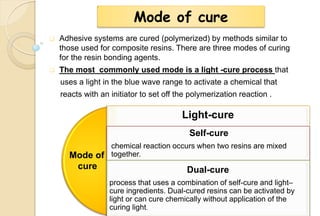
Mode of cure
 Adhesive systems are cured (polymerized) by methods similar to
those used for composite resins. There are three modes of curing
for the resin bonding agents.
 The most commonly used mode is a light -cure process that
uses a light in the blue wave range to activate a chemical that
reacts with an initiator to set off the polymerization reaction .
Light-cure
Mode of
cure
Self-cure
chemical reaction occurs when two resins are mixed
together.
Dual-cure
process that uses a combination of self-cure and light–
cure ingredients. Dual-cured resins can be activated by
light or can cure chemically without application of the
curing light.
 On the surface of the polymerized bonding resin is a very thin
coating of uncured resin. The resins used for composites and
sealants also will form this layer of uncured resin on their
surfaces.
 Polymerization is inhibited where the surface is exposed to
oxygen in the air (this layer is called the oxygen-inhibited layer, or
air-inhibited layer). Once the composite resin is placed over the
bonding resin, its presence will exclude air, and that uncured
layer on the bonding resin will cure when the composite is cured.
 The uncured layer will actually help facilitate a chemical bond
between the bonding resin and the composite resin.
Oxygen-Inhibited Layer
References
 Clinical Applications For Dental assistants And Dental Hygienists ,3rd
edition
 Phillips’ Science of Dental Materials, 12th edition.
 Sturdevant’s Art and Science of Operative Dentistry, 7th edition.
 Dental Hard Tissues and Bonding Interfacial Phenomena and Related
Properties , G. Eliades , D. C. Watts · T, Eliades (Eds.), 2005.
 BASIC DENTAL MATERIALS, 3rd edition.
 Textbook of OPERATIVE DENTISTRY By Nisha Garg & Amit Garg ,
3rd edition , 2015.
 Clinical Aspects Of Dental Materials Theory, Practice, and Cases
4th edition , 2013

Adhesion and Dentin Bonding agent

  • 1.
  • 2.
    1. Introduction 2. Definitions 3.History of Adhesive Dentistry 4. Indications for use of adhesive 5. Mechanism of Adhesion 6. Factors affecting Adhesion 7. Enamel Bonding 8. Dentin Bonding 9. Essentials or components of dentin bonding system
  • 3.
    Essentials or components ofdentin bonding system - Etchant - Primer - Bonding agent 10. Classifications Of Modern Bonding Agents 11. Total etch vs Self-etch 12. Etch and Rinse bonding systems 13. Self-etch bonding systems 14. 8th generation bonding agent
  • 4.
    The Traditional “drilland fill” approach is fading now because of numerous advancements taking place in restorative dentistry. For a restorative material, adhesion is the primary requirement so that restorative materials can be bonded to enamel or dentin and without the need of extensive tooth preparation.
  • 5.
    The fundamental objectiveof all restorations since centuries has been to create adhesion between two dissimilar surfaces , mineralized tooth structure and the restorative materials. The concept of dentistry with the introduction of adhesives has changed from – extension for prevention to prevention of extension.
  • 6.
    Adhesion adhesion occurs whenatoms or molecules of dissimilar substances bond together by the attraction of the atoms or molecules at the surfaces. ‫أن‬ ‫شيء‬ ‫أهم‬ ‫مختلفتين‬ ‫مادتين‬ ‫بين‬ ‫يكون‬ Adherend The surface or substance that is adhered ( eg. Enamel or dentin / composite resin). Adhesive or adherent A material or substance that promotes adhesion of one substance or material to another. Adhesive can join substances together, resist separation and transmit loads across the bond ( eg. Bonding Agent) Definitions
  • 8.
    Wetting Is the abilityor relative affinity of a liquid to intimately contact a solid surface (important for adhesive). ‫مقدرة‬‫صلب‬ ‫سطح‬ ‫على‬ ‫االنتشار‬ ‫في‬ ‫السائل‬ eg. Water beading on a waxed car is an example of poor wetting. Etching The process of preparing and increasing the surface reactivity of a tooth or restoration for bonding. Priming The process of cleaning, structural alteration and increasing the adhesiveness of the substrate or adhesive.
  • 9.
    Bonding Agent A low-viscosity resinthat penetrates porosities and irregularities in the surface of the tooth or restoration created by acid etching for the purpose of facilitating bonding.
  • 10.
    History of Adhesionsystems ( in summary) ** Before acid etching
  • 14.
    Note that… The acidetch technique was initially developed to improve retention to enamel. Initial bonding agents did not appear to bond to the dentin. At the time it was widely believed that:  dentin could not be etched as well as enamel.  acid etching of dentin would cause injury to the pulp.
  • 15.
    dentin and enamelare etched simultaneously (demonstrated that dentin could be etched without causing any significant harm to the pulp) . **The underlined words will be discussed later on .
  • 17.
    Indications For UseOf Adhesives  To treat carious and fractured tooth structure.  To restore erosion or abrasion defects in cervical areas.  To correct unaesthetic contours, positions , dimensions, or shades of teeth.  For pit and fissure sealants  To bond composite restoration  To bond amalgam restoration  To treat dentine hypersensitivity  To bond orthodontic brackets
  • 18.
    To treat cariousand fractured tooth structure.
  • 19.
    To restore erosionor abrasion defects in cervical areas. Before After
  • 20.
    To correct unaestheticcontours, positions, dimensions, or shades of teeth.
  • 21.
    For pit andfissure sealants
  • 22.
    To bond amalgamrestoration To bond composite restoration (B) Bonded amalgam restoration used to reduce microleakage and postoperative sensitivity + to increase retention + and other advantages over the non-bonded amalgam.
  • 23.
    To treat DentineHypersensitivity
  • 24.
  • 25.
    The fundamental mechanismof adhesion to tooth structure can be regarded simply as an *exchange by which inorganic tooth material (hydroxyapatite) is replaced by synthetic resins. This process involves two parts: (1) Removing hydroxyapatite to create micropores and (2) infiltration of resin monomers into the micropores and subsequent polymerization. As a result, resin tags are formed that micromechanically interlock or interpenetrate with the hard tissue.
  • 27.
  • 30.
    Wetting is principallyinfluenced by :
  • 31.
    Contact Angel Contact anglerefers to the angle formed between the surface of a liquid drop and its adherent surface (Figs 16.6A to C). Stronger the attraction between adhesive and adherent ,smaller is the contact angle. Zero contact angle is the best to obtain wetting.
  • 33.
    Surface Energy The increasein energy per unit area of surface is referred to as the surface energy or surface tension.
  • 34.
     High surfaceenergy means a strong molecular attraction, while low surface energy means weaker attractive forces.  In general, the comparatively low surface tension of liquids ( adhesives) permit hem to spread freely on solids of high surface energy ( enamel and dentin) .
  • 36.
     A clean,micro-roughened tooth surface has higher surface energy than unprepared tooth surfaces.  The acid etch technique by which contaminants are removed and micro-porosities are created, is widely used to generate high-energy tooth surfaces and promote wetting by adhesive monomers.
  • 37.
    Surface Contamination - Cleanerthe surface, better is the adhesion (Fig. 16.7).
  • 38.
    We will focuson the Dentin Bonding Systems and Agents in more details rather than Enamel Bonding .
  • 39.
     These werethe earliest bond agents. Before the total-etch technique was adopted, enamel bonding agents were used only to enhance the wetting and adaptation of resin to conditioned enamel surfaces.  The enamel bond agent helped improve the bond by flowing into all the micro-porosities of the etched enamel and creating a micro-mechanical retention.
  • 40.
     They areunfilled resins similar to that of the resin matrix of composite resin, diluted by other monomers to lower the viscosity (The more viscous composite did not bond well to the etched enamel). These materials have been replaced by agents that bond to both enamel and dentin.  Because enamel can be kept fairly dry, these rather hydrophobic resins work well as long as they are restricted to enamel . Resin Composite”‫ال‬ ‫أو‬enamel bonding agents‫تذوب‬ ‫ال‬ ‫مركبات‬ ‫هي‬ ‫عام‬ ‫بشكل‬ ‫الماء‬ ‫في‬(‫للماء‬ ‫كارهه‬),‫به‬ ‫تمسك‬ ‫ولن‬ ‫منه‬ ‫تقترب‬ ‫لن‬ ‫طريقها‬ ‫في‬ ‫الماء‬ ‫وجدت‬ ‫اذا‬ ‫لذلك‬!‫إن‬ ‫الحظ‬ ‫ولحسن‬ ‫الـ‬Enamel‫للماء‬ ‫يفتقر‬(‫جدا‬ ‫قليلة‬ ‫كمية‬ ‫على‬ ‫يحتوي‬)‫ال‬ ‫فإن‬ ‫لذلك‬Resin‫منه‬ ‫ويقترب‬ ‫سيقبله‬.. ‫يكفي‬ ‫ال‬ ‫وحده‬ ‫االقتراب‬ ‫لكن‬!‫إللتصاق‬ ‫بحاجة‬ ‫نحن‬!‫الحمض‬ ‫وضع‬ ‫بعد‬ ‫أنه‬ ‫حيث‬ ‫ميكانيكي‬ ‫بشكل‬ ‫يتم‬ ‫وهذا‬ Acid Etch‫الـ‬ ‫يزيل‬ ‫و‬ ‫السطح‬ ‫سيتخشن‬Debris‫من‬ ‫كبير‬ ‫عدد‬ ‫فيتكون‬small undercuts‫يدخل‬ ‫الـ‬ ‫تحتها‬Resin‫يلتصق‬ ‫يتصلب‬ ‫وعندما‬!“ ‫ال‬ ‫الخالصة‬Enamel‫الـ‬ ‫و‬Resin‫بينهم‬ ‫لواسطة‬ ‫بحاجة‬ ‫وليسو‬ ‫أصدقاء‬.
  • 42.
     Resin bondseasily to enamel.
  • 43.
     Bonding todentin has been proven more difficult and less reliable and predictable than enamel. This is because of difference in morphologic, histologic , complex microstructure and compositional differences between the two.  Dentin is heterogeneous compared to enamel .  The high water content interferes with bonding (hydrophilic surface). Its tubular nature provides a variable area.  Presence of a smear layer on the cut dentin surface (The smear layer is the layer of debris which adheres tightly to the dentin and fills the tubules after cavity cutting).
  • 44.
     Developing agentsthat will adhere to dentin was more difficult because:  It is heterogeneous .  The high water content interferes with bonding (hydrophilic surface). Its tubular nature provides a variable area.  Presence of a smear layer on the cut dentin surface (The smear layer is the layer of debris which adheres tightly to the dentin and fills the tubules after cavity cutting).
  • 45.
    Whenever both enamel anddentin tissues are mechanically cut, especially with a rotary instrument, a layer of adherent grinding debris and organic film known as a smear layers left on their surfaces and prevents strong bonding.
  • 46.
    ‫الـ‬ ‫تحضير‬ ‫بعد‬Cavity‫من‬‫طبقة‬ ‫سيتكون‬ smear layerDebris called ‫ال‬ ‫تملئ‬ ‫عندما‬ ‫الطبقة‬ ‫وهذه‬ Orifices of Dentinal tubules called smear plugs . ‫ال‬plugs‫اغالق‬ ‫على‬ ‫تعمل‬dentinal tubules!! ‫؟‬ ‫نزيلها‬ ‫أم‬ ‫سنبقيها‬ ‫هل‬ ** ‫في‬‫الغالب‬‫نزيلها‬ ,pulp ‫السني‬ ‫اللب‬ ‫من‬ ‫اقترابها‬ ‫مدى‬ ‫**حسب‬ - In deep cavities, the smear layer should not be removed as it acts as a barrier to acid penetration.
  • 49.
    Dentin bond systemsare supplied in one or more bottles containing :  Etchant  Primer  Adhesive ( bonding agent)
  • 50.
    Definition: The etchant isan acid which selectively dissolves the tooth structure to provide retention for the restoration. In more details, etchants are relatively strong acids (pH =1–2) used to remove smear layers and to dissolve the mineral phase to allow formation of micromechanical interlocking in enamel and in dentin.
  • 51.
    The etchants areacidic in nature. They may be grouped as: Mineral (e.g., phosphoric, nitric acid, etc.) Organic (e.g., maleic, citric, etc.) Polymeric (e.g., poly-acrylic acid)
  • 52.
     phosphoric acidat a concentration between 30% and 50%, typically 37%, is the preferred etching agent to produce consistent etching patterns while not damaging the pulp.  Concentrations greater than > 50% result in The deposition of an adherent layer of monocalcium phosphate monohydrate on the etched surface, which inhibits further dissolution.
  • 53.
     Acid maybe available as a liquid or gel.  Generally, the etchant is supplied as an aqueous gel to allow precise placement over a specific area ( gel etchants are preferred due to better control in placement over the surface) .
  • 54.
     Brushes areused to place the acidic gel, or the acid may be supplied in a disposable syringe from which it can be expressed onto enamel and dentin.
  • 55.
     The firststep in the bonding process involves preparation of the surface of the tooth to receive the material that will be bonded to it .  Preparing the tooth surface usually includes removing plaque and debris and then etching or conditioning the enamel and dentin with an acid .  The most frequently used etchant is 37% phosphoric acid. Acid removes mineral from the surface to create roughness or microscopic porosity that aids in increasing the surface energy of the solid surface (enamel and dentin).
  • 57.
     Conditioning: Itis the process of cleaning the surface and activating the calcium ions, so as to make them more reactive.  Etching: It is the process of increasing the surface reactivity by demineralizing the superficial calcium layer in enamel or dentin to provide a micro-mechanical surface for the retention of bonding agents .
  • 58.
     The firstmeaningful demonstration of intraoral adhesion was reported by Buonocore (1955).  Buonocore etched enamel surfaces with various acids, placed an acrylic restorative material on the micromechanically roughened surfaces, and found a great increase in the resin–enamel bond strength.
  • 60.
    MODE OF ACTIONON ENAMEL  It creates microporosities by discrete etching of the enamel, i.e., by selective dissolution of enamel rod centers (Fig. 10.16), or peripheries, or both.
  • 62.
    MODE OF ACTIONON ENAMEL  Etching increases or enlarges the surface area ( increases surface energy).  Etched enamel has a high surface energy, allowing the resin to wet the tooth surface better and penetrate into the microporosities. When polymerized, it forms resin ‘tags’ which forms a mechanical bond to the enamel (Fig. 10.17).
  • 63.
     Resin tags:Extensions of resin that have penetrated into etched enamel or dentin.
  • 64.
     Two typesof resin tags interlock within the etch-pits: Macrotags: form between enamel prisms peripheries ( in a space surrounding the enamel prisms). Microtags: form at the core of enamel (Finer network of numerous small tags is formed across the end of each rod where individual hydroxyapatite crystals were dissolved). These microtags are more important due to their larger number and greater surface area of contact.
  • 68.
    4. Chemical natureof enamel ( whether enamel is fluoridated or demineralized, high fluoride concentration makes enamel more resistance to etching). 5. Type of dentition, i.e. Primary or permanent ( Deciduous teeth require longer time for etching than permanent teeth because of the presence of aprismatic enamel in deciduous teeth) . Aprismatic Enamel is the structureless outer surface of enamel that is more mineralized than the rest of enamel. 6. The physical state of the solution ( gels are more popular because they stay in place thus achieve wider and deeper enamel penetration, whereas liquids tend to run without control).
  • 69.
     Dentin Etchingdid not gain wide acceptance until Fusayama introduced the total-etch concept.  His study demonstrated that not only was restoration retention substantially increased but also pulp damage did not occur as had been generally assumed.
  • 70.
    1. Remove thesmear layer. Smear layer: is amorphous layer (1 to 5 μm thick) that is comprised of residual organic and inorganic debris and forms as a result of mechanical instrumentation of enamel and dentin. This layer obstructs the entrances of dentinal tubules, decreasing dentin permeability by up to 86%.
  • 72.
    2. Demineralizes thefirst 3 to 5 μm dentinal tissue in order to widen the dentinal tubules (increase permeability) and creates **funnel shaped dentinal tubules. 3. Demineralize the superficial peri-and intertubular dentin exposing fine collagen fibers. The presence of higher mineral-content in peritubular dentin ( completely dissolved and demineralized) than in intratubular dentin creates funnel shaped dentinal tubules (fig 5-11) .
  • 73.
    Longitudinal view of dentindecalcification of after application od etchant . At the dentin tubule walls, peritubular dentin has been completely dissolved, resulting in the typical funneling of the tubule orifice.
  • 74.
    Intratubular dentine appears asa porous structure characterized by complex network of interconnection collagen fibrils .
  • 75.
  • 76.
     Primer aremixtures of monomers such as (HEMA-TEGDMA- 10MPD) which have varying degrees of hydrophilic and hydrophobic properties dissolved in organic solvent ( acetone or ethanol ) or water .  Primer is a solution applied to etched dentin to infiltrate and fill the space between the collagen fibers and support them (prevent their collapse).  Thus they serve as a bridge connecting the tooth structure to the adhesive (amphiphilic bifunctional molecules) binds to adhesive or binds to exposed collagen fibers. bonding agent philicphobic
  • 77.
    phobic part facilitatesrestoration bonding to the resin matrix.  philic part stabilizes the collagen fibers and facilitates monomer permeation into the collagen matrix and form a hybridized collagen-resin layer ( hybrid layer) .
  • 78.
    Functions of primer Stabilizes and maintainan expanded collagen network Encourages monomer infiltration of demineralized dentin Increases wettability of the dentin surface Bonding between the dentin and adhesive
  • 79.
     Solvents (thinningagents) are added to : reduce the viscosity of co-monomer blends hence increase wetting and molecular wettability. volatile solvents displace water (water chasing ability) from the wet collagen network and dentinal surface allowing monomers to penetrate the collagen fiber network. Water solvent can re-expand the collapsed collagen network thus helping in better penetration and bonding between resin and dentin.
  • 80.
     In wetbonding enamel, the primer should be always applied to acid- etched enamel in order to displace residual moisture .  In air dried enamel, application of primer is not necessary because the bonding between enamel and the bonding agent is still effective.
  • 81.
    A primer ismore important on dentin than enamel because the primer contains hydrophilic groups that penetrate wet ,etched dentin and keep the meshwork of collagen fibrils expanded so that the adhesive resin can penetrate. Note that …
  • 82.
     Adhesive aregenerally hydrophobic monomers. Being hydrophobic they do not wet the tooth leading to air entrapment, air inhibition and thereby poor bonding. Thus they have to be used in combination with primers to form an effective bond to tooth structure.
  • 83.
    Ideal Adhesive  Consideringthe hydrophilic nature of the tooth especially dentin ( enamel exhibits low amount of water), it is logical that an adhesive also should have a *hydrophilic nature when placed*in order to wet the surface and penetrate the available microstructure.  A *hydrophobic polymeric layer *is more insoluble and resistant to erosion and degradation by acids and other components of oral fluids than a more hydrophilic one. Thus, the ideal adhesive would have a hydrophilic nature during placement and would become much more hydrophobic after curing.
  • 84.
    Such materials arenot readily available to dentistry instead a combination of hydrophobic and hydrophilic molecules are used in modern adhesives.  The primer and adhesive penetrate the inter-tubular dentin, forming a resin-dentin inter-diffusion zone, or “Hybrid Layer” and infiltrate the tubules to form resin tags after their polymerization.  Hybrid layer is an intermediate layer or a zone of material consists of components of both bonding resin and dentin with the collagen fibers, that is produced by acid etching of dentin(demineralized dentin) and infiltration of resin into the etched dentin.
  • 85.
    Hybrid layer Hybrid Layer= Interdiffusion zone = resin-dentin interpenetration: a resin-dentin layer formed by intermixing of the dentin bonding agent with collagen fibrils exposed by acid etching and the etched dentin surface. composite Resin tags priming Bonding
  • 87.
     Generally, adhesiveresins are composed mainly of hydrophobic monomers such as (bis-GMA, TEGDMA)  At the same time, adhesives require a certain hydrophilicity to diffuse into the hydrophilic, primer- wetted dentin.
  • 89.
    *Based on Generations •1st generation • 2nd generation • 3rd generation • 4th generation • 5th generation • 6th generation • 7th generation • 8th generation *Based on Number of Steps • 3 steps • 2 steps • 1 step *Based on the approach to Smear Layer removal • Smear layer removing(completely dissolve) agents ( Total etch or Etch and Rinse Adhesive) • Smear layer modifying agents **The first three generations of adhesive systems are no longer commercially available.
  • 93.
    Etch and RinseVS Self-etching
  • 94.
    Etch and RinseVS Self-etch
  • 95.
    Postoperative Sensitivity  Thepain response comes from odontoblasts that lie in the pulp at its junction with the dentin. The odontoblasts have processes that extend about one third of the way up the dentinal tubules, and the tubules contain a column of pulpal fluid. The odontoblastic processes have pressure receptors that can only interpret in a painful response any change in pressure in this column of pulpal fluid.  One primary reason for the sensitivity is unsealed dentinal tubules. Acid etching opens the tubules. If they are not properly sealed during the dentin bonding process, a number of things can influence the pressure on the fluid in the tubules and elicit a pain response. This dentinal fluid movement caused by pressure changes is called the hydrodynamic theory of tooth sensitivity.
  • 97.
    Etch and RinseVS Self-etching
  • 98.
    Etch and RinseVS Self-etching
  • 99.
     SEAs areless likely to result in a discrepancy between the depth of demineralization and the depth of resin infiltration(etch and prime to the same depth) because SEAs demineralize and infiltrate dentin simultaneously, this method leaves no voids, hence reduces the chances of leakage and postoperative sensitivity. Self Etching Technique
  • 100.
    In the E&Rtechnique, the difference between penetration of the adhesive and action of the conditioning acid agent leads to an incomplete hybridization of the exposed collagen network . Discrepancy between the depth of infiltration of the adhesive and that of conditioned dentin leaving collagen exposed without hybridizing. E&R technique E&R Technique
  • 101.
     Indications ofself-etch bonding systems:- 1. Pediatric patients or uncooperative patients(physically and mentally challenged), where simpler clinical steps are preferred. 2. Class V cavities, especially extending subgingivally, where isolation is a challenge. 3. In deep class II cavities where isolation in the gingival seat is difficult.
  • 103.
     Developed inearly 1990s  Based on (total etch technique) and moist bonding concept.  Based on concept of hybridization and hybrid layer formation.  Three main steps application : 1- Total etching 2- Application of primer 3- Application of bonding agent
  • 104.
     Step bystep application of the three-step etch and rinse adhesives
  • 105.
    Preparation complete; readyfor bonding system application. Appropriate isolation must be provided.
  • 107.
     35% -37%Phosphoric acid(commonly used acid) etchant gel is initially applied to the enamel margins only for 15s-30s .
  • 108.
    If enamel isetched for more than required time, it results in deeper etch. Since a bonding agent has a high viscosity, surface tension effect of agent does not allow its full penetration into etched enamel. This results in ‘dead space’ beyond the bonded area. When enamel bends , or weak resin based bond breaks off, the dead space gets exposed to oral fluids. These oral fluids have lower surface tension and thus penetrate into the dead space This may result in secondary caries or discoloration of the margins.
  • 109.
     Phosphoric acidetchant gel is applied to the remaining prepared dentin surfaces and allowed to remain for 15s
  • 110.
    Start applying theetchant to the enamel first , and then to the dentin. Over-etching dentin will open the tubules too much and remove too much mineral (hydroxyapatite) from the dentin surface.
  • 111.
    Etching should belimited to superficial dentin because the viscosity of primers and bonding agents allows only a few micrometers of impregnation. Excessive etching or demineralization produce weak zone and make the dentin tubules more susceptible to incomplete infiltration of resin monomers.
  • 112.
     Etchant gelis thoroughly rinsed with air-water spray for 15s.
  • 113.
    • Particular careshould be taken to rinse all silica and to ensure that is removed
  • 114.
     Preparation isdried. White , Frosty appearance of enamel confirms adequacy of etch.
  • 115.
    A very importantclinical consideration is the application of Wet Bonding Technique
  • 116.
    Moist dentin forbonding  The acid is removed by rinsing for 15 seconds. The excess water is removed by a gentle stream of air . However, the dentin is left slightly moist so that it glistens, shiny but without any puddles of water.
  • 117.
     Desiccation (excessivedrying) of the dentin should be avoided. Desiccation can result in the collapse of the collagen mesh or network which forms a dense film that is difficult to penetrate by the bond agent. A moist cotton pellet can be applied to the dried dentin surface for 30s to remoisten the dentin surface.
  • 118.
     On theother hand, too much water remaining makes it difficult for the resin to displace the water trapped in the collagen fibrils and produces a potential source for leakage. A moistened cotton pellet can be used to remove excess moisture.  Both over-drying and under-drying can produce an Incomplete sealing of the dentinal tubules and a much weaker bond results, because the dentin-resin interface will fracture more easily.
  • 122.
     The preparationis rewetted with an aqueous chlorhexidine(rewetting agent) solution for 30s
  • 123.
     A dampcotton pellet is used to absorb excess chlorhexidine solution.
  • 124.
     The glisteningappearance of the dentin indicates the appropriate dentin moistness before applying the primer.
  • 125.
     The primercomponent is actively applied for at least 30 s. Gently agitated or rubbed onto the dentin surface with a small brush .
  • 126.
     The primercomponent is air dried for 30s to 40s to ensure thorough evaporation of solvents.
  • 127.
     The adhesivecomponent is actively applied to the entire preparation using micro-brush .  A bristle brush is used to absorb , avoid pooling and distribute the adhesive evenly on all wall cavity( to ensure an even coating of the resin ).
  • 128.
     The adhesiveis light cured for 10s to 20s prior to inserting the resin composite .
  • 132.
     Two-step (simplified)etch and rinse adhesive systems were developed in an effort to simplify clinical application. These simplified bonding system have been commercially successful because of their ease of use and reduced application steps.  Considered as fifth generation, these systems employ an etching procedure similar to that for three step systems, followed by the application of a combined primer and bonding resin.  Also utilize a total etch technique ( a separate etchant for enamel and dentin).
  • 133.
     In thetwo-step etch and rinse system primer solvents and hydrophilic components with the more hydrophobic monomers of bonding agent are combined, with the result that the bonded interface does not develop a hydrophobic resin layer and(causing them to behave as semipermeable membranes), thus leaves the bond susceptible to *water penetration and *subsequent degradation, which greatly *reduces bond durability. Disadvantages
  • 134.
     The combinedprimer and bonding resins contain high concentrations ( up to 50%) of solvents that may interfere with adhesive polymerization.  Note: solvent concentrations greater than 20% by weight usually lower the degree of conversion ?? How ?? by increasing the physical space between reactive species during polymerization.
  • 135.
     Step bystep application of the two-step etch and rinse adhesives
  • 136.
     Etching • Theconsiderations discussed for etching with three-step systems also apply to the use of two-step etch and rinse adhesives. • The dentinal tissue moisture level is even more critical than with three-step etch and rinse adhesives ??why?? because two-step etch and rinse systems don’t have the rewetting ability of primers used in three-step etch and rinse systems.
  • 137.
    Similar to thethree step etch and rinse bonding agents ( 4th generation)
  • 138.
    The basic differencesbetween 4th and 5th generations
  • 139.
     The combinedprimer adhesive component is actively applied for 30s.
  • 140.
     Mode ofapplication The use of vigorous rubbing is essential to achieve a high immediate bond strength to dentin using primer-adhesive component. This action increases molecular kinetics and inward monomer diffusion to outward solvent diffusion which also reducing dentinal wetness + improves the long term stability of the dentin bond + increasing the biomechanical characteristics of the hybrid layer.
  • 141.
     The primer-adhesivecomponent is air dried for 30s to 40s to ensure through evaporation of solvents.
  • 142.
     The combinedprimer-adhesive component is actively reapplied for 30s . Active rubbing application and the use of multiple coats of the adhesive have been shown to somewhat compensate for the lack of a hydrophobic resin bonding agent layer as the last step in two-step etch-and-rinse adhesives.
  • 143.
     The primer-adhesivecomponent is air dried for 30s to 40s to ensure through evaporation of solvents.
  • 144.
     The adhesiveis light cured for 10s to 20s prior to inserting the resin composite.
  • 145.
    Most important thingto remember is (hydrolytic degradation) is directly relates to the hydrophilicity of the adhesive.
  • 147.
     A separateetchant is not required.  These are 2 bottle systems.  Two varieties are seen - Type I andType II. Type II 2 bottle 1 step system. LiquidA contains the primer. Liquid B contains a phosphoric acid modified resin (self etching adhesive). Both liquids are mixed just before application.A drop from each bottle is taken, mixed and applied to the tooth surface, for example, Prompt L-pop. Type I 2 bottle 2 step system. Etchant and primer are combined in one bottle (called self etching primer). Other bottle contains adhesive
  • 148.
     Type 12 bottle 2 step system  Etchant and primer are combined in one bottle (called self etching primer). Other bottle contains adhesive.  Two-step self-etch adhesives (SEAs) contain an acidic monomer that functions as a self-etching primer and a hydrophobic non-solvated bonding resin.  The acidic primers include performs two functions simultaneously—etching and priming of dentin and enamel.  No rinsing. In contrast to conventional etchants, the acidic primers are not rinsed off.  The bonding mechanism of SEAs is based on the simultaneous etching and priming of enamel and dentin, forming a continuum in the substrate and incorporating smear plugs into the resin tags.
  • 149.
    No removal tothe smear layer, the acidic primer infiltrates the smear layer and creates a ”hybridized dentin/resin layer”. The smear Plug becomes a filler within the resin entering the dentinal tubules. Two Step Self-Etching Adhesive
  • 150.
     In additionto simplifying the bonding technique, the elimination of rinsing and drying steps reduces the possibility of over-wetting or over-drying dentin, either of which can affect adhesion adversely.  Also, water is always a component of the acidic primer because it is needed for the monomers to ionize and trigger demineralization of hard dental tissues; this makes SEAs less susceptible to variations in the degree of substrate moisture.
  • 151.
     It hasbeen suggested that the two-step self-etching systems should be further subdivided by strength into:  Strong (PH<1)  Intermediately strong (PH =1 to 2 ≈1.5)  Mild(PH=2)  Ultra-mild(PH≥2.5)  SEAs are less likely to result in a discrepancy between the depth of demineralization and the depth of resin infiltration(etch and prime to the same depth) because SEAs demineralize and infiltrate dentin simultaneously, this method leaves no voids, hence reduces the chances of leakage and postoperative sensitivity ( mentioned previously). Depending on the self-etching (acidity) or demineralized intensity
  • 152.
     The self-etchingsystems don’t involve a rinsing step and thus the dissolved calcium phosphates remain in the hybrid layer( contribute to buffering of the acidity of the solution).
  • 153.
     Self-etching andpriming of enamel  Clinically the application of primers that are weakly acidic have weak bonds to enamel, especially uncut enamel .  This is likely due to the less retentive enamel-etching pattern that is shallow resulting in poor micromechanical and insufficient penetration into the enamel surface.  Therefore weak acids to enamel cannot produce the same extent of demineralization and typical frosty appearance obtained by the use of phosphoric acid .
  • 154.
     Although Somestrong self-etching adhesives create demineralized enamel that morphologically similar to that created by phosphoric acid, mild self etching adhesives have shown unsatisfactory bonding to enamel(low bond strength and poor marginal adaptation)  Thus phosphoric acid should be preferred for enamel etching (selective etching the enamel) . To ensure a good bond to enamel, some manufacturers recommend “selective etching,” meaning that enamel only should be etched with phosphoric acid before the application of the self-etching bonding materials.
  • 155.
     Self-etching andpriming of dentin  Mild self-etching adhesives are preferred for dentin bonding . Such adhesives partially demineralize dentin, leaving residual hydroxyapatite crystals that protect the collagen fibrils.  The lower the pH (e.g Strong self-etching adhesives), the more intense is the dissolution process, such that more of calcium phosphates remain embedded in the hybrid layer. Since these calcium phosphates are rather soluble, they may leach out and compromise the long-term durability of the bond to dentine.  In other words, their high intrinsic acidity doesn’t allow complete buffering from the dissolved hydroxyapatite, leading to continuous etching and incomplete polymerization.
  • 156.
     The clinicalsuccess of mild two-step self-etching might be a result of its chemical composition, specially the reactive monomer such as 10-MDP, which has been shown to bond chemically with mineral component of dentin(calcium in hydroxyapatite).  Ionic bonds are formed between carboxylic acid or phosphate groups within the functional or reactive monomers and the calcium in hydroxyapatite.  The resulting hybrid layer exhibits both micromechanical interlocking and chemical interaction.
  • 157.
     Why theselective etch technique ( using phosphoric acid ) isn’t used on dentin? Because the removal of smear layer created by the demineralization of dentin during phosphoric acid etching depletes most of the hydroxyapatite in dentin that could be available for such chemical interaction, which in turn reduces the bond strength created by mild two-step self etching adhesives.
  • 158.
     That’s whymanufactures of mild self etching adhesive systems recommend that phosphoric acid etching be used only on enamel .
  • 159.
    Step by stepapplication of the two step self etching adhesives
  • 160.
     Preparation complete;ready for bonding system application. Appropriate isolation must be provided.
  • 161.
     Phosphoric etchantgel is used to selectively etch the enamel margins of the preparation.
  • 162.
     Etchant gelis thoroughly rinsed with air water spray for 15 s.
  • 163.
     Preparation isdried. White , Frosty appearance of enamel confirms adequacy of etch.
  • 164.
     The combinedetchant-primer component is actively applied for 20s
  • 165.
     The etchant-primeradhesive component is air dried for 30s to 40s to terminate etching reaction and ensure thorough evaporation of solvents.
  • 166.
     The adhesiveor bonding agent is actively applied to the entire preparation. The bonding agents of two step self etching adhesives contain hydrophobic and relatively solvent- free monomer blends . Thus the clinical recommendations that described for etch and rinse adhesives(such as brush thinning to optimize adhesive thickness) are also applicable to two-step self etching systems.
  • 167.
     The adhesiveis light cured for 10s to 20s before inserting the resin composite.  A bristle brush is used to absorb excess resin , avoid pooling and distribute the adhesive evenly on all wall cavity(to ensure an even coating of the resin ).
  • 168.
  • 169.
    • Reduces postoperativesensitivity because they etch and prime simultaneously. • Much faster and simpler technique. • Less technique sensitive as fewer number of steps are involved for the self-etch system. • Since they do not remove the smear layer, the tubules remain sealed, resulting in less sensitivity. • Since they consist of an acidic solution, they cannot be stored and have to be refreshed
  • 170.
    The application ofself etching adhesive to smear layer- covered dentin avoids most problems that are encountered when using etch and rinse adhesives.
  • 171.
    One-step – Onebottle bonding self etching adhesive
  • 172.
     Continuing thetrend toward simplification, no-rinse self-etch materials that incorporate the fundamental steps of etching, priming, and bonding into one solution have become increasingly popular.  One-step SEAs, which have etching, priming, and bonding functions delivered in a single solution or bottle containing complex mixtures of hydrophilic and hydrophobic resin blends, acid, and water to activate etching. The chemical complexity has caused shelf-life problems.  They achieve the same objective as the sixth generation systems except that they simplified multiple sixth generation materials into a single component, single bottle one step self etch adhesive, thus avoiding any mistakes in mixing.
  • 173.
     This classof adhesives has the highest hydrophilic monomer content and tend to behave as semipermeable membranes, facilitating hydrolytic degradation of the resin–dentin interface.  Thus, simplified adhesives demonstrate increased water sorption, which promotes polymer swelling and other water-mediated degradation phenomena.
  • 174.
     Although hydrophobicmonomers have been added to one-step adhesives to produce stronger cross-linked polymer networks, the hydrophilic monomers tend to cluster before polymerization begins and reticular patterns of nano-leakage, so-called water trees(microscopic water filled channels) , can be found within the adhesive layer of one step SEAs and are considered as sites of incomplete water removal and Subsequent suboptimal polymerized resins. These channels pass from the hybrid layer through the adhesive to the composite interface.
  • 175.
    Compared with multi-stepself-etch and etch-and-rinse versions, one-step self-etch adhesives consistently achieve lower bond strengths.
  • 176.
     Application toenamel Like two step self etching adhesives one step systems have demonstrated a reduced ability to bond to unabraded enamel. For this reason, preliminary phosphoric acid etching of enamel is recommended before the application of one- step adhesives.
  • 177.
     Application ofdentin One step-self etching adhesives focused on several parameters to improve the stability of dentin-adhesive interface :- 1) Preliminary etching self etching adhesive products are intended to eliminate the need for phosphoric acid etching of dentin, thus simplifying clinical application and reducing operator technique sensitivity. 2) Hydrophobic coating this approach may improve adhesive performance the application of an additional hydrophobic resin layer has been shown to improve immediate resin-dentin bond strength and reduce long term adhesive interface degradation
  • 178.
    3) Application modeactive application produces consistent etching and enhances the interaction of acid monomers with the tooth structure dispersing etching by products into the surface. Active brush technique increases the immediate bind strength and improves the long term stability.
  • 179.
    4) Application timeand multi-layering the use of multi- layering technique or prolonged application times during dentin bonding has been suggested to enhance the uniformity of adhesive infiltration and increase water and solvent evaporation. 5) Appropriate polymerization the use of extended curing times that exceed the manufacture recommendations has been found to improve polymerization and reduce permeability, potentially improving the performance of one step adhesives.
  • 180.
    Step by stepapplication of the one-step self etching adhesives ( 7th generation)
  • 181.
     Preparation complete;ready for bonding system application. Appropriate isolation must be provided.
  • 182.
     Phosphoric etchantgel is used to selectively etch the enamel margins of the preparation.
  • 183.
     Etchant gelis thoroughly rinsed with air water spray for 15 s.
  • 184.
     Preparation isdried. White , Frosty appearance of enamel confirms adequacy of etch.
  • 185.
     The combinedetchant-primer-adhesive component is actively applied on etched enamel and unetched smear layer covered dentin for the time recommended by the manufacture.
  • 186.
     The etchant-primer-adhesivecomponent is air dried for 30s to 40s to terminate the etching reaction and ensure thorough evaporation of solvents .
  • 187.
     The combinedetchant-primer-adhesive is actively reapplied.  The etchant-primer-adhesive component is air dried for 30s to 40s to terminate the etching reaction and ensure thorough evaporation of solvents .
  • 188.
     The adhesiveis light cured for 10s to 20s before the resin composite.
  • 189.
  • 190.
    • Simultaneous demineralization andresin penetration. • Less technique sensitivity.
  • 192.
    Etch And RinseBonding Systems Self-etch Bonding Systems Comparison of components of dentin bonding agents
  • 193.
    These materials arecalled Multimode or Universal because they can be used as self-etch, etch and rinse, or selective-etch systems.  With the advent of universal adhesives dentists are now using the same dentin adhesive for different adhesion strategies (i.e., self- etch, etch-and rinse, or selective enamel etch adhesive), according to each specific clinical situation.
  • 194.
     Can beused with light-cure, self-cure and dual cure materials  Can be used for both direct and indirect restorations.  Theses adhesives have the ability to bond methacrylate based restoratives , cement , and sealant to all dental substrates such as dentin , enamel , glass ionomer, metals , zirconia , and alumina .
  • 195.
     The reportedstrong bond strengths of these new materials is likely a result of functional acidic monomer MDP contained within the formulation of most UA . which has been shown to bond ionically to hydroxyapatite.  This reactive monomer has been reported to have strong affinity to dentine, enamel and metal.  It has also been shown that MDP-containing adhesives render the adhesive interface more resistant to bio-degradation because of the chemical bond with the residual hydroxyapatite crystals that remain available on the substrate after use of a self-etch approach on dentin.
  • 196.
     In someUA, a silane coupling agent was incorporated to aid adhesion to certain ceramic surfaces (for compatibility with glass-ceramic materials).  The primary use of UA with light-activated resin composites in direct restorations.
  • 197.
    Mode of cure Adhesive systems are cured (polymerized) by methods similar to those used for composite resins. There are three modes of curing for the resin bonding agents.  The most commonly used mode is a light -cure process that uses a light in the blue wave range to activate a chemical that reacts with an initiator to set off the polymerization reaction . Light-cure Mode of cure Self-cure chemical reaction occurs when two resins are mixed together. Dual-cure process that uses a combination of self-cure and light– cure ingredients. Dual-cured resins can be activated by light or can cure chemically without application of the curing light.
  • 198.
     On thesurface of the polymerized bonding resin is a very thin coating of uncured resin. The resins used for composites and sealants also will form this layer of uncured resin on their surfaces.  Polymerization is inhibited where the surface is exposed to oxygen in the air (this layer is called the oxygen-inhibited layer, or air-inhibited layer). Once the composite resin is placed over the bonding resin, its presence will exclude air, and that uncured layer on the bonding resin will cure when the composite is cured.  The uncured layer will actually help facilitate a chemical bond between the bonding resin and the composite resin. Oxygen-Inhibited Layer
  • 199.
    References  Clinical ApplicationsFor Dental assistants And Dental Hygienists ,3rd edition  Phillips’ Science of Dental Materials, 12th edition.  Sturdevant’s Art and Science of Operative Dentistry, 7th edition.  Dental Hard Tissues and Bonding Interfacial Phenomena and Related Properties , G. Eliades , D. C. Watts · T, Eliades (Eds.), 2005.  BASIC DENTAL MATERIALS, 3rd edition.  Textbook of OPERATIVE DENTISTRY By Nisha Garg & Amit Garg , 3rd edition , 2015.  Clinical Aspects Of Dental Materials Theory, Practice, and Cases 4th edition , 2013