C
CALCIUM
HYDROXIDE
CONTENTS
•INTRODUCTION
•CLASSIFICATION
•MECHANISM OF ACTION
•PROPERTIES
•APPLICATIONS
INTRODUCTION
• Calcium hydroxide is a strong alkali, which can be formed by the reaction of calcium
oxide. If the oxide is treated with only sufficient water to make it crumble to a fine,
white, dry powder slaked lime is produced.
HISTORY :
• Nygren (1838) used ca(OH)2 for the treatment of ‘Fistula dentalis’.
• Codman (1851) was the first to attempt to preserve the involved dental pulp.
• calcium hydroxide use became more prominent in 1930s through the work of
Herman for bridging of the exposed pulpal surface.
CLASSIFICATION
• BASED ON THE SETTING TIME :
• Fast Setting
• Controlled Setting
• Slow Setting
• No Setting
• BASED ON MECHANISM OF SETTING :
• Self curing
• Light curing
• Fast setting cement (Dycal) :
• It is used as subbase or liner. The normal setting time is 2.5 – 3.5 minutes. The setting reaction
is accelerated by moisture (chemical cure).
• Since it is a low – strength base, a suitable high strength base has to be given over Ca(OH)2.
• Controlled setting cement (Calcimol LC) :
• it is indicated in case of direct and indirect pulp capping.
• This material can be placed insufficient thickness (less than 1 mm) and light cured for 20
seconds.
• Slow setting (Sealapex) :
• it is used as a temporary sealing material which sets slowly in the presence of saliva.
• Ca(OH)2 – based root sealers are also slow – setting materials.
• Nonsetting (RC Cal) :
• It is used as an intracanal medicament.
MECHANISM OF ACTION
• • The main actions of calcium hydroxide come from the ionic dissociation of Ca & OH ions
and the action of these ions on vital tissue and bacteria generate the induction of hard tissue
deposition and the antibacterial effect.
Ca reduces the permeability of new capillaries
Increases concentration of Ca 2+
Decreases inhibitory pyrophosphatase
Increases the activity of calcium dependent pyrophosphatase
Uncontrolled mineralization
HEALING WITH HIGH pH (11 – 13)
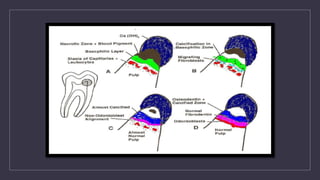
• ZONE OF OBLITERATION :
• This zone consists of debris, dentinal fragments, hemorrhage, blood clot, particles of CH.
• This zone can be visualized after 1 hour of contact between the Ca(OH)2 and the tissue.
• Was due to a combination of pressure of medicament application and chemical injury due to
high concentration of hydroxyl ions.
• ZONE OF COAGULATION NECROSIS :
• A weaker chemical effect reaches a more apical region and results in a zone of coagulation
necrosis.
• This zone is 0.3 – 0.7 mm thick and represents devitalized tissue without complete obliteration
of structural architecture.
• THE LINE OF DEMARCATION :
• Between the deepest zone of coagulation necrosis and the subjacent vital pulp tissue the line of
demarcation develops
• This line resulted from the reaction of CH with tissue protein to form proteinate globules
• The migration of inflammatory cells begin as early as 6hrs after injury.
• THE DENSE ZONE(EARLY STAGE OF BRIDGE FORMATION) :
• Immediately subjacent to the line of demarcation proliferation of mesenchymal cells occur.
• Within 2-3 days after the injury, connective tissue fibers accumulate.
• At first they are disorganized, consisting of both fine and coarse fibers lying parallel to the applied
medicament.
• The increase in collagen formation becomes apparent at 3- 7 days.
• The number of fibroblast, mesenchymal cells multiply sufficiently to present a modified cell rich layer
• The cells within this layer gradually differentiate into preodontoblast and columnar shaped
odontoblasts.
• CALICIFICATION OF THE BRIDGE :
• A mineralized barrier or dentin bridge is usually produced following the application of Ca(OH)2.
• Necrotic zone is formed adjacent to the material and the dentin bridge is formed between this
necrotic layer and underlying vital pulp .
• Calcification occurs soon after the predentin has developed.
• The stage of tubular predentin formation may be reached in 2 weeks
• After 1-3 month the barrier consists of more coronal layer of irregular osteodentin like tissue with
cellular inclusions and the pulpal part consists of predentin lined with odontoblasts
• With this high Ph CH, bridge formation occurs at the line of demarcation
• Over a period of time the coagulated necrotic tissue above the line of demarcation degenerates
• In case of lower PH such as dycal the necrotic zone similarly formed, but is resorbed prior to the
dentin bridge which then forms to be directly against the capping material.
• Dentinal bridge formed by high PH materials are histologically similar to those produced by lower
PH material but are easier to distinguish on a radiograph because of the space B/W the bridge and
Ca(OH)2
VEHICLES USED FOR CALCIUM
HYDROXIDE
• Allow gradual & slow ionic release
• Allow slow diffusion in the tissues with low solubility in tissue fluids
• Have no adverse effect on the hard tissue induction
• There are several types of vehicles used for the calcium hydroxide.
• AQUEOUS :
• Water
• Sterile water
• Distilled water
• Sterile distilled water
• Saline or sterile saline
• Anesthetic solution
• Ringer’s solution
• Methyl cellulose & carboxy methyl cellulose
• Anionic detergent solution
• CLINICAL IMPORTANCE :
• Ca 2+ and OH- are rapidly released.
• direct contact with the tissue and the tissue fluids causing it to be rapidly solubilized and
resorbed by the macrophages
• increasing the number of appointments.
• USED :
• Indirect pulp capping
• Direct pulp capping
• Pulpotomy
• Apexification subsequent to the apical curettage
• VISCOUS:
• Glycerin
• Polyethylene glycol
• Propylene glycol
• CLINICAL IMPORTANCE :
• Release calcium and hydroxyl ions more slowly for extended periods.
• Lower solubility of the paste when compared with aqueous vehicles probably
• because of their higher molecular weights.
• pastes remain in direct contact with the vital tissues for extended time intervals
• appointments and redressing of the root canal is drastically reduced
• USED :
• Apexification
• Treatment of large periapical lesions
• Interappointment dressing in cases of vital pulpectomy
• Acute apical periodontitis
• Endodontic retreatment after endodontic & surgical failures
• OILY :
• Olive oil
• Silicone oil.
• Camphor(the essential oil of camphorated parachlorophenol).
• Metacresylacetate.
• Some fatty acids such as oleic linoleic isostearic acids.
• CLINICAL IMPORTANCE :
• lower solubility and diffusion of the paste with in the tissues.
• Pastes containing this kind of vehicle may remain with in the root canal for longer periods than
pastes containing aqueous and viscous vehicles.
• USED :
• Perforation defects after internal resorption
• Reversal of external resorption
PROPERTIES
• PHYSICAL PROPERTIES :
• Compressive Strength :
• 7 minutes : 3.8 to 7.6 MPa to 550 psi.
• 30 minutes: 4.8 to 6.2 MPa to 750 – 900 psi
• 24 hours: 8.3 to 10.3 MPa or 1200 – 1500 psi
• Tensile strength: 10 MPa
• Modulus of elasticity: low -0.37 Gpa/m2
• pH: high alkaline: 9.2 to 11.7
• Setting time: 2.5 – 5.5 minutes.
• Solubility and disintegration: solubility is high 0.4 to 7.8%
• The main actions of calcium hydroxide come from the ionic dissociation of
• ca & OH ions and the action of these ions on vital tissue and bacteria
• generate the induction of hard tissue deposition and the antibacterial effect
• various formulations have been suggested by adding various substances to
• the calcium hydroxide powder to improve properties such as antibacterial
• action, radiopacity, flow and consistency.
• Advantages of Calcium hydroxide :
• Initially bactericidal then bacteriostatic.
• Promotes healing and repair.
• High pH stimulates fibroblasts.
• Neutralizes low pH of acids.
• Stops internal resorption.
• Inexpensive and easy to use.
• Disadvantages of Calcium hydroxide :
• Does not exclusively stimulate dentinogenesis.
• Does exclusively stimulate reparative dentin.
• Associated with primary tooth resorption.
• May dissolve after one year with cavosurface dissolution.
• May degrade during acid etching.
• Degrades upon tooth flexure.
• Marginal failure with amalgam condensation.
• Does not adhere to dentin or resin restoration
APPLICATION
• Vital pulp therapy.
• Direct pulp capping.
• Indirect pulp capping.
• Pulpotomy.
• Apexogenesis.
• Routine intracanal dressing between appointments.
• Routine dressing.
• Long-term temporary dressing.
• Large periapical lesions –
• non surgical endodontic treatment
• Treatment of divergent apex in a pulpless tooth (Apexification).
• Control of persistent apical exudates into the canal.
• AS A LINER :
• The calcium hydroxide pastes are now in general use as lining materials. Their perceived advantages, in addition to their
therapeutic effects are as follows:
• They have a rapid initial set in the cavity under the accelerating effect of moisture.
• They do not interfere with the setting reaction of the Bis-GMA resins.
• It is generally considered that the initial set of the material in thin sections is sufficiently hard to resist the applied
condensation pressures that are required even for the lathe cut amalgam alloys.
• Liners are relatively thin layers of material used primarily to provide a barrier to protect the dentin from residual reactants
diffusing out of a restoration.
• Liners are of two types
1. Thin film liners
2. Thick liners
• Thin liners (1-50μm)
1. Solution liner or varnishes (2-5μm)
2. Suspension liners (20-25μm)
• Thick liners
• Also called cement liners (0.2-1mm).Used primarily for pulpal medications and thermal protection
• bases (1-2mm) provide thermal protection and mechanical support for the restoration by distributing local stresses from
the restoration across the underlying dentin surface
• AS A BASE AND A SUB BASE :
• Calcium hydroxide can be used both as a sub base and as a base. It should be
• placed deep in deep portions of the cavity preparation subsequently covered
• by a definitive supporting base.
• • It helps in repair of pulpal tissue
• • It provides chemical insulation
• • It replaces the lost portion of the dentin.
• • Calcium hydroxide bases are of relatively of low strength when compared
• to the other bases. These bases are used only for their therapeutic benefits,
• chemical insulation or for retaining the sub bases.
• INDIRECT PULP TREATMENT :
• Indirect pulp treatment is defined as “the application of a medicament over a thin layer of
remaining carious dentin, after deep excavation, with no exposure of the pulp”
• Carious dentin actually consists of two layers having different ultramicroscopic and chemical
structures. The outer carious layer is irreversibly denatured, infected and incapable of being
remineralized and hence should be removed. The inner carious layer is reversibly denatured
but not infected and is capable of being remineralized
• The technique:
• carious dentin is removed with a sharp spoon excavator and a hard set calcium hydroxide
dressing is given to cover the remaining affected dentin.
• The remainder of the cavity is then filled with a reinforced zinc oxide eugenol cement or GIC.
This sealed cavity is not disturbed for a minimum of 6-8 weeks.
• At the next appointment radiographs of the affected tooth are taken to assess the presence of
reparative dentin. The temporary filling with calcium hydroxide is removed carefully.
• The reparative dentin layer is not disturbed. Over this another fresh application of calcium
hydroxide is given over which a permanent filling is done with a suitable base.
• CALCIUM HYDROXIDE AS AN INTRACANAL MEDICAMENT :
• plays a major role as an inter-visit dressing in the disinfection of the root canal system.
• Calcium hydroxide is normally used as slurry of Calcium hydroxide in a water base.
• At body temperature less than 0.2% of Calcium hydroxide is dissolved into ca++ and OH- ions.
• Calcium hydroxide needs water to dissolve. Therefore it is most advantageous to use water as a
vehicle for the Calcium hydroxide paste.
• Direct contact experiments in vitro require a 24 hour contact period for complete kill of
enterococci. Calcium hydroxide not only kills bacteria, but it also reduces the effect of the
remaining cell wall material lipo-polysaccharide.
• It should be mixed to a thick mixture to carry as much Calcium hydroxide particles as possible.
This slurry is best applied with a lentulo-spiral.
• CALCIUM HYDROXIDE AS AN ENDODONTIC SEALER :
• Calcium hydroxide must be dissociated into Ca++ and OH-. Therefore to be effective, an
endodontic sealer based on calcium hydroxide must dissolve and the solid consequently lose
content.
• Thus one major concern is that the calcium hydroxide content dissolve, leaving obturation
voids. This would ruin the function of the sealer, because it would disintegrate in the tissue.
• Recently introduced several calcium hydroxide sealers are Sealapex(Kerr), apexkit(vivadent).
• Comparative studies reveal their mild cytotoxicity, but their antibacterial effects are variable.
• Further research is required to establish the tissue healing properties of calcium hydroxide in
root canal sealers.
• CALCIUM HYDROXIDE AS A PULP CAPPING AGENT :
• Calcium hydroxide is generally accepted as the material of choice for pulp capping.
• Histologically there is a complete dentinal bridging with healthy radicular pulp under calcium
hydroxide dressings.
• When calcium hydroxide is applied directly to pulp tissue there is necrosis of adjacent pulp
tissue and an inflammation of contiguous tissue.
• Dentinal bridge formation occurs at the junction of necrotic tissue and vital inflamed tissue.
Beneath the region of necrosis, cells of underlying pulp tissue differentiate into odontoblasts
and elaborate dentin matrix.
• CALCIUM HYDROXIDE IN APEXIFICATION :
• In apexification technique canal is cleaned and disinfected, when tooth is free of signs and
symptoms of infection, the canal is dried and filled with stiff mix of calcium hydroxide and
CMCP
.
• Commercial paste of calcium hydroxide (eg. Calasept, Pulpdent, Hypocal, Calyxl) may be used
to fill the canals.
• Histologically the formation of osteodentin after placement of calcium hydroxide paste
immediately on conclusion of a vital pulpectomy has been reported
• There appears to be a differentiation of adjacent connective tissue cells; there is also deposition
of calcified tissue adjacent to the filling material.
• The calcified material is continuous with lateral root surfaces, the closure of apex may be partial
or complete but consistently has minute communications with the periapical tissue.
C
THANK YOU …!
M.P.YUVAN SAI
2ND YR BDS

Calcium hydroxide

  • 1.
  • 2.
  • 3.
    INTRODUCTION • Calcium hydroxideis a strong alkali, which can be formed by the reaction of calcium oxide. If the oxide is treated with only sufficient water to make it crumble to a fine, white, dry powder slaked lime is produced. HISTORY : • Nygren (1838) used ca(OH)2 for the treatment of ‘Fistula dentalis’. • Codman (1851) was the first to attempt to preserve the involved dental pulp. • calcium hydroxide use became more prominent in 1930s through the work of Herman for bridging of the exposed pulpal surface.
  • 4.
    CLASSIFICATION • BASED ONTHE SETTING TIME : • Fast Setting • Controlled Setting • Slow Setting • No Setting • BASED ON MECHANISM OF SETTING : • Self curing • Light curing
  • 5.
    • Fast settingcement (Dycal) : • It is used as subbase or liner. The normal setting time is 2.5 – 3.5 minutes. The setting reaction is accelerated by moisture (chemical cure). • Since it is a low – strength base, a suitable high strength base has to be given over Ca(OH)2. • Controlled setting cement (Calcimol LC) : • it is indicated in case of direct and indirect pulp capping. • This material can be placed insufficient thickness (less than 1 mm) and light cured for 20 seconds. • Slow setting (Sealapex) : • it is used as a temporary sealing material which sets slowly in the presence of saliva. • Ca(OH)2 – based root sealers are also slow – setting materials. • Nonsetting (RC Cal) : • It is used as an intracanal medicament.
  • 6.
    MECHANISM OF ACTION •• The main actions of calcium hydroxide come from the ionic dissociation of Ca & OH ions and the action of these ions on vital tissue and bacteria generate the induction of hard tissue deposition and the antibacterial effect. Ca reduces the permeability of new capillaries Increases concentration of Ca 2+ Decreases inhibitory pyrophosphatase Increases the activity of calcium dependent pyrophosphatase Uncontrolled mineralization
  • 7.
    HEALING WITH HIGHpH (11 – 13) • ZONE OF OBLITERATION : • This zone consists of debris, dentinal fragments, hemorrhage, blood clot, particles of CH. • This zone can be visualized after 1 hour of contact between the Ca(OH)2 and the tissue. • Was due to a combination of pressure of medicament application and chemical injury due to high concentration of hydroxyl ions. • ZONE OF COAGULATION NECROSIS : • A weaker chemical effect reaches a more apical region and results in a zone of coagulation necrosis. • This zone is 0.3 – 0.7 mm thick and represents devitalized tissue without complete obliteration of structural architecture.
  • 8.
    • THE LINEOF DEMARCATION : • Between the deepest zone of coagulation necrosis and the subjacent vital pulp tissue the line of demarcation develops • This line resulted from the reaction of CH with tissue protein to form proteinate globules • The migration of inflammatory cells begin as early as 6hrs after injury. • THE DENSE ZONE(EARLY STAGE OF BRIDGE FORMATION) : • Immediately subjacent to the line of demarcation proliferation of mesenchymal cells occur. • Within 2-3 days after the injury, connective tissue fibers accumulate. • At first they are disorganized, consisting of both fine and coarse fibers lying parallel to the applied medicament. • The increase in collagen formation becomes apparent at 3- 7 days. • The number of fibroblast, mesenchymal cells multiply sufficiently to present a modified cell rich layer • The cells within this layer gradually differentiate into preodontoblast and columnar shaped odontoblasts.
  • 9.
    • CALICIFICATION OFTHE BRIDGE : • A mineralized barrier or dentin bridge is usually produced following the application of Ca(OH)2. • Necrotic zone is formed adjacent to the material and the dentin bridge is formed between this necrotic layer and underlying vital pulp . • Calcification occurs soon after the predentin has developed. • The stage of tubular predentin formation may be reached in 2 weeks • After 1-3 month the barrier consists of more coronal layer of irregular osteodentin like tissue with cellular inclusions and the pulpal part consists of predentin lined with odontoblasts • With this high Ph CH, bridge formation occurs at the line of demarcation • Over a period of time the coagulated necrotic tissue above the line of demarcation degenerates • In case of lower PH such as dycal the necrotic zone similarly formed, but is resorbed prior to the dentin bridge which then forms to be directly against the capping material. • Dentinal bridge formed by high PH materials are histologically similar to those produced by lower PH material but are easier to distinguish on a radiograph because of the space B/W the bridge and Ca(OH)2
  • 11.
    VEHICLES USED FORCALCIUM HYDROXIDE • Allow gradual & slow ionic release • Allow slow diffusion in the tissues with low solubility in tissue fluids • Have no adverse effect on the hard tissue induction • There are several types of vehicles used for the calcium hydroxide. • AQUEOUS : • Water • Sterile water • Distilled water • Sterile distilled water • Saline or sterile saline • Anesthetic solution • Ringer’s solution • Methyl cellulose & carboxy methyl cellulose • Anionic detergent solution
  • 12.
    • CLINICAL IMPORTANCE: • Ca 2+ and OH- are rapidly released. • direct contact with the tissue and the tissue fluids causing it to be rapidly solubilized and resorbed by the macrophages • increasing the number of appointments. • USED : • Indirect pulp capping • Direct pulp capping • Pulpotomy • Apexification subsequent to the apical curettage
  • 13.
    • VISCOUS: • Glycerin •Polyethylene glycol • Propylene glycol • CLINICAL IMPORTANCE : • Release calcium and hydroxyl ions more slowly for extended periods. • Lower solubility of the paste when compared with aqueous vehicles probably • because of their higher molecular weights. • pastes remain in direct contact with the vital tissues for extended time intervals • appointments and redressing of the root canal is drastically reduced • USED : • Apexification • Treatment of large periapical lesions • Interappointment dressing in cases of vital pulpectomy • Acute apical periodontitis • Endodontic retreatment after endodontic & surgical failures
  • 14.
    • OILY : •Olive oil • Silicone oil. • Camphor(the essential oil of camphorated parachlorophenol). • Metacresylacetate. • Some fatty acids such as oleic linoleic isostearic acids. • CLINICAL IMPORTANCE : • lower solubility and diffusion of the paste with in the tissues. • Pastes containing this kind of vehicle may remain with in the root canal for longer periods than pastes containing aqueous and viscous vehicles. • USED : • Perforation defects after internal resorption • Reversal of external resorption
  • 15.
    PROPERTIES • PHYSICAL PROPERTIES: • Compressive Strength : • 7 minutes : 3.8 to 7.6 MPa to 550 psi. • 30 minutes: 4.8 to 6.2 MPa to 750 – 900 psi • 24 hours: 8.3 to 10.3 MPa or 1200 – 1500 psi • Tensile strength: 10 MPa • Modulus of elasticity: low -0.37 Gpa/m2 • pH: high alkaline: 9.2 to 11.7 • Setting time: 2.5 – 5.5 minutes. • Solubility and disintegration: solubility is high 0.4 to 7.8%
  • 16.
    • The mainactions of calcium hydroxide come from the ionic dissociation of • ca & OH ions and the action of these ions on vital tissue and bacteria • generate the induction of hard tissue deposition and the antibacterial effect • various formulations have been suggested by adding various substances to • the calcium hydroxide powder to improve properties such as antibacterial • action, radiopacity, flow and consistency.
  • 17.
    • Advantages ofCalcium hydroxide : • Initially bactericidal then bacteriostatic. • Promotes healing and repair. • High pH stimulates fibroblasts. • Neutralizes low pH of acids. • Stops internal resorption. • Inexpensive and easy to use. • Disadvantages of Calcium hydroxide : • Does not exclusively stimulate dentinogenesis. • Does exclusively stimulate reparative dentin. • Associated with primary tooth resorption. • May dissolve after one year with cavosurface dissolution. • May degrade during acid etching. • Degrades upon tooth flexure. • Marginal failure with amalgam condensation. • Does not adhere to dentin or resin restoration
  • 18.
    APPLICATION • Vital pulptherapy. • Direct pulp capping. • Indirect pulp capping. • Pulpotomy. • Apexogenesis. • Routine intracanal dressing between appointments. • Routine dressing. • Long-term temporary dressing. • Large periapical lesions – • non surgical endodontic treatment • Treatment of divergent apex in a pulpless tooth (Apexification). • Control of persistent apical exudates into the canal.
  • 19.
    • AS ALINER : • The calcium hydroxide pastes are now in general use as lining materials. Their perceived advantages, in addition to their therapeutic effects are as follows: • They have a rapid initial set in the cavity under the accelerating effect of moisture. • They do not interfere with the setting reaction of the Bis-GMA resins. • It is generally considered that the initial set of the material in thin sections is sufficiently hard to resist the applied condensation pressures that are required even for the lathe cut amalgam alloys. • Liners are relatively thin layers of material used primarily to provide a barrier to protect the dentin from residual reactants diffusing out of a restoration. • Liners are of two types 1. Thin film liners 2. Thick liners • Thin liners (1-50μm) 1. Solution liner or varnishes (2-5μm) 2. Suspension liners (20-25μm) • Thick liners • Also called cement liners (0.2-1mm).Used primarily for pulpal medications and thermal protection • bases (1-2mm) provide thermal protection and mechanical support for the restoration by distributing local stresses from the restoration across the underlying dentin surface
  • 20.
    • AS ABASE AND A SUB BASE : • Calcium hydroxide can be used both as a sub base and as a base. It should be • placed deep in deep portions of the cavity preparation subsequently covered • by a definitive supporting base. • • It helps in repair of pulpal tissue • • It provides chemical insulation • • It replaces the lost portion of the dentin. • • Calcium hydroxide bases are of relatively of low strength when compared • to the other bases. These bases are used only for their therapeutic benefits, • chemical insulation or for retaining the sub bases.
  • 21.
    • INDIRECT PULPTREATMENT : • Indirect pulp treatment is defined as “the application of a medicament over a thin layer of remaining carious dentin, after deep excavation, with no exposure of the pulp” • Carious dentin actually consists of two layers having different ultramicroscopic and chemical structures. The outer carious layer is irreversibly denatured, infected and incapable of being remineralized and hence should be removed. The inner carious layer is reversibly denatured but not infected and is capable of being remineralized • The technique: • carious dentin is removed with a sharp spoon excavator and a hard set calcium hydroxide dressing is given to cover the remaining affected dentin. • The remainder of the cavity is then filled with a reinforced zinc oxide eugenol cement or GIC. This sealed cavity is not disturbed for a minimum of 6-8 weeks. • At the next appointment radiographs of the affected tooth are taken to assess the presence of reparative dentin. The temporary filling with calcium hydroxide is removed carefully. • The reparative dentin layer is not disturbed. Over this another fresh application of calcium hydroxide is given over which a permanent filling is done with a suitable base.
  • 22.
    • CALCIUM HYDROXIDEAS AN INTRACANAL MEDICAMENT : • plays a major role as an inter-visit dressing in the disinfection of the root canal system. • Calcium hydroxide is normally used as slurry of Calcium hydroxide in a water base. • At body temperature less than 0.2% of Calcium hydroxide is dissolved into ca++ and OH- ions. • Calcium hydroxide needs water to dissolve. Therefore it is most advantageous to use water as a vehicle for the Calcium hydroxide paste. • Direct contact experiments in vitro require a 24 hour contact period for complete kill of enterococci. Calcium hydroxide not only kills bacteria, but it also reduces the effect of the remaining cell wall material lipo-polysaccharide. • It should be mixed to a thick mixture to carry as much Calcium hydroxide particles as possible. This slurry is best applied with a lentulo-spiral.
  • 23.
    • CALCIUM HYDROXIDEAS AN ENDODONTIC SEALER : • Calcium hydroxide must be dissociated into Ca++ and OH-. Therefore to be effective, an endodontic sealer based on calcium hydroxide must dissolve and the solid consequently lose content. • Thus one major concern is that the calcium hydroxide content dissolve, leaving obturation voids. This would ruin the function of the sealer, because it would disintegrate in the tissue. • Recently introduced several calcium hydroxide sealers are Sealapex(Kerr), apexkit(vivadent). • Comparative studies reveal their mild cytotoxicity, but their antibacterial effects are variable. • Further research is required to establish the tissue healing properties of calcium hydroxide in root canal sealers.
  • 24.
    • CALCIUM HYDROXIDEAS A PULP CAPPING AGENT : • Calcium hydroxide is generally accepted as the material of choice for pulp capping. • Histologically there is a complete dentinal bridging with healthy radicular pulp under calcium hydroxide dressings. • When calcium hydroxide is applied directly to pulp tissue there is necrosis of adjacent pulp tissue and an inflammation of contiguous tissue. • Dentinal bridge formation occurs at the junction of necrotic tissue and vital inflamed tissue. Beneath the region of necrosis, cells of underlying pulp tissue differentiate into odontoblasts and elaborate dentin matrix.
  • 25.
    • CALCIUM HYDROXIDEIN APEXIFICATION : • In apexification technique canal is cleaned and disinfected, when tooth is free of signs and symptoms of infection, the canal is dried and filled with stiff mix of calcium hydroxide and CMCP . • Commercial paste of calcium hydroxide (eg. Calasept, Pulpdent, Hypocal, Calyxl) may be used to fill the canals. • Histologically the formation of osteodentin after placement of calcium hydroxide paste immediately on conclusion of a vital pulpectomy has been reported • There appears to be a differentiation of adjacent connective tissue cells; there is also deposition of calcified tissue adjacent to the filling material. • The calcified material is continuous with lateral root surfaces, the closure of apex may be partial or complete but consistently has minute communications with the periapical tissue.
  • 26.