DENTAL MATERIALS
Chemistry in Dental Materials Definition of Chemistry: A science that deals with the composition of matter and the  changes in composition which  the matter may undergo.
Base  - main or supporting  ingredient in material. Catalyst  - substance that  initiates a chemical reaction. Chemistry in Dental Materials
Composition of Matter Mixture-two or more not chemically combined Solution - a homogenous mixture Solubility-how well something dissolves. Chemistry in Dental Materials
Bases and Dentin Bonding Agents. Function and purpose  Placed in tooth after cavity prep and just before placement of restorative material. Function to reduce microscopic gap between surface of dentin and restorative material.
Function and Purpose  Cont’d Reducing the microscopic gap can Reduce “micro leakage.” Reduce sensitivity of restoration. Help living tissue inside the tooth recover from stress of preparation and restoration.
Reducing the microscopic gap can  Serve to bond or tie restoration to tooth chemically and micro-mechanically. Assists retention of restoration. Function and Purpose  Cont’d
Bases Glass Ionomer (GI) Mix liquid with powder IAW  manufacturers instructions. Mix material and hand applicator  to dentist. Hold material on small mixing pad near patient’s mouth.
Dentist will place material in cavity   preparation with instrument. You or dentist will light cure base  for 30-60 seconds. Glass Ionomer   cont’d
GI bonds somewhat to tooth structure, has good strength, resists decay. Usually best choice of base material, if no pulp exposure. Cavity prep needs to be relatively dry before place of GI or Calcium hydroxide.  Glass Ionomer   cont’d
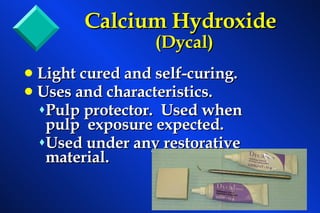
Calcium Hydroxide (Dycal) Light cured and self-curing. Uses and characteristics. Pulp protector.  Used when pulp  exposure expected. Used under any restorative material.
Dentist will apply dycal only to relatively dry cavity preparation. Once dycal mixed, you may need to dry cavity preparation before dentist place the dycal. Calcium Hydroxide  (Dycal)
Preparation Dispense equal amounts of base and catalyst. Mix with dycal instrument until uniform in color. Mixing time is 10 seconds. Calcium Hydroxide  (Dycal)
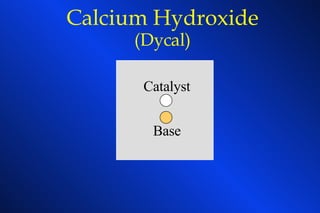
Calcium Hydroxide  (Dycal) Base Catalyst
Dentin Bonding Agents (DBA) DBA dentist uses may require multiple steps and complex technique using several substances, acid etching steps, drying steps, and light curing. You must become familiar with material to be used prior to use on patient.
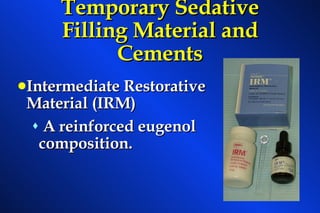
Temporary Sedative Filling Material and Cements Intermediate Restorative  Material (IRM)  A reinforced eugenol composition.
IRM Uses and Characteristics Temporary restoration up to 1 year Base or a temporary cement Not used under composite restorations
IRM Preparation Measurement Dispense 1:1 ratio powder to liquid onto a parchment pad Fluff powder prior to measuring Dispense liquid by holding dropper vertically
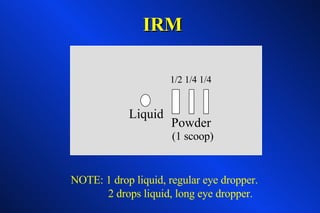
IRM NOTE: 1 drop liquid, regular eye dropper.   2 drops liquid, long eye dropper. 1/2 1/4 1/4 Powder  (1 scoop) Liquid
IRM Preparation Mixing Combine half the powder with liquid. Combine remaining powder in two or three increments Use all the powder. Mix will have consistency of play dough. Mixing time will not exceed 1 min.
Zinc Phosphate Cement (Zinc oxide and phosphoric acid) Uses and characteristics Cementing agent for crowns and FPDs. Temporary restorations. Insulating base. Produces heat when mixed.
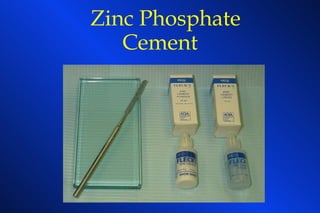
Zinc Phosphate Cement
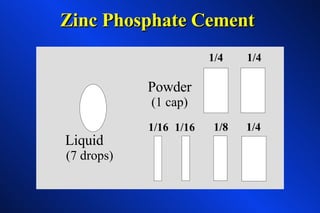
Zinc Phosphate Cement   Preparation Measurement. Dispense 7 drops of liquid on a cool, clean, dry glass slab. Fill powder cap to shoulder and dispense on glass slab. Divide powder into segments.
Zinc Phosphate Cement 1/4 1/4 1/4 1/8 1/16 Liquid  (7 drops) Powder  (1 cap) 1/16
Zinc Phosphate Cement   Preparation Mixing Start with smallest increment and graduate to largest Mix each segment approximately 15 seconds over a large area to dissipate heat Mix time is 1 1/2 - 2 minutes
Zinc Phosphate Cement   Preparation Precautions - Mix over a LARGE area to dissipate the generated heat as this heat will accelerate setting time.
Glass Ionomer Cement Uses and Characteristics. Cementing crowns and FPDs. Temporary filling. Base material. Releases fluoride ions which helps GI resist recurrent decay. Preparation IAW manufacturers instructions.
Impression Materials Alginate impression material. Uses and Characteristics. Preliminary impressions for study casts (seldom used for final impressions). Irreversible hydrocolloid. CAUTION - Do NOT inhale powder.
Types. Regular set - working time, 2  minutes; set time, 4 1/2 minutes. Fast set - working time 1 minute;  set time, 1 to 2 minutes. Setting time is reduced by warmer  water. Alginate Impression Materials
Preparation. Measure water and place in rubber  mixing bowl. Tumble alginate container. Measure powder and add to water. Stir in middle of bowl; then,  spatulate against sides of bowl. Alginate Impression Materials
Mix must have a smooth, creamy   texture. Complete mix within 60 seconds. Place mix into impression tray. Alginate Impression Materials
Vinyl-polysiloxane  Impression  Material    (Reprosil) Uses and Characteristics  Extremely accurate impression material. Crown and bridge impressions. Precise duplication of models (diagnostic casts) in the dental laboratory.
Vinyl-polysiloxane   Impression Material Four Types Light Body (low viscosity) - used in syringe or tray. Regular Body (medium viscosity) - used in syringe or tray. Heavy Body (high viscosity)  - used in tray.  Putty-Used in tray.
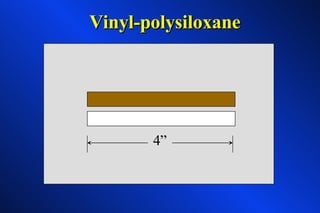
Preparation Dispense equal lengths (4 “) of  materials from each tube on to a parchment pad. Dispense in middle of pad close together, but not touching. Use two tongue blades to incorporate the two materials.
Vinyl-polysiloxane 4”
Use first tongue blade to begin the  mix, at 30 seconds, turn the mix  with the second tongue blade and  complete the mix. Mix must be complete within 60  seconds. Mix must be uniform in color, no  streaks. Preparation
Infection Control Sterilize instruments used in treatment (material syringe, impression trays, etc.).
Disinfect impression material prior to sending to lab.   Rinse thoroughly. Spray with disinfectant  solution. Place in sealed plastic  bag and give to the lab. Infection Control
Restorative  Resin Materials Acid Etch (35 - 50% solution of Phosphoric Acid). Purpose. Increases bond between enamel & resin. Provides added source of retention and marginal seal. ABC
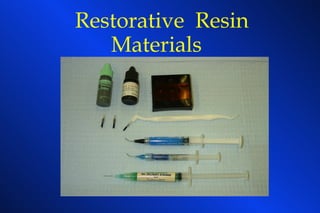
Restorative  Resin Materials
Acid Etch Procedure Dry cavity prep thoroughly. Apply etch to enamel wall and leave on IAW manufacturer’s instructions. Rinse and dry thoroughly. A
Acid Etch Procedure Treated tooth will appear chalky. If prep becomes contaminated with  saliva, repeat procedure. A
Acid Etch Precautions. Avoid contact with soft tissues, rinse thoroughly if contaminated. Protect pulp. A
Bonding Agent Purpose - chemically bonds    composite filling material to tooth structure. Light cured - no mixing required. B
Bonding Agent Procedure Apply bond to etched tooth surface (use of a dentin primer to bond is optional). Light cure IAW manufacturer’s instructions (20 - 30 seconds). B
Bonding Agent Precaution Proper use of the protective shield when curing bonding agent eliminates potential eye hazards to provider and patient. B
Light Cured Composite   Resins    Uses and Characteristics. Restorative material for anterior teeth. Matches tooth color. C
Procedure. Apply Base. Etch tooth. Apply bonding agent, light cure. Place resin filling material and light-cure (20-40 sec). Finish/polish restoration. Light Cured Composite   Resins    C
Light Cured Composite   Resins    Precautions  Ensure proper use of the protective shield. Dispense materials prior to use. C
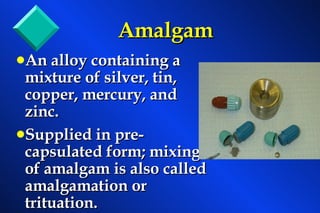
Amalgam An alloy containing a mixture of silver, tin, copper, mercury, and zinc. Supplied in pre-capsulated form; mixing of amalgam is also called amalgamation or trituation.
Physical Characteristics of Mercury   Liquid at room temperature. Vaporizes with increased heat. Provides plasticity to amalgam restorations. Highly Poisonous - symptoms of poisoning are nausea, headache, swollen glands.  Amalgam
Amalgam Mercury absorption - absorbed directly through skin contact or from inhalation of mercury vapors. Personal Hygiene. Avoid touching hair or face after handling. Wash hands thoroughly.
Personal Hygiene. NEVER wear jewelry (mercury combines readily with silver and gold). Store scrap in unbreakable, tightly-sealed container. Notify NCOIC in the event of mercury spill. Amalgam
Amalgam Advantages. Best restorative material for posterior teeth, restore all surfaces. “User Friendly” can be readily mixed, placed, and carved in a short time. High compression strength upon setting - withstands biting forces. Resists recurrent decay better than composite resin.  Can last a very long time.
Amalgam Disadvantages. Non esthetic - silver color does not match natural tooth color. Contains mercury.
Amalgam Preparation Triturate. Place capsule in amalgamator. Set timer IAW manufacturer’s Inst. Use over rimmed tray. Dispose of scrap amalgam properly.
Material Safety Material Safety Data Sheets (MSDS) contain information on the chemical and physical hazards in the workplace. MSDs should be centrally located within the clinic, this allows easy access for all personnel.
Material Safety Misuse of chemicals can cause injury to you or a patient.
Storage of hazardous/flammable materials. Utilized in patient treatment. DTR - 1-2 week supply (clinic policy). Bulk - centrally located supply area. Bulk flammable material must be stored in a centrally located flame proof cabinet. Material Safety
Precious Metals Recovery    Program Designed to save money and conserve natural resources. Comply with local SOPs. Silver bearing scraps. Scrap amalgam. Scrap dental x-ray film. Used X-ray fixer solution.
QUESTIONS
SUMMARY Chemistry relating to dental materials. Bases and dentin bonding agents. Temporary sedative materials and cements. Glass Ionomer products. Identied the basic facts and principles of:
SUMMARY Impression materials. Restorative resin materials. Amalgam. Material safety relating to dental materials and mercury. Precious metals recovery program. Identied the basic facts and principles of:

Dental Materials

  • 1.
  • 2.
    Chemistry in DentalMaterials Definition of Chemistry: A science that deals with the composition of matter and the changes in composition which the matter may undergo.
  • 3.
    Base -main or supporting ingredient in material. Catalyst - substance that initiates a chemical reaction. Chemistry in Dental Materials
  • 4.
    Composition of MatterMixture-two or more not chemically combined Solution - a homogenous mixture Solubility-how well something dissolves. Chemistry in Dental Materials
  • 5.
    Bases and DentinBonding Agents. Function and purpose Placed in tooth after cavity prep and just before placement of restorative material. Function to reduce microscopic gap between surface of dentin and restorative material.
  • 6.
    Function and Purpose Cont’d Reducing the microscopic gap can Reduce “micro leakage.” Reduce sensitivity of restoration. Help living tissue inside the tooth recover from stress of preparation and restoration.
  • 7.
    Reducing the microscopicgap can Serve to bond or tie restoration to tooth chemically and micro-mechanically. Assists retention of restoration. Function and Purpose Cont’d
  • 8.
    Bases Glass Ionomer(GI) Mix liquid with powder IAW manufacturers instructions. Mix material and hand applicator to dentist. Hold material on small mixing pad near patient’s mouth.
  • 9.
    Dentist will placematerial in cavity preparation with instrument. You or dentist will light cure base for 30-60 seconds. Glass Ionomer cont’d
  • 10.
    GI bonds somewhatto tooth structure, has good strength, resists decay. Usually best choice of base material, if no pulp exposure. Cavity prep needs to be relatively dry before place of GI or Calcium hydroxide. Glass Ionomer cont’d
  • 11.
    Calcium Hydroxide (Dycal)Light cured and self-curing. Uses and characteristics. Pulp protector. Used when pulp exposure expected. Used under any restorative material.
  • 12.
    Dentist will applydycal only to relatively dry cavity preparation. Once dycal mixed, you may need to dry cavity preparation before dentist place the dycal. Calcium Hydroxide (Dycal)
  • 13.
    Preparation Dispense equalamounts of base and catalyst. Mix with dycal instrument until uniform in color. Mixing time is 10 seconds. Calcium Hydroxide (Dycal)
  • 14.
    Calcium Hydroxide (Dycal) Base Catalyst
  • 15.
    Dentin Bonding Agents(DBA) DBA dentist uses may require multiple steps and complex technique using several substances, acid etching steps, drying steps, and light curing. You must become familiar with material to be used prior to use on patient.
  • 16.
    Temporary Sedative FillingMaterial and Cements Intermediate Restorative Material (IRM) A reinforced eugenol composition.
  • 17.
    IRM Uses andCharacteristics Temporary restoration up to 1 year Base or a temporary cement Not used under composite restorations
  • 18.
    IRM Preparation MeasurementDispense 1:1 ratio powder to liquid onto a parchment pad Fluff powder prior to measuring Dispense liquid by holding dropper vertically
  • 19.
    IRM NOTE: 1drop liquid, regular eye dropper. 2 drops liquid, long eye dropper. 1/2 1/4 1/4 Powder (1 scoop) Liquid
  • 20.
    IRM Preparation MixingCombine half the powder with liquid. Combine remaining powder in two or three increments Use all the powder. Mix will have consistency of play dough. Mixing time will not exceed 1 min.
  • 21.
    Zinc Phosphate Cement(Zinc oxide and phosphoric acid) Uses and characteristics Cementing agent for crowns and FPDs. Temporary restorations. Insulating base. Produces heat when mixed.
  • 22.
  • 23.
    Zinc Phosphate Cement Preparation Measurement. Dispense 7 drops of liquid on a cool, clean, dry glass slab. Fill powder cap to shoulder and dispense on glass slab. Divide powder into segments.
  • 24.
    Zinc Phosphate Cement1/4 1/4 1/4 1/8 1/16 Liquid (7 drops) Powder (1 cap) 1/16
  • 25.
    Zinc Phosphate Cement Preparation Mixing Start with smallest increment and graduate to largest Mix each segment approximately 15 seconds over a large area to dissipate heat Mix time is 1 1/2 - 2 minutes
  • 26.
    Zinc Phosphate Cement Preparation Precautions - Mix over a LARGE area to dissipate the generated heat as this heat will accelerate setting time.
  • 27.
    Glass Ionomer CementUses and Characteristics. Cementing crowns and FPDs. Temporary filling. Base material. Releases fluoride ions which helps GI resist recurrent decay. Preparation IAW manufacturers instructions.
  • 28.
    Impression Materials Alginateimpression material. Uses and Characteristics. Preliminary impressions for study casts (seldom used for final impressions). Irreversible hydrocolloid. CAUTION - Do NOT inhale powder.
  • 29.
    Types. Regular set- working time, 2 minutes; set time, 4 1/2 minutes. Fast set - working time 1 minute; set time, 1 to 2 minutes. Setting time is reduced by warmer water. Alginate Impression Materials
  • 30.
    Preparation. Measure waterand place in rubber mixing bowl. Tumble alginate container. Measure powder and add to water. Stir in middle of bowl; then, spatulate against sides of bowl. Alginate Impression Materials
  • 31.
    Mix must havea smooth, creamy texture. Complete mix within 60 seconds. Place mix into impression tray. Alginate Impression Materials
  • 32.
    Vinyl-polysiloxane Impression Material (Reprosil) Uses and Characteristics Extremely accurate impression material. Crown and bridge impressions. Precise duplication of models (diagnostic casts) in the dental laboratory.
  • 33.
    Vinyl-polysiloxane Impression Material Four Types Light Body (low viscosity) - used in syringe or tray. Regular Body (medium viscosity) - used in syringe or tray. Heavy Body (high viscosity) - used in tray. Putty-Used in tray.
  • 34.
    Preparation Dispense equallengths (4 “) of materials from each tube on to a parchment pad. Dispense in middle of pad close together, but not touching. Use two tongue blades to incorporate the two materials.
  • 35.
  • 36.
    Use first tongueblade to begin the mix, at 30 seconds, turn the mix with the second tongue blade and complete the mix. Mix must be complete within 60 seconds. Mix must be uniform in color, no streaks. Preparation
  • 37.
    Infection Control Sterilizeinstruments used in treatment (material syringe, impression trays, etc.).
  • 38.
    Disinfect impression materialprior to sending to lab. Rinse thoroughly. Spray with disinfectant solution. Place in sealed plastic bag and give to the lab. Infection Control
  • 39.
    Restorative ResinMaterials Acid Etch (35 - 50% solution of Phosphoric Acid). Purpose. Increases bond between enamel & resin. Provides added source of retention and marginal seal. ABC
  • 40.
  • 41.
    Acid Etch ProcedureDry cavity prep thoroughly. Apply etch to enamel wall and leave on IAW manufacturer’s instructions. Rinse and dry thoroughly. A
  • 42.
    Acid Etch ProcedureTreated tooth will appear chalky. If prep becomes contaminated with saliva, repeat procedure. A
  • 43.
    Acid Etch Precautions.Avoid contact with soft tissues, rinse thoroughly if contaminated. Protect pulp. A
  • 44.
    Bonding Agent Purpose- chemically bonds composite filling material to tooth structure. Light cured - no mixing required. B
  • 45.
    Bonding Agent ProcedureApply bond to etched tooth surface (use of a dentin primer to bond is optional). Light cure IAW manufacturer’s instructions (20 - 30 seconds). B
  • 46.
    Bonding Agent PrecautionProper use of the protective shield when curing bonding agent eliminates potential eye hazards to provider and patient. B
  • 47.
    Light Cured Composite Resins Uses and Characteristics. Restorative material for anterior teeth. Matches tooth color. C
  • 48.
    Procedure. Apply Base.Etch tooth. Apply bonding agent, light cure. Place resin filling material and light-cure (20-40 sec). Finish/polish restoration. Light Cured Composite Resins C
  • 49.
    Light Cured Composite Resins Precautions Ensure proper use of the protective shield. Dispense materials prior to use. C
  • 50.
    Amalgam An alloycontaining a mixture of silver, tin, copper, mercury, and zinc. Supplied in pre-capsulated form; mixing of amalgam is also called amalgamation or trituation.
  • 51.
    Physical Characteristics ofMercury Liquid at room temperature. Vaporizes with increased heat. Provides plasticity to amalgam restorations. Highly Poisonous - symptoms of poisoning are nausea, headache, swollen glands. Amalgam
  • 52.
    Amalgam Mercury absorption- absorbed directly through skin contact or from inhalation of mercury vapors. Personal Hygiene. Avoid touching hair or face after handling. Wash hands thoroughly.
  • 53.
    Personal Hygiene. NEVERwear jewelry (mercury combines readily with silver and gold). Store scrap in unbreakable, tightly-sealed container. Notify NCOIC in the event of mercury spill. Amalgam
  • 54.
    Amalgam Advantages. Bestrestorative material for posterior teeth, restore all surfaces. “User Friendly” can be readily mixed, placed, and carved in a short time. High compression strength upon setting - withstands biting forces. Resists recurrent decay better than composite resin. Can last a very long time.
  • 55.
    Amalgam Disadvantages. Nonesthetic - silver color does not match natural tooth color. Contains mercury.
  • 56.
    Amalgam Preparation Triturate.Place capsule in amalgamator. Set timer IAW manufacturer’s Inst. Use over rimmed tray. Dispose of scrap amalgam properly.
  • 57.
    Material Safety MaterialSafety Data Sheets (MSDS) contain information on the chemical and physical hazards in the workplace. MSDs should be centrally located within the clinic, this allows easy access for all personnel.
  • 58.
    Material Safety Misuseof chemicals can cause injury to you or a patient.
  • 59.
    Storage of hazardous/flammablematerials. Utilized in patient treatment. DTR - 1-2 week supply (clinic policy). Bulk - centrally located supply area. Bulk flammable material must be stored in a centrally located flame proof cabinet. Material Safety
  • 60.
    Precious Metals Recovery Program Designed to save money and conserve natural resources. Comply with local SOPs. Silver bearing scraps. Scrap amalgam. Scrap dental x-ray film. Used X-ray fixer solution.
  • 61.
  • 62.
    SUMMARY Chemistry relatingto dental materials. Bases and dentin bonding agents. Temporary sedative materials and cements. Glass Ionomer products. Identied the basic facts and principles of:
  • 63.
    SUMMARY Impression materials.Restorative resin materials. Amalgam. Material safety relating to dental materials and mercury. Precious metals recovery program. Identied the basic facts and principles of: