BY
T.SUDHAKAR
14L41A0134
Seminar
On
DEMOLITION OF
BUILDING
 INTRODUCTION
 DEMOLITION
 STEPS BEFORE DEMOLITION
 Surveying
 Removal of hazardous materials
 Preparation of
plan
 Stability
report
 Safety
measures
 METHODS OF DEMOLITION
 Non-explosive demolition
 Explosive demolition
 CONCLUSION
 REFERENCES
 We know every structure is designed for a life period.
 The existence of the structure after the service life
period is very dangerous to its occupants and
surrounding buildings .
 The building act usually contains provisions that
enable local authorities to control demolition works for
the protection of public safety and to ensure adjoining
premises and the site are made good on completion of
the demolition.
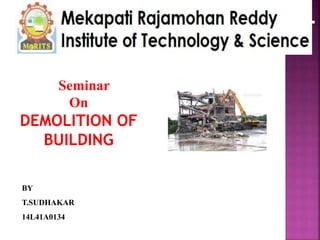
 Demolition is the process of tearing down or falling
down of a building after its life period with the help of
some equipments or any other method.
 When explosives are used for this then the demolition
process are called as an implosion.
 The different steps before the execution of a
demolition process are:
1. Surveying
2. Removal of hazardous materials
3. Preparation of plan
4. Stability report
5. Safety measures
There are two types of demolition
1. Non explosive demolition
2. Explosive demolition
 Non explosive demolition
It means the demolition of a structure done with
some equipment without the use of
any explosive.
 Sledge hammer
 The basic idea of explosive demolition is quite simple.
 If we remove the support structure of a building at a
certain point, the section of the building above the
point will fall down on the part of the building below
that point.
 Type of demolition method depends upon various
factors such as site condition, type of structures, age of
building, height of building and economy.
 Anyway controlled demolition of building is necessary
to ensure safety.
 Explosive demolition is the preferred method for safely
and efficiently demolishing the larger structures.
 www.google.com
 www.wikipedia.com
 www.studymafia.org
BUILDING DEMOLITION

BUILDING DEMOLITION

  • 1.
  • 2.
     INTRODUCTION  DEMOLITION STEPS BEFORE DEMOLITION  Surveying  Removal of hazardous materials  Preparation of plan  Stability report  Safety measures  METHODS OF DEMOLITION  Non-explosive demolition  Explosive demolition  CONCLUSION  REFERENCES
  • 3.
     We knowevery structure is designed for a life period.  The existence of the structure after the service life period is very dangerous to its occupants and surrounding buildings .  The building act usually contains provisions that enable local authorities to control demolition works for the protection of public safety and to ensure adjoining premises and the site are made good on completion of the demolition.
  • 4.
     Demolition isthe process of tearing down or falling down of a building after its life period with the help of some equipments or any other method.  When explosives are used for this then the demolition process are called as an implosion.
  • 5.
     The differentsteps before the execution of a demolition process are: 1. Surveying 2. Removal of hazardous materials 3. Preparation of plan 4. Stability report 5. Safety measures
  • 6.
    There are twotypes of demolition 1. Non explosive demolition 2. Explosive demolition
  • 7.
     Non explosivedemolition It means the demolition of a structure done with some equipment without the use of any explosive.  Sledge hammer
  • 9.
     The basicidea of explosive demolition is quite simple.  If we remove the support structure of a building at a certain point, the section of the building above the point will fall down on the part of the building below that point.
  • 10.
     Type ofdemolition method depends upon various factors such as site condition, type of structures, age of building, height of building and economy.  Anyway controlled demolition of building is necessary to ensure safety.  Explosive demolition is the preferred method for safely and efficiently demolishing the larger structures.
  • 11.

Editor's Notes