SRI VENKATESHWARAA COLLEGE OF
ENGINEERING AND TECHNOLOGY
DEPARTMENT OF CIVIL ENGINEERING
NAME: ANJALI DESHMUKH
DEPT: CIVIL ENGINEERING
EMAIL:anjalideshmukh031996@gmail.com
NAME: R.ARUN
DEPT: CIVIL ENGINEERING
EMAIL: arun62916@gmail.com
Objective:
3D Printing has revolutionised the way products are built. It is
used extensively for ideation, envisioning the product design with a model in
hand. It is possible to create functional models, which makes it easy for the
designers and engineers to validate the product designs and identify the errors
which otherwise would not have been noticed in virtual simulation and analysis,
especially the design fallacies related to fit, form and ergonomics. With a wide
range of materials available in different colours, the companies can now create
models that are astonishingly close to the real or final product.
What is 3D printing Technology:
3D Printing is a technique that deposits material layer by layer using a
head similar to that of an inkjet printer. The head tends to move along the X and
Y axes and the object being printed moves up and down on the Z axis. It is a
process whereby the information in a digital file describing an object virtually
(such as an STL or CAD file) is used to rapidly make a real object, usually by
one single machine and usually in limited production runs.
Need of study:
Reduce the cost of change and cost of error by identifying and rectifying design
errors earlier in the design cycle
Compress their design and development cycle time
Build robust products with superior functionality
Build jigs and fixtures to aid production line and quality control inspection
fixtures
Build products with great aesthetic appeal
Boost product design innovation
Development costs, and
And hit the market early.
Barack Obama :
“…the 3D printing technology has the potential to revolutionize the way we
make almost everything…”
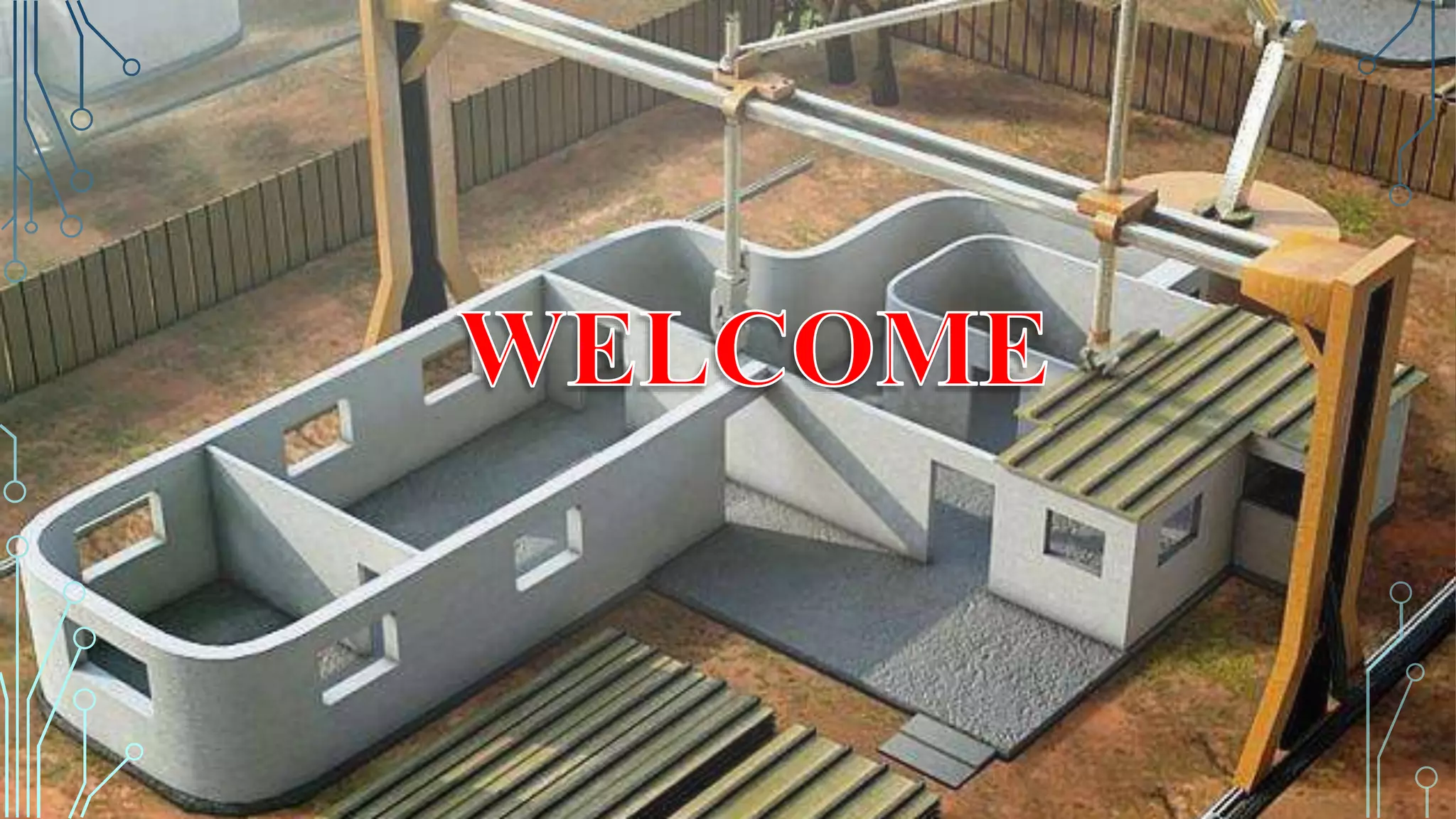
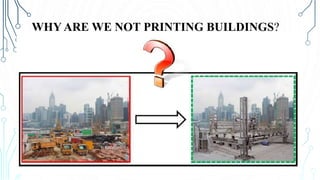
WHY ARE WE NOT PRINTING BUILDINGS?
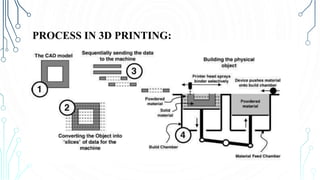
PROCESS IN 3D PRINTING:
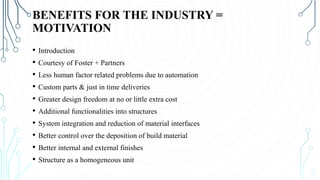
BENEFITS FOR THE INDUSTRY =
MOTIVATION
• Introduction
• Courtesy of Foster + Partners
• Less human factor related problems due to automation
• Custom parts & just in time deliveries
• Greater design freedom at no or little extra cost
• Additional functionalities into structures
• System integration and reduction of material interfaces
• Better control over the deposition of build material
• Better internal and external finishes
• Structure as a homogeneous unit
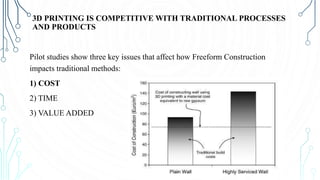
3D PRINTING IS COMPETITIVE WITH TRADITIONAL PROCESSES
AND PRODUCTS
Pilot studies show three key issues that affect how Freeform Construction
impacts traditional methods:
1) COST
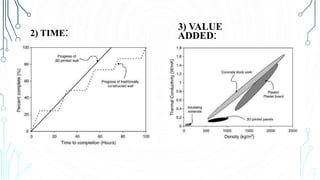
2) TIME
3) VALUE ADDED
2) TIME:
3) VALUE
ADDED:
ADVANTAGES:
 Rapid Prototyping
 Creation of Employment Opportunities
 Manufacture of Customized Products
Boon for Organ Donation
DEFECTS:
• Counterfeiting
• Manufacture of Dangerous Items
• Size Limitations
• Production of Unnecessary Stuff
Thank you!
3D Printing Technology in Civil Engineering

3D Printing Technology in Civil Engineering

  • 3.
    SRI VENKATESHWARAA COLLEGEOF ENGINEERING AND TECHNOLOGY DEPARTMENT OF CIVIL ENGINEERING NAME: ANJALI DESHMUKH DEPT: CIVIL ENGINEERING EMAIL:anjalideshmukh031996@gmail.com NAME: R.ARUN DEPT: CIVIL ENGINEERING EMAIL: arun62916@gmail.com
  • 4.
    Objective: 3D Printing hasrevolutionised the way products are built. It is used extensively for ideation, envisioning the product design with a model in hand. It is possible to create functional models, which makes it easy for the designers and engineers to validate the product designs and identify the errors which otherwise would not have been noticed in virtual simulation and analysis, especially the design fallacies related to fit, form and ergonomics. With a wide range of materials available in different colours, the companies can now create models that are astonishingly close to the real or final product.
  • 5.
    What is 3Dprinting Technology: 3D Printing is a technique that deposits material layer by layer using a head similar to that of an inkjet printer. The head tends to move along the X and Y axes and the object being printed moves up and down on the Z axis. It is a process whereby the information in a digital file describing an object virtually (such as an STL or CAD file) is used to rapidly make a real object, usually by one single machine and usually in limited production runs.
  • 6.
    Need of study: Reducethe cost of change and cost of error by identifying and rectifying design errors earlier in the design cycle Compress their design and development cycle time Build robust products with superior functionality Build jigs and fixtures to aid production line and quality control inspection fixtures Build products with great aesthetic appeal Boost product design innovation Development costs, and And hit the market early.
  • 7.
    Barack Obama : “…the3D printing technology has the potential to revolutionize the way we make almost everything…”
  • 8.
    WHY ARE WENOT PRINTING BUILDINGS?
  • 9.
    PROCESS IN 3DPRINTING:
  • 10.
    BENEFITS FOR THEINDUSTRY = MOTIVATION • Introduction • Courtesy of Foster + Partners • Less human factor related problems due to automation • Custom parts & just in time deliveries • Greater design freedom at no or little extra cost • Additional functionalities into structures • System integration and reduction of material interfaces • Better control over the deposition of build material • Better internal and external finishes • Structure as a homogeneous unit
  • 11.
    3D PRINTING ISCOMPETITIVE WITH TRADITIONAL PROCESSES AND PRODUCTS Pilot studies show three key issues that affect how Freeform Construction impacts traditional methods: 1) COST 2) TIME 3) VALUE ADDED
  • 12.
  • 13.
    ADVANTAGES:  Rapid Prototyping Creation of Employment Opportunities  Manufacture of Customized Products Boon for Organ Donation
  • 14.
    DEFECTS: • Counterfeiting • Manufactureof Dangerous Items • Size Limitations • Production of Unnecessary Stuff
  • 15.