UNIT 2
DIGITAL
MODULATION
TECHNIQUES
INTRODUCTION
• WHAT IS MODULATION:
In electronics and telecommunications, modulation is the
process of varying one or more properties of a periodic
waveform, called the carrier signal, with a modulating signal
that typically contains information to be transmitted.
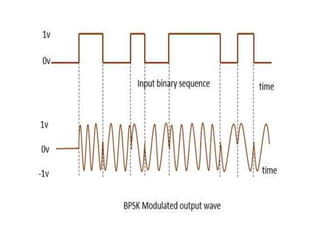
.Digital modulation uses discrete signals for modulating a
carrier wave i.e if a binary signal modulates a high frequency
carrier signal then it is called as “Digital modulation”
Types of digital modulation
• There are several kinds of digital modulation
techniques are available based on the
requirement which includes the following.
• ASK or Amplitude shift Key
• FSK or Frequency shift key
• PSK or Phase shift key
Synchronous and Asynchronous detection
• Generally there are two types of Demodulation
techniques.
They are
1.Asynchronous Demodulation/detection
2.Synchronous Demodulation/detection
• The clock frequency at the transmitter when
matches with the clock frequency at the receiver,
it is known as a Synchronous method, as the
frequency gets synchronized. Otherwise, it is
known as Asynchronous.
Amplitude-shift keying (ASK)
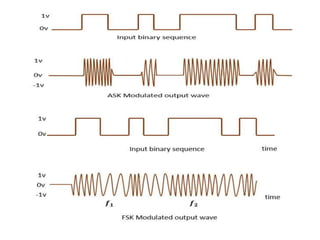
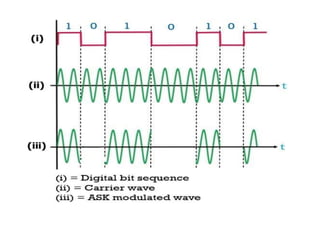
• Amplitude-shift keying (ASK) is a form
of amplitude modulation that
represents digital data as variations in
the amplitude of a carrier wave. In an ASK
system, the binary symbol 1 is represented by
transmitting a fixed-amplitude carrier wave
and fixed frequency for a bit duration of T
seconds. If the signal value is 1 then the
carrier signal will be transmitted; otherwise, a
signal value of 0 will be transmitted.
Digital modulation techniques

Digital modulation techniques

  • 1.
  • 2.
    INTRODUCTION • WHAT ISMODULATION: In electronics and telecommunications, modulation is the process of varying one or more properties of a periodic waveform, called the carrier signal, with a modulating signal that typically contains information to be transmitted. .Digital modulation uses discrete signals for modulating a carrier wave i.e if a binary signal modulates a high frequency carrier signal then it is called as “Digital modulation”
  • 3.
    Types of digitalmodulation • There are several kinds of digital modulation techniques are available based on the requirement which includes the following. • ASK or Amplitude shift Key • FSK or Frequency shift key • PSK or Phase shift key
  • 6.
    Synchronous and Asynchronousdetection • Generally there are two types of Demodulation techniques. They are 1.Asynchronous Demodulation/detection 2.Synchronous Demodulation/detection • The clock frequency at the transmitter when matches with the clock frequency at the receiver, it is known as a Synchronous method, as the frequency gets synchronized. Otherwise, it is known as Asynchronous.
  • 7.
    Amplitude-shift keying (ASK) •Amplitude-shift keying (ASK) is a form of amplitude modulation that represents digital data as variations in the amplitude of a carrier wave. In an ASK system, the binary symbol 1 is represented by transmitting a fixed-amplitude carrier wave and fixed frequency for a bit duration of T seconds. If the signal value is 1 then the carrier signal will be transmitted; otherwise, a signal value of 0 will be transmitted.