INTRODUCTION
Plant poisoning in humans is a well known phenomenon, especially in
semi-urban and rural India.
It occurs following ingestion of any of the various parts of the plant,
viz. fruits, seeds, flowers, leaves, stem and root, as in most situations
all parts of the plant can be poisonous.
The nature of the plant poisoning is influenced by regional practices,
and hence, varies to some extent in various parts of our country,
though oleander and abrus poisoning are seen all over.
There appears to be a seasonal influence on the severity of the
poisoning besides quantity and mode of ingestion.
 Plant poisoning can occur from contact, ingestion and rarely by
inhalation.
Most of the cases in adults are suicidal, less commonly accidental or
homicidal.
The following are the commonly encountered acute and at times fatal
plant poisoning (in adults) in our country.
Yellow oleander
Abrus precatorius
Datura
Castor seed
Aconite
Cleistanthus collinus
Indian hemp
Cerbera odollam
Nux vomica
• SALIENT FEATURES
• 1. All parts of most plants are usually poisonous, though specific parts are
used.
• 2. Life-threatening poisoning occurs by ingestion.
• 3. The severity of the toxicity is influenced by the time of the year(season)
• 4. The toxic dose is very unpredictable.
• 5. Antidote is not available.
• 6. Stomach wash and activated charcoal is indicated for all.
• 7. There is an increased tendency to accidental poisoning, though in most,
it is suicidal.
• 8. Mortality is low.
• 9. Good supportive care is the sheet anchor for treatment.
CLASSIFICATION
Poisonous plants can be classified based on the chemical nature of
the toxin, the mechanism of action of the toxin or the predominant
system of the body involved.
• To the healthcare provider and recipient, classification based on the
body system involvement is most useful and is as follows:
1. Gastrointestinal: Abrus precatorius, Ricinus communis, Jatropha
curcas.
2. Cardiovascular: Yellow oleander, white oleander, Cerbera odollam,
aconite.
3. Central nervous system (CNS): Datura, Atropa belladonna,Strychnos
nux-vomica, Indian hemp (kidney).
4. Nephrotoxic: Aloe.
5. Haemotoxic: Gingko biloba, fava beans.
6. Hepatotoxic: Liquorice.
7. Dermatological/contact poisons: Poison ivy, capsicum.
8. Miscellaneous: Cleistanthus collinus, neem.
• Commonly encountered plant poisoning limited to their acute
presentation following oral ingestion are described below.,
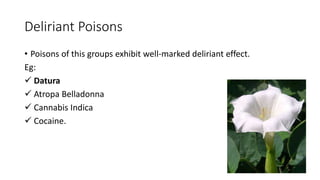
Deliriant Poisons
• Poisons of this groups exhibit well-marked deliriant effect.
Eg:
 Datura
 Atropa Belladonna
 Cannabis Indica
 Cocaine.
Datura poisoning
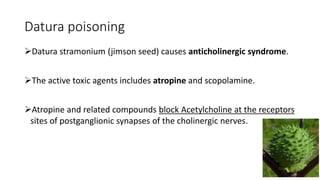
Datura stramonium (jimson seed) causes anticholinergic syndrome.
The active toxic agents includes atropine and scopolamine.
Atropine and related compounds block Acetylcholine at the receptors
sites of postganglionic synapses of the cholinergic nerves.
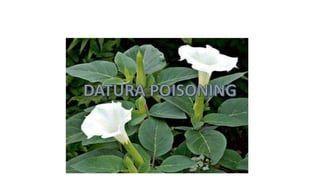
DATURA POISONING
The plant (Datura fastuosa) grows widely all over India.
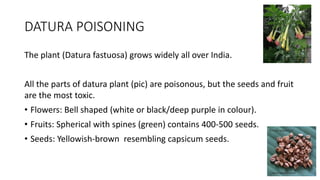
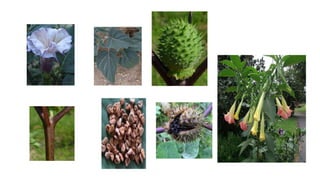
All the parts of datura plant (pic) are poisonous, but the seeds and fruit
are the most toxic.
• Flowers: Bell shaped (white or black/deep purple in colour).
• Fruits: Spherical with spines (green) contains 400-500 seeds.
• Seeds: Yellowish-brown resembling capsicum seeds.
Mode Of Action:
• Exerts central and peripheral action.
• Mainly anticholinergic effects CNS, CVS, Eyes, Smooth muscles,
Glands, Body Temp, Local Anesthetics, decreases bronchial secretion,
etc..
Mode of poisoning: most popular mode of poisoning is by mixing
the seeds in sweets and given to others with the intention of thefts.
CNS Effects
• In small doses stimulates CNS.
• Large doses depresses CNS, causes delirium and coma.
Peripheral Effects
• Depression of cholinergic fibers with parasymphatic paralysis.
Clinical features:
Toxic symptoms often appear within 30 minutes of ingestion and last
for 24-48hrs.
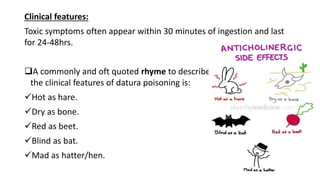
A commonly and oft quoted rhyme to describe
the clinical features of datura poisoning is:
Hot as hare.
Dry as bone.
Red as beet.
Blind as bat.
Mad as hatter/hen.
Hot as a hare : cutaneous vasodilatation leading to anhidrotic
hyperthermia.(Body temperature may be as high as 40 to 42 °C).
Blind as a bat : ciliary muscle paralysis, mydriasis, dilated pupils.
Dry as a bone : Anhidrosis, dryness of mouth, urinary retention,
decreased bowel motility.
Red as a beet : cutaneous vasodilatation causing flushing.
Mad as a hen : cns arousal, agitation, delirium, hallucinations
Other features include tachycardia and lose their bowel & bladder
tone, and the heart runs alone.
• Clinical features include bitter taste, vomiting, dry mouth and throat
(dry as bone) with intense thirst and at the same time difficulty in
swallowing and burning pain in the abdomen.
• On examination, patient feels hot/febrile with dry skin and rapid
pulse. Body temperature may be as high as 40°C to 42 °C (hot as a
hare).
• Face is flushed with suffused conjunctivae (red as beet).
• Neurological features include giddiness, dilated pupils with
photophobia, diplopia, loss of accommodation for near vision and
near blindness (blind as bat).
• Unsteadiness with inability to stand/walk, confusion, agitative,
violent, noisy, restlessness with tendency to runaway (mad as a hen)
or silent muttering delirium, visual and auditory hallucinations with
tendency to grasp imaginary objects or picking up bed clothes or
pulling imaginary threads from finger tips (carphologia), spontaneous
laughing/crying.
These features appear in two stages:
• 1. Stage of delirium
• 2. Stage of coma
 Stage of delirium
Onset: few min. to ½ hour.
Dry as bone: Mouth & throat
will be dry.
Intense thirst.
Difficulties in talking and
swallowing.
Burning pain in abdomen.
Dizziness.
Confusion.
Drunken gait.
Inability to stand.
Hoarseness of voice/aphonia.
Hot as hare: Skin becomes dry,
hot & exfoliatiated.
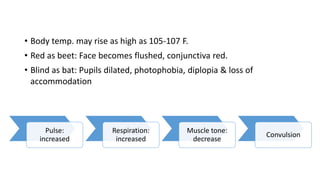
• Body temp. may rise as high as 105-107 F.
• Red as beet: Face becomes flushed, conjunctiva red.
• Blind as bat: Pupils dilated, photophobia, diplopia & loss of
accommodation
Pulse:
increased
Respiration:
increased
Muscle tone:
decrease
Convulsion
• Delirium sets in as patient may become restless, noisy, violent and
may have to be kept controlled in bed by several persons, as he is
inclined to run away from bed and wander about.
• Mad as hen: Person may be silent or may mutter indistinct,
incoherent & inaudible words. Visual, auditory hallucination.
Show certain ludicrous movements
• Grasping imaginary objects.
• Picking up bed clothes; imaginary threads from the tips of his
fingers(car phologia).
• Person begins to improve & awakes with severe headache, vertigo,
nausea and vomiting.
• Vision remains disordered for a few days until dilatation of pupil
subsides.
• Finally the patients recovers completely and remembers nothing of
his illness or events that had happened.
 Stage of Coma
• Occurs when drowsiness passes into stupor followed by convulsions
and coma.
• Gen. sings of deterioration.
• Death usually results from respiratory depression.
 Datura is excreted unchanged in urine for 10-20 Hrs., after ingestion.
 Urine should always be preserved for chemical analysis.
 Fatal Dose: 100-125 seeds confirms death.
 Fatal Period: within 24 Hrs.
 Treatment:
• Gastric lavage : (avoid in unconscious or violent individual)
• Activated charcoal (50 g) adsorbs the alkaloids with magnesium
sulphate 30 g
• Control of hyperthermia- tepid sponging.
• Intravenous diazepam for seizures
• Short acting barbiturates for delirium.
• Intravenous physostigmine 0.5 to 2.0 mg in extreme situations.
• Dark room if patient is agitated
• Light diet
Post-mortem Appearance
• Not characteristic.
• Cyanosis
• Dilated pupils
• Gen. signs of poisoning
• Seeds resists putrefication hence can be recovered from decomposed
body.
Medico-legal Aspects
• Rarely used for homicide or suicide.
• Used as stupefying agent for theft, robbery, rape or kidnapping.
• Accidental poisoning.
• Important manifestations
• Dryness of mouth, thirst, slurred speech
• Dysphagia
• Dilated pupils
• Diploplia
• Dry hot skin
• Dysuria
• Drunken gait
• Delirium
• Death
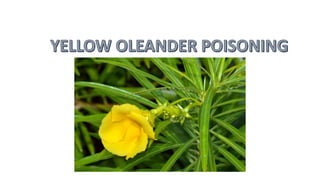
YELLOW OLEANDER POISONING
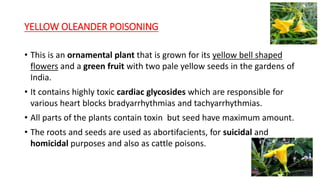
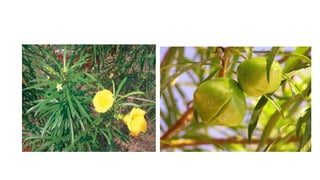
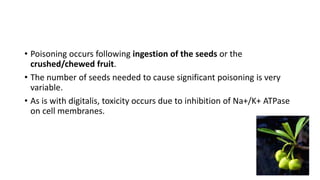
• This is an ornamental plant that is grown for its yellow bell shaped
flowers and a green fruit with two pale yellow seeds in the gardens of
India.
• It contains highly toxic cardiac glycosides which are responsible for
various heart blocks bradyarrhythmias and tachyarrhythmias.
• All parts of the plants contain toxin but seed have maximum amount.
• The roots and seeds are used as abortifacients, for suicidal and
homicidal purposes and also as cattle poisons.
• Poisoning occurs following ingestion of the seeds or the
crushed/chewed fruit.
• The number of seeds needed to cause significant poisoning is very
variable.
• As is with digitalis, toxicity occurs due to inhibition of Na+/K+ ATPase
on cell membranes.
• Patients may be asymptomatic even after ingestion of a large number
of seeds.
• Symptomatic patients present most commonly with various cardiac
arrhythmias including sinus bradycardia, various sino-atrial (SA)
nodal disturbances (sinus pause, sinus arrest), atrio-ventricular (AV)
nodal disturbances (first, second and third degree blocks), combined
SA and AV nodal disturbances and ectopic rhythms.
• Tachyarrhythmia is uncommon.
• Other symptoms include nausea, vomiting, diarrhoea, pain abdomen
and less commonly dry throat, oral paraesthesias, refractory
hypotension and altered sensorium/delirium.
• Blood biochemistry study may uncommonly show hyperkalaemia
(because of shift from intracellular compartment) otherwise it is
unremarkable.
• Electrocardiogram is essential to demonstrate the various
arrhythmias for the management.
• Management includes stomach wash (gastric lavage) using a wide
bore tube.
• Activated charcoal 50 g is used as single dose and repeated if
required.
• Cardiac arrhythmias of the SA nodal and AV nodal disturbances are
best managed by temporary venous pacing.
• Sinus bradycardia can be managed with atropine injections at regular
intervals or isoprenaline but with close monitoring.
• Tachyarrhythmias are treated with intravenous lidocaine.
• The role of intravenous magnesium in such situations is not well-
defined.
• Hypotension is poorly responsive to routine measures.
• Serious poisoning can be treated with digoxin specific antibody
fragments (Fab digoxin)1,200 mg single intravenous dose.
• Hyperkalaemia rarely requires treatment and is best managed, if
necessary, with intravenous dextrose and insulin.
• Intravenous calcium is to be avoided.
• Mortality in yellow oleander poisoning is 3% to 4%.
• Vegetable poisioning
Principle : Abrin = similar to Viper’s Venom
Extract from seeds….. Seeds are not poisonous, Only extracts are
poisonous.
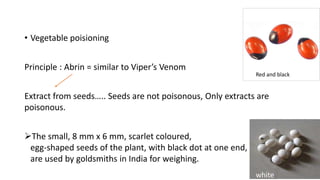
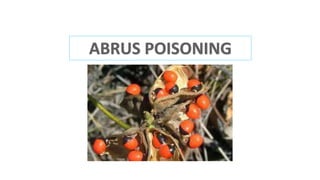
The small, 8 mm x 6 mm, scarlet coloured,
egg-shaped seeds of the plant, with black dot at one end,
are used by goldsmiths in India for weighing.
Red and black
white
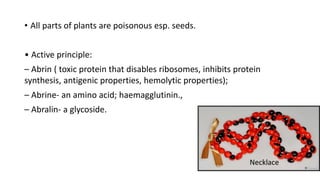
• All parts of plants are poisonous esp. seeds.
• Active principle:
– Abrin ( toxic protein that disables ribosomes, inhibits protein
synthesis, antigenic properties, hemolytic properties);
– Abrine- an amino acid; haemagglutinin.,
– Abralin- a glycoside.
Necklace
ABRUS PRECATORIUS POISONING
Abrus precatorius is a climbing plant with seeds that are scarlet red
in colour with a black spot at one end.
Poisoning results from consumption of the seeds either crushed or
chewed or made into a paste but not when consumed as a whole
intact seed and rarely by inhalation when the active moiety is used as
chemical warfare agent.
It is usually ingested with suicidal intent.
The toxic principle is abrin which is a toxalbumin or toxic protein with
two chains namely A and B.
Plant
The A chain has 256 residues and is the toxic component. It binds to
60S rRNA and inactivates it thereby preventing protein synthesis and
causing cell damage. The B chain has 268 residues and is bound to
the A chain by a disulphide bond at position cys 8 with cys 247 of A
chain.
The B chain binds to the cell surface receptor and facilitates the entry
of the molecule into the cytoplasm.
Abrin is a highly toxic chemical, only 0.1 to 1 mg/kg being
sufficient to cause death.
• Clinical manifestations are commonly of gastrointestinal origin and
include nausea, vomiting, pain abdomen, diarrhoea which later turns
bloody.
• Patient may later develop hypotension and shock.
• Acute renal failure, hepatotoxicity, intravascular haemolysis, altered
sensorium and seizures can also occur.
• The toxin because of its nature of action can cause tissue oedema and
vascular leakage/capillary leak syndrome.
On ingestion:
• Abdominal pain, nausea, vomiting, bloody diarrhoea,
• Vertigo, tinnitus, and giddiness,
• Cold clammy skin, irregular pulse, laboured breathing, convulsions,
• Haemolysis, oliguria and death d/t cardiac failure.
Injected:
• Resembles viper snake bite.
• Inflammation, oedema, oozing of fluid.
• Painful swelling and necrosis of muscles and regional lymph node
may occur.
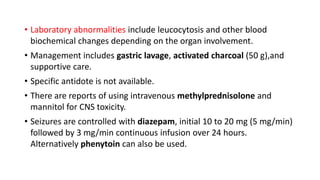
• Laboratory abnormalities include leucocytosis and other blood
biochemical changes depending on the organ involvement.
• Management includes gastric lavage, activated charcoal (50 g),and
supportive care.
• Specific antidote is not available.
• There are reports of using intravenous methylprednisolone and
mannitol for CNS toxicity.
• Seizures are controlled with diazepam, initial 10 to 20 mg (5 mg/min)
followed by 3 mg/min continuous infusion over 24 hours.
Alternatively phenytoin can also be used.
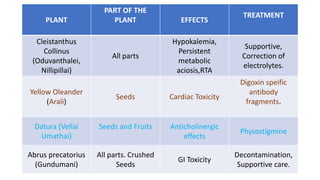
PLANT
PART OF THE
PLANT EFFECTS
TREATMENT
Cleistanthus
Collinus
(Oduvanthalei,
Nillipillai)
All parts
Hypokalemia,
Persistent
metabolic
aciosis,RTA
Supportive,
Correction of
electrolytes.
Yellow Oleander
(Arali)
Seeds Cardiac Toxicity
Digoxin speific
antibody
fragments.
Datura (Vellai
Umathai)
Seeds and Fruits Anticholinergic
effects
Physostigmine
Abrus precatorius
(Gundumani)
All parts. Crushed
Seeds
GI Toxicity
Decontamination,
Supportive care.
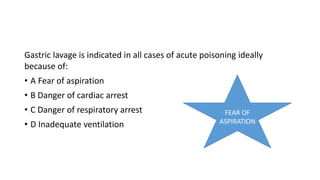
Gastric lavage is indicated in all cases of acute poisoning ideally
because of:
• A Fear of aspiration
• B Danger of cardiac arrest
• C Danger of respiratory arrest
• D Inadequate ventilation
FEAR OF
ASPIRATION
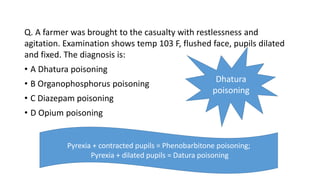
Q. A farmer was brought to the casualty with restlessness and
agitation. Examination shows temp 103 F, flushed face, pupils dilated
and fixed. The diagnosis is:
• A Dhatura poisoning
• B Organophosphorus poisoning
• C Diazepam poisoning
• D Opium poisoning
Dhatura
poisoning
Pyrexia + contracted pupils = Phenobarbitone poisoning;
Pyrexia + dilated pupils = Datura poisoning
• An 8 year old boy, Ramu, is brought to the casualty with a history of
consuming something while playing outside in a play ground. On
examination, there was altered sensorium, hyperpyrexia, and dilated
pupils. Most probable cause is:
• A Datura poisoning
• B Organophosphorus poisoning
• C Parthemium poisoning
• D Barbiturate poisoning
DATURA
Dhatura causes intoxication when there is intake of:
• A Seeds
• B Flowers
• C Leaves
• D Resinous intake
Fatal dose = 0.6 – 1 gm (100 – 120 seeds),
Fatal period = 24 hrs
Plant poison

Plant poison

  • 2.
    INTRODUCTION Plant poisoning inhumans is a well known phenomenon, especially in semi-urban and rural India. It occurs following ingestion of any of the various parts of the plant, viz. fruits, seeds, flowers, leaves, stem and root, as in most situations all parts of the plant can be poisonous. The nature of the plant poisoning is influenced by regional practices, and hence, varies to some extent in various parts of our country, though oleander and abrus poisoning are seen all over.
  • 3.
    There appears tobe a seasonal influence on the severity of the poisoning besides quantity and mode of ingestion.  Plant poisoning can occur from contact, ingestion and rarely by inhalation. Most of the cases in adults are suicidal, less commonly accidental or homicidal.
  • 4.
    The following arethe commonly encountered acute and at times fatal plant poisoning (in adults) in our country. Yellow oleander Abrus precatorius Datura Castor seed Aconite Cleistanthus collinus Indian hemp Cerbera odollam Nux vomica
  • 5.
    • SALIENT FEATURES •1. All parts of most plants are usually poisonous, though specific parts are used. • 2. Life-threatening poisoning occurs by ingestion. • 3. The severity of the toxicity is influenced by the time of the year(season) • 4. The toxic dose is very unpredictable. • 5. Antidote is not available. • 6. Stomach wash and activated charcoal is indicated for all. • 7. There is an increased tendency to accidental poisoning, though in most, it is suicidal. • 8. Mortality is low. • 9. Good supportive care is the sheet anchor for treatment.
  • 6.
    CLASSIFICATION Poisonous plants canbe classified based on the chemical nature of the toxin, the mechanism of action of the toxin or the predominant system of the body involved. • To the healthcare provider and recipient, classification based on the body system involvement is most useful and is as follows: 1. Gastrointestinal: Abrus precatorius, Ricinus communis, Jatropha curcas. 2. Cardiovascular: Yellow oleander, white oleander, Cerbera odollam, aconite.
  • 7.
    3. Central nervoussystem (CNS): Datura, Atropa belladonna,Strychnos nux-vomica, Indian hemp (kidney). 4. Nephrotoxic: Aloe. 5. Haemotoxic: Gingko biloba, fava beans. 6. Hepatotoxic: Liquorice. 7. Dermatological/contact poisons: Poison ivy, capsicum. 8. Miscellaneous: Cleistanthus collinus, neem. • Commonly encountered plant poisoning limited to their acute presentation following oral ingestion are described below.,
  • 9.
    Deliriant Poisons • Poisonsof this groups exhibit well-marked deliriant effect. Eg:  Datura  Atropa Belladonna  Cannabis Indica  Cocaine.
  • 10.
    Datura poisoning Datura stramonium(jimson seed) causes anticholinergic syndrome. The active toxic agents includes atropine and scopolamine. Atropine and related compounds block Acetylcholine at the receptors sites of postganglionic synapses of the cholinergic nerves.
  • 11.
    DATURA POISONING The plant(Datura fastuosa) grows widely all over India. All the parts of datura plant (pic) are poisonous, but the seeds and fruit are the most toxic. • Flowers: Bell shaped (white or black/deep purple in colour). • Fruits: Spherical with spines (green) contains 400-500 seeds. • Seeds: Yellowish-brown resembling capsicum seeds.
  • 13.
    Mode Of Action: •Exerts central and peripheral action. • Mainly anticholinergic effects CNS, CVS, Eyes, Smooth muscles, Glands, Body Temp, Local Anesthetics, decreases bronchial secretion, etc.. Mode of poisoning: most popular mode of poisoning is by mixing the seeds in sweets and given to others with the intention of thefts.
  • 14.
    CNS Effects • Insmall doses stimulates CNS. • Large doses depresses CNS, causes delirium and coma. Peripheral Effects • Depression of cholinergic fibers with parasymphatic paralysis.
  • 15.
    Clinical features: Toxic symptomsoften appear within 30 minutes of ingestion and last for 24-48hrs. A commonly and oft quoted rhyme to describe the clinical features of datura poisoning is: Hot as hare. Dry as bone. Red as beet. Blind as bat. Mad as hatter/hen.
  • 16.
    Hot as ahare : cutaneous vasodilatation leading to anhidrotic hyperthermia.(Body temperature may be as high as 40 to 42 °C). Blind as a bat : ciliary muscle paralysis, mydriasis, dilated pupils. Dry as a bone : Anhidrosis, dryness of mouth, urinary retention, decreased bowel motility. Red as a beet : cutaneous vasodilatation causing flushing. Mad as a hen : cns arousal, agitation, delirium, hallucinations Other features include tachycardia and lose their bowel & bladder tone, and the heart runs alone.
  • 17.
    • Clinical featuresinclude bitter taste, vomiting, dry mouth and throat (dry as bone) with intense thirst and at the same time difficulty in swallowing and burning pain in the abdomen. • On examination, patient feels hot/febrile with dry skin and rapid pulse. Body temperature may be as high as 40°C to 42 °C (hot as a hare). • Face is flushed with suffused conjunctivae (red as beet).
  • 18.
    • Neurological featuresinclude giddiness, dilated pupils with photophobia, diplopia, loss of accommodation for near vision and near blindness (blind as bat). • Unsteadiness with inability to stand/walk, confusion, agitative, violent, noisy, restlessness with tendency to runaway (mad as a hen) or silent muttering delirium, visual and auditory hallucinations with tendency to grasp imaginary objects or picking up bed clothes or pulling imaginary threads from finger tips (carphologia), spontaneous laughing/crying.
  • 19.
    These features appearin two stages: • 1. Stage of delirium • 2. Stage of coma
  • 20.
     Stage ofdelirium Onset: few min. to ½ hour. Dry as bone: Mouth & throat will be dry. Intense thirst. Difficulties in talking and swallowing. Burning pain in abdomen. Dizziness. Confusion. Drunken gait. Inability to stand. Hoarseness of voice/aphonia. Hot as hare: Skin becomes dry, hot & exfoliatiated.
  • 21.
    • Body temp.may rise as high as 105-107 F. • Red as beet: Face becomes flushed, conjunctiva red. • Blind as bat: Pupils dilated, photophobia, diplopia & loss of accommodation Pulse: increased Respiration: increased Muscle tone: decrease Convulsion
  • 22.
    • Delirium setsin as patient may become restless, noisy, violent and may have to be kept controlled in bed by several persons, as he is inclined to run away from bed and wander about. • Mad as hen: Person may be silent or may mutter indistinct, incoherent & inaudible words. Visual, auditory hallucination. Show certain ludicrous movements • Grasping imaginary objects. • Picking up bed clothes; imaginary threads from the tips of his fingers(car phologia).
  • 23.
    • Person beginsto improve & awakes with severe headache, vertigo, nausea and vomiting. • Vision remains disordered for a few days until dilatation of pupil subsides. • Finally the patients recovers completely and remembers nothing of his illness or events that had happened.
  • 24.
     Stage ofComa • Occurs when drowsiness passes into stupor followed by convulsions and coma. • Gen. sings of deterioration. • Death usually results from respiratory depression.
  • 25.
     Datura isexcreted unchanged in urine for 10-20 Hrs., after ingestion.  Urine should always be preserved for chemical analysis.  Fatal Dose: 100-125 seeds confirms death.  Fatal Period: within 24 Hrs.
  • 26.
     Treatment: • Gastriclavage : (avoid in unconscious or violent individual) • Activated charcoal (50 g) adsorbs the alkaloids with magnesium sulphate 30 g • Control of hyperthermia- tepid sponging. • Intravenous diazepam for seizures • Short acting barbiturates for delirium. • Intravenous physostigmine 0.5 to 2.0 mg in extreme situations. • Dark room if patient is agitated • Light diet
  • 27.
    Post-mortem Appearance • Notcharacteristic. • Cyanosis • Dilated pupils • Gen. signs of poisoning • Seeds resists putrefication hence can be recovered from decomposed body.
  • 28.
    Medico-legal Aspects • Rarelyused for homicide or suicide. • Used as stupefying agent for theft, robbery, rape or kidnapping. • Accidental poisoning.
  • 29.
    • Important manifestations •Dryness of mouth, thirst, slurred speech • Dysphagia • Dilated pupils • Diploplia • Dry hot skin • Dysuria • Drunken gait • Delirium • Death
  • 31.
    YELLOW OLEANDER POISONING •This is an ornamental plant that is grown for its yellow bell shaped flowers and a green fruit with two pale yellow seeds in the gardens of India. • It contains highly toxic cardiac glycosides which are responsible for various heart blocks bradyarrhythmias and tachyarrhythmias. • All parts of the plants contain toxin but seed have maximum amount. • The roots and seeds are used as abortifacients, for suicidal and homicidal purposes and also as cattle poisons.
  • 33.
    • Poisoning occursfollowing ingestion of the seeds or the crushed/chewed fruit. • The number of seeds needed to cause significant poisoning is very variable. • As is with digitalis, toxicity occurs due to inhibition of Na+/K+ ATPase on cell membranes.
  • 34.
    • Patients maybe asymptomatic even after ingestion of a large number of seeds. • Symptomatic patients present most commonly with various cardiac arrhythmias including sinus bradycardia, various sino-atrial (SA) nodal disturbances (sinus pause, sinus arrest), atrio-ventricular (AV) nodal disturbances (first, second and third degree blocks), combined SA and AV nodal disturbances and ectopic rhythms. • Tachyarrhythmia is uncommon. • Other symptoms include nausea, vomiting, diarrhoea, pain abdomen and less commonly dry throat, oral paraesthesias, refractory hypotension and altered sensorium/delirium.
  • 35.
    • Blood biochemistrystudy may uncommonly show hyperkalaemia (because of shift from intracellular compartment) otherwise it is unremarkable. • Electrocardiogram is essential to demonstrate the various arrhythmias for the management.
  • 36.
    • Management includesstomach wash (gastric lavage) using a wide bore tube. • Activated charcoal 50 g is used as single dose and repeated if required. • Cardiac arrhythmias of the SA nodal and AV nodal disturbances are best managed by temporary venous pacing. • Sinus bradycardia can be managed with atropine injections at regular intervals or isoprenaline but with close monitoring. • Tachyarrhythmias are treated with intravenous lidocaine. • The role of intravenous magnesium in such situations is not well- defined. • Hypotension is poorly responsive to routine measures.
  • 37.
    • Serious poisoningcan be treated with digoxin specific antibody fragments (Fab digoxin)1,200 mg single intravenous dose. • Hyperkalaemia rarely requires treatment and is best managed, if necessary, with intravenous dextrose and insulin. • Intravenous calcium is to be avoided. • Mortality in yellow oleander poisoning is 3% to 4%.
  • 39.
    • Vegetable poisioning Principle: Abrin = similar to Viper’s Venom Extract from seeds….. Seeds are not poisonous, Only extracts are poisonous. The small, 8 mm x 6 mm, scarlet coloured, egg-shaped seeds of the plant, with black dot at one end, are used by goldsmiths in India for weighing. Red and black white
  • 40.
    • All partsof plants are poisonous esp. seeds. • Active principle: – Abrin ( toxic protein that disables ribosomes, inhibits protein synthesis, antigenic properties, hemolytic properties); – Abrine- an amino acid; haemagglutinin., – Abralin- a glycoside. Necklace
  • 41.
    ABRUS PRECATORIUS POISONING Abrusprecatorius is a climbing plant with seeds that are scarlet red in colour with a black spot at one end. Poisoning results from consumption of the seeds either crushed or chewed or made into a paste but not when consumed as a whole intact seed and rarely by inhalation when the active moiety is used as chemical warfare agent. It is usually ingested with suicidal intent. The toxic principle is abrin which is a toxalbumin or toxic protein with two chains namely A and B. Plant
  • 42.
    The A chainhas 256 residues and is the toxic component. It binds to 60S rRNA and inactivates it thereby preventing protein synthesis and causing cell damage. The B chain has 268 residues and is bound to the A chain by a disulphide bond at position cys 8 with cys 247 of A chain. The B chain binds to the cell surface receptor and facilitates the entry of the molecule into the cytoplasm. Abrin is a highly toxic chemical, only 0.1 to 1 mg/kg being sufficient to cause death.
  • 43.
    • Clinical manifestationsare commonly of gastrointestinal origin and include nausea, vomiting, pain abdomen, diarrhoea which later turns bloody. • Patient may later develop hypotension and shock. • Acute renal failure, hepatotoxicity, intravascular haemolysis, altered sensorium and seizures can also occur. • The toxin because of its nature of action can cause tissue oedema and vascular leakage/capillary leak syndrome.
  • 44.
    On ingestion: • Abdominalpain, nausea, vomiting, bloody diarrhoea, • Vertigo, tinnitus, and giddiness, • Cold clammy skin, irregular pulse, laboured breathing, convulsions, • Haemolysis, oliguria and death d/t cardiac failure. Injected: • Resembles viper snake bite. • Inflammation, oedema, oozing of fluid. • Painful swelling and necrosis of muscles and regional lymph node may occur.
  • 45.
    • Laboratory abnormalitiesinclude leucocytosis and other blood biochemical changes depending on the organ involvement. • Management includes gastric lavage, activated charcoal (50 g),and supportive care. • Specific antidote is not available. • There are reports of using intravenous methylprednisolone and mannitol for CNS toxicity. • Seizures are controlled with diazepam, initial 10 to 20 mg (5 mg/min) followed by 3 mg/min continuous infusion over 24 hours. Alternatively phenytoin can also be used.
  • 46.
    PLANT PART OF THE PLANTEFFECTS TREATMENT Cleistanthus Collinus (Oduvanthalei, Nillipillai) All parts Hypokalemia, Persistent metabolic aciosis,RTA Supportive, Correction of electrolytes. Yellow Oleander (Arali) Seeds Cardiac Toxicity Digoxin speific antibody fragments. Datura (Vellai Umathai) Seeds and Fruits Anticholinergic effects Physostigmine Abrus precatorius (Gundumani) All parts. Crushed Seeds GI Toxicity Decontamination, Supportive care.
  • 48.
    Gastric lavage isindicated in all cases of acute poisoning ideally because of: • A Fear of aspiration • B Danger of cardiac arrest • C Danger of respiratory arrest • D Inadequate ventilation FEAR OF ASPIRATION
  • 49.
    Q. A farmerwas brought to the casualty with restlessness and agitation. Examination shows temp 103 F, flushed face, pupils dilated and fixed. The diagnosis is: • A Dhatura poisoning • B Organophosphorus poisoning • C Diazepam poisoning • D Opium poisoning Dhatura poisoning Pyrexia + contracted pupils = Phenobarbitone poisoning; Pyrexia + dilated pupils = Datura poisoning
  • 50.
    • An 8year old boy, Ramu, is brought to the casualty with a history of consuming something while playing outside in a play ground. On examination, there was altered sensorium, hyperpyrexia, and dilated pupils. Most probable cause is: • A Datura poisoning • B Organophosphorus poisoning • C Parthemium poisoning • D Barbiturate poisoning DATURA
  • 51.
    Dhatura causes intoxicationwhen there is intake of: • A Seeds • B Flowers • C Leaves • D Resinous intake Fatal dose = 0.6 – 1 gm (100 – 120 seeds), Fatal period = 24 hrs