Delayed puberty , Etiology , Diagnostic
approach
By – Dr . Aftab Ahmad
Mod – Dr. Jatin
Definition
Delayed puberty is defined as failure to develop secondary sexual
charecteristics by 2 SD beyond the mean age of onset for that population
An absence of an increase in testicular volume (less than 4 mL) at 14 yr in
a boy
OR
absence of any breast development at 13 yr in a girl.
delay in the onset, progression or completion of puberty sufficient to
cause concern to the adolescent, parents or physician
Pubertal arrest
Those in whom puberty commences but does not progress
Therefore, evaluation is warranted if more than 4–5 yr has elapsed from
the onset of puberty to adult testicular size in boys or menarche in girls.
in girls:
lack of breast development
by 13
more than five years between
breast growth and menstrual
period
lack of pubic hair by age 14
failure to menstruate by age
15-16
• in boys:
• lack of testicular
enlargement by age 14
• lack of pubic hair by age
15
• more than five years to
complete genital
enlargement
Introduction
Occurs in approximately 3% of children
In boys, delayed puberty is often constitutional and functional. (63 %)
In girls, delayed puberty is less common and often organic.
Normal puberty
Normal puberty
Normal puberty
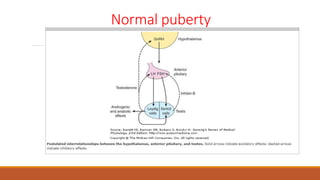
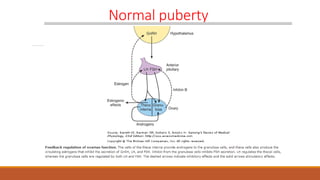
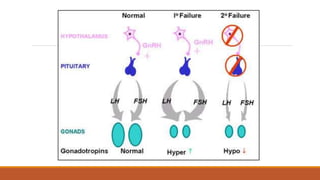
Normal puberty is initiated by the onset of pulsatile secretion of gonadotropin-
releasing hormone (GnRH) from the hypothalamus
These pulses cause release of luteinizing hormone (LH) and follicular stimulating
hormone (FSH) from the pituitary gland
These pituitary gonadotropins then circulate to the gonads and stimulate
production of sex steroids.
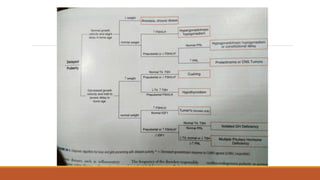
Classification
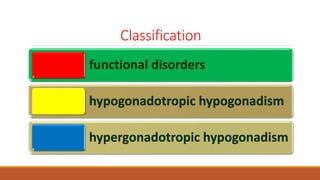
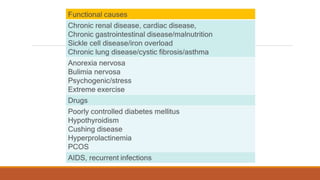
functional disorders
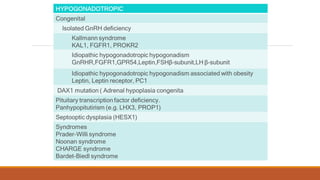
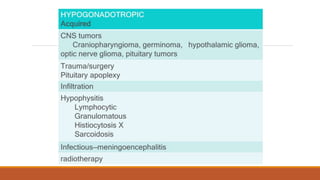
hypogonadotropic hypogonadism
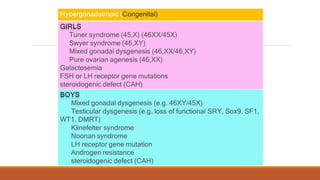
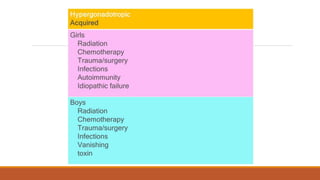
hypergonadotropic hypogonadism
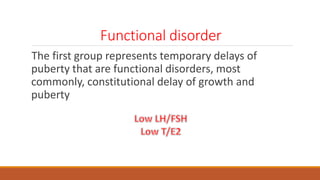
Functional disorder
The first group represents temporary delays of
puberty that are functional disorders, most
commonly, constitutional delay of growth and
puberty
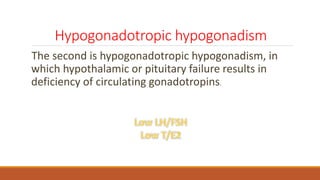
Hypogonadotropic hypogonadism
The second is hypogonadotropic hypogonadism, in
which hypothalamic or pituitary failure results in
deficiency of circulating gonadotropins.
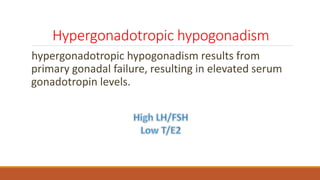
Hypergonadotropic hypogonadism
hypergonadotropic hypogonadism results from
primary gonadal failure, resulting in elevated serum
gonadotropin levels.
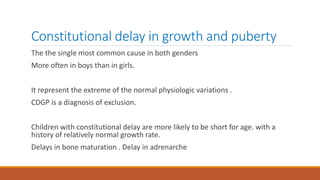
Constitutional delay in growth and puberty
The the single most common cause in both genders
More often in boys than in girls.
It represent the extreme of the normal physiologic variations .
CDGP is a diagnosis of exclusion.
Children with constitutional delay are more likely to be short for age. with a
history of relatively normal growth rate.
Delays in bone maturation . Delay in adrenarche
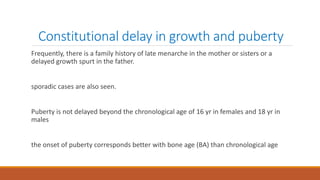
Constitutional delay in growth and puberty
Frequently, there is a family history of late menarche in the mother or sisters or a
delayed growth spurt in the father.
sporadic cases are also seen.
Puberty is not delayed beyond the chronological age of 16 yr in females and 18 yr in
males
the onset of puberty corresponds better with bone age (BA) than chronological age
Evaluation of pubertal delay
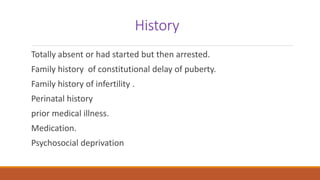
History
Totally absent or had started but then arrested.
Family history of constitutional delay of puberty.
Family history of infertility .
Perinatal history
prior medical illness.
Medication.
Psychosocial deprivation
History
Nutritional habits, exercise intensity.
Neurologic symptoms such as headache, visual disturbances,
seizures, and intellectual disability .
Sense of smell.
Hypoglycemia.
Cancer history :Radiation, Chemotherapy
history compatible with testicular injury (bilateral cryptorchidism,
surgery, irradiation, bilateral torsion)
Physical examination
Growth parameter Ht, Wt, BMI .weight for height.
The growth velocity ,Arm span.
pubertal staging.
Systemic exam. dysmorphisim
Visual field exam. Fundoscopy.
Evaluation of the sense of smell.
Associated congenital abnormalities (eg, midline defects, cleft lip/palate,
cryptorchidism, and microphallus )
Physical examination
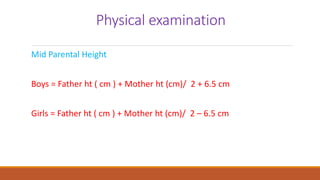
Mid Parental Height
Boys = Father ht ( cm ) + Mother ht (cm)/ 2 + 6.5 cm
Girls = Father ht ( cm ) + Mother ht (cm)/ 2 – 6.5 cm
Physical examination
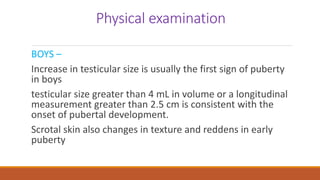
BOYS –
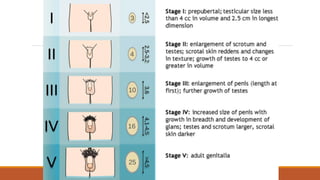
Increase in testicular size is usually the first sign of puberty
in boys
testicular size greater than 4 mL in volume or a longitudinal
measurement greater than 2.5 cm is consistent with the
onset of pubertal development.
Scrotal skin also changes in texture and reddens in early
puberty
Physical examination
GIRLS –
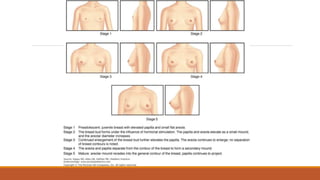
Breast development in girls begins with formation of breast
buds.
This development is frequently unilateral for several
months.
Development of axillary and pubic hair may or may not
accompany the onset of puberty.
the vaginal mucosa changes from a reddish to pink.
Lab
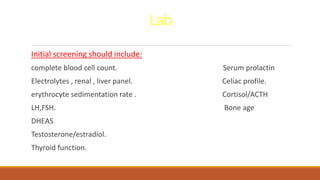
Initial screening should include:
complete blood cell count. Serum prolactin
Electrolytes , renal , liver panel. Celiac profile.
erythrocyte sedimentation rate . Cortisol/ACTH
LH,FSH. Bone age
DHEAS
Testosterone/estradiol.
Thyroid function.
Lab
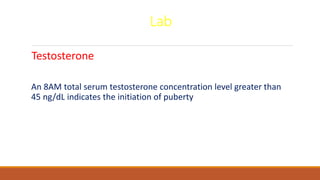
Testosterone
An 8AM total serum testosterone concentration level greater than
45 ng/dL indicates the initiation of puberty
Lab
Estradiol
a plasma estradiol of more than 9 pg/mL is indicative of puberty.
Elevations are reassuring for onset of early puberty.
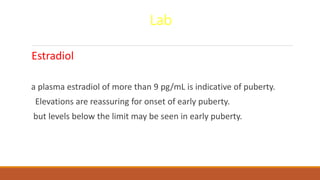
but levels below the limit may be seen in early puberty.
Lab
Serum gonadotropin levels (LH and FSH).
Baseline serum gonadotropin values are typically low in both
constitutional delay of puberty and congenital GnRH deficiency.
If elevated, the etiology for gonadal failure should be further
investigated based on the differential diagnoses.
Lab
Sleep-associated gonadotropin secretion
In normal puberty during night there is episodic LH secretion
coincident with the onset of sleep.
In compare to those with CDGP , Hypogonadotropic children
typically do not experience an increase in serum LH during sleep
Lab
Karyotyping :
if physical examination suggest the presence of a genetic syndrome .
Also in any short girl.
GnRH stimulation testing:
limited benifit
Imaging
Bone age :
may be obtained at the initial visit to assess skeletal maturation and
repeated over time if needed.
Skeletal age more closely correlates with sexual development than
does chronological age.
Bone age more than 13 for girls and 14 for boys less likely to
constitutonal
Imaging
Pelvic /scrotal ultrasound:
Indicated when an dysgenesis is suspected to
determine the presence or absence of internal
organs.
Imaging
MRI Brain
should be obtained in patients with hypogonadotropic
hypogonadism.
Treatment
The aim of treatment:
Development of age-appropriate secondary sex characteristics .
Induction of a growth spurt without inducing premature epiphyseal
closure.
Achievement of normal muscle mass and bone mineral density for
age.
Improvement in psychosocial wellbeing.
In some patient reversal of GnRH defceincy.
Treatment
constitutional delay:
conservative management with observation over 6 mo to 1 yr may be
warranted.
Constitutional delay of growth and puberty can cause significant psychosocial
stress, particularly in males.
Cases must be evaluated on an individual basis for psychosocial distress, and
subsequent need for intervention.
Treatment
In cases of clearly permanent hypogonadism,
therapy should be initiated at a normal pubertal
age to avoid the delay of growth and
psychological effect of pubertal delay.
Treatment of CDGP
most physicians advocate a period of “watchful waiting”.
including periodic evaluation, reassurance, and psychological
counseling .
short course of testosterone therapy may be initiated .
A low dose of testosterone enanthate (50–100 mg given
intramuscularly every 4 wk) for 4–6 mo will stimulate linear growth
and secondary sexual characteristics without inappropriately
accelerating bone age.
Treatment of permanent hypogonadal state in boys
Testosterone enanthate , administered by intramuscular injection, is the most
common method of pubertal induction and maintenance .
Various schemes have been proposed, but most authors advocate a starting
dose of 50 mg every 4 wk.
When the pubertal growth spurt is well established, the dose should be
gradually increased to a full adult dose of 200 mg every 2 wk.
When hypogonadism is diagnosed at a prepubertal age, testosterone therapy
may be started as early as a bone age of 11–12 yr .
Treatment ( Boys )
Transdermal Testosterone:
a scrotal patch and a nongenital patch.
When applied daily, result in similar testosterone
concentrations to those seen in normal young men in
magnitude and diurnal variation.
Treatment ( Boys )
Transdermal Testosterone:
substantially more expensive than testosterone esters .
can produce skin reaction .
not yet approved in males younger than age 18 years
their effectiveness in induction of puberty remains unclear
Treatment ( Boys )
Side effect:
acne, and gynecomastia.
fast skeletal maturation leading to impaired adult height.
excessive aggressiveness.
excessive stimulation of libido, priapism, polycythemia,
obstructive sleep apnea mainly in obese subjects
Treatment ( Boys )
Beneficial effects:
decline in total plasma cholesterol and LDL concentrations,
increased lean body mass.
decreased risk of osteoporosis
Treatment ( Boys )
Oxandrolone:
Can be used for Induction of a pubertal growth spurt in CDGP .
the mechanism of action is unclear.
it is anabolic steroid that increases growth velocity without
promoting excessive skeletal maturation
Doses of (0.1 mg/kg/day, 1.25 or 2.5 mg/d for 3–12 months).
Treatment ( Boys )
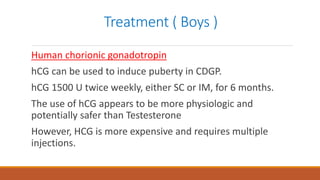
Human chorionic gonadotropin
hCG can be used to induce puberty in CDGP.
hCG 1500 U twice weekly, either SC or IM, for 6 months.
The use of hCG appears to be more physiologic and
potentially safer than Testesterone
However, HCG is more expensive and requires multiple
injections.
Treatment ( Boys )
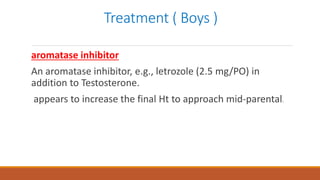
aromatase inhibitor
An aromatase inhibitor, e.g., letrozole (2.5 mg/PO) in
addition to Testosterone.
appears to increase the final Ht to approach mid-parental.
Treatment ( Boys )
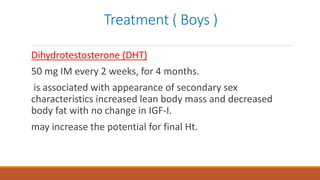
Dihydrotestosterone (DHT)
50 mg IM every 2 weeks, for 4 months.
is associated with appearance of secondary sex
characteristics increased lean body mass and decreased
body fat with no change in IGF-I.
may increase the potential for final Ht.
Treatment ( Girls )
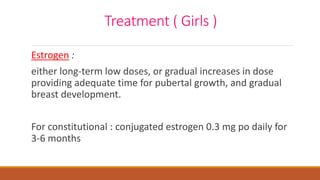
Estrogen :
either long-term low doses, or gradual increases in dose
providing adequate time for pubertal growth, and gradual
breast development.
For constitutional : conjugated estrogen 0.3 mg po daily for
3-6 months
Treatment ( Girls )
A progesterone should be added after two years of
estrogen , after full breast development or if spotting
occurs.
This is usually administered as:
Provera (medroxyprogesterone) at a dose of 5–10 mg or
micronized progesteroneat 200 mg/day (eg, Prometrium)
for 10–14 d
Treatment ( Girls )
In girls without a uterus, such as in androgen
insensitivity or XY gonadal dysgenesis, the same
guidelines for estrogen replacement can be
used, but there is no need for the addition of
progesterone.
Follow up and monitoring
Regular clinical follow-up assessing growth and
pubertal progression every 3-6 months
Bone age assessment.
Follow up and monitoring
Hematocrit level -
the discontinuation of therapy is required if hematocrit is
greater than 54% until it decreases to a safer level).
THANK YOU

Delayed puberty , etiology , diagnostic approach

  • 1.
    Delayed puberty ,Etiology , Diagnostic approach By – Dr . Aftab Ahmad Mod – Dr. Jatin
  • 2.
    Definition Delayed puberty isdefined as failure to develop secondary sexual charecteristics by 2 SD beyond the mean age of onset for that population An absence of an increase in testicular volume (less than 4 mL) at 14 yr in a boy OR absence of any breast development at 13 yr in a girl. delay in the onset, progression or completion of puberty sufficient to cause concern to the adolescent, parents or physician
  • 3.
    Pubertal arrest Those inwhom puberty commences but does not progress Therefore, evaluation is warranted if more than 4–5 yr has elapsed from the onset of puberty to adult testicular size in boys or menarche in girls.
  • 4.
    in girls: lack ofbreast development by 13 more than five years between breast growth and menstrual period lack of pubic hair by age 14 failure to menstruate by age 15-16 • in boys: • lack of testicular enlargement by age 14 • lack of pubic hair by age 15 • more than five years to complete genital enlargement
  • 5.
    Introduction Occurs in approximately3% of children In boys, delayed puberty is often constitutional and functional. (63 %) In girls, delayed puberty is less common and often organic.
  • 6.
  • 7.
  • 8.
    Normal puberty Normal pubertyis initiated by the onset of pulsatile secretion of gonadotropin- releasing hormone (GnRH) from the hypothalamus These pulses cause release of luteinizing hormone (LH) and follicular stimulating hormone (FSH) from the pituitary gland These pituitary gonadotropins then circulate to the gonads and stimulate production of sex steroids.
  • 9.
  • 10.
    Functional disorder The firstgroup represents temporary delays of puberty that are functional disorders, most commonly, constitutional delay of growth and puberty
  • 11.
    Hypogonadotropic hypogonadism The secondis hypogonadotropic hypogonadism, in which hypothalamic or pituitary failure results in deficiency of circulating gonadotropins.
  • 12.
    Hypergonadotropic hypogonadism hypergonadotropic hypogonadismresults from primary gonadal failure, resulting in elevated serum gonadotropin levels.
  • 14.
    Constitutional delay ingrowth and puberty The the single most common cause in both genders More often in boys than in girls. It represent the extreme of the normal physiologic variations . CDGP is a diagnosis of exclusion. Children with constitutional delay are more likely to be short for age. with a history of relatively normal growth rate. Delays in bone maturation . Delay in adrenarche
  • 15.
    Constitutional delay ingrowth and puberty Frequently, there is a family history of late menarche in the mother or sisters or a delayed growth spurt in the father. sporadic cases are also seen. Puberty is not delayed beyond the chronological age of 16 yr in females and 18 yr in males the onset of puberty corresponds better with bone age (BA) than chronological age
  • 21.
  • 22.
    History Totally absent orhad started but then arrested. Family history of constitutional delay of puberty. Family history of infertility . Perinatal history prior medical illness. Medication. Psychosocial deprivation
  • 23.
    History Nutritional habits, exerciseintensity. Neurologic symptoms such as headache, visual disturbances, seizures, and intellectual disability . Sense of smell. Hypoglycemia. Cancer history :Radiation, Chemotherapy history compatible with testicular injury (bilateral cryptorchidism, surgery, irradiation, bilateral torsion)
  • 24.
    Physical examination Growth parameterHt, Wt, BMI .weight for height. The growth velocity ,Arm span. pubertal staging. Systemic exam. dysmorphisim Visual field exam. Fundoscopy. Evaluation of the sense of smell. Associated congenital abnormalities (eg, midline defects, cleft lip/palate, cryptorchidism, and microphallus )
  • 25.
    Physical examination Mid ParentalHeight Boys = Father ht ( cm ) + Mother ht (cm)/ 2 + 6.5 cm Girls = Father ht ( cm ) + Mother ht (cm)/ 2 – 6.5 cm
  • 26.
    Physical examination BOYS – Increasein testicular size is usually the first sign of puberty in boys testicular size greater than 4 mL in volume or a longitudinal measurement greater than 2.5 cm is consistent with the onset of pubertal development. Scrotal skin also changes in texture and reddens in early puberty
  • 27.
  • 29.
    Physical examination GIRLS – Breastdevelopment in girls begins with formation of breast buds. This development is frequently unilateral for several months. Development of axillary and pubic hair may or may not accompany the onset of puberty. the vaginal mucosa changes from a reddish to pink.
  • 31.
    Lab Initial screening shouldinclude: complete blood cell count. Serum prolactin Electrolytes , renal , liver panel. Celiac profile. erythrocyte sedimentation rate . Cortisol/ACTH LH,FSH. Bone age DHEAS Testosterone/estradiol. Thyroid function.
  • 32.
    Lab Testosterone An 8AM totalserum testosterone concentration level greater than 45 ng/dL indicates the initiation of puberty
  • 33.
    Lab Estradiol a plasma estradiolof more than 9 pg/mL is indicative of puberty. Elevations are reassuring for onset of early puberty. but levels below the limit may be seen in early puberty.
  • 34.
    Lab Serum gonadotropin levels(LH and FSH). Baseline serum gonadotropin values are typically low in both constitutional delay of puberty and congenital GnRH deficiency. If elevated, the etiology for gonadal failure should be further investigated based on the differential diagnoses.
  • 35.
    Lab Sleep-associated gonadotropin secretion Innormal puberty during night there is episodic LH secretion coincident with the onset of sleep. In compare to those with CDGP , Hypogonadotropic children typically do not experience an increase in serum LH during sleep
  • 36.
    Lab Karyotyping : if physicalexamination suggest the presence of a genetic syndrome . Also in any short girl. GnRH stimulation testing: limited benifit
  • 37.
    Imaging Bone age : maybe obtained at the initial visit to assess skeletal maturation and repeated over time if needed. Skeletal age more closely correlates with sexual development than does chronological age. Bone age more than 13 for girls and 14 for boys less likely to constitutonal
  • 38.
    Imaging Pelvic /scrotal ultrasound: Indicatedwhen an dysgenesis is suspected to determine the presence or absence of internal organs.
  • 39.
    Imaging MRI Brain should beobtained in patients with hypogonadotropic hypogonadism.
  • 41.
    Treatment The aim oftreatment: Development of age-appropriate secondary sex characteristics . Induction of a growth spurt without inducing premature epiphyseal closure. Achievement of normal muscle mass and bone mineral density for age. Improvement in psychosocial wellbeing. In some patient reversal of GnRH defceincy.
  • 42.
    Treatment constitutional delay: conservative managementwith observation over 6 mo to 1 yr may be warranted. Constitutional delay of growth and puberty can cause significant psychosocial stress, particularly in males. Cases must be evaluated on an individual basis for psychosocial distress, and subsequent need for intervention.
  • 43.
    Treatment In cases ofclearly permanent hypogonadism, therapy should be initiated at a normal pubertal age to avoid the delay of growth and psychological effect of pubertal delay.
  • 44.
    Treatment of CDGP mostphysicians advocate a period of “watchful waiting”. including periodic evaluation, reassurance, and psychological counseling . short course of testosterone therapy may be initiated . A low dose of testosterone enanthate (50–100 mg given intramuscularly every 4 wk) for 4–6 mo will stimulate linear growth and secondary sexual characteristics without inappropriately accelerating bone age.
  • 45.
    Treatment of permanenthypogonadal state in boys Testosterone enanthate , administered by intramuscular injection, is the most common method of pubertal induction and maintenance . Various schemes have been proposed, but most authors advocate a starting dose of 50 mg every 4 wk. When the pubertal growth spurt is well established, the dose should be gradually increased to a full adult dose of 200 mg every 2 wk. When hypogonadism is diagnosed at a prepubertal age, testosterone therapy may be started as early as a bone age of 11–12 yr .
  • 46.
    Treatment ( Boys) Transdermal Testosterone: a scrotal patch and a nongenital patch. When applied daily, result in similar testosterone concentrations to those seen in normal young men in magnitude and diurnal variation.
  • 47.
    Treatment ( Boys) Transdermal Testosterone: substantially more expensive than testosterone esters . can produce skin reaction . not yet approved in males younger than age 18 years their effectiveness in induction of puberty remains unclear
  • 48.
    Treatment ( Boys) Side effect: acne, and gynecomastia. fast skeletal maturation leading to impaired adult height. excessive aggressiveness. excessive stimulation of libido, priapism, polycythemia, obstructive sleep apnea mainly in obese subjects
  • 49.
    Treatment ( Boys) Beneficial effects: decline in total plasma cholesterol and LDL concentrations, increased lean body mass. decreased risk of osteoporosis
  • 50.
    Treatment ( Boys) Oxandrolone: Can be used for Induction of a pubertal growth spurt in CDGP . the mechanism of action is unclear. it is anabolic steroid that increases growth velocity without promoting excessive skeletal maturation Doses of (0.1 mg/kg/day, 1.25 or 2.5 mg/d for 3–12 months).
  • 51.
    Treatment ( Boys) Human chorionic gonadotropin hCG can be used to induce puberty in CDGP. hCG 1500 U twice weekly, either SC or IM, for 6 months. The use of hCG appears to be more physiologic and potentially safer than Testesterone However, HCG is more expensive and requires multiple injections.
  • 52.
    Treatment ( Boys) aromatase inhibitor An aromatase inhibitor, e.g., letrozole (2.5 mg/PO) in addition to Testosterone. appears to increase the final Ht to approach mid-parental.
  • 53.
    Treatment ( Boys) Dihydrotestosterone (DHT) 50 mg IM every 2 weeks, for 4 months. is associated with appearance of secondary sex characteristics increased lean body mass and decreased body fat with no change in IGF-I. may increase the potential for final Ht.
  • 54.
    Treatment ( Girls) Estrogen : either long-term low doses, or gradual increases in dose providing adequate time for pubertal growth, and gradual breast development. For constitutional : conjugated estrogen 0.3 mg po daily for 3-6 months
  • 55.
    Treatment ( Girls) A progesterone should be added after two years of estrogen , after full breast development or if spotting occurs. This is usually administered as: Provera (medroxyprogesterone) at a dose of 5–10 mg or micronized progesteroneat 200 mg/day (eg, Prometrium) for 10–14 d
  • 56.
    Treatment ( Girls) In girls without a uterus, such as in androgen insensitivity or XY gonadal dysgenesis, the same guidelines for estrogen replacement can be used, but there is no need for the addition of progesterone.
  • 57.
    Follow up andmonitoring Regular clinical follow-up assessing growth and pubertal progression every 3-6 months Bone age assessment.
  • 58.
    Follow up andmonitoring Hematocrit level - the discontinuation of therapy is required if hematocrit is greater than 54% until it decreases to a safer level).
  • 59.