Uma Chidiebere John
Introduction
Types
Manifestations
Cause
Diagnosis
Retroconversion
Complications
Treatment
Terato - Greek : monster, oma : swelling)
Teratomas - embryonic neoplasm from
totipotent stem cells.
Component derived from all 3 germ layers.
Tissues foreign to the location found.
Mature,
1. cystic
2. solid
malignant transformation in < 2%
Immature
Monodermal, highly specialized
Most common germ cell neoplasm
Well-differentiated derivations from at least two of
the three germ cell layers
Younger age group (mean patient age, 30 years)
Asymptomatic
Grow slowly
Bilateral in about 10% of cases
Unilocular in 88% of cases
Filled with sebaceous material,
Squamous epithelium lines the wall of the cyst,
Hyalinized ovarian stroma covers the external
surface
Hair follicles, skin glands, muscle, and other
tissues lie within the wall.
Gross appearance of a mature dermoid cyst
Mesodermal tissue (fat, bone, cartilage, muscle) –
90%
Endodermal tissue (gastrointestinal and bronchial
epithelium, thyroid tissue) – 80%
Adipose tissue 67-75%
Teeth – 31%
Rokitansky nodule
Echogenic area usually demonstrating sound
attenuation owing to sebaceous material and hair
within the cyst cavity
Multiple thin, echogenic bands caused by hair in
the cyst cavity
A raised protuberance projecting into the cyst cavity.
Most of the hair typically arises from this protuberance.
When bone or teeth are present, they tend to be located within
this nodule
Has no identifiable immature components
Are benign, corresponding to grade 0 immature
teratomas.
Radiologically indistinguishable from immature
teratomas and occur in a similar age group (20 years).
 Fat may be visible at MR imaging or CT
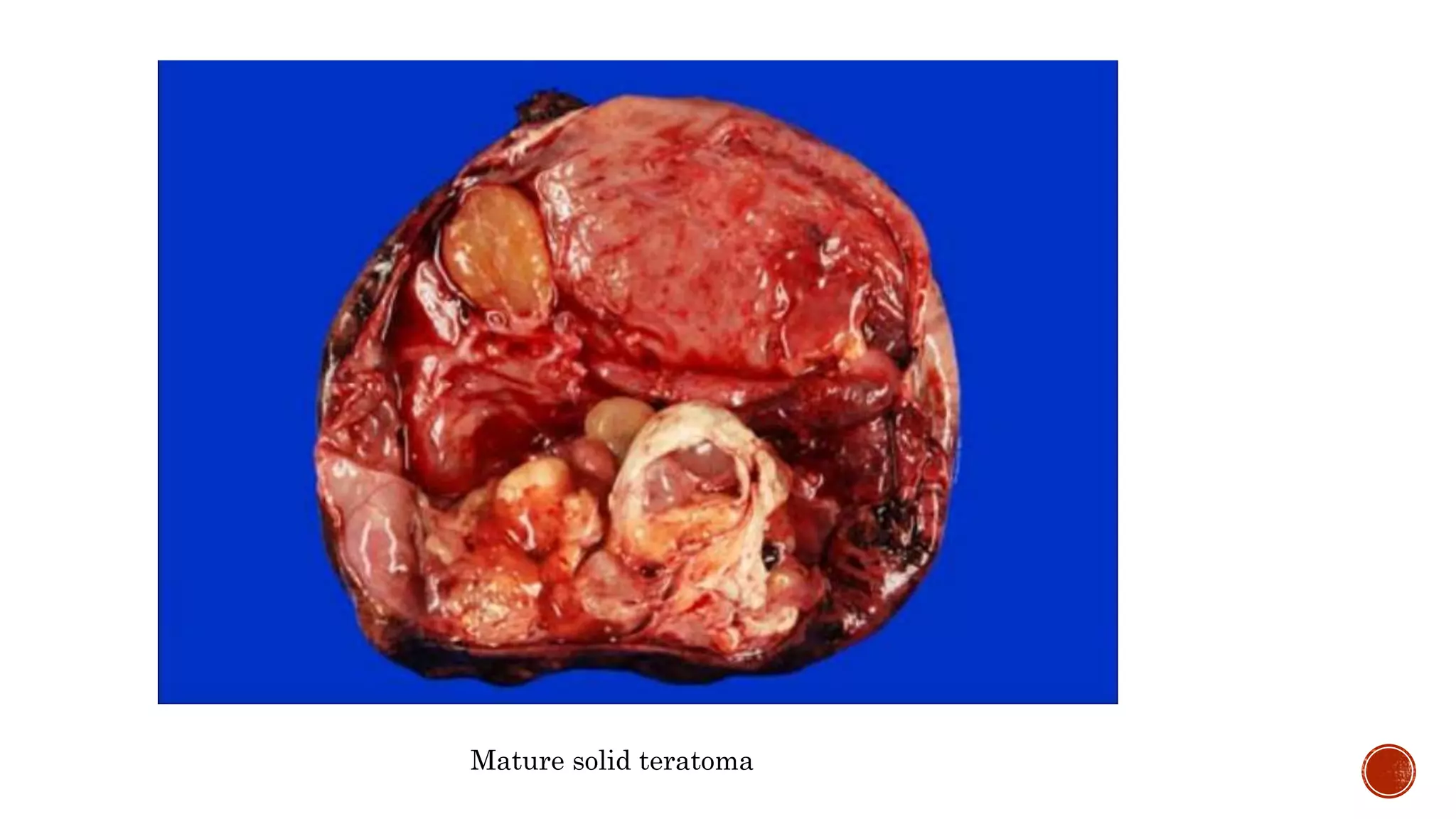
Mature solid teratoma
Demonstrate clinically malignant behavior
Much less common (1% of ovarian teratomas)
Affect a younger age group (mean patient age, 20
years)
Histologically distinguished by the presence of
immature or embryonic tissues
Usually perforated
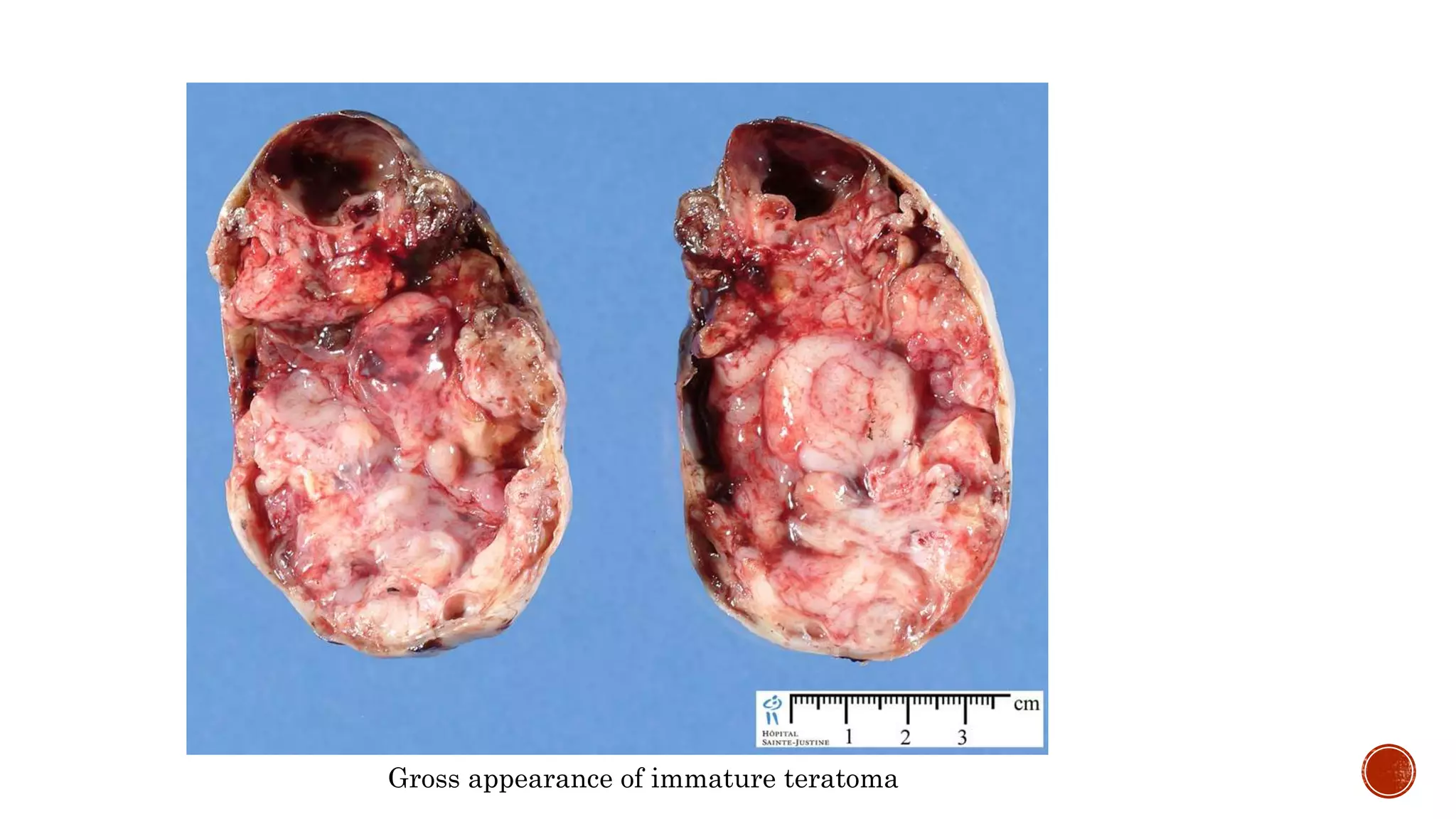
Photograph of an immature teratoma
At initial manifestation, immature teratomas
are typically larger (14–25 cm) than mature
cystic teratomas (average, 7 cm)
May be solid or have a prominent solid
component with cystic elements.
Usually filled with serous or mucinous fluid or
may be filled with fatty sebaceous material.
Ipsilateral typical mature cystic teratomas
are present in 26% of cases of immature
teratoma, and an immature teratoma will be
seen in the contralateral ovary in 10%
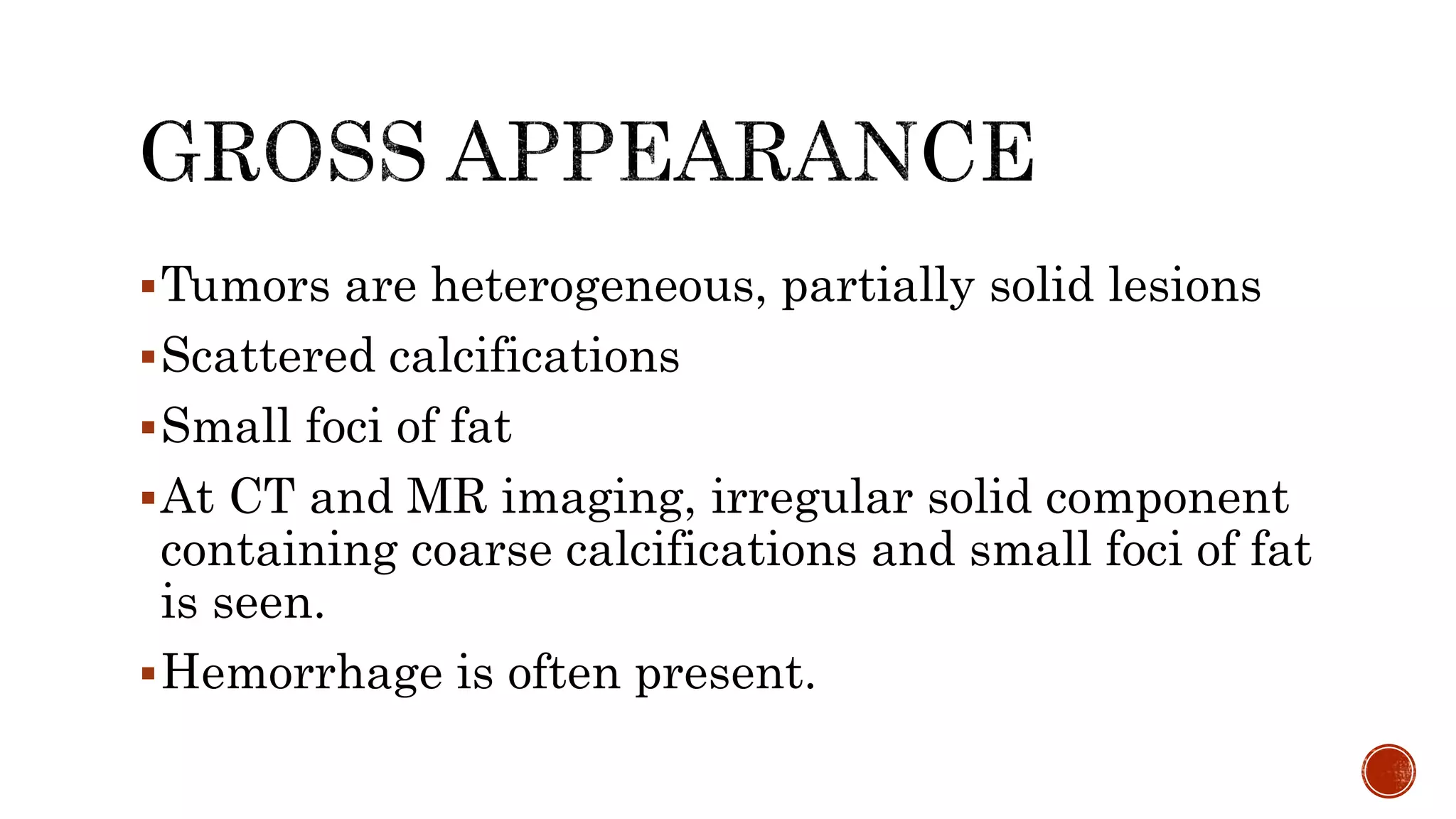
Tumors are heterogeneous, partially solid lesions
Scattered calcifications
Small foci of fat
At CT and MR imaging, irregular solid component
containing coarse calcifications and small foci of fat
is seen.
Hemorrhage is often present.
Gross appearance of immature teratoma
This is a situation where immature teratomas
undergo tissue maturation and take on an
appearance more typical of mature cystic
teratomas.
CT features of maturation include
i. increased density of mass lesions,
ii. the onset of internal calcification, with fatty areas
and cystic change.
Composed predominantly or solely of one
tissue type.
There are three main types of ovarian
monodermal tumors:
i. struma ovarii,
ii. ovarian carcinoid tumors, and
iii. tumors with neural differentiation.
Composed predominantly or solely of mature
thyroid tissue
Such thyroid tissue can occur as a minor
component of mature cystic teratomas.
Accounts for approximately 3% of all mature
teratomas.
In rare cases, thyrotoxicosis has been seen as a
complication of struma ovarii
Consists of amber-colored thyroid tissue, hemorrhage,
necrosis, and fibrosis.
Malignancy is uncommon
The US features:
a heterogeneous, predominantly solid mass
with multiple cystic and solid areas
MR imaging findings:
The cystic spaces demonstrate both high and low signal
intensity on T1- and T2-weighted images
No fat is evident in these lesions.
Uncommon.
May be insular (islet tumors), trabecular, or
mucinous.
Frequently associated with a mature cystic
teratoma or mucinous tumor
At gross pathologic examination, ovarian carcinoid
tumors are solid
Usually occur in postmenopausal women.
Most of these tumors have a relatively benign
clinical course, with metastases being uncommon.
Secretory granules are seen within the tumor cells,
Immunocytochemical analysis demonstrates
serotonin and hormonal peptides.
Carcinoid syndrome is uncommon.
Monodermal teratomas with neuroectodermal
differentiation can form benign, or primitive
neuroectodermal tumors
May be associated with glia formation.
Abdominal pain; depending on the size
Dyspareunia
Compression
Serum alpha-fetoprotein (AFP)
Beta-human chorionic gonadotropin (HCG)
Cancer antigen 125 (CA125),
CA19-9, and
Carcinoembryonic antigen (CEA)
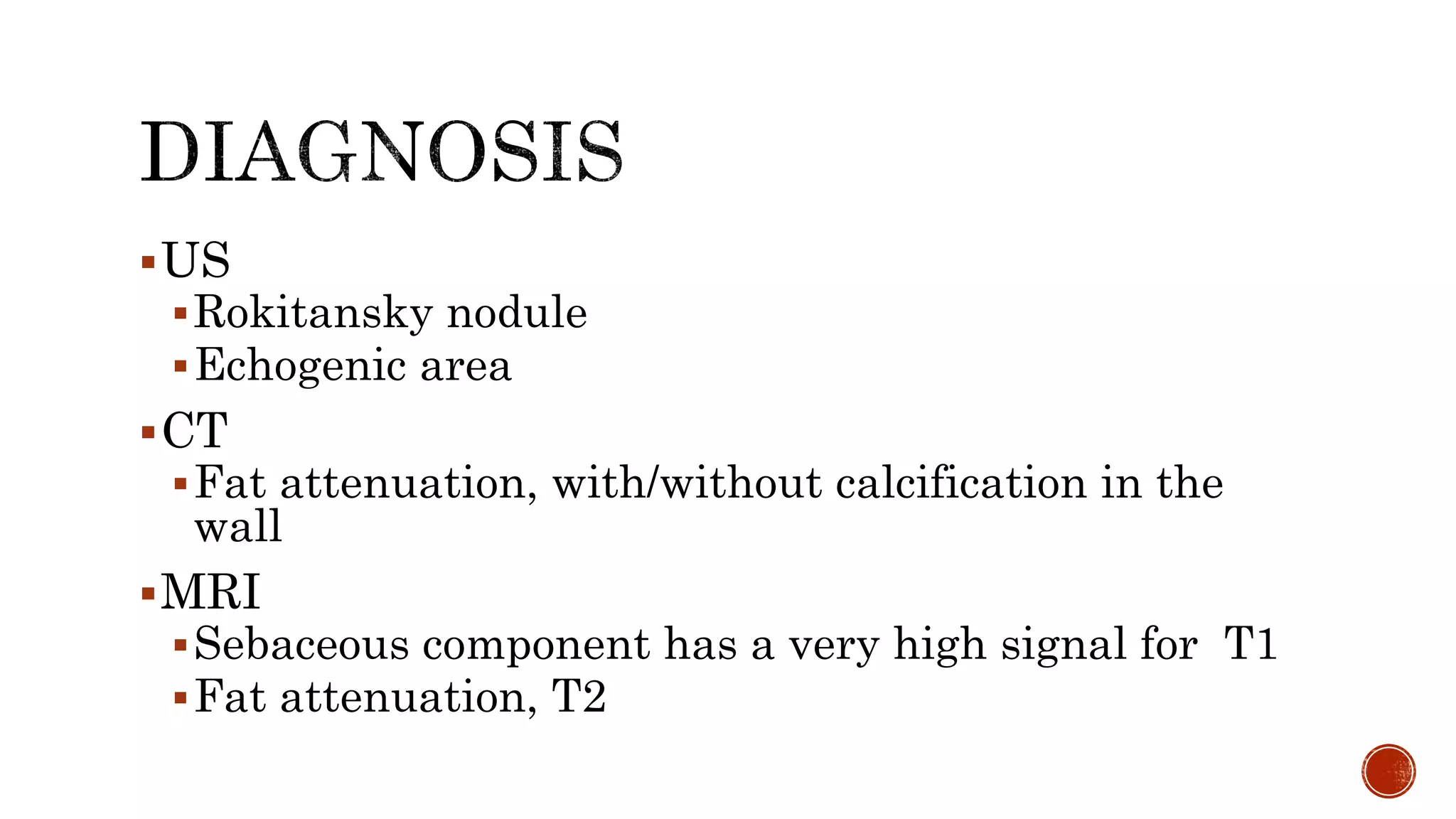
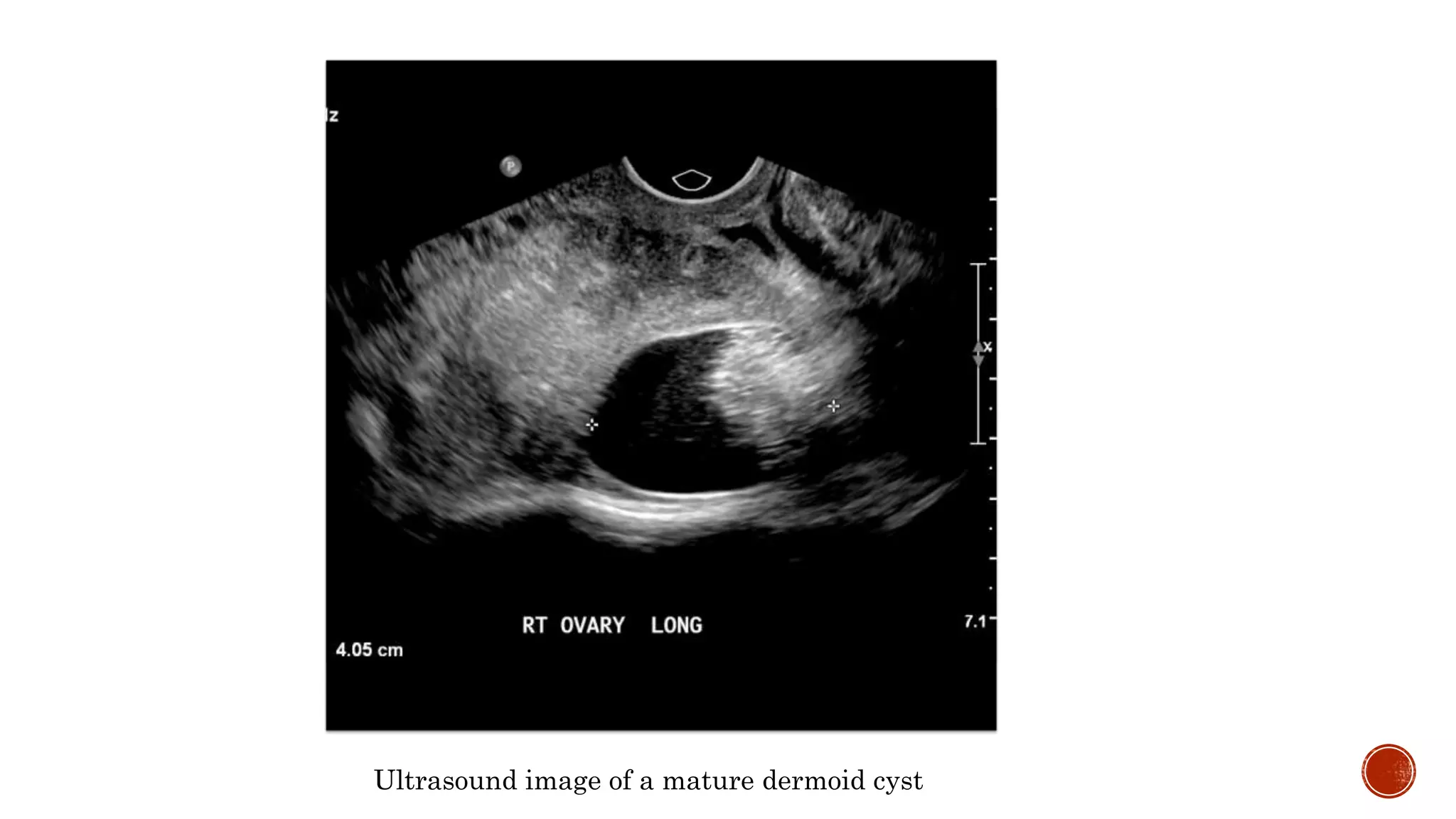
US
Rokitansky nodule
Echogenic area
CT
Fat attenuation, with/without calcification in the
wall
MRI
Sebaceous component has a very high signal for T1
Fat attenuation, T2
Ultrasound image of a mature dermoid cyst
Axial unenhanced CT scan shows intratumoral fat
(small arrows) and calcifications (large arrow)
Ovarian torsion: ~3-16% of ovarian teratomas,
Rupture: ~1-4%; peritonitis
Malignant transformation: ~1-2%, usually
into squamous cell carcinoma (adults) or rarely
into endodermal sinus tumors (pediatrics)
Superimposed infection: 1%
Axial contrast-enhanced CT scans show several free-
floating areas of fat attenuation from a perforated
dermoid cyst
Photograph of squamous cell carcinoma malignant
transformation within a mature cystic teratoma
Stage 1 - means the cancer is only in the ovary (or both
ovaries)
Stage 2 - means the cancer has spread into the fallopian
tube, womb, or elsewhere in the area circled by your hip
bones (your pelvis)
Stage 3 - means the cancer has spread to the lymph nodes
or to the tissues lining the abdomen (called the
peritoneum)
Stage 4 - means the cancer has spread to another body
organ some distance away, for example the lungs
3D-reconstructed CT showing a calcification
Blood clot
Hemorrhagic cyst
Echogenic bowel
Perforated appendix with appendicolith
Pedunculated lipoleiomyoma of the uterus
Ovarian serous or mucinous
cystadenoma/cystadenocarcinoma
Goals
Removal, where possible
Relief of symptoms
Depends on diagnosis
Surgical excision.
Chemotherapy
Follow-up
Risk of recurrence related to degree of maturity.
<10% in completely resected mature Teratoma.
33% immature Teratoma.
Completeness of resection.
 Williams GYNECOLOGY
 Radiographics (RSNA)
 Medscape
 Cancer Research UK
 Patient Info
 University of Ottawa
 Radiopaedia
Ovarian teratoma

Ovarian teratoma

  • 1.
  • 2.
  • 3.
    Terato - Greek: monster, oma : swelling) Teratomas - embryonic neoplasm from totipotent stem cells. Component derived from all 3 germ layers. Tissues foreign to the location found.
  • 6.
    Mature, 1. cystic 2. solid malignanttransformation in < 2% Immature Monodermal, highly specialized
  • 7.
    Most common germcell neoplasm Well-differentiated derivations from at least two of the three germ cell layers Younger age group (mean patient age, 30 years) Asymptomatic Grow slowly Bilateral in about 10% of cases
  • 8.
    Unilocular in 88%of cases Filled with sebaceous material, Squamous epithelium lines the wall of the cyst, Hyalinized ovarian stroma covers the external surface Hair follicles, skin glands, muscle, and other tissues lie within the wall.
  • 9.
    Gross appearance ofa mature dermoid cyst
  • 10.
    Mesodermal tissue (fat,bone, cartilage, muscle) – 90% Endodermal tissue (gastrointestinal and bronchial epithelium, thyroid tissue) – 80% Adipose tissue 67-75% Teeth – 31%
  • 11.
    Rokitansky nodule Echogenic areausually demonstrating sound attenuation owing to sebaceous material and hair within the cyst cavity Multiple thin, echogenic bands caused by hair in the cyst cavity
  • 12.
    A raised protuberanceprojecting into the cyst cavity. Most of the hair typically arises from this protuberance. When bone or teeth are present, they tend to be located within this nodule
  • 14.
    Has no identifiableimmature components Are benign, corresponding to grade 0 immature teratomas. Radiologically indistinguishable from immature teratomas and occur in a similar age group (20 years).  Fat may be visible at MR imaging or CT
  • 15.
  • 16.
    Demonstrate clinically malignantbehavior Much less common (1% of ovarian teratomas) Affect a younger age group (mean patient age, 20 years) Histologically distinguished by the presence of immature or embryonic tissues Usually perforated
  • 17.
    Photograph of animmature teratoma
  • 18.
    At initial manifestation,immature teratomas are typically larger (14–25 cm) than mature cystic teratomas (average, 7 cm) May be solid or have a prominent solid component with cystic elements. Usually filled with serous or mucinous fluid or may be filled with fatty sebaceous material.
  • 19.
    Ipsilateral typical maturecystic teratomas are present in 26% of cases of immature teratoma, and an immature teratoma will be seen in the contralateral ovary in 10%
  • 20.
    Tumors are heterogeneous,partially solid lesions Scattered calcifications Small foci of fat At CT and MR imaging, irregular solid component containing coarse calcifications and small foci of fat is seen. Hemorrhage is often present.
  • 21.
    Gross appearance ofimmature teratoma
  • 22.
    This is asituation where immature teratomas undergo tissue maturation and take on an appearance more typical of mature cystic teratomas. CT features of maturation include i. increased density of mass lesions, ii. the onset of internal calcification, with fatty areas and cystic change.
  • 23.
    Composed predominantly orsolely of one tissue type. There are three main types of ovarian monodermal tumors: i. struma ovarii, ii. ovarian carcinoid tumors, and iii. tumors with neural differentiation.
  • 24.
    Composed predominantly orsolely of mature thyroid tissue Such thyroid tissue can occur as a minor component of mature cystic teratomas. Accounts for approximately 3% of all mature teratomas. In rare cases, thyrotoxicosis has been seen as a complication of struma ovarii
  • 25.
    Consists of amber-coloredthyroid tissue, hemorrhage, necrosis, and fibrosis. Malignancy is uncommon The US features: a heterogeneous, predominantly solid mass with multiple cystic and solid areas MR imaging findings: The cystic spaces demonstrate both high and low signal intensity on T1- and T2-weighted images No fat is evident in these lesions.
  • 26.
    Uncommon. May be insular(islet tumors), trabecular, or mucinous. Frequently associated with a mature cystic teratoma or mucinous tumor At gross pathologic examination, ovarian carcinoid tumors are solid
  • 27.
    Usually occur inpostmenopausal women. Most of these tumors have a relatively benign clinical course, with metastases being uncommon. Secretory granules are seen within the tumor cells, Immunocytochemical analysis demonstrates serotonin and hormonal peptides. Carcinoid syndrome is uncommon.
  • 28.
    Monodermal teratomas withneuroectodermal differentiation can form benign, or primitive neuroectodermal tumors May be associated with glia formation.
  • 29.
    Abdominal pain; dependingon the size Dyspareunia Compression
  • 30.
    Serum alpha-fetoprotein (AFP) Beta-humanchorionic gonadotropin (HCG) Cancer antigen 125 (CA125), CA19-9, and Carcinoembryonic antigen (CEA)
  • 31.
    US Rokitansky nodule Echogenic area CT Fatattenuation, with/without calcification in the wall MRI Sebaceous component has a very high signal for T1 Fat attenuation, T2
  • 32.
    Ultrasound image ofa mature dermoid cyst
  • 33.
    Axial unenhanced CTscan shows intratumoral fat (small arrows) and calcifications (large arrow)
  • 34.
    Ovarian torsion: ~3-16%of ovarian teratomas, Rupture: ~1-4%; peritonitis Malignant transformation: ~1-2%, usually into squamous cell carcinoma (adults) or rarely into endodermal sinus tumors (pediatrics) Superimposed infection: 1%
  • 35.
    Axial contrast-enhanced CTscans show several free- floating areas of fat attenuation from a perforated dermoid cyst
  • 36.
    Photograph of squamouscell carcinoma malignant transformation within a mature cystic teratoma
  • 37.
    Stage 1 -means the cancer is only in the ovary (or both ovaries) Stage 2 - means the cancer has spread into the fallopian tube, womb, or elsewhere in the area circled by your hip bones (your pelvis) Stage 3 - means the cancer has spread to the lymph nodes or to the tissues lining the abdomen (called the peritoneum) Stage 4 - means the cancer has spread to another body organ some distance away, for example the lungs
  • 38.
  • 39.
    Blood clot Hemorrhagic cyst Echogenicbowel Perforated appendix with appendicolith Pedunculated lipoleiomyoma of the uterus Ovarian serous or mucinous cystadenoma/cystadenocarcinoma
  • 40.
    Goals Removal, where possible Reliefof symptoms Depends on diagnosis Surgical excision. Chemotherapy Follow-up
  • 41.
    Risk of recurrencerelated to degree of maturity. <10% in completely resected mature Teratoma. 33% immature Teratoma. Completeness of resection.
  • 42.
     Williams GYNECOLOGY Radiographics (RSNA)  Medscape  Cancer Research UK  Patient Info  University of Ottawa  Radiopaedia

Editor's Notes

  • #14 On an axial contrast material–enhanced CT scan, the cyst cavity demonstrates fat attenuation (F). A round Rokitansky nodule is seen (arrow) and has a feathery appearance at the fatty interface where the hair arises from it (arrowhead). (c) Photograph of the bisected tumor shows the two components of the fat attenuation seen in b: the Rokitansky nodule (thick arrow), which has the yellowish appearance of adipose tissue, and sebaceous components (F). Teeth are seen in the center of the Rokitansky nodule and account for the calcification seen in b. The bulk of the cyst cavity is filled with hair (arrowheads). Note how the cyst wall is folded back (thin arrow).