


Dr.Yassin M Al-Saleh
• Their Prophet said to them: 'Allah has raised Saul to
be your king. ' But they replied: 'Should he be given
the kingship over us, when we are more deserving of
it than he and he has not been given abundant
wealth? ' He said: 'Allah has chosen him over you
and increased him with amplitude in knowledge and
body. Allah gives His kingship to whom He will. Allah
is the Embracer, the Knower.
Case senario
• 12 year old boy healthy
• his height is far below 3ed centile
• aslo far from mid parentral height.
• No FH of constitutional delay.
• GV 4 cm/year , on exam : non dysmorphic
• bone age 1yaer delay .
• GH stimulation test normal. IGF-1, IGFBP3
normal.
• It is common condition.
• The term has been in use since at
least 1975.
• It is a clinical description rather than a
disease.
Idiopathic short stature
introduction
• Definition: stature that is 2 standard
deviations (SD) or more below the
mean for age (approximately the 2nd
percentile) and for whom no
endocrine, metabolic, or other
diagnosis can be made .
• Children with ISS fall into two main
groups:
• Familial short stature (in which bone age
is not delayed and the child is growing
within the parental target range)
• Constitutional delay of growth (in which
bone age is delayed)
• Also combination of these two condition.
introduction
presentation
• usually Children with ISS have
normal growth velocity
• no biochemical or other evidence for
a specific growth-retarding condition.
• normal growth hormone (GH)
responses to pharmacologic agents
• some children with ISS may have low
serum concentrations of IGF-I
treatment
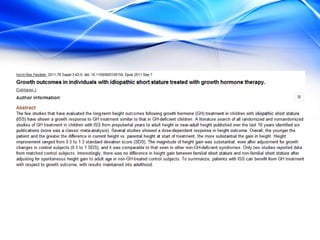
• Several studies have demonstrated
that growth hormone therapy
generally increases height velocity
acutely and may increase adult
height in children with ISS.
GROWTH HORMONE
• was approved by the United States Food
and Drug Administration (FDA) in 2003.
• The indication is for children with current
height below -2.25 SD of the mean, in
whom the epiphyses are not closed, and
whose expected adult height is less than
63 inches (160 cm) for boys and 59
inches (150 cm) for girls
GROWTH HORMONE
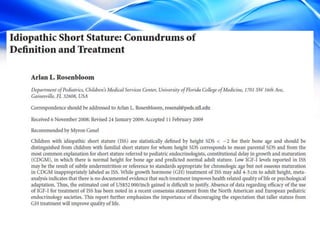
• the use of growth hormone for ISS
remains controversial.
• A majority of children with short stature
will experience some catch-up growth
during puberty without GH treatment
• There is little evidence that short stature
has a detrimental effect on an
individual's psychosocial or physical
functioning.
GROWTH HORMONE
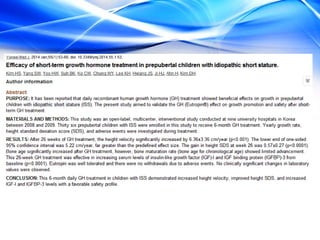
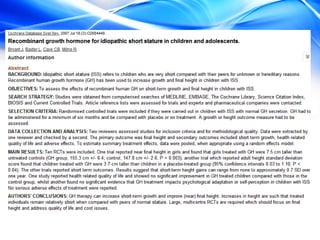
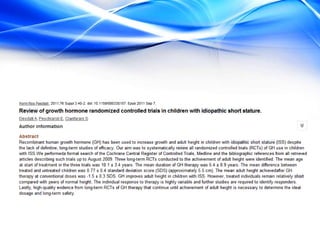
• The available evidence suggests only
modest efficacy for GH treatment in
children and adolescents with ISS.
• treated individuals remain relatively
short compared with their peers
GROWTH HORMONE
• The decision to treat children and adolescents
with ISS using growth hormone requires
complex psychosocial considerations
• GH treatment should be considered only if the
short stature represents a disability to the child
and is not amenable to counseling and
reassurance
• GH treatment could have adverse psychosocial
consequences due to the extreme focus on a
child's stature conferred by GH treatment.
• Most patients with ISS have normal
psychosocial functioning.
GROWTH HORMONE
Psychosocial considerations
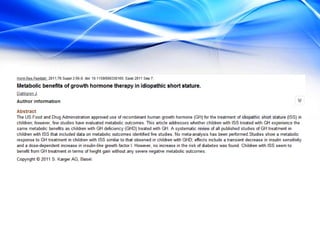
• Growth hormone treatment at standard
doses appears to have minimal
physiological adverse effects.
• High-dose GH treatment
(71 mcg/kg/day) was reported to
accelerate the onset of puberty and
epiphyseal closure in children with ISS
but lower doses (34 or
53mcg/kg/day) did not
GROWTH HORMONE
Safety
• For children with ISS the optimal
dosing range is well established.
• In prepubertal children with ISS, GH
routinely is used in the range of 25 to
50 mcg/kg/day.
• Higher doses lead to modest
increases in short-term growth
velocity and adult height .
GROWTH HORMONE
Dosing
For how long
• continue treatment only if the height
velocity increases by 50 percent or at
least 2.5 cm/year above the baseline
height velocity.
• If the initial growth response is
significant . treatment is continued until
linear growth decreases to less than 2.0
to 2.5 cm (about 1 inch)/year.
• If bone age >14 for girls, >16 for boys.
GROWTH HORMONE
Dose adjustment
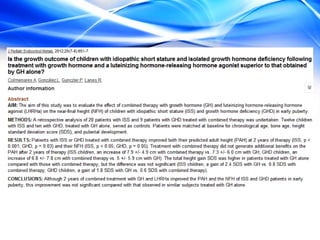
• evidence supports the idea of
adjusting GH dose based on IGF-I
levels when treating children with
ISS.
• GH dosing be adjusted to maintain
IGF-I within a normal range.
GROWTH HORMONE
• IGF-I levels approximately four weeks
after beginning therapy or changing
the GH dose, and approximately
every 6 to 12 months
thereafter, similar to the approach we
use for patients with GH deficiency
GROWTH HORMONE
Dose adjustment
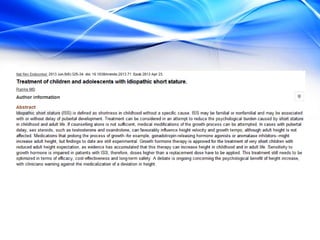
OTHER TREATMENTS
• IGF-1.
• GnRH analogs.
• Testosterone.
• Aromatase inhibitors.
Recombinant human IGF-I
• Recombinant IGF-I (rhIGF-I) has
been effectively used for treatment of
children with "severe primary IGF-I
deficiency.
• A preparation of rhIGF-I is approved
by the FDA for this use.
• Patients with ISS may have degrees of
growth hormone insensitivity, with
normal or elevated circulating serum
GH levels but low levels of insulin-like
growth factor-I (IGF-I) and IGF binding
protein 3 (IGFBP-3).
• For these children, direct replacement
of IGF-I may be more effective than GH
treatment.
Recombinant human IGF-I
GnRH analogs
• An alternative approach to attempt to
delay pubertal development and
epiphyseal fusion.
• The range of the effect is limited to
approximately 0 to 4 cm.
Testosterone
• Boys with mild to moderate short
stature whose puberty and bone age
are delayed
• treatment with testosterone during
adolescence may be helpful to
promote puberty and accelerate
linear growth.
Aromatase inhibitors
• in adolescent males it will facilitate
growth by delaying epiphyseal closure.
• Preliminary studies suggest that
treatment with aromatase inhibitors, with
or without concomitant growth hormone,
increases predicted adult height.
• long-term safety and efficacy results are
not available
• In girls, aromatase inhibitors would be
expected to slow growth because they
inhibit estrogen production.
conclusion
• Treatment of children with idiopathic short
stature (ISS) with growth hormone is
controversial .
• the decision to treat children with ISS
using growth hormone depends on
individual considerations.
• Growth hormone treatment is likely to yield
only modest gains in height compared with
no treatment
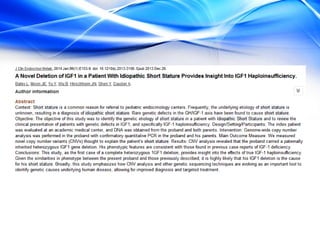
IGF-1
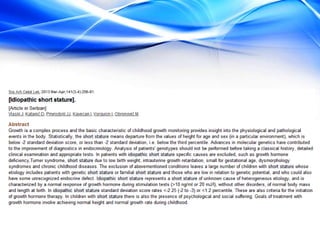
idopathic short stature

idopathic short stature

  • 1.
  • 2.
    • Their Prophetsaid to them: 'Allah has raised Saul to be your king. ' But they replied: 'Should he be given the kingship over us, when we are more deserving of it than he and he has not been given abundant wealth? ' He said: 'Allah has chosen him over you and increased him with amplitude in knowledge and body. Allah gives His kingship to whom He will. Allah is the Embracer, the Knower.
  • 3.
    Case senario • 12year old boy healthy • his height is far below 3ed centile • aslo far from mid parentral height. • No FH of constitutional delay. • GV 4 cm/year , on exam : non dysmorphic • bone age 1yaer delay . • GH stimulation test normal. IGF-1, IGFBP3 normal.
  • 4.
    • It iscommon condition. • The term has been in use since at least 1975. • It is a clinical description rather than a disease. Idiopathic short stature
  • 5.
    introduction • Definition: staturethat is 2 standard deviations (SD) or more below the mean for age (approximately the 2nd percentile) and for whom no endocrine, metabolic, or other diagnosis can be made .
  • 6.
    • Children withISS fall into two main groups: • Familial short stature (in which bone age is not delayed and the child is growing within the parental target range) • Constitutional delay of growth (in which bone age is delayed) • Also combination of these two condition. introduction
  • 7.
    presentation • usually Childrenwith ISS have normal growth velocity • no biochemical or other evidence for a specific growth-retarding condition. • normal growth hormone (GH) responses to pharmacologic agents • some children with ISS may have low serum concentrations of IGF-I
  • 8.
    treatment • Several studieshave demonstrated that growth hormone therapy generally increases height velocity acutely and may increase adult height in children with ISS. GROWTH HORMONE
  • 9.
    • was approvedby the United States Food and Drug Administration (FDA) in 2003. • The indication is for children with current height below -2.25 SD of the mean, in whom the epiphyses are not closed, and whose expected adult height is less than 63 inches (160 cm) for boys and 59 inches (150 cm) for girls GROWTH HORMONE
  • 10.
    • the useof growth hormone for ISS remains controversial. • A majority of children with short stature will experience some catch-up growth during puberty without GH treatment • There is little evidence that short stature has a detrimental effect on an individual's psychosocial or physical functioning. GROWTH HORMONE
  • 11.
    • The availableevidence suggests only modest efficacy for GH treatment in children and adolescents with ISS. • treated individuals remain relatively short compared with their peers GROWTH HORMONE
  • 12.
    • The decisionto treat children and adolescents with ISS using growth hormone requires complex psychosocial considerations • GH treatment should be considered only if the short stature represents a disability to the child and is not amenable to counseling and reassurance • GH treatment could have adverse psychosocial consequences due to the extreme focus on a child's stature conferred by GH treatment. • Most patients with ISS have normal psychosocial functioning. GROWTH HORMONE Psychosocial considerations
  • 13.
    • Growth hormonetreatment at standard doses appears to have minimal physiological adverse effects. • High-dose GH treatment (71 mcg/kg/day) was reported to accelerate the onset of puberty and epiphyseal closure in children with ISS but lower doses (34 or 53mcg/kg/day) did not GROWTH HORMONE Safety
  • 14.
    • For childrenwith ISS the optimal dosing range is well established. • In prepubertal children with ISS, GH routinely is used in the range of 25 to 50 mcg/kg/day. • Higher doses lead to modest increases in short-term growth velocity and adult height . GROWTH HORMONE Dosing
  • 15.
    For how long •continue treatment only if the height velocity increases by 50 percent or at least 2.5 cm/year above the baseline height velocity. • If the initial growth response is significant . treatment is continued until linear growth decreases to less than 2.0 to 2.5 cm (about 1 inch)/year. • If bone age >14 for girls, >16 for boys. GROWTH HORMONE
  • 16.
    Dose adjustment • evidencesupports the idea of adjusting GH dose based on IGF-I levels when treating children with ISS. • GH dosing be adjusted to maintain IGF-I within a normal range. GROWTH HORMONE
  • 17.
    • IGF-I levelsapproximately four weeks after beginning therapy or changing the GH dose, and approximately every 6 to 12 months thereafter, similar to the approach we use for patients with GH deficiency GROWTH HORMONE Dose adjustment
  • 18.
    OTHER TREATMENTS • IGF-1. •GnRH analogs. • Testosterone. • Aromatase inhibitors.
  • 19.
    Recombinant human IGF-I •Recombinant IGF-I (rhIGF-I) has been effectively used for treatment of children with "severe primary IGF-I deficiency. • A preparation of rhIGF-I is approved by the FDA for this use.
  • 20.
    • Patients withISS may have degrees of growth hormone insensitivity, with normal or elevated circulating serum GH levels but low levels of insulin-like growth factor-I (IGF-I) and IGF binding protein 3 (IGFBP-3). • For these children, direct replacement of IGF-I may be more effective than GH treatment. Recombinant human IGF-I
  • 21.
    GnRH analogs • Analternative approach to attempt to delay pubertal development and epiphyseal fusion. • The range of the effect is limited to approximately 0 to 4 cm.
  • 22.
    Testosterone • Boys withmild to moderate short stature whose puberty and bone age are delayed • treatment with testosterone during adolescence may be helpful to promote puberty and accelerate linear growth.
  • 23.
    Aromatase inhibitors • inadolescent males it will facilitate growth by delaying epiphyseal closure. • Preliminary studies suggest that treatment with aromatase inhibitors, with or without concomitant growth hormone, increases predicted adult height. • long-term safety and efficacy results are not available • In girls, aromatase inhibitors would be expected to slow growth because they inhibit estrogen production.
  • 24.
    conclusion • Treatment ofchildren with idiopathic short stature (ISS) with growth hormone is controversial . • the decision to treat children with ISS using growth hormone depends on individual considerations. • Growth hormone treatment is likely to yield only modest gains in height compared with no treatment
  • 37.