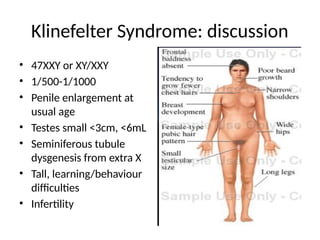
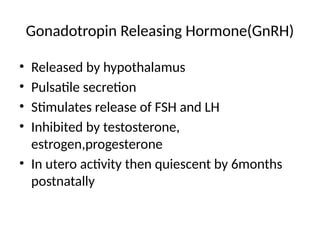
Gonadotropin Releasing Hormone(GnRH)
•Released by hypothalamus
• Pulsatile secretion
• Stimulates release of FSH and LH
• Inhibited by testosterone,
estrogen,progesterone
• In utero activity then quiescent by 6months
postnatally
5.
Follicle Stimulating Hormone(FSH)
•Stimulates ovarian follicular development
• Gametogenesis in the testes
• Inhibited by inhibin (made in sertoli cells of
testes)
6.
Luteinizing Hormone(LH)
• Stimulatestestosterone secretion(leydig cells)
• Luteinization of ovary –corpus luteum,
ovulation
• Inhibited by androgens,estrogens
7.
Adrenal cortex
• Androgenproduction: progesterone, DHEA
• Stimulate conversion into testosterone
• Testosterone converts to estradiol
• Leads to adrenarche
Pubic hair, axillary hair, body odour, voice
changes, acne
• Not related to HPG axis
8.
Prepubertal Development:
• Upto 8-9 years old
• GnRH secretion stops by 6 months postnatally
• GnRH secretion dormant until peripubertal
stage
9.
Peripubertal Development:
• 1-3years before clinically evident puberty
• GnRH pulsatility increases in frequency
• Low serum LH levels during sleep
• LH levels found during daytime once enter
puberty
10.
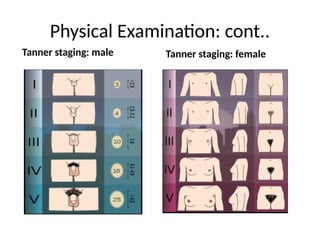
Pubertal Development:Females
• 8-12years old on average
• Stage1:Thelarche
• Stage2:Pubarche 6-12 months later
• Stage3:Increased growth velocity
• Stage4:Menarche(~12.5years old)
Delayed Puberty Definitions:
Female:
•No breast development by 14 years of age
• Absence of menarche by 16 years or within 5
years of pubertal onset
Male:
• Failure of maturation by 14 years of age
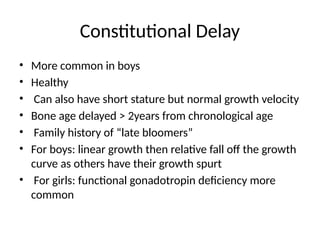
Constitutional Delay
• Morecommon in boys
• Healthy
• Can also have short stature but normal growth velocity
• Bone age delayed > 2years from chronological age
• Family history of “late bloomers”
• For boys: linear growth then relative fall off the growth
curve as others have their growth spurt
• For girls: functional gonadotropin deficiency more
common
23.
Management
• Guided byunderlying cause
• Can use short courses of testosterone or
estrogen to induce puberty
• Lifelong hormone replacement may be
required in some cases
• Referral to endocrine
• Ongoing follow up required to ensure
progress through puberty
24.
Summary
• Differentiate betweenHPG axis and adrenarche
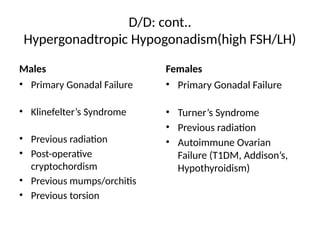
• Hypergonadotropic hypogonadism= gonads not
responding so high FSH/LH
• Hypogonadotropic hypogonadism = gonads not
stimulated so low FSH/LH
• Constitutional delay most common reason for
delayed puberty in boys and functional
gonadotropin deficiency in girls
25.
The Case
13.5 yearold boy, previously healthy, complains of short stature
and delayed sexual development. 5th
percentile for height, 10th
percentile for weight. Mom’s height is 160cm and dad’s is
172cm. Dad’s growth spurt was in college. Mom had
menarche at 14 years of age.
Systemic exam is normal. Both testes are 3cc in volume and
tanner stage 1 for pubic hair
a) Turner Syndrome
b) Kallman Syndrome
c) Klinefelter Syndrome
d) Constitutional delay
Case oriented approach
15year old boy presents with delayed puberty and on
examination has small testes and is Tanner Stage V of pubic
hair.
a) Turner Syndrome
b) Kallman Syndrome
c) Klinefelter Syndrome
d) Constitutional delay
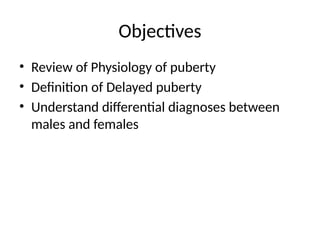
Klinefelter Syndrome: discussion
•47XXY or XY/XXY
• 1/500-1/1000
• Penile enlargement at
usual age
• Testes small <3cm, <6mL
• Seminiferous tubule
dysgenesis from extra X
• Tall, learning/behaviour
difficulties
• Infertility


![Physical Examination: cont
Mid-Parental Height (MPH):
• Female: [(Paternal Height–13cm)+Maternal
Height]/2
• Male: [Paternal Height + (Maternal Height +
13cm)]/2
Child’s height can be within +/- 5cm of
calculated MPH](https://image.slidesharecdn.com/approachtodelayedpuberty-250829153821-59e1e071/85/Approach-to-a-child-with-delayed-puberty-18-320.jpg)