By Dr. ANIRUDH RAO
Moderator Dr. V.R. ANAND
INTRODUCTION
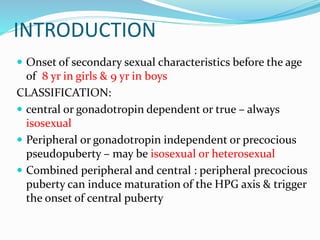
 Onset of secondary sexual characteristics before the age
of 8 yr in girls & 9 yr in boys
CLASSIFICATION:
 central or gonadotropin dependent or true – always
isosexual
 Peripheral or gonadotropin independent or precocious
pseudopuberty – may be isosexual or heterosexual
 Combined peripheral and central : peripheral precocious
puberty can induce maturation of the HPG axis & trigger
the onset of central puberty
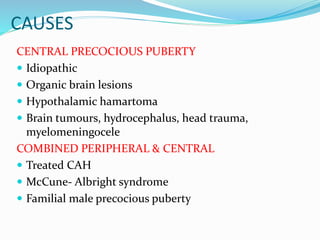
CAUSES
CENTRAL PRECOCIOUS PUBERTY
 Idiopathic
 Organic brain lesions
 Hypothalamic hamartoma
 Brain tumours, hydrocephalus, head trauma,
myelomeningocele
COMBINED PERIPHERAL & CENTRAL
 Treated CAH
 McCune- Albright syndrome
 Familial male precocious puberty
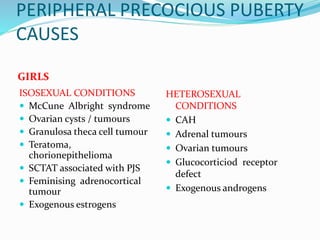
PERIPHERAL PRECOCIOUS PUBERTY
CAUSES
GIRLS
ISOSEXUAL CONDITIONS
 McCune Albright syndrome
 Ovarian cysts / tumours
 Granulosa theca cell tumour
 Teratoma,
chorionepithelioma
 SCTAT associated with PJS
 Feminising adrenocortical
tumour
 Exogenous estrogens
HETEROSEXUAL
CONDITIONS
 CAH
 Adrenal tumours
 Ovarian tumours
 Glucocorticiod receptor
defect
 Exogenous androgens
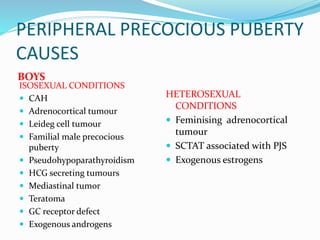
PERIPHERAL PRECOCIOUS PUBERTY
CAUSES
BOYS
ISOSEXUAL CONDITIONS
 CAH
 Adrenocortical tumour
 Leideg cell tumour
 Familial male precocious
puberty
 Pseudohypoparathyroidism
 HCG secreting tumours
 Mediastinal tumor
 Teratoma
 GC receptor defect
 Exogenous androgens
HETEROSEXUAL
CONDITIONS
 Feminising adrenocortical
tumour
 SCTAT associated with PJS
 Exogenous estrogens
INCOMPLETE/PARTIAL
PRECOCIOUS PUBERTY
 Premature thelarche
 Premature adrenarche
 Premature menarche
CENTRAL PRECOCIOUS PUBERTY
DEFINITION:
 Onset of breast development before the age of 8yr in
girls & by the onset of testicular development before
the age of 9 yrs in boys, as a result of early activation of
HPG axis
 5 to 10 times more common in girls than in boys
 In girls – 90% cases idiopathic
 In boys – 75% of cases structural CNS abnormality
CLINICAL MANIFESTATIONS
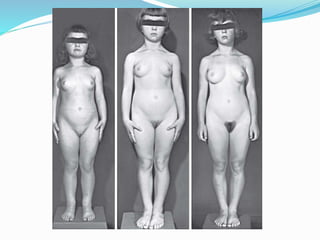
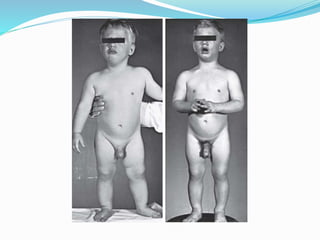
 Sexual development may begin at any age & follows the
sequence observed in normal puberty
 In girls early menstrual cycles more irregular
 The initial cycles are usually anovulatory
 In boys testicular biopsies shown stimulation of all
elements of the testes & spermatogenesis observed as
early as 5-6 yrs of age
CLINICAL MANIFESTATIONS
 In affected girls & boys height, weight & osseous
maturation are advanced
 Early closure of the epiphyses & ultimate stature is less
 Mental development is usually compatible with
chronological age
 Emotional behaviour & mood swings common
CLINICAL FEATURES
3 patterns of pubertal progression
 Rapid – most common pattern. characterised by rapid
physical & osseous maturation, leading to loss of
height potential
 Slow - parallel advancement of osseous maturation &
linear growth, with preserved height potential
 Spontaneously regressive/unsustained - rare
CLINICAL MANIFESTATIONS
 In hypothalamic hamartoma remain static in size or
grow slowly – no signs other than precocious puberty
 for symptomatic, manifestations may be present for 1-2
yr before the tumour can be detected radiologically
 Hypothalamic signs or symptoms include diabetis
insipidus , adipsia , hyperthermia, unnatural crying or
laughing, obesity & cachexia
 Visual signs may be the first manifestation of optic
glioma
LAB INVESTIGATIONS
 Sex hormone levels usually appropriate for the stage of
puberty in both sexes
 Measurement of LH in serial blood samples obtained
during sleep is best & reveals pulsatile LH secretion
 GnRH stimulation test: predominant LH response over FSH
after i.v administration of GnRH or GnRH agonist like
Leuprolide
 However in girls LH:FSH ratio can remain low until mid
puberty.
 In such girls with low LH response , the central nature of
precocious puberty can be proved by detecting pubertal
levels of estradiol (>50 pg/ml), 20-24 hr after stimulation
with leuprolide
INVESTIGATIONS
 USG pelvis: in girls reveals progressive enlargement of
ovaries f/b enlargement of uterus to pubertal size
 MRI: physiologic enlargement of the pituitary gland
 May also reveal CNS pathology
TREATMENT
 Virtually all boys and the large subgroup of girls with
rapidly progressive precocious puberty are candidates for
treatment.
 Girls with slowly progressive idiopathic central precocious
puberty do not seem to benefit in terms of height prognosis
from GnRH -agonist therapy.
 Former SGA infants may be at greater risk of short stature
as adults & may require more aggressive treatment of
precocious puberty, possibly in conjunction with human
growth hormone therapy.
 Certain patients require treatment solely for psychologic or
social reasons , including children with special needs and
very young girls at risk of early menarche
TREATMENT
 The observation that the pituitary gonadotropic cells
require pulsatile rather than continuous, stimulation by
GnRH to maintain the ongoing release of gonadotropins
provides the rationale for using GnRH agonists for
treatment of central precocious puberty
 Long-acting formulations of GnRH agonists which
maintain fairly constant serum concentrations of the
drug for weeks or months , constitute the preparations of
choice for treatment of central precocious puberty.
TREATMENT
The available preparations include
 (1) leuprolide acetate (Lupron Depot- Ped) in a dose of
0.25-0.3 mg/kg (minimum 7.5 mg) intramuscularly once
every 4 wk
 (2) longer-acting preparations of depot leuprolide
allowing for injections 11.35- 30.0 mg IM every 90 days
 (3) histrelin (Supprelin LA) , a subcutaneous 50 mg
implant with effects lasting 12 months
 Other preparations Decapeptyl , goserelin acetate
( Zoladex ) are approved for treatment of precocious
puberty in other countries
TREATMENT
Other available treatment options include
 Subcutaneous injections of aqueous leuprolide, given
once or twice daily (total dose 60 μg/kg/24 hr)
 Intranasal administration of GnRH agonist nafarelin
(Synarel) 800 μg bid.
 The potential for irregular compliance with daily
administration, as well as the variable absorption of
the intranasal route for nafarelin may limit the long
term benefit of these preparations on adult height.
TREATMENT
 Treatment results in decrease of the growth rate,
generally to age appropriate values
 Treatment results in enhancement of the predicted
height
 In girls, breast development may regress in those with
Tanner stages II-III development
 Most commonly the size of the breasts remains
unchanged in girls with stages III-V development or
may even increase slightly because of progressive
adipose tissue deposition
TREATMENT
 Pubic hair usually remains stable in girls, or may
progress slowly during treatment, reflecting the
gradual increase in adrenal androgens.
 Menses, if present, cease.
 Pelvic sonography demonstrates a decrease of the
ovarian and uterine size.
 In boys, there is decrease of testicular size, variable
regression of pubic hair , and decrease in the
frequency of erections.
TREATMENT
 If treatment is effective, the serum sex hormone
concentrations decrease to pre pubertal levels
(testosterone <10-20 ng/dL in boys ; estradiol <5-10
pg/ml in girls).
 The serum LH and FSH concentrations decrease to less
than 1 IU/L in most Patients
 The incremental FSH and LH responses to GnRH
stimulation decrease to less than 2-3 IU/L.
 Serum LH and sex hormone levels remain suppressed
for as long as therapy is continued but puberty resumes
promptly when therapy is discontinued, typically at a
“pubertal” chronological age
TREATMENT
 In patients with hypothalamic hamartoma and
associated intractable gelastic or psychomotor seizures
stereotactic radiation therapy (gamma knife surgery)
is effective and less risky than neurosurgical
intervention.
 Combined growth hormone therapy should be
considered for patients with associated GH deficiency
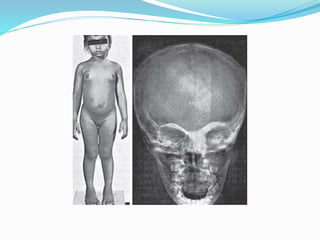
McCune – albright syndrome
 A rare disorder pevalence 1 in 1 lakh to 1 in 10 lakh. Is
associated with patchy cutaneous pigmentation & fibrous
dysplasia of the skeletal system
 A classical cause of peripheral precocious puberty, it can
also induce pituitary, thyroid, and adrenal aberrations
 characterized by autonomous hyper function of many
glands and caused by a missense mutation in the gene
encoding the α-subunit of GS, the G protein that stimulates
c AMP formation, resulting in the formation of the putative
gsp oncoprotein.
 Activation of receptors (corticotropin ,ACTH, TSH, FSH,
and LH receptors) that operate via a cyclic AMP dependent
mechanism as well as cell proliferation ensue.
PRESENTATION
GIRLS- average age at onset is about 3 yrs
 Young girls have suppressed levels of LH and FSH,
and there is no response to GnRH or leuprolide
stimulation.
 Estradiol levels vary from normal to markedly elevated
(>900 pg/ml) & often cyclic may correlate with the size
of the recurrent ovarian cysts.
BOYS- precocious puberty is less common but has been
reported in several instances.
 At pubertal age, central precocious puberty over rides
the antecedent precocious pseudopuberty
LAB INVESTIGATIONS
 Estradiol levels vary from normal to markedly elevated
(>900 pg/ml), are often cyclic may correlate with the
size of the recurrent ovarian cysts.
 Testicular histology has demonstrated large
seminiferous tubules and no or minimal Leydig cell
hyperplasia; these findings may simply reflect the fact
that biopsy specimens were obtained at an early stage
of pubertal development
 TREATMENT : Pubertal progression is variable in these
patients. Functioning ovarian cysts often disappear
spontaneously; aspiration or surgical excision of cysts is
rarely indicated
 For girls with persistent estradiol secretion aromatase
inhibitors such as letrozole (1.25-2.5 mg/day orally) or
anti estrogens such as tamoxifen (5-20 mg/day orally)
 The same compounds have also been used in boys, in
combination with anti androgens such as
spironolactone 50-100 mg bid , flutamide 125-250 mg
bid or bicalutamide 25-50 mg daily
INCOMPLETE (PARTIAL) VARIANTS
 Isolated manifestations of precocity without development of
other signs of puberty
 Premature thelarche - sporadic, transient condition of
isolated breast development that most often appears in the
1st 2 yr of life.
 In some girls, breast development is present at birth and
persists.
 Growth and osseous maturation are normal or slightly
advanced.
 The genitalia show no evidence of estrogenic stimulation.
 Breast development may regress after 2 yr, often persists for
3-5 yr, and is rarely progressive.
 Menarche occurs at the expected age , and reproduction is
normal.
PREMATURE THELARCHE
 Basal serum levels of FSH and the FSH response to GnRH
stimulation may be greater than that seen in normal
controls
 Plasma levels of LH and estradiol consistently less than
the limits of detection.
 Ultrasound examination of the ovaries reveals normal size,
but a few small cysts may seen
 In some girls, breast development may be associated with
definite evidence of systemic estrogen effects, such as
growth acceleration or bone age advancement.
 Pelvic sonography may reveal enlarged ovaries or uterus.
This condition, referred to as exaggerated or atypical
thelarche differs from central precocious puberty because
it spontaneously regresses.
PREMATURE PUBARCHE
 The appearance of sexual hair before the age of 8 yr in
girls or 9 yr in boys without other evidence of
maturation.
 girls > boys
 Associated with reduced 3 beta HSD activity& increase
in C- 17,20-lyase activity. Leads to increased DHEA,
androstenidione & 17 HOP
 Idiopathic premature adrenarche is a slowly
progressive condition that requires no therapy.
 ATYPICAL PREMATURE ADRENARCHE : some
patients with precocious pubarche has 1 or more
features of systemic androgen effect, such as marked
growth acceleration, clitoral or phallic enlargement,
cystic acne, or advanced bone age
 About 50% of girls with premature adrenarche are at
high risk for hyperandrogenism and polycystic ovary
syndrome, alone or in combination with other
components of the metabolic syndrome
PREMATURE MENARCHE
 It is a diagnosis of exclusion.
 In girls with isolated vaginal bleeding in the absence of
other secondary sexual characteristics, more common
causes such as vulvovaginitis, a foreign body , or sexual
abuse and uncommon causes, such as urethral prolapse and
sarcoma botryoides, must be carefully excluded.
 The majority of girls with idiopathic premature menarche
have only 1-3 episodes of bleeding
 puberty occurs at the usual time, and menstrual cycles are
normal.
 Plasma levels of gonadotropins are low, but estradiol levels
may be occasionally elevated, probably owing to episodic
ovarian estrogen secretion associated with ovarian follicular
cysts that can be detected on ultrasound
Thank you

Precocious puberty

  • 1.
    By Dr. ANIRUDHRAO Moderator Dr. V.R. ANAND
  • 2.
    INTRODUCTION  Onset ofsecondary sexual characteristics before the age of 8 yr in girls & 9 yr in boys CLASSIFICATION:  central or gonadotropin dependent or true – always isosexual  Peripheral or gonadotropin independent or precocious pseudopuberty – may be isosexual or heterosexual  Combined peripheral and central : peripheral precocious puberty can induce maturation of the HPG axis & trigger the onset of central puberty
  • 3.
    CAUSES CENTRAL PRECOCIOUS PUBERTY Idiopathic  Organic brain lesions  Hypothalamic hamartoma  Brain tumours, hydrocephalus, head trauma, myelomeningocele COMBINED PERIPHERAL & CENTRAL  Treated CAH  McCune- Albright syndrome  Familial male precocious puberty
  • 4.
    PERIPHERAL PRECOCIOUS PUBERTY CAUSES GIRLS ISOSEXUALCONDITIONS  McCune Albright syndrome  Ovarian cysts / tumours  Granulosa theca cell tumour  Teratoma, chorionepithelioma  SCTAT associated with PJS  Feminising adrenocortical tumour  Exogenous estrogens HETEROSEXUAL CONDITIONS  CAH  Adrenal tumours  Ovarian tumours  Glucocorticiod receptor defect  Exogenous androgens
  • 5.
    PERIPHERAL PRECOCIOUS PUBERTY CAUSES BOYS ISOSEXUALCONDITIONS  CAH  Adrenocortical tumour  Leideg cell tumour  Familial male precocious puberty  Pseudohypoparathyroidism  HCG secreting tumours  Mediastinal tumor  Teratoma  GC receptor defect  Exogenous androgens HETEROSEXUAL CONDITIONS  Feminising adrenocortical tumour  SCTAT associated with PJS  Exogenous estrogens
  • 6.
    INCOMPLETE/PARTIAL PRECOCIOUS PUBERTY  Prematurethelarche  Premature adrenarche  Premature menarche
  • 7.
    CENTRAL PRECOCIOUS PUBERTY DEFINITION: Onset of breast development before the age of 8yr in girls & by the onset of testicular development before the age of 9 yrs in boys, as a result of early activation of HPG axis  5 to 10 times more common in girls than in boys  In girls – 90% cases idiopathic  In boys – 75% of cases structural CNS abnormality
  • 8.
    CLINICAL MANIFESTATIONS  Sexualdevelopment may begin at any age & follows the sequence observed in normal puberty  In girls early menstrual cycles more irregular  The initial cycles are usually anovulatory  In boys testicular biopsies shown stimulation of all elements of the testes & spermatogenesis observed as early as 5-6 yrs of age
  • 9.
    CLINICAL MANIFESTATIONS  Inaffected girls & boys height, weight & osseous maturation are advanced  Early closure of the epiphyses & ultimate stature is less  Mental development is usually compatible with chronological age  Emotional behaviour & mood swings common
  • 10.
    CLINICAL FEATURES 3 patternsof pubertal progression  Rapid – most common pattern. characterised by rapid physical & osseous maturation, leading to loss of height potential  Slow - parallel advancement of osseous maturation & linear growth, with preserved height potential  Spontaneously regressive/unsustained - rare
  • 11.
    CLINICAL MANIFESTATIONS  Inhypothalamic hamartoma remain static in size or grow slowly – no signs other than precocious puberty  for symptomatic, manifestations may be present for 1-2 yr before the tumour can be detected radiologically  Hypothalamic signs or symptoms include diabetis insipidus , adipsia , hyperthermia, unnatural crying or laughing, obesity & cachexia  Visual signs may be the first manifestation of optic glioma
  • 14.
    LAB INVESTIGATIONS  Sexhormone levels usually appropriate for the stage of puberty in both sexes  Measurement of LH in serial blood samples obtained during sleep is best & reveals pulsatile LH secretion  GnRH stimulation test: predominant LH response over FSH after i.v administration of GnRH or GnRH agonist like Leuprolide  However in girls LH:FSH ratio can remain low until mid puberty.  In such girls with low LH response , the central nature of precocious puberty can be proved by detecting pubertal levels of estradiol (>50 pg/ml), 20-24 hr after stimulation with leuprolide
  • 15.
    INVESTIGATIONS  USG pelvis:in girls reveals progressive enlargement of ovaries f/b enlargement of uterus to pubertal size  MRI: physiologic enlargement of the pituitary gland  May also reveal CNS pathology
  • 16.
    TREATMENT  Virtually allboys and the large subgroup of girls with rapidly progressive precocious puberty are candidates for treatment.  Girls with slowly progressive idiopathic central precocious puberty do not seem to benefit in terms of height prognosis from GnRH -agonist therapy.  Former SGA infants may be at greater risk of short stature as adults & may require more aggressive treatment of precocious puberty, possibly in conjunction with human growth hormone therapy.  Certain patients require treatment solely for psychologic or social reasons , including children with special needs and very young girls at risk of early menarche
  • 17.
    TREATMENT  The observationthat the pituitary gonadotropic cells require pulsatile rather than continuous, stimulation by GnRH to maintain the ongoing release of gonadotropins provides the rationale for using GnRH agonists for treatment of central precocious puberty  Long-acting formulations of GnRH agonists which maintain fairly constant serum concentrations of the drug for weeks or months , constitute the preparations of choice for treatment of central precocious puberty.
  • 18.
    TREATMENT The available preparationsinclude  (1) leuprolide acetate (Lupron Depot- Ped) in a dose of 0.25-0.3 mg/kg (minimum 7.5 mg) intramuscularly once every 4 wk  (2) longer-acting preparations of depot leuprolide allowing for injections 11.35- 30.0 mg IM every 90 days  (3) histrelin (Supprelin LA) , a subcutaneous 50 mg implant with effects lasting 12 months  Other preparations Decapeptyl , goserelin acetate ( Zoladex ) are approved for treatment of precocious puberty in other countries
  • 19.
    TREATMENT Other available treatmentoptions include  Subcutaneous injections of aqueous leuprolide, given once or twice daily (total dose 60 μg/kg/24 hr)  Intranasal administration of GnRH agonist nafarelin (Synarel) 800 μg bid.  The potential for irregular compliance with daily administration, as well as the variable absorption of the intranasal route for nafarelin may limit the long term benefit of these preparations on adult height.
  • 20.
    TREATMENT  Treatment resultsin decrease of the growth rate, generally to age appropriate values  Treatment results in enhancement of the predicted height  In girls, breast development may regress in those with Tanner stages II-III development  Most commonly the size of the breasts remains unchanged in girls with stages III-V development or may even increase slightly because of progressive adipose tissue deposition
  • 21.
    TREATMENT  Pubic hairusually remains stable in girls, or may progress slowly during treatment, reflecting the gradual increase in adrenal androgens.  Menses, if present, cease.  Pelvic sonography demonstrates a decrease of the ovarian and uterine size.  In boys, there is decrease of testicular size, variable regression of pubic hair , and decrease in the frequency of erections.
  • 22.
    TREATMENT  If treatmentis effective, the serum sex hormone concentrations decrease to pre pubertal levels (testosterone <10-20 ng/dL in boys ; estradiol <5-10 pg/ml in girls).  The serum LH and FSH concentrations decrease to less than 1 IU/L in most Patients  The incremental FSH and LH responses to GnRH stimulation decrease to less than 2-3 IU/L.  Serum LH and sex hormone levels remain suppressed for as long as therapy is continued but puberty resumes promptly when therapy is discontinued, typically at a “pubertal” chronological age
  • 23.
    TREATMENT  In patientswith hypothalamic hamartoma and associated intractable gelastic or psychomotor seizures stereotactic radiation therapy (gamma knife surgery) is effective and less risky than neurosurgical intervention.  Combined growth hormone therapy should be considered for patients with associated GH deficiency
  • 24.
    McCune – albrightsyndrome  A rare disorder pevalence 1 in 1 lakh to 1 in 10 lakh. Is associated with patchy cutaneous pigmentation & fibrous dysplasia of the skeletal system  A classical cause of peripheral precocious puberty, it can also induce pituitary, thyroid, and adrenal aberrations  characterized by autonomous hyper function of many glands and caused by a missense mutation in the gene encoding the α-subunit of GS, the G protein that stimulates c AMP formation, resulting in the formation of the putative gsp oncoprotein.  Activation of receptors (corticotropin ,ACTH, TSH, FSH, and LH receptors) that operate via a cyclic AMP dependent mechanism as well as cell proliferation ensue.
  • 25.
    PRESENTATION GIRLS- average ageat onset is about 3 yrs  Young girls have suppressed levels of LH and FSH, and there is no response to GnRH or leuprolide stimulation.  Estradiol levels vary from normal to markedly elevated (>900 pg/ml) & often cyclic may correlate with the size of the recurrent ovarian cysts. BOYS- precocious puberty is less common but has been reported in several instances.  At pubertal age, central precocious puberty over rides the antecedent precocious pseudopuberty
  • 27.
    LAB INVESTIGATIONS  Estradiollevels vary from normal to markedly elevated (>900 pg/ml), are often cyclic may correlate with the size of the recurrent ovarian cysts.  Testicular histology has demonstrated large seminiferous tubules and no or minimal Leydig cell hyperplasia; these findings may simply reflect the fact that biopsy specimens were obtained at an early stage of pubertal development
  • 28.
     TREATMENT :Pubertal progression is variable in these patients. Functioning ovarian cysts often disappear spontaneously; aspiration or surgical excision of cysts is rarely indicated  For girls with persistent estradiol secretion aromatase inhibitors such as letrozole (1.25-2.5 mg/day orally) or anti estrogens such as tamoxifen (5-20 mg/day orally)  The same compounds have also been used in boys, in combination with anti androgens such as spironolactone 50-100 mg bid , flutamide 125-250 mg bid or bicalutamide 25-50 mg daily
  • 29.
    INCOMPLETE (PARTIAL) VARIANTS Isolated manifestations of precocity without development of other signs of puberty  Premature thelarche - sporadic, transient condition of isolated breast development that most often appears in the 1st 2 yr of life.  In some girls, breast development is present at birth and persists.  Growth and osseous maturation are normal or slightly advanced.  The genitalia show no evidence of estrogenic stimulation.  Breast development may regress after 2 yr, often persists for 3-5 yr, and is rarely progressive.  Menarche occurs at the expected age , and reproduction is normal.
  • 30.
    PREMATURE THELARCHE  Basalserum levels of FSH and the FSH response to GnRH stimulation may be greater than that seen in normal controls  Plasma levels of LH and estradiol consistently less than the limits of detection.  Ultrasound examination of the ovaries reveals normal size, but a few small cysts may seen  In some girls, breast development may be associated with definite evidence of systemic estrogen effects, such as growth acceleration or bone age advancement.  Pelvic sonography may reveal enlarged ovaries or uterus. This condition, referred to as exaggerated or atypical thelarche differs from central precocious puberty because it spontaneously regresses.
  • 31.
    PREMATURE PUBARCHE  Theappearance of sexual hair before the age of 8 yr in girls or 9 yr in boys without other evidence of maturation.  girls > boys  Associated with reduced 3 beta HSD activity& increase in C- 17,20-lyase activity. Leads to increased DHEA, androstenidione & 17 HOP
  • 32.
     Idiopathic prematureadrenarche is a slowly progressive condition that requires no therapy.  ATYPICAL PREMATURE ADRENARCHE : some patients with precocious pubarche has 1 or more features of systemic androgen effect, such as marked growth acceleration, clitoral or phallic enlargement, cystic acne, or advanced bone age  About 50% of girls with premature adrenarche are at high risk for hyperandrogenism and polycystic ovary syndrome, alone or in combination with other components of the metabolic syndrome
  • 33.
    PREMATURE MENARCHE  Itis a diagnosis of exclusion.  In girls with isolated vaginal bleeding in the absence of other secondary sexual characteristics, more common causes such as vulvovaginitis, a foreign body , or sexual abuse and uncommon causes, such as urethral prolapse and sarcoma botryoides, must be carefully excluded.  The majority of girls with idiopathic premature menarche have only 1-3 episodes of bleeding  puberty occurs at the usual time, and menstrual cycles are normal.  Plasma levels of gonadotropins are low, but estradiol levels may be occasionally elevated, probably owing to episodic ovarian estrogen secretion associated with ovarian follicular cysts that can be detected on ultrasound
  • 34.