HEARING
ABNORMALITIES
By
Fozia Waqar
Lecturer (H.I)
Gtctd, Lahore
2.3
ANATOMY
• Average adult female ear is 59 mm and the
average male ear 63mm.
• Ear length is 48 mm at six months
increasing to 55 mm at five years and 59
mm at ten years (fully grown)
• Average adult ear protrudes 19 mm from
the mastoid skin
Hearing Abnormalities
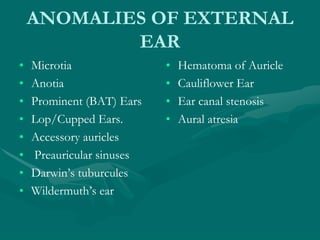
• ANOMALIES OF
EXTERNAL EAR
• Microtia
• Anotia
• Prominent (BAT) Ears
• Lop/Cupped Ears.
• Accessory auricles
• Preauricular sinuses
• Darwin’s tubercles
• Wildermuth’s ear
• Hematoma of Auricle
• Cauliflower Ear
• Ear canal stenosis
• Aural atresia
Hearing Abnormalities
• ANOMALIES OF
MIDDLE EAR
• Ossicular deformities
• Mandibulofacial dystosis
• Ossicular Anomalies
• Other Middle Ear
Anomalies
• ANOMALIES OF
INNER EAR
• Cochlear malformations
• Vestibular
malformations.
• Semicircular canal
malformations.
• Malformations of the
internal auditory canal.
ANOMALIES OF EXTERNAL
EAR
• Microtia
• Anotia
• Prominent (BAT) Ears
• Lop/Cupped Ears.
• Accessory auricles
• Preauricular sinuses
• Darwin’s tuburcules
• Wildermuth’s ear
• Hematoma of Auricle
• Cauliflower Ear
• Ear canal stenosis
• Aural atresia
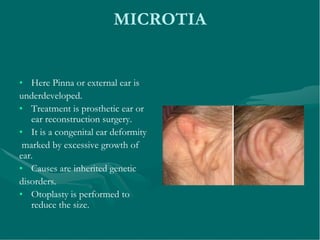
MICROTIA
• Here Pinna or external ear is
underdeveloped.
• Treatment is prosthetic ear or
ear reconstruction surgery.
• It is a congenital ear deformity
marked by excessive growth of
ear.
• Causes are inherited genetic
disorders.
• Otoplasty is performed to
reduce the size.
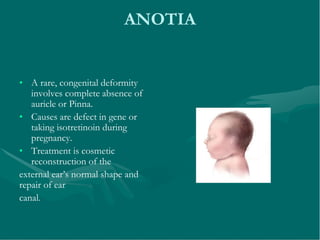
ANOTIA
• A rare, congenital deformity
involves complete absence of
auricle or Pinna.
• Causes are defect in gene or
taking isotretinoin during
pregnancy.
• Treatment is cosmetic
reconstruction of the
external ear’s normal shape and
repair of ear
canal.
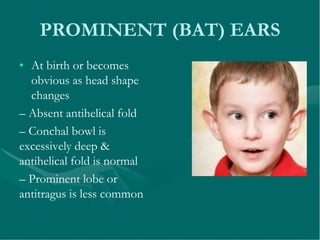
PROMINENT (BAT) EARS
• At birth or becomes
obvious as head shape
changes
– Absent antihelical fold
– Conchal bowl is
excessively deep &
antihelical fold is normal
– Prominent lobe or
antitragus is less common
LOP/CUPPED EARS.
• Lop/cupped ears means
that the rim of the ear is
tightened or constricted.
The condition can range
from mild to severe.
Children with the most
severe cases have ears
that are rolled almost
into a tube, with inner
ear deformities that can
affect hearing.
ACCESSORY AURICLES
• Polyotia is extreme rare
congenital anomaly
• It is defined as an
accessory ear that is large
enough to resemble an
additional Pinna.
• Treatment is surgical
excision.
PREAURICULAR SINUS
• Also known as congenital
auricular fistula or
Preauricular cysts.
• It is a common birth defect
marked by nodule,
dimple located adjacent to
the external ear.
• Treatment are systemic
antibiotics for infection
and surgery to remove
sinus.
DARWIN’S TUBERCLE
• • It is a congenital ear
condition often presents
as a thickening on the
helix of the ear at the
junction of the upper
and middle thirds.
WILDERMUTH’S EAR
• Congenital anomalies
helix is turned backward
and the anthelix is
prominent.
• Treatment is Otoplasty.
HEMATOMA OF AURICLE
CAULIFLOWER EAR
Cauliflower ear, also
known as perichondrial
hematoma or
wrestler's ear, is a
deformity of
the ear caused by
trauma. Cauliflower
ear occurs when blood
pools in your pinna after
it's been hit or struck.
EAR CANAL STENOSIS
• • Narrowing of ear
canal develops when ear
canal fails to develop
during 7th month in
uterus.
• It is repaired by widening
the canal by canalpalsty.
AURAL ATRESIA
• Absence or incomplete
formation of an external
ear canal.
ANOMALIES OF MIDDLE
EAR
• Ossicular deformities
• Mandibulofacial dystosis
• Ossicular Anomalies
• Other Middle Ear Anomalies
ANOMALIES OF MIDDLE EAR
OSSICULAR DEFORMITIES
• Malleus is the most frequent malformed ossicles.
MANDIBULOFACIAL
DYSOSTOSIS
• • Hypoplasia of the
middle third of face.
• • Hypoplasia of
mandible and
underdevelopment of
ear.
• Also known as Treacher
Collins syndrome.
ANOMALIES OF INNER EAR
• Cochlear malformations
• Vestibular malformations.
• Semicircular canal malformations.
• Malformations of the internal auditory canal.
COCHLEAR MALFORMATIONS
• Michel’s deformity:
– complete absence of all cochlear and vestibular
structures.
• Cochlear aplasia:
Complete absence of the cochlea. cochlea is a rare
anomaly which accounts for only 3% of cochlear
malformations.
• Common cavity deformity:
cystic cavity replacing the cochlea and vestibule.
COCHLEAR HYPOPLASIA:
The dimensions of the cochlea and vestibule are
smaller than normal.
Cochlear hypoplasia is defined by small
underdeveloped cochlea with < 2 turns.
• a small cochlear bud of variable length (usually 1–3
mm). It has only one turn or a partial turn is seen
• cochlear nerve often hypoplastic or absent
• cochlear nerve canal: absent, narrow or normal
• vestibule and semicircular canals are usually
malformed but may be normal
• internal auditory canal: normal or narrow
• vestibular aqueduct: normal or large
INCOMPLETE PARTITION
TYPE 1 (IP-I):
The cochlea lacks a modiolus and is
accompanied by a large cystic vestibule.
It is associated with sensorineural hearing loss.
• absent modiolus
• absent interscalar septum
• wide (most common) or normal cochlear
nerve canal
INCOMPLETE PARTITION
TYPE 2 (IP-II) OR MONDINI
MALFORMATION:
The cochlea consists of 1.5 turns, in which the
middle and apical turns join to form an apex of cystic
aspect, with the dilated vestibule and the enlarged
vestibular aqueduct.
Cochlear incomplete partition type II (IP-II) is a type
of cochlear anomaly associated with sensorineural hearing
loss.
• absent interscalar septum
• absent osseous spiral lamina
• absent or deficient modiolus
– only normal at level of basal turn
• normal basal turn of the cochlea
• vestibular aqueduct enlargement very common
– can be normal, but rare
• normal vestibule
VESTIBULAR
MALFORMATIONS.
• Malformación de Michel,
• cavidad común,
• vestíbulo ausente,
• vestíbulo hipoplásico y dilatado.
SEMICIRCULAR CANAL
MALFORMATIONS.
• Semicircular canal absent,
• hypoplastic semicircular canal,
• dilated semicircular canal.
MALFORMATIONS OF THE
INTERNAL AUDITORY CANAL.
• Internal auditory canal absent,
• narrow internal auditory canal,
• dilated internal auditory canal.
Hearing abnormalities

Hearing abnormalities

  • 1.
  • 2.
    ANATOMY • Average adultfemale ear is 59 mm and the average male ear 63mm. • Ear length is 48 mm at six months increasing to 55 mm at five years and 59 mm at ten years (fully grown) • Average adult ear protrudes 19 mm from the mastoid skin
  • 3.
    Hearing Abnormalities • ANOMALIESOF EXTERNAL EAR • Microtia • Anotia • Prominent (BAT) Ears • Lop/Cupped Ears. • Accessory auricles • Preauricular sinuses • Darwin’s tubercles • Wildermuth’s ear • Hematoma of Auricle • Cauliflower Ear • Ear canal stenosis • Aural atresia
  • 4.
    Hearing Abnormalities • ANOMALIESOF MIDDLE EAR • Ossicular deformities • Mandibulofacial dystosis • Ossicular Anomalies • Other Middle Ear Anomalies • ANOMALIES OF INNER EAR • Cochlear malformations • Vestibular malformations. • Semicircular canal malformations. • Malformations of the internal auditory canal.
  • 5.
    ANOMALIES OF EXTERNAL EAR •Microtia • Anotia • Prominent (BAT) Ears • Lop/Cupped Ears. • Accessory auricles • Preauricular sinuses • Darwin’s tuburcules • Wildermuth’s ear • Hematoma of Auricle • Cauliflower Ear • Ear canal stenosis • Aural atresia
  • 8.
    MICROTIA • Here Pinnaor external ear is underdeveloped. • Treatment is prosthetic ear or ear reconstruction surgery. • It is a congenital ear deformity marked by excessive growth of ear. • Causes are inherited genetic disorders. • Otoplasty is performed to reduce the size.
  • 9.
    ANOTIA • A rare,congenital deformity involves complete absence of auricle or Pinna. • Causes are defect in gene or taking isotretinoin during pregnancy. • Treatment is cosmetic reconstruction of the external ear’s normal shape and repair of ear canal.
  • 10.
    PROMINENT (BAT) EARS •At birth or becomes obvious as head shape changes – Absent antihelical fold – Conchal bowl is excessively deep & antihelical fold is normal – Prominent lobe or antitragus is less common
  • 11.
    LOP/CUPPED EARS. • Lop/cuppedears means that the rim of the ear is tightened or constricted. The condition can range from mild to severe. Children with the most severe cases have ears that are rolled almost into a tube, with inner ear deformities that can affect hearing.
  • 12.
    ACCESSORY AURICLES • Polyotiais extreme rare congenital anomaly • It is defined as an accessory ear that is large enough to resemble an additional Pinna. • Treatment is surgical excision.
  • 13.
    PREAURICULAR SINUS • Alsoknown as congenital auricular fistula or Preauricular cysts. • It is a common birth defect marked by nodule, dimple located adjacent to the external ear. • Treatment are systemic antibiotics for infection and surgery to remove sinus.
  • 14.
    DARWIN’S TUBERCLE • •It is a congenital ear condition often presents as a thickening on the helix of the ear at the junction of the upper and middle thirds.
  • 15.
    WILDERMUTH’S EAR • Congenitalanomalies helix is turned backward and the anthelix is prominent. • Treatment is Otoplasty.
  • 16.
  • 17.
    CAULIFLOWER EAR Cauliflower ear,also known as perichondrial hematoma or wrestler's ear, is a deformity of the ear caused by trauma. Cauliflower ear occurs when blood pools in your pinna after it's been hit or struck.
  • 18.
    EAR CANAL STENOSIS •• Narrowing of ear canal develops when ear canal fails to develop during 7th month in uterus. • It is repaired by widening the canal by canalpalsty.
  • 19.
    AURAL ATRESIA • Absenceor incomplete formation of an external ear canal.
  • 21.
    ANOMALIES OF MIDDLE EAR •Ossicular deformities • Mandibulofacial dystosis • Ossicular Anomalies • Other Middle Ear Anomalies
  • 22.
  • 23.
    OSSICULAR DEFORMITIES • Malleusis the most frequent malformed ossicles.
  • 24.
    MANDIBULOFACIAL DYSOSTOSIS • • Hypoplasiaof the middle third of face. • • Hypoplasia of mandible and underdevelopment of ear. • Also known as Treacher Collins syndrome.
  • 33.
    ANOMALIES OF INNEREAR • Cochlear malformations • Vestibular malformations. • Semicircular canal malformations. • Malformations of the internal auditory canal.
  • 34.
    COCHLEAR MALFORMATIONS • Michel’sdeformity: – complete absence of all cochlear and vestibular structures. • Cochlear aplasia: Complete absence of the cochlea. cochlea is a rare anomaly which accounts for only 3% of cochlear malformations. • Common cavity deformity: cystic cavity replacing the cochlea and vestibule.
  • 35.
    COCHLEAR HYPOPLASIA: The dimensionsof the cochlea and vestibule are smaller than normal. Cochlear hypoplasia is defined by small underdeveloped cochlea with < 2 turns.
  • 36.
    • a smallcochlear bud of variable length (usually 1–3 mm). It has only one turn or a partial turn is seen • cochlear nerve often hypoplastic or absent • cochlear nerve canal: absent, narrow or normal • vestibule and semicircular canals are usually malformed but may be normal • internal auditory canal: normal or narrow • vestibular aqueduct: normal or large
  • 37.
    INCOMPLETE PARTITION TYPE 1(IP-I): The cochlea lacks a modiolus and is accompanied by a large cystic vestibule. It is associated with sensorineural hearing loss. • absent modiolus • absent interscalar septum • wide (most common) or normal cochlear nerve canal
  • 38.
    INCOMPLETE PARTITION TYPE 2(IP-II) OR MONDINI MALFORMATION: The cochlea consists of 1.5 turns, in which the middle and apical turns join to form an apex of cystic aspect, with the dilated vestibule and the enlarged vestibular aqueduct. Cochlear incomplete partition type II (IP-II) is a type of cochlear anomaly associated with sensorineural hearing loss.
  • 39.
    • absent interscalarseptum • absent osseous spiral lamina • absent or deficient modiolus – only normal at level of basal turn • normal basal turn of the cochlea • vestibular aqueduct enlargement very common – can be normal, but rare • normal vestibule
  • 40.
    VESTIBULAR MALFORMATIONS. • Malformación deMichel, • cavidad común, • vestíbulo ausente, • vestíbulo hipoplásico y dilatado.
  • 41.
    SEMICIRCULAR CANAL MALFORMATIONS. • Semicircularcanal absent, • hypoplastic semicircular canal, • dilated semicircular canal.
  • 42.
    MALFORMATIONS OF THE INTERNALAUDITORY CANAL. • Internal auditory canal absent, • narrow internal auditory canal, • dilated internal auditory canal.