Microorganisms as Biofertilizer
Definition
• preparations containing living cells or latent
cells of efficient strains of microorganisms
• that help crop plants’ uptake of nutrients by
their interactions in the rhizosphere when
applied through seed or soil.
• They accelerate certain microbial processes in
the soil which augment the extent of
availability of nutrients in a form easily
assimilated by plants.
Introduction
• Use of biofertilizers is one of the important
components of integrated nutrient management
• They are cost effective and renewable source of
plant nutrients to supplement the chemical
fertilizers for sustainable agriculture
• Several microorganisms and their association
with crop plants are being exploited in the
production of biofertilizers
• They can be grouped in different ways based on
their nature and function.
Types of bio fertilizers
• N2 fixing Biofertilizers-
Azotobacter,Anabaena,Nostoc
• P Solubilizing Biofertilizers-. phosphaticum, Bacillus
subtilis,Bacillus circulans
• P Mobilizing Biofertilizers- Gigaspora sp,
Acaulospora sp., Scutellospora sp.
• Biofertilizers for Micro nutrients-Bacillus sp.
• Plant Growth Promoting Rhizobacteria-
Pseudomonas
Rhizobium
• Rhizobium is a soil habitat bacterium, which
can able to colonize the legume roots and
fixes the atmospheric nitrogen symbiotically.
• They are the most efficient biofertilizer as
per the quantity of nitrogen fixed
concerned.
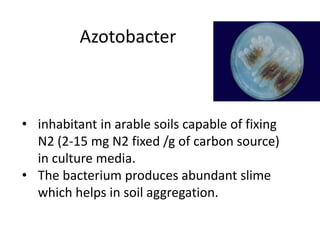
Azotobacter
• inhabitant in arable soils capable of fixing
N2 (2-15 mg N2 fixed /g of carbon source)
in culture media.
• The bacterium produces abundant slime
which helps in soil aggregation.
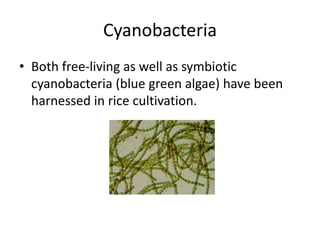
Cyanobacteria
• Both free-living as well as symbiotic
cyanobacteria (blue green algae) have been
harnessed in rice cultivation.
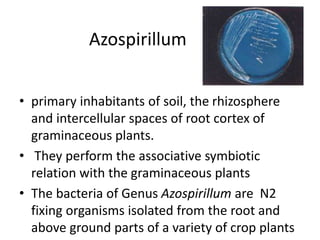
Azospirillum
• primary inhabitants of soil, the rhizosphere
and intercellular spaces of root cortex of
graminaceous plants.
• They perform the associative symbiotic
relation with the graminaceous plants
• The bacteria of Genus Azospirillum are N2
fixing organisms isolated from the root and
above ground parts of a variety of crop plants
Azolla
• Azolla is a free-floating water fern that floats in
water and fixes atmospheric nitrogen in
association with nitrogen fixing blue green alga
Anabaena azollae.
• Rice growing areas in South East Asia and other
third World countries have recently been evincing
increased interest in the use of the symbiotic N2
fixing water fern Azolla either as an alternate
nitrogen sources or as a supplement to
commercial nitrogen fertilizers.
Phosphate solubilizing microorganisms
(PSM)
• Several soil bacteria and fungi, notably species of
Pseudomonas, Bacillus, Penicillium, Aspergillus
etc.
• secrete organic acids and lower the pH in their
vicinity to bring about dissolution of bound
phosphates in soil.
• Increased yields of wheat and potato were
demonstrated due to inoculation of peat based
cultures of Bacillus polymyxa and Pseudomonas
striata..
Silicate solubilizing bacteria (SSB)
• Microorganisms are capable of degrading
silicates and aluminum silicates.
• During the metabolism of microbes several
organic acids are produced and these have a
dual role in silicate weathering.
• They supply H+ ions to the medium and
promote hydrolysis and the organic acids like
citric, oxalic acid, Keto acids and hydroxy
carbolic acids.
Plant Growth Promoting Rhizobacteria
(PGPR)
• The group of bacteria that colonize roots or
rhizosphere soil and beneficial to crops are
referred to as plant growth promoting
rhizobacteria (PGPR).
Method of biofertilizer production
1. Culturing of microorganisms-starter culture
and inoculum production
2. Processing of carrier material
3. Mixing the carrier and broth culture
4. Packing
5. Proper storage
Applicatios of Biofertilizers
• Seed treatment
• Root dipping
• Soil application
• The best feed for cattle and poultry
Importance of Biofertilizers
• They increase the yield of plants by 15-35%
• Bio-fertilizers are effective even under semi-arid
conditions
• Farmers can prepare the inoculum themselves
• They improve soil texture
• Bio-fertilizers do not allow pathogens to flourish
• They produce vitamins and growth promoting bio-
chemical’s
• They are non-polluting
• Group Members
• UWU/EAG/13/0033-
• UWU/EAG/13/0035- M.M.B.S.SILVA
• UWU/EAG/13/0037-
• UWU/EAG/13/0038-

Microorganisms as biofertilizer

  • 1.
  • 2.
    Definition • preparations containingliving cells or latent cells of efficient strains of microorganisms • that help crop plants’ uptake of nutrients by their interactions in the rhizosphere when applied through seed or soil. • They accelerate certain microbial processes in the soil which augment the extent of availability of nutrients in a form easily assimilated by plants.
  • 3.
    Introduction • Use ofbiofertilizers is one of the important components of integrated nutrient management • They are cost effective and renewable source of plant nutrients to supplement the chemical fertilizers for sustainable agriculture • Several microorganisms and their association with crop plants are being exploited in the production of biofertilizers • They can be grouped in different ways based on their nature and function.
  • 4.
    Types of biofertilizers • N2 fixing Biofertilizers- Azotobacter,Anabaena,Nostoc • P Solubilizing Biofertilizers-. phosphaticum, Bacillus subtilis,Bacillus circulans • P Mobilizing Biofertilizers- Gigaspora sp, Acaulospora sp., Scutellospora sp. • Biofertilizers for Micro nutrients-Bacillus sp. • Plant Growth Promoting Rhizobacteria- Pseudomonas
  • 5.
    Rhizobium • Rhizobium isa soil habitat bacterium, which can able to colonize the legume roots and fixes the atmospheric nitrogen symbiotically. • They are the most efficient biofertilizer as per the quantity of nitrogen fixed concerned.
  • 6.
    Azotobacter • inhabitant inarable soils capable of fixing N2 (2-15 mg N2 fixed /g of carbon source) in culture media. • The bacterium produces abundant slime which helps in soil aggregation.
  • 7.
    Cyanobacteria • Both free-livingas well as symbiotic cyanobacteria (blue green algae) have been harnessed in rice cultivation.
  • 8.
    Azospirillum • primary inhabitantsof soil, the rhizosphere and intercellular spaces of root cortex of graminaceous plants. • They perform the associative symbiotic relation with the graminaceous plants • The bacteria of Genus Azospirillum are N2 fixing organisms isolated from the root and above ground parts of a variety of crop plants
  • 9.
    Azolla • Azolla isa free-floating water fern that floats in water and fixes atmospheric nitrogen in association with nitrogen fixing blue green alga Anabaena azollae. • Rice growing areas in South East Asia and other third World countries have recently been evincing increased interest in the use of the symbiotic N2 fixing water fern Azolla either as an alternate nitrogen sources or as a supplement to commercial nitrogen fertilizers.
  • 10.
    Phosphate solubilizing microorganisms (PSM) •Several soil bacteria and fungi, notably species of Pseudomonas, Bacillus, Penicillium, Aspergillus etc. • secrete organic acids and lower the pH in their vicinity to bring about dissolution of bound phosphates in soil. • Increased yields of wheat and potato were demonstrated due to inoculation of peat based cultures of Bacillus polymyxa and Pseudomonas striata..
  • 11.
    Silicate solubilizing bacteria(SSB) • Microorganisms are capable of degrading silicates and aluminum silicates. • During the metabolism of microbes several organic acids are produced and these have a dual role in silicate weathering. • They supply H+ ions to the medium and promote hydrolysis and the organic acids like citric, oxalic acid, Keto acids and hydroxy carbolic acids.
  • 12.
    Plant Growth PromotingRhizobacteria (PGPR) • The group of bacteria that colonize roots or rhizosphere soil and beneficial to crops are referred to as plant growth promoting rhizobacteria (PGPR).
  • 13.
    Method of biofertilizerproduction 1. Culturing of microorganisms-starter culture and inoculum production 2. Processing of carrier material 3. Mixing the carrier and broth culture 4. Packing 5. Proper storage
  • 14.
    Applicatios of Biofertilizers •Seed treatment • Root dipping • Soil application • The best feed for cattle and poultry
  • 15.
    Importance of Biofertilizers •They increase the yield of plants by 15-35% • Bio-fertilizers are effective even under semi-arid conditions • Farmers can prepare the inoculum themselves • They improve soil texture • Bio-fertilizers do not allow pathogens to flourish • They produce vitamins and growth promoting bio- chemical’s • They are non-polluting
  • 16.
    • Group Members •UWU/EAG/13/0033- • UWU/EAG/13/0035- M.M.B.S.SILVA • UWU/EAG/13/0037- • UWU/EAG/13/0038-