Medical Virology
pathogenesis
WALTER WASWA,BSC.MLS 1
Viral Pathogenesis
• Viral pathogenesis is the process by which a viral infection
leads to disease.
• Viral pathogenesis is an abnormal situation of no value to
the virus.
• The majority of viral infections are subclinical. It is not in
the interest of the virus to severely harm or kill the host.
• The consequences of viral infections depend on the
interplay between a number of viral and host factors.
Outcome of Viral Infection
• Acute Infection
– Recovery with no residue effects
– Recovery with residue effects e.g. acute viral encephalitis leading to
neurological sequelae.
– Death
– Proceed to chronic infection
• Chronic Infection
– Silent subclinical infection for life e.g. CMV, EBV
– A long silent period before disease e.g. HIV, SSPE, PML
– Reactivation to cause acute disease e.g. herpes and shingles.
– Chronic disease with relapses and excerbations e.g. HBV, HCV.
– Cancers e.g. EBV, HTLV-1, HPV, HBV, HCV, HHV-8
Acute vs. Latent
Transmission of Viruses
• Respiratory transmission
– Influenza A virus
• Faecal-oral transmission
– Enterovirus
• Blood-borne transmission
– Hepatitis B virus
• Sexual Transmission
– HIV
• Animal or insect vectors
– Rabies virus
WALTER WASWA,BSC.MLS 5
Blood borne
• which are associated with persistent replication
and a persistent viraemia, are well-recognised
causes of nosocomial infection.
• The most commonly reported nosocomial BBVs
are
– Hepatitis B virus (HBV),
– Hepatitis C virus (HCV) and
– Human immunodeficiency virus (HIV).
• Transmission may occur from patient to health
care worker (HCW) or from HCW to patient;
WALTER WASWA,BSC.MLS 6
• Nosocomial infection may occur when
1. blood,
2. other body fluids,
3. unfixed tissues
4. or organs
• are transferred from an infected source to an
uninfected recipient.
WALTER WASWA,BSC.MLS 7
Factors in Viral Pathogenesis
• Effects of viral infection on cells (Cellular Pathogenesis)
• Entry into the Host
• Course of Infection (Primary Replication, Systemic Spread,
Secondary Replication)
• Cell/Tissue Tropism
• Cell/Tissue Damage
• Host Immune Response
• Virus Clearance or Persistence
Cellular Pathogenesis
• Cells can respond to viral infections in 3 ways: (1) No apparent change,
(2) Death, and (3) Transformation
• Direct cell damage and death from viral infection may result from
– diversion of the cell's energy
– shutoff of cell macromolecular synthesis
– competition of viral mRNA for cellular ribosomes
– competition of viral promoters and transcriptional enhancers for cellular
transcriptional factors such as RNA polymerases, and inhibition of the
interferon defense mechanisms.
• Indirect cell damage can result from
– integration of the viral genome
– induction of mutations in the host genome
– inflammation
– host immune response.
What damage do viruses do?
• Direct damage to cells
due to cell
death/apoptosis
– Paralysis
– Immune deficiency
• Disruption of normal cell
functions (eg protein
synthesis, secretion,
membrane trafficking)
• Immune response to
virus infected cells
• Immune cell release of
cytokines
• Virus
hijacking/expressing host
genes
Viral Entry
• Skin - Most viruses which infect via the skin require a breach in the
physical integrity of this effective barrier, e.g. cuts or abrasions. Many
viruses employ vectors, e.g. ticks, mosquitos or vampire bats to breach
the barrier.
• Conjunctiva and other mucous membranes - rather exposed site and
relatively unprotected
• Respiratory tract - In contrast to skin, the respiratory tract and all other
mucosal surfaces possess sophisticated immune defence mechanisms, as
well as non-specific inhibitory mechanisms (cilliated epithelium, mucus
secretion, lower temperature) which viruses must overcome.
• Gastrointestinal tract - a hostile environment; gastric acid, bile salts, etc.
Viruses that spread by the GI tract must be adapted to this hostile
environment.
• Genitourinary tract - relatively less hostile than the above, but less
frequently exposed to extraneous viruses (?)
Course of Viral Infection
• Primary Replication
– The place of primary replication is where the virus replicates after
gaining initial entry into the host.
– This frequently determines whether the infection will be localized at
the site of entry or spread to become a systemic infection.
• Systemic Spread
– Apart from direct cell-to-cell contact, the virus may spread via
the blood stream and the CNS.
• Secondary Replication
– Secondary replication takes place at susceptible organs/tissues
following systemic spread.
Cell Tropism
Viral affinity for specific body tissues (tropism) is determined by
– Cell receptors for virus.
– Cell transcription factors that recognize viral promoters and
enhancer sequences.
– Ability of the cell to support virus replication.
– Physical barriers.
– Local temperature, pH, and oxygen tension enzymes and non-
specific factors in body secretions.
– Digestive enzymes and bile in the gastrointestinal tract that
may inactivate some viruses.
Cell Damage
• Viruses may replicate widely throughout the body without any
disease symptoms if they do not cause significant cell damage or
death.
• Retroviruses do not generally cause cell death, being released
from the cell by budding rather than by cell lysis, and cause
persistent infections.
• Conversely, Picornaviruses cause lysis and death of the cells in
which they replicate, leading to fever and increased mucus
secretion in the case of Rhinoviruses, paralysis or death (usually
due to respiratory failure) for Poliovirus.
Immune Response
• The immune response to the virus probably has the greatest
impact on the outcome of infection.
• In the most cases, the virus is cleared completely from the body
and results in complete recovery.
• In other infections, the immune response is unable to clear the
virus completely and the virus persists.
• In a number of infections, the immune response plays a major
pathological role in the disease.
• In general, cellular immunity plays the major role in clearing virus
infection whereas humoral immunity protects against reinfection.
Immune Pathological Response
• Enhanced viral injury could be due to one or a mixture of the
following mechanisms;-
– Increased secondary response to Tc cells e.g. HBV
– Specific ADCC or complement mediated cell lysis
– Binding of un-neutralized virus-Ab complexes to cell surface Fc
receptors, and thus increasing the number of cells infected e.g.
Dengue haemorrhagic fever, HIV.
– Immune complex deposition in organs such as the skin, brain or
kidney e.g. rash of rubella and measles.
Viral Clearance or Persistence
• The majority of viral infections are cleared but certain
viruses may cause persistent infections. There are 2 types of
chronic persistent infections.
• True Latency - the virus remains completely latent
following primary infection e.g. HSV, VZV. Its genome
may be integrated into the cellular genome or exists as
episomes.
• Persistence - the virus replicates continuously in the body
at a very low level e.g. HIV, HBV, CMV, EBV.
Examples of Viral Pathogenesis
Cytokinesany of a number of substances,
such as interferon, interleukin, and growth
factors, that are secreted by certain cells of the
immune system and have an effect on other
cells.
Rubella
 Transmitted by the respiratory route and replicates upper/lower
respiratory tract and then local lymphoid tissues.
 Following an incubation period of 2 weeks, a viraemia occurs and the
virus spreads throughout the body.
 Clinical Features:-
 maculopapular rash due to immune complex deposition
 lymphadenopathy
 fever
 arthropathy (up to 60% of cases)
Rubella infection during pregnancy
• Rubella virus enters the fetus during the maternal viraemic phase
through the placenta.
• The damage to the fetus seems to involve all germ layers and results
from rapid death of some cells and persistent viral infection in others.
Preconception Risks
0-12 weeks 100% risk of fetus being congenitally infected
resulting in major congenital abnormalities.
Spontaneous abortion occurs in 20% of cases.
13-16 weeks deafness and retinopathy 15%
after 16 weeks normal development, slight risk of deafness
and retinopathy
Herpes Simplex Virus
• HSV is spread by contact, as the virus is shed in saliva, tears,
genital and other secretions.
• Primary infection is usually trivial or subclinical in most
individuals. It is a disease mainly of very young children ie. those
below 5 years.
• About 10% of the population acquires HSV infection through the
genital route and the risk is concentrated in young adulthood.
• Following primary infection, 45% of orally infected individuals
and 60% of patients with genital herpes will experience recurrences.
• The actual frequency of recurrences varies widely between
individuals. The mean number of episodes per year is about 1.6.
Pathogenesis
• During the primary infection, HSV spreads locally and a short-lived
viraemia occurs, whereby the virus is disseminated in the body. Spread to
the to craniospinal ganglia occurs.
• The virus then establishes latency in the craniospinal ganglia.
• The exact mechanism of latency is not known, it may be true latency
where there is no viral replication or viral persistence where there is a low
level of viral replication.
• Reactivation - It is well known that many triggers can provoke a
recurrence. These include physical or psychological stress, infection;
especially pneumococcal and meningococcal, fever, irradiation; including
sunlight, and menstruation.
Clinical Manifestations
HSV is involved in a variety of clinical manifestations
which includes ;-
1. Acute gingivostomatitis
2. Herpes Labialis (cold sore)
3. Ocular Herpes
4. Herpes Genitalis
5. Other forms of cutaneous herpes
7. Meningitis
8. Encephalitis
9. Neonatal herpes
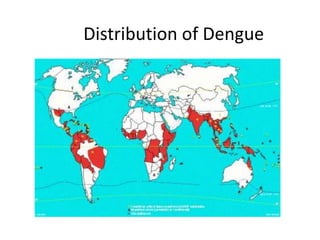
Dengue (1)
• Dengue is the biggest arbovirus problem in the world
today with over 2 million cases per year. Dengue is found in SE
Asia, Africa and the Caribbean and S America.
• Flavivirus, 4 serotypes, transmitted by Aedes mosquitoes which
reside in water-filled containers.
• Human infections arise from a human-mosquitoe-human cycle
• Classically, dengue presents with a high fever, lymphadenopathy,
myalgia, bone and joint pains, headache, and a maculopapular
rash.
Distribution of Dengue
Man-Arthropod-Man Cycle
Dengue (2)
• Severe cases may present with haemorrhagic fever and shock
with a mortality of 5-10%. (Dengue haemorrhagic fever or
Dengue shock syndrome.)
• Dengue haemorrhagic fever and shock syndrome appear most
often (90%) in patients previously infected by a different
serotype of dengue, thus suggesting an immunopathological
mechanism.
• Antibody-dependent enhancement - Binding of heterotypic
antibodies to the virus, and subsequent infection of
macrophages with Fc receptors.
Hepatitis B Virus
 Incubation period: Average 60-90 days
Range 45-180 days
 Clinical illness (jaundice): <5 yrs, <10%
5 yrs, 30%-50%
 Acute case-fatality rate: 0.5%-1%
 Chronic infection: <5 yrs, 30%-90%
5 yrs, 2%-10%
 Premature mortality from
chronic liver disease: 15%-25%
Hepatitis B - Clinical
Features
Symptomatic Infection
Chronic Infection
Age at Infection
Chronic Infection (%)
SymptomaticInfection(%)
Birth 1-6 months 7-12 months 1-4 years Older Children
and Adults
0
20
40
60
80
100100
80
60
40
20
0
Outcome of Hepatitis B Virus Infection
by Age at Infection
ChronicInfection(%)
Spectrum of Chronic Hepatitis B Diseases
1. Chronic Persistent Hepatitis - asymptomatic
2. Chronic Active Hepatitis - symptomatic
exacerbations of hepatitis
3. Cirrhosis of Liver
4. Hepatocellular Carcinoma
HIV
Kills cells rather than immortalizing them
•HIV is a slow cytocidal virus with exquisite tropism for
CD4+ expressing cells and macrophages.
•It is the loss of CD4+ cells which destroys helper and
delayed type hypersensitivity functions of the immune
response.
Retrovirus virion structure
Figure 59-17 Schematic
representation of a mature HIV-1
virion.
Figure 60-2 Organization of a mature human immunodeficiency
virus (HIV)-1 virion. Envelope glycoproteins project from the outer
lipid membrane. Two copies of the HIV genome are contained
within the core
Fields Virology 4th
edition, 2002, Chapters
59 & 60, Lippincott,
Williams and Wilkins,
2002
HIV-1 Replication Cycle
CCR5
CD4
CXCR4
Reverse
Transcription
Integration
Uncoating
Assembly
Budding
Attachment
Maturation
Reverse
Transcriptase
Integrase
Protease
Beth D. Jamieson, Ph.D.
HIV – the disease
•HIV primarily infects CD4 T cells and cells of the macrophage
lineage
•Monocytes
•Macrophages(including alveolar macrophages)
•Dendritic cells (skin)
•Microglial cells (CNS)
•Virus causes lytic infection of CD4 T cells and a persistent low-
level productive infection of macrophages
•Virus alters T-cell and macrophage cell functions
Natural Course of HIV-1 Infection
HIV pathogenesis
From Murray et. al., Medical Microbiology 5th
edition, 2005, Chapter 65, published by
Mosby Philadelphia,,
Figure 65-8
HIV pathogenesis
From Murray et. al., Medical Microbiology 5th
edition, 2005, Chapter 65, published by
Mosby Philadelphia,,
Table 65-3
AIDS epidemiology
From Murray et. al., Medical
Microbiology 5th edition, 2005,
Chapter 65, published by
Mosby Philadelphia.
Box 65-3.
AIDS-associated secondary infections
From Murray et. al., Medical
Microbiology 5th edition, 2005,
Chapter 65, published by
Mosby Philadelphia.
Table 65-5.
Summary
• Viral Pathogenesis depends on the complex interplay of a
large number of viral and host factors.
• Viral factors include cell tropism and cellular pathogenesis.
• The immune response is the most important host factor, as
it determines whether the virus is cleared or not.
• Sometimes, the immune response itself is responsible for
the damage.
• Evoking an autoimmune response that affects
uninfected cells
– Mimicry
– Exposing protected sites
– Infecting immune cells - B cell antibody
production against variety of proteins
– Hyperexpression of MHC
HIV associated dementia (HAD)
• Occurs in ~ 15 - 30% of cases of
subtype B but only 1-2% of subtype C
• Migration of monocytes to brain
correlated to HAD
• Extracellular Tat protein exhibits
strong monocyte chemotactic
properties
WALTER WASWA,BSC.MLS 44
THE END

Medical virology

  • 1.
  • 2.
    Viral Pathogenesis • Viralpathogenesis is the process by which a viral infection leads to disease. • Viral pathogenesis is an abnormal situation of no value to the virus. • The majority of viral infections are subclinical. It is not in the interest of the virus to severely harm or kill the host. • The consequences of viral infections depend on the interplay between a number of viral and host factors.
  • 3.
    Outcome of ViralInfection • Acute Infection – Recovery with no residue effects – Recovery with residue effects e.g. acute viral encephalitis leading to neurological sequelae. – Death – Proceed to chronic infection • Chronic Infection – Silent subclinical infection for life e.g. CMV, EBV – A long silent period before disease e.g. HIV, SSPE, PML – Reactivation to cause acute disease e.g. herpes and shingles. – Chronic disease with relapses and excerbations e.g. HBV, HCV. – Cancers e.g. EBV, HTLV-1, HPV, HBV, HCV, HHV-8
  • 4.
  • 5.
    Transmission of Viruses •Respiratory transmission – Influenza A virus • Faecal-oral transmission – Enterovirus • Blood-borne transmission – Hepatitis B virus • Sexual Transmission – HIV • Animal or insect vectors – Rabies virus WALTER WASWA,BSC.MLS 5
  • 6.
    Blood borne • whichare associated with persistent replication and a persistent viraemia, are well-recognised causes of nosocomial infection. • The most commonly reported nosocomial BBVs are – Hepatitis B virus (HBV), – Hepatitis C virus (HCV) and – Human immunodeficiency virus (HIV). • Transmission may occur from patient to health care worker (HCW) or from HCW to patient; WALTER WASWA,BSC.MLS 6
  • 7.
    • Nosocomial infectionmay occur when 1. blood, 2. other body fluids, 3. unfixed tissues 4. or organs • are transferred from an infected source to an uninfected recipient. WALTER WASWA,BSC.MLS 7
  • 8.
    Factors in ViralPathogenesis • Effects of viral infection on cells (Cellular Pathogenesis) • Entry into the Host • Course of Infection (Primary Replication, Systemic Spread, Secondary Replication) • Cell/Tissue Tropism • Cell/Tissue Damage • Host Immune Response • Virus Clearance or Persistence
  • 9.
    Cellular Pathogenesis • Cellscan respond to viral infections in 3 ways: (1) No apparent change, (2) Death, and (3) Transformation • Direct cell damage and death from viral infection may result from – diversion of the cell's energy – shutoff of cell macromolecular synthesis – competition of viral mRNA for cellular ribosomes – competition of viral promoters and transcriptional enhancers for cellular transcriptional factors such as RNA polymerases, and inhibition of the interferon defense mechanisms. • Indirect cell damage can result from – integration of the viral genome – induction of mutations in the host genome – inflammation – host immune response.
  • 10.
    What damage doviruses do? • Direct damage to cells due to cell death/apoptosis – Paralysis – Immune deficiency • Disruption of normal cell functions (eg protein synthesis, secretion, membrane trafficking) • Immune response to virus infected cells • Immune cell release of cytokines • Virus hijacking/expressing host genes
  • 11.
    Viral Entry • Skin- Most viruses which infect via the skin require a breach in the physical integrity of this effective barrier, e.g. cuts or abrasions. Many viruses employ vectors, e.g. ticks, mosquitos or vampire bats to breach the barrier. • Conjunctiva and other mucous membranes - rather exposed site and relatively unprotected • Respiratory tract - In contrast to skin, the respiratory tract and all other mucosal surfaces possess sophisticated immune defence mechanisms, as well as non-specific inhibitory mechanisms (cilliated epithelium, mucus secretion, lower temperature) which viruses must overcome. • Gastrointestinal tract - a hostile environment; gastric acid, bile salts, etc. Viruses that spread by the GI tract must be adapted to this hostile environment. • Genitourinary tract - relatively less hostile than the above, but less frequently exposed to extraneous viruses (?)
  • 12.
    Course of ViralInfection • Primary Replication – The place of primary replication is where the virus replicates after gaining initial entry into the host. – This frequently determines whether the infection will be localized at the site of entry or spread to become a systemic infection. • Systemic Spread – Apart from direct cell-to-cell contact, the virus may spread via the blood stream and the CNS. • Secondary Replication – Secondary replication takes place at susceptible organs/tissues following systemic spread.
  • 13.
    Cell Tropism Viral affinityfor specific body tissues (tropism) is determined by – Cell receptors for virus. – Cell transcription factors that recognize viral promoters and enhancer sequences. – Ability of the cell to support virus replication. – Physical barriers. – Local temperature, pH, and oxygen tension enzymes and non- specific factors in body secretions. – Digestive enzymes and bile in the gastrointestinal tract that may inactivate some viruses.
  • 14.
    Cell Damage • Virusesmay replicate widely throughout the body without any disease symptoms if they do not cause significant cell damage or death. • Retroviruses do not generally cause cell death, being released from the cell by budding rather than by cell lysis, and cause persistent infections. • Conversely, Picornaviruses cause lysis and death of the cells in which they replicate, leading to fever and increased mucus secretion in the case of Rhinoviruses, paralysis or death (usually due to respiratory failure) for Poliovirus.
  • 15.
    Immune Response • Theimmune response to the virus probably has the greatest impact on the outcome of infection. • In the most cases, the virus is cleared completely from the body and results in complete recovery. • In other infections, the immune response is unable to clear the virus completely and the virus persists. • In a number of infections, the immune response plays a major pathological role in the disease. • In general, cellular immunity plays the major role in clearing virus infection whereas humoral immunity protects against reinfection.
  • 16.
    Immune Pathological Response •Enhanced viral injury could be due to one or a mixture of the following mechanisms;- – Increased secondary response to Tc cells e.g. HBV – Specific ADCC or complement mediated cell lysis – Binding of un-neutralized virus-Ab complexes to cell surface Fc receptors, and thus increasing the number of cells infected e.g. Dengue haemorrhagic fever, HIV. – Immune complex deposition in organs such as the skin, brain or kidney e.g. rash of rubella and measles.
  • 17.
    Viral Clearance orPersistence • The majority of viral infections are cleared but certain viruses may cause persistent infections. There are 2 types of chronic persistent infections. • True Latency - the virus remains completely latent following primary infection e.g. HSV, VZV. Its genome may be integrated into the cellular genome or exists as episomes. • Persistence - the virus replicates continuously in the body at a very low level e.g. HIV, HBV, CMV, EBV.
  • 18.
    Examples of ViralPathogenesis Cytokinesany of a number of substances, such as interferon, interleukin, and growth factors, that are secreted by certain cells of the immune system and have an effect on other cells.
  • 19.
    Rubella  Transmitted bythe respiratory route and replicates upper/lower respiratory tract and then local lymphoid tissues.  Following an incubation period of 2 weeks, a viraemia occurs and the virus spreads throughout the body.  Clinical Features:-  maculopapular rash due to immune complex deposition  lymphadenopathy  fever  arthropathy (up to 60% of cases)
  • 20.
    Rubella infection duringpregnancy • Rubella virus enters the fetus during the maternal viraemic phase through the placenta. • The damage to the fetus seems to involve all germ layers and results from rapid death of some cells and persistent viral infection in others. Preconception Risks 0-12 weeks 100% risk of fetus being congenitally infected resulting in major congenital abnormalities. Spontaneous abortion occurs in 20% of cases. 13-16 weeks deafness and retinopathy 15% after 16 weeks normal development, slight risk of deafness and retinopathy
  • 21.
    Herpes Simplex Virus •HSV is spread by contact, as the virus is shed in saliva, tears, genital and other secretions. • Primary infection is usually trivial or subclinical in most individuals. It is a disease mainly of very young children ie. those below 5 years. • About 10% of the population acquires HSV infection through the genital route and the risk is concentrated in young adulthood. • Following primary infection, 45% of orally infected individuals and 60% of patients with genital herpes will experience recurrences. • The actual frequency of recurrences varies widely between individuals. The mean number of episodes per year is about 1.6.
  • 22.
    Pathogenesis • During theprimary infection, HSV spreads locally and a short-lived viraemia occurs, whereby the virus is disseminated in the body. Spread to the to craniospinal ganglia occurs. • The virus then establishes latency in the craniospinal ganglia. • The exact mechanism of latency is not known, it may be true latency where there is no viral replication or viral persistence where there is a low level of viral replication. • Reactivation - It is well known that many triggers can provoke a recurrence. These include physical or psychological stress, infection; especially pneumococcal and meningococcal, fever, irradiation; including sunlight, and menstruation.
  • 23.
    Clinical Manifestations HSV isinvolved in a variety of clinical manifestations which includes ;- 1. Acute gingivostomatitis 2. Herpes Labialis (cold sore) 3. Ocular Herpes 4. Herpes Genitalis 5. Other forms of cutaneous herpes 7. Meningitis 8. Encephalitis 9. Neonatal herpes
  • 24.
    Dengue (1) • Dengueis the biggest arbovirus problem in the world today with over 2 million cases per year. Dengue is found in SE Asia, Africa and the Caribbean and S America. • Flavivirus, 4 serotypes, transmitted by Aedes mosquitoes which reside in water-filled containers. • Human infections arise from a human-mosquitoe-human cycle • Classically, dengue presents with a high fever, lymphadenopathy, myalgia, bone and joint pains, headache, and a maculopapular rash.
  • 25.
  • 26.
  • 27.
    Dengue (2) • Severecases may present with haemorrhagic fever and shock with a mortality of 5-10%. (Dengue haemorrhagic fever or Dengue shock syndrome.) • Dengue haemorrhagic fever and shock syndrome appear most often (90%) in patients previously infected by a different serotype of dengue, thus suggesting an immunopathological mechanism. • Antibody-dependent enhancement - Binding of heterotypic antibodies to the virus, and subsequent infection of macrophages with Fc receptors.
  • 28.
  • 29.
     Incubation period:Average 60-90 days Range 45-180 days  Clinical illness (jaundice): <5 yrs, <10% 5 yrs, 30%-50%  Acute case-fatality rate: 0.5%-1%  Chronic infection: <5 yrs, 30%-90% 5 yrs, 2%-10%  Premature mortality from chronic liver disease: 15%-25% Hepatitis B - Clinical Features
  • 30.
    Symptomatic Infection Chronic Infection Ageat Infection Chronic Infection (%) SymptomaticInfection(%) Birth 1-6 months 7-12 months 1-4 years Older Children and Adults 0 20 40 60 80 100100 80 60 40 20 0 Outcome of Hepatitis B Virus Infection by Age at Infection ChronicInfection(%)
  • 31.
    Spectrum of ChronicHepatitis B Diseases 1. Chronic Persistent Hepatitis - asymptomatic 2. Chronic Active Hepatitis - symptomatic exacerbations of hepatitis 3. Cirrhosis of Liver 4. Hepatocellular Carcinoma
  • 32.
    HIV Kills cells ratherthan immortalizing them •HIV is a slow cytocidal virus with exquisite tropism for CD4+ expressing cells and macrophages. •It is the loss of CD4+ cells which destroys helper and delayed type hypersensitivity functions of the immune response.
  • 33.
    Retrovirus virion structure Figure59-17 Schematic representation of a mature HIV-1 virion. Figure 60-2 Organization of a mature human immunodeficiency virus (HIV)-1 virion. Envelope glycoproteins project from the outer lipid membrane. Two copies of the HIV genome are contained within the core Fields Virology 4th edition, 2002, Chapters 59 & 60, Lippincott, Williams and Wilkins, 2002
  • 34.
  • 35.
    HIV – thedisease •HIV primarily infects CD4 T cells and cells of the macrophage lineage •Monocytes •Macrophages(including alveolar macrophages) •Dendritic cells (skin) •Microglial cells (CNS) •Virus causes lytic infection of CD4 T cells and a persistent low- level productive infection of macrophages •Virus alters T-cell and macrophage cell functions
  • 36.
    Natural Course ofHIV-1 Infection
  • 37.
    HIV pathogenesis From Murrayet. al., Medical Microbiology 5th edition, 2005, Chapter 65, published by Mosby Philadelphia,, Figure 65-8
  • 38.
    HIV pathogenesis From Murrayet. al., Medical Microbiology 5th edition, 2005, Chapter 65, published by Mosby Philadelphia,, Table 65-3
  • 39.
    AIDS epidemiology From Murrayet. al., Medical Microbiology 5th edition, 2005, Chapter 65, published by Mosby Philadelphia. Box 65-3.
  • 40.
    AIDS-associated secondary infections FromMurray et. al., Medical Microbiology 5th edition, 2005, Chapter 65, published by Mosby Philadelphia. Table 65-5.
  • 41.
    Summary • Viral Pathogenesisdepends on the complex interplay of a large number of viral and host factors. • Viral factors include cell tropism and cellular pathogenesis. • The immune response is the most important host factor, as it determines whether the virus is cleared or not. • Sometimes, the immune response itself is responsible for the damage.
  • 42.
    • Evoking anautoimmune response that affects uninfected cells – Mimicry – Exposing protected sites – Infecting immune cells - B cell antibody production against variety of proteins – Hyperexpression of MHC
  • 43.
    HIV associated dementia(HAD) • Occurs in ~ 15 - 30% of cases of subtype B but only 1-2% of subtype C • Migration of monocytes to brain correlated to HAD • Extracellular Tat protein exhibits strong monocyte chemotactic properties
  • 44.