“Culture” and “Popular Culture”

 What is “Culture”?
 Characteristics of “culture”
 Defining “Popular” + “Culture”


 Characteristics of “Popular Culture”
 The Popular Culture Formula
What is "CULTURE?"
"Culture?” a first definition…

   Agricultural meaning…
"Culture?“ a second definition…

    An Evaluative Definition
    • The general process of intellectual,
       spiritual, and/or aesthetic development
•Historically

   “Culture” = refinement and intellectual superiority
    “The best that has been thought and said in the world”
   (Matthew Arnold, 1869)

•Socially Defined

       Working classes were “raw and uncultivated”
                posed a cultural danger to the elite


       Upper classes possessed and protected Culture
                their duty was to impart culture on everyone else

                                              Matthew Arnold
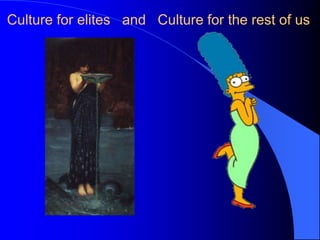
Culture for elites and Culture for the rest of us
Okay But…
   If “Culture” belonged to the elite – how did we classify the “un-
    culture” of the masses: folk music, legends, traditions, folk arts?

   As opposed to “High” culture , late 19th Century saw a rise in “folk”
    culture
     – artifacts created by a specific community or ethnic group –
       transmitted through oral communication – Fairytales, folksongs,
       proverbs and dialects
          Not a threat to society because it was a culture in decline
           (industrialization and urbanization)
Other Categories of Culture
   Folk culture
    – Products developed in a limited community and
      transmitted directly from generation to
      generation, between "folk" familiar with each
      other
Categories of Culture
   Folk culture
    – Products developed in a limited community and
      transmitted directly from generation to
      generation, between "folk" familiar with each
      other
   Elite/High Culture
    – Products produced by and for a limited number
      of people with specialized interests, training or
      knowledge
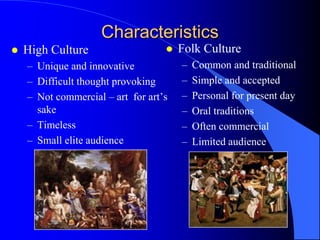
Characteristics
   High Culture                      Folk Culture
    – Unique and innovative            –   Common and traditional
    – Difficult thought provoking      –   Simple and accepted
    – Not commercial – art for art‟s   –   Personal for present day
      sake                             –   Oral traditions
    – Timeless                         –   Often commercial
    – Small elite audience             –   Limited audience
"Culture?“ – a third definition
 a general process of intellectual, spiritual,
  and aesthetic development
 a particular way of life, whether of a people,
  a period or a group


                     Raymond Williams
"Culture?"
 a general process of intellectual, spiritual,
  and aesthetic development
 a particular way of life, whether of a people,
  a period or a group
   – the works and practices of creative
     activity
"Culture?"
 a general process of intellectual, spiritual,
  and aesthetic development
 a particular way of life, whether of a people,
  a period or a group
   – the works and practices of creative
     activity
Yeah, but What About
             Everyone Else?
   High and Folk Culture represented only a small
    population, so...

 What about the modifier “popular”? What do we
  mean by “popular culture” as opposed to just
  “culture”?
 “Popular” – in its broadest sense means “of the
  people” and we use it to mean “accepted and/or
  approved of by a larger number of people”
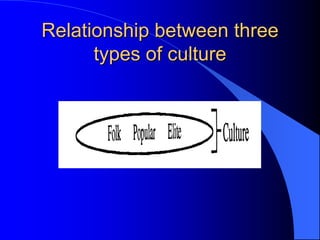
Relationship between three
      types of culture
Be aware that…
   Negative Connotation:
    o Seen as a hollow imitation of „true‟
      culture – conveyed no worthwhile
      message or value
    o Works as a drug – giving its audience a
      false sense of reality (Marxist)
    o “Powerful and pervasive de-educator of
      the public mind” – F.R. Leavis
Relationship between three
          types of culture
   FLUID
     – Nothing to prevent YOU from moving
       from one area/type to another
     – Cultural ARTIFACT can change
       categories
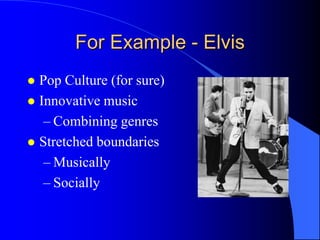
For Example - Elvis
 Pop Culture (for sure)
 Innovative music
   – Combining genres
 Stretched boundaries
   – Musically
   – Socially
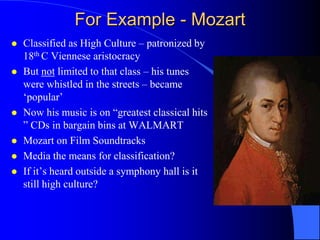
For Example - Mozart
   Classified as High Culture – patronized by
    18th C Viennese aristocracy
   But not limited to that class – his tunes
    were whistled in the streets – became
    „popular‟
   Now his music is on “greatest classical hits
    ” CDs in bargain bins at WALMART
   Mozart on Film Soundtracks
   Media the means for classification?
   If it‟s heard outside a symphony hall is it
    still high culture?
“Culture” and “Popular Culture”

 What is “Culture”?
 Characteristics of “culture”
 Defining “Popular” + “Culture”


 Characteristics of “Popular Culture”
 The Popular Culture Formula
Characteristics of CULTURE
   Culture is SYMBOLIC
Characteristics of CULTURE
 Culture is SYMBOLIC
 Culture is SHARED
Characteristics of CULTURE
 Culture is SYMBOLIC
 Culture is SHARED
  – Subcultures
Characteristics of CULTURE
 Culture is SYMBOLIC
 Culture is SHARED
  – Subcultures
 Culture is LEARNED
Characteristics of CULTURE
 Culture is SYMBOLIC
 Culture is SHARED
  – Subcultures
 Culture is LEARNED
 Culture is ORDINARY
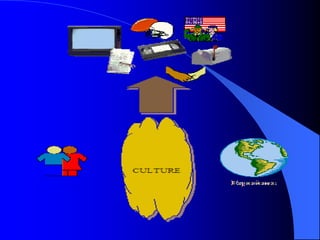
So, in other words…


CULTURE is a social group's
  SYSTEM OF MEANING
“Believing that man is an animal suspended in webs
of meaning that he has spun himself, I take culture to
be those webs....”
--Clifford Geertz, The Interpretation of Cultures 1973)
“A society is possible in the last analysis because
the individuals in it carry around in their heads
some sort of picture of that society.”
      --- Karl Mannheim, Utopia and Society (1964)
“If you can write the nation’s stories, you don’t
need to worry about who writes its laws.”
--- George Gerbner, Communication, (1978)
“Communication is a symbolic process
whereby reality is produced, maintained,
repaired and transformed.”


        --James Carey, “Cultural View of
        Communication”, p. 10
“Culture” and “Popular Culture”

 What is “Culture”?
 Characteristics of “culture”
 Defining “Popular” + “Culture”


 Characteristics of “Popular Culture”
 The Popular Culture Formula
And Popular Culture is…
   the products of human work and thought
    which are accepted and approved of by a
    large community or population
But what about history?


Did popular culture start with mass media?
But what about history?


Modernists           Classicists
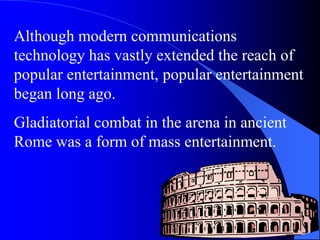
Although modern communications
technology has vastly extended the reach of
popular entertainment, popular entertainment
began long ago.
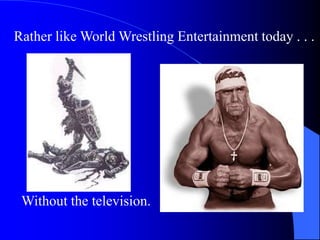
Gladiatorial combat in the arena in ancient
Rome was a form of mass entertainment.
Rather like World Wrestling Entertainment today . . .


 Without the television.
   The Roman and Greek comparison is important.
    – State-sponsored entertainment provided in the
      Coliseum kept the Roman mob contented and
      amused. In fact there was a phrase for this:
      “bread and circuses.”
    – Popular entertainment in ancient Rome was a
      form of social control.
           – Give the masses plenty of free food and entertainment
             to keep them in line so they wouldn‟t make trouble for
             the upper classes.
   Some theorists of popular culture think this is
    still the motive behind popular culture today. (e.g.
    Adorno & Horkheimer)
And Popular Culture is…
   the products of human work and thought
    which are (or have been in the past)
    accepted and approved of by a large
    community or population
“Culture” and “Popular Culture”

 What is “Culture”?
 Characteristics of “culture”
 Defining “Popular” + “Culture”


 Characteristics of “Popular Culture”
 The Popular Culture Formula
Characteristics of
            Popular Culture
   Consists of artifacts & events & products
Characteristics of
            Popular Culture
   Consists of artifacts & events & products
    – Icons
    – Stereotypes
    – Heroes
    – Rituals
    – Popular Arts
Characteristics of
          Popular Culture
 Consists of artifacts & events & products
 Surrounds us
Characteristics of
          Popular Culture
 Consists of artifacts & events & products
 Surrounds us
 Reflects audience beliefs and values
“... "most of popular culture constantly reaffirms
and reproduces the already taken-for-granted
meanings and values in American Society…”

--Lawrence Grossberg, p. 15
“zeitgeist”

   ="spirit of an era"
   Popular culture‟s "reflective” nature
    – Transitory attitudes and perspectives (hidden and abstract) as
      well as deep seated beliefs and values are made CONCRETE in
      popular culture
The Popular Culture Formula
The popularity of a given cultural element
(object, person, event) is directly proportional
to the degree to which the element reflects
audience beliefs and values. The greater the
popularity of the cultural element—in an era
and/or over time—the more reflective of the
zeitgeist this element is likely to be.
                 ---Nachbar and Lause, p. 5
Characteristics of
          Popular Culture
 Consists of artifacts & events & products
 Surrounds us
 Reflects audience beliefs and values
 Is commercial
Characteristics of
          Popular Culture
 Consists of artifacts & events & products
 Surrounds us
 Reflects audience beliefs and values
 Is commercial
 Is often imitative (of itself)
Characteristics of
          Popular Culture
 Consists of artifacts & events & products
 Surrounds us
 Reflects audience beliefs and values
 Is commercial
 Is often imitative (of itself)
 Shapes audience beliefs and values
Characteristics of
          Popular Culture
 Consists of artifacts & events & products
 Surrounds us
 Reflects audience beliefs and values
 Is commercial
 Is often imitative (of itself)
 Shapes audience beliefs and values
"Popular culture is, then…”
   the artifacts (icons, objects, people,
    practices, „art‟ forms) which are (or have
    been) accepted and approved of by a large
    community or population, promoted via
    mass communication media…
    – and having widely shared meanings
    – and manifesting group identifications to us
    – and capable of both reflecting & shaping values, beliefs

Defining key terms

  • 1.
  • 2.
    “Culture” and “PopularCulture”  What is “Culture”?  Characteristics of “culture”  Defining “Popular” + “Culture”  Characteristics of “Popular Culture”  The Popular Culture Formula
  • 3.
  • 4.
    "Culture?” a firstdefinition…  Agricultural meaning…
  • 5.
    "Culture?“ a seconddefinition…  An Evaluative Definition • The general process of intellectual, spiritual, and/or aesthetic development
  • 6.
    •Historically “Culture” = refinement and intellectual superiority “The best that has been thought and said in the world” (Matthew Arnold, 1869) •Socially Defined Working classes were “raw and uncultivated” posed a cultural danger to the elite Upper classes possessed and protected Culture their duty was to impart culture on everyone else Matthew Arnold
  • 7.
    Culture for elitesand Culture for the rest of us
  • 8.
    Okay But…  If “Culture” belonged to the elite – how did we classify the “un- culture” of the masses: folk music, legends, traditions, folk arts?  As opposed to “High” culture , late 19th Century saw a rise in “folk” culture – artifacts created by a specific community or ethnic group – transmitted through oral communication – Fairytales, folksongs, proverbs and dialects  Not a threat to society because it was a culture in decline (industrialization and urbanization)
  • 9.
    Other Categories ofCulture  Folk culture – Products developed in a limited community and transmitted directly from generation to generation, between "folk" familiar with each other
  • 10.
    Categories of Culture  Folk culture – Products developed in a limited community and transmitted directly from generation to generation, between "folk" familiar with each other  Elite/High Culture – Products produced by and for a limited number of people with specialized interests, training or knowledge
  • 11.
    Characteristics  High Culture  Folk Culture – Unique and innovative – Common and traditional – Difficult thought provoking – Simple and accepted – Not commercial – art for art‟s – Personal for present day sake – Oral traditions – Timeless – Often commercial – Small elite audience – Limited audience
  • 12.
    "Culture?“ – athird definition  a general process of intellectual, spiritual, and aesthetic development  a particular way of life, whether of a people, a period or a group Raymond Williams
  • 13.
    "Culture?"  a generalprocess of intellectual, spiritual, and aesthetic development  a particular way of life, whether of a people, a period or a group – the works and practices of creative activity
  • 14.
    "Culture?"  a generalprocess of intellectual, spiritual, and aesthetic development  a particular way of life, whether of a people, a period or a group – the works and practices of creative activity
  • 15.
    Yeah, but WhatAbout Everyone Else?  High and Folk Culture represented only a small population, so...  What about the modifier “popular”? What do we mean by “popular culture” as opposed to just “culture”?  “Popular” – in its broadest sense means “of the people” and we use it to mean “accepted and/or approved of by a larger number of people”
  • 16.
  • 17.
    Be aware that…  Negative Connotation: o Seen as a hollow imitation of „true‟ culture – conveyed no worthwhile message or value o Works as a drug – giving its audience a false sense of reality (Marxist) o “Powerful and pervasive de-educator of the public mind” – F.R. Leavis
  • 18.
    Relationship between three types of culture  FLUID – Nothing to prevent YOU from moving from one area/type to another – Cultural ARTIFACT can change categories
  • 19.
    For Example -Elvis  Pop Culture (for sure)  Innovative music – Combining genres  Stretched boundaries – Musically – Socially
  • 20.
    For Example -Mozart  Classified as High Culture – patronized by 18th C Viennese aristocracy  But not limited to that class – his tunes were whistled in the streets – became „popular‟  Now his music is on “greatest classical hits ” CDs in bargain bins at WALMART  Mozart on Film Soundtracks  Media the means for classification?  If it‟s heard outside a symphony hall is it still high culture?
  • 21.
    “Culture” and “PopularCulture”  What is “Culture”?  Characteristics of “culture”  Defining “Popular” + “Culture”  Characteristics of “Popular Culture”  The Popular Culture Formula
  • 22.
  • 23.
    Characteristics of CULTURE  Culture is SYMBOLIC
  • 24.
    Characteristics of CULTURE Culture is SYMBOLIC  Culture is SHARED
  • 25.
    Characteristics of CULTURE Culture is SYMBOLIC  Culture is SHARED – Subcultures
  • 26.
    Characteristics of CULTURE Culture is SYMBOLIC  Culture is SHARED – Subcultures  Culture is LEARNED
  • 27.
    Characteristics of CULTURE Culture is SYMBOLIC  Culture is SHARED – Subcultures  Culture is LEARNED  Culture is ORDINARY
  • 28.
    So, in otherwords… CULTURE is a social group's SYSTEM OF MEANING
  • 29.
    “Believing that manis an animal suspended in webs of meaning that he has spun himself, I take culture to be those webs....” --Clifford Geertz, The Interpretation of Cultures 1973)
  • 31.
    “A society ispossible in the last analysis because the individuals in it carry around in their heads some sort of picture of that society.” --- Karl Mannheim, Utopia and Society (1964)
  • 32.
    “If you canwrite the nation’s stories, you don’t need to worry about who writes its laws.” --- George Gerbner, Communication, (1978)
  • 33.
    “Communication is asymbolic process whereby reality is produced, maintained, repaired and transformed.” --James Carey, “Cultural View of Communication”, p. 10
  • 34.
    “Culture” and “PopularCulture”  What is “Culture”?  Characteristics of “culture”  Defining “Popular” + “Culture”  Characteristics of “Popular Culture”  The Popular Culture Formula
  • 35.
    And Popular Cultureis…  the products of human work and thought which are accepted and approved of by a large community or population
  • 36.
    But what abouthistory? Did popular culture start with mass media?
  • 37.
    But what abouthistory? Modernists Classicists
  • 38.
    Although modern communications technologyhas vastly extended the reach of popular entertainment, popular entertainment began long ago. Gladiatorial combat in the arena in ancient Rome was a form of mass entertainment.
  • 39.
    Rather like WorldWrestling Entertainment today . . . Without the television.
  • 40.
    The Roman and Greek comparison is important. – State-sponsored entertainment provided in the Coliseum kept the Roman mob contented and amused. In fact there was a phrase for this: “bread and circuses.” – Popular entertainment in ancient Rome was a form of social control. – Give the masses plenty of free food and entertainment to keep them in line so they wouldn‟t make trouble for the upper classes.  Some theorists of popular culture think this is still the motive behind popular culture today. (e.g. Adorno & Horkheimer)
  • 41.
    And Popular Cultureis…  the products of human work and thought which are (or have been in the past) accepted and approved of by a large community or population
  • 42.
    “Culture” and “PopularCulture”  What is “Culture”?  Characteristics of “culture”  Defining “Popular” + “Culture”  Characteristics of “Popular Culture”  The Popular Culture Formula
  • 43.
    Characteristics of Popular Culture  Consists of artifacts & events & products
  • 44.
    Characteristics of Popular Culture  Consists of artifacts & events & products – Icons – Stereotypes – Heroes – Rituals – Popular Arts
  • 45.
    Characteristics of Popular Culture  Consists of artifacts & events & products  Surrounds us
  • 46.
    Characteristics of Popular Culture  Consists of artifacts & events & products  Surrounds us  Reflects audience beliefs and values
  • 47.
    “... "most ofpopular culture constantly reaffirms and reproduces the already taken-for-granted meanings and values in American Society…” --Lawrence Grossberg, p. 15
  • 48.
    “zeitgeist”  ="spirit of an era"  Popular culture‟s "reflective” nature – Transitory attitudes and perspectives (hidden and abstract) as well as deep seated beliefs and values are made CONCRETE in popular culture
  • 49.
    The Popular CultureFormula The popularity of a given cultural element (object, person, event) is directly proportional to the degree to which the element reflects audience beliefs and values. The greater the popularity of the cultural element—in an era and/or over time—the more reflective of the zeitgeist this element is likely to be. ---Nachbar and Lause, p. 5
  • 50.
    Characteristics of Popular Culture  Consists of artifacts & events & products  Surrounds us  Reflects audience beliefs and values  Is commercial
  • 51.
    Characteristics of Popular Culture  Consists of artifacts & events & products  Surrounds us  Reflects audience beliefs and values  Is commercial  Is often imitative (of itself)
  • 52.
    Characteristics of Popular Culture  Consists of artifacts & events & products  Surrounds us  Reflects audience beliefs and values  Is commercial  Is often imitative (of itself)  Shapes audience beliefs and values
  • 53.
    Characteristics of Popular Culture  Consists of artifacts & events & products  Surrounds us  Reflects audience beliefs and values  Is commercial  Is often imitative (of itself)  Shapes audience beliefs and values
  • 54.
    "Popular culture is,then…”  the artifacts (icons, objects, people, practices, „art‟ forms) which are (or have been) accepted and approved of by a large community or population, promoted via mass communication media… – and having widely shared meanings – and manifesting group identifications to us – and capable of both reflecting & shaping values, beliefs

Editor's Notes

  • #7 Include #3 in pdf of An introduction to popular culture
  • #8 Culture for elites; culture for the rest of us
  • #13 AnthropologicallyThe distinct practices, artifacts, institutions, customs, and values of a particular social group (manners, beliefs, ways of dressing, behaviors etc.)
  • #42 Were greek theaters “popular culture?” what about shakespeare?See Nachbar on classicists/modernists:: understand that the boundaries are fluid and seem to depend on context of when the classifying is done and who is doing ittwo perspectives on itclassicistsalso not limited to "presently" popularExample: can study mindset of Beatles fans in the 1960s as well as mindset of _________ fans nowstudy popular culture see it as always aroundinclude in their definition Athenians eager to laugh at Greek plays of comic Aristophanes, standing room only crowds pressed into the Globe Theater to see the latest hit play by Shakespeare, massive Nielsen audience which made Roseanne the number one tv program in USA in 1991modernistspopular culture is a recent thing (maybe only since late 18th century)because it neededmasses of peoplemoney & leisuremechanics or means of communicatingpress, books, radio, tv, film, internetSUMMARY: both classicists and modernists agree that we need to examine that which as been or is accepted or approved by a large group; they disagree about additional characteristics and time periodsDo seem to need an understanding of what the cultural artifacts are DOING; what function they provide for the society