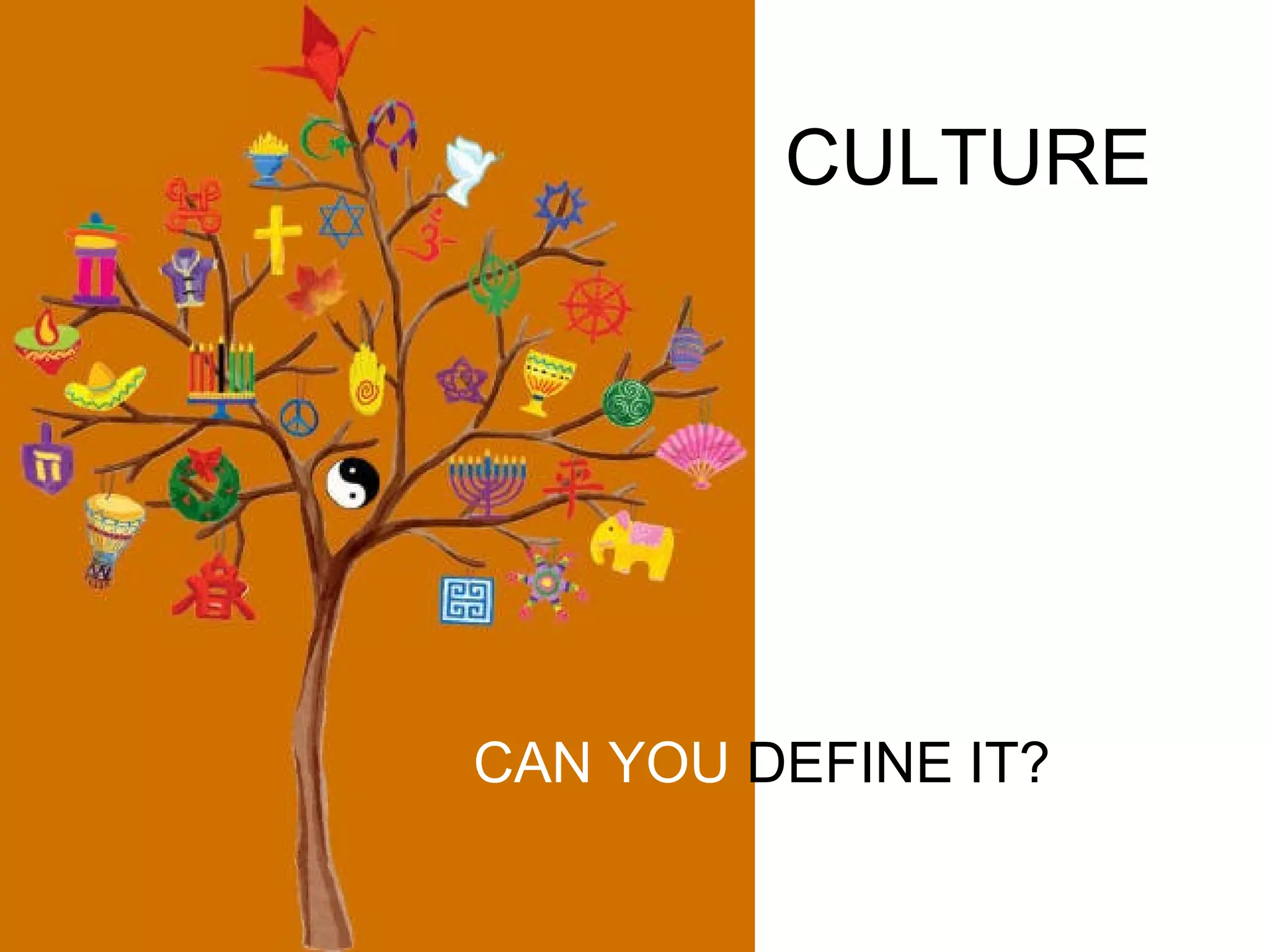
CULTURE


CAN YOU DEFINE IT?
Learning objectives
• Evaluate sociological definitions of culture
• Identify the difference between material
  culture and non-material culture
What are the essential ingredients of a
            society’s culture?
• List the important elements of
  ‘Britishness’
  – Material things (physical objects:cars,
    fashion, food)
  – Non-material things (knowledge, beliefs etc)
• List the important elements of your
  culture
• What are the similarities/differences?
• What do all cultures have in common?
Sharing, teaching and learning
• The things people value and the usual
  way they obey and express these values
  gives us the concept of a culture
• Eg british culture:
  – A belief that we speak a common language
  – A belief in love and the right of the
    individual to choose their partner
  – A belief that murder is wrong and people
    who murder should be punished
Material and Non-material distinction


• When is a house not a house?
 •Physical artefacts have cultural meanings, a house is not
 simply somewhere to live (manifest function)
 •Houses have cultural meanings –It means different things to
 different people which may or may not be obvious (latent
 function)


                    Answer:
                    When it’s a home
Kidd (2002)                        Abbott (1998)
The features of culture            Language is the most obvious
(language, symbols, history,       set of symbols through which
norms and values) influence the    members of society share
way members of society live        meanings
their lives


Marshall (1998)                    Giddens (1997)
Culture is all that in human       No cultures could exists without
society which is socially rather   societies. But equally no
than biologically transmitted      societies could exist without
                                   culture, no one could human at
                                   all
Dahl (2001)
A collectively held set of              Societies develop mechanisms
attributes which is dynamic and         for the transmission of cultural
changing over time                      signs, symbols and meanings
                                        from one generation to the next


Mazrui (1996)                           Jencks (1993)
There are seven functions of culture:   There are four ways to describe
Communication                           culture:
Perception                              1. A state of mind – a ‘quality’
                                        possessed by individuals
Identity
                                        2. Civilization – some cultures are
Value systems                           seen as more civilized than others
Motivation                              3. ‘Collective body of arts and
Stratification                          intellectual work within any society’
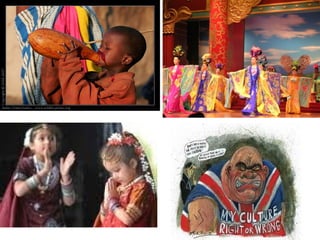
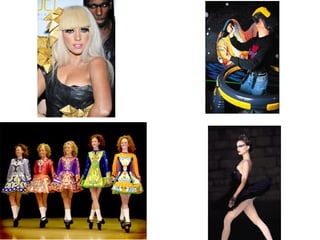
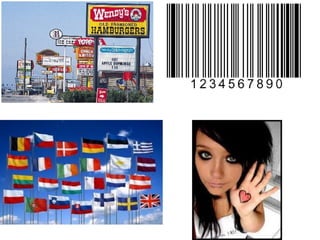
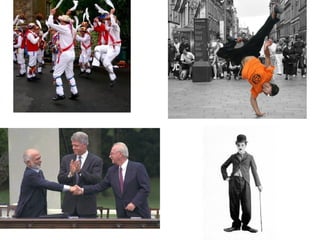
Look at the images how many can you
    recognise the 5 types of culture

 •   Subculture
 •   High culture
 •   Popular culture
 •   Consumer culture
 •   Global culture
•Identify at least 4 characteristics of each type of culture
•Comment on how each type of culture has developed as a response
to the way society is structured
•Create a revision card for each type
TYPE OF CULTURE:

DESCRIPTION


CHARACTERISTICS


Examples
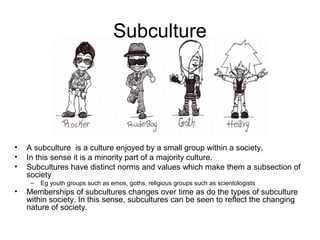
Subculture


•   A subculture is a culture enjoyed by a small group within a society.
•   In this sense it is a minority part of a majority culture.
•   Subcultures have distinct norms and values which make them a subsection of
    society
     –   Eg youth groups such as emos, goths, religious groups such as scientologists
•   Memberships of subcultures changes over time as do the types of subculture
    within society. In this sense, subcultures can be seen to reflect the changing
    nature of society.
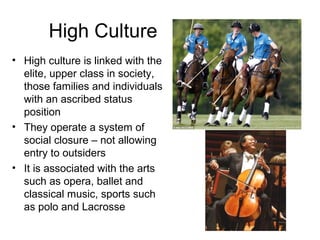
High Culture
• High culture is linked with the
  elite, upper class in society,
  those families and individuals
  with an ascribed status
  position
• They operate a system of
  social closure – not allowing
  entry to outsiders
• It is associated with the arts
  such as opera, ballet and
  classical music, sports such
  as polo and Lacrosse
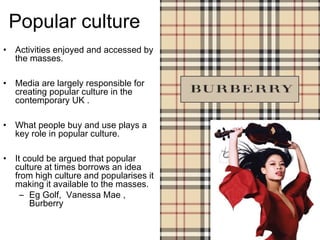
Popular culture
•   Activities enjoyed and accessed by
    the masses.

•   Media are largely responsible for
    creating popular culture in the
    contemporary UK .

•   What people buy and use plays a
    key role in popular culture.

•   It could be argued that popular
    culture at times borrows an idea
    from high culture and popularises it
    making it available to the masses.
      – Eg Golf, Vanessa Mae ,
        Burberry
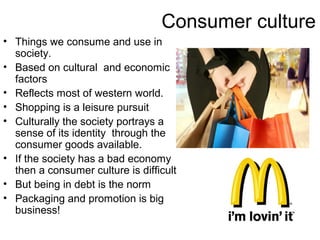
Consumer culture
• Things we consume and use in
  society.
• Based on cultural and economic
  factors
• Reflects most of western world.
• Shopping is a leisure pursuit
• Culturally the society portrays a
  sense of its identity through the
  consumer goods available.
• If the society has a bad economy
  then a consumer culture is difficult
• But being in debt is the norm
• Packaging and promotion is big
  business!
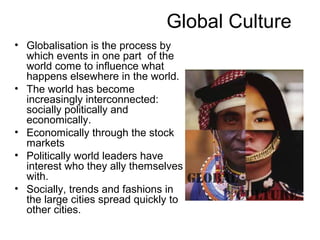
Global Culture
• Globalisation is the process by
  which events in one part of the
  world come to influence what
  happens elsewhere in the world.
• The world has become
  increasingly interconnected:
  socially politically and
  economically.
• Economically through the stock
  markets
• Politically world leaders have
  interest who they ally themselves
  with.
• Socially, trends and fashions in
  the large cities spread quickly to
  other cities.
EXAM FOCUS
• Define culture [3]
• Identify two ways in which material culture
  differs from non-material culture [4]
• Explain what is meant by ‘folk’ culture [2]
• Explain the difference between ‘high’ and
  ‘low’ culture [4]
• Suggest 3 characteristics of the
  globalisation of culture [6]
• Describe the different types of cultures [6]
Characteristics of POPULAR
             CULTURE
• Constantly changing
• Based in large, heterogeneous groups of people
• Based mainly in urban areas
• Material goods mass-produced by machines in factories
• Weaker family structure
• Distinct division of labor with highly specialized
  professions and jobs
• Contributions to the spread of popular culture
      •   Industrialization
      •   Urbanization
      •   Rise of formal education
      •   Resultant increase in leisure time
CHARACTERISTICS OF
        GLOBAL CULTURE
• Increasing connections between various parts of the
  world
• Global availability of cultural products (KFC, McDonalds,
  curry)
• Access to diversity of cultural products (food, music,
  clothing)
• Global media corporations (Sky, Disney, Apple)
• Internet access (WWW, Facebook, twitter)
• Global advertising campaigns (McDonalds, Pepsi, Nike)
• International tourism
Characteristics of SUBCULTURE
• Based around ethnicity, social class or age
• Functionalist perspective
• People select norms and values and lifestyles
Characteristics of MASSCULTURE
• Culture that is produced for mass consumption
• Value laden as information is ‘dumbed down’ superficial
  and bland (goodies and baddies stereotypes)
• Consumers are seen as passive and easily manipulated
• Consumers lack critical judgement of the society in which
  they live
• Ruling class exploit working class as media represent
  capitalist system as normal
• create false needs through advertising at same time make
  profits
Characteristics of HIGH CULTURE

• The tastes or wealthy and educated people (elite)
• The opposite is low culture (mass)
• To understand high culture requires access to a
  particular kind of education
• Ruling class seen more intellectual
• Value laden as agencies of socialisation present
  some cultural products as more ‘worthy’ than
  others
  – Opera or Soap opera?

SociologyExchange.co.uk Shared Resource

  • 1.
  • 2.
    Learning objectives • Evaluatesociological definitions of culture • Identify the difference between material culture and non-material culture
  • 3.
    What are theessential ingredients of a society’s culture? • List the important elements of ‘Britishness’ – Material things (physical objects:cars, fashion, food) – Non-material things (knowledge, beliefs etc) • List the important elements of your culture • What are the similarities/differences? • What do all cultures have in common?
  • 4.
    Sharing, teaching andlearning • The things people value and the usual way they obey and express these values gives us the concept of a culture • Eg british culture: – A belief that we speak a common language – A belief in love and the right of the individual to choose their partner – A belief that murder is wrong and people who murder should be punished
  • 5.
    Material and Non-materialdistinction • When is a house not a house? •Physical artefacts have cultural meanings, a house is not simply somewhere to live (manifest function) •Houses have cultural meanings –It means different things to different people which may or may not be obvious (latent function) Answer: When it’s a home
  • 6.
    Kidd (2002) Abbott (1998) The features of culture Language is the most obvious (language, symbols, history, set of symbols through which norms and values) influence the members of society share way members of society live meanings their lives Marshall (1998) Giddens (1997) Culture is all that in human No cultures could exists without society which is socially rather societies. But equally no than biologically transmitted societies could exist without culture, no one could human at all
  • 7.
    Dahl (2001) A collectivelyheld set of Societies develop mechanisms attributes which is dynamic and for the transmission of cultural changing over time signs, symbols and meanings from one generation to the next Mazrui (1996) Jencks (1993) There are seven functions of culture: There are four ways to describe Communication culture: Perception 1. A state of mind – a ‘quality’ possessed by individuals Identity 2. Civilization – some cultures are Value systems seen as more civilized than others Motivation 3. ‘Collective body of arts and Stratification intellectual work within any society’
  • 15.
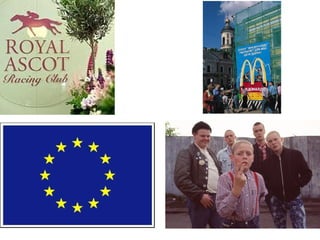
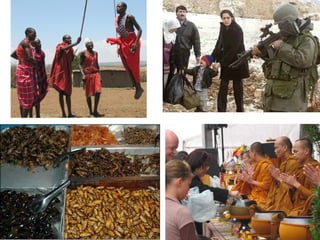
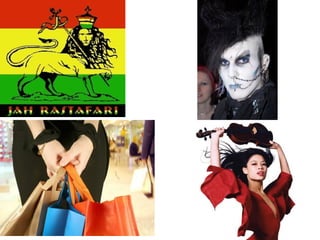
    Look at theimages how many can you recognise the 5 types of culture • Subculture • High culture • Popular culture • Consumer culture • Global culture •Identify at least 4 characteristics of each type of culture •Comment on how each type of culture has developed as a response to the way society is structured •Create a revision card for each type
  • 16.
  • 17.
    Subculture • A subculture is a culture enjoyed by a small group within a society. • In this sense it is a minority part of a majority culture. • Subcultures have distinct norms and values which make them a subsection of society – Eg youth groups such as emos, goths, religious groups such as scientologists • Memberships of subcultures changes over time as do the types of subculture within society. In this sense, subcultures can be seen to reflect the changing nature of society.
  • 18.
    High Culture • Highculture is linked with the elite, upper class in society, those families and individuals with an ascribed status position • They operate a system of social closure – not allowing entry to outsiders • It is associated with the arts such as opera, ballet and classical music, sports such as polo and Lacrosse
  • 19.
    Popular culture • Activities enjoyed and accessed by the masses. • Media are largely responsible for creating popular culture in the contemporary UK . • What people buy and use plays a key role in popular culture. • It could be argued that popular culture at times borrows an idea from high culture and popularises it making it available to the masses. – Eg Golf, Vanessa Mae , Burberry
  • 20.
    Consumer culture • Thingswe consume and use in society. • Based on cultural and economic factors • Reflects most of western world. • Shopping is a leisure pursuit • Culturally the society portrays a sense of its identity through the consumer goods available. • If the society has a bad economy then a consumer culture is difficult • But being in debt is the norm • Packaging and promotion is big business!
  • 21.
    Global Culture • Globalisationis the process by which events in one part of the world come to influence what happens elsewhere in the world. • The world has become increasingly interconnected: socially politically and economically. • Economically through the stock markets • Politically world leaders have interest who they ally themselves with. • Socially, trends and fashions in the large cities spread quickly to other cities.
  • 22.
    EXAM FOCUS • Defineculture [3] • Identify two ways in which material culture differs from non-material culture [4] • Explain what is meant by ‘folk’ culture [2] • Explain the difference between ‘high’ and ‘low’ culture [4] • Suggest 3 characteristics of the globalisation of culture [6] • Describe the different types of cultures [6]
  • 23.
    Characteristics of POPULAR CULTURE • Constantly changing • Based in large, heterogeneous groups of people • Based mainly in urban areas • Material goods mass-produced by machines in factories • Weaker family structure • Distinct division of labor with highly specialized professions and jobs • Contributions to the spread of popular culture • Industrialization • Urbanization • Rise of formal education • Resultant increase in leisure time
  • 24.
    CHARACTERISTICS OF GLOBAL CULTURE • Increasing connections between various parts of the world • Global availability of cultural products (KFC, McDonalds, curry) • Access to diversity of cultural products (food, music, clothing) • Global media corporations (Sky, Disney, Apple) • Internet access (WWW, Facebook, twitter) • Global advertising campaigns (McDonalds, Pepsi, Nike) • International tourism
  • 25.
    Characteristics of SUBCULTURE •Based around ethnicity, social class or age • Functionalist perspective • People select norms and values and lifestyles
  • 26.
    Characteristics of MASSCULTURE •Culture that is produced for mass consumption • Value laden as information is ‘dumbed down’ superficial and bland (goodies and baddies stereotypes) • Consumers are seen as passive and easily manipulated • Consumers lack critical judgement of the society in which they live • Ruling class exploit working class as media represent capitalist system as normal • create false needs through advertising at same time make profits
  • 27.
    Characteristics of HIGHCULTURE • The tastes or wealthy and educated people (elite) • The opposite is low culture (mass) • To understand high culture requires access to a particular kind of education • Ruling class seen more intellectual • Value laden as agencies of socialisation present some cultural products as more ‘worthy’ than others – Opera or Soap opera?