reflect our beliefs and values, and shape
  our actions and our identities


Stereotypes
Standardized    conception or image of a specific
 group of people or objects
Held   in common by members of a group
Direct   expression of beliefs and values


Stereotypes
Standardized    conception or image of a specific
 group of people or objects
Held   in common by members of a group
Direct   expression of beliefs and values


Stereotypes
Creating “categories”
Countertypes
Source for conventional characters
 (character-types) in popular stories


Uses of Stereotypes
Negative stereotypes can be associated
 with negative actions
Tendency to use internalize stereotypes
 as models for behavior


Dangers of Stereotypes
Simple (and “simplify our experiences”)
Acquired second-hand
Questions of Accuracy
Resistant to change


Characteristics of Stereotypes
Masculinity is made, not given
Pop culture images of manhood “reflect”
 masculinity
  ◦ What does it mean to be a “real man” in US society?
Pop   culture is primary “teaching” force (“shapes”)
  ◦ Connect manhood to dominance, violence, control
Pop   culture equates masculinity w/ violence
  ◦ Not “deviant”, but “accepted part of masculinity”


“Tough Guise”                 -J. Katz
Negative  stereotypes can be associated
 with ugly and negative actions
Tendency to use internalize stereotypes
 as models for behavior


Dangers of Stereotypes
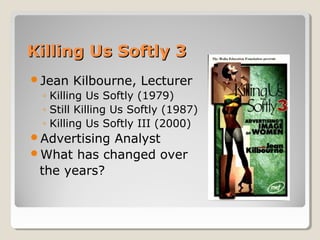
Killing Us Softly 3
Jean   Kilbourne, Lecturer
 ◦ Killing Us Softly (1979)
 ◦ Still Killing Us Softly (1987)
 ◦ Killing Us Softly III (2000)
AdvertisingAnalyst
What has changed over
 the years?
Popular culture (especially advertising)
 both shapes and reflects fictions about
 women’s desires and identities
  ◦ Physical perfection equals value in our society
  ◦ “self-objectification”


“Killing Us Softly, III”               - J.
Kilbourne
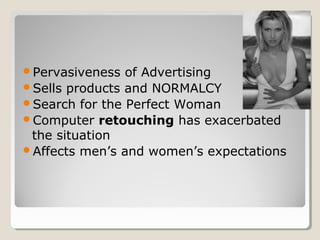
Pervasiveness  of Advertising
Sells products and NORMALCY
Search for the Perfect Woman
Computer retouching has exacerbated
 the situation
Affects men’s and women’s expectations
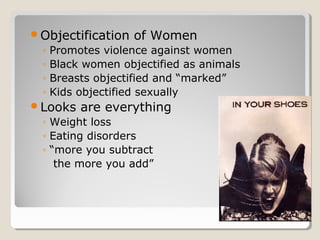
Objectification    of Women
 ◦   Promotes violence against women
 ◦   Black women objectified as animals
 ◦   Breasts objectified and “marked”
 ◦   Kids objectified sexually
Looks    are everything
 ◦ Weight loss
 ◦ Eating disorders
 ◦ “more you subtract
    the more you add”
Perfect   women are portrayed as
 ◦   Silent (hands over mouth)
 ◦   Vulnerable
 ◦   Innocent
 ◦   Passive
 ◦   Powerless


Power politics
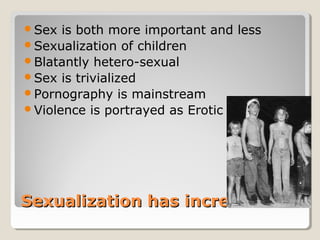
Sex  is both more important and less
Sexualization of children
Blatantly hetero-sexual
Sex is trivialized
Pornography is mainstream
Violence is portrayed as Erotic


Sexualization has increased
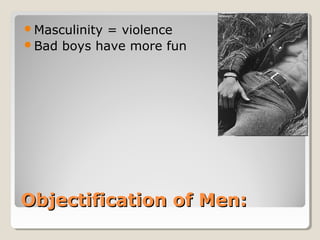
Masculinity= violence
Bad boys have more fun


Objectification of Men:
We  should become citizens
     rather than consumers


Citizens or Consumers
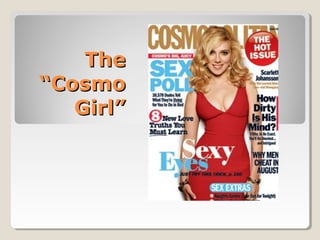
The
“Cosmo
   Girl”
Ethnic Notions           – M. Riggs (1987)

“…no  other group …
 has been linked so
 consistently with
 stereotyped
 presentation in the
 popular arts…than
 African-Americans.”
 (Geist & Nelson, 262)

Stereotypes  have
 fueled anti-black
 prejudice
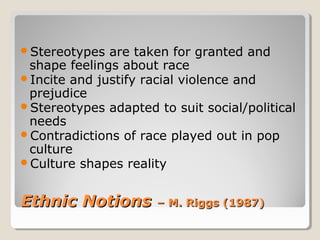
Stereotypes  are taken for granted and
 shape feelings about race
Incite and justify racial violence and
 prejudice
Stereotypes adapted to suit social/political
 needs
Contradictions of race played out in pop
 culture
Culture shapes reality


Ethnic Notions        – M. Riggs (1987)
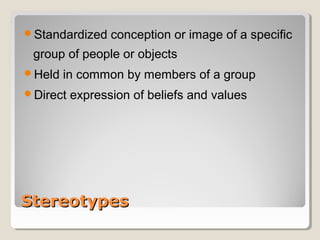
Standardized    conception or image of a specific
 group of people or objects
Held   in common by members of a group
Direct   expression of beliefs and values


Stereotypes
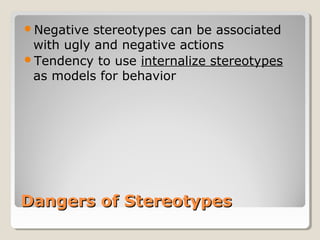
Negative  stereotypes can be associated
 with ugly and negative actions
Tendency to use internalize stereotypes
 as models for behavior


Dangers of Stereotypes

Stereotypes

  • 1.
    reflect our beliefsand values, and shape our actions and our identities Stereotypes
  • 2.
    Standardized conception or image of a specific group of people or objects Held in common by members of a group Direct expression of beliefs and values Stereotypes
  • 3.
    Standardized conception or image of a specific group of people or objects Held in common by members of a group Direct expression of beliefs and values Stereotypes
  • 4.
    Creating “categories” Countertypes Source forconventional characters (character-types) in popular stories Uses of Stereotypes
  • 5.
    Negative stereotypes canbe associated with negative actions Tendency to use internalize stereotypes as models for behavior Dangers of Stereotypes
  • 6.
    Simple (and “simplifyour experiences”) Acquired second-hand Questions of Accuracy Resistant to change Characteristics of Stereotypes
  • 7.
    Masculinity is made,not given Pop culture images of manhood “reflect” masculinity ◦ What does it mean to be a “real man” in US society? Pop culture is primary “teaching” force (“shapes”) ◦ Connect manhood to dominance, violence, control Pop culture equates masculinity w/ violence ◦ Not “deviant”, but “accepted part of masculinity” “Tough Guise” -J. Katz
  • 12.
    Negative stereotypescan be associated with ugly and negative actions Tendency to use internalize stereotypes as models for behavior Dangers of Stereotypes
  • 16.
    Killing Us Softly3 Jean Kilbourne, Lecturer ◦ Killing Us Softly (1979) ◦ Still Killing Us Softly (1987) ◦ Killing Us Softly III (2000) AdvertisingAnalyst What has changed over the years?
  • 17.
    Popular culture (especiallyadvertising) both shapes and reflects fictions about women’s desires and identities ◦ Physical perfection equals value in our society ◦ “self-objectification” “Killing Us Softly, III” - J. Kilbourne
  • 18.
    Pervasiveness ofAdvertising Sells products and NORMALCY Search for the Perfect Woman Computer retouching has exacerbated the situation Affects men’s and women’s expectations
  • 19.
    Objectification of Women ◦ Promotes violence against women ◦ Black women objectified as animals ◦ Breasts objectified and “marked” ◦ Kids objectified sexually Looks are everything ◦ Weight loss ◦ Eating disorders ◦ “more you subtract the more you add”
  • 20.
    Perfect women are portrayed as ◦ Silent (hands over mouth) ◦ Vulnerable ◦ Innocent ◦ Passive ◦ Powerless Power politics
  • 21.
    Sex isboth more important and less Sexualization of children Blatantly hetero-sexual Sex is trivialized Pornography is mainstream Violence is portrayed as Erotic Sexualization has increased
  • 22.
    Masculinity= violence Bad boyshave more fun Objectification of Men:
  • 23.
    We shouldbecome citizens rather than consumers Citizens or Consumers
  • 24.
  • 25.
    Ethnic Notions – M. Riggs (1987) “…no other group … has been linked so consistently with stereotyped presentation in the popular arts…than African-Americans.” (Geist & Nelson, 262) Stereotypes have fueled anti-black prejudice
  • 26.
    Stereotypes aretaken for granted and shape feelings about race Incite and justify racial violence and prejudice Stereotypes adapted to suit social/political needs Contradictions of race played out in pop culture Culture shapes reality Ethnic Notions – M. Riggs (1987)
  • 27.
    Standardized conception or image of a specific group of people or objects Held in common by members of a group Direct expression of beliefs and values Stereotypes
  • 28.
    Negative stereotypescan be associated with ugly and negative actions Tendency to use internalize stereotypes as models for behavior Dangers of Stereotypes