The Land and the Tribe of Brave
Inhabiting the rugged terrain of the
Cordillera Region of Northern
Philippines there are six ethno-
linguistic tribes known as the Ibaloy,
Kankana-ey, Ifugao, Kalinga,
Apayao/Isneg, and the Bontoc. They
are referred to by a generic term,
Igorot, a word coined from the root
word, “golot” meaning mountain.
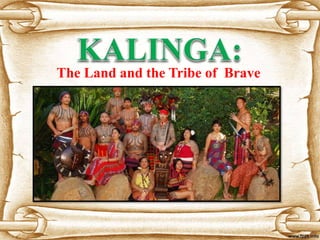
The Kalingas are the
indigenous peoples of
Kalinga, Philippines. They
are generally known to be
tall, dark-complexioned, and
lissome with high bridsed
noses. Physically they are
very sturdy and well-built so
that their war-like
characteristics make them
more like soldiers.
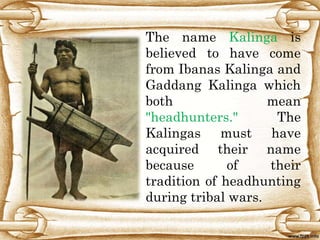
The name Kalinga is
believed to have come
from Ibanas Kalinga and
Gaddang Kalinga which
both mean
"headhunters." The
Kalingas must have
acquired their name
because of their
tradition of headhunting
during tribal wars.
 Tribal wars occur when a
bodong peace pact system was
broken or violated.
 The bodong is the most
admirable and efficient
Kalinga institution. It is a
peace pact or treaty between
two tribes, wherein the Pagta
or laws on inter-tribal
relations are made.
 The bodong is also the Magna
Carta of the Kalingas.
According to the National
Commission on Culture and the
Arts, there are 31 sub-tribes of
the Kalinga ethnolinguistic
group. They are live in Kalinga
province's eight towns.
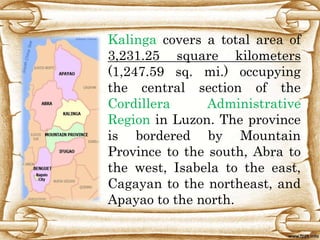
Kalinga covers a total area of
3,231.25 square kilometers
(1,247.59 sq. mi.) occupying
the central section of the
Cordillera Administrative
Region in Luzon. The province
is bordered by Mountain
Province to the south, Abra to
the west, Isabela to the east,
Cagayan to the northeast, and
Apayao to the north.
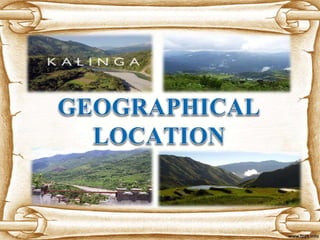
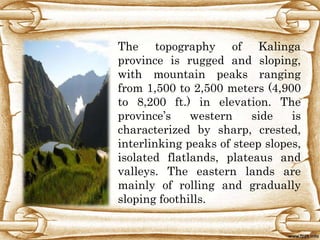
The topography of Kalinga
province is rugged and sloping,
with mountain peaks ranging
from 1,500 to 2,500 meters (4,900
to 8,200 ft.) in elevation. The
province’s western side is
characterized by sharp, crested,
interlinking peaks of steep slopes,
isolated flatlands, plateaus and
valleys. The eastern lands are
mainly of rolling and gradually
sloping foothills.
Large swaths of the province's
lowlands are open grassland
suitable for pasture, while the
highlands have extensive areas of
tropical rainforest. In higher
elevations to the west, particularly
in the mountains of Balbalan, lie
some of the most intact pine forests
of Luzon island. Biggest rice
production are the mountainous
area of the rice terraces of
Balbalan, Lubuagan, Pasil,
Pinukpuk, Tinglayan, and
Tanudan.
CLIMATE
The province experiences an average
temperature ranging from 17 to 22 °C
(63 to 72 °F) with Type 3 weather
patterns. The dry season extends from
November to April, while the rest of
the year is considered the rainy
season, the heaviest rains usually
occurring from July to October.
HYDROLOGY
The province is drained mainly
by the Chico River, with its
headwaters in the Mountain
Province and emptying into the
Cagayan River. The Chico River
has several tributaries: Bunog
River in Tinglayan in the south;
the Tanudan and Biga Rivers in
the east; Pasil River in the
central area; and Poswoy, Dao-
angan, Mabaca and Saltan
Rivers in the west.
ADMINISTRATIVE DIVISIONS
Kalinga comprises one city and
seven municipalities, all encompassed by
a single legislative district.
Tabuk was proclaimed a component city in
2007, but in November 2008 the Supreme
Court of the Philippines ruled that its cityhood
was unconstitutional. However, Tabuk had its
city status reinstated by the Supreme Court
on December 22, 2009.
•
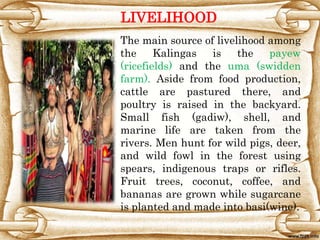
The main source of livelihood among
the Kalingas is the payew
(ricefields) and the uma (swidden
farm). Aside from food production,
cattle are pastured there, and
poultry is raised in the backyard.
Small fish (gadiw), shell, and
marine life are taken from the
rivers. Men hunt for wild pigs, deer,
and wild fowl in the forest using
spears, indigenous traps or rifles.
Fruit trees, coconut, coffee, and
bananas are grown while sugarcane
is planted and made into basi(wine).
LIVELIHOOD
The Kalinga household consists of a nuclear
family and an aged grandparent for they
show great respect for elders.
The Kalinga society may be stratified into
lawa or kapus (poor) and the baknang
(wealthy). Among the signs of prestige and
wealth are possessions of several ricefields,
working animals, heirlooms like china plates
and jars, agate head/necklaces, and brass
gongs.
FAMILY
The identification of self with
the kinship circle could be
such that whatever an
individual does is the
responsibility of the group,
and whatever threatens the
security of the group must be
opposed by the individual.
Kalinga women are strong
and would kill their husbands
if caught cheating.
FAMILY
Animist rituals with
Christian worship.
Religious beliefs generally
nature-related, and they
make proprietary offerings to
“anitos” (spirits) as well as to
household gods.
RELIGION
Kalingas are also known as Limos or
Limos-Liwan Kalinga.
The speak the Kalinga and Limos
languages.
KALINGA - TAGALOG
* ampiya - masarap
* laweng - pangit
* gona ogom - nasaan ka
* awadak sina - nandito ako
LANGUAGE
The male Kalinga
native costume is very
simple. It consists of a
woven, long rectangular
cloth which could be
used to cover the male
private organ. There are
no upper clothing.
Feathers could be worn
as a head dress.
CLOTHING
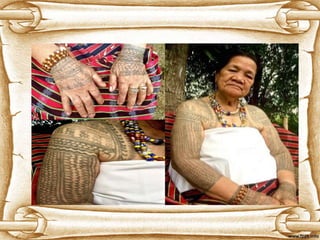
In the olden days,
tattoos were worn by
proud warriors. The
more tattoo a male had,
the more prized heads,
he had cut off. It is a
proud symbol of
bravery and courage, in
the olden times.
BABAI: TAPIS
LALAKI: "BAHAG" or G-string
BONGOL = necklace made of beads.
THE EXTINCTION OF
ETHNIC EXPERTISE
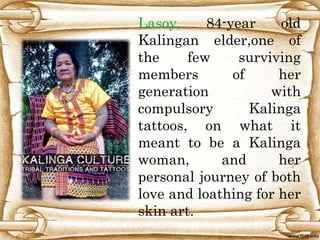
Lasoy, 84-year old
Kalingan elder,one of
the few surviving
members of her
generation with
compulsory Kalinga
tattoos, on what it
meant to be a Kalinga
woman, and her
personal journey of both
love and loathing for her
skin art.
REASONS OF TATTOOS
CUTURE
• As a symbol of their strength, coming of
age and beauty.
• Special privileges and lifelong respect.
• Specific motifs are saved only for men in
order to communicate their bravery,
battles won and how many people they
have killed.
TATTOO TECHNIQUE &
MAMBABATOK MEANINGS
• The tattoo tools themselves are made from a
instrument constructed in bamboo and razor
sharp lemon thorns. The design is marked
onto the skin using long strips of straight
grass, dipped in simple a mixture of charcoal
and water. Then thorn tip is submerged in the
charcoal solution before rigorously hand
tapping the piercing point into the design on
the skin.
Apo Whang-Od, world renowned
Apo and the last practicing
traditional Mambabatok in the
whole region. At 92 years old,
time is running out for her to
pass on the time honored hand
tapping technique and tribal
motifs to her 13 year old grand
daughter and apprentice.
Tourists are currently flocking to
Buscalan village to have the last
living legend of Philippine
artistry scar their skin.
Sukran
Kamayo Ubus!
Madyaw na
Maserum.

Kalinga

  • 1.
    The Land andthe Tribe of Brave
  • 2.
    Inhabiting the ruggedterrain of the Cordillera Region of Northern Philippines there are six ethno- linguistic tribes known as the Ibaloy, Kankana-ey, Ifugao, Kalinga, Apayao/Isneg, and the Bontoc. They are referred to by a generic term, Igorot, a word coined from the root word, “golot” meaning mountain.
  • 3.
    The Kalingas arethe indigenous peoples of Kalinga, Philippines. They are generally known to be tall, dark-complexioned, and lissome with high bridsed noses. Physically they are very sturdy and well-built so that their war-like characteristics make them more like soldiers.
  • 4.
    The name Kalingais believed to have come from Ibanas Kalinga and Gaddang Kalinga which both mean "headhunters." The Kalingas must have acquired their name because of their tradition of headhunting during tribal wars.
  • 5.
     Tribal warsoccur when a bodong peace pact system was broken or violated.  The bodong is the most admirable and efficient Kalinga institution. It is a peace pact or treaty between two tribes, wherein the Pagta or laws on inter-tribal relations are made.  The bodong is also the Magna Carta of the Kalingas.
  • 6.
    According to theNational Commission on Culture and the Arts, there are 31 sub-tribes of the Kalinga ethnolinguistic group. They are live in Kalinga province's eight towns.
  • 8.
    Kalinga covers atotal area of 3,231.25 square kilometers (1,247.59 sq. mi.) occupying the central section of the Cordillera Administrative Region in Luzon. The province is bordered by Mountain Province to the south, Abra to the west, Isabela to the east, Cagayan to the northeast, and Apayao to the north.
  • 9.
    The topography ofKalinga province is rugged and sloping, with mountain peaks ranging from 1,500 to 2,500 meters (4,900 to 8,200 ft.) in elevation. The province’s western side is characterized by sharp, crested, interlinking peaks of steep slopes, isolated flatlands, plateaus and valleys. The eastern lands are mainly of rolling and gradually sloping foothills.
  • 10.
    Large swaths ofthe province's lowlands are open grassland suitable for pasture, while the highlands have extensive areas of tropical rainforest. In higher elevations to the west, particularly in the mountains of Balbalan, lie some of the most intact pine forests of Luzon island. Biggest rice production are the mountainous area of the rice terraces of Balbalan, Lubuagan, Pasil, Pinukpuk, Tinglayan, and Tanudan.
  • 11.
    CLIMATE The province experiencesan average temperature ranging from 17 to 22 °C (63 to 72 °F) with Type 3 weather patterns. The dry season extends from November to April, while the rest of the year is considered the rainy season, the heaviest rains usually occurring from July to October.
  • 12.
    HYDROLOGY The province isdrained mainly by the Chico River, with its headwaters in the Mountain Province and emptying into the Cagayan River. The Chico River has several tributaries: Bunog River in Tinglayan in the south; the Tanudan and Biga Rivers in the east; Pasil River in the central area; and Poswoy, Dao- angan, Mabaca and Saltan Rivers in the west.
  • 13.
    ADMINISTRATIVE DIVISIONS Kalinga comprisesone city and seven municipalities, all encompassed by a single legislative district. Tabuk was proclaimed a component city in 2007, but in November 2008 the Supreme Court of the Philippines ruled that its cityhood was unconstitutional. However, Tabuk had its city status reinstated by the Supreme Court on December 22, 2009. •
  • 15.
    The main sourceof livelihood among the Kalingas is the payew (ricefields) and the uma (swidden farm). Aside from food production, cattle are pastured there, and poultry is raised in the backyard. Small fish (gadiw), shell, and marine life are taken from the rivers. Men hunt for wild pigs, deer, and wild fowl in the forest using spears, indigenous traps or rifles. Fruit trees, coconut, coffee, and bananas are grown while sugarcane is planted and made into basi(wine). LIVELIHOOD
  • 16.
    The Kalinga householdconsists of a nuclear family and an aged grandparent for they show great respect for elders. The Kalinga society may be stratified into lawa or kapus (poor) and the baknang (wealthy). Among the signs of prestige and wealth are possessions of several ricefields, working animals, heirlooms like china plates and jars, agate head/necklaces, and brass gongs. FAMILY
  • 17.
    The identification ofself with the kinship circle could be such that whatever an individual does is the responsibility of the group, and whatever threatens the security of the group must be opposed by the individual. Kalinga women are strong and would kill their husbands if caught cheating. FAMILY
  • 18.
    Animist rituals with Christianworship. Religious beliefs generally nature-related, and they make proprietary offerings to “anitos” (spirits) as well as to household gods. RELIGION
  • 19.
    Kalingas are alsoknown as Limos or Limos-Liwan Kalinga. The speak the Kalinga and Limos languages. KALINGA - TAGALOG * ampiya - masarap * laweng - pangit * gona ogom - nasaan ka * awadak sina - nandito ako LANGUAGE
  • 20.
    The male Kalinga nativecostume is very simple. It consists of a woven, long rectangular cloth which could be used to cover the male private organ. There are no upper clothing. Feathers could be worn as a head dress. CLOTHING
  • 21.
    In the oldendays, tattoos were worn by proud warriors. The more tattoo a male had, the more prized heads, he had cut off. It is a proud symbol of bravery and courage, in the olden times.
  • 22.
    BABAI: TAPIS LALAKI: "BAHAG"or G-string BONGOL = necklace made of beads.
  • 23.
  • 25.
    Lasoy, 84-year old Kalinganelder,one of the few surviving members of her generation with compulsory Kalinga tattoos, on what it meant to be a Kalinga woman, and her personal journey of both love and loathing for her skin art.
  • 26.
    REASONS OF TATTOOS CUTURE •As a symbol of their strength, coming of age and beauty. • Special privileges and lifelong respect. • Specific motifs are saved only for men in order to communicate their bravery, battles won and how many people they have killed.
  • 27.
    TATTOO TECHNIQUE & MAMBABATOKMEANINGS • The tattoo tools themselves are made from a instrument constructed in bamboo and razor sharp lemon thorns. The design is marked onto the skin using long strips of straight grass, dipped in simple a mixture of charcoal and water. Then thorn tip is submerged in the charcoal solution before rigorously hand tapping the piercing point into the design on the skin.
  • 28.
    Apo Whang-Od, worldrenowned Apo and the last practicing traditional Mambabatok in the whole region. At 92 years old, time is running out for her to pass on the time honored hand tapping technique and tribal motifs to her 13 year old grand daughter and apprentice. Tourists are currently flocking to Buscalan village to have the last living legend of Philippine artistry scar their skin.
  • 29.

Editor's Notes

  • #16 Other economic activities among Kalingas are cloth and basket-weaving, blacksmith, and pottery.