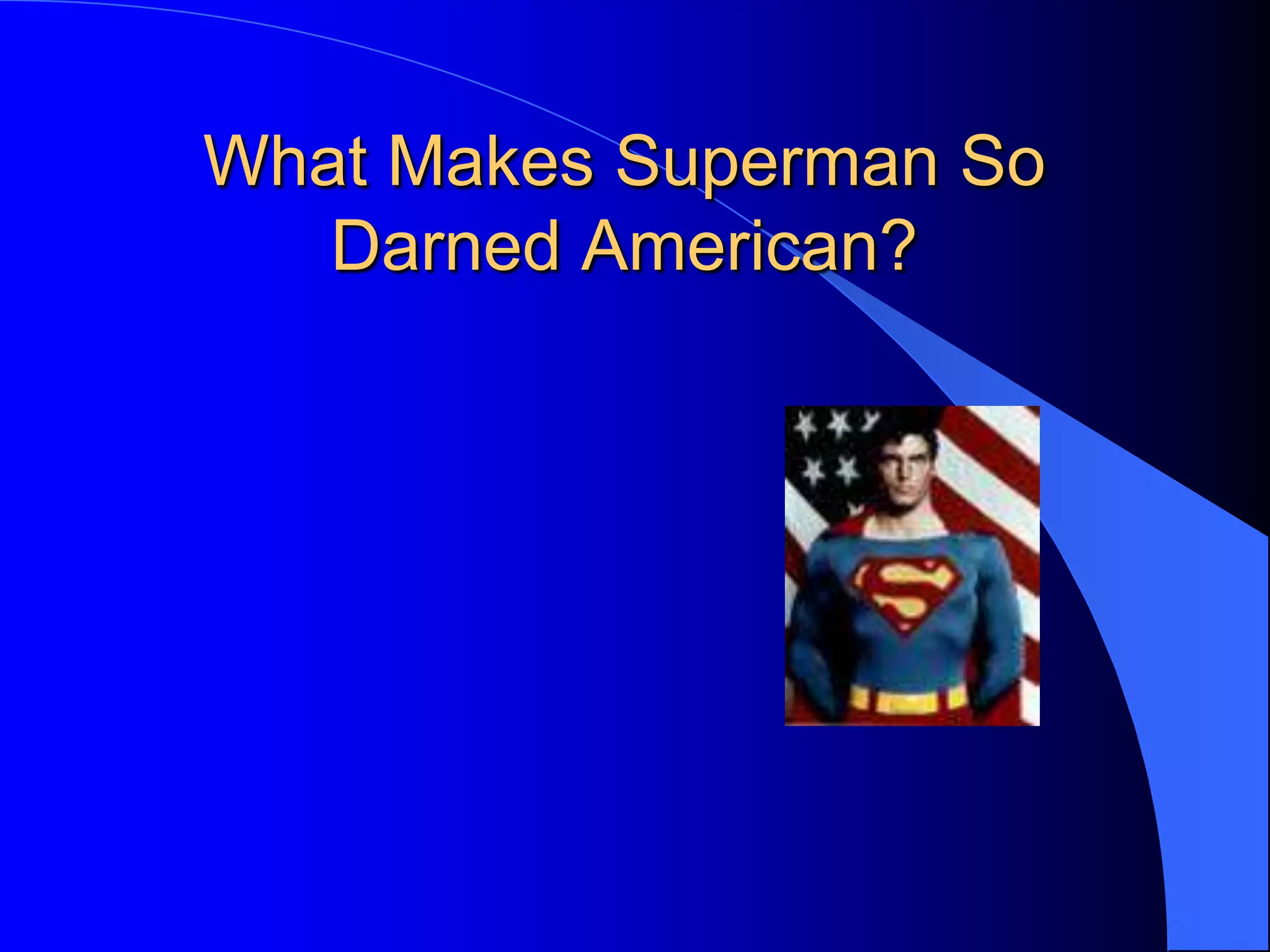
What Makes Superman So
   Darned American?
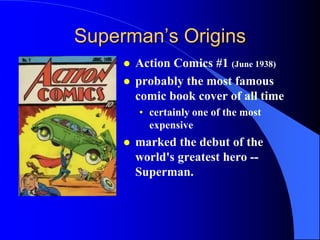
Superman’s Origins
        Action Comics #1 (June 1938)
        probably the most famous
         comic book cover of all time
         • certainly one of the most
           expensive
        marked the debut of the
         world's greatest hero --
         Superman.
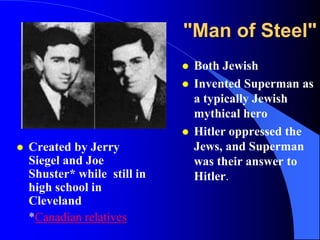
"Man of Steel"
                                 Both Jewish
                                 Invented Superman as
                                  a typically Jewish
                                  mythical hero
                                 Hitler oppressed the
   Created by Jerry              Jews, and Superman
    Siegel and Joe                was their answer to
    Shuster* while still in       Hitler.
    high school in
    Cleveland
    *Canadian relatives
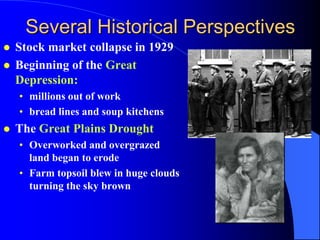
Several Historical Perspectives
   Stock market collapse in 1929
   Beginning of the Great
    Depression:
    • millions out of work
    • bread lines and soup kitchens
   The Great Plains Drought
    • Overworked and overgrazed
      land began to erode
    • Farm topsoil blew in huge clouds
      turning the sky brown
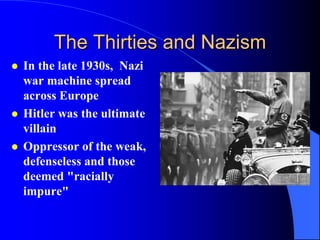
The Thirties and Nazism
   In the late 1930s, Nazi
    war machine spread
    across Europe
   Hitler was the ultimate
    villain
   Oppressor of the weak,
    defenseless and those
    deemed "racially
    impure"
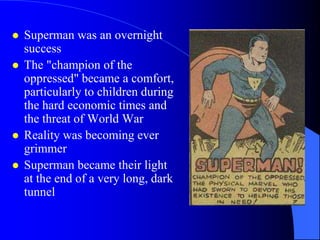
   Superman was an overnight
    success
   The "champion of the
    oppressed" became a comfort,
    particularly to children during
    the hard economic times and
    the threat of World War
   Reality was becoming ever
    grimmer
   Superman became their light
    at the end of a very long, dark
    tunnel
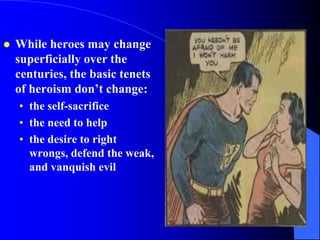
   While heroes may change
    superficially over the
    centuries, the basic tenets
    of heroism don’t change:
    • the self-sacrifice
    • the need to help
    • the desire to right
      wrongs, defend the weak,
      and vanquish evil
What Makes Superman so
      Darned American?
 “Superman is the American hero”
      (Gary Engle 333/739).
 Superman achieves truly mythic stature by
  interweaving
    • a pattern of beliefs
    • literary conventions
    • cultural traditions
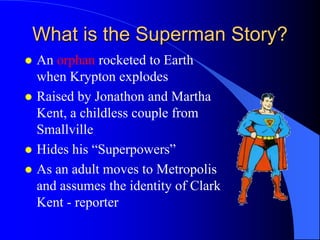
What is the Superman Story?
   An orphan rocketed to Earth
    when Krypton explodes
   Raised by Jonathon and Martha
    Kent, a childless couple from
    Smallville
   Hides his “Superpowers”
   As an adult moves to Metropolis
    and assumes the identity of Clark
    Kent - reporter
The Eternal Triangle

While defending America/World/Universe
  from Evil
 As Clark Kent he hopelessly pursues Lois
  Lane
 Lois hopelessly pursues Superman
 Lois must prove herself worthy of
  Superman by falling in love with Clark
1. Superman is an Orphan
   Emphasizes themes of Dislocation, Mobility and
    Displacement
    • USA is an orphan separated from parent countries.
      Alone: Superman & the World
    • USA‟s social consciousness imbed the imagery of
      passage form one identity to another: Mayflower
    • Past is left behind: Must constantly move
   Superman reinvents himself for the future
    • “This makes the orphan a potent symbol of the American character.
      Orphans aren‟t merely free to reinvent themselves. They are obliged
      to do so” (337/741)
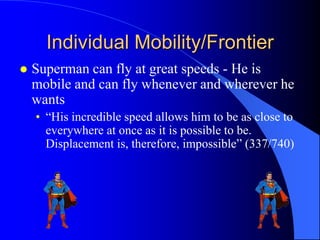
Individual Mobility/Frontier
   Superman can fly at great speeds - He is
    mobile and can fly whenever and wherever he
    wants
    • “His incredible speed allows him to be as close to
      everywhere at once as it is possible to be.
      Displacement is, therefore, impossible” (337/740)
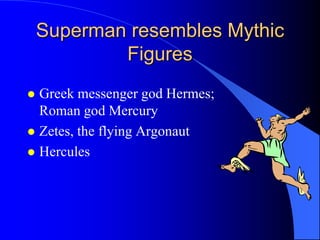
Superman resembles Mythic
            Figures
 Greek messenger god Hermes;
  Roman god Mercury
 Zetes, the flying Argonaut
 Hercules
2. Superman is an Immigrant
   Superman is an alien in a new land
    • underneath Clark‟s all American exterior he is
      always Superman: very visible minority
    • Superman undresses unlike other superheroes
      who don their costumes – e.g. Batman
    • “Superman‟s powers - strength, mobility, x-ray
      vision and the like are the comic-book
      equivalents of ethnic characteristics” (334/739)
The Immigrant Dilemma
   Clinging to Old World identity meant
    •   isolation in ghettos
    •   confrontation with a prejudiced mainstream culture
    •   second-class social status
    •   impoverishment
   Assimilation into the New World meant
    • loss of culture, language, tradition, soul
    • struggle for identity: drowning in the melting pot
   Generational rift
The Immigrant Dilemma mirrors
       the Western Myth
 Civilization vs Wilderness
 “The Mythic frontier represented an attempt
  to embody the perfect degree of
  assimilation in which both the old and new
  identities came together” (339/742)
 Lone Ranger and Tonto
3. Dual Identity solves the
                dilemma
   Engle: „Kent‟ makes the myth work
    (342/744)
   Improvement on Western Myth:
    • “optimistic myth of assimilation, but with an
      urban, technocratic setting”
   Disguise is a moral act to protect parents
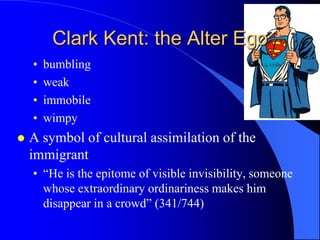
Clark Kent: the Alter Ego
    •   bumbling
    •   weak
    •   immobile
    •   wimpy
   A symbol of cultural assimilation of the
    immigrant
    • “He is the epitome of visible invisibility, someone
      whose extraordinary ordinariness makes him
      disappear in a crowd” (341/744)
Duality
   SUPERMAN                    CLARK KENT
   Real Identity               Illusion; unreal
   Unique, powerful            Assimilated; weak
   Above society and           Blended into society
    culture                      and culture
   Represents heroic past      Represents everyman
    and gods                     and the present
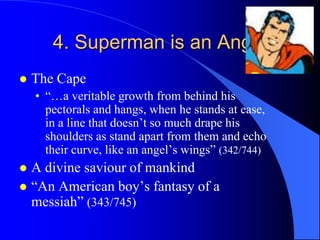
4. Superman is an Angel
   The Cape
    • “…a veritable growth from behind his
      pectorals and hangs, when he stands at ease,
      in a line that doesn‟t so much drape his
      shoulders as stand apart from them and echo
      their curve, like an angel‟s wings” (342/744)
 A divine saviour of mankind
 “An American boy‟s fantasy of a
  messiah” (343/745)
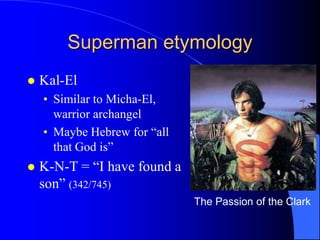
Superman etymology
   Kal-El
    • Similar to Micha-El,
      warrior archangel
    • Maybe Hebrew for “all
      that God is”
   K-N-T = “I have found a
    son” (342/745)
                              The Passion of the Clark
5. Superman is a religious
              myth
 An ET from heaven to supply a gap in
  American mythology/iconography
 “America has no national religious icons
  nor any pilgrimage shrines” (343/745)

   Do you agree or disagree with this
    statement?
Engle’s 5 Points
1.   Being orphaned, Superman taps into the
     Western‟s mythology of dislocation,
     constant moving, and re-identification
2.   Being an immigrant/alien, Superman
     represents the American dichotomy: fitting
     in or standing apart
Engle’s 5 Points
3.   His dual identity resolves the
     assimilation/ isolation dilemma: he‟s a
     righteous wolf in cheap clothing
4.   Superman is an angel: his powers are
     heaven sent
5.   The Superman myth is religious–
     especially Judeo-Christian–at its core

Sman new

  • 1.
    What Makes SupermanSo Darned American?
  • 2.
    Superman’s Origins  Action Comics #1 (June 1938)  probably the most famous comic book cover of all time • certainly one of the most expensive  marked the debut of the world's greatest hero -- Superman.
  • 3.
    "Man of Steel"  Both Jewish  Invented Superman as a typically Jewish mythical hero  Hitler oppressed the  Created by Jerry Jews, and Superman Siegel and Joe was their answer to Shuster* while still in Hitler. high school in Cleveland *Canadian relatives
  • 4.
    Several Historical Perspectives  Stock market collapse in 1929  Beginning of the Great Depression: • millions out of work • bread lines and soup kitchens  The Great Plains Drought • Overworked and overgrazed land began to erode • Farm topsoil blew in huge clouds turning the sky brown
  • 5.
    The Thirties andNazism  In the late 1930s, Nazi war machine spread across Europe  Hitler was the ultimate villain  Oppressor of the weak, defenseless and those deemed "racially impure"
  • 6.
    Superman was an overnight success  The "champion of the oppressed" became a comfort, particularly to children during the hard economic times and the threat of World War  Reality was becoming ever grimmer  Superman became their light at the end of a very long, dark tunnel
  • 7.
    While heroes may change superficially over the centuries, the basic tenets of heroism don’t change: • the self-sacrifice • the need to help • the desire to right wrongs, defend the weak, and vanquish evil
  • 8.
    What Makes Supermanso Darned American?  “Superman is the American hero” (Gary Engle 333/739).  Superman achieves truly mythic stature by interweaving • a pattern of beliefs • literary conventions • cultural traditions
  • 9.
    What is theSuperman Story?  An orphan rocketed to Earth when Krypton explodes  Raised by Jonathon and Martha Kent, a childless couple from Smallville  Hides his “Superpowers”  As an adult moves to Metropolis and assumes the identity of Clark Kent - reporter
  • 10.
    The Eternal Triangle Whiledefending America/World/Universe from Evil  As Clark Kent he hopelessly pursues Lois Lane  Lois hopelessly pursues Superman  Lois must prove herself worthy of Superman by falling in love with Clark
  • 11.
    1. Superman isan Orphan  Emphasizes themes of Dislocation, Mobility and Displacement • USA is an orphan separated from parent countries. Alone: Superman & the World • USA‟s social consciousness imbed the imagery of passage form one identity to another: Mayflower • Past is left behind: Must constantly move  Superman reinvents himself for the future • “This makes the orphan a potent symbol of the American character. Orphans aren‟t merely free to reinvent themselves. They are obliged to do so” (337/741)
  • 12.
    Individual Mobility/Frontier  Superman can fly at great speeds - He is mobile and can fly whenever and wherever he wants • “His incredible speed allows him to be as close to everywhere at once as it is possible to be. Displacement is, therefore, impossible” (337/740)
  • 13.
    Superman resembles Mythic Figures  Greek messenger god Hermes; Roman god Mercury  Zetes, the flying Argonaut  Hercules
  • 14.
    2. Superman isan Immigrant  Superman is an alien in a new land • underneath Clark‟s all American exterior he is always Superman: very visible minority • Superman undresses unlike other superheroes who don their costumes – e.g. Batman • “Superman‟s powers - strength, mobility, x-ray vision and the like are the comic-book equivalents of ethnic characteristics” (334/739)
  • 15.
    The Immigrant Dilemma  Clinging to Old World identity meant • isolation in ghettos • confrontation with a prejudiced mainstream culture • second-class social status • impoverishment  Assimilation into the New World meant • loss of culture, language, tradition, soul • struggle for identity: drowning in the melting pot  Generational rift
  • 16.
    The Immigrant Dilemmamirrors the Western Myth  Civilization vs Wilderness  “The Mythic frontier represented an attempt to embody the perfect degree of assimilation in which both the old and new identities came together” (339/742)  Lone Ranger and Tonto
  • 17.
    3. Dual Identitysolves the dilemma  Engle: „Kent‟ makes the myth work (342/744)  Improvement on Western Myth: • “optimistic myth of assimilation, but with an urban, technocratic setting”  Disguise is a moral act to protect parents
  • 18.
    Clark Kent: theAlter Ego • bumbling • weak • immobile • wimpy  A symbol of cultural assimilation of the immigrant • “He is the epitome of visible invisibility, someone whose extraordinary ordinariness makes him disappear in a crowd” (341/744)
  • 19.
    Duality  SUPERMAN  CLARK KENT  Real Identity  Illusion; unreal  Unique, powerful  Assimilated; weak  Above society and  Blended into society culture and culture  Represents heroic past  Represents everyman and gods and the present
  • 20.
    4. Superman isan Angel  The Cape • “…a veritable growth from behind his pectorals and hangs, when he stands at ease, in a line that doesn‟t so much drape his shoulders as stand apart from them and echo their curve, like an angel‟s wings” (342/744)  A divine saviour of mankind  “An American boy‟s fantasy of a messiah” (343/745)
  • 21.
    Superman etymology  Kal-El • Similar to Micha-El, warrior archangel • Maybe Hebrew for “all that God is”  K-N-T = “I have found a son” (342/745) The Passion of the Clark
  • 22.
    5. Superman isa religious myth  An ET from heaven to supply a gap in American mythology/iconography  “America has no national religious icons nor any pilgrimage shrines” (343/745)  Do you agree or disagree with this statement?
  • 23.
    Engle’s 5 Points 1. Being orphaned, Superman taps into the Western‟s mythology of dislocation, constant moving, and re-identification 2. Being an immigrant/alien, Superman represents the American dichotomy: fitting in or standing apart
  • 24.
    Engle’s 5 Points 3. His dual identity resolves the assimilation/ isolation dilemma: he‟s a righteous wolf in cheap clothing 4. Superman is an angel: his powers are heaven sent 5. The Superman myth is religious– especially Judeo-Christian–at its core