CULTURE
Introduction:
    Culture is one of the important concepts in
sociology.
   No human society can exist and develop without its
culture. The main difference between the animal and
human societies is of culture only.
  Animal societies have no culture because they do not
have systems of learning and transmitting social
experiences.
   Sociologists are keenly interested in the study of
culture because the study of human society is
incomplete without it.
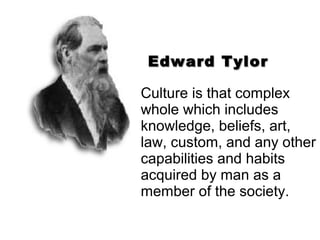
Edward Tylor

Culture is that complex
whole which includes
knowledge, beliefs, art,
law, custom, and any other
capabilities and habits
acquired by man as a
member of the society.
Definition of culture
Different sociologists have differently defined the
 term culture:
  Taylor: “Culture is the complex whole which
   includes knowledge, belief, art, morals, law, customs
   and habits and any capabilities acquired by man as a
   member of society”.
  Linton: “Culture is social heredity, which is
   transmitted from one generation to another with the
   accumulation of individual experiences”.
  John Beattee: Culture is the way of life which is
   transmitted from generation to generation”.
TYPES OF CULTURE
• Material Culture
• Non-material Culture
• Real Culture
• Ideal Culture
1. Material Culture
• From material culture we understand material and
   physical objects. For instance, house, road, vehicles,
   pen, table, radio set, book etc. these are the products of
   human efforts to control his environment and make his
   life conformable and safe.
2. Non-material culture
• In non-material culture we include non material
   objects. For example religion, art, ideas, customs,
   values system, attitudes, knowledge etc. it does not
   have physical shape. It is very important in determining
   human behavior and has strong hold on an individual.
   Both parts are inter-related with each other.
Real Culture:
• Real culture is that which can be observed in our
    social life. The culture on which we act upon in our
    daily life is real culture. It is that parts of culture,
    which the people adopt in their social life, for
    example. If a person/ says that he/she is Muslim, will
    be, when followed all the principles of Islam is the
    real and when doesn’t follow, is not a real one.
Ideal Culture:
• The culture which is presented as a pattern to the
    people is called ideal culture. It is the goal of society
    and never achieved fully because some parts remain
    out of practice. This culture is explained in books,
    speeches etc.
CHARACTERISTICS OF CULTURE:
       From the definitions it becomes clear that
  sociologically culture has specific meaning and
  characteristics. It is the product of human behavior
  and gaining knowledge through group. It is a
  system of learned behavior and set procedure. Some
  of the salient characteristics of culture are as under:
• Culture is learned.
• Culture is shared.
• Culture is transmitted.
• Culture is changing.
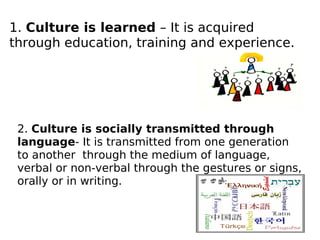
1. Culture is learned – It is acquired
through education, training and experience.


 2. Culture is socially transmitted through
 language- It is transmitted from one generation
 to another through the medium of language,
 verbal or non-verbal through the gestures or signs,
 orally or in writing.
• Culture is learned:
• Most of the behavior is learned in society. This
  learning might be conscious or unconscious but no
  body can deny the process of learning. Culture is
  something learnt and acquired e.g. wearing clothes or
  dancing. It is not something natural to the person.
• Culture is shared:
• All the traits, attitudes, ideas, knowledge and material
  objects like radio, television and automobiles etc is
  actually shared by members of society.
Culture is transmitted
 All the culture traits and objects are transmitted among
 the members of society continually. Most of the cultural
 traits and material objects are transmitted to the
 members of the society from their forefathers. We learn
 new fashion, how to move in society and how to behave
 in a particular social situation.
Culture is changing
     Culture never remains static but changing. It is
 changing in every society, but with different speed and
 causes. It constantly under goes change and adapts
 itself to the environments.
COMPONENTS OF
   CULTURE
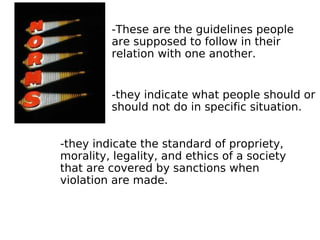
-These are the guidelines people
         are supposed to follow in their
         relation with one another.


         -they indicate what people should or
         should not do in specific situation.


-they indicate the standard of propriety,
morality, legality, and ethics of a society
that are covered by sanctions when
violation are made.
Social norms
  a. Folkways – these are everyday habits;
  customs, traditions and conventions people
  obey without giving much thought to the
  matter


  b. Mores- these are the norms people
  consider vital to their wellbeing and most
  cherished values; they are special customs
  with moral and ethical significance, which are
  strongly held and emphasized.
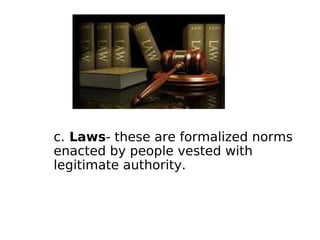
c. Laws- these are formalized norms
enacted by people vested with
legitimate authority.
IDEAS, BELIEFS, VALUES


        Ideas are non-materials aspects of culture
        and embody man's conception of his
        physical, social and cultural world
    Beliefs refer to a person's
    conviction about a certain idea.

Values are abstract concepts of what is
important and worthwhile, they are
general ideas that individuals share
about what is good or bad.
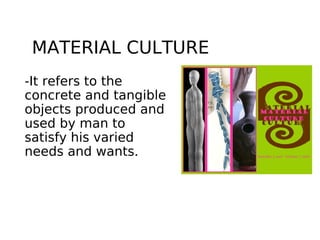
MATERIAL CULTURE
-It refers to the
concrete and tangible
objects produced and
used by man to
satisfy his varied
needs and wants.
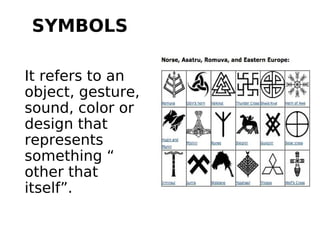
SYMBOLS

It refers to an
object, gesture,
sound, color or
design that
represents
something “
other that
itself”.
DIFFERENT
  VIEWPOINTS/
PERSPECTIVE ON
    CULTURE
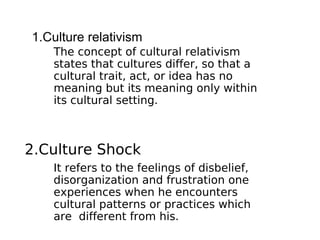
1.Culture relativism
   The concept of cultural relativism
   states that cultures differ, so that a
   cultural trait, act, or idea has no
   meaning but its meaning only within
   its cultural setting.


2.Culture Shock
   It refers to the feelings of disbelief,
   disorganization and frustration one
   experiences when he encounters
   cultural patterns or practices which
   are different from his.
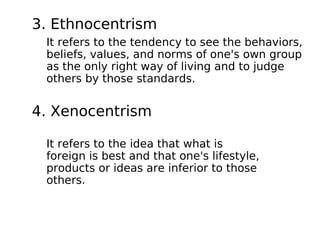
3. Ethnocentrism
 It refers to the tendency to see the behaviors,
 beliefs, values, and norms of one's own group
 as the only right way of living and to judge
 others by those standards.


4. Xenocentrism

 It refers to the idea that what is
 foreign is best and that one's lifestyle,
 products or ideas are inferior to those
 others.
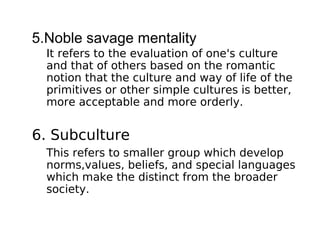
5.Noble savage mentality
  It refers to the evaluation of one's culture
  and that of others based on the romantic
  notion that the culture and way of life of the
  primitives or other simple cultures is better,
  more acceptable and more orderly.


6. Subculture
  This refers to smaller group which develop
  norms,values, beliefs, and special languages
  which make the distinct from the broader
  society.
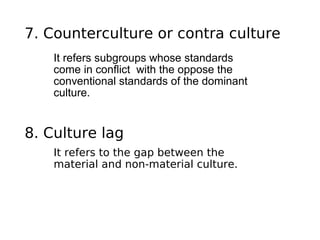
7. Counterculture or contra culture
    It refers subgroups whose standards
    come in conflict with the oppose the
    conventional standards of the dominant
    culture.


8. Culture lag
    It refers to the gap between the
    material and non-material culture.

Lecture 06.culture and types

  • 1.
  • 2.
    Introduction: Culture is one of the important concepts in sociology. No human society can exist and develop without its culture. The main difference between the animal and human societies is of culture only. Animal societies have no culture because they do not have systems of learning and transmitting social experiences. Sociologists are keenly interested in the study of culture because the study of human society is incomplete without it.
  • 3.
    Edward Tylor Culture isthat complex whole which includes knowledge, beliefs, art, law, custom, and any other capabilities and habits acquired by man as a member of the society.
  • 4.
    Definition of culture Differentsociologists have differently defined the term culture: Taylor: “Culture is the complex whole which includes knowledge, belief, art, morals, law, customs and habits and any capabilities acquired by man as a member of society”. Linton: “Culture is social heredity, which is transmitted from one generation to another with the accumulation of individual experiences”. John Beattee: Culture is the way of life which is transmitted from generation to generation”.
  • 5.
    TYPES OF CULTURE •Material Culture • Non-material Culture • Real Culture • Ideal Culture
  • 6.
    1. Material Culture •From material culture we understand material and physical objects. For instance, house, road, vehicles, pen, table, radio set, book etc. these are the products of human efforts to control his environment and make his life conformable and safe. 2. Non-material culture • In non-material culture we include non material objects. For example religion, art, ideas, customs, values system, attitudes, knowledge etc. it does not have physical shape. It is very important in determining human behavior and has strong hold on an individual. Both parts are inter-related with each other.
  • 7.
    Real Culture: • Realculture is that which can be observed in our social life. The culture on which we act upon in our daily life is real culture. It is that parts of culture, which the people adopt in their social life, for example. If a person/ says that he/she is Muslim, will be, when followed all the principles of Islam is the real and when doesn’t follow, is not a real one. Ideal Culture: • The culture which is presented as a pattern to the people is called ideal culture. It is the goal of society and never achieved fully because some parts remain out of practice. This culture is explained in books, speeches etc.
  • 8.
    CHARACTERISTICS OF CULTURE: From the definitions it becomes clear that sociologically culture has specific meaning and characteristics. It is the product of human behavior and gaining knowledge through group. It is a system of learned behavior and set procedure. Some of the salient characteristics of culture are as under: • Culture is learned. • Culture is shared. • Culture is transmitted. • Culture is changing.
  • 9.
    1. Culture islearned – It is acquired through education, training and experience. 2. Culture is socially transmitted through language- It is transmitted from one generation to another through the medium of language, verbal or non-verbal through the gestures or signs, orally or in writing.
  • 10.
    • Culture islearned: • Most of the behavior is learned in society. This learning might be conscious or unconscious but no body can deny the process of learning. Culture is something learnt and acquired e.g. wearing clothes or dancing. It is not something natural to the person. • Culture is shared: • All the traits, attitudes, ideas, knowledge and material objects like radio, television and automobiles etc is actually shared by members of society.
  • 11.
    Culture is transmitted All the culture traits and objects are transmitted among the members of society continually. Most of the cultural traits and material objects are transmitted to the members of the society from their forefathers. We learn new fashion, how to move in society and how to behave in a particular social situation. Culture is changing Culture never remains static but changing. It is changing in every society, but with different speed and causes. It constantly under goes change and adapts itself to the environments.
  • 12.
  • 13.
    -These are theguidelines people are supposed to follow in their relation with one another. -they indicate what people should or should not do in specific situation. -they indicate the standard of propriety, morality, legality, and ethics of a society that are covered by sanctions when violation are made.
  • 14.
    Social norms a. Folkways – these are everyday habits; customs, traditions and conventions people obey without giving much thought to the matter b. Mores- these are the norms people consider vital to their wellbeing and most cherished values; they are special customs with moral and ethical significance, which are strongly held and emphasized.
  • 15.
    c. Laws- theseare formalized norms enacted by people vested with legitimate authority.
  • 16.
    IDEAS, BELIEFS, VALUES Ideas are non-materials aspects of culture and embody man's conception of his physical, social and cultural world Beliefs refer to a person's conviction about a certain idea. Values are abstract concepts of what is important and worthwhile, they are general ideas that individuals share about what is good or bad.
  • 17.
    MATERIAL CULTURE -It refersto the concrete and tangible objects produced and used by man to satisfy his varied needs and wants.
  • 18.
    SYMBOLS It refers toan object, gesture, sound, color or design that represents something “ other that itself”.
  • 19.
  • 20.
    1.Culture relativism The concept of cultural relativism states that cultures differ, so that a cultural trait, act, or idea has no meaning but its meaning only within its cultural setting. 2.Culture Shock It refers to the feelings of disbelief, disorganization and frustration one experiences when he encounters cultural patterns or practices which are different from his.
  • 21.
    3. Ethnocentrism Itrefers to the tendency to see the behaviors, beliefs, values, and norms of one's own group as the only right way of living and to judge others by those standards. 4. Xenocentrism It refers to the idea that what is foreign is best and that one's lifestyle, products or ideas are inferior to those others.
  • 22.
    5.Noble savage mentality It refers to the evaluation of one's culture and that of others based on the romantic notion that the culture and way of life of the primitives or other simple cultures is better, more acceptable and more orderly. 6. Subculture This refers to smaller group which develop norms,values, beliefs, and special languages which make the distinct from the broader society.
  • 23.
    7. Counterculture orcontra culture It refers subgroups whose standards come in conflict with the oppose the conventional standards of the dominant culture. 8. Culture lag It refers to the gap between the material and non-material culture.