
Family
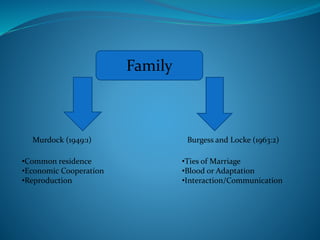
Murdock (1949:1)
•Common residence
•Economic Cooperation
•Reproduction
Burgess and Locke (1963:2)
•Ties of Marriage
•Blood or Adaptation
•Interaction/Communication
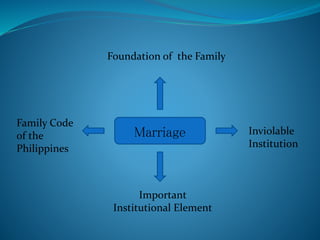
Marriage
Important
Institutional Element
Foundation of the Family
Family Code
of the
Philippines
Inviolable
Institution
Forms of Marriage
Monogamy PolygamyMonogamy Polygamy
Polygyny
Group
Marriage
Polyandry
Selection of
Marriage Partner
Endogamy
Exogamy Levirate
Sororate
Family Structures
Based on Internal
Organization or
Membership
Based on Descent
Based on Residence
Based on Authority
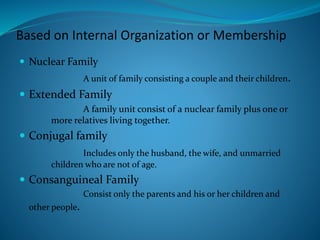
Based on Internal Organization or Membership
 Nuclear Family
A unit of family consisting a couple and their children.
 Extended Family
A family unit consist of a nuclear family plus one or
more relatives living together.
 Conjugal family
Includes only the husband, the wife, and unmarried
children who are not of age.
 Consanguineal Family
Consist only the parents and his or her children and
other people.
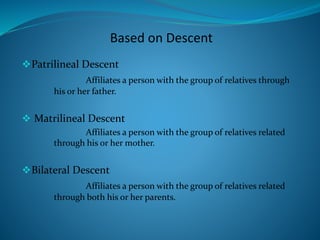
Based on Descent
Patrilineal Descent
Affiliates a person with the group of relatives through
his or her father.
 Matrilineal Descent
Affiliates a person with the group of relatives related
through his or her mother.
Bilateral Descent
Affiliates a person with the group of relatives related
through both his or her parents.
Based on Residence
 Patrilocal Residence
Requires that the newly married couple live with or near
the domicile of the parents of the bride’s groom.
 Matrilocal Residence
Requires that the newly married couples live with or near
the domicile of the parents of her bride.
 Bilocal Residence
Gives a couple a choice of staying with either the groom’s
or bride’s parents.
 Neolocal Residence
Residence permits the newly married couple to reside
independently of the parents of either groom or bride.
 Avunculocal Residence
Prescribe that the newly married with or near the maternal
uncle of the groom
Based on the Authority
 The Patriarchal Family
Is one which the authority is vested in the oldest male in
the family, often the father.
 The Matriarchal Family
Is one which the authority is vested in the mother or the
mother’s kin.
 The Egalitarian Family
Is one in which the husband and the wife exercise a more
or less equal amount of authority.
 The Matricentic Family
Is a recently Emerged type usually found in the
suburb of the United States.
Functions of Family
Regulates sexual behaviour
and is the unit of
reproduction.
Performs the function of
biologic maintenance.
Chief agency for
socializing the child.
Gives its member a
status.
Important mechanism for
social control.
Performs economic
function, especially in
simple societies.
Structural Characteristic of Filipino Family
 The basic social units in the Philippine society are the nuclear family which
includes the father, mother ,and children, and bilaterally extended kinship
group, which embraces all relatives of the father and mother.
 The Christian Filipino has a often been describe as a large family group,
usually including three generations in the same home, that extended
family in terms of membership.
 Among the Filipino Muslim the more common type is the joint family.
 The Filipino family is said to be a patriarchal in authority . Studies made by
the sociologist and anthropologist reveal that the Filipino family is not
patriarchal nor was it’s so in the egalitarian.
 The Filipino family is bilateral in terms of reckoning descent and social
allocation.
 In terms of residence the Filipino family may be said to be bilocal and
neolocal.
Courtship and Marriage
Courtship and Marriage are the culmination of the
development that has taken place throughout the first
eighteen to twenty years of life. Courtship allows to
practice in a limited way the roles and virtues necessary in
marriage. Marriage permits them to practice the roles and
virtues necessary in eternal life. In the proper courtship
the partners recognize that their first responsibilities are
to encourage each other in righteous behaviour and to
sustain and support each other in righteous desires and
ambitions.
Social Change and the Filipino Family
The Philippine is undergoing many changes. These have been
brought about by many factors which had profound effects on the
family. Among them are the geographical mobility, increasing
population, increasing industrialization and urbanization, the idea of
the universal education, the changed status and role of the Filipino
women, The diffusion of the mass media.
These changes brings about conflicts in the values and mores,
which may turns bring about social problems. And there is n
gainsaying the fact that the problems beset the Filipino family today.
Among these are conflict in the families, separation and desertion,
abortion, illegitimacy, prostitution, the youth problem, juvenile
delinquency, Drug abuse, and their likes. The extent of the problems is
difficult to ascertain.
Chapter 11

Chapter 11

  • 2.
    Family Murdock (1949:1) •Common residence •EconomicCooperation •Reproduction Burgess and Locke (1963:2) •Ties of Marriage •Blood or Adaptation •Interaction/Communication
  • 3.
    Marriage Important Institutional Element Foundation ofthe Family Family Code of the Philippines Inviolable Institution
  • 4.
    Forms of Marriage MonogamyPolygamyMonogamy Polygamy Polygyny Group Marriage Polyandry
  • 5.
  • 6.
    Family Structures Based onInternal Organization or Membership Based on Descent Based on Residence Based on Authority
  • 7.
    Based on InternalOrganization or Membership  Nuclear Family A unit of family consisting a couple and their children.  Extended Family A family unit consist of a nuclear family plus one or more relatives living together.  Conjugal family Includes only the husband, the wife, and unmarried children who are not of age.  Consanguineal Family Consist only the parents and his or her children and other people.
  • 8.
    Based on Descent PatrilinealDescent Affiliates a person with the group of relatives through his or her father.  Matrilineal Descent Affiliates a person with the group of relatives related through his or her mother. Bilateral Descent Affiliates a person with the group of relatives related through both his or her parents.
  • 9.
    Based on Residence Patrilocal Residence Requires that the newly married couple live with or near the domicile of the parents of the bride’s groom.  Matrilocal Residence Requires that the newly married couples live with or near the domicile of the parents of her bride.  Bilocal Residence Gives a couple a choice of staying with either the groom’s or bride’s parents.  Neolocal Residence Residence permits the newly married couple to reside independently of the parents of either groom or bride.  Avunculocal Residence Prescribe that the newly married with or near the maternal uncle of the groom
  • 10.
    Based on theAuthority  The Patriarchal Family Is one which the authority is vested in the oldest male in the family, often the father.  The Matriarchal Family Is one which the authority is vested in the mother or the mother’s kin.  The Egalitarian Family Is one in which the husband and the wife exercise a more or less equal amount of authority.  The Matricentic Family Is a recently Emerged type usually found in the suburb of the United States.
  • 11.
    Functions of Family Regulatessexual behaviour and is the unit of reproduction. Performs the function of biologic maintenance. Chief agency for socializing the child. Gives its member a status. Important mechanism for social control. Performs economic function, especially in simple societies.
  • 12.
    Structural Characteristic ofFilipino Family  The basic social units in the Philippine society are the nuclear family which includes the father, mother ,and children, and bilaterally extended kinship group, which embraces all relatives of the father and mother.  The Christian Filipino has a often been describe as a large family group, usually including three generations in the same home, that extended family in terms of membership.  Among the Filipino Muslim the more common type is the joint family.  The Filipino family is said to be a patriarchal in authority . Studies made by the sociologist and anthropologist reveal that the Filipino family is not patriarchal nor was it’s so in the egalitarian.  The Filipino family is bilateral in terms of reckoning descent and social allocation.  In terms of residence the Filipino family may be said to be bilocal and neolocal.
  • 13.
    Courtship and Marriage Courtshipand Marriage are the culmination of the development that has taken place throughout the first eighteen to twenty years of life. Courtship allows to practice in a limited way the roles and virtues necessary in marriage. Marriage permits them to practice the roles and virtues necessary in eternal life. In the proper courtship the partners recognize that their first responsibilities are to encourage each other in righteous behaviour and to sustain and support each other in righteous desires and ambitions.
  • 14.
    Social Change andthe Filipino Family The Philippine is undergoing many changes. These have been brought about by many factors which had profound effects on the family. Among them are the geographical mobility, increasing population, increasing industrialization and urbanization, the idea of the universal education, the changed status and role of the Filipino women, The diffusion of the mass media. These changes brings about conflicts in the values and mores, which may turns bring about social problems. And there is n gainsaying the fact that the problems beset the Filipino family today. Among these are conflict in the families, separation and desertion, abortion, illegitimacy, prostitution, the youth problem, juvenile delinquency, Drug abuse, and their likes. The extent of the problems is difficult to ascertain.