PRESENTEDTO:MA’AMSIDRA
PRESENTEDBY:AMENAHGONDAL
CLASS:BS.ED7
Suppose R is a relation on a set S satisfying the following three
properties:
𝑂1 𝑅𝑒𝑓𝑙𝑒𝑥𝑖𝑣𝑒 : 𝐹𝑜𝑟 𝑎𝑛𝑦 𝑎 ∈ 𝑆, 𝑤𝑒 ℎ𝑎𝑣𝑒 𝑎𝑅𝑎
𝑂2 𝐴𝑛𝑡𝑖𝑠𝑦𝑚𝑚𝑒𝑡𝑟𝑖𝑐 : 𝐼𝑓 𝑎𝑅𝑏 𝑎𝑛𝑑 𝑏𝑅𝑎, 𝑡ℎ𝑒𝑛 𝑎 = 𝑏
𝑂3 𝑇𝑟𝑎𝑛𝑠𝑖𝑡𝑖𝑣𝑒 : 𝐼𝑓 𝑎𝑅𝑏 𝑎𝑛𝑑 𝑏𝑅𝑐, 𝑡ℎ𝑒𝑛 𝑎𝑅𝑐
Then R is called a partial order or, simply an order relation, and R is said to
and R is said to define a partial ordering of S.The set S with partial ordering
partial ordering R is called a partially ordered set (poset) or, simply an
simply an ordered set.
A partial ordering relation is denoted by ≾
With this notation, the above three properties of a partial order appear in the
following usual form:
𝑂1 𝑅𝑒𝑓𝑙𝑒𝑥𝑖𝑣𝑒 : 𝐹𝑜𝑟 𝑎𝑛𝑦 𝑎 ∈ 𝑆, 𝑤𝑒 ℎ𝑎𝑣𝑒 𝑎 ≾ 𝑎
𝑂2 𝐴𝑛𝑡𝑖𝑠𝑦𝑚𝑚𝑒𝑡𝑟𝑖𝑐 : 𝐼𝑓 𝑎 ≾ 𝑏 𝑎𝑛𝑑 𝑏 ≾ 𝑎, 𝑡ℎ𝑒𝑛 𝑎 = 𝑏
𝑂3 𝑇𝑟𝑎𝑛𝑠𝑖𝑡𝑖𝑣𝑒 : 𝐼𝑓 𝑎 ≾ 𝑏 𝑎𝑛𝑑 𝑏 ≾ 𝑐, 𝑡ℎ𝑒𝑛 𝑎 ≾ 𝑏
An ordered set consist of two things, a set S and the partial ordering. Ordered set is
denoted by the pair 𝑆, ≾ .
Suppose X and Y are partially ordered sets. A one-to-one (injective)
function is called a similarity mapping from X into Y if f preserves the
preserves the order relation, i.e., if the following conditions holds for
holds for any pair :
Accordingly, if the underlying sets X and Y are both linearly ordered,
then only (1) is needed for f to be a similarity mapping.
𝒂 ≤ 𝒃 𝒊𝒏 𝑿 𝒊𝒇𝒇 𝒇 𝒂 ≤ 𝒇 𝒃 𝒊𝒏𝒀 ……1
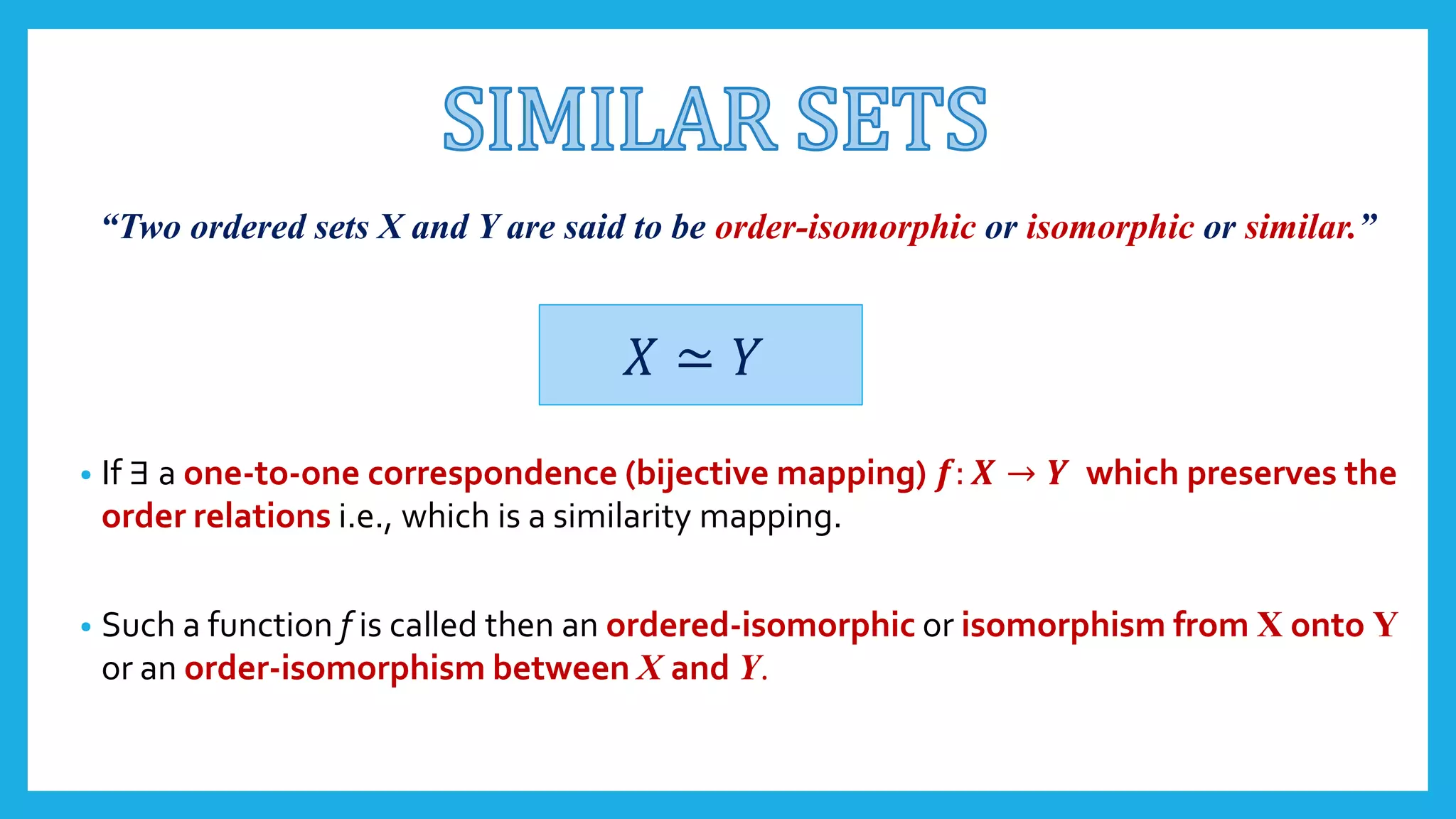
“Two ordered sets X and Y are said to be order-isomorphic or isomorphic or similar.”
• If ∃ a one-to-one correspondence (bijective mapping) 𝒇: 𝑿 → 𝒀 which preserves the
order relations i.e., which is a similarity mapping.
• Such a function f is called then an ordered-isomorphic or isomorphism from X onto Y
or an order-isomorphism between X and Y.
𝑋 ≃ 𝑌
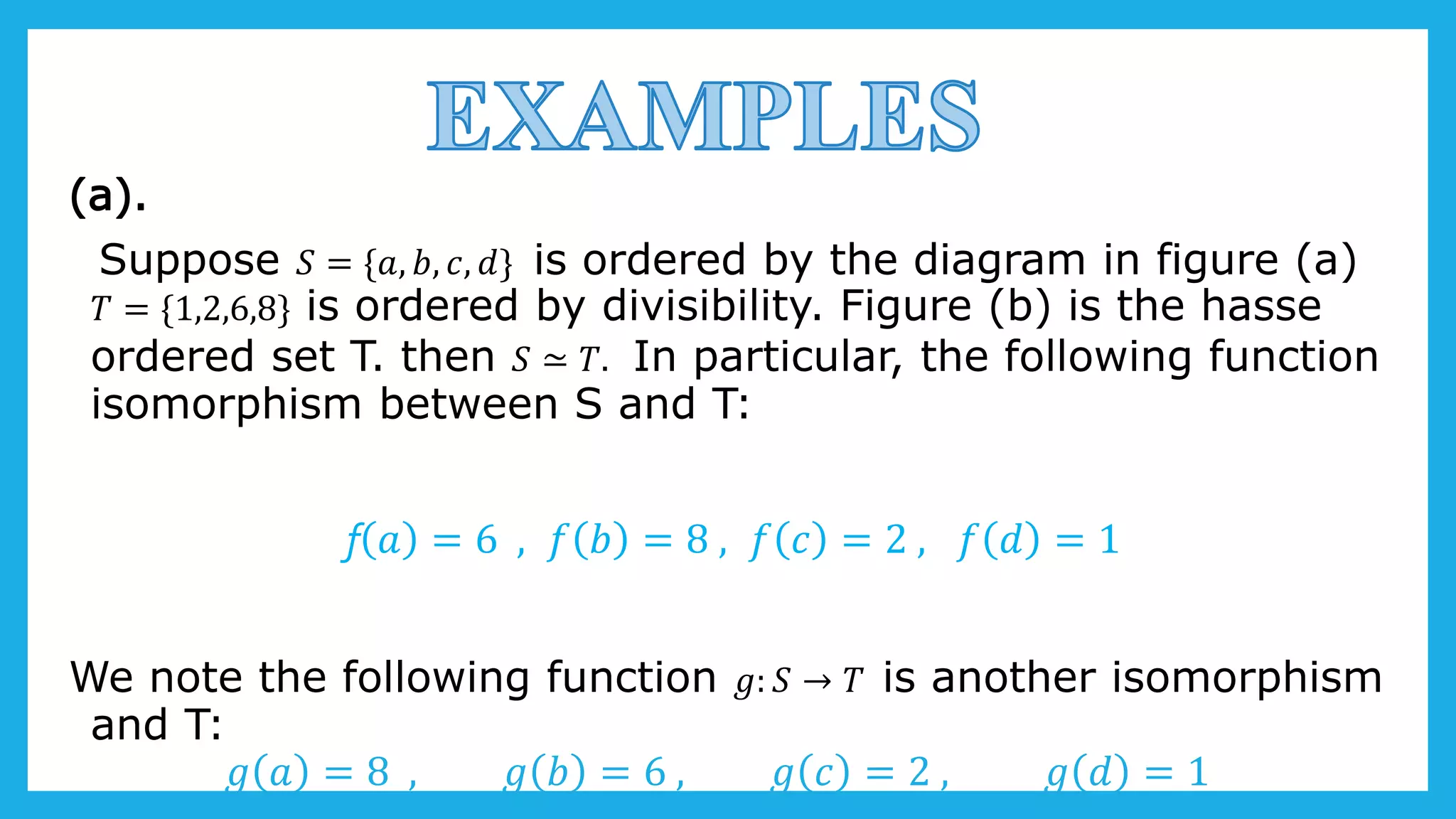
(a).
Suppose 𝑆 = {𝑎, 𝑏, 𝑐, 𝑑} is ordered by the diagram in figure (a)
𝑇 = {1,2,6,8} is ordered by divisibility. Figure (b) is the hasse
ordered set T. then 𝑆 ≃ 𝑇. In particular, the following function
isomorphism between S and T:
f 𝑎 = 6 , 𝑓 𝑏 = 8 , 𝑓 𝑐 = 2 , 𝑓 𝑑 = 1
We note the following function 𝑔: 𝑆 → 𝑇 is another isomorphism
and T:
𝑔 𝑎 = 8 , 𝑔 𝑏 = 6 , 𝑔 𝑐 = 2 , 𝑔 𝑑 = 1
(b).
The set of positive integers 𝑃 = 1,2,3, … … … is order-isomorphic to the set of
integers 𝐸 = {2,4,6, … … } since the function 𝑓: 𝑃 → 𝐸 defined by 𝑓 𝑥 = 2𝑥 is an
between P and E.
The function f is both one-to-one and onto (bijective mapping) and also order
so the function is order-isomorphism.
(c).
Consider the usual ordering ≤ of the positive integers 𝑃 = {1,2,3, … … . . } and the
integers 𝐴 = {−1, −2, −3, … … . . }. Then P is not order-isomorphic to A. For if
isomorphism then, for every 𝑛 ∈ 𝑃,
• 1 ≤ 𝑛 𝑠ℎ𝑜𝑢𝑙𝑑 𝑖𝑚𝑝𝑙𝑦 𝑓(1) ≤ 𝑓(𝑛)
For every 𝑓 𝑛 ∈ 𝐴. Since A has no first element f cannot exist.
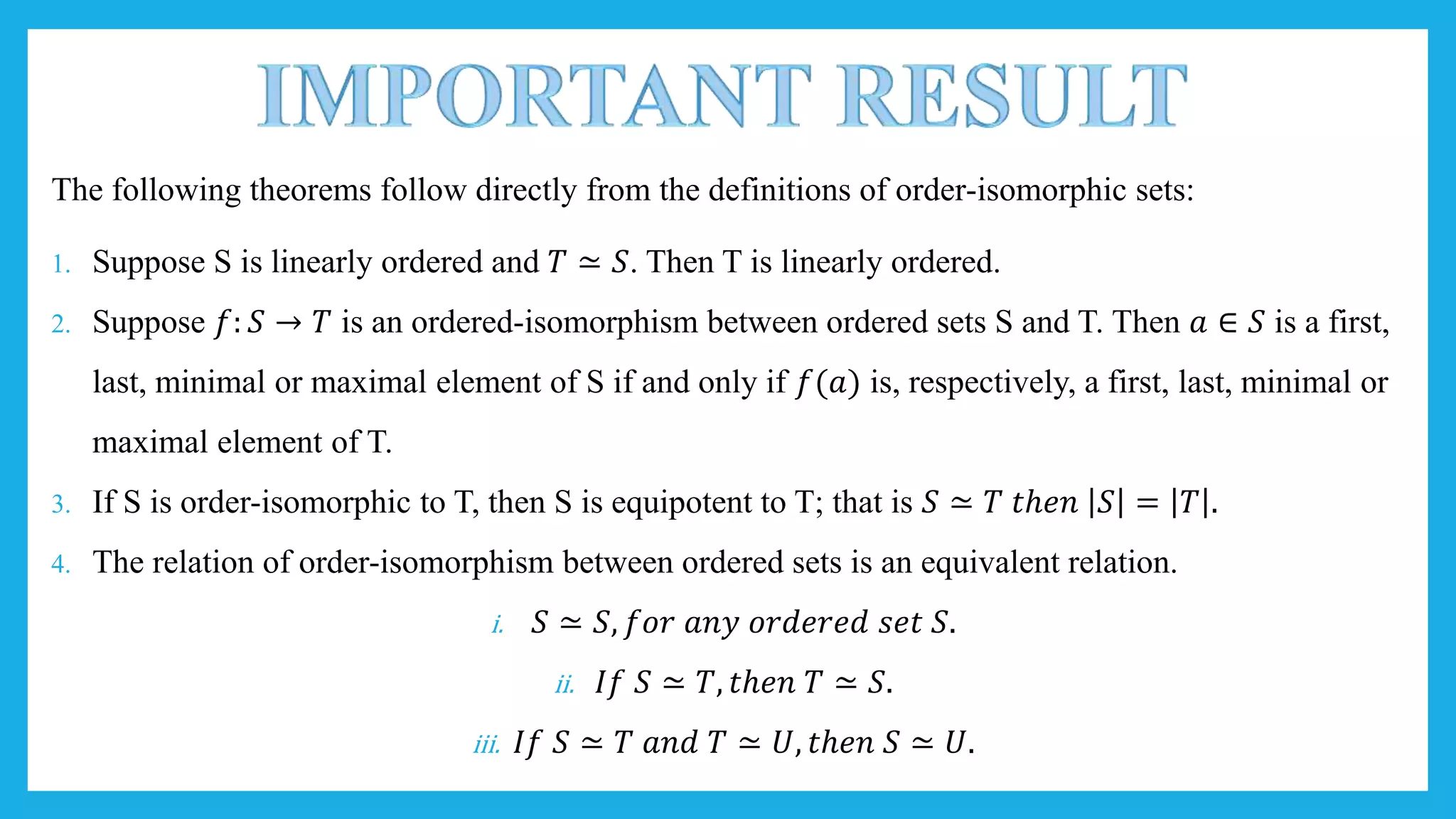
The following theorems follow directly from the definitions of order-isomorphic sets:
1. Suppose S is linearly ordered and 𝑇 ≃ 𝑆. Then T is linearly ordered.
2. Suppose 𝑓: 𝑆 → 𝑇 is an ordered-isomorphism between ordered sets S and T. Then 𝑎 ∈ 𝑆 is a first,
last, minimal or maximal element of S if and only if 𝑓(𝑎) is, respectively, a first, last, minimal or
maximal element of T.
3. If S is order-isomorphic to T, then S is equipotent to T; that is 𝑆 ≃ 𝑇 𝑡ℎ𝑒𝑛 𝑆 = 𝑇 .
4. The relation of order-isomorphism between ordered sets is an equivalent relation.
i. 𝑆 ≃ 𝑆, 𝑓𝑜𝑟 𝑎𝑛𝑦 𝑜𝑟𝑑𝑒𝑟𝑒𝑑 𝑠𝑒𝑡 𝑆.
ii. 𝐼𝑓 𝑆 ≃ 𝑇, 𝑡ℎ𝑒𝑛 𝑇 ≃ 𝑆.
iii. 𝐼𝑓 𝑆 ≃ 𝑇 𝑎𝑛𝑑 𝑇 ≃ 𝑈, 𝑡ℎ𝑒𝑛 𝑆 ≃ 𝑈.
ISOMORPHIC (SIMILAR) ORDERD SETS

ISOMORPHIC (SIMILAR) ORDERD SETS

  • 2.
  • 4.
    Suppose R isa relation on a set S satisfying the following three properties: 𝑂1 𝑅𝑒𝑓𝑙𝑒𝑥𝑖𝑣𝑒 : 𝐹𝑜𝑟 𝑎𝑛𝑦 𝑎 ∈ 𝑆, 𝑤𝑒 ℎ𝑎𝑣𝑒 𝑎𝑅𝑎 𝑂2 𝐴𝑛𝑡𝑖𝑠𝑦𝑚𝑚𝑒𝑡𝑟𝑖𝑐 : 𝐼𝑓 𝑎𝑅𝑏 𝑎𝑛𝑑 𝑏𝑅𝑎, 𝑡ℎ𝑒𝑛 𝑎 = 𝑏 𝑂3 𝑇𝑟𝑎𝑛𝑠𝑖𝑡𝑖𝑣𝑒 : 𝐼𝑓 𝑎𝑅𝑏 𝑎𝑛𝑑 𝑏𝑅𝑐, 𝑡ℎ𝑒𝑛 𝑎𝑅𝑐 Then R is called a partial order or, simply an order relation, and R is said to and R is said to define a partial ordering of S.The set S with partial ordering partial ordering R is called a partially ordered set (poset) or, simply an simply an ordered set.
  • 5.
    A partial orderingrelation is denoted by ≾ With this notation, the above three properties of a partial order appear in the following usual form: 𝑂1 𝑅𝑒𝑓𝑙𝑒𝑥𝑖𝑣𝑒 : 𝐹𝑜𝑟 𝑎𝑛𝑦 𝑎 ∈ 𝑆, 𝑤𝑒 ℎ𝑎𝑣𝑒 𝑎 ≾ 𝑎 𝑂2 𝐴𝑛𝑡𝑖𝑠𝑦𝑚𝑚𝑒𝑡𝑟𝑖𝑐 : 𝐼𝑓 𝑎 ≾ 𝑏 𝑎𝑛𝑑 𝑏 ≾ 𝑎, 𝑡ℎ𝑒𝑛 𝑎 = 𝑏 𝑂3 𝑇𝑟𝑎𝑛𝑠𝑖𝑡𝑖𝑣𝑒 : 𝐼𝑓 𝑎 ≾ 𝑏 𝑎𝑛𝑑 𝑏 ≾ 𝑐, 𝑡ℎ𝑒𝑛 𝑎 ≾ 𝑏 An ordered set consist of two things, a set S and the partial ordering. Ordered set is denoted by the pair 𝑆, ≾ .
  • 6.
    Suppose X andY are partially ordered sets. A one-to-one (injective) function is called a similarity mapping from X into Y if f preserves the preserves the order relation, i.e., if the following conditions holds for holds for any pair : Accordingly, if the underlying sets X and Y are both linearly ordered, then only (1) is needed for f to be a similarity mapping. 𝒂 ≤ 𝒃 𝒊𝒏 𝑿 𝒊𝒇𝒇 𝒇 𝒂 ≤ 𝒇 𝒃 𝒊𝒏𝒀 ……1
  • 7.
    “Two ordered setsX and Y are said to be order-isomorphic or isomorphic or similar.” • If ∃ a one-to-one correspondence (bijective mapping) 𝒇: 𝑿 → 𝒀 which preserves the order relations i.e., which is a similarity mapping. • Such a function f is called then an ordered-isomorphic or isomorphism from X onto Y or an order-isomorphism between X and Y. 𝑋 ≃ 𝑌
  • 8.
    (a). Suppose 𝑆 ={𝑎, 𝑏, 𝑐, 𝑑} is ordered by the diagram in figure (a) 𝑇 = {1,2,6,8} is ordered by divisibility. Figure (b) is the hasse ordered set T. then 𝑆 ≃ 𝑇. In particular, the following function isomorphism between S and T: f 𝑎 = 6 , 𝑓 𝑏 = 8 , 𝑓 𝑐 = 2 , 𝑓 𝑑 = 1 We note the following function 𝑔: 𝑆 → 𝑇 is another isomorphism and T: 𝑔 𝑎 = 8 , 𝑔 𝑏 = 6 , 𝑔 𝑐 = 2 , 𝑔 𝑑 = 1
  • 10.
    (b). The set ofpositive integers 𝑃 = 1,2,3, … … … is order-isomorphic to the set of integers 𝐸 = {2,4,6, … … } since the function 𝑓: 𝑃 → 𝐸 defined by 𝑓 𝑥 = 2𝑥 is an between P and E. The function f is both one-to-one and onto (bijective mapping) and also order so the function is order-isomorphism. (c). Consider the usual ordering ≤ of the positive integers 𝑃 = {1,2,3, … … . . } and the integers 𝐴 = {−1, −2, −3, … … . . }. Then P is not order-isomorphic to A. For if isomorphism then, for every 𝑛 ∈ 𝑃, • 1 ≤ 𝑛 𝑠ℎ𝑜𝑢𝑙𝑑 𝑖𝑚𝑝𝑙𝑦 𝑓(1) ≤ 𝑓(𝑛) For every 𝑓 𝑛 ∈ 𝐴. Since A has no first element f cannot exist.
  • 11.
    The following theoremsfollow directly from the definitions of order-isomorphic sets: 1. Suppose S is linearly ordered and 𝑇 ≃ 𝑆. Then T is linearly ordered. 2. Suppose 𝑓: 𝑆 → 𝑇 is an ordered-isomorphism between ordered sets S and T. Then 𝑎 ∈ 𝑆 is a first, last, minimal or maximal element of S if and only if 𝑓(𝑎) is, respectively, a first, last, minimal or maximal element of T. 3. If S is order-isomorphic to T, then S is equipotent to T; that is 𝑆 ≃ 𝑇 𝑡ℎ𝑒𝑛 𝑆 = 𝑇 . 4. The relation of order-isomorphism between ordered sets is an equivalent relation. i. 𝑆 ≃ 𝑆, 𝑓𝑜𝑟 𝑎𝑛𝑦 𝑜𝑟𝑑𝑒𝑟𝑒𝑑 𝑠𝑒𝑡 𝑆. ii. 𝐼𝑓 𝑆 ≃ 𝑇, 𝑡ℎ𝑒𝑛 𝑇 ≃ 𝑆. iii. 𝐼𝑓 𝑆 ≃ 𝑇 𝑎𝑛𝑑 𝑇 ≃ 𝑈, 𝑡ℎ𝑒𝑛 𝑆 ≃ 𝑈.

Editor's Notes

  • #7 the two notations are equivalent because f is also required to be a bijection. This condition ensures that f(a)=f(b)⟺a f(a)=f(b)⟺a=b.
  • #8 A generalization of the elementary geometrical concept of a similarity. Two sets AA and BB that are totally ordered by relations RR and SS respectively are said to be similar if there exists a bijection f:A→Bf:A→B such that for any x,y∈Ax,y∈A it follows from xRyxRy that f(x)Sf(y)f(x)Sf(y).