INSTITUTE OF ACCOUNTANCY ARUSHA
MODULE: RESEARCH METHODS
2024/2025
What is research?
 It is Research is an organized and systematic
way of studying a phenomena in order to
establish facts/answers to questions and reach
new conclusions
 Systematic because there is a definite set of
procedures and steps which you will follow.
 These procedures are always done in order to
get the most accurate results.
What is research?
 Research is what we do when we have a
question or a problem we want to resolve
 We may already think we know the answer to
our question already
 We may think the answer is obvious, common
sense even
 But until we have subjected our problem to
research, our 'knowledge' remains little more
than guesswork or at best, intuition.
Research Process
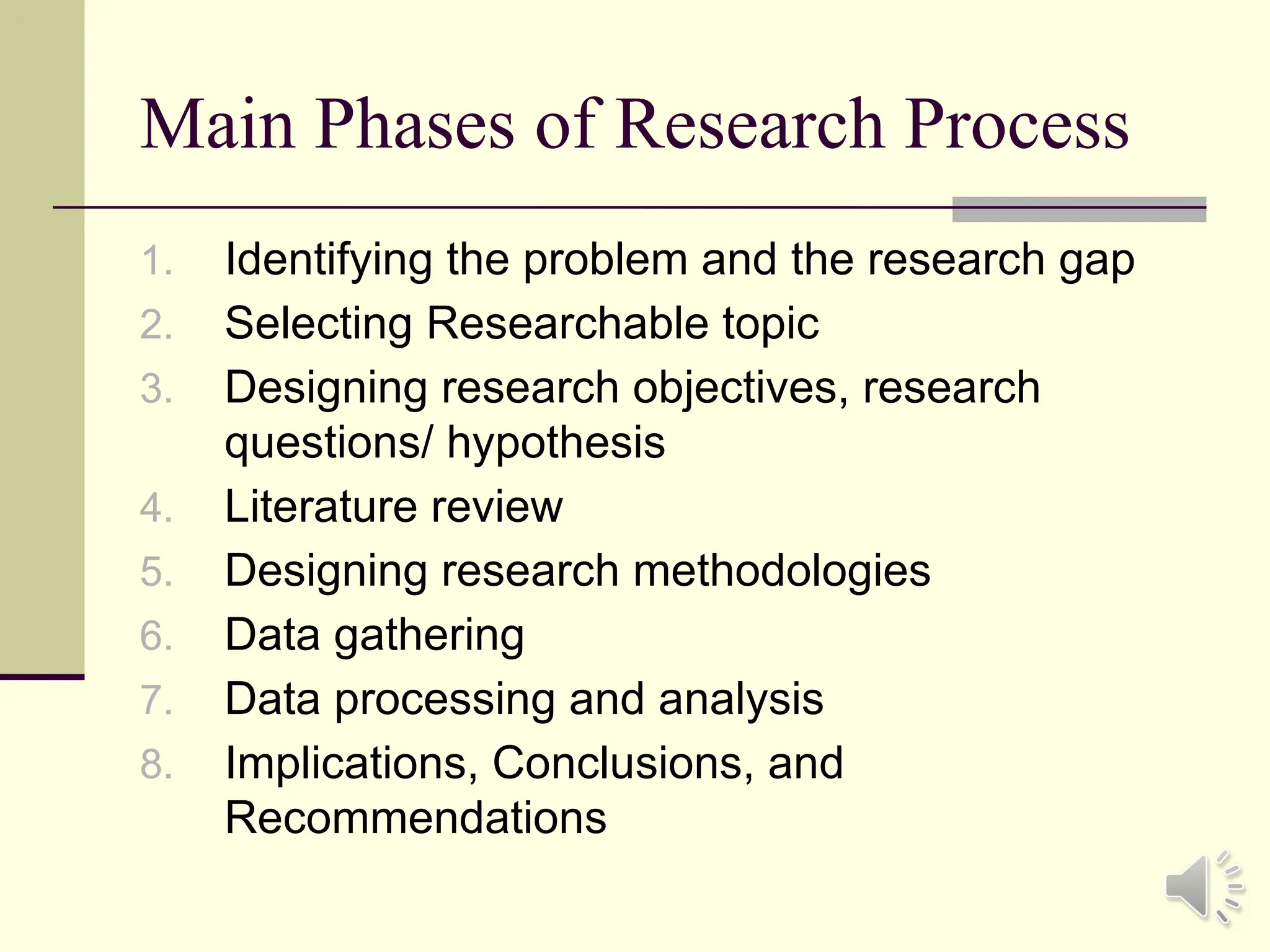
Main Phases of Research Process
1. Identifying the problem and the research gap
2. Selecting Researchable topic
3. Designing research objectives, research
questions/ hypothesis
4. Literature review
5. Designing research methodologies
6. Data gathering
7. Data processing and analysis
8. Implications, Conclusions, and
Recommendations
CONTEXTUALIZING A
RESEARCH PROBLEM
Characteristics of a good research
Supported by the Literature
 Your research problem should be relevant to
the field and supported by a number of recent
peer-reviewed studies in the field. Even if you
identify the problem based on the
recommendation of one journal article or
dissertation, you will still need to conduct a
literature search and ensure that other
researchers support the problem and need
for conducting research to further address the
problem.
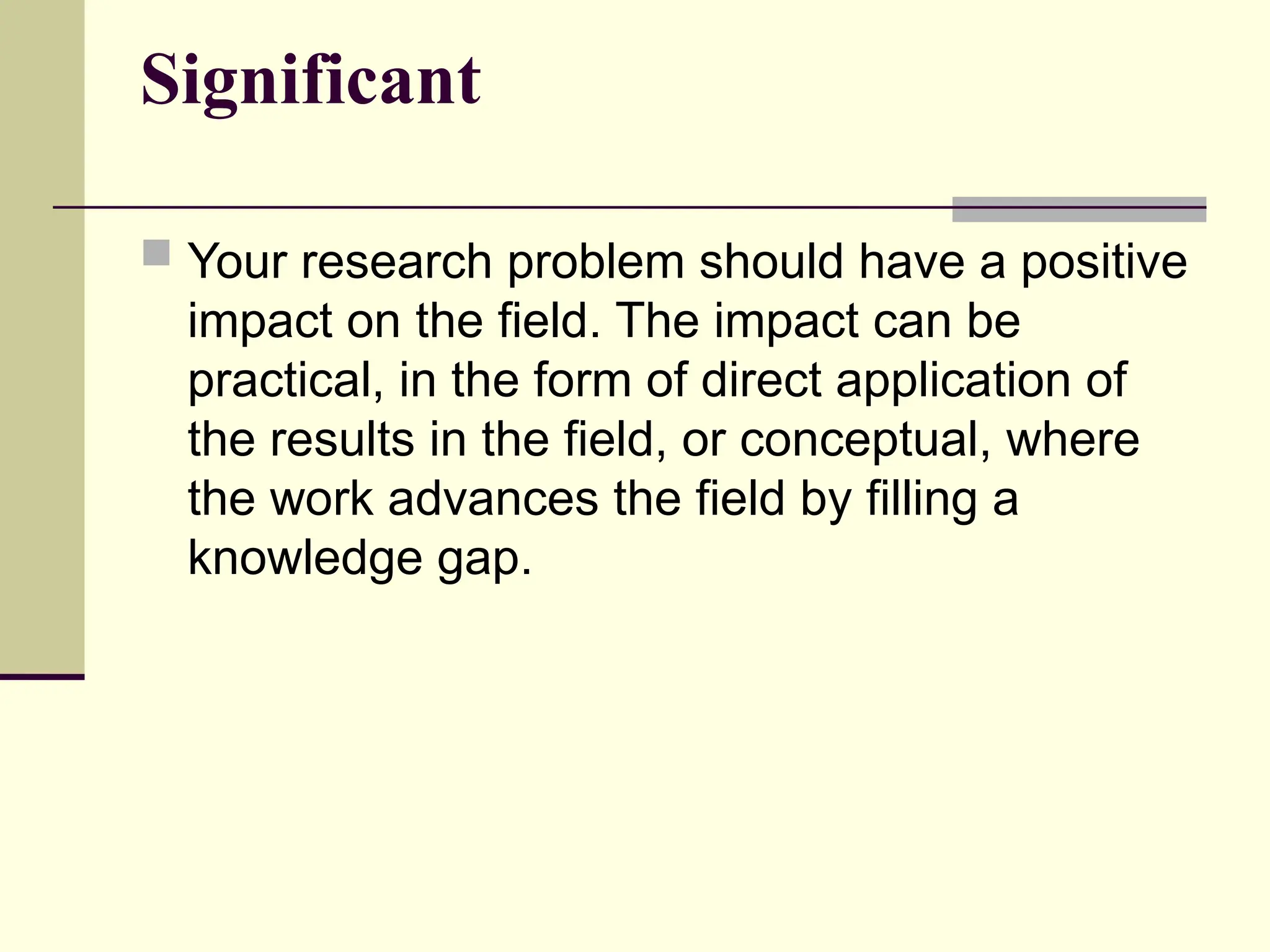
Significant
 Your research problem should have a positive
impact on the field. The impact can be
practical, in the form of direct application of
the results in the field, or conceptual, where
the work advances the field by filling a
knowledge gap.
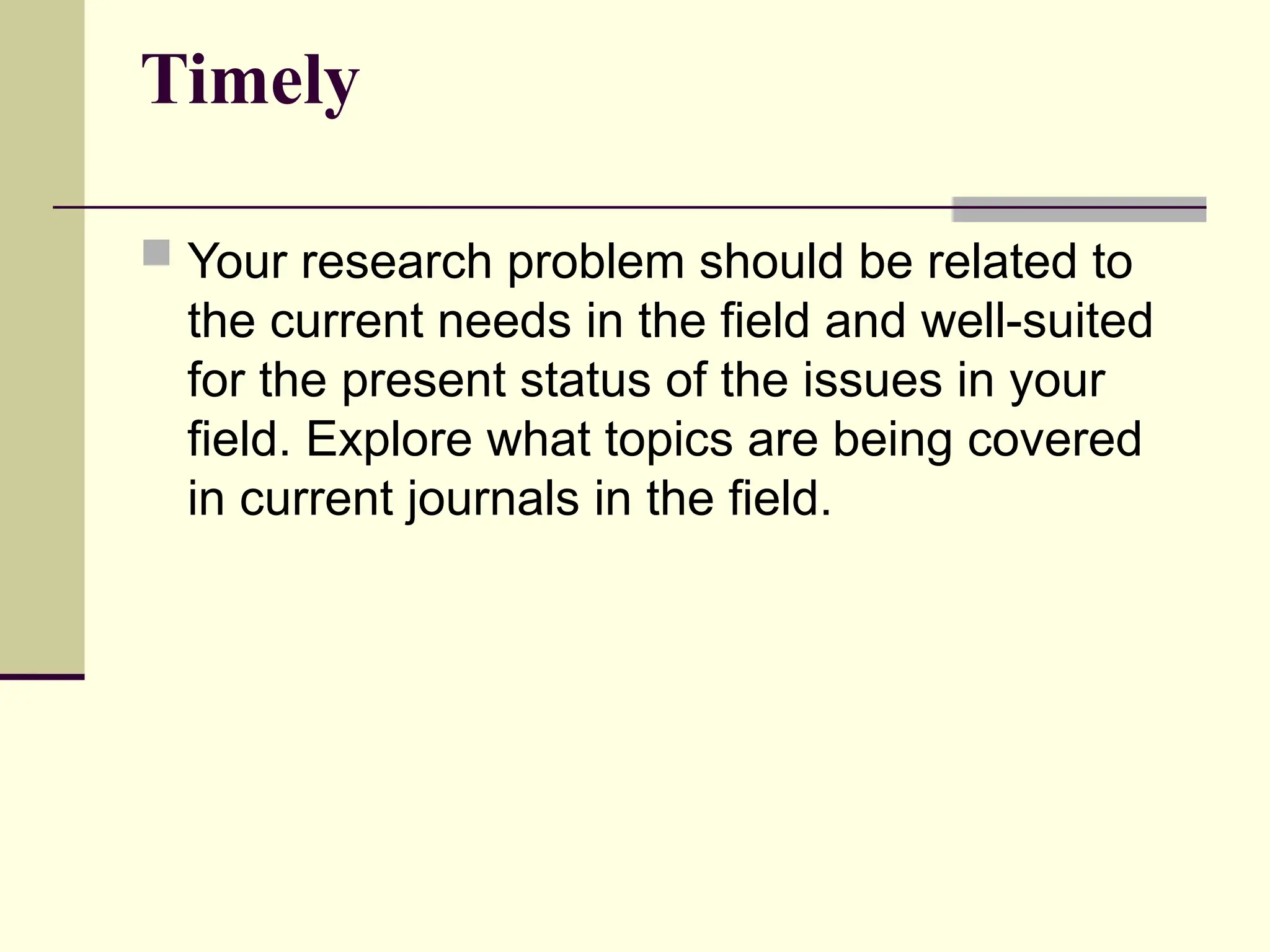
Timely
 Your research problem should be related to
the current needs in the field and well-suited
for the present status of the issues in your
field. Explore what topics are being covered
in current journals in the field.
Novel
 Your research problem should be original and
unique. It should seek to address a gap in our
knowledge or application. An exhaustive
review of literature can help you identify
whether the problem has already been
addressed with your particular sample and/or
context. Talking to experts in the research
area can illuminate a problem. Replication of
an existing study warrants discussion of value
elsewhere, but novelty can be found in
determining if an already-resolved problem
holds in a new sample and/or context.
Specific and Clear
 Your research problem should be specific
enough to set the direction of the study, raise
research question(s), and determine an
appropriate research method and design.
Vague research problems may not be useful
to specify the direction of the study or
develop research questions.
Researchable
 Research problems are solved through the
scientific method. This means research-
ability, or feasibility of the problem, is more
important than all of the above
characteristics. You as the researcher should
be able to solve the problem with your
abilities and available research methods,
designs, research sites, resources, and
timeframe. If a research problem retains all of
aforementioned characteristics but it is not
researchable, it may not be an appropriate
research problem.
How to select a
researchable topic
Selecting Researchable Topics
 Research Topic
 A concept, subject or issue that can be studied
through research
Determine the Sources of research
topic
 The selection of a research topic is often the
result of many factors, example:
 Personal interests, experiences, values, and
passions, the desire to satisfy scientific curiosity
 Contemporary issues: The current political,
economic, and social climates

Literature review
 Data accessibility
 Sponsorship: Having a way to fund a study
 Variables are clearly identified
Sources of research topic
 Personal Factors
 Personal interests often influence researchers’
specific research topics
 Having a strong personal interests can lead to
the willingness to make the necessary
investment of time and energy
 Ambitions for future prospectives
Sources of research topic
 Contemporary issues: Research and Social,
Political and Economic World
 Change in society influences research on
topics
 E.g. Gender, Sexual Orientation
 Before the 1970s, some studies focused on women,
as a result of the women's movement in the late
1960s and early 70s, scholars began to study
women and their lives
 Current events focus attention: e.g. natural
disasters, poverty, outbreak of pandemics like
COVID- 19 e.t.c.
Sources of research topic
 Research Funding
 Some research projects are funded through
private foundations, government agencies,
local and state institutions, or corporate
sponsors
Sources of research topic
 Research Funding
 Funding research expresses a value choice
 The particular values associated with a specific
project affect funding as the appropriations
process for research is part of a larger political
process
 The availability of funding and economic
support can influence a study
 The questions asked
 The amount and kind of data collected
 The availability of the resulting research report
Reviewing the Literature in
choosing the Research topic
 Why?
 Be informed!
 Don’t want to duplicate pre-existing research.
Types of Literature
 Scholarly versus General Sources
 Scholarly: For professionals and students.
 General: For general public.
Scholarly literature
 Most scholarly works(primary sources) will
contain the following sections:
 Abstract
 Introduction
 Literature review
 Methods
 Results
 Discussion
 Conclusion and recommendations
Determine Variables to be measured
 A variable in research refers to a person,
place, thing, or phenomenon that you are
trying to measure in some way.
 The independent and dependent variables
and their relationship must be featured from
the research topic
 It is helpful to ensure a researchable topic
and determine the focus from the very
biginning
Narrow down the topic
 Narrow down the broad area of interest into something
that is manageable
Narrow down the topic
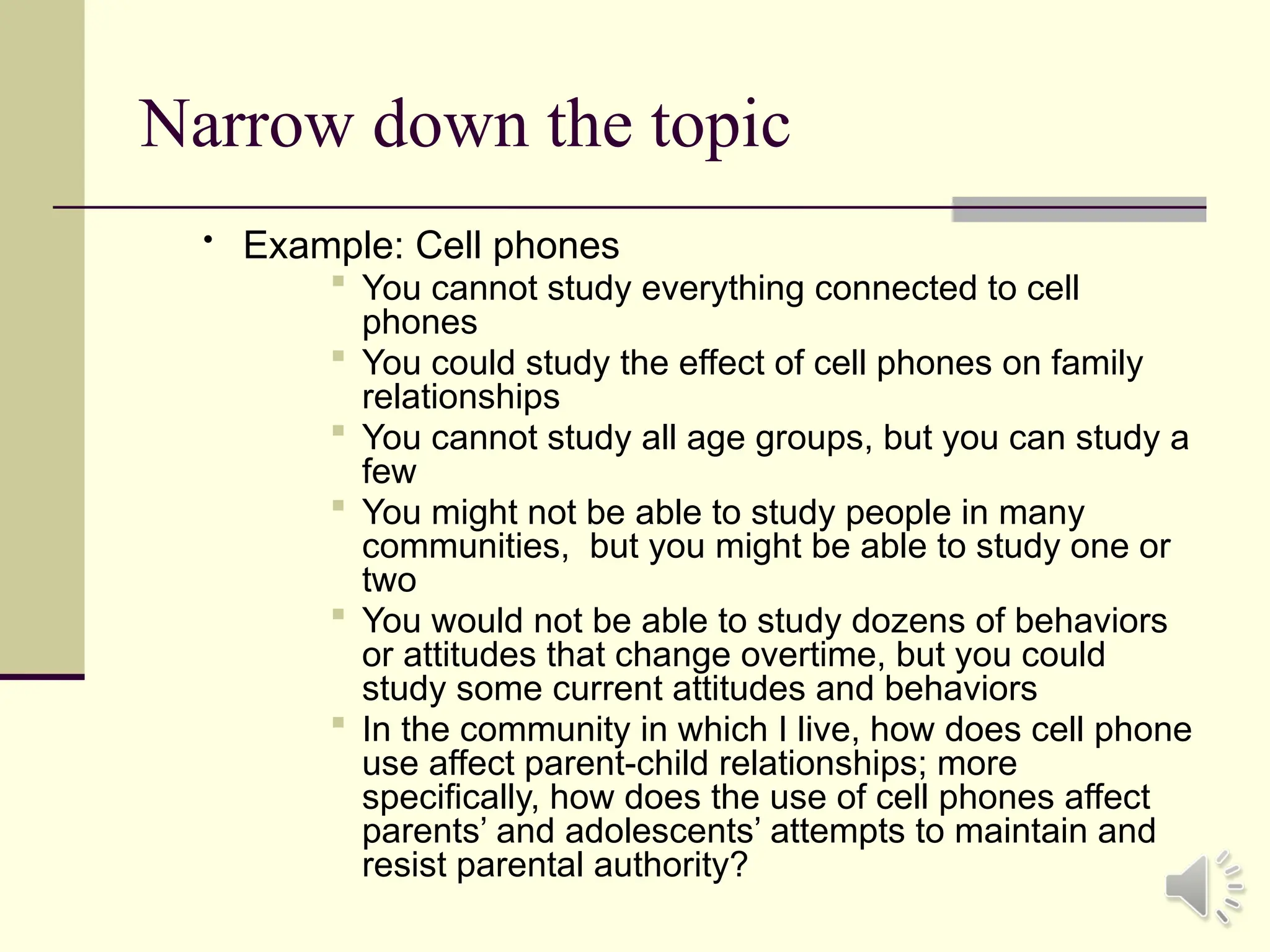
• Example: Cell phones
 You cannot study everything connected to cell
phones
 You could study the effect of cell phones on family
relationships
 You cannot study all age groups, but you can study a
few
 You might not be able to study people in many
communities, but you might be able to study one or
two
 You would not be able to study dozens of behaviors
or attitudes that change overtime, but you could
study some current attitudes and behaviors
 In the community in which I live, how does cell phone
use affect parent-child relationships; more
specifically, how does the use of cell phones affect
parents’ and adolescents’ attempts to maintain and
resist parental authority?
Summary of Recommendable
research topic
 Researchable
 Have both Independent variable(s) and
Dependent variable(s)
 Variables should be measurable
 Use action verb
 Not too long/short
 Focused/narrowed
How to introduce the
research problem
How to introduce the research problem
 Explain the background to the Problem and Context
(Showing the trend of the problem at global, regional
and national levels)
 What is the main problem (to be translated into main
objective) and sub problems ( to be translated to
specific objectives)
 What is the extent of the problem
 Support the problem with statistics
 Support the problem with policy statements and other
government/legal aspects
 What have been done so far to address the problem
and how successfully such strategies are
 Show the gap and sub gaps along the discussion
 Raise the research question and sub questions
 MUST BE ENRICHED WITH LITERATURE REVIEW (CICTATIONS)
How to write the statement of
research problem
 Briefly state the problem (summarize the background
to research problem in one or two sentences)
 What have been done to address the problem
 what have not been done (practical gap)
 What have been the effect of such missing attempt
and what will happen if such missing attempt is not
addressed
 What have been studies about the problem and what
not ( knowledge gap)
 What is the contribution of your study in addressing
the gap
Class activity: Evaluate the following statement of Research Problem
Since the beginning of the Covid pandemic, most educational institutions around the world
have transitioned to a fully online study model, at least during peak times of infections and
social distancing measures. This transition has not been easy and even two years into the
pandemic, problems with online teaching and studying persist. The increasing gap between
those with access to technology and equipment and those without access has been
determined to be one of the main challenges. Since teachers and students cannot wait for
circumstances to go back to normal, the measures that schools and universities have
implemented during the last two years, their advantages and disadvantages, and the impact
of those measures on students’ progress, satisfaction, and well-being need to be understood
so that improvements can be made and demographics that have been left behind can receive
the support they need as soon as possible.
Several studies have dwelt in assessing the capacity of educational institution towards the
application of online learning and some have focused on answering the question of what is
the executable model in handling online learning in different academic environment and
whether such models were fruitful. Though fewer studies have explained the challenges of
online learning those have been biased to higher learning institutions and more importantly
they lack the analysis pertaining to varying economic situations of the learners’ history. Poor
academic performance, drop out and further marginalization between those who have and
who have no access to online learning resources is likely to challenge the educational system
of less developed states if efforts are not made to address the problem. To identify what
issues in the learning environment were considered the most challenging in secondary
schools and how those issues relate to a variety of student academic performance, the study
conducted surveys and interviews among teachers and students at ten secondary schools.
Responses were analyzed with a focus on different student demographics and economic
status and how they might have been affected differently by the current situation.
Group work
 Read at least 10 statements of research
problem related to the area of your
specialization and evaluate them as per the
characteristics of good research problem.
Suggested Source:https://ndltd.org/ go to link
of south Africa
 Suggest and present a research problem
and researchable topic related to your field of
study
CHAPTER TWO
Literature Reviews
Purpose of a Literature Review
The literature review is a critical look at the existing
research that is significant to the work that you are
carrying out.
 To provide background information
 To establish importance of the study
 To demonstrate familiarity of the researcher to the
study area
 To discover areas for further research
Characteristics of
Effective Literature Reviews
 NB. It is paramount to note that literature
review doesn’t mean merely the
presentation of the contents. But apart from
being relevant and current, it requires the
logic flow and more important the analysis
of such content as an academic input
Characteristics of
Effective Literature Reviews
 Outlining important research trends from
global, regional and local contexts
 Assessing the strengths and weaknesses of
existing research in relation to your study
 Identifying potential gaps in knowledge in
relation to your study
 Establishing a need for current and/or future
research projects
Sections of literature review
 Theoretical
 Empirical
 Conceptual framework
• THEORETICAL REVIEW
• A theory refers to a set of statements of relationships
between VARIABLES
• Answer these questions:
• Which theory to review?
• Who developed the theory?
• What does the theory state?
• What are major variables and assumptions of the
theory?
• How does it relate to your study? Which variables and
insights adopted in your study and why
THEORETICAL REVIEW
 One theory/model may be adopted if
justifiable
 In many cases the analysis of two or more
variables is expected to tradeoff the
weakness among them. However give
reasons of applying more than one theory
and how they compelement each other
LITERATURE REVIEW
 EMPIRICAL REVIEW
 This is a source of evidence acquired from previous
studies
 Split the section as per specifc objectives
Steps for Writing a Literature
Review
 Planning
 Read critically
 argumentation
 Drafting
 Conceptual framework
 Research gap
 Revising
Planning
Since there are lots of literatures, it is
important save your time by planning in
advance of what you are going to read
Planning
 Plan the main sections and sub sections of your literature
review where the objectives acts as main sections
 Determine the main sources of information such as internet
browsers, reports/policy from government and other
agencies, existing online scholarly databases that are
relevant to your study
 Identify and read from renown experts in the field
 Identifying a focus that allows you to sort and categorize
information according to how they fit to the study.
Eliminate irrelevant information
 Search for recent literatures and avoid outdated ones. If it’s
a policy/report ensure is the current
 Focus on the contexts of your study. If your study focuses
on Tanzania, prioritize on information about Tanzania.
Read crictically
 Collect and read material.
 Summarize sources.
 Who is the author?
 What is the author's main purpose?
 What is the author’s theoretical perspective? Research
methodology?
 Who is the intended audience?
 What is the principal point, conclusion, thesis, or question?
 How is the author’s position supported?
 How does this study relate to other studies of the problem or
topic?
 What does this study add to your project?
Argumentation
Literature review is not meant for only
presentation of the content but mainly the
ability to make arguments from the content
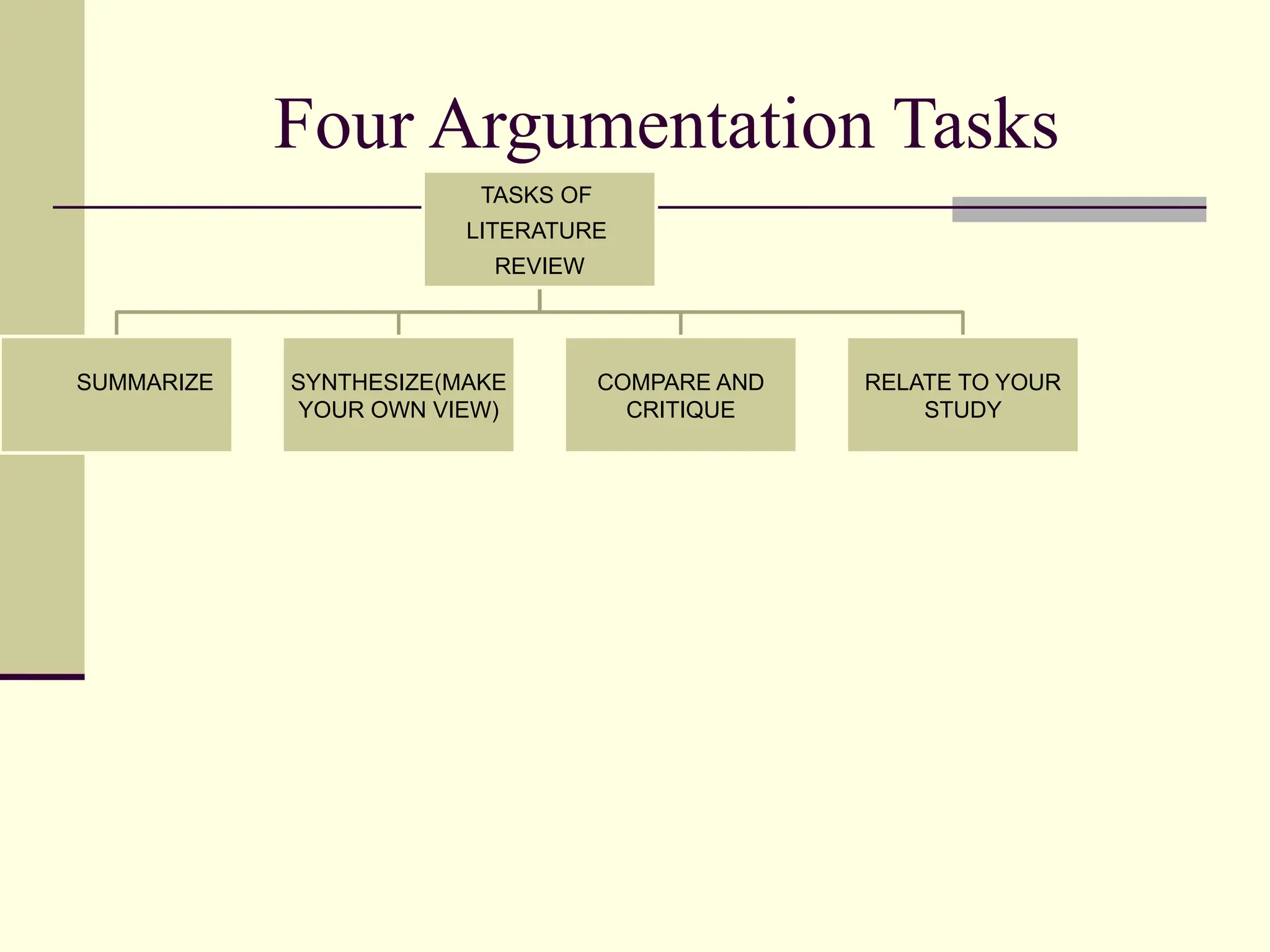
Four Argumentation Tasks
TASKS OF
LITERATURE
REVIEW
SUMMARIZE SYNTHESIZE(MAKE
YOUR OWN VIEW)
COMPARE AND
CRITIQUE
RELATE TO YOUR
STUDY
Summary and Synthesis
 In your own words, summarize and/or
synthesize the key findings relevant to your
study.
 Interpret the content
 What are the key arguments, key characteristics,
key concepts or key figures?
 What are the existing debates/theories?
Comparison and Critique
Evaluates the strength and weaknesses of the
work:
 How do the different studies relate to it? What is new,
different, or controversial?
 What views need further testing?
 What evidence is lacking, inconclusive, contradicting, or
too limited?
RELATE TO YOUR STUDY
 Show how it is useful to your study
 Indicate the variables or arguments you are
going to adopt in your study
 Show the gap and how is it addressed in your
study
Drafting
Organize the content clearly and
precisely
Drafting
 Write down what is relevant
 Use the objectives as main sub chapters
 Arrange the content in sections and sub sections under each objective
 Ensure that you include both theoretical and imperial contents.
 Usually start with narration of key concepts followed by theoretical
reviews and then empirical reviews.
 Each paragraph to stand for key idea (have the introduction, main
body, conclusion and transition statement)
Conceptual
framework
The researcher can either adopt the existing
theory/model, modify (adapt) the existing
theory/model or build a new model that combines
the variables from the theories explained
Conceptual framework
 It is a written and/or visual presentation that: -
explains either graphically and/or in narrative form,
the main things to be studied – the key factors,
concepts or variables -and the presumed
relationship among them.
 Provides the roadmap of your study
 It must reflect and operationalize the objectives of
the study
 It must reflect the constructs and variables pointed
out in literature review
 It guides the design of the research instruments like
questionnaire and some other methodological
aspects
Research gap
Summarize the literature review and the
research gap(s)
Revising
Proof read and perfect the work
Some Tips on Revising
 Title: Is my title consistent with the content of my paper?
 Introduction: Do I appropriately introduce the problem?
 Thesis: Does my review have a clear claim?
 Body: Is the organization clear? Have I provided
headings?
 Topic sentences: Have I clearly indicated the major idea(s)
of each paragraph?
 Is the review comprehensive?
 Transitions and connections: Does my writing flow?
 Conclusion: Do I provide sufficient closure?
 Spelling and Grammar: Are there any major spelling or
grammatical mistakes?
CLASSIFICATION OF
RESEARCH
NOTE: IT IS NOT COMMON TO HAVE A
PURELY ONE TYPE OF RESEARCH.
THUS MANY RESEARCH ARE MIXED
ONES THOUGH ONE TYPE CAN BE
DOMINANT
Research can be classified
according to:
1.The Research Design
2. The Uses of Research
3. The handling of time during the research
4. Approach used
According to Research Design
 Exploratory research
 Descriptive
 Causal
Exploratory research
 Is a research conducted for a problem that has not been studied more
clearly, intended to establish priorities, develop operational definitions
and improve the final research design. Exploratory research helps
determine the best research design, data-collection method and
selection of subjects.
Descriptive research
Is used to describe characteristics of a population or
phenomenon being studied. It does not answer
questions about how/when/why the characteristics
occurred
 To describe data and characteristics about the
phenomenon being studied.
 Descriptive data for who, what questions
 The description is done by descriptive statistics, e.g.
frequencies, averages, mode, median, standard
deviation
 No causality is claimed
Causal research:
 The objective of causal research is to test hypotheses
about cause-and-effect relationships.
 Determining which variable might be causing a certain
behavior in terms of cause- effect relationship
 This type of research is very complex and the
researcher can never be completely certain that there
are not other factors influencing the causal relationship,
especially when dealing with social science research
Classification according to use
 Applied research
 Basic research
Applied research
 Applied research - conducted when
a decision must be made about a
specific real-life problem.
 Management wants to make
decision based on the findings of
this kind of study.
 For example, should we advertise?
Should we price our products
above average?
 Management research is one of
Applied Research…….
 Applied Researchers may
investigate the ways to:
1. Improve agricultural crop
production
2. Treat or cure specific disease
3. Improve energy efficiency at home
and offices.
Basic Research -
fundamental/pure
 Attempts to expand the limits of
knowledge.
 Not directly involved in the solution
to a pragmatic problem.
 It is driven by scientific curiosity
and or interest in a scientific
question.
 For example, is executive success
correlated with high need for
achievement?
Time handling based classification
 Time series
 Cross section
 Longitudinal research
Time series
 Data collected over a considerable period of
time on one or more variables
 Analyse Form 4 examination performance for
10 years
Cross section research
 Involve analysis of bulk data on one or more
variables collected in a one point of time
 Example: Compare Form Four results
between public and private schools in one
period of time for 500 schools
Longitudinal research
 Contain features of both time series and
cross section data
 Involves analysis of panel data that is data
collected over a considerable period of time
across many units.
 Longitudinal research, researchers examine
the features of a unit at more than one time.
 For example: Compare Form Four
examination results between 500 public and
private schools for 10 years
Approach used
 Qualitative research
 Quantitative research
 Mixed research
Quantitative research
 In quantitative research data is represented in
the quantitative form in the form of numbers.
Statistical analysis is conducted in
quantitative research.
Qualitative research:
 This means that qualitative researchers study
things in their natural settings, attempting to make
sense of, or interpret, phenomena in terms of the
meanings people bring to them.
 It is used to gain an understanding of human
views/behavior including underlying reasons,
opinions, perceptions, motivations
 Example: To investigate the perceptions of teachers
on the reasons for mass failure in Mathematics
 However, qualitative data can be quantified and
analysed quantitatively
Mixed research approach
 Combines both quantitative and qualitative
characteristics
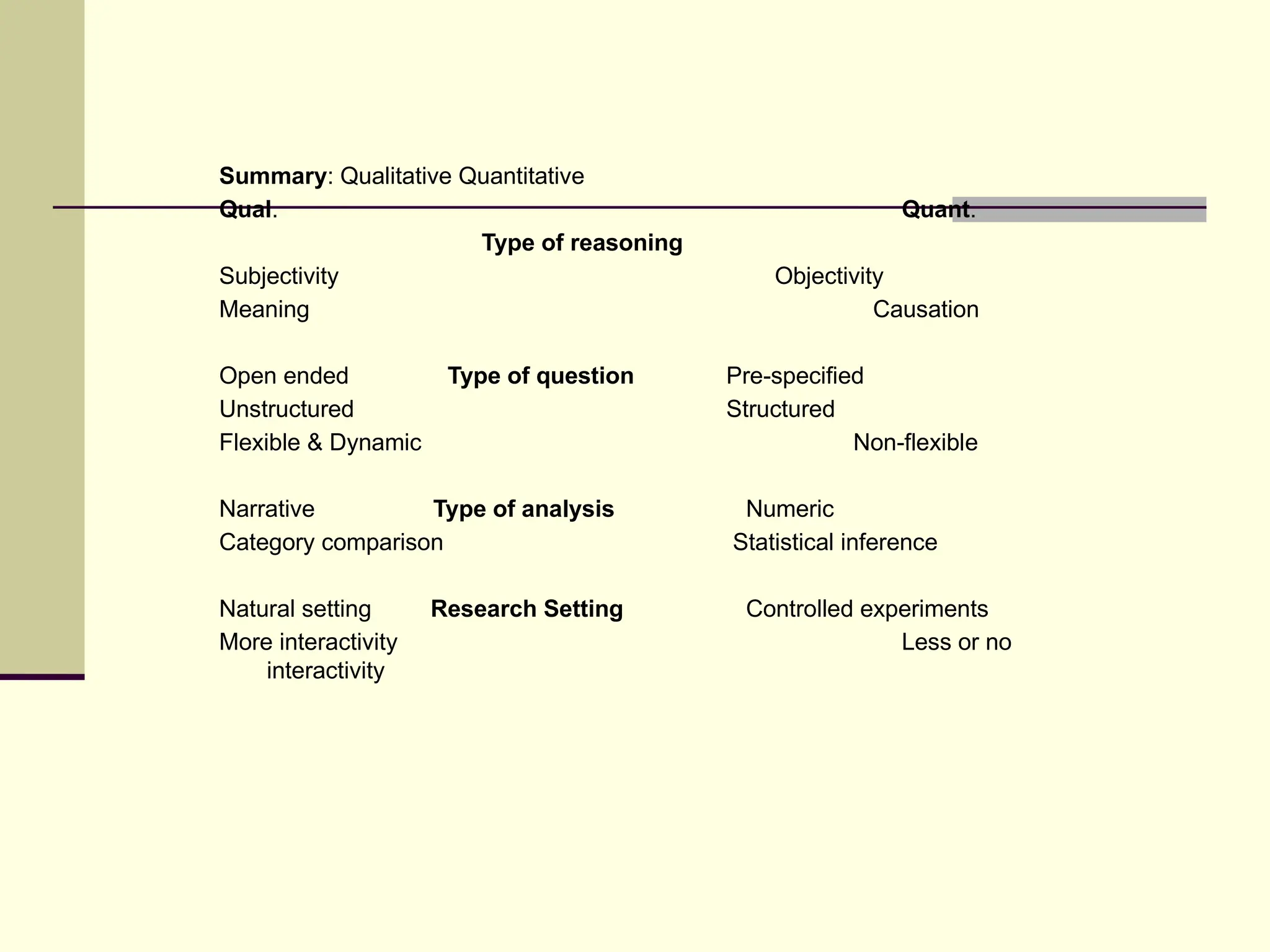
Summary: Qualitative Quantitative
Qual. Quant.
Type of reasoning
Subjectivity Objectivity
Meaning Causation
Open ended Type of question Pre-specified
Unstructured Structured
Flexible & Dynamic Non-flexible
Narrative Type of analysis Numeric
Category comparison Statistical inference
Natural setting Research Setting Controlled experiments
More interactivity Less or no
interactivity
WRITING THE RESEARCH REPORT
Writing the Research Report
The purpose of the written report is to
present the results of your research, but
more importantly to provide a persuasive
argument to readers of what you have
found.
How to Introduce a Research
Problem
 Start by a brief explanation of the nature of the
phenomenon. For example if the research is about
the COVID-19 pandemic the researcher may define
the term, state the causes, symptoms, impact and
treatment of the pandemic. However, the discussion
should be limited by the nature of the selected topic
as one may not discuss every aspect of the topic.
Nevertheless, the discussion must trend in such a
way that the importance of the study is revealed.
 Discuss how the situation (problem) trends from
different contexts for instance from first, second
and third World countries. The discussion can as
well trend from Countries outside Africa (globe
contexts), Africa and East Africa (regional
context), Tanzania (local context) and where
applicable organizational context. For example;
if a researcher is looking for the solution for
COVID – 19 pandemic in Tanzania, should
understand how the pandemic trend and dealt
with at different places of the globe.
 The discussion of the historical contexts of the
problem should go along with the identification of the
existing gaps. In general the researcher should
provide an insight of what is expected and what have
been achieved. For example, what have been
revealed about COVID – 19 pandemic (may be
causes and symptoms) and what have not been
revealed (may be treatment) (knowledge gap).
Another gap may be what measures that have been
taken to deal with the situation (may be measures to
reduce the spread of the pandemic) and how
effective they were on one side and have not been
implemented on the other side (i.e practice gap).
 The gaps should be discussed in such a way that the
main problem and sub problems are well portrayed
( to be translated to main and specific objectives)
 The policy issues and other governmental and
intergovernmental interventions should be discussed
along the historical contexts of the problem. These
evidences on the extent the problem received
governmental attention and so increase the
possibility of the research findings to be useful and
adopted.
 The discussion can be supported by providing a trend
of statistical information to indicate the magnitude of
the problems
 The section should logically flow in a way that it ends
up by showing or stating and so convincing the
reader that the study of the phenomenon is inevitable
 The analysis should be enriched with literature
analysis for academic research and so opinions and
experiences should be avoided at this stage

 How to Write a Statement of Research Problem
 Briefly state the context of the problem (summarize
the historical contexts as discussed in the preceding
section)
 Write the actual problem statement as a declarative
statement or as a question.
 Explain how previous studies have addressed the
issue and where have fallen short due to certain
limitations (knowledge gap).
 Show the consequences if the problem/gap is not
addressed
 Outline how you plan to overcome or
circumvent previous roadblocks to fill these
deficiencies(depict the main objective)
 Show how the expected solution will be useful
to address the problem and positively impact
on the society
 Ensure the statement is lucid and to the point,
without any distracting information.
 Cite credible sources as deemed necessary
 Don’t exceed one page
How to Write Research
objectives
 Another key step to writing strong research objectives
is to use the SMART format. Using this format can
make your objectives clearer and easier to
understand, which can make you more likely to
achieve them. Make sure your objectives meet these
criteria
 Be specific about your desired outcomes. Your
objectives should be clearly written and leave no
room for confusion. This can help you keep them
narrow and focused.
 Making your objectives measurable is essential to
achieving them. You can create metrics to measure
your progress toward achieving your objectives
 Be sure to create objectives that are achievable to
help you avoid getting overwhelmed by unrealistic
expectations. Make sure you have the resources and
budget to accomplish your objectives
 Make your objectives are relevant to your research
and your overall goals. This can help you stay
motivated and on track throughout your research
project
 You have to establish Time bound to help you
keep your research process on track. You can
set a major deadline for your entire project as
well as smaller deadlines for each
 Moreover, Ensure that objectives flow logically
from the statement of need and address the
problem, and that objectives should be
hierarchical and/or chronological
 The main objective reflects the main
problem/main gap while the specific objectives
reflect the sub problems/sub gaps
General Considerations for
Writing a Research report
 Read as many past research reports as you can
 Begin writing up the report as soon as you can. Do not
leave it until you have finished your data collection
before you start writing up. Many sections, can be
drafted during or even before data collection.
 Write down ideas as soon as you get them, rather than
leaving them to the writing-up stage. Keep a research
diary where you can safely note any ideas. Not all of
your ideas will be useful, but it is certain that some of
them will be! Do not imagine that you will be able to
remember these ideas at a later date.
 Be aware of the nature of the report and the intended
audience. If it is for a student research project, then
ensure you have read and understood the criteria laid
down by your institution in terms of content,
presentation, length and so on.
 If you are writing for a journal, ensure that your
research fits within the scope of that journal’s
objectives as well as its editorial requirements. If you
are producing a report or piece of consultancy,
ensure that you are clear about the requirements of
your audience.
 You may not be able to write the final report out first
time. You will need to rewrite it a number of times
before it reaches completion. You should allow for
this when planning your research timetable, and not
become discouraged when the first draft is not
perfect.
 Evaluate the content of the report by getting
somebody else to read it with a critical eye.
 Make sure before you begin writing up that you make
backups of your work at every available opportunity.
Whatever you do, do not assume that whatever you
save on a hard drive will be safe!
 You should keep your backups in a separate location.
As a further safety measure, print out what you have
written so far at regular intervals.
 The submission version should be error free at your
best level
 Maintain logical flow of idea. It is advisable for each
paragraph to present the main idea and each
paragraph to provide statement(s) pertaining to its
introduction, main body, conclusion, and linkage to
the next paragraph
 Use the specific objectives as main
themes/chapters followed by sub themes/sub
chapters as a guide
 Maintain consistence and clarity
 Use varieties of techniques such as
narrations, figures, tables, and graphs to
present the work
 Use relevant data analysis technique. Eg.
Thematic for qualitative research and
statistical models for quantitative research
 Describe and justify the methodological aspects and
their justification, including the research location,
Research design, population, sampling procedures and
techniques, sample size, research instruments design,
data sources, data analysis tools and methods, data
reliability and validity, and ethical issues. Also
acknowledge the assumptions and limitations (if any) of
methods chosen.
 Present the aspect in analytical and argumentative
manner. Interpret and discuss the literature, the
gaps, the findings and issues raised and justify your
position instead of merely presenting the content.
You can compare and contrast, show weaknesses
and/strengths of various aspects instead of merely
describing. Show how the presented aspects are
relevance to the study. For example; If you have
adapted several theories to guide the study you have
to compare and contrast their strength and
weaknesses in relation to the study, how they
complement each other and justify the aspects
adapted to the study.
 Conclude as per specific objectives and present the
concrete statements derived from the discussion
instead of repeating the presentation of the findings.
 Recommend the viable solutions and direct the same
to the relevant and responsible parties
 Ensure that you have covered all important aspects
of the report. Usually the structure of the research
report follows the Institutes’ guide. However the
following main components are expected
11. Avoid plagiarism
• Unintended must be kept to minimum depending of
Institutional policy.
• You ca avoid by:
– Provide proper citations
– Paraphrasing
– Use quotations
– Avoid using a substantial part of other’ s work
TYPICAL RESEARCH REPORT STRUCTURE
1. Title Page
2. Abstract
3. Acknowledgements
4. Contents
 Table of content
 List of Tables
 List of Figures
5. Introduction
6. Literature Review
7. Methodology
8. Results
9. Discussion
10. Conclusions and Recommendations
11. Reference List
12. Appendices
ABSTRACT
Summarizes the whole work in a page
• What your research aim was.
• Key background theory.
• What data were collected from whom, and how.
• How it was analysed.
• Key findings.
•Conclusions
•Recommendations
INTRODUCTION
•Refer previous discussion/notes
LITERATURE REVIEW
• Refer previous discussion/notes
METHODOLOGY
Describe and and justify the methodological aspects and
their justification, including the research location,
Research design, population, sampling procedures and
techniques, sample size, research instruments design,
data sources, data analysis tools and methods, data
reliability and validity, and ethical issues. Also
acknowledge the assumptions and limitations (if any) of
methods chosen.
RESULTS
• Address each objectives.
•Use appropriate themes and sub themes(sections and
sub sections)
•Use various presentation techniques
•Provide simple interpretation/implication of the data
within and across themes
•Use quotes for qualitative data.
•You can quantify and use descriptive statistics for
qualitative data
•Only report relevant results.
WRITING THE DISCUSSION
 Discuss the implications of your results in light of your
research objectives.
 Uses other reference to discuss how your findings agree
or disagree with them.
 Establish your own position with reference to the other
references and your findings
 Put more focus on key/interesting/unique findings
Ask:
 Do your findings find support in the literature?
 Were your findings predicted by the literature?
 How does your research add to the literature?
 If your findings differed from expectations, then are there
any possible explanations why?
 Does the particular theory or model you have used still
hold true in light of your research?
 If the theory or model seems imperfect, then how can it
be refined in light of your research?
CONCLUSION AND RECOMMENDATIONS
• What the key findings were.
•Should relate to aims/objectives in introduction and research
questions
•Conclude as per research questions and discussions
•Recommend as per research objective/research question
and conclusions
•Include recommendations for action and future research.
•Specify the responsible parties for action
•Recommendations should be viable
REFERENCES
Must be consistent with text.
APPENDICES
Must relate to the research, but not be directly related.
SAMPLING
 A sample is “a smaller (but hopefully
representative) collection of units from a
population used to determine truths about that
population” (Field, 2005)
Why sampling?
Get information about large populations
 Less costs
 Less field time
 More accuracy i.e. Can Do A Better Job of
Data Collection
 When it’s impossible to study the whole
population
SAMPLING……
 What is your population of interest?
 To whom do you want to generalize your
results?
 All doctors
 School children
 Low income earners
 Ask: Can you sample the entire population?
SAMPLING…….
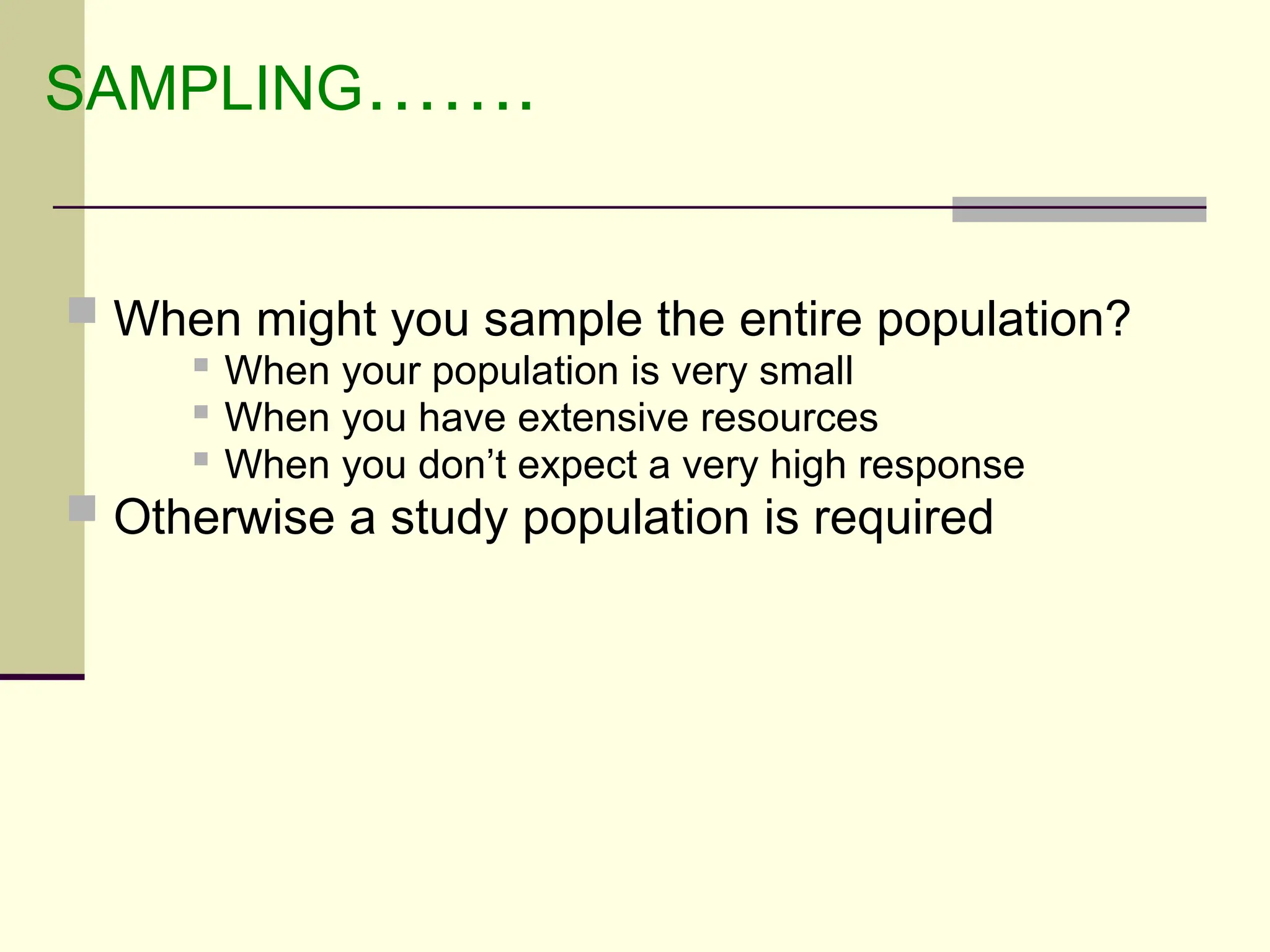
 When might you sample the entire population?

When your population is very small
 When you have extensive resources

When you don’t expect a very high response
 Otherwise a study population is required
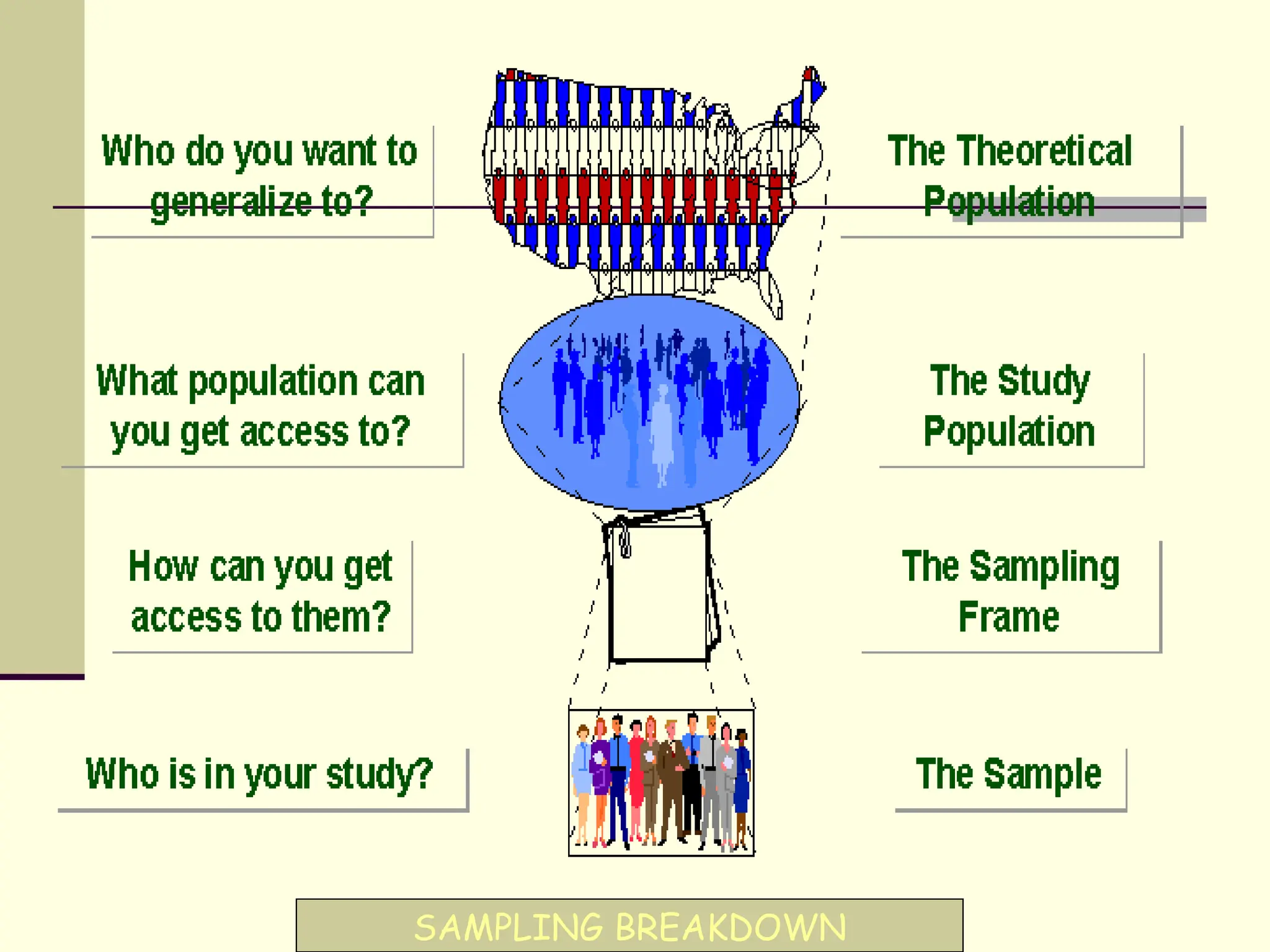
SAMPLING BREAKDOWN
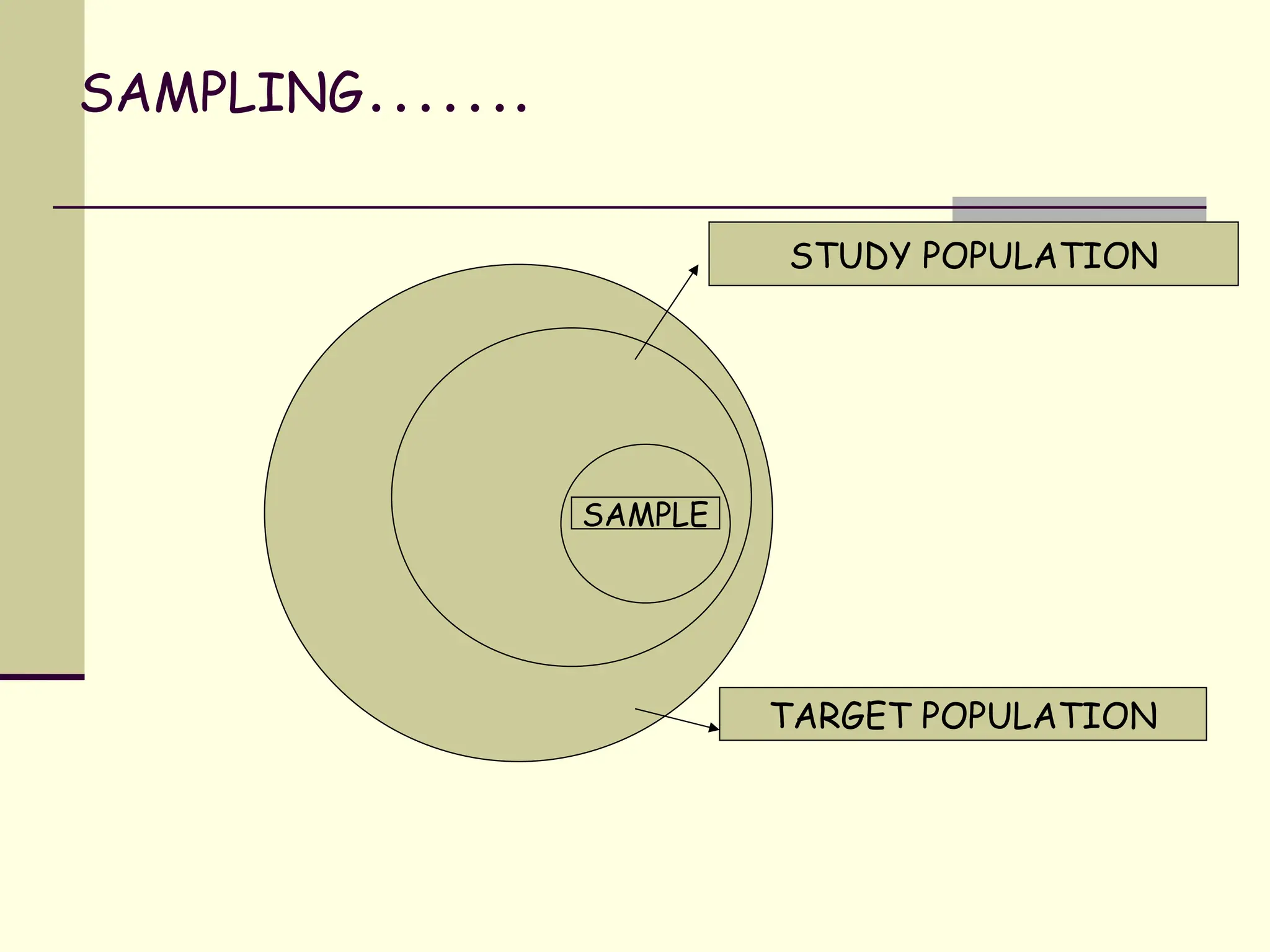
SAMPLING…….
TARGET POPULATION
STUDY POPULATION
SAMPLE
Slide 7-114
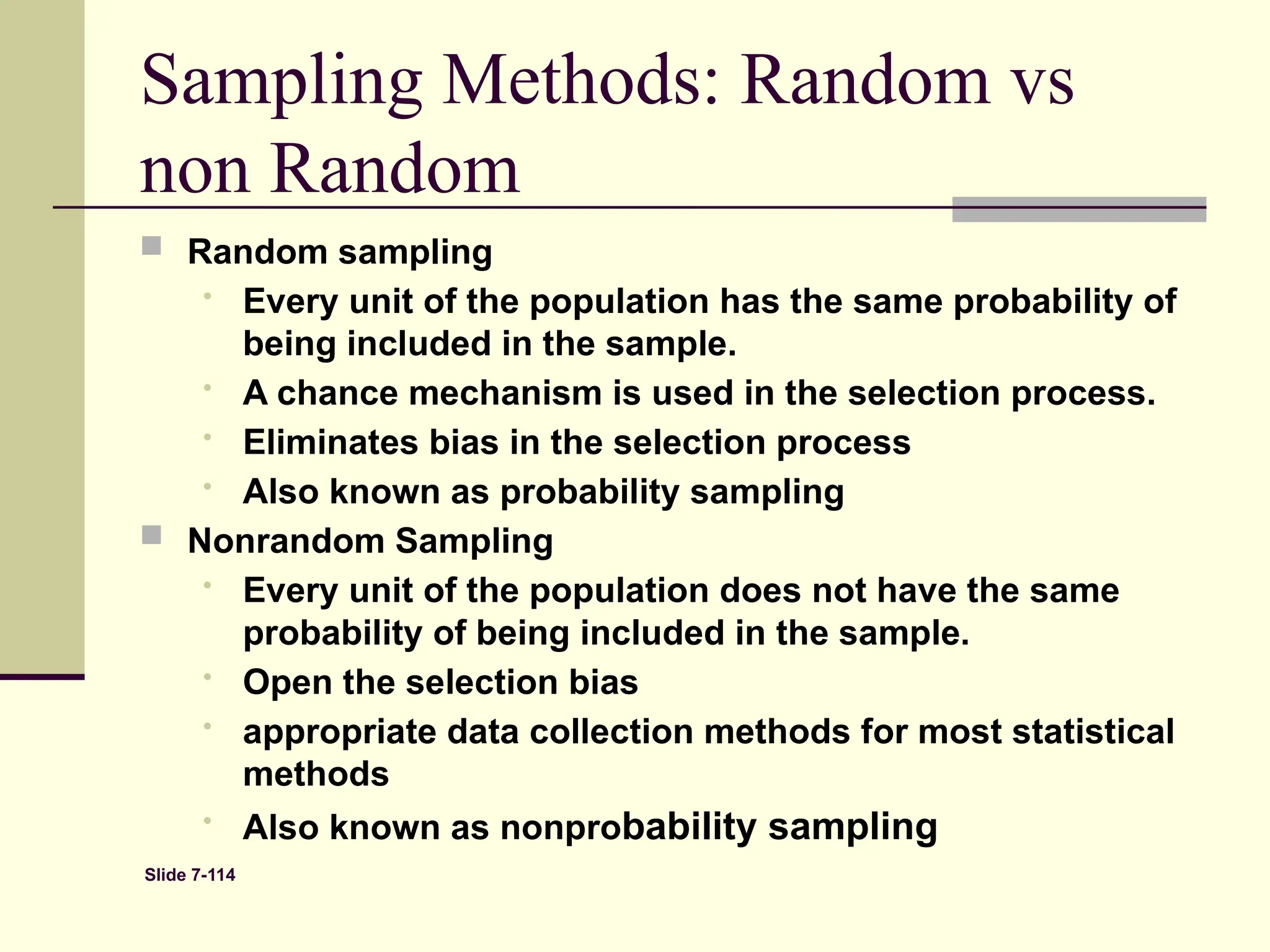
 Random sampling
• Every unit of the population has the same probability of
being included in the sample.
• A chance mechanism is used in the selection process.
• Eliminates bias in the selection process
• Also known as probability sampling
 Nonrandom Sampling
• Every unit of the population does not have the same
probability of being included in the sample.
• Open the selection bias
• appropriate data collection methods for most statistical
methods
• Also known as nonprobability sampling
Sampling Methods: Random vs
non Random
Slide 7-115
Random sampling
 Simple Random Sample
 Stratified Random Sample
 Systematic Random Sample
 Cluster (or Area) Sampling
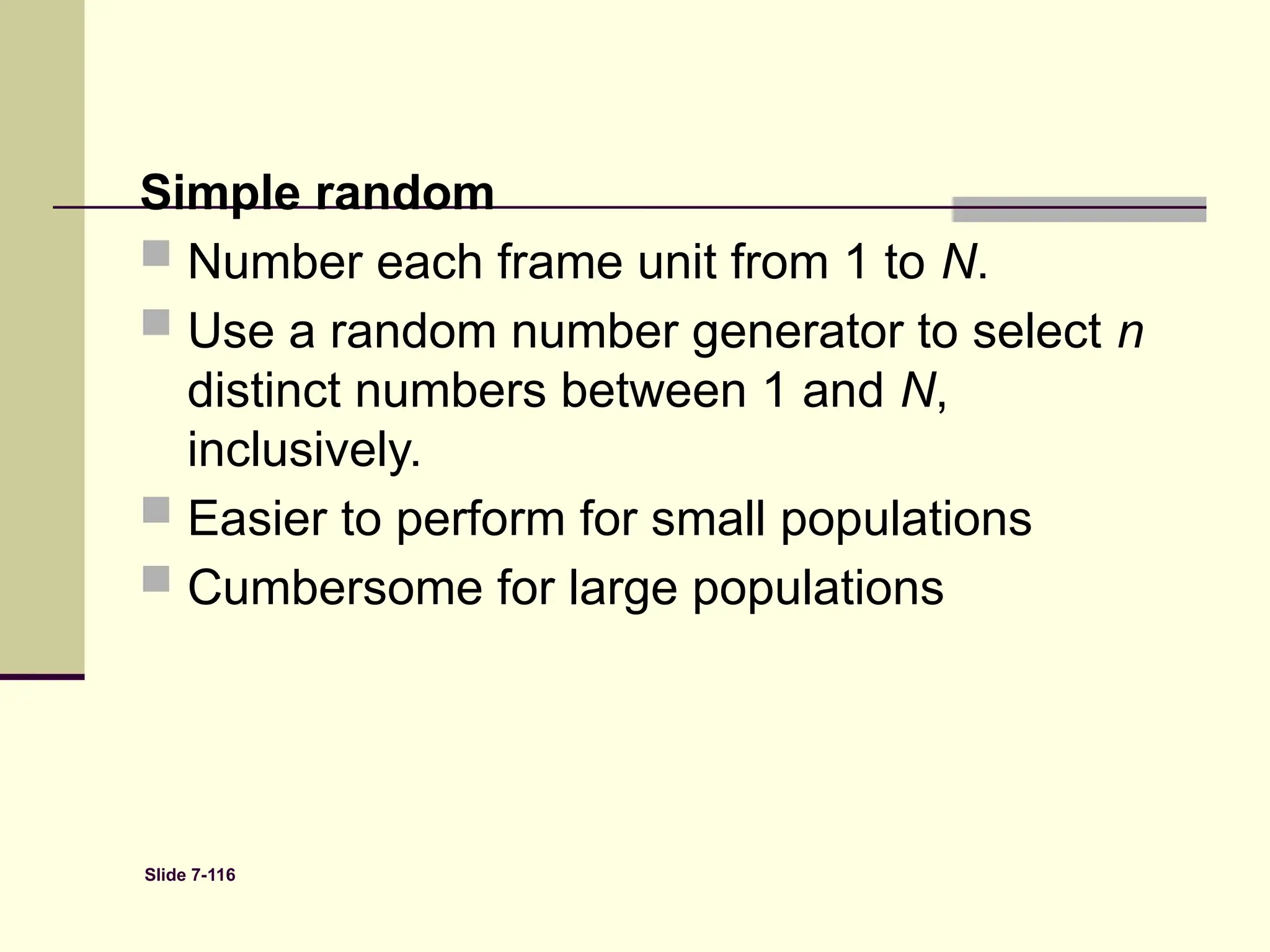
Slide 7-116
Simple random
 Number each frame unit from 1 to N.
 Use a random number generator to select n
distinct numbers between 1 and N,
inclusively.
 Easier to perform for small populations
 Cumbersome for large populations
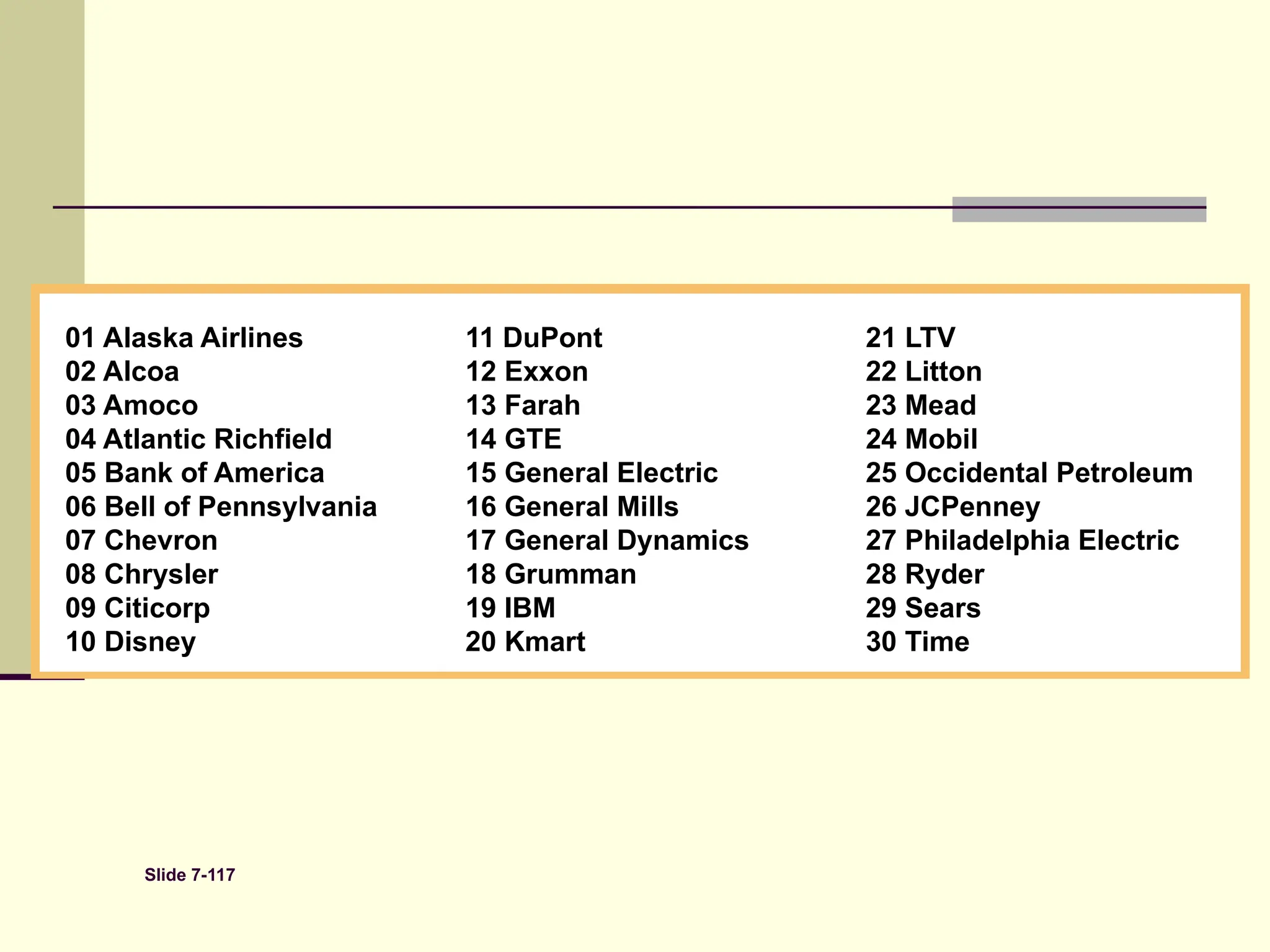
Slide 7-117
01 Alaska Airlines
02 Alcoa
03 Amoco
04 Atlantic Richfield
05 Bank of America
06 Bell of Pennsylvania
07 Chevron
08 Chrysler
09 Citicorp
10 Disney
11 DuPont
12 Exxon
13 Farah
14 GTE
15 General Electric
16 General Mills
17 General Dynamics
18 Grumman
19 IBM
20 Kmart
21 LTV
22 Litton
23 Mead
24 Mobil
25 Occidental Petroleum
26 JCPenney
27 Philadelphia Electric
28 Ryder
29 Sears
30 Time
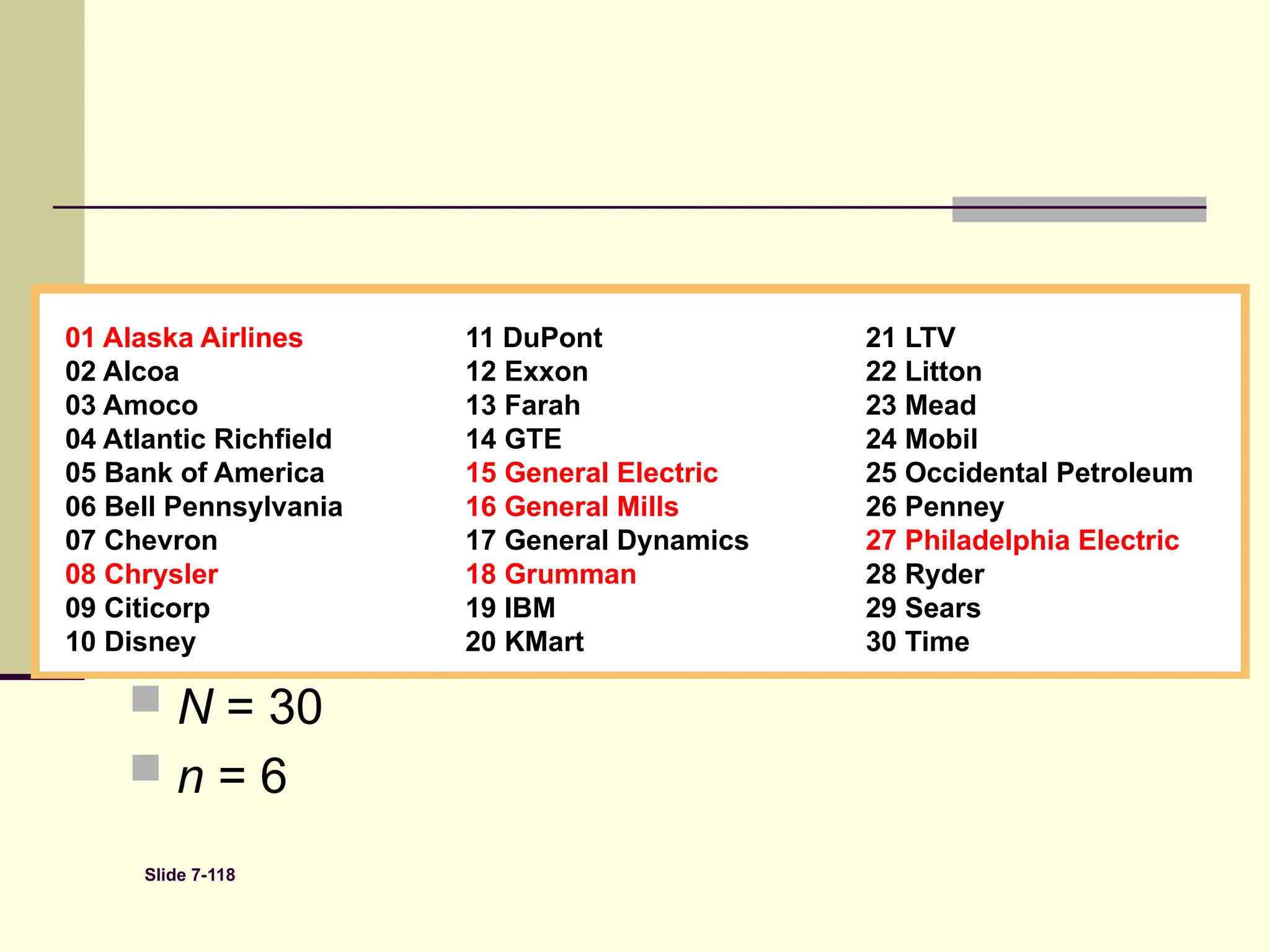
Slide 7-118
01 Alaska Airlines
02 Alcoa
03 Amoco
04 Atlantic Richfield
05 Bank of America
06 Bell Pennsylvania
07 Chevron
08 Chrysler
09 Citicorp
10 Disney
11 DuPont
12 Exxon
13 Farah
14 GTE
15 General Electric
16 General Mills
17 General Dynamics
18 Grumman
19 IBM
20 KMart
21 LTV
22 Litton
23 Mead
24 Mobil
25 Occidental Petroleum
26 Penney
27 Philadelphia Electric
28 Ryder
29 Sears
30 Time
 N = 30
 n = 6
Slide 7-119
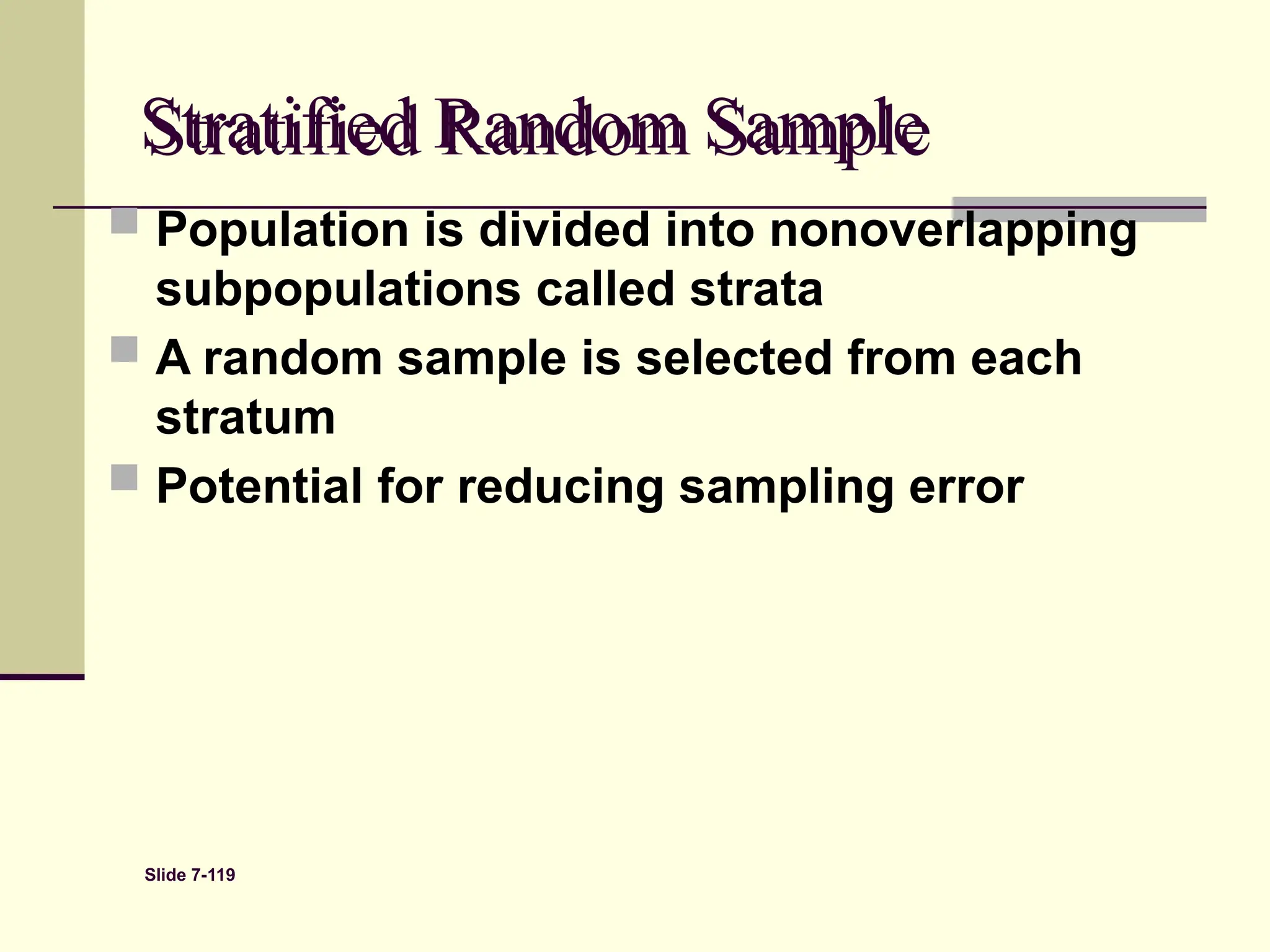
Stratified Random Sample
 Population is divided into nonoverlapping
subpopulations called strata
 A random sample is selected from each
stratum
 Potential for reducing sampling error
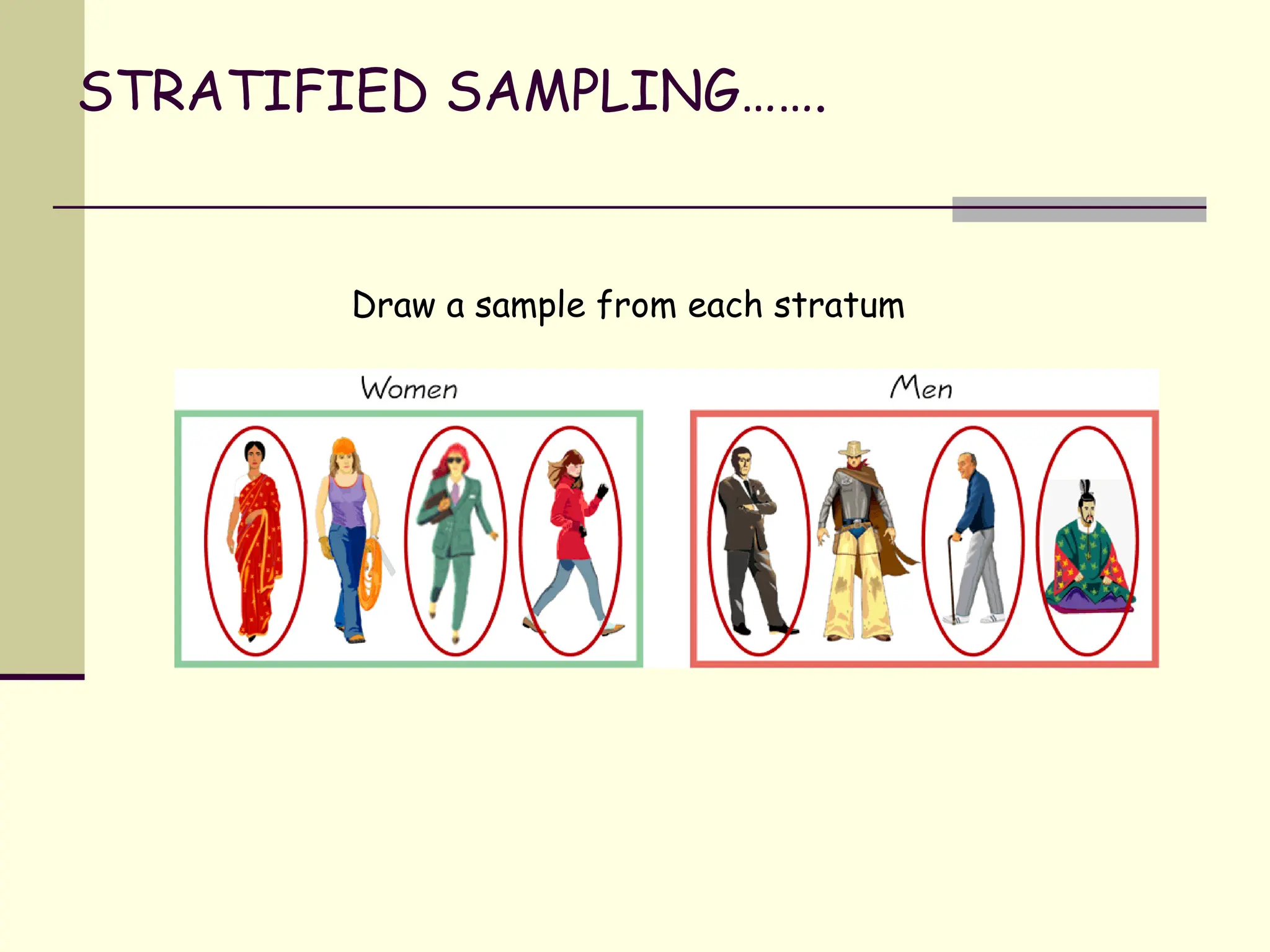
STRATIFIED SAMPLING…….
Draw a sample from each stratum
Slide 7-121
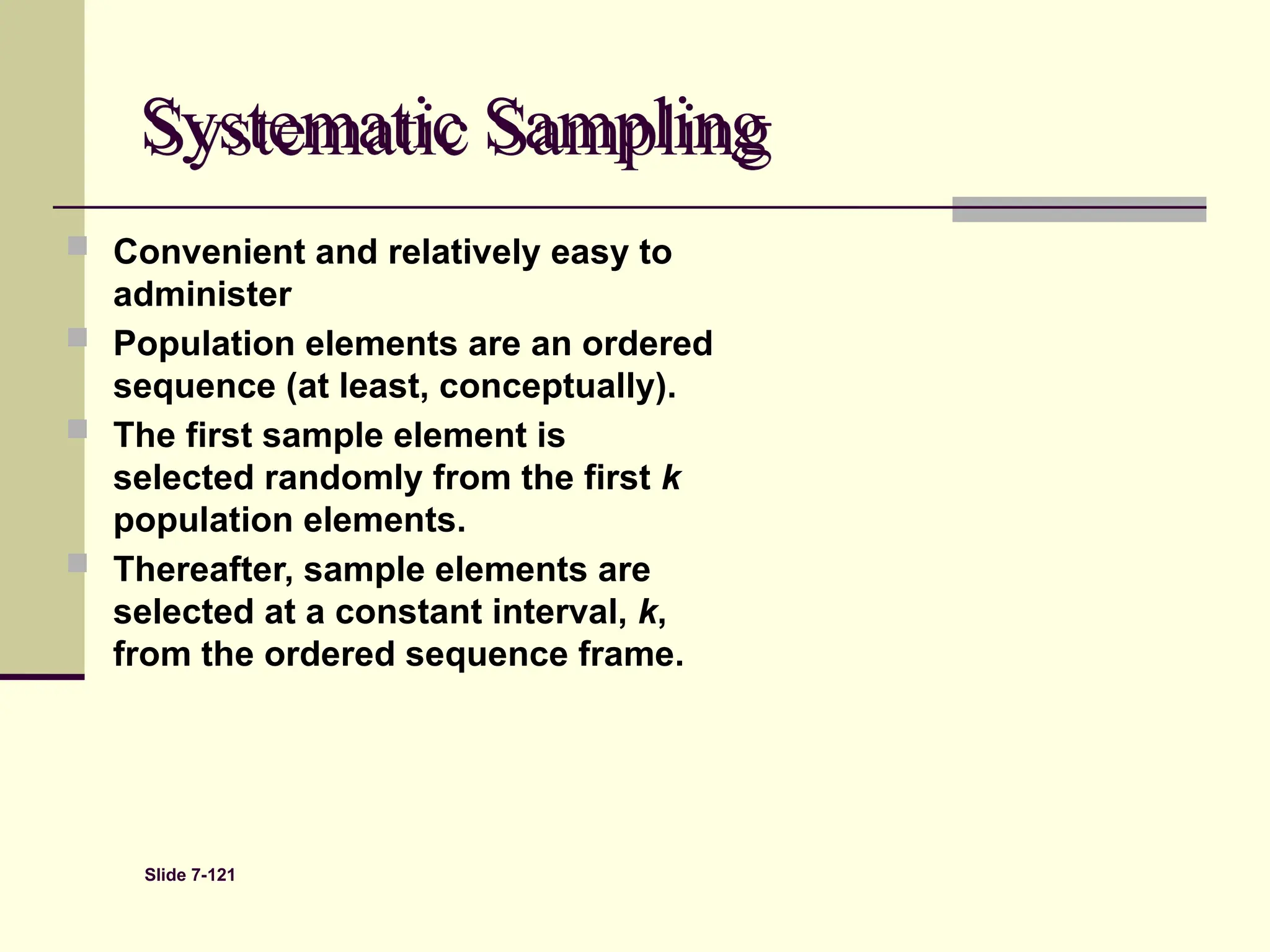
Systematic Sampling
 Convenient and relatively easy to
administer
 Population elements are an ordered
sequence (at least, conceptually).
 The first sample element is
selected randomly from the first k
population elements.
 Thereafter, sample elements are
selected at a constant interval, k,
from the ordered sequence frame.
Slide 7-122
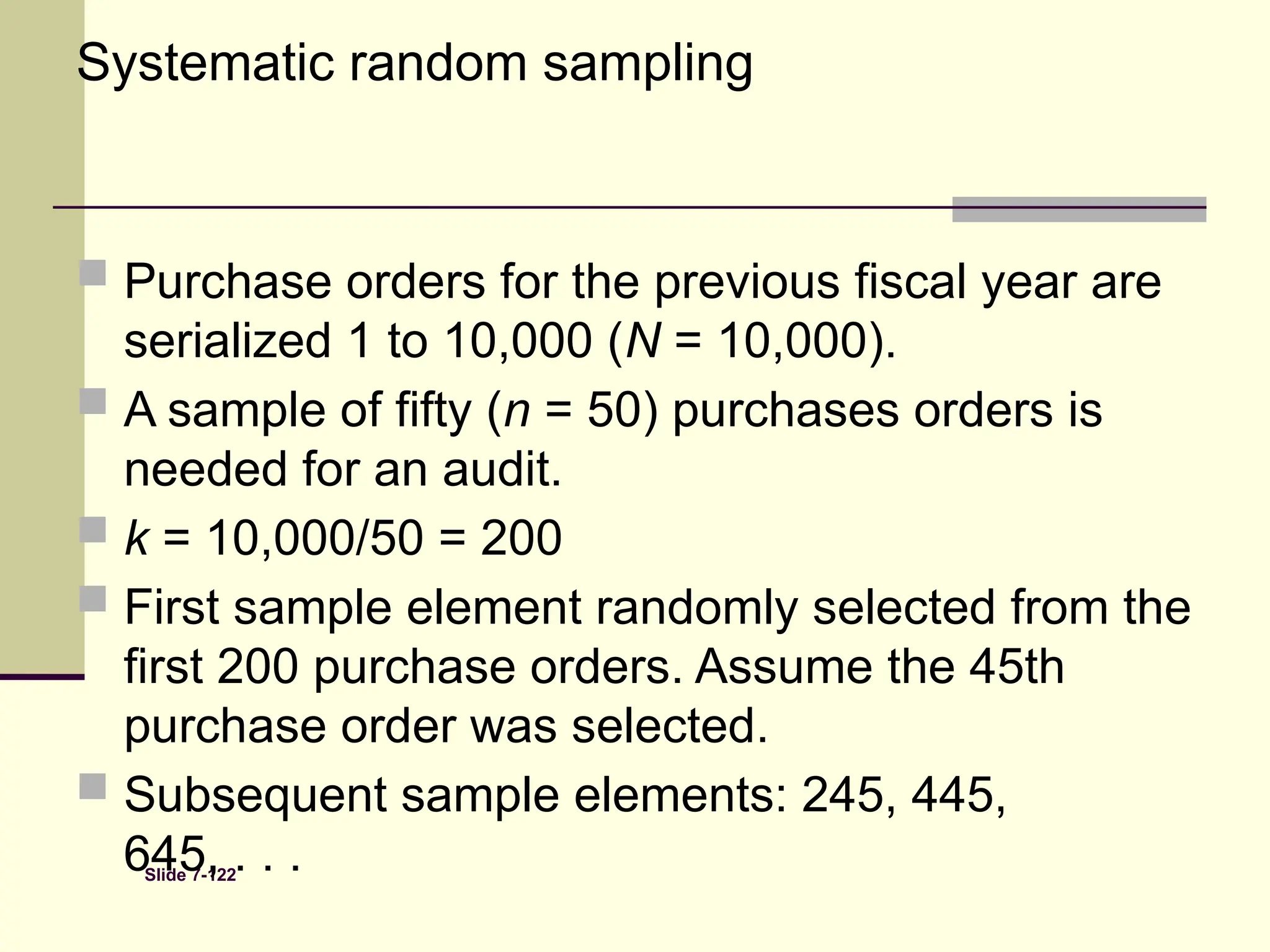
Systematic random sampling
 Purchase orders for the previous fiscal year are
serialized 1 to 10,000 (N = 10,000).
 A sample of fifty (n = 50) purchases orders is
needed for an audit.
 k = 10,000/50 = 200
 First sample element randomly selected from the
first 200 purchase orders. Assume the 45th
purchase order was selected.
 Subsequent sample elements: 245, 445,
645, . . .
Slide 7-123
Cluster sampling
 Population is divided into non overlapping
clusters or areas
 A subset of the clusters is selected randomly for
the sample.
Slide 7-124
Cluster random sampling
• More convenient for geographically dispersed
populations
• Reduced travel costs to contact sample elements
• Simplified administration of the survey
NON PROBABILITY SAMPLING
 Any sampling method where some elements of population
have no chance of selection (these are sometimes
referred to as 'out of coverage'/'undercovered'). It
involves the selection of elements based on assumptions
regarding the population of interest, which forms the
criteria for selection. Hence, because the selection of
elements is nonrandom, nonprobability sampling not allows
the estimation of sampling errors..
NONPROBABILITY SAMPLING…….
CONVENIENCE SAMPLING
 Sometimes known as grab or opportunity sampling or accidental
or haphazard sampling.
 A type of nonprobability sampling which involves the sample being
drawn from that part of the population which is close to hand.
That is, readily available and convenient.

Snow ball sampling
 In social science research,
snowball sampling is a similar technique,
where existing study subjects are used to
recruit more subjects into the sample.
Judgmental sampling or Purposive
sampling
 - The researcher chooses the sample based
on who they think would be appropriate for
the study. This is used primarily when
there is a limited number of people that
have expertise in the area being
researched
Quota Sampling
 First identify the group randomly and their
proportions as they are represented in the
population
 Then convenience or judgment sampling is
used to select the required number of subjects
from each stratum.
Exercise 2
 Read carefully the thesis/dissertation used in
exercise. Describe and evaluate the
relevance of the population, sampling
framework, sampling techniques and
procedures applied
Research Ethics
 Ethics: Principles for guiding decision
making and reconciling conflicting issues
 Research ethics concerns the
responsibility of researchers to be honest
and respectful to all individuals who are
affected by their research studies or their
reports of the studies’ results.
Examples of research subject to risk
 Research involving vulnerable groups;
 Research involving sensitive topics;
 Research involving access to confidential
records or personal information;
 Research that could induce psychological
stress, anxiety, humiliation or more than
minimal pain;
 Research involving unpleasant
interventions.
Areas for Ethical Concerns
1. The relationship between society
and science.
 Many research ideas should come
from areas considered important in
society.
 However, the governments,
researchers’ interest , and research
funding agencies may influence the
research areas.
2. Professional issues.
 The primary ethical concern here is fraudulent activity by
scientists such as plagiarism where one literally present
another's’ work as his/her own work
3. Treatment of research participants.
 This is probably the most fundamental
ethical issue.
 It involves insuring that research
participants are not harmed physically
or psychologically.
Example of Measures to protect the research
participants
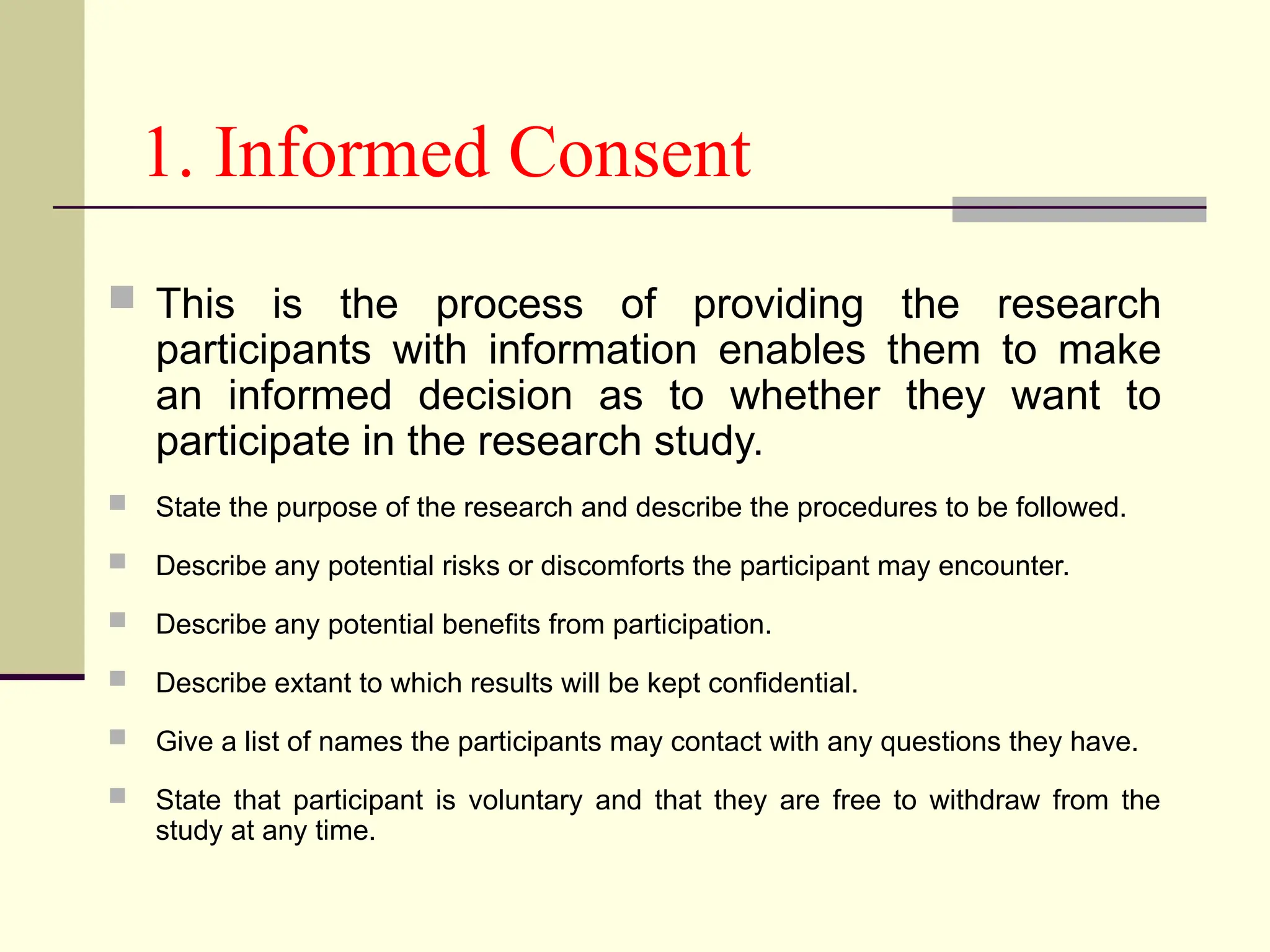
1. Informed Consent
 This is the process of providing the research
participants with information enables them to make
an informed decision as to whether they want to
participate in the research study.
 State the purpose of the research and describe the procedures to be followed.
 Describe any potential risks or discomforts the participant may encounter.
 Describe any potential benefits from participation.
 Describe extant to which results will be kept confidential.
 Give a list of names the participants may contact with any questions they have.
 State that participant is voluntary and that they are free to withdraw from the
study at any time.
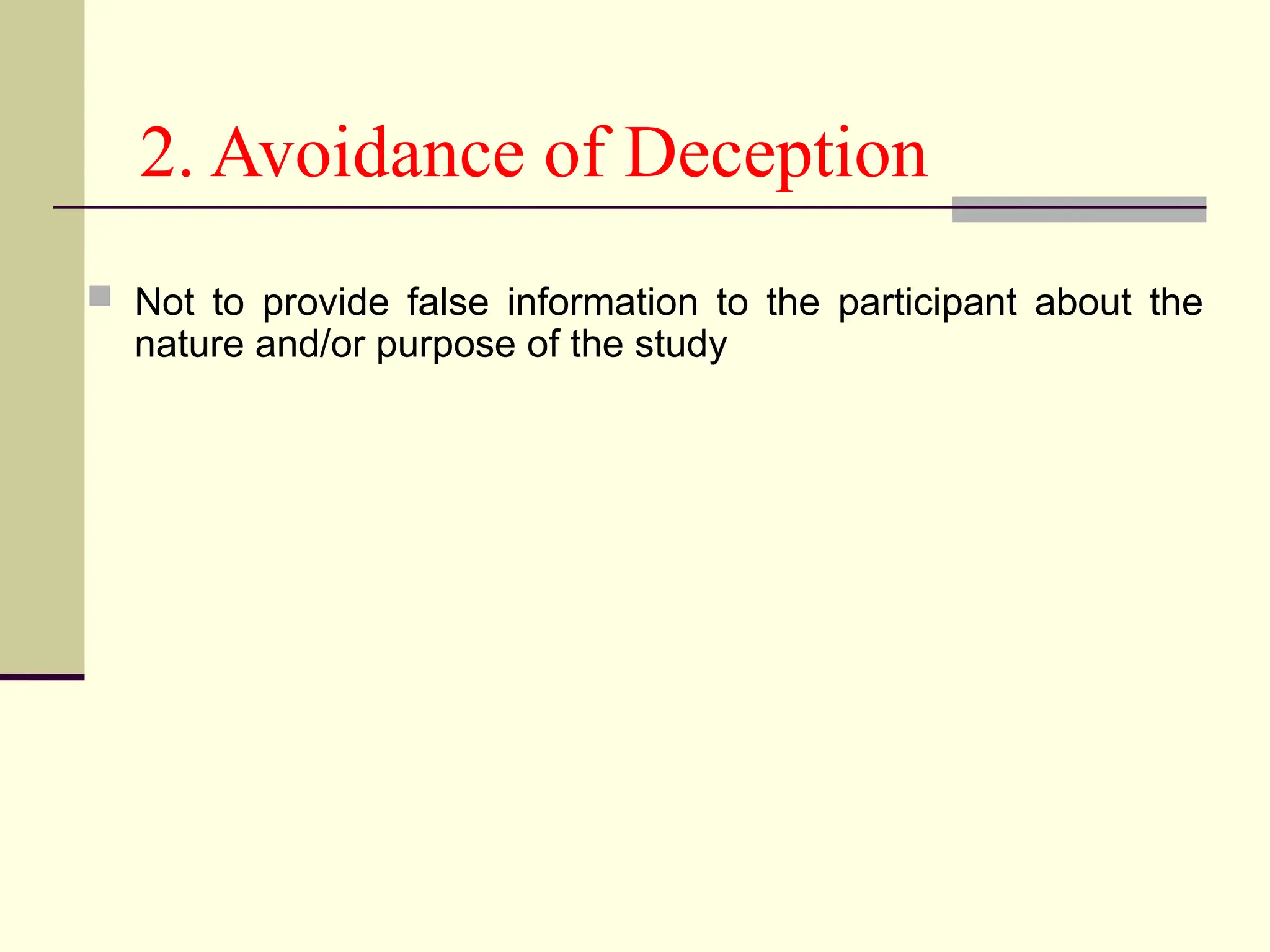
2. Avoidance of Deception
 Not to provide false information to the participant about the
nature and/or purpose of the study
3. Freedom to Withdraw
 Participants must be informed that they are
free to withdraw from the study at any time
without penalty.
 If you have a power relationship with the
participants you must be extra careful to make
sure that they really do feel free to withdraw.
4. Protection from Mental and Physical Harm
 This is the most fundamental ethical issue
confronting the researcher.
 Educational research generally poses
minimal risk to participants.
5. Protection of the participants’ identity
 Confidentiality: It requires that you guarantee that no one will be
individually identifiable in any way by you, that all your tables, reports,
and publications will only discuss findings in the aggregate.
QUALITATIVE DATA
ANALYSIS
 1. Thematic Analysis
 Definition: Identifies, analyzes, and reports
patterns or themes within data.
 Process: Involves coding data, grouping
codes into themes, and interpreting
meanings.
 Example:
In interviews with primary school teachers
about integrating sports into the curriculum, the
analyst codes responses like "sports create
bonding" and "students work better in teams."
These codes are grouped into the theme:
Cooperation and Social Skills Development.
 2. Content Analysis
 Definition: Systematic analysis of the
content of communication by counting
occurrences of specific words, phrases, or
concepts.
 Process: Can be both inductive (data-
driven) or deductive (theory-driven).
 Example:
A study on Tanzanian primary school policies
might analyze school reports and extract the
frequency of terms like "sports," "teamwork,"
and "academic achievement" to see if sports
activities are being emphasized in school
programs
3. Narrative Analysis
 Definition: Focuses on the stories people
tell and how these narratives shape their
understanding of the world.
 Process: Analyzes how individuals
structure their experiences and make sense
of events over time.
Example:
A researcher gathers life histories from
students to understand how sports activities
have influenced their development. One student
might narrate how participating in football
helped them become more confident and make
new friends.
4. Grounded Theory Analysis
Definition: Aims to generate new theories
directly from the data, rather than applying
existing theories.
Process: Data is collected and analyzed
simultaneously, with emerging concepts guiding
further data collection.
Example:
 If researchers are studying how sports
impact school cooperation, they might not
start with a predefined framework. Through
continuous interviews with teachers and
students, they develop a theory that
“structured sports competitions foster
leadership among students.”
5. Discourse Analysis
 Definition: Examines how language is used
in a specific context and how it reflects social
and cultural norms.
 Process: Analyzes written or spoken
language to explore deeper meanings and
social implications.
Example:
Analyzing the language used by Tanzanian
teachers when discussing physical education
(e.g., "playtime," "not serious work") may reveal
underlying attitudes toward sports in the
curriculum.
 Content analysis. This refers to the process of
categorizing verbal or behavioural data to
classify, summarize and tabulate the data.
 Narrative analysis. This method involves the
reformulation of stories presented by
respondents taking into account context of each
case and different experiences of each
respondent. In other words, narrative analysis is
the revision of primary qualitative data by
researcher.
 6. Phenomenological Analysis
 Definition: Focuses on understanding
people's lived experiences and the meanings
they attach to them.
 Process: Requires in-depth interviews, with
emphasis on participants' subjective
experiences.
Example:
 A study explores how students experience
teamwork in sports. Through interviews,
researchers capture the feelings students
associate with winning or losing and how
these experiences impact their motivation in
both sports and academics.

Lecture notes.pptx. Research Methods for Business

  • 1.
    INSTITUTE OF ACCOUNTANCYARUSHA MODULE: RESEARCH METHODS 2024/2025
  • 2.
    What is research? It is Research is an organized and systematic way of studying a phenomena in order to establish facts/answers to questions and reach new conclusions  Systematic because there is a definite set of procedures and steps which you will follow.  These procedures are always done in order to get the most accurate results.
  • 3.
    What is research? Research is what we do when we have a question or a problem we want to resolve  We may already think we know the answer to our question already  We may think the answer is obvious, common sense even  But until we have subjected our problem to research, our 'knowledge' remains little more than guesswork or at best, intuition.
  • 4.
  • 5.
    Main Phases ofResearch Process 1. Identifying the problem and the research gap 2. Selecting Researchable topic 3. Designing research objectives, research questions/ hypothesis 4. Literature review 5. Designing research methodologies 6. Data gathering 7. Data processing and analysis 8. Implications, Conclusions, and Recommendations
  • 6.
  • 7.
    Characteristics of agood research
  • 8.
    Supported by theLiterature  Your research problem should be relevant to the field and supported by a number of recent peer-reviewed studies in the field. Even if you identify the problem based on the recommendation of one journal article or dissertation, you will still need to conduct a literature search and ensure that other researchers support the problem and need for conducting research to further address the problem.
  • 9.
    Significant  Your researchproblem should have a positive impact on the field. The impact can be practical, in the form of direct application of the results in the field, or conceptual, where the work advances the field by filling a knowledge gap.
  • 10.
    Timely  Your researchproblem should be related to the current needs in the field and well-suited for the present status of the issues in your field. Explore what topics are being covered in current journals in the field.
  • 11.
    Novel  Your researchproblem should be original and unique. It should seek to address a gap in our knowledge or application. An exhaustive review of literature can help you identify whether the problem has already been addressed with your particular sample and/or context. Talking to experts in the research area can illuminate a problem. Replication of an existing study warrants discussion of value elsewhere, but novelty can be found in determining if an already-resolved problem holds in a new sample and/or context.
  • 12.
    Specific and Clear Your research problem should be specific enough to set the direction of the study, raise research question(s), and determine an appropriate research method and design. Vague research problems may not be useful to specify the direction of the study or develop research questions.
  • 13.
    Researchable  Research problemsare solved through the scientific method. This means research- ability, or feasibility of the problem, is more important than all of the above characteristics. You as the researcher should be able to solve the problem with your abilities and available research methods, designs, research sites, resources, and timeframe. If a research problem retains all of aforementioned characteristics but it is not researchable, it may not be an appropriate research problem.
  • 14.
    How to selecta researchable topic
  • 15.
    Selecting Researchable Topics Research Topic  A concept, subject or issue that can be studied through research
  • 16.
    Determine the Sourcesof research topic  The selection of a research topic is often the result of many factors, example:  Personal interests, experiences, values, and passions, the desire to satisfy scientific curiosity  Contemporary issues: The current political, economic, and social climates  Literature review  Data accessibility  Sponsorship: Having a way to fund a study  Variables are clearly identified
  • 17.
    Sources of researchtopic  Personal Factors  Personal interests often influence researchers’ specific research topics  Having a strong personal interests can lead to the willingness to make the necessary investment of time and energy  Ambitions for future prospectives
  • 18.
    Sources of researchtopic  Contemporary issues: Research and Social, Political and Economic World  Change in society influences research on topics  E.g. Gender, Sexual Orientation  Before the 1970s, some studies focused on women, as a result of the women's movement in the late 1960s and early 70s, scholars began to study women and their lives  Current events focus attention: e.g. natural disasters, poverty, outbreak of pandemics like COVID- 19 e.t.c.
  • 19.
    Sources of researchtopic  Research Funding  Some research projects are funded through private foundations, government agencies, local and state institutions, or corporate sponsors
  • 20.
    Sources of researchtopic  Research Funding  Funding research expresses a value choice  The particular values associated with a specific project affect funding as the appropriations process for research is part of a larger political process  The availability of funding and economic support can influence a study  The questions asked  The amount and kind of data collected  The availability of the resulting research report
  • 21.
    Reviewing the Literaturein choosing the Research topic  Why?  Be informed!  Don’t want to duplicate pre-existing research.
  • 22.
    Types of Literature Scholarly versus General Sources  Scholarly: For professionals and students.  General: For general public.
  • 23.
    Scholarly literature  Mostscholarly works(primary sources) will contain the following sections:  Abstract  Introduction  Literature review  Methods  Results  Discussion  Conclusion and recommendations
  • 24.
    Determine Variables tobe measured  A variable in research refers to a person, place, thing, or phenomenon that you are trying to measure in some way.  The independent and dependent variables and their relationship must be featured from the research topic  It is helpful to ensure a researchable topic and determine the focus from the very biginning
  • 25.
    Narrow down thetopic  Narrow down the broad area of interest into something that is manageable
  • 26.
    Narrow down thetopic • Example: Cell phones  You cannot study everything connected to cell phones  You could study the effect of cell phones on family relationships  You cannot study all age groups, but you can study a few  You might not be able to study people in many communities, but you might be able to study one or two  You would not be able to study dozens of behaviors or attitudes that change overtime, but you could study some current attitudes and behaviors  In the community in which I live, how does cell phone use affect parent-child relationships; more specifically, how does the use of cell phones affect parents’ and adolescents’ attempts to maintain and resist parental authority?
  • 27.
    Summary of Recommendable researchtopic  Researchable  Have both Independent variable(s) and Dependent variable(s)  Variables should be measurable  Use action verb  Not too long/short  Focused/narrowed
  • 28.
    How to introducethe research problem
  • 29.
    How to introducethe research problem  Explain the background to the Problem and Context (Showing the trend of the problem at global, regional and national levels)  What is the main problem (to be translated into main objective) and sub problems ( to be translated to specific objectives)  What is the extent of the problem  Support the problem with statistics  Support the problem with policy statements and other government/legal aspects  What have been done so far to address the problem and how successfully such strategies are  Show the gap and sub gaps along the discussion  Raise the research question and sub questions  MUST BE ENRICHED WITH LITERATURE REVIEW (CICTATIONS)
  • 30.
    How to writethe statement of research problem  Briefly state the problem (summarize the background to research problem in one or two sentences)  What have been done to address the problem  what have not been done (practical gap)  What have been the effect of such missing attempt and what will happen if such missing attempt is not addressed  What have been studies about the problem and what not ( knowledge gap)  What is the contribution of your study in addressing the gap
  • 31.
    Class activity: Evaluatethe following statement of Research Problem Since the beginning of the Covid pandemic, most educational institutions around the world have transitioned to a fully online study model, at least during peak times of infections and social distancing measures. This transition has not been easy and even two years into the pandemic, problems with online teaching and studying persist. The increasing gap between those with access to technology and equipment and those without access has been determined to be one of the main challenges. Since teachers and students cannot wait for circumstances to go back to normal, the measures that schools and universities have implemented during the last two years, their advantages and disadvantages, and the impact of those measures on students’ progress, satisfaction, and well-being need to be understood so that improvements can be made and demographics that have been left behind can receive the support they need as soon as possible. Several studies have dwelt in assessing the capacity of educational institution towards the application of online learning and some have focused on answering the question of what is the executable model in handling online learning in different academic environment and whether such models were fruitful. Though fewer studies have explained the challenges of online learning those have been biased to higher learning institutions and more importantly they lack the analysis pertaining to varying economic situations of the learners’ history. Poor academic performance, drop out and further marginalization between those who have and who have no access to online learning resources is likely to challenge the educational system of less developed states if efforts are not made to address the problem. To identify what issues in the learning environment were considered the most challenging in secondary schools and how those issues relate to a variety of student academic performance, the study conducted surveys and interviews among teachers and students at ten secondary schools. Responses were analyzed with a focus on different student demographics and economic status and how they might have been affected differently by the current situation.
  • 32.
    Group work  Readat least 10 statements of research problem related to the area of your specialization and evaluate them as per the characteristics of good research problem. Suggested Source:https://ndltd.org/ go to link of south Africa  Suggest and present a research problem and researchable topic related to your field of study
  • 33.
  • 34.
    Purpose of aLiterature Review The literature review is a critical look at the existing research that is significant to the work that you are carrying out.  To provide background information  To establish importance of the study  To demonstrate familiarity of the researcher to the study area  To discover areas for further research
  • 35.
    Characteristics of Effective LiteratureReviews  NB. It is paramount to note that literature review doesn’t mean merely the presentation of the contents. But apart from being relevant and current, it requires the logic flow and more important the analysis of such content as an academic input
  • 36.
    Characteristics of Effective LiteratureReviews  Outlining important research trends from global, regional and local contexts  Assessing the strengths and weaknesses of existing research in relation to your study  Identifying potential gaps in knowledge in relation to your study  Establishing a need for current and/or future research projects
  • 37.
    Sections of literaturereview  Theoretical  Empirical  Conceptual framework
  • 38.
    • THEORETICAL REVIEW •A theory refers to a set of statements of relationships between VARIABLES • Answer these questions: • Which theory to review? • Who developed the theory? • What does the theory state? • What are major variables and assumptions of the theory? • How does it relate to your study? Which variables and insights adopted in your study and why
  • 39.
    THEORETICAL REVIEW  Onetheory/model may be adopted if justifiable  In many cases the analysis of two or more variables is expected to tradeoff the weakness among them. However give reasons of applying more than one theory and how they compelement each other
  • 40.
    LITERATURE REVIEW  EMPIRICALREVIEW  This is a source of evidence acquired from previous studies  Split the section as per specifc objectives
  • 41.
    Steps for Writinga Literature Review  Planning  Read critically  argumentation  Drafting  Conceptual framework  Research gap  Revising
  • 42.
    Planning Since there arelots of literatures, it is important save your time by planning in advance of what you are going to read
  • 43.
    Planning  Plan themain sections and sub sections of your literature review where the objectives acts as main sections  Determine the main sources of information such as internet browsers, reports/policy from government and other agencies, existing online scholarly databases that are relevant to your study  Identify and read from renown experts in the field  Identifying a focus that allows you to sort and categorize information according to how they fit to the study. Eliminate irrelevant information  Search for recent literatures and avoid outdated ones. If it’s a policy/report ensure is the current  Focus on the contexts of your study. If your study focuses on Tanzania, prioritize on information about Tanzania.
  • 44.
    Read crictically  Collectand read material.  Summarize sources.  Who is the author?  What is the author's main purpose?  What is the author’s theoretical perspective? Research methodology?  Who is the intended audience?  What is the principal point, conclusion, thesis, or question?  How is the author’s position supported?  How does this study relate to other studies of the problem or topic?  What does this study add to your project?
  • 45.
    Argumentation Literature review isnot meant for only presentation of the content but mainly the ability to make arguments from the content
  • 46.
    Four Argumentation Tasks TASKSOF LITERATURE REVIEW SUMMARIZE SYNTHESIZE(MAKE YOUR OWN VIEW) COMPARE AND CRITIQUE RELATE TO YOUR STUDY
  • 47.
    Summary and Synthesis In your own words, summarize and/or synthesize the key findings relevant to your study.  Interpret the content  What are the key arguments, key characteristics, key concepts or key figures?  What are the existing debates/theories?
  • 48.
    Comparison and Critique Evaluatesthe strength and weaknesses of the work:  How do the different studies relate to it? What is new, different, or controversial?  What views need further testing?  What evidence is lacking, inconclusive, contradicting, or too limited?
  • 49.
    RELATE TO YOURSTUDY  Show how it is useful to your study  Indicate the variables or arguments you are going to adopt in your study  Show the gap and how is it addressed in your study
  • 50.
    Drafting Organize the contentclearly and precisely
  • 51.
    Drafting  Write downwhat is relevant  Use the objectives as main sub chapters  Arrange the content in sections and sub sections under each objective  Ensure that you include both theoretical and imperial contents.  Usually start with narration of key concepts followed by theoretical reviews and then empirical reviews.  Each paragraph to stand for key idea (have the introduction, main body, conclusion and transition statement)
  • 52.
    Conceptual framework The researcher caneither adopt the existing theory/model, modify (adapt) the existing theory/model or build a new model that combines the variables from the theories explained
  • 53.
    Conceptual framework  Itis a written and/or visual presentation that: - explains either graphically and/or in narrative form, the main things to be studied – the key factors, concepts or variables -and the presumed relationship among them.  Provides the roadmap of your study  It must reflect and operationalize the objectives of the study  It must reflect the constructs and variables pointed out in literature review  It guides the design of the research instruments like questionnaire and some other methodological aspects
  • 54.
    Research gap Summarize theliterature review and the research gap(s)
  • 55.
    Revising Proof read andperfect the work
  • 56.
    Some Tips onRevising  Title: Is my title consistent with the content of my paper?  Introduction: Do I appropriately introduce the problem?  Thesis: Does my review have a clear claim?  Body: Is the organization clear? Have I provided headings?  Topic sentences: Have I clearly indicated the major idea(s) of each paragraph?  Is the review comprehensive?  Transitions and connections: Does my writing flow?  Conclusion: Do I provide sufficient closure?  Spelling and Grammar: Are there any major spelling or grammatical mistakes?
  • 57.
    CLASSIFICATION OF RESEARCH NOTE: ITIS NOT COMMON TO HAVE A PURELY ONE TYPE OF RESEARCH. THUS MANY RESEARCH ARE MIXED ONES THOUGH ONE TYPE CAN BE DOMINANT
  • 58.
    Research can beclassified according to: 1.The Research Design 2. The Uses of Research 3. The handling of time during the research 4. Approach used
  • 59.
    According to ResearchDesign  Exploratory research  Descriptive  Causal
  • 60.
    Exploratory research  Isa research conducted for a problem that has not been studied more clearly, intended to establish priorities, develop operational definitions and improve the final research design. Exploratory research helps determine the best research design, data-collection method and selection of subjects.
  • 61.
    Descriptive research Is usedto describe characteristics of a population or phenomenon being studied. It does not answer questions about how/when/why the characteristics occurred  To describe data and characteristics about the phenomenon being studied.  Descriptive data for who, what questions  The description is done by descriptive statistics, e.g. frequencies, averages, mode, median, standard deviation  No causality is claimed
  • 62.
    Causal research:  Theobjective of causal research is to test hypotheses about cause-and-effect relationships.  Determining which variable might be causing a certain behavior in terms of cause- effect relationship  This type of research is very complex and the researcher can never be completely certain that there are not other factors influencing the causal relationship, especially when dealing with social science research
  • 63.
    Classification according touse  Applied research  Basic research
  • 64.
    Applied research  Appliedresearch - conducted when a decision must be made about a specific real-life problem.  Management wants to make decision based on the findings of this kind of study.  For example, should we advertise? Should we price our products above average?  Management research is one of
  • 65.
    Applied Research…….  AppliedResearchers may investigate the ways to: 1. Improve agricultural crop production 2. Treat or cure specific disease 3. Improve energy efficiency at home and offices.
  • 66.
    Basic Research - fundamental/pure Attempts to expand the limits of knowledge.  Not directly involved in the solution to a pragmatic problem.  It is driven by scientific curiosity and or interest in a scientific question.  For example, is executive success correlated with high need for achievement?
  • 67.
    Time handling basedclassification  Time series  Cross section  Longitudinal research
  • 68.
    Time series  Datacollected over a considerable period of time on one or more variables  Analyse Form 4 examination performance for 10 years
  • 69.
    Cross section research Involve analysis of bulk data on one or more variables collected in a one point of time  Example: Compare Form Four results between public and private schools in one period of time for 500 schools
  • 70.
    Longitudinal research  Containfeatures of both time series and cross section data  Involves analysis of panel data that is data collected over a considerable period of time across many units.  Longitudinal research, researchers examine the features of a unit at more than one time.  For example: Compare Form Four examination results between 500 public and private schools for 10 years
  • 71.
    Approach used  Qualitativeresearch  Quantitative research  Mixed research
  • 72.
    Quantitative research  Inquantitative research data is represented in the quantitative form in the form of numbers. Statistical analysis is conducted in quantitative research.
  • 73.
    Qualitative research:  Thismeans that qualitative researchers study things in their natural settings, attempting to make sense of, or interpret, phenomena in terms of the meanings people bring to them.  It is used to gain an understanding of human views/behavior including underlying reasons, opinions, perceptions, motivations  Example: To investigate the perceptions of teachers on the reasons for mass failure in Mathematics  However, qualitative data can be quantified and analysed quantitatively
  • 74.
    Mixed research approach Combines both quantitative and qualitative characteristics
  • 75.
    Summary: Qualitative Quantitative Qual.Quant. Type of reasoning Subjectivity Objectivity Meaning Causation Open ended Type of question Pre-specified Unstructured Structured Flexible & Dynamic Non-flexible Narrative Type of analysis Numeric Category comparison Statistical inference Natural setting Research Setting Controlled experiments More interactivity Less or no interactivity
  • 76.
  • 77.
    Writing the ResearchReport The purpose of the written report is to present the results of your research, but more importantly to provide a persuasive argument to readers of what you have found.
  • 78.
    How to Introducea Research Problem  Start by a brief explanation of the nature of the phenomenon. For example if the research is about the COVID-19 pandemic the researcher may define the term, state the causes, symptoms, impact and treatment of the pandemic. However, the discussion should be limited by the nature of the selected topic as one may not discuss every aspect of the topic. Nevertheless, the discussion must trend in such a way that the importance of the study is revealed.
  • 79.
     Discuss howthe situation (problem) trends from different contexts for instance from first, second and third World countries. The discussion can as well trend from Countries outside Africa (globe contexts), Africa and East Africa (regional context), Tanzania (local context) and where applicable organizational context. For example; if a researcher is looking for the solution for COVID – 19 pandemic in Tanzania, should understand how the pandemic trend and dealt with at different places of the globe.
  • 80.
     The discussionof the historical contexts of the problem should go along with the identification of the existing gaps. In general the researcher should provide an insight of what is expected and what have been achieved. For example, what have been revealed about COVID – 19 pandemic (may be causes and symptoms) and what have not been revealed (may be treatment) (knowledge gap). Another gap may be what measures that have been taken to deal with the situation (may be measures to reduce the spread of the pandemic) and how effective they were on one side and have not been implemented on the other side (i.e practice gap).
  • 81.
     The gapsshould be discussed in such a way that the main problem and sub problems are well portrayed ( to be translated to main and specific objectives)  The policy issues and other governmental and intergovernmental interventions should be discussed along the historical contexts of the problem. These evidences on the extent the problem received governmental attention and so increase the possibility of the research findings to be useful and adopted.
  • 82.
     The discussioncan be supported by providing a trend of statistical information to indicate the magnitude of the problems  The section should logically flow in a way that it ends up by showing or stating and so convincing the reader that the study of the phenomenon is inevitable  The analysis should be enriched with literature analysis for academic research and so opinions and experiences should be avoided at this stage 
  • 83.
     How toWrite a Statement of Research Problem  Briefly state the context of the problem (summarize the historical contexts as discussed in the preceding section)  Write the actual problem statement as a declarative statement or as a question.  Explain how previous studies have addressed the issue and where have fallen short due to certain limitations (knowledge gap).  Show the consequences if the problem/gap is not addressed
  • 84.
     Outline howyou plan to overcome or circumvent previous roadblocks to fill these deficiencies(depict the main objective)  Show how the expected solution will be useful to address the problem and positively impact on the society  Ensure the statement is lucid and to the point, without any distracting information.
  • 85.
     Cite crediblesources as deemed necessary  Don’t exceed one page
  • 86.
    How to WriteResearch objectives  Another key step to writing strong research objectives is to use the SMART format. Using this format can make your objectives clearer and easier to understand, which can make you more likely to achieve them. Make sure your objectives meet these criteria  Be specific about your desired outcomes. Your objectives should be clearly written and leave no room for confusion. This can help you keep them narrow and focused.
  • 87.
     Making yourobjectives measurable is essential to achieving them. You can create metrics to measure your progress toward achieving your objectives  Be sure to create objectives that are achievable to help you avoid getting overwhelmed by unrealistic expectations. Make sure you have the resources and budget to accomplish your objectives  Make your objectives are relevant to your research and your overall goals. This can help you stay motivated and on track throughout your research project
  • 88.
     You haveto establish Time bound to help you keep your research process on track. You can set a major deadline for your entire project as well as smaller deadlines for each  Moreover, Ensure that objectives flow logically from the statement of need and address the problem, and that objectives should be hierarchical and/or chronological  The main objective reflects the main problem/main gap while the specific objectives reflect the sub problems/sub gaps
  • 89.
    General Considerations for Writinga Research report  Read as many past research reports as you can  Begin writing up the report as soon as you can. Do not leave it until you have finished your data collection before you start writing up. Many sections, can be drafted during or even before data collection.  Write down ideas as soon as you get them, rather than leaving them to the writing-up stage. Keep a research diary where you can safely note any ideas. Not all of your ideas will be useful, but it is certain that some of them will be! Do not imagine that you will be able to remember these ideas at a later date.
  • 90.
     Be awareof the nature of the report and the intended audience. If it is for a student research project, then ensure you have read and understood the criteria laid down by your institution in terms of content, presentation, length and so on.  If you are writing for a journal, ensure that your research fits within the scope of that journal’s objectives as well as its editorial requirements. If you are producing a report or piece of consultancy, ensure that you are clear about the requirements of your audience.
  • 91.
     You maynot be able to write the final report out first time. You will need to rewrite it a number of times before it reaches completion. You should allow for this when planning your research timetable, and not become discouraged when the first draft is not perfect.  Evaluate the content of the report by getting somebody else to read it with a critical eye.  Make sure before you begin writing up that you make backups of your work at every available opportunity. Whatever you do, do not assume that whatever you save on a hard drive will be safe!
  • 92.
     You shouldkeep your backups in a separate location. As a further safety measure, print out what you have written so far at regular intervals.  The submission version should be error free at your best level  Maintain logical flow of idea. It is advisable for each paragraph to present the main idea and each paragraph to provide statement(s) pertaining to its introduction, main body, conclusion, and linkage to the next paragraph
  • 93.
     Use thespecific objectives as main themes/chapters followed by sub themes/sub chapters as a guide  Maintain consistence and clarity  Use varieties of techniques such as narrations, figures, tables, and graphs to present the work  Use relevant data analysis technique. Eg. Thematic for qualitative research and statistical models for quantitative research
  • 94.
     Describe andjustify the methodological aspects and their justification, including the research location, Research design, population, sampling procedures and techniques, sample size, research instruments design, data sources, data analysis tools and methods, data reliability and validity, and ethical issues. Also acknowledge the assumptions and limitations (if any) of methods chosen.
  • 95.
     Present theaspect in analytical and argumentative manner. Interpret and discuss the literature, the gaps, the findings and issues raised and justify your position instead of merely presenting the content. You can compare and contrast, show weaknesses and/strengths of various aspects instead of merely describing. Show how the presented aspects are relevance to the study. For example; If you have adapted several theories to guide the study you have to compare and contrast their strength and weaknesses in relation to the study, how they complement each other and justify the aspects adapted to the study.
  • 96.
     Conclude asper specific objectives and present the concrete statements derived from the discussion instead of repeating the presentation of the findings.  Recommend the viable solutions and direct the same to the relevant and responsible parties  Ensure that you have covered all important aspects of the report. Usually the structure of the research report follows the Institutes’ guide. However the following main components are expected
  • 97.
    11. Avoid plagiarism •Unintended must be kept to minimum depending of Institutional policy. • You ca avoid by: – Provide proper citations – Paraphrasing – Use quotations – Avoid using a substantial part of other’ s work
  • 98.
    TYPICAL RESEARCH REPORTSTRUCTURE 1. Title Page 2. Abstract 3. Acknowledgements 4. Contents  Table of content  List of Tables  List of Figures 5. Introduction 6. Literature Review 7. Methodology 8. Results 9. Discussion 10. Conclusions and Recommendations 11. Reference List 12. Appendices
  • 99.
    ABSTRACT Summarizes the wholework in a page • What your research aim was. • Key background theory. • What data were collected from whom, and how. • How it was analysed. • Key findings. •Conclusions •Recommendations
  • 100.
  • 101.
    LITERATURE REVIEW • Referprevious discussion/notes
  • 102.
    METHODOLOGY Describe and andjustify the methodological aspects and their justification, including the research location, Research design, population, sampling procedures and techniques, sample size, research instruments design, data sources, data analysis tools and methods, data reliability and validity, and ethical issues. Also acknowledge the assumptions and limitations (if any) of methods chosen.
  • 103.
    RESULTS • Address eachobjectives. •Use appropriate themes and sub themes(sections and sub sections) •Use various presentation techniques •Provide simple interpretation/implication of the data within and across themes •Use quotes for qualitative data. •You can quantify and use descriptive statistics for qualitative data •Only report relevant results.
  • 104.
    WRITING THE DISCUSSION Discuss the implications of your results in light of your research objectives.  Uses other reference to discuss how your findings agree or disagree with them.  Establish your own position with reference to the other references and your findings  Put more focus on key/interesting/unique findings
  • 105.
    Ask:  Do yourfindings find support in the literature?  Were your findings predicted by the literature?  How does your research add to the literature?  If your findings differed from expectations, then are there any possible explanations why?  Does the particular theory or model you have used still hold true in light of your research?  If the theory or model seems imperfect, then how can it be refined in light of your research?
  • 106.
    CONCLUSION AND RECOMMENDATIONS •What the key findings were. •Should relate to aims/objectives in introduction and research questions •Conclude as per research questions and discussions •Recommend as per research objective/research question and conclusions •Include recommendations for action and future research. •Specify the responsible parties for action •Recommendations should be viable
  • 107.
    REFERENCES Must be consistentwith text. APPENDICES Must relate to the research, but not be directly related.
  • 108.
    SAMPLING  A sampleis “a smaller (but hopefully representative) collection of units from a population used to determine truths about that population” (Field, 2005)
  • 109.
    Why sampling? Get informationabout large populations  Less costs  Less field time  More accuracy i.e. Can Do A Better Job of Data Collection  When it’s impossible to study the whole population
  • 110.
    SAMPLING……  What isyour population of interest?  To whom do you want to generalize your results?  All doctors  School children  Low income earners  Ask: Can you sample the entire population?
  • 111.
    SAMPLING…….  When mightyou sample the entire population?  When your population is very small  When you have extensive resources  When you don’t expect a very high response  Otherwise a study population is required
  • 112.
  • 113.
  • 114.
    Slide 7-114  Randomsampling • Every unit of the population has the same probability of being included in the sample. • A chance mechanism is used in the selection process. • Eliminates bias in the selection process • Also known as probability sampling  Nonrandom Sampling • Every unit of the population does not have the same probability of being included in the sample. • Open the selection bias • appropriate data collection methods for most statistical methods • Also known as nonprobability sampling Sampling Methods: Random vs non Random
  • 115.
    Slide 7-115 Random sampling Simple Random Sample  Stratified Random Sample  Systematic Random Sample  Cluster (or Area) Sampling
  • 116.
    Slide 7-116 Simple random Number each frame unit from 1 to N.  Use a random number generator to select n distinct numbers between 1 and N, inclusively.  Easier to perform for small populations  Cumbersome for large populations
  • 117.
    Slide 7-117 01 AlaskaAirlines 02 Alcoa 03 Amoco 04 Atlantic Richfield 05 Bank of America 06 Bell of Pennsylvania 07 Chevron 08 Chrysler 09 Citicorp 10 Disney 11 DuPont 12 Exxon 13 Farah 14 GTE 15 General Electric 16 General Mills 17 General Dynamics 18 Grumman 19 IBM 20 Kmart 21 LTV 22 Litton 23 Mead 24 Mobil 25 Occidental Petroleum 26 JCPenney 27 Philadelphia Electric 28 Ryder 29 Sears 30 Time
  • 118.
    Slide 7-118 01 AlaskaAirlines 02 Alcoa 03 Amoco 04 Atlantic Richfield 05 Bank of America 06 Bell Pennsylvania 07 Chevron 08 Chrysler 09 Citicorp 10 Disney 11 DuPont 12 Exxon 13 Farah 14 GTE 15 General Electric 16 General Mills 17 General Dynamics 18 Grumman 19 IBM 20 KMart 21 LTV 22 Litton 23 Mead 24 Mobil 25 Occidental Petroleum 26 Penney 27 Philadelphia Electric 28 Ryder 29 Sears 30 Time  N = 30  n = 6
  • 119.
    Slide 7-119 Stratified RandomSample  Population is divided into nonoverlapping subpopulations called strata  A random sample is selected from each stratum  Potential for reducing sampling error
  • 120.
    STRATIFIED SAMPLING……. Draw asample from each stratum
  • 121.
    Slide 7-121 Systematic Sampling Convenient and relatively easy to administer  Population elements are an ordered sequence (at least, conceptually).  The first sample element is selected randomly from the first k population elements.  Thereafter, sample elements are selected at a constant interval, k, from the ordered sequence frame.
  • 122.
    Slide 7-122 Systematic randomsampling  Purchase orders for the previous fiscal year are serialized 1 to 10,000 (N = 10,000).  A sample of fifty (n = 50) purchases orders is needed for an audit.  k = 10,000/50 = 200  First sample element randomly selected from the first 200 purchase orders. Assume the 45th purchase order was selected.  Subsequent sample elements: 245, 445, 645, . . .
  • 123.
    Slide 7-123 Cluster sampling Population is divided into non overlapping clusters or areas  A subset of the clusters is selected randomly for the sample.
  • 124.
    Slide 7-124 Cluster randomsampling • More convenient for geographically dispersed populations • Reduced travel costs to contact sample elements • Simplified administration of the survey
  • 125.
    NON PROBABILITY SAMPLING Any sampling method where some elements of population have no chance of selection (these are sometimes referred to as 'out of coverage'/'undercovered'). It involves the selection of elements based on assumptions regarding the population of interest, which forms the criteria for selection. Hence, because the selection of elements is nonrandom, nonprobability sampling not allows the estimation of sampling errors..
  • 126.
  • 127.
    CONVENIENCE SAMPLING  Sometimesknown as grab or opportunity sampling or accidental or haphazard sampling.  A type of nonprobability sampling which involves the sample being drawn from that part of the population which is close to hand. That is, readily available and convenient. 
  • 128.
    Snow ball sampling In social science research, snowball sampling is a similar technique, where existing study subjects are used to recruit more subjects into the sample.
  • 129.
    Judgmental sampling orPurposive sampling  - The researcher chooses the sample based on who they think would be appropriate for the study. This is used primarily when there is a limited number of people that have expertise in the area being researched
  • 130.
    Quota Sampling  Firstidentify the group randomly and their proportions as they are represented in the population  Then convenience or judgment sampling is used to select the required number of subjects from each stratum.
  • 131.
    Exercise 2  Readcarefully the thesis/dissertation used in exercise. Describe and evaluate the relevance of the population, sampling framework, sampling techniques and procedures applied
  • 132.
    Research Ethics  Ethics:Principles for guiding decision making and reconciling conflicting issues  Research ethics concerns the responsibility of researchers to be honest and respectful to all individuals who are affected by their research studies or their reports of the studies’ results.
  • 133.
    Examples of researchsubject to risk  Research involving vulnerable groups;  Research involving sensitive topics;  Research involving access to confidential records or personal information;  Research that could induce psychological stress, anxiety, humiliation or more than minimal pain;  Research involving unpleasant interventions.
  • 134.
    Areas for EthicalConcerns 1. The relationship between society and science.  Many research ideas should come from areas considered important in society.  However, the governments, researchers’ interest , and research funding agencies may influence the research areas.
  • 135.
    2. Professional issues. The primary ethical concern here is fraudulent activity by scientists such as plagiarism where one literally present another's’ work as his/her own work
  • 136.
    3. Treatment ofresearch participants.  This is probably the most fundamental ethical issue.  It involves insuring that research participants are not harmed physically or psychologically.
  • 137.
    Example of Measuresto protect the research participants
  • 138.
    1. Informed Consent This is the process of providing the research participants with information enables them to make an informed decision as to whether they want to participate in the research study.  State the purpose of the research and describe the procedures to be followed.  Describe any potential risks or discomforts the participant may encounter.  Describe any potential benefits from participation.  Describe extant to which results will be kept confidential.  Give a list of names the participants may contact with any questions they have.  State that participant is voluntary and that they are free to withdraw from the study at any time.
  • 139.
    2. Avoidance ofDeception  Not to provide false information to the participant about the nature and/or purpose of the study
  • 140.
    3. Freedom toWithdraw  Participants must be informed that they are free to withdraw from the study at any time without penalty.  If you have a power relationship with the participants you must be extra careful to make sure that they really do feel free to withdraw.
  • 141.
    4. Protection fromMental and Physical Harm  This is the most fundamental ethical issue confronting the researcher.  Educational research generally poses minimal risk to participants.
  • 142.
    5. Protection ofthe participants’ identity  Confidentiality: It requires that you guarantee that no one will be individually identifiable in any way by you, that all your tables, reports, and publications will only discuss findings in the aggregate.
  • 143.
  • 144.
     1. ThematicAnalysis  Definition: Identifies, analyzes, and reports patterns or themes within data.  Process: Involves coding data, grouping codes into themes, and interpreting meanings.
  • 145.
     Example: In interviewswith primary school teachers about integrating sports into the curriculum, the analyst codes responses like "sports create bonding" and "students work better in teams." These codes are grouped into the theme: Cooperation and Social Skills Development.
  • 146.
     2. ContentAnalysis  Definition: Systematic analysis of the content of communication by counting occurrences of specific words, phrases, or concepts.  Process: Can be both inductive (data- driven) or deductive (theory-driven).
  • 147.
     Example: A studyon Tanzanian primary school policies might analyze school reports and extract the frequency of terms like "sports," "teamwork," and "academic achievement" to see if sports activities are being emphasized in school programs
  • 148.
    3. Narrative Analysis Definition: Focuses on the stories people tell and how these narratives shape their understanding of the world.  Process: Analyzes how individuals structure their experiences and make sense of events over time.
  • 149.
    Example: A researcher gatherslife histories from students to understand how sports activities have influenced their development. One student might narrate how participating in football helped them become more confident and make new friends.
  • 150.
    4. Grounded TheoryAnalysis Definition: Aims to generate new theories directly from the data, rather than applying existing theories. Process: Data is collected and analyzed simultaneously, with emerging concepts guiding further data collection.
  • 151.
    Example:  If researchersare studying how sports impact school cooperation, they might not start with a predefined framework. Through continuous interviews with teachers and students, they develop a theory that “structured sports competitions foster leadership among students.”
  • 152.
    5. Discourse Analysis Definition: Examines how language is used in a specific context and how it reflects social and cultural norms.  Process: Analyzes written or spoken language to explore deeper meanings and social implications.
  • 153.
    Example: Analyzing the languageused by Tanzanian teachers when discussing physical education (e.g., "playtime," "not serious work") may reveal underlying attitudes toward sports in the curriculum.
  • 154.
     Content analysis.This refers to the process of categorizing verbal or behavioural data to classify, summarize and tabulate the data.  Narrative analysis. This method involves the reformulation of stories presented by respondents taking into account context of each case and different experiences of each respondent. In other words, narrative analysis is the revision of primary qualitative data by researcher.
  • 155.
     6. PhenomenologicalAnalysis  Definition: Focuses on understanding people's lived experiences and the meanings they attach to them.  Process: Requires in-depth interviews, with emphasis on participants' subjective experiences.
  • 156.
    Example:  A studyexplores how students experience teamwork in sports. Through interviews, researchers capture the feelings students associate with winning or losing and how these experiences impact their motivation in both sports and academics.

Editor's Notes

  • #19 Insert page number for quote
  • #42 (This slide serves as an introduction to the next four questions, about focus, type, scope and discipline).
  • #46 As you’ll remember the four tasks of the literature review include: Let’s look at summary and synthesis…
  • #108 Sampling frame errors: university versus personal email addresses; changing class rosters; are all students in your population of interest represented?
  • #110 How do we determine our population of interest? Administrators can tell us We notice anecdotally or through qualitative research that a particular subgroup of students is experiencing higher risk We decide to do everyone and go from there 3 factors that influence sample representativeness Sampling procedure Sample size Participation (response) When might you sample the entire population? When your population is very small When you have extensive resources When you don’t expect a very high response
  • #112 Picture of sampling breakdown