CONTENT
Population education
Objectives
Needs of population education
Importance
Characteristics
Effects of population growth on national development
Measures to control
Role and responsibilities
Family planning
POPULATION:
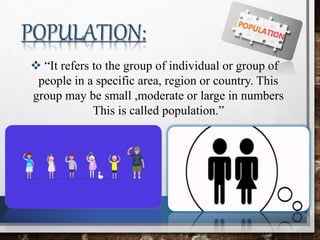
 “It refers to the group of individual or group of
people in a specific area, region or country. This
group may be small ,moderate or large in numbers
This is called population.”
EDUCATION:
 “The word education is derived from latin word
Educere, Educare and Educatum which
means “to learn”, “to know” and “to lead out”.
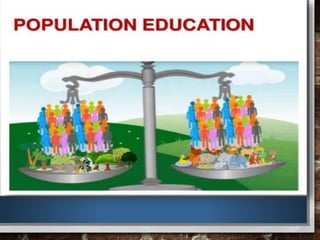
POPULATION EDUCATION:
 According to UNESCO:
“Population education is an educational
programme which provides for a study of population situation
of the family, the community, nation and world, with the
purpose of developing in the students’ rational and responsible
attitudes and behavior towards that situation.”
OBJECTIVES OF POPULATION
EDUCATION :
 To develop the understanding of:
i. Relevant demographic concept and process.
ii. The rapid growth of population and it's causes.
iii. The influence of population trends on various aspects of
human life.
iv. The evil effects of population on environment.
v. The scientific and medic advancement resulting in the
imbalance between the death and birth rate.
CONT...
 To develop and appreciation of :
i. The small family norms as proper and desirable.
ii. The relationship between population size and the quality
of life .
iii. To develop awareness of the population of the population
policies and programs of the country.
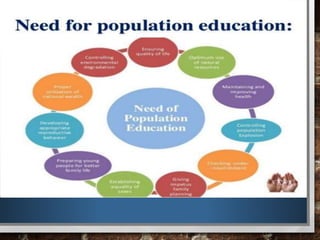
NEED OF POPULATION EDUCATION:
i. Controlling population
ii. Ensuring better quality of life
iii. Optimum uses of natural resource's
iv. Better health
v. Solving food problem
vi. Well around system of education
vii. Increasing national wealth
viii. Value orientation
IMPORTANCE:
 Today's children's are tomorrow's citizens .
 They must know the population and it's consequences.
 Education an effective way to conscientize people of the
needs of accepting small family norms.
 Student play major role to spread this message.
 It provides information and creates awareness about the
harms over population.
CHARACTERISTICS OF POPULATION
EDUCATION:
A new branch of the study in the field of education.
 Studies the impact the increase in population of different age
groups.
 Studies the impact of population on the economic development of
country.
 Help the students to investigate and explore the interaction
between population and environment.
 Enable the students to describe causes and consequence of
population.
POPULATION GROWTH:
•The term population growth refers to how the number of
individuals in a population increase with time.
•The growth is controlled by the rate at which new
individuals are added to the population , the birth rate and
the rate at which individuals leave the the population the
death rate.
CONT....
•When the birth rate is higher than the death rate,more
people are being born than are dying ,so that population
grows .This is called natural increase.
•When the death rate is higher than the birth rate it is called
the natural decrease.
POPULATION SITUATION IN PAKISTAN:
•According to the economic survey of pakistan
•2010- 11 the total population of pakistan is 177.1 million
against the 173.5 million in last year.
•Population growth rate is 2.1% and in the list of most
population countries ,pakistan is at the 6 number.
EFFECTS OF POPULATION GROWTH ON
NATIONAL DEVELOPMENT:
• Low per capital income
• Unemployment, under-employment and disguised - unemployment
• Low growth of agriculture sector
• Low saving and low investment
• High rate of inflation
• Pollution
• Back worinfrastructure structure
• Vicious circle of poverty
• Low living standard
• Increase in dependence ratio
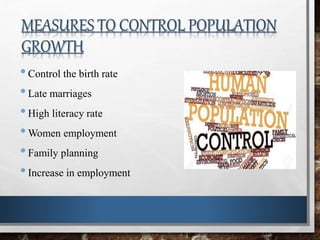
MEASURES TO CONTROL POPULATION
GROWTH
•Control the birth rate
•Late marriages
•High literacy rate
•Women employment
•Family planning
•Increase in employment
ROLES AND RESPONSIBILITIES:
•To promote awareness about population problems
and the effects of rapid population growth on
development.
•To educate all young people on population matters,
sexual relationships, fertility regulation and family
planning so that they can make responsible decisions
once they become able to marry and have children.
CONT...
•In Islam, mosques are not just “places of prayers.”
Mosques are in modern terminology are community
centers.
•The communities' role is to act as a watchdog and
ensure that education serves people, industrial
organizations, and the planet.
FAMILY PLANNING:
•Family planning means planning by individuals or couples to
have only the children they want, when they want them.
•This is responsible parenthood.
• Family welfare includes not only planning of births ,but they
welfare of whole family by means of total family health care.
•The family welfare programme has high priority in Pakistan,
because its success depends upon the quality
of life of all citizen.
STEPS TOWARDS POPULATION PLANNING
AND WELFARE:
•Broadcasting programs on family planning
•Family welfare programs
•Medical termination of pregnancy
•Awareness and use of family planning
•Maternal and child health programme
•Method and source of family planning
ADD A BROADCASTING PROGRAMS ON FAMILY
PLANNING:
•Two children norm
•Spacing methods
•Use of contraceptives
•Raising of marriage age
•Terminal methods of family planning
•Women’s education
FAMILY WELFARE PROGRAMS:
•Family welfare services are offered through the
total health-care delivery system.
•Maternal and child health-care and expanded
programme of immunization are also a part of the
family welfare programme.
MATERNAL AND CHILD HEALTH
PROGRAMS:
• The maternity and child health programmes (MCH) are directed towards
effective prenatal care.
• Ensuring safe and aseptic delivery
• Appropriate post-natal care
• Initiation and maintenance of breast-feeding
• Timely immunization against common infectious diseases
• Attention to growth and provision of basic medical care.
CONCLUSION:
• Population education helps to improve the well-being of their families
and communities.
• Family planning is one of the most effective life saving interventions
we have to reduce maternal and child morality.
• Increased use of family planning can significantly reduce abortion rates.
• It enables us to look into the future.
• It provides information and creates awareness about the harms of over
population .
CONT...
•High growth rate of population creates unfavorable effect
on the economic development in the developing countries
like Pakistan.
•Higrate of population growth in population means poverty,
literacy, low living standard ,absence of prosperity and
vicious circle of poverty.
Population Education

Population Education

  • 4.
    CONTENT Population education Objectives Needs ofpopulation education Importance Characteristics Effects of population growth on national development Measures to control Role and responsibilities Family planning
  • 5.
    POPULATION:  “It refersto the group of individual or group of people in a specific area, region or country. This group may be small ,moderate or large in numbers This is called population.”
  • 6.
    EDUCATION:  “The wordeducation is derived from latin word Educere, Educare and Educatum which means “to learn”, “to know” and “to lead out”.
  • 8.
    POPULATION EDUCATION:  Accordingto UNESCO: “Population education is an educational programme which provides for a study of population situation of the family, the community, nation and world, with the purpose of developing in the students’ rational and responsible attitudes and behavior towards that situation.”
  • 9.
    OBJECTIVES OF POPULATION EDUCATION:  To develop the understanding of: i. Relevant demographic concept and process. ii. The rapid growth of population and it's causes. iii. The influence of population trends on various aspects of human life. iv. The evil effects of population on environment. v. The scientific and medic advancement resulting in the imbalance between the death and birth rate.
  • 10.
    CONT...  To developand appreciation of : i. The small family norms as proper and desirable. ii. The relationship between population size and the quality of life . iii. To develop awareness of the population of the population policies and programs of the country.
  • 12.
    NEED OF POPULATIONEDUCATION: i. Controlling population ii. Ensuring better quality of life iii. Optimum uses of natural resource's iv. Better health v. Solving food problem vi. Well around system of education vii. Increasing national wealth viii. Value orientation
  • 14.
    IMPORTANCE:  Today's children'sare tomorrow's citizens .  They must know the population and it's consequences.  Education an effective way to conscientize people of the needs of accepting small family norms.  Student play major role to spread this message.  It provides information and creates awareness about the harms over population.
  • 15.
    CHARACTERISTICS OF POPULATION EDUCATION: Anew branch of the study in the field of education.  Studies the impact the increase in population of different age groups.  Studies the impact of population on the economic development of country.  Help the students to investigate and explore the interaction between population and environment.  Enable the students to describe causes and consequence of population.
  • 16.
    POPULATION GROWTH: •The termpopulation growth refers to how the number of individuals in a population increase with time. •The growth is controlled by the rate at which new individuals are added to the population , the birth rate and the rate at which individuals leave the the population the death rate.
  • 17.
    CONT.... •When the birthrate is higher than the death rate,more people are being born than are dying ,so that population grows .This is called natural increase. •When the death rate is higher than the birth rate it is called the natural decrease.
  • 18.
    POPULATION SITUATION INPAKISTAN: •According to the economic survey of pakistan •2010- 11 the total population of pakistan is 177.1 million against the 173.5 million in last year. •Population growth rate is 2.1% and in the list of most population countries ,pakistan is at the 6 number.
  • 19.
    EFFECTS OF POPULATIONGROWTH ON NATIONAL DEVELOPMENT: • Low per capital income • Unemployment, under-employment and disguised - unemployment • Low growth of agriculture sector • Low saving and low investment • High rate of inflation • Pollution • Back worinfrastructure structure • Vicious circle of poverty • Low living standard • Increase in dependence ratio
  • 20.
    MEASURES TO CONTROLPOPULATION GROWTH •Control the birth rate •Late marriages •High literacy rate •Women employment •Family planning •Increase in employment
  • 22.
    ROLES AND RESPONSIBILITIES: •Topromote awareness about population problems and the effects of rapid population growth on development. •To educate all young people on population matters, sexual relationships, fertility regulation and family planning so that they can make responsible decisions once they become able to marry and have children.
  • 23.
    CONT... •In Islam, mosquesare not just “places of prayers.” Mosques are in modern terminology are community centers. •The communities' role is to act as a watchdog and ensure that education serves people, industrial organizations, and the planet.
  • 24.
    FAMILY PLANNING: •Family planningmeans planning by individuals or couples to have only the children they want, when they want them. •This is responsible parenthood. • Family welfare includes not only planning of births ,but they welfare of whole family by means of total family health care. •The family welfare programme has high priority in Pakistan, because its success depends upon the quality of life of all citizen.
  • 25.
    STEPS TOWARDS POPULATIONPLANNING AND WELFARE: •Broadcasting programs on family planning •Family welfare programs •Medical termination of pregnancy •Awareness and use of family planning •Maternal and child health programme •Method and source of family planning
  • 26.
    ADD A BROADCASTINGPROGRAMS ON FAMILY PLANNING: •Two children norm •Spacing methods •Use of contraceptives •Raising of marriage age •Terminal methods of family planning •Women’s education
  • 27.
    FAMILY WELFARE PROGRAMS: •Familywelfare services are offered through the total health-care delivery system. •Maternal and child health-care and expanded programme of immunization are also a part of the family welfare programme.
  • 28.
    MATERNAL AND CHILDHEALTH PROGRAMS: • The maternity and child health programmes (MCH) are directed towards effective prenatal care. • Ensuring safe and aseptic delivery • Appropriate post-natal care • Initiation and maintenance of breast-feeding • Timely immunization against common infectious diseases • Attention to growth and provision of basic medical care.
  • 29.
    CONCLUSION: • Population educationhelps to improve the well-being of their families and communities. • Family planning is one of the most effective life saving interventions we have to reduce maternal and child morality. • Increased use of family planning can significantly reduce abortion rates. • It enables us to look into the future. • It provides information and creates awareness about the harms of over population .
  • 30.
    CONT... •High growth rateof population creates unfavorable effect on the economic development in the developing countries like Pakistan. •Higrate of population growth in population means poverty, literacy, low living standard ,absence of prosperity and vicious circle of poverty.