Writing Learning
Objectives
By
Melinda Tompkins
Lewis Clark State College
By the end of class you should
be able to (SWBAT)
• Compare and contrast learning objectives vs learning
goals
• List the components of the “ideal” learning objective
• Write a learning objective that contains a Measureable
Verb
• Develop learning objectives which demonstrate Bloom’s
Higher Levels of Thinking.
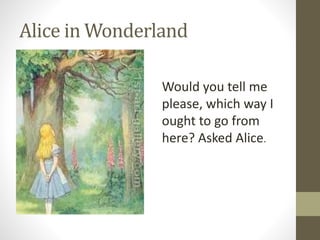
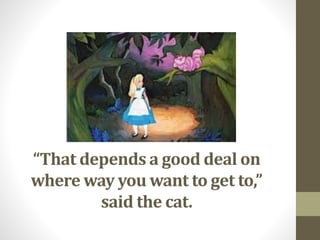
Alice in Wonderland
Would you tell me
please, which way I
ought to go from
here? Asked Alice.
“That depends a good deal on
where way you want to get to,”
said the cat.
“I don’t much
care where,”
said Alice.
“Then it doesn’t
matter which
way you go,”
said the Cat.
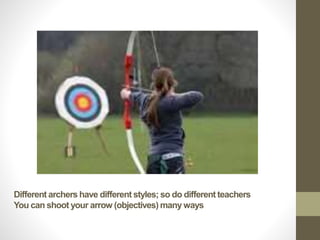
If you aim at
nothing, you will
never miss, but you
will also never hit
the bulls eye.
Different archers have different styles; so do different teachers
You can shoot your arrow (objectives) many ways
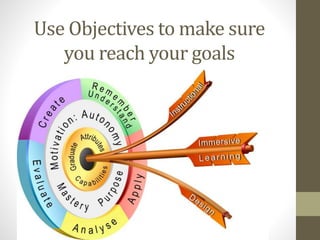
Use Objectives to make sure
you reach your goals
Instructional Objectives
• Objectives are statements which describe what the
learner is expected to achieve as a result of instruction
• They must be identified as specific as possible and
provide clear direction to the teacher
• They are CLEARLY connected to the Standards
• Specific objectives help evaluate learning, by clearly
identifying what your outcomes are and you will be able to
see them when they are achieved.
• They are easily connected to the standards and to the
assessments. Aligned
Instructional Objectives
• Are:
• SPECIFIC
• MEASURABLE
• SHORT-TERM
• OBSERVABLE
• Clearly written statements that indicate the
learning or behavior that the student
demonstrates during the lesson.
• Objectives ARE NOT lists of activities that
you want the students to complete!
• They ensure that learning is taking place and
the teacher knows what is going on!
Objectives
• Identifies the learner
• The student will
• SWABT – Students will be able to.. or
SWDAT – Students will demonstrate the ability
to….
• Identifies the Taxonomic Level of Thinking
and Performance Outcome
• Identify the vowels in a sentence
• They are Verbs!!
• Observable action
Characteristics of Learning
Objectives
• Based on Standards
• Collaborative
• Learner centered
• Specific
• Action oriented
• Cognitively
appropriate
• Behavioral
• Measurable
• Observable
• Cognitively
appropriate
• Behavioral
• Measurable
• Observable
• Understandable
• Achievable
• Realistic
• Understandable
• Achievable
• Realistic
Goals
• A statement that describes in broad terms what the learner
will gain from instruction
• They are Broad Generalizations and Big Ideas that you want
students to experience
• Overall description of what you are going to do
• They are NOT Measurable!
Instructional Objectives
•They are the foundation that you
use to build on what you teach --
and
•They prove that you have met your
overall goals for both the course
as well as the lesson.
•They are VERBS – They are
Measurable
Some Things to Watch
• Don’t make it them too Broad or too
Complex
• Focus on the “Observable”
Steer clear of words
KNOW
LEARN
APPRECIATE,
UNDERSTAND.
We WANT students to achieve those goals, but
they are NOT performances that are observable or
measurable.
•Describe instructional outcomes,
not activities you want them to
complete.
•Incorporate Higher Order Thinking
Skills
• Revisit Bloom’s Taxonomy
Assessments
• These should NOT be the FINAL
consideration!
• Think about your assessment first!
• If you start with the end in mind, you will know
exactly what material you need to cover.
• I’m sure you have been frustrated at times by tests that
didn’t really cover what the core of the lesson was!
• Think about what you would accept as evidence
that your students have attained the desired
knowledge, understanding and skills.
• This is often considered a part of the “Backward Design”
an instructional model developed by Grant Wiggins and
Jay McTighe, that promotes student understanding and
engagement.
Questions for Assessment
1. What do you want the student to be
able to do? (Outcome)
2. What does the student need to know in
order to do this well? (Curriculum)
3. What activity will facilitate the
learning? (Pedagogy)
4. How will the student demonstrate the
learning? (Assessment)
5. How will I know the student has done
this well? (Criteria)
Three Types of Assessment
• Diagnostic (Gather Info – What students know and
can already do)
• KWL; Journal Entries, Graphic Organizers; Pre-Tests
• Formative (Provide Feedback)
• Conferences; Observations; Q& A; First Drafts; Quizzes;
Journals
• Summative
• Unit tests; Projects; Performances; Presentations; Final
Copies
• Rubric
Assessing for Understanding
• Evidence of a student “understanding” is
more of a challenge than evidence that they
know the “right answer”
• You REALLY understand something when
you are able to
• Explain it, Make other connections, Systematize
and make predictions, Show its meaning or
importance, Look at it from other perspectives,
and Apply it and Adapt it to different situations.
Lesson Plans & Assessment
• You need to keep in mind that what you
assess is CLEARLY connected to your
objectives!!
• You want to make sure that your objective is
accomplished!
• You do not assess “behaviors” unrelated to the
objective, example
• “the student will be assessed by observing if they are
paying attention”
• This has been an “assessment” that I have frequently seen
in Lesson Plans!
• It is NOT an ASSESSMENT of Learning! Not in the
standards! Not an objective!
• How do YOU KNOW they are paying attention or not --
anyway?
LESSON PLANS – OBJECTIVES –
ASSESSMENTS - STANDARDS
Evaluate Your Lesson Plan
• Identify the Goals, Objectives, and Assessments
• Evaluate them based on the materials and information from
today.
• Are they SSSPECIFIC?- Are they VERBS? - Are the MEASURABLE?
• Do they focus on OBSERVABLE student behaviors?
• Does the Assessment actually ASSESS the learning objective?
• If there are Standards – do they Align?
• Adjust the lesson plan as needed.

Lesson objectives goals assessment

  • 1.
  • 2.
    By the endof class you should be able to (SWBAT) • Compare and contrast learning objectives vs learning goals • List the components of the “ideal” learning objective • Write a learning objective that contains a Measureable Verb • Develop learning objectives which demonstrate Bloom’s Higher Levels of Thinking.
  • 3.
    Alice in Wonderland Wouldyou tell me please, which way I ought to go from here? Asked Alice.
  • 4.
    “That depends agood deal on where way you want to get to,” said the cat.
  • 5.
    “I don’t much carewhere,” said Alice. “Then it doesn’t matter which way you go,” said the Cat.
  • 6.
    If you aimat nothing, you will never miss, but you will also never hit the bulls eye.
  • 7.
    Different archers havedifferent styles; so do different teachers You can shoot your arrow (objectives) many ways
  • 8.
    Use Objectives tomake sure you reach your goals
  • 9.
    Instructional Objectives • Objectivesare statements which describe what the learner is expected to achieve as a result of instruction • They must be identified as specific as possible and provide clear direction to the teacher • They are CLEARLY connected to the Standards • Specific objectives help evaluate learning, by clearly identifying what your outcomes are and you will be able to see them when they are achieved. • They are easily connected to the standards and to the assessments. Aligned
  • 10.
    Instructional Objectives • Are: •SPECIFIC • MEASURABLE • SHORT-TERM • OBSERVABLE • Clearly written statements that indicate the learning or behavior that the student demonstrates during the lesson. • Objectives ARE NOT lists of activities that you want the students to complete! • They ensure that learning is taking place and the teacher knows what is going on!
  • 11.
    Objectives • Identifies thelearner • The student will • SWABT – Students will be able to.. or SWDAT – Students will demonstrate the ability to…. • Identifies the Taxonomic Level of Thinking and Performance Outcome • Identify the vowels in a sentence • They are Verbs!! • Observable action
  • 12.
    Characteristics of Learning Objectives •Based on Standards • Collaborative • Learner centered • Specific • Action oriented • Cognitively appropriate • Behavioral • Measurable • Observable • Cognitively appropriate • Behavioral • Measurable • Observable • Understandable • Achievable • Realistic • Understandable • Achievable • Realistic
  • 13.
    Goals • A statementthat describes in broad terms what the learner will gain from instruction • They are Broad Generalizations and Big Ideas that you want students to experience • Overall description of what you are going to do • They are NOT Measurable!
  • 14.
    Instructional Objectives •They arethe foundation that you use to build on what you teach -- and •They prove that you have met your overall goals for both the course as well as the lesson. •They are VERBS – They are Measurable
  • 15.
    Some Things toWatch • Don’t make it them too Broad or too Complex • Focus on the “Observable” Steer clear of words KNOW LEARN APPRECIATE, UNDERSTAND. We WANT students to achieve those goals, but they are NOT performances that are observable or measurable.
  • 16.
    •Describe instructional outcomes, notactivities you want them to complete. •Incorporate Higher Order Thinking Skills • Revisit Bloom’s Taxonomy
  • 17.
    Assessments • These shouldNOT be the FINAL consideration! • Think about your assessment first! • If you start with the end in mind, you will know exactly what material you need to cover. • I’m sure you have been frustrated at times by tests that didn’t really cover what the core of the lesson was! • Think about what you would accept as evidence that your students have attained the desired knowledge, understanding and skills. • This is often considered a part of the “Backward Design” an instructional model developed by Grant Wiggins and Jay McTighe, that promotes student understanding and engagement.
  • 18.
    Questions for Assessment 1.What do you want the student to be able to do? (Outcome) 2. What does the student need to know in order to do this well? (Curriculum) 3. What activity will facilitate the learning? (Pedagogy) 4. How will the student demonstrate the learning? (Assessment) 5. How will I know the student has done this well? (Criteria)
  • 19.
    Three Types ofAssessment • Diagnostic (Gather Info – What students know and can already do) • KWL; Journal Entries, Graphic Organizers; Pre-Tests • Formative (Provide Feedback) • Conferences; Observations; Q& A; First Drafts; Quizzes; Journals • Summative • Unit tests; Projects; Performances; Presentations; Final Copies • Rubric
  • 20.
    Assessing for Understanding •Evidence of a student “understanding” is more of a challenge than evidence that they know the “right answer” • You REALLY understand something when you are able to • Explain it, Make other connections, Systematize and make predictions, Show its meaning or importance, Look at it from other perspectives, and Apply it and Adapt it to different situations.
  • 21.
    Lesson Plans &Assessment • You need to keep in mind that what you assess is CLEARLY connected to your objectives!! • You want to make sure that your objective is accomplished! • You do not assess “behaviors” unrelated to the objective, example • “the student will be assessed by observing if they are paying attention” • This has been an “assessment” that I have frequently seen in Lesson Plans! • It is NOT an ASSESSMENT of Learning! Not in the standards! Not an objective! • How do YOU KNOW they are paying attention or not -- anyway?
  • 22.
    LESSON PLANS –OBJECTIVES – ASSESSMENTS - STANDARDS
  • 23.
    Evaluate Your LessonPlan • Identify the Goals, Objectives, and Assessments • Evaluate them based on the materials and information from today. • Are they SSSPECIFIC?- Are they VERBS? - Are the MEASURABLE? • Do they focus on OBSERVABLE student behaviors? • Does the Assessment actually ASSESS the learning objective? • If there are Standards – do they Align? • Adjust the lesson plan as needed.