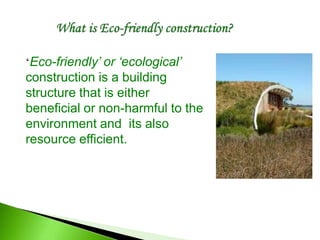
‘Eco-friendly’ or ‘ecological’
construction is a building
structure that is either
beneficial or non-harmful to the
environment and its also
resource efficient.
Causes of building eco-friendly
structures:
• 1.Eco-friendly construction has been developed in
response to the knowledge that buildings often have
a negative impact on our environment and our
natural resources .
• T2.This includes transporting materials hundreds
or thousands of miles, which has a negative
impact in the energy required to transport them.
• A3.Also in emissions of hazardous chemicals from
poorly designed building that creates, and traps
them.
• a
• .
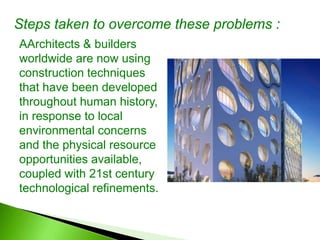
AArchitects & builders
worldwide are now using
construction techniques
that have been developed
throughout human history,
in response to local
environmental concerns
and the physical resource
opportunities available,
coupled with 21st century
technological refinements.
Steps taken to overcome these problems :

A. Rammed
Earth
Construction .

B. Eathship
Construction.
AA. Rammed Earth
Construction :
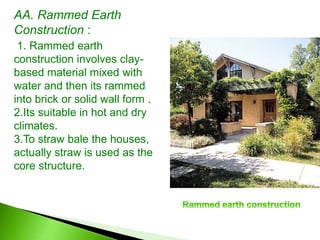
1. Rammed earth
construction involves clay-
based material mixed with
water and then its rammed
into brick or solid wall form .
2.Its suitable in hot and dry
climates.
3.To straw bale the houses,
actually straw is used as the
core structure.
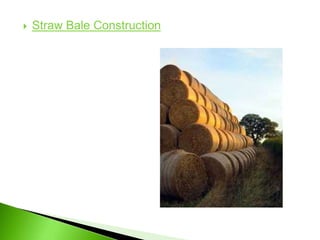
 Straw Bale Construction
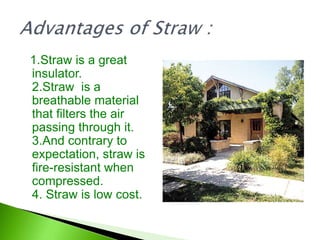
1.Straw is a great
insulator.
2.Straw is a
breathable material
that filters the air
passing through it.
3.And contrary to
expectation, straw is
fire-resistant when
compressed.
4. Straw is low cost.
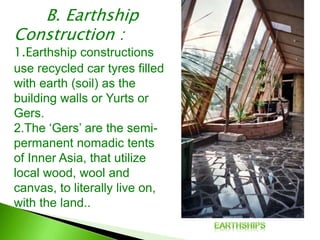
B. Earthship
Construction :
1.Earthship constructions
use recycled car tyres filled
with earth (soil) as the
building walls or Yurts or
Gers.
2.The ‘Gers’ are the semi-
permanent nomadic tents
of Inner Asia, that utilize
local wood, wool and
canvas, to literally live on,
with the land..
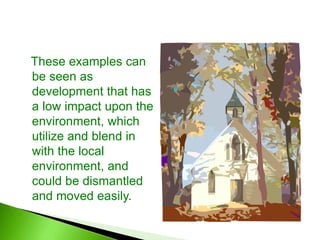
These examples can
be seen as
development that has
a low impact upon the
environment, which
utilize and blend in
with the local
environment, and
could be dismantled
and moved easily.
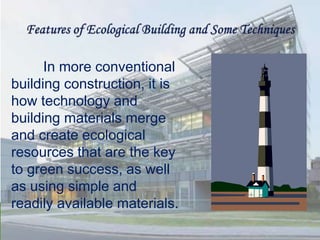
In more conventional
building construction, it is
how technology and
building materials merge
and create ecological
resources that are the key
to green success, as well
as using simple and
readily available materials.
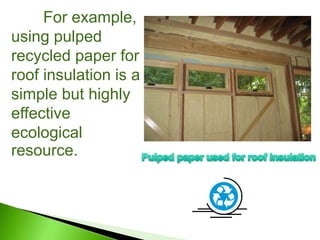
For example,
using pulped
recycled paper for
roof insulation is a
simple but highly
effective
ecological
resource.
1.The damage to
human health from
asbestos insulation,
laid out in rolls in
thousands of UK
homes.
2.Asbestos also takes
hundreds of years to
decompose in landfill.
Improper Insulation :
 At Home :
 1.Distinguish organic waste and inorganic
waste.
 2.Kitchen gardening.
 At College :
 Try to make the campus a plastic free
campus.
 Q.1. Name the only Indian , eco-
friendly chain of five star hotels
which has won several awards for its
various eco-friendly techniques used
 And who started it ?
 The Orchid Group of Hotels.
 Vitthal Kamat .
 100% recycled material.
 Metallic nature of aluminum creates brighter, more
vibrant colors than white photo paper. Special print
process generates photographic quality images and
museum quality text
 Industrial coating protects graphics from scratches
 Great alternative to non eco-friendly application of
printing on paper, film lam and mounting to sintra.
Eco-Aluminum offers better quality and superior
durability.
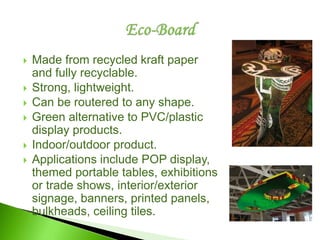
 Made from recycled kraft paper
and fully recyclable.
 Strong, lightweight.
 Can be routered to any shape.
 Green alternative to PVC/plastic
display products.
 Indoor/outdoor product.
 Applications include POP display,
themed portable tables, exhibitions
or trade shows, interior/exterior
signage, banners, printed panels,
bulkheads, ceiling tiles.
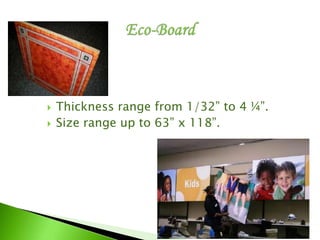
 Thickness range from 1/32” to 4 ¼”.
 Size range up to 63” x 118”.
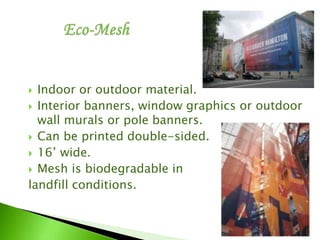
 Indoor or outdoor material.
 Interior banners, window graphics or outdoor
wall murals or pole banners.
 Can be printed double-sided.
 16’ wide.
 Mesh is biodegradable in
landfill conditions.
 7 year outdoor life
 1 ½” thick material. 5’ x 10’ sheets
 Returns are ½” to 1 ½” thick
 Easy to install and low cost.
 An effective alternative to high pressure digital
laminates and porcelain enamel for outdoor
signage such as parking lot signs.
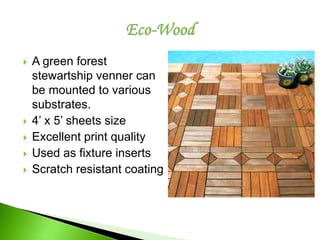
 A green forest
stewartship venner can
be mounted to various
substrates.
 4’ x 5’ sheets size
 Excellent print quality
 Used as fixture inserts
 Scratch resistant coating
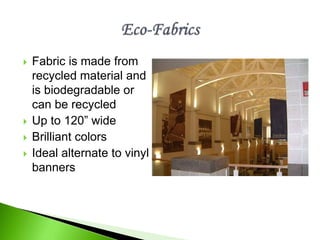
 Fabric is made from
recycled material and
is biodegradable or
can be recycled
 Up to 120” wide
 Brilliant colors
 Ideal alternate to vinyl
banners
 Film made from corn. Eco-friendly adhesive can
be added.
 Printed with green inks.
 10 ml, 60” wide material; indoor only
 Great eco-friendly alternate for hanging banners,
great for curved surfaces and applications to
acrylic or glass.
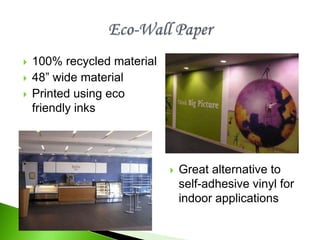
 100% recycled material
 48” wide material
 Printed using eco
friendly inks
 Great alternative to
self-adhesive vinyl for
indoor applications
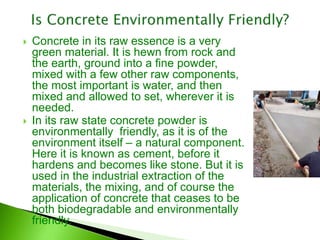
 Concrete in its raw essence is a very
green material. It is hewn from rock and
the earth, ground into a fine powder,
mixed with a few other raw components,
the most important is water, and then
mixed and allowed to set, wherever it is
needed.
 In its raw state concrete powder is
environmentally friendly, as it is of the
environment itself – a natural component.
Here it is known as cement, before it
hardens and becomes like stone. But it is
used in the industrial extraction of the
materials, the mixing, and of course the
application of concrete that ceases to be
both biodegradable and environmentally
friendly.
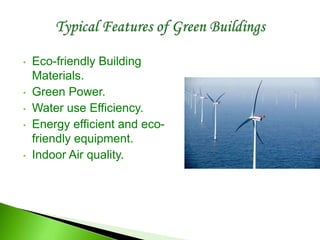
• Eco-friendly Building
Materials.
• Green Power.
• Water use Efficiency.
• Energy efficient and eco-
friendly equipment.
• Indoor Air quality.
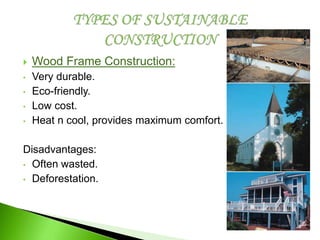
 Wood Frame Construction:
• Very durable.
• Eco-friendly.
• Low cost.
• Heat n cool, provides maximum comfort.
Disadvantages:
• Often wasted.
• Deforestation.
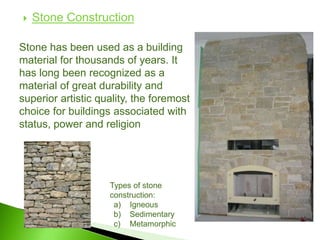
 Stone Construction
Stone has been used as a building
material for thousands of years. It
has long been recognized as a
material of great durability and
superior artistic quality, the foremost
choice for buildings associated with
status, power and religion
Types of stone
construction:
a) Igneous
b) Sedimentary
c) Metamorphic
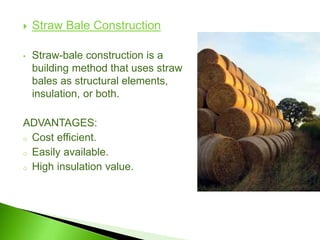
 Straw Bale Construction
• Straw-bale construction is a
building method that uses straw
bales as structural elements,
insulation, or both.
ADVANTAGES:
o Cost efficient.
o Easily available.
o High insulation value.
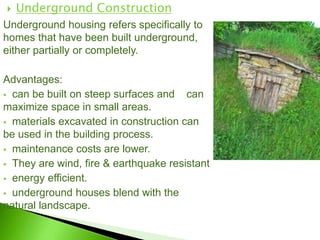
 Underground Construction
Underground housing refers specifically to
homes that have been built underground,
either partially or completely.
Advantages:
 can be built on steep surfaces and can
maximize space in small areas.
 materials excavated in construction can
be used in the building process.
 maintenance costs are lower.
 They are wind, fire & earthquake resistant
 energy efficient.
 underground houses blend with the
natural landscape.
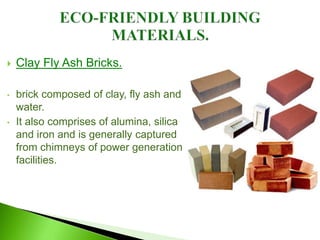
 Clay Fly Ash Bricks.
• brick composed of clay, fly ash and
water.
• It also comprises of alumina, silica
and iron and is generally captured
from chimneys of power generation
facilities.
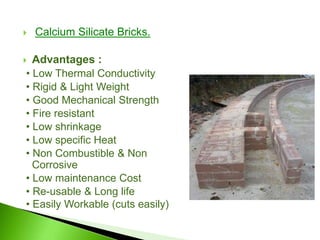
 Calcium Silicate Bricks.
 Advantages :
• Low Thermal Conductivity
• Rigid & Light Weight
• Good Mechanical Strength
• Fire resistant
• Low shrinkage
• Low specific Heat
• Non Combustible & Non
Corrosive
• Low maintenance Cost
• Re-usable & Long life
• Easily Workable (cuts easily)
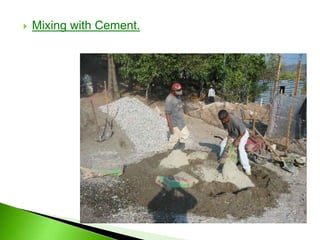
 Mixing with Cement.
 Autoclaved Aerated Concrete.
 Autoclaved Aerated Concrete (AAC) is a high quality
engineered building material that offers a unique combination
of strength, light weight, thermal & sound insulation, fire
resistance to water penetration & good workability.
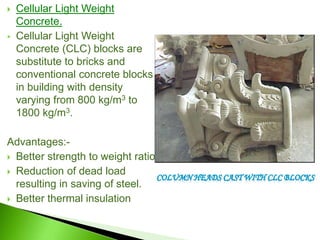
 Cellular Light Weight
Concrete.
 Cellular Light Weight
Concrete (CLC) blocks are
substitute to bricks and
conventional concrete blocks
in building with density
varying from 800 kg/m3 to
1800 kg/m3.
Advantages:-
 Better strength to weight ratio
 Reduction of dead load
resulting in saving of steel.
 Better thermal insulation
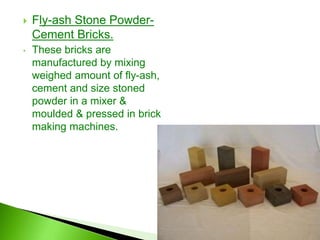
 Fly-ash Stone Powder-
Cement Bricks.
• These bricks are
manufactured by mixing
weighed amount of fly-ash,
cement and size stoned
powder in a mixer &
moulded & pressed in brick
making machines.
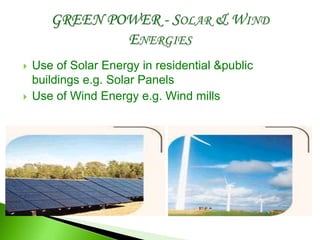
 Use of Solar Energy in residential &public
buildings e.g. Solar Panels
 Use of Wind Energy e.g. Wind mills
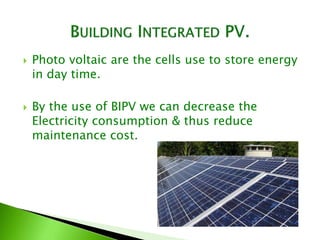
 Photo voltaic are the cells use to store energy
in day time.
 By the use of BIPV we can decrease the
Electricity consumption & thus reduce
maintenance cost.
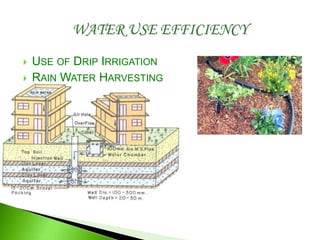
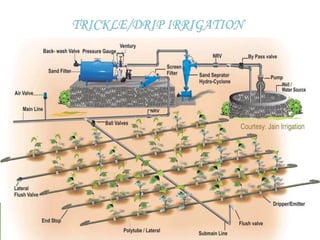
 USE OF DRIP IRRIGATION
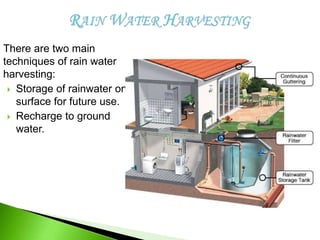
 RAIN WATER HARVESTING
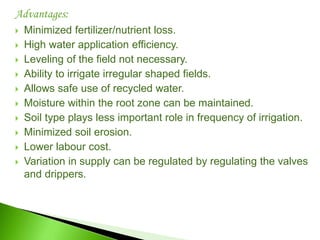
Advantages:
 Minimized fertilizer/nutrient loss.
 High water application efficiency.
 Leveling of the field not necessary.
 Ability to irrigate irregular shaped fields.
 Allows safe use of recycled water.
 Moisture within the root zone can be maintained.
 Soil type plays less important role in frequency of irrigation.
 Minimized soil erosion.
 Lower labour cost.
 Variation in supply can be regulated by regulating the valves
and drippers.
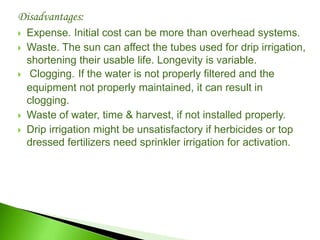
Disadvantages:
 Expense. Initial cost can be more than overhead systems.
 Waste. The sun can affect the tubes used for drip irrigation,
shortening their usable life. Longevity is variable.
 Clogging. If the water is not properly filtered and the
equipment not properly maintained, it can result in
clogging.
 Waste of water, time & harvest, if not installed properly.
 Drip irrigation might be unsatisfactory if herbicides or top
dressed fertilizers need sprinkler irrigation for activation.
There are two main
techniques of rain water
harvesting:
 Storage of rainwater on
surface for future use.
 Recharge to ground
water.
ecofriendly materials used for construction

ecofriendly materials used for construction

  • 2.
    ‘Eco-friendly’ or ‘ecological’ constructionis a building structure that is either beneficial or non-harmful to the environment and its also resource efficient.
  • 3.
    Causes of buildingeco-friendly structures: • 1.Eco-friendly construction has been developed in response to the knowledge that buildings often have a negative impact on our environment and our natural resources . • T2.This includes transporting materials hundreds or thousands of miles, which has a negative impact in the energy required to transport them. • A3.Also in emissions of hazardous chemicals from poorly designed building that creates, and traps them. • a • .
  • 4.
    AArchitects & builders worldwideare now using construction techniques that have been developed throughout human history, in response to local environmental concerns and the physical resource opportunities available, coupled with 21st century technological refinements. Steps taken to overcome these problems :
  • 5.
  • 6.
    AA. Rammed Earth Construction: 1. Rammed earth construction involves clay- based material mixed with water and then its rammed into brick or solid wall form . 2.Its suitable in hot and dry climates. 3.To straw bale the houses, actually straw is used as the core structure.
  • 7.
     Straw BaleConstruction
  • 8.
    1.Straw is agreat insulator. 2.Straw is a breathable material that filters the air passing through it. 3.And contrary to expectation, straw is fire-resistant when compressed. 4. Straw is low cost.
  • 9.
    B. Earthship Construction : 1.Earthshipconstructions use recycled car tyres filled with earth (soil) as the building walls or Yurts or Gers. 2.The ‘Gers’ are the semi- permanent nomadic tents of Inner Asia, that utilize local wood, wool and canvas, to literally live on, with the land..
  • 10.
    These examples can beseen as development that has a low impact upon the environment, which utilize and blend in with the local environment, and could be dismantled and moved easily.
  • 11.
    In more conventional buildingconstruction, it is how technology and building materials merge and create ecological resources that are the key to green success, as well as using simple and readily available materials.
  • 12.
    For example, using pulped recycledpaper for roof insulation is a simple but highly effective ecological resource.
  • 13.
    1.The damage to humanhealth from asbestos insulation, laid out in rolls in thousands of UK homes. 2.Asbestos also takes hundreds of years to decompose in landfill. Improper Insulation :
  • 14.
     At Home:  1.Distinguish organic waste and inorganic waste.  2.Kitchen gardening.  At College :  Try to make the campus a plastic free campus.
  • 15.
     Q.1. Namethe only Indian , eco- friendly chain of five star hotels which has won several awards for its various eco-friendly techniques used  And who started it ?
  • 16.
     The OrchidGroup of Hotels.  Vitthal Kamat .
  • 17.
     100% recycledmaterial.  Metallic nature of aluminum creates brighter, more vibrant colors than white photo paper. Special print process generates photographic quality images and museum quality text  Industrial coating protects graphics from scratches  Great alternative to non eco-friendly application of printing on paper, film lam and mounting to sintra. Eco-Aluminum offers better quality and superior durability.
  • 18.
     Made fromrecycled kraft paper and fully recyclable.  Strong, lightweight.  Can be routered to any shape.  Green alternative to PVC/plastic display products.  Indoor/outdoor product.  Applications include POP display, themed portable tables, exhibitions or trade shows, interior/exterior signage, banners, printed panels, bulkheads, ceiling tiles.
  • 19.
     Thickness rangefrom 1/32” to 4 ¼”.  Size range up to 63” x 118”.
  • 20.
     Indoor oroutdoor material.  Interior banners, window graphics or outdoor wall murals or pole banners.  Can be printed double-sided.  16’ wide.  Mesh is biodegradable in landfill conditions.
  • 21.
     7 yearoutdoor life  1 ½” thick material. 5’ x 10’ sheets  Returns are ½” to 1 ½” thick  Easy to install and low cost.  An effective alternative to high pressure digital laminates and porcelain enamel for outdoor signage such as parking lot signs.
  • 22.
     A greenforest stewartship venner can be mounted to various substrates.  4’ x 5’ sheets size  Excellent print quality  Used as fixture inserts  Scratch resistant coating
  • 23.
     Fabric ismade from recycled material and is biodegradable or can be recycled  Up to 120” wide  Brilliant colors  Ideal alternate to vinyl banners
  • 24.
     Film madefrom corn. Eco-friendly adhesive can be added.  Printed with green inks.  10 ml, 60” wide material; indoor only  Great eco-friendly alternate for hanging banners, great for curved surfaces and applications to acrylic or glass.
  • 25.
     100% recycledmaterial  48” wide material  Printed using eco friendly inks  Great alternative to self-adhesive vinyl for indoor applications
  • 26.
     Concrete inits raw essence is a very green material. It is hewn from rock and the earth, ground into a fine powder, mixed with a few other raw components, the most important is water, and then mixed and allowed to set, wherever it is needed.  In its raw state concrete powder is environmentally friendly, as it is of the environment itself – a natural component. Here it is known as cement, before it hardens and becomes like stone. But it is used in the industrial extraction of the materials, the mixing, and of course the application of concrete that ceases to be both biodegradable and environmentally friendly.
  • 27.
    • Eco-friendly Building Materials. •Green Power. • Water use Efficiency. • Energy efficient and eco- friendly equipment. • Indoor Air quality.
  • 28.
     Wood FrameConstruction: • Very durable. • Eco-friendly. • Low cost. • Heat n cool, provides maximum comfort. Disadvantages: • Often wasted. • Deforestation.
  • 29.
     Stone Construction Stonehas been used as a building material for thousands of years. It has long been recognized as a material of great durability and superior artistic quality, the foremost choice for buildings associated with status, power and religion Types of stone construction: a) Igneous b) Sedimentary c) Metamorphic
  • 30.
     Straw BaleConstruction • Straw-bale construction is a building method that uses straw bales as structural elements, insulation, or both. ADVANTAGES: o Cost efficient. o Easily available. o High insulation value.
  • 31.
     Underground Construction Undergroundhousing refers specifically to homes that have been built underground, either partially or completely. Advantages:  can be built on steep surfaces and can maximize space in small areas.  materials excavated in construction can be used in the building process.  maintenance costs are lower.  They are wind, fire & earthquake resistant  energy efficient.  underground houses blend with the natural landscape.
  • 32.
     Clay FlyAsh Bricks. • brick composed of clay, fly ash and water. • It also comprises of alumina, silica and iron and is generally captured from chimneys of power generation facilities.
  • 33.
     Calcium SilicateBricks.  Advantages : • Low Thermal Conductivity • Rigid & Light Weight • Good Mechanical Strength • Fire resistant • Low shrinkage • Low specific Heat • Non Combustible & Non Corrosive • Low maintenance Cost • Re-usable & Long life • Easily Workable (cuts easily)
  • 34.
  • 35.
     Autoclaved AeratedConcrete.  Autoclaved Aerated Concrete (AAC) is a high quality engineered building material that offers a unique combination of strength, light weight, thermal & sound insulation, fire resistance to water penetration & good workability.
  • 36.
     Cellular LightWeight Concrete.  Cellular Light Weight Concrete (CLC) blocks are substitute to bricks and conventional concrete blocks in building with density varying from 800 kg/m3 to 1800 kg/m3. Advantages:-  Better strength to weight ratio  Reduction of dead load resulting in saving of steel.  Better thermal insulation
  • 37.
     Fly-ash StonePowder- Cement Bricks. • These bricks are manufactured by mixing weighed amount of fly-ash, cement and size stoned powder in a mixer & moulded & pressed in brick making machines.
  • 38.
     Use ofSolar Energy in residential &public buildings e.g. Solar Panels  Use of Wind Energy e.g. Wind mills
  • 39.
     Photo voltaicare the cells use to store energy in day time.  By the use of BIPV we can decrease the Electricity consumption & thus reduce maintenance cost.
  • 40.
     USE OFDRIP IRRIGATION  RAIN WATER HARVESTING
  • 42.
    Advantages:  Minimized fertilizer/nutrientloss.  High water application efficiency.  Leveling of the field not necessary.  Ability to irrigate irregular shaped fields.  Allows safe use of recycled water.  Moisture within the root zone can be maintained.  Soil type plays less important role in frequency of irrigation.  Minimized soil erosion.  Lower labour cost.  Variation in supply can be regulated by regulating the valves and drippers.
  • 43.
    Disadvantages:  Expense. Initialcost can be more than overhead systems.  Waste. The sun can affect the tubes used for drip irrigation, shortening their usable life. Longevity is variable.  Clogging. If the water is not properly filtered and the equipment not properly maintained, it can result in clogging.  Waste of water, time & harvest, if not installed properly.  Drip irrigation might be unsatisfactory if herbicides or top dressed fertilizers need sprinkler irrigation for activation.
  • 44.
    There are twomain techniques of rain water harvesting:  Storage of rainwater on surface for future use.  Recharge to ground water.