Seminarreports
On
“GREENBUILDING”
Submitted by: -
SMITARANJAN SAMANTARAY
REG.NO: -1301227329
SL.NO. TITLE PAGENO.
1. INTRODUCTION 1-5
2. FUNADMENTAL PRINCIPLE 6-7
3. MATERIALUSED 8-10
4. METHOD USED 11-12
5. INDIANGREENBUILDINGCOUNCIL 13-14
6. APPLICATIONOFGREENBUILDING 15
7. CASE STUDY 16-20
8. MERITSOFGREENBUILDING 21
9. DEMERITSOFGREENBUILDING 22
10. CONCLUSION 23
11. REFERNCES 24
CONTENTS
Introduction
Shelter is one of the fundamental needs of human beings. The need to own a place for
living is also seen in animals and birds. In the beginning of human civilization man
used to live in caves and on trees, gradually he has identified materials suitable for
construction like clay, stone and timber. Basic purpose of these dwellings is to protect
man from weather and predators. These houses made way for larger inhabitations like
castles, forts and palaces which had built in mechanism for providing sunlight and
fresh air. As the time went on, man with his knowledge invented latest technologies
and materials which helped him in construction of different types of buildings. These
buildings and the materials used for construction brought rapid changes in the
environment. Limitation of space, growth of population and rapid urbanization lead
to community dwelling culture which increased problems like CFC emissions,
insufficient ventilation, increase of waste materials during construction and
maintenanceofhousearouse.
It is found that the building industry will consume 40% of total global
energy and release about 3800megatons of CO2 into atmosphere. They have harmful
impactonthe nature.Accordingtoreportthebuildingindustryhasfollowingimpacts:
• Consumptionof40%ofworld’stotal
energy.
• Consumptionof30%ofrawmaterials.
• About25%of timberharvestis goingdown.
• 35% of CO2 emission
• 16%of freshwateris beingdepleted.
• 40% of municipalsolidwasteis beinggenerated.
• 50% of ozonedepleting CFC’s are still in use.30% of theresidentshave
sickbuildingsyndrome.
1
The above issues have forced man to think along the terms of sustainable development
which gave solution for his problem through “green building” concept. Most of the
people think that it is latest technology which has been invented in recent times. But a
very few people know that this concept is being used since time immemorial. The Hawa
Mahal in Jaipur Rajasthan in India is constructed in such a way that it has natural
ventilation which is also one of the principles of green construction. Similarly, many
buildings were constructed using different principles of green construction unknowingly
the concept.
The concept of sustainable development can be traced to the energy crisis and
environmental pollution concern in the 1970s (1). In the US Green Building movement
started from the need and desire for the more energy efficient and environment friendly
construction practices. There are number of benefits from building green like
environmental, economic and social. Environmental benefits protect biodiversity,
ecosystems and also improve air and water quality, reduce wastes, conserve and restore
natural resources. Economic benefits are reduction of costs and improvement in occupant
productivity and optimize life-cycle economic performance. Social benefits enhance
comfortandhealthofoccupantsbygivingaestheticquality.
A Green Building is the one whose construction and life time operation provides
healthiest possible environment having the most efficient and least disruptive use of the
land, water, energy and resources. Green Building is the one that preserves and restores
the habitat which is vital for sustaining life by reducing negative environmental impact.
Construction of Green Building minimizes on-site grading, saves natural resources by
using alternative building material and recycles construction waste rather than dumping
in landfill. Green Building’s interior spaces have natural lighting, outdoor views while
highly efficient heating, ventilating and air conditioning (HVAC) systems and low volatile
organic compounds like paints, flooring and furniture create a superior indoor air quality.
Most of the Green Buildings are designed according to LEED (Leadership in Energy
and Environmental Design). Green Buildings are more comfortable and easier to live with
due to Row operating and owning costs. It is estimated by the year 2050, residential,
commercial and institutional buildings consume about 38-40%global energy and
release3800-4000 megatons of carbon in to the atmosphere. Climate change by itself
can also precipitate lager energy demand as people seek greater comfort levels in more
extreme conditions.
2
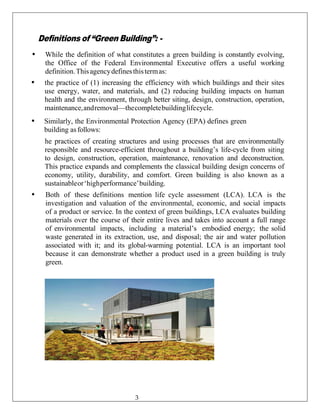
Definitions of “Green Building”: -
• While the definition of what constitutes a green building is constantly evolving,
the Office of the Federal Environmental Executive offers a useful working
definition.Thisagencydefinesthistermas:
• the practice of (1) increasing the efficiency with which buildings and their sites
use energy, water, and materials, and (2) reducing building impacts on human
health and the environment, through better siting, design, construction, operation,
maintenance,andremoval—thecompletebuildinglifecycle.
• Similarly, the Environmental Protection Agency (EPA) defines green
building asfollows:
he practices of creating structures and using processes that are environmentally
responsible and resource-efficient throughout a building’s life-cycle from siting
to design, construction, operation, maintenance, renovation and deconstruction.
This practice expands and complements the classical building design concerns of
economy, utility, durability, and comfort. Green building is also known as a
sustainableor‘highperformance’building.
• Both of these definitions mention life cycle assessment (LCA). LCA is the
investigation and valuation of the environmental, economic, and social impacts
of a product or service. In the context of green buildings, LCA evaluates building
materials over the course of their entire lives and takes into account a full range
of environmental impacts, including a material’s embodied energy; the solid
waste generated in its extraction, use, and disposal; the air and water pollution
associated with it; and its global-warming potential. LCA is an important tool
because it can demonstrate whether a product used in a green building is truly
green.
3
NEEDFORGREEN BUILDINGS:
Takesanintelligentapproachtoenergy
•Minimizing energy use in all stages of a building’s life-cycle, making new and renovated
buildings more comfortable, less expensive to run and helping building users learn to be
efficient too.
•Integratingrenewableandlowcarbontechnologiestosupplybuildings’energyneeds,
oncedesignhasmaximizedinbuiltandnaturalefficiencies.
Safeguards our water resources
•Exploringwaystoimprovedrinkingandwastewaterefficiencyandmanagement,harvesting
waterforsafeindooruseininnovativewaysandgenerallyminimizing wateruseinthesector.
•Considering the impact of the built environment on storm water and drainage
infrastructure, ensuring these are not put under undue stress or prevented from doing their
job.
Minimizeswasteandmaximizesreuse
•Usingfewer,moredurablematerialsandgeneratinglesswaste,aswellasaccountingfora
building’sendoflifestagebydesigningfordemolitionwasterecoveryandreuse.
•Engagingbuildingusersinreuseandrecycling.
Promoteshealthandwell-being
•Bringinga breath of fresh air inside,delivering high indoor air qualitythrough good
ventilationandavoidingmaterialsandchemicalsthatcreateharmfulemissions.
•Incorporatingnatural light andviews to ensure buildingusers’ comfort and enjoymentof
theirsurroundings,reducinglightingenergyneedsintheprocess.
•Designingforearsaswellaseyes.Intheeducation,healthandresidentialsectors,acoustics
and proper sound insulation play important roles in helping concentration, recuperation, and
peacefulenjoymentofproperty.
•Ensuringpeople are comfortablein their everyday environments, creating the rightindoor
temperatureas the seasonspassthroughpassivedesign or building management and
monitoring systems.
4
Keepsour landscapegreen
•Recognizingthatour urbanenvironmentshouldpreservenature,ensuringdiversewildlife
and land quality are protected or enhanced, for exampleby remediating and building on
pollutedlandorcreatinggreenspaces.
•Lookingfor ways we can makeour urban areas moreproductive,bringing agricultureinto
our cities.
Creates resilientandflexible structures
•Adaptingto a changingenvironment,ensuringresilienceto eventssuch asflooding,
earthquakesor fires so that our buildings stand the test of time and keep people andtheir
belongings safe.
•Designing flexible and dynamic spaces, anticipating changes in their use over time and
avoiding the need to demolish and rebuild or significantly renovate buildings to prevent
them becoming obsolete.
Considersallstagesofabuilding’slife-cycle.
•Seekingtolowerallenvironmentalimpactsandmaximizesocialandeconomicvalueovera
building’swholelife-cycle:throughdesign,construction,operation,maintenance, renovation,
and demolition. The fragmented nature of the building industry value chain means wehave
long lookedat partsof thelife-cyclein isolation,but Green Building Councils are bringing the
sector’s wholevalue chain togetherthroughour members to build awidervision.
•Makingtheinvisiblevisible.Embodiedresourcesaretheinvisibleresourcesusedin
buildings: for example,the energy or water used to produce and transport the materials in
thebuilding.Greenbuildingconsiderstheseamongstabuilding’simpacts,ensuringthat
ourbuildingsaretruly lowimpact.
5
FUNDAMENTAL PRINCIPLE
• Structuredesignefficiency
• Energy efficiency
• Waterefficiency
• Materials Efficiency
• Wasteand toxicreduction
STRUCTURE EFFICIENCY:
It is the concept of sustainable building and has largest impact on cost and performance.
It aims to minimizethe environment impact associated with all life-cycles.
ENERGY EFFICIENCY:
The layout of the construction can be strategized so that natural light pours for
additional warmth.
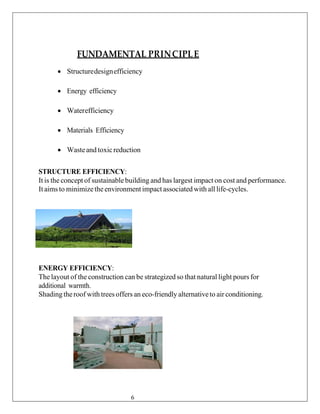
Shadingtheroof with trees offers an eco-friendly alternativeto air conditioning.
6
WATER EFFICIENCY:
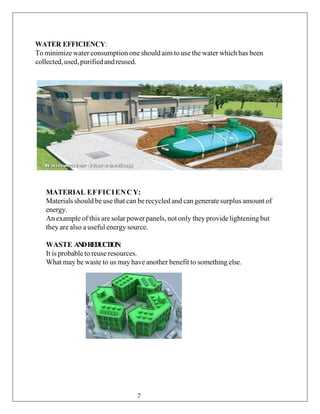
To minimize water consumption one should aim to use the water which has been
collected,used,purifiedandreused.
MATERIAL EFFICIENCY:
Materials should be use that can be recycled and can generate surplus amount of
energy.
An example of this are solar power panels, not only they provide lightening but
they are also a useful energy source.
WASTE ANDREDUCTION:
It is probable to reuse resources.
What may be waste to us may have another benefit to something else.
7
MATERIALS USED IN GREEN BUILDING
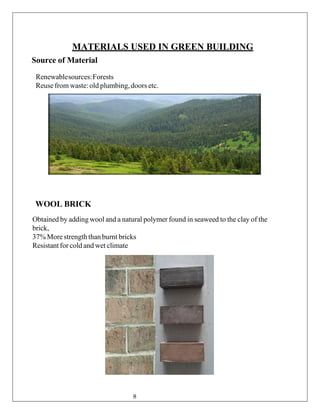
Source of Material
Renewablesources:Forests
Reusefrom waste:old plumbing,doors etc.
WOOL BRICK
Obtained by adding wool and a natural polymer found in seaweed to the clay of the
brick,
37% More strength thanburnt bricks
Resistant for cold and wet climate
8
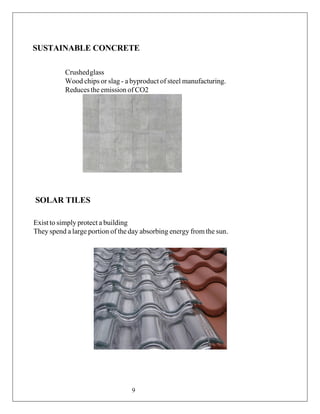
SUSTAINABLE CONCRETE
Crushedglass
Wood chips or slag - a byproduct of steel manufacturing.
Reducesthe emission of CO2
SOLAR TILES
Exist to simply protect a building
They spend a large portion of theday absorbing energy from the sun.
9
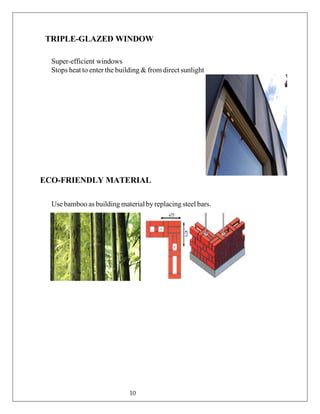
TRIPLE-GLAZED WINDOW
Super-efficient windows
Stops heat to enter the building & from direct sunlight
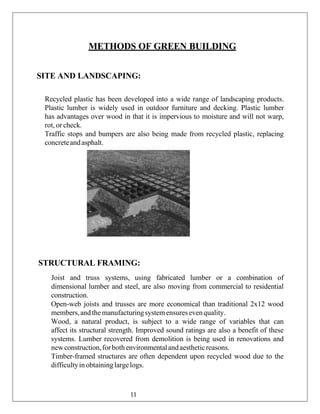
ECO-FRIENDLY MATERIAL
Use bamboo as building materialby replacing steel bars.
10
METHODS OF GREEN BUILDING
SITE AND LANDSCAPING:
Recycled plastic has been developed into a wide range of landscaping products.
Plastic lumber is widely used in outdoor furniture and decking. Plastic lumber
has advantages over wood in that it is impervious to moisture and will not warp,
rot, or check.
Traffic stops and bumpers are also being made from recycled plastic, replacing
concreteandasphalt.
STRUCTURAL FRAMING:
Joist and truss systems, using fabricated lumber or a combination of
dimensional lumber and steel, are also moving from commercial to residential
construction.
Open-web joists and trusses are more economical than traditional 2x12 wood
members,andthe manufacturingsystemensuresevenquality.
Wood, a natural product, is subject to a wide range of variables that can
affect its structural strength. Improved sound ratings are also a benefit of these
systems. Lumber recovered from demolition is being used in renovations and
newconstruction,forbothenvironmentalandaestheticreasons.
Timber-framed structures are often dependent upon recycled wood due to the
difficultyinobtaininglargelogs.
11
ROOFING:
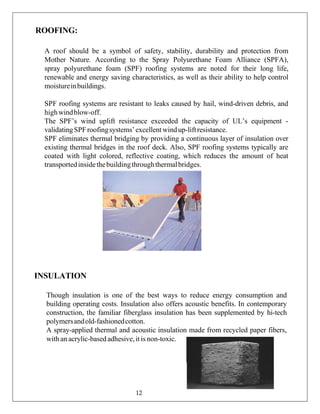
A roof should be a symbol of safety, stability, durability and protection from
Mother Nature. According to the Spray Polyurethane Foam Alliance (SPFA),
spray polyurethane foam (SPF) roofing systems are noted for their long life,
renewable and energy saving characteristics, as well as their ability to help control
moistureinbuildings.
SPF roofing systems are resistant to leaks caused by hail, wind-driven debris, and
highwindblow-off.
The SPF’s wind uplift resistance exceeded the capacity of UL’s equipment -
validatingSPFroofingsystems’excellentwindup-liftresistance.
SPF eliminates thermal bridging by providing a continuous layer of insulation over
existing thermal bridges in the roof deck. Also, SPF roofing systems typically are
coated with light colored, reflective coating, which reduces the amount of heat
transportedinsidethebuildingthroughthermalbridges.
INSULATION
Though insulation is one of the best ways to reduce energy consumption and
building operating costs. Insulation also offers acoustic benefits. In contemporary
construction, the familiar fiberglass insulation has been supplemented by hi-tech
polymersandold-fashionedcotton.
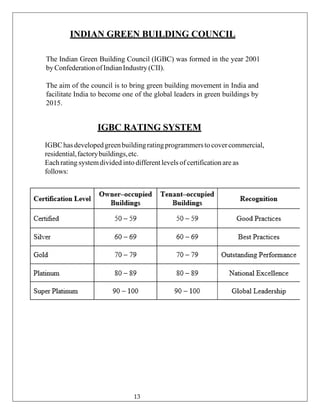
A spray-applied thermal and acoustic insulation made from recycled paper fibers,
with an acrylic-basedadhesive,it is non-toxic.
12
INDIAN GREEN BUILDING COUNCIL
The Indian Green Building Council (IGBC) was formed in the year 2001
byConfederationofIndianIndustry(CII).
The aim of the council is to bring green building movement in India and
facilitate India to become one of the global leaders in green buildings by
2015.
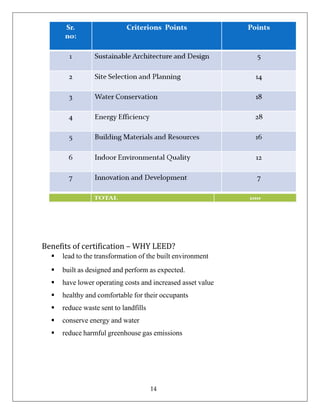
IGBC RATING SYSTEM
IGBChas developedgreenbuildingratingprogrammersto covercommercial,
residential,factorybuildings,etc.
Eachrating systemdivided into different levels of certification are as
follows:
13
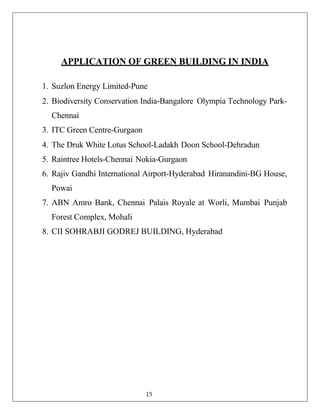
Benefits of certification – WHY LEED?
 lead to the transformation of the built environment
 built as designed and perform as expected.
 have lower operating costs and increased asset value
 healthy and comfortable for their occupants
 reduce waste sent to landfills
 conserve energy and water
 reduce harmful greenhouse gas emissions
14
APPLICATION OF GREEN BUILDING IN INDIA
1. Suzlon Energy Limited-Pune
2. Biodiversity Conservation India-Bangalore Olympia Technology Park-
Chennai
3. ITC Green Centre-Gurgaon
4. The Druk White Lotus School-Ladakh Doon School-Dehradun
5. Raintree Hotels-Chennai Nokia-Gurgaon
6. Rajiv Gandhi International Airport-Hyderabad Hiranandini-BG House,
Powai
7. ABN Amro Bank, Chennai Palais Royale at Worli, Mumbai Punjab
Forest Complex, Mohali
8. CII SOHRABJI GODREJ BUILDING, Hyderabad
15
16
CASE STUDY
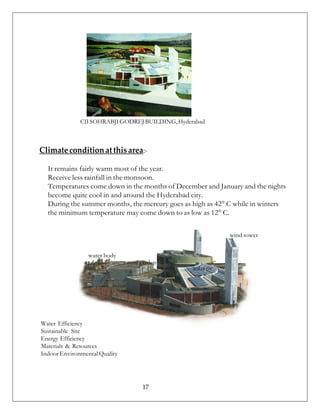
CII SOHRABJI GODREJ BUILDING, Hyderabad
CIISOHRABJIGODREJBUILDING,Hyderabad
Climateconditionatthisarea:-
It remains fairly warm most of the year.
Receive less rainfall in the monsoon.
Temperatures come down in the months of December and January and the nights
become quite cool in and around the Hyderabad city.
During the summer months, the mercury goes as high as 42° C while in winters
the minimum temperature may come down to as low as 12° C.
wind tower
water body
Water Efficiency
Sustainable Site
Energy Efficiency
Materials & Resources
IndoorEnvironmentalQuality
roof garden
solar pv
17
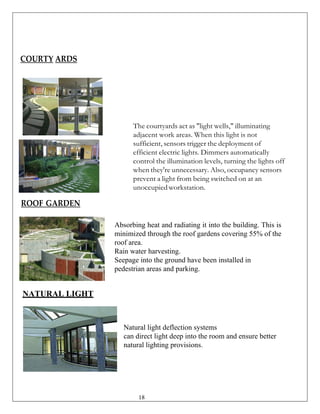
COURTY ARDS
The courtyards act as "light wells," illuminating
adjacent work areas. When this light is not
sufficient, sensors trigger the deployment of
efficient electric lights. Dimmers automatically
control the illumination levels, turning the lights off
when they're unnecessary. Also, occupancy sensors
prevent a light from being switched on at an
unoccupiedworkstation.
ROOF GARDEN
NATURAL LIGHT
Absorbing heat and radiating it into the building. This is
minimized through the roof gardens covering 55% of the
roof area.
Rain water harvesting.
Seepage into the ground have been installed in
pedestrian areas and parking.
Natural light deflection systems
can direct light deep into the room and ensure better
natural lighting provisions.
18
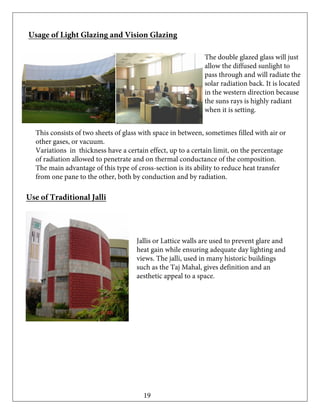
Usage of Light Glazing and Vision Glazing
The double glazed glass will just
allow the diffused sunlight to
pass through and will radiate the
solar radiation back. It is located
in the western direction because
the suns rays is highly radiant
when it is setting.
This consists of two sheets of glass with space in between, sometimes filled with air or
other gases, or vacuum.
Variations in thickness have a certain effect, up to a certain limit, on the percentage
of radiation allowed to penetrate and on thermal conductance of the composition.
The main advantage of this type of cross-section is its ability to reduce heat transfer
from one pane to the other, both by conduction and by radiation.
Use of Traditional Jalli
Jallis or Lattice walls are used to prevent glare and
heat gain while ensuring adequate day lighting and
views. The jalli, used in many historic buildings
such as the Taj Mahal, gives definition and an
aesthetic appeal to a space.
19
Solar system
Harvesting of solar energy - 20% of the buildings
energy requirement is catered to by solar photovoltaic
The Solar PV has an installed capacity of 23.5 KW
Average generation is 100-125 units per day
The solar panels are placed on the eastern side and they
are sloping which helps production of energy throughout
the day and as it is a commercial building more amount of
energy is consumed during the working hours [day]
compared to the evenings.
Wind System
A combination of sensible cooling in the ground and
evaporative cooling with the flow of air induced by the wind
tower can be achieved by a configuration as shown. The heat
loss from air results in a decreased air temperature, but no
change in the water vapour content of the air.
WIND TOWER
20
MERITS OF GREEN BUILDING
1- Cost:
Theconstructioncostsarethe sameas a standardbuildingandsometimetheycost a littlebit
moreastheyrequirespecialmaterialsto bebuilt.However,aregularbuildingcostswon’tstop
afteritsconstructionsincemoneywillalwaysbespentonmaintenance,renovation,operation
orevendemolition.
Thisdoesn’tmeanthatgreenbuildingswon’tneedmaintenance,renovation,operationoreven
demolitionas well,but beingbuiltof naturalresources allthatre-doingstuffwilltakeagestill
doneas theyarenot damagedthat fasthence,investing in greenbuildingis 10 times more
profitablethanstandardones.
2- Efficiency:
Thishereis dividedto thefollowing:-
A-Waterefficiency:
Greenbuildingsdon’tknowthemeaningof“wasted”,theyrecyclerain waterandgreywater
andusethemfortoilet flushingforinstance.
B- Energy Efficiency:
Thesebuildings saveenergy morethan thosebuilt outof bricks. Theyonly dependon all
renewableenergyresourcessuchsolarpower,hydro-powerandwindpowerwhichareusedfor
heatand electricityandhelpimprovetheindoorairquality.
C- Material Efficiency:
Greenbuildingsarebuiltfromnatural,non-toxicandrecycledmaterialsthatdon’tcostmuch
andEco-friendlysuchasbamboo,straw,recycledmetalorconcrete,etc.
21
3- Preserving infrastructure:
Beingefficientin both energyandwatersupply,thesebuildingsstretchthe capacityoflocal
infrastructuregreatly.
4- HighROIrates:
Consideringthatthesebuildingsareallnatural,theyhavehugereturnoninvestmentrates
andpropertiesin thesebuildingssell athigh prices.
DEMERITS OF GREEN BUILDING
1- Location:
Sincethesebuildingsdependon sun for energy,they needto be located in
positionthatwillhavethebestsunexposurewhich maydemandplacingthem
oppositetootherneighborhoodhomes.
2- Availability:
The materialsto buildsuchbuildingscanbe hardto find especiallyin urban areas
wherepreservingtheenvironmentisnotthepeople’sfirstoption.
So shippingthese materialscan then cost a lot thana standardbuilding.
3- Noaircoolingfeatures:
Thesebuildings runon heatto generatepower,so they arenot designedfor hot
areasasthey do not haveanyventilationsystems,so air conditionerswillbe
requiredwhichwillmakethesebuildingsanythingbutEco-friendly.
22
CONCLUSION
With increasing degradation of the environment because of increased
energy consumption, environment, conscious building design has become urgent.
The benefits of green design to society in general, and building owners and users
in particular, are manifold. The construction of such buildings results in reduced
destruction of natural habitats and bio-diversity, reduced air and water pollution,
less water consumption, limited waste generation and increased user productivity.
With increasing threat on our planet earth caused by depleting resources and
increasing emissions it is absolutely pertinent that all our future buildings should
bedesignedtofunctionas“greenbuildings”.
Green building is a much better product as compared to conventional
homes. It's good for your pocket book through much lower utility bills, good for
your employer since healthy homes save on medical bills and sick leave, and you
live with the knowledge that you are helping the earth.
23
REFERNCES:
1. Bowyer, J.L., 2007: The green building programs-are they really green? Forest
Prod.J.57(9):6-17.
2. Sinha, A.; Kutnar, A., 2012. Green Building Rating Sys- tem – Leadership in Energy
and Environmental Design (LEED): Significance for wood industry.
LesWood.64(1/2):1-5.
3. Trusty, W.; Horst, S., 2002: Integrating LCA Tools in Green Building Rating Systems.
In Environmental Build- ing News (Ed.), The Austin Papers: Best of the 2002 In-
ternationalGreen BuildingConference(pp. 53–57).Brattleboro VT: BuildingGreenInc.
4. Spiegel, R.; Meadows, D., 2006: Green Building Materi- als – A guide to product
selection and specification. 2nd edition. John Wiley and Sons, Virginia, USA.
5. Newsham, G.R.; Mancini, S.; Birt, B.J., 2009: “Do LEED-certified buildings save
energy? Yes, but...”. En- ergy Build. 41: 897-905 http://dx.doi.org/10.1016/
j.enbuild.2009.03.014.
24

green building report

  • 1.
  • 2.
    SL.NO. TITLE PAGENO. 1.INTRODUCTION 1-5 2. FUNADMENTAL PRINCIPLE 6-7 3. MATERIALUSED 8-10 4. METHOD USED 11-12 5. INDIANGREENBUILDINGCOUNCIL 13-14 6. APPLICATIONOFGREENBUILDING 15 7. CASE STUDY 16-20 8. MERITSOFGREENBUILDING 21 9. DEMERITSOFGREENBUILDING 22 10. CONCLUSION 23 11. REFERNCES 24 CONTENTS
  • 3.
    Introduction Shelter is oneof the fundamental needs of human beings. The need to own a place for living is also seen in animals and birds. In the beginning of human civilization man used to live in caves and on trees, gradually he has identified materials suitable for construction like clay, stone and timber. Basic purpose of these dwellings is to protect man from weather and predators. These houses made way for larger inhabitations like castles, forts and palaces which had built in mechanism for providing sunlight and fresh air. As the time went on, man with his knowledge invented latest technologies and materials which helped him in construction of different types of buildings. These buildings and the materials used for construction brought rapid changes in the environment. Limitation of space, growth of population and rapid urbanization lead to community dwelling culture which increased problems like CFC emissions, insufficient ventilation, increase of waste materials during construction and maintenanceofhousearouse. It is found that the building industry will consume 40% of total global energy and release about 3800megatons of CO2 into atmosphere. They have harmful impactonthe nature.Accordingtoreportthebuildingindustryhasfollowingimpacts: • Consumptionof40%ofworld’stotal energy. • Consumptionof30%ofrawmaterials. • About25%of timberharvestis goingdown. • 35% of CO2 emission • 16%of freshwateris beingdepleted. • 40% of municipalsolidwasteis beinggenerated. • 50% of ozonedepleting CFC’s are still in use.30% of theresidentshave sickbuildingsyndrome. 1
  • 4.
    The above issueshave forced man to think along the terms of sustainable development which gave solution for his problem through “green building” concept. Most of the people think that it is latest technology which has been invented in recent times. But a very few people know that this concept is being used since time immemorial. The Hawa Mahal in Jaipur Rajasthan in India is constructed in such a way that it has natural ventilation which is also one of the principles of green construction. Similarly, many buildings were constructed using different principles of green construction unknowingly the concept. The concept of sustainable development can be traced to the energy crisis and environmental pollution concern in the 1970s (1). In the US Green Building movement started from the need and desire for the more energy efficient and environment friendly construction practices. There are number of benefits from building green like environmental, economic and social. Environmental benefits protect biodiversity, ecosystems and also improve air and water quality, reduce wastes, conserve and restore natural resources. Economic benefits are reduction of costs and improvement in occupant productivity and optimize life-cycle economic performance. Social benefits enhance comfortandhealthofoccupantsbygivingaestheticquality. A Green Building is the one whose construction and life time operation provides healthiest possible environment having the most efficient and least disruptive use of the land, water, energy and resources. Green Building is the one that preserves and restores the habitat which is vital for sustaining life by reducing negative environmental impact. Construction of Green Building minimizes on-site grading, saves natural resources by using alternative building material and recycles construction waste rather than dumping in landfill. Green Building’s interior spaces have natural lighting, outdoor views while highly efficient heating, ventilating and air conditioning (HVAC) systems and low volatile organic compounds like paints, flooring and furniture create a superior indoor air quality. Most of the Green Buildings are designed according to LEED (Leadership in Energy and Environmental Design). Green Buildings are more comfortable and easier to live with due to Row operating and owning costs. It is estimated by the year 2050, residential, commercial and institutional buildings consume about 38-40%global energy and release3800-4000 megatons of carbon in to the atmosphere. Climate change by itself can also precipitate lager energy demand as people seek greater comfort levels in more extreme conditions. 2
  • 5.
    Definitions of “GreenBuilding”: - • While the definition of what constitutes a green building is constantly evolving, the Office of the Federal Environmental Executive offers a useful working definition.Thisagencydefinesthistermas: • the practice of (1) increasing the efficiency with which buildings and their sites use energy, water, and materials, and (2) reducing building impacts on human health and the environment, through better siting, design, construction, operation, maintenance,andremoval—thecompletebuildinglifecycle. • Similarly, the Environmental Protection Agency (EPA) defines green building asfollows: he practices of creating structures and using processes that are environmentally responsible and resource-efficient throughout a building’s life-cycle from siting to design, construction, operation, maintenance, renovation and deconstruction. This practice expands and complements the classical building design concerns of economy, utility, durability, and comfort. Green building is also known as a sustainableor‘highperformance’building. • Both of these definitions mention life cycle assessment (LCA). LCA is the investigation and valuation of the environmental, economic, and social impacts of a product or service. In the context of green buildings, LCA evaluates building materials over the course of their entire lives and takes into account a full range of environmental impacts, including a material’s embodied energy; the solid waste generated in its extraction, use, and disposal; the air and water pollution associated with it; and its global-warming potential. LCA is an important tool because it can demonstrate whether a product used in a green building is truly green. 3
  • 6.
    NEEDFORGREEN BUILDINGS: Takesanintelligentapproachtoenergy •Minimizing energyuse in all stages of a building’s life-cycle, making new and renovated buildings more comfortable, less expensive to run and helping building users learn to be efficient too. •Integratingrenewableandlowcarbontechnologiestosupplybuildings’energyneeds, oncedesignhasmaximizedinbuiltandnaturalefficiencies. Safeguards our water resources •Exploringwaystoimprovedrinkingandwastewaterefficiencyandmanagement,harvesting waterforsafeindooruseininnovativewaysandgenerallyminimizing wateruseinthesector. •Considering the impact of the built environment on storm water and drainage infrastructure, ensuring these are not put under undue stress or prevented from doing their job. Minimizeswasteandmaximizesreuse •Usingfewer,moredurablematerialsandgeneratinglesswaste,aswellasaccountingfora building’sendoflifestagebydesigningfordemolitionwasterecoveryandreuse. •Engagingbuildingusersinreuseandrecycling. Promoteshealthandwell-being •Bringinga breath of fresh air inside,delivering high indoor air qualitythrough good ventilationandavoidingmaterialsandchemicalsthatcreateharmfulemissions. •Incorporatingnatural light andviews to ensure buildingusers’ comfort and enjoymentof theirsurroundings,reducinglightingenergyneedsintheprocess. •Designingforearsaswellaseyes.Intheeducation,healthandresidentialsectors,acoustics and proper sound insulation play important roles in helping concentration, recuperation, and peacefulenjoymentofproperty. •Ensuringpeople are comfortablein their everyday environments, creating the rightindoor temperatureas the seasonspassthroughpassivedesign or building management and monitoring systems. 4
  • 7.
    Keepsour landscapegreen •Recognizingthatour urbanenvironmentshouldpreservenature,ensuringdiversewildlife andland quality are protected or enhanced, for exampleby remediating and building on pollutedlandorcreatinggreenspaces. •Lookingfor ways we can makeour urban areas moreproductive,bringing agricultureinto our cities. Creates resilientandflexible structures •Adaptingto a changingenvironment,ensuringresilienceto eventssuch asflooding, earthquakesor fires so that our buildings stand the test of time and keep people andtheir belongings safe. •Designing flexible and dynamic spaces, anticipating changes in their use over time and avoiding the need to demolish and rebuild or significantly renovate buildings to prevent them becoming obsolete. Considersallstagesofabuilding’slife-cycle. •Seekingtolowerallenvironmentalimpactsandmaximizesocialandeconomicvalueovera building’swholelife-cycle:throughdesign,construction,operation,maintenance, renovation, and demolition. The fragmented nature of the building industry value chain means wehave long lookedat partsof thelife-cyclein isolation,but Green Building Councils are bringing the sector’s wholevalue chain togetherthroughour members to build awidervision. •Makingtheinvisiblevisible.Embodiedresourcesaretheinvisibleresourcesusedin buildings: for example,the energy or water used to produce and transport the materials in thebuilding.Greenbuildingconsiderstheseamongstabuilding’simpacts,ensuringthat ourbuildingsaretruly lowimpact. 5
  • 8.
    FUNDAMENTAL PRINCIPLE • Structuredesignefficiency •Energy efficiency • Waterefficiency • Materials Efficiency • Wasteand toxicreduction STRUCTURE EFFICIENCY: It is the concept of sustainable building and has largest impact on cost and performance. It aims to minimizethe environment impact associated with all life-cycles. ENERGY EFFICIENCY: The layout of the construction can be strategized so that natural light pours for additional warmth. Shadingtheroof with trees offers an eco-friendly alternativeto air conditioning. 6
  • 9.
    WATER EFFICIENCY: To minimizewater consumption one should aim to use the water which has been collected,used,purifiedandreused. MATERIAL EFFICIENCY: Materials should be use that can be recycled and can generate surplus amount of energy. An example of this are solar power panels, not only they provide lightening but they are also a useful energy source. WASTE ANDREDUCTION: It is probable to reuse resources. What may be waste to us may have another benefit to something else. 7
  • 10.
    MATERIALS USED INGREEN BUILDING Source of Material Renewablesources:Forests Reusefrom waste:old plumbing,doors etc. WOOL BRICK Obtained by adding wool and a natural polymer found in seaweed to the clay of the brick, 37% More strength thanburnt bricks Resistant for cold and wet climate 8
  • 11.
    SUSTAINABLE CONCRETE Crushedglass Wood chipsor slag - a byproduct of steel manufacturing. Reducesthe emission of CO2 SOLAR TILES Exist to simply protect a building They spend a large portion of theday absorbing energy from the sun. 9
  • 12.
    TRIPLE-GLAZED WINDOW Super-efficient windows Stopsheat to enter the building & from direct sunlight ECO-FRIENDLY MATERIAL Use bamboo as building materialby replacing steel bars. 10
  • 13.
    METHODS OF GREENBUILDING SITE AND LANDSCAPING: Recycled plastic has been developed into a wide range of landscaping products. Plastic lumber is widely used in outdoor furniture and decking. Plastic lumber has advantages over wood in that it is impervious to moisture and will not warp, rot, or check. Traffic stops and bumpers are also being made from recycled plastic, replacing concreteandasphalt. STRUCTURAL FRAMING: Joist and truss systems, using fabricated lumber or a combination of dimensional lumber and steel, are also moving from commercial to residential construction. Open-web joists and trusses are more economical than traditional 2x12 wood members,andthe manufacturingsystemensuresevenquality. Wood, a natural product, is subject to a wide range of variables that can affect its structural strength. Improved sound ratings are also a benefit of these systems. Lumber recovered from demolition is being used in renovations and newconstruction,forbothenvironmentalandaestheticreasons. Timber-framed structures are often dependent upon recycled wood due to the difficultyinobtaininglargelogs. 11
  • 14.
    ROOFING: A roof shouldbe a symbol of safety, stability, durability and protection from Mother Nature. According to the Spray Polyurethane Foam Alliance (SPFA), spray polyurethane foam (SPF) roofing systems are noted for their long life, renewable and energy saving characteristics, as well as their ability to help control moistureinbuildings. SPF roofing systems are resistant to leaks caused by hail, wind-driven debris, and highwindblow-off. The SPF’s wind uplift resistance exceeded the capacity of UL’s equipment - validatingSPFroofingsystems’excellentwindup-liftresistance. SPF eliminates thermal bridging by providing a continuous layer of insulation over existing thermal bridges in the roof deck. Also, SPF roofing systems typically are coated with light colored, reflective coating, which reduces the amount of heat transportedinsidethebuildingthroughthermalbridges. INSULATION Though insulation is one of the best ways to reduce energy consumption and building operating costs. Insulation also offers acoustic benefits. In contemporary construction, the familiar fiberglass insulation has been supplemented by hi-tech polymersandold-fashionedcotton. A spray-applied thermal and acoustic insulation made from recycled paper fibers, with an acrylic-basedadhesive,it is non-toxic. 12
  • 15.
    INDIAN GREEN BUILDINGCOUNCIL The Indian Green Building Council (IGBC) was formed in the year 2001 byConfederationofIndianIndustry(CII). The aim of the council is to bring green building movement in India and facilitate India to become one of the global leaders in green buildings by 2015. IGBC RATING SYSTEM IGBChas developedgreenbuildingratingprogrammersto covercommercial, residential,factorybuildings,etc. Eachrating systemdivided into different levels of certification are as follows: 13
  • 16.
    Benefits of certification– WHY LEED?  lead to the transformation of the built environment  built as designed and perform as expected.  have lower operating costs and increased asset value  healthy and comfortable for their occupants  reduce waste sent to landfills  conserve energy and water  reduce harmful greenhouse gas emissions 14
  • 17.
    APPLICATION OF GREENBUILDING IN INDIA 1. Suzlon Energy Limited-Pune 2. Biodiversity Conservation India-Bangalore Olympia Technology Park- Chennai 3. ITC Green Centre-Gurgaon 4. The Druk White Lotus School-Ladakh Doon School-Dehradun 5. Raintree Hotels-Chennai Nokia-Gurgaon 6. Rajiv Gandhi International Airport-Hyderabad Hiranandini-BG House, Powai 7. ABN Amro Bank, Chennai Palais Royale at Worli, Mumbai Punjab Forest Complex, Mohali 8. CII SOHRABJI GODREJ BUILDING, Hyderabad 15
  • 18.
    16 CASE STUDY CII SOHRABJIGODREJ BUILDING, Hyderabad
  • 19.
    CIISOHRABJIGODREJBUILDING,Hyderabad Climateconditionatthisarea:- It remains fairlywarm most of the year. Receive less rainfall in the monsoon. Temperatures come down in the months of December and January and the nights become quite cool in and around the Hyderabad city. During the summer months, the mercury goes as high as 42° C while in winters the minimum temperature may come down to as low as 12° C. wind tower water body Water Efficiency Sustainable Site Energy Efficiency Materials & Resources IndoorEnvironmentalQuality roof garden solar pv 17
  • 20.
    COURTY ARDS The courtyardsact as "light wells," illuminating adjacent work areas. When this light is not sufficient, sensors trigger the deployment of efficient electric lights. Dimmers automatically control the illumination levels, turning the lights off when they're unnecessary. Also, occupancy sensors prevent a light from being switched on at an unoccupiedworkstation. ROOF GARDEN NATURAL LIGHT Absorbing heat and radiating it into the building. This is minimized through the roof gardens covering 55% of the roof area. Rain water harvesting. Seepage into the ground have been installed in pedestrian areas and parking. Natural light deflection systems can direct light deep into the room and ensure better natural lighting provisions. 18
  • 21.
    Usage of LightGlazing and Vision Glazing The double glazed glass will just allow the diffused sunlight to pass through and will radiate the solar radiation back. It is located in the western direction because the suns rays is highly radiant when it is setting. This consists of two sheets of glass with space in between, sometimes filled with air or other gases, or vacuum. Variations in thickness have a certain effect, up to a certain limit, on the percentage of radiation allowed to penetrate and on thermal conductance of the composition. The main advantage of this type of cross-section is its ability to reduce heat transfer from one pane to the other, both by conduction and by radiation. Use of Traditional Jalli Jallis or Lattice walls are used to prevent glare and heat gain while ensuring adequate day lighting and views. The jalli, used in many historic buildings such as the Taj Mahal, gives definition and an aesthetic appeal to a space. 19
  • 22.
    Solar system Harvesting ofsolar energy - 20% of the buildings energy requirement is catered to by solar photovoltaic The Solar PV has an installed capacity of 23.5 KW Average generation is 100-125 units per day The solar panels are placed on the eastern side and they are sloping which helps production of energy throughout the day and as it is a commercial building more amount of energy is consumed during the working hours [day] compared to the evenings. Wind System A combination of sensible cooling in the ground and evaporative cooling with the flow of air induced by the wind tower can be achieved by a configuration as shown. The heat loss from air results in a decreased air temperature, but no change in the water vapour content of the air. WIND TOWER 20
  • 23.
    MERITS OF GREENBUILDING 1- Cost: Theconstructioncostsarethe sameas a standardbuildingandsometimetheycost a littlebit moreastheyrequirespecialmaterialsto bebuilt.However,aregularbuildingcostswon’tstop afteritsconstructionsincemoneywillalwaysbespentonmaintenance,renovation,operation orevendemolition. Thisdoesn’tmeanthatgreenbuildingswon’tneedmaintenance,renovation,operationoreven demolitionas well,but beingbuiltof naturalresources allthatre-doingstuffwilltakeagestill doneas theyarenot damagedthat fasthence,investing in greenbuildingis 10 times more profitablethanstandardones. 2- Efficiency: Thishereis dividedto thefollowing:- A-Waterefficiency: Greenbuildingsdon’tknowthemeaningof“wasted”,theyrecyclerain waterandgreywater andusethemfortoilet flushingforinstance. B- Energy Efficiency: Thesebuildings saveenergy morethan thosebuilt outof bricks. Theyonly dependon all renewableenergyresourcessuchsolarpower,hydro-powerandwindpowerwhichareusedfor heatand electricityandhelpimprovetheindoorairquality. C- Material Efficiency: Greenbuildingsarebuiltfromnatural,non-toxicandrecycledmaterialsthatdon’tcostmuch andEco-friendlysuchasbamboo,straw,recycledmetalorconcrete,etc. 21
  • 24.
    3- Preserving infrastructure: Beingefficientinboth energyandwatersupply,thesebuildingsstretchthe capacityoflocal infrastructuregreatly. 4- HighROIrates: Consideringthatthesebuildingsareallnatural,theyhavehugereturnoninvestmentrates andpropertiesin thesebuildingssell athigh prices. DEMERITS OF GREEN BUILDING 1- Location: Sincethesebuildingsdependon sun for energy,they needto be located in positionthatwillhavethebestsunexposurewhich maydemandplacingthem oppositetootherneighborhoodhomes. 2- Availability: The materialsto buildsuchbuildingscanbe hardto find especiallyin urban areas wherepreservingtheenvironmentisnotthepeople’sfirstoption. So shippingthese materialscan then cost a lot thana standardbuilding. 3- Noaircoolingfeatures: Thesebuildings runon heatto generatepower,so they arenot designedfor hot areasasthey do not haveanyventilationsystems,so air conditionerswillbe requiredwhichwillmakethesebuildingsanythingbutEco-friendly. 22
  • 25.
    CONCLUSION With increasing degradationof the environment because of increased energy consumption, environment, conscious building design has become urgent. The benefits of green design to society in general, and building owners and users in particular, are manifold. The construction of such buildings results in reduced destruction of natural habitats and bio-diversity, reduced air and water pollution, less water consumption, limited waste generation and increased user productivity. With increasing threat on our planet earth caused by depleting resources and increasing emissions it is absolutely pertinent that all our future buildings should bedesignedtofunctionas“greenbuildings”. Green building is a much better product as compared to conventional homes. It's good for your pocket book through much lower utility bills, good for your employer since healthy homes save on medical bills and sick leave, and you live with the knowledge that you are helping the earth. 23
  • 26.
    REFERNCES: 1. Bowyer, J.L.,2007: The green building programs-are they really green? Forest Prod.J.57(9):6-17. 2. Sinha, A.; Kutnar, A., 2012. Green Building Rating Sys- tem – Leadership in Energy and Environmental Design (LEED): Significance for wood industry. LesWood.64(1/2):1-5. 3. Trusty, W.; Horst, S., 2002: Integrating LCA Tools in Green Building Rating Systems. In Environmental Build- ing News (Ed.), The Austin Papers: Best of the 2002 In- ternationalGreen BuildingConference(pp. 53–57).Brattleboro VT: BuildingGreenInc. 4. Spiegel, R.; Meadows, D., 2006: Green Building Materi- als – A guide to product selection and specification. 2nd edition. John Wiley and Sons, Virginia, USA. 5. Newsham, G.R.; Mancini, S.; Birt, B.J., 2009: “Do LEED-certified buildings save energy? Yes, but...”. En- ergy Build. 41: 897-905 http://dx.doi.org/10.1016/ j.enbuild.2009.03.014. 24