Business Management
Subject Coverage Management and Principles Planning Organizing Directing Controlling Total Quality Management Entrepreneurship
Module: 01 Management and Principles
Module Coverage Meaning, nature / characteristics  Scope and functional areas of management Management as a science, art or profession Management & Administration  Management Process Management Principles Evolution of-System Approach to management in detail (in domestic & international context) planning, organizing, staffing, Directing, coordination, controlling and innovation   (creativity)
Definition Of Management “ Management is the art of getting things done through others” – M ary Parker Follett “ Management is the art of getting things done though and with people in formally organized groups” –  Harold Koontz “ Management is the process of optimizing human, material and financial contributions for the achievement of organizational goals” -  John A Pearce & R B Robinson
 
Objectives of Management Proper utilization of resources Improving performance Mobilizing best talent Planning for the future
Nature/Characteristics of Management - Multidisciplinary - It is a group activity - Goal oriented - Management is a factor of production - Universal in character - Social Process - System of authority - Dynamic function - Art as well as science - It is a profession
Scope of Management Activities - Planning - Staffing - Coordinating - Organisation - Directing - controlling Operations - Production/Operations Management - Financial Management - Marketing Management - Personnel Management - Office Management - Management of Information system
Functions of Management 1. Planning 2. Organizing 3. Coordinating 4. Staffing 5. Directing 6. Controlling
Functions of Management 1. Planning What to do? When to do? How to do? Who is to do? 2. Organizing - To identify, classify and assign activities - Delegate authority and fix responsibility - Coordinate relationship
Functions of Management 3. Staffing Manpower planning Recruitment Selection and training Placement, development Promotion Transfer, appraisal Employee remuneratio 4. Directing Management in action It involves: leadership, communication, motivation  Supervision
Functions of Management 5. Coordinating - Orderly arrangement of goods,  - Effort to provide unity of action in the pursuit of common objectives 6. Controlling -Establishing standards -Measuring actual performance -Comparing actual with standard  -Finding variances -Taking corrective action
Administration Vs Management
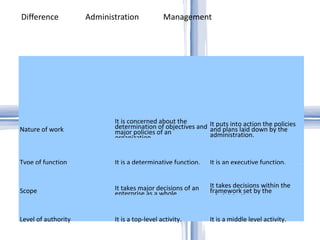
Difference    Administration  Management Nature of work It is concerned about the determination of objectives and major policies of an organization. It puts into action the policies and plans laid down by the administration. Type of function It is a determinative function. It is an executive function. Scope It takes major decisions of an enterprise as a whole. It takes decisions within the framework set by the administration. Level of authority It is a top-level activity. It is a middle level activity.
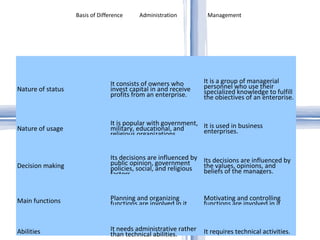
Basis of Difference  Administration  Management Nature of status It consists of owners who invest capital in and receive profits from an enterprise. It is a group of managerial personnel who use their specialized knowledge to fulfill the objectives of an enterprise. Nature of usage It is popular with government, military, educational, and religious organizations. It is used in business enterprises. Decision making Its decisions are influenced by public opinion, government policies, social, and religious factors. Its decisions are influenced by the values, opinions, and beliefs of the managers. Main functions  Planning and organizing functions are involved in it. Motivating and controlling functions are involved in it. Abilities It needs administrative rather than technical abilities. It requires technical activities.
Principles of Management
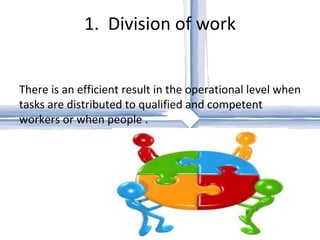
1.  Division of work There is an efficient result in the operational level when tasks are distributed to qualified and competent workers or when people .
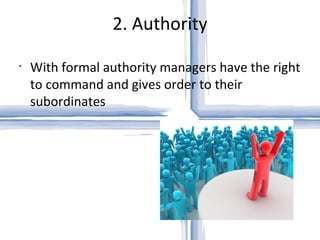
2. Authority With formal authority managers have the right to command and gives order to their subordinates
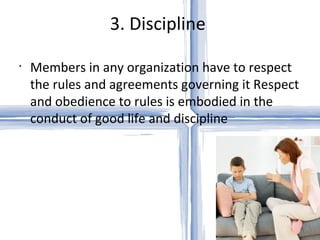
3. Discipline  Members in any organization have to respect the rules and agreements governing it Respect and obedience to rules is embodied in the conduct of good life and discipline
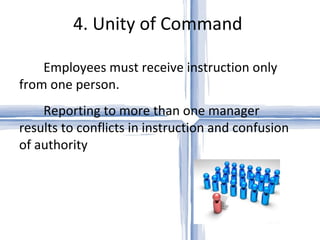
4. Unity of Command  Employees must receive instruction only from one person.  Reporting to more than one manager results to conflicts in instruction and confusion of authority
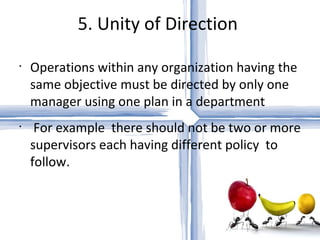
5. Unity of Direction  Operations within any organization having the same objective must be directed by only one manager using one plan in a department For example  there should not be two or more supervisors each having different policy  to follow.
6. Subordination of the Individual Interest to General interest   Individual interest must be subordinate to general interest when there is conflict between the two The agreement between the employers and the employees should be fair and there should be constant vigilance and  supervision
7. Remuneration Compensation for the work done should be fair to the employees and the employers
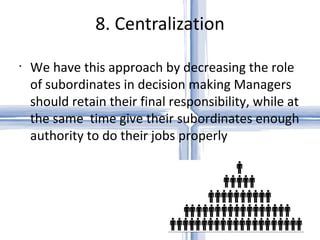
8. Centralization We have this approach by decreasing the role of subordinates in decision making Managers should retain their final responsibility, while at the same  time give their subordinates enough authority to do their jobs properly
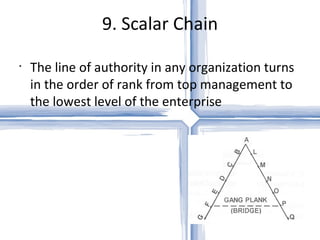
9. Scalar Chain The line of authority in any organization turns in the order of rank from top management to the lowest level of the enterprise
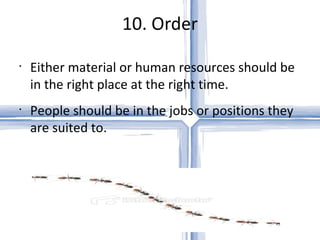
10. Order Either material or human resources should be in the right place at the right time.  People should be in the jobs or positions they are suited to.
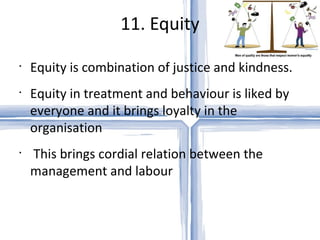
11. Equity Equity is combination of justice and kindness. Equity in treatment and behaviour is liked by everyone and it brings loyalty in the organisation This brings cordial relation between the management and labour
12. Stability of Staff Employees work better if job security and career progress are assured to  them  A high employee turnover rate will effect the organization
13. Initiative Managers should encourage their employees for taking initiative with in limits of authority and discipline Initiative increases the zeal and energy on the  part of human beings Fayols describes initiative as one of the keenest satisfactions for an intelligent man to experience
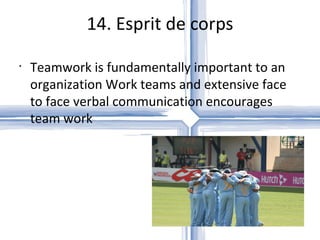
14. Esprit de corps Teamwork is fundamentally important to an organization Work teams and extensive face to face verbal communication encourages team work
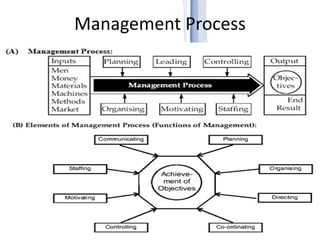
Management Process
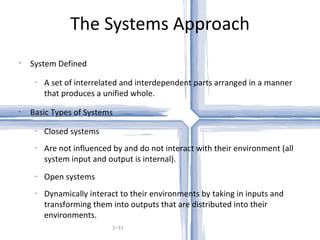
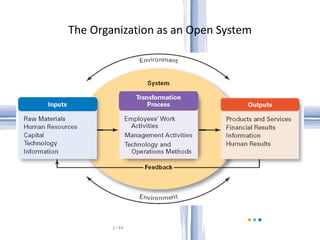
The Systems Approach 2– System Defined A set of interrelated and interdependent parts arranged in a manner that produces a unified whole. Basic Types of Systems Closed systems Are not influenced by and do not interact with their environment (all system input and output is internal). Open systems Dynamically interact to their environments by taking in inputs and transforming them into outputs that are distributed into their environments.
The Organization as an Open System 2–
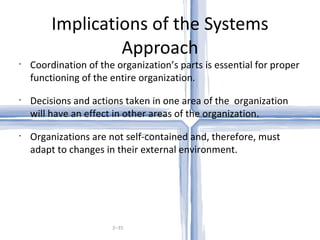
Implications of the Systems Approach 2– Coordination of the organization’s parts is essential for proper functioning of the entire organization. Decisions and actions taken in one area of the  organization will have an effect in other areas of the organization. Organizations are not self-contained and, therefore, must adapt to changes in their external environment.
Module: 02 PLANNING
Module Coverage Nature and Importance and purpose  of Planning Planning process Objectives, Types of plans Nature and Hierarchy of Objectives Management by Objectives Management by Exceptions Management by Moving around Decision making, importance and steps
Meaning of Planning A plan is a forecast for accomplishment. It is a predetermined course of action. It is today's projection for tomorrow's activity. In other words, to plan is to produce a scheme for future action, to bring about specified results at a specified cost, in a specified period of time.
Features of Planning Planning has a number of characteristics: Planning is goal-oriented Planning is a primary function Planning is all-pervasive Planning is a mental exercise Planning is a continuous process Planning involves choice Planning is forward looking Planning is flexible Planning is an integrated process Planning includes efficiency and effectiveness dimensions
Steps in Planning Process Establishing objectives Developing premises Evaluating alternatives and selection Formulating derivative plans Securing cooperation and participation Providing for follow-up
Importance of Planning Planning helps an organisation in the following ways: Planning provides direction Planning provides a unifying framework Planning is economical Planning reduces the risks of uncertainty Planning facilitates decision making Planning encourages innovation and creativity Planning improves morale Planning facilities control
Principles of Planning Principle of contribution to objectives Principle of primacy of planning Principle of pervasiveness of planning Principle of flexibility Principle of periodicity Principle of planning premises Principle of limiting factor
Limitations of Planning The limitations of planning can be examined under the following headings: Rigidity Costly and time consuming Employee resistance False sense of security Managerial deficiencies Planning prevents innovation External Limitations Difficult to predict Projected too far into the future Environmental turbulence Emergency situations
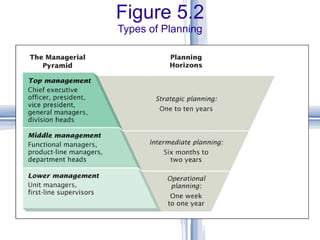
The Essentials of Planning  (cont’d) Types of Planning Strategic planning:  determining how to pursue long-term goals with available resources. Intermediate planning:  determining subunits’ contribution with allocated resources. Operational planning:  determining how to accomplish specific tasks with available resources.
Figure 5.2 Types of Planning
Other Forms  of Planning 1. Long-Range Planning - Short-Range Planning 2. Formal and Informal Planning 3. Strategic, Tactic and Operational Planning 4. Proactive and Reactive Planning 5. Functional and Corporate Planning
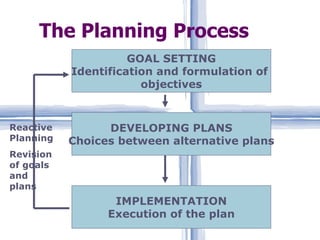
The Planning Process GOAL SETTING Identification and formulation of  objectives DEVELOPING PLANS Choices between alternative plans IMPLEMENTATION Execution of the plan Reactive Planning Revision of goals and plans
What Is an Objective? “ objective are goals, aims or purposes that organisation wish over varying periods of time”
Management by Objectives (MBO)— 10— Management by Objectives (MBO) A philosophy of management, a planning and controlling technique, and an employee involvement program in which managers ask workers to join them in deciding what their goals should be.
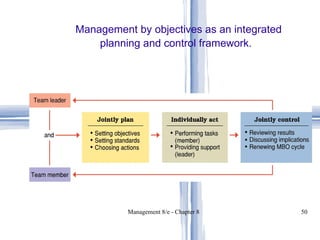
Management by objectives as an integrated planning and control framework.
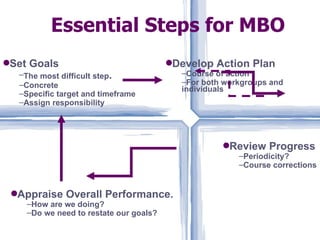
Essential Steps for MBO Set Goals The most difficult step . Concrete Specific target and timeframe Assign responsibility Develop Action Plan Course of action For both workgroups and individuals Review Progress Periodicity? Course corrections Appraise Overall Performance. How are we doing? Do we need to restate our goals?
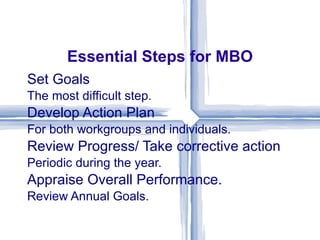
Essential Steps for MBO Set Goals The most difficult step. Develop Action Plan For both workgroups and individuals. Review Progress/ Take corrective action Periodic during the year. Appraise Overall Performance. Review Annual Goals.
Management By Exceptions Administrative policy of focusing on those events deviating from an established standard. Management by exception practices are established where it has been determined that only those events that deviate from a standard are significant.
Management by walking around Management method emphasizing the importance of interpersonal contact.  The objective of MBWA is to achieve harmony in an organization between management and employees through face-to-face contact as well as to keep abreast of current operational developments.
Decision Making A decision is a choice made from available alternatives.  Decision-making is the process by which individuals select a course of action among several alternatives, to produce a desired result. Decision making is the selection based on some criteria from two or more possible alternatives – George Terrry
Characteristics of Decision Making Goal-oriented Alternatives Analytical-intellectual Dynamic process Pervasive function Continuous activity Commitment of time, effort and money Human and social process Integral part of planning
Steps involved in  Decision Making 1. Defining the Problem 2. Analysis of Problem 3. Alternative Course of Action 4. Evaluation of Alternatives 5. Experience 6. Experimentation 7. Taking Decision and Follow up
Module: 03 ORGANIZATION
Module Coverage Nature and purpose of organization, Principles of organization Types of organization – Formal and Informal- Centralization Vs decentralization of authority and responsibility Span of Control – Organizational Behaviour – nature and significance
Meaning of Organization A group of people united by a common purpose. An entity, an ongoing business unit engaged in utilizing  resources to create a result. A process by which employees, facilities and tasks are related to  each other, with a view to achieve specific goals.
Principles of Organization 1. Principle of Objective 2. Principle of Specialization 3. Principle of Co-ordination 4. Principle of Authority and Responsibility 5. Principle of Definition 6. Span of Control 7. Principle of Balance 8. Principle of Continuity 9. Principle of Uniformity 10. Principle of Unity of Command 11. Principle of Exception 12. Principle of Simplicity 13. Principle of Efficiency 14. Scalar Chain
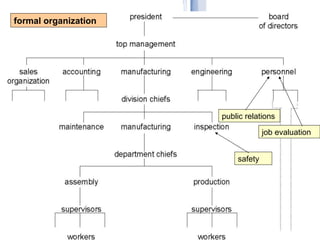
Formal Organization refers to the collection of work groups that have been consciously designed by senior management to maximize efficiency and achieve organizational goals
5/6/2003 Organizational Structure Laura Hofman Miquel, Hanna Barst, Jörg Petzold formal organization public relations job evaluation safety
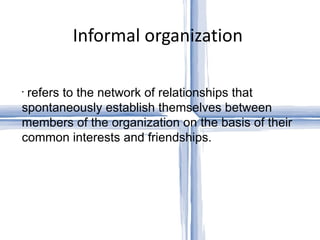
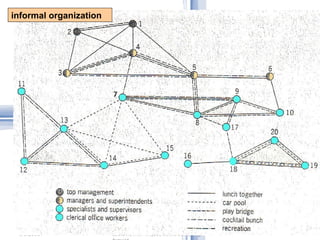
Informal organization  refers to the network of relationships that spontaneously establish themselves between members of the organization on the basis of their common interests and friendships.
5/6/2003 Organizational Structure Laura Hofman Miquel, Hanna Barst, Jörg Petzold informal organization
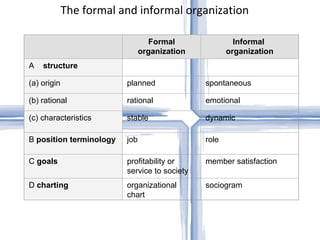
The formal and informal organization   Formal organization Informal  organization A  structure     (a) origin planned spontaneous (b) rational rational emotional (c) characteristics stable dynamic   B  position terminology job role   C  goals profitability or service to society member satisfaction D  charting organizational chart sociogram  
Centralization/Decentralization Centralization  is that in which Authority and responsibility are tightly held by upper levels of the organization and are not delegated. Decentralization  actually refers to the degree to which authority is delegated to lower levels. In decentralization, a great deal of authority is delegated and more decisions are made at lower levels.
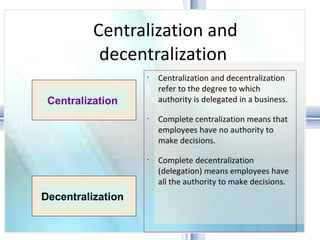
Centralization and decentralization  Centralization and decentralization refer to the degree to which authority is delegated in a business. Complete centralization means that employees have no authority to make decisions.  Complete decentralization (delegation) means employees have all the authority to make decisions.  Centralization  Decentralization
Delegating Work Assignments Centralization:   retains decision-making at the top of the management hierarchy Decentralization:  locates decision-making at lower levels © PhotoDisc
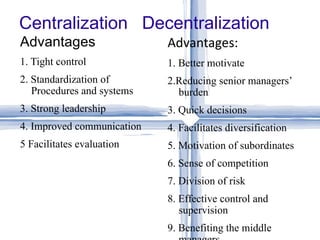
Centralization   Decentralization Advantages 1. Tight control  2. Standardization of Procedures and systems 3. Strong leadership  4. Improved communication 5 Facilitates evaluation Advantages: 1. Better motivate  2.Reducing senior managers’ burden 3. Quick decisions 4. Facilitates diversification 5. Motivation of subordinates 6. Sense of competition 7. Division of risk 8. Effective control and supervision 9. Benefiting the middle managers
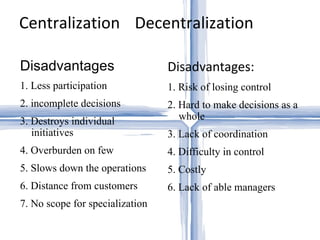
Disadvantages 1. Less participation 2. incomplete decisions 3. Destroys individual initiatives 4. Overburden on few 5. Slows down the operations 6. Distance from customers 7. No scope for specialization Disadvantages: 1. Risk of losing control 2. Hard to make decisions as a whole 3. Lack of coordination 4. Difficulty in control 5. Costly 6. Lack of able managers Centralization   Decentralization
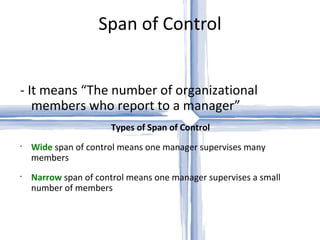
Span of Control - It means “The number of organizational members who report to a manager” Types of Span of Control Wide  span of control means one manager supervises many members Narrow  span of control means one manager supervises a small number of members
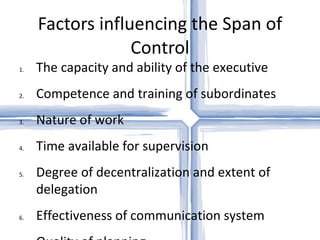
Factors influencing the Span of Control The capacity and ability of the executive Competence and training of subordinates Nature of work Time available for supervision Degree of decentralization and extent of delegation Effectiveness of communication system Quality of planning Degree of physical dispersion Assistance of experts Control mechanism Dynamism or rate of change Need for balance
Module: 04 Directing
Module Coverage Meaning and nature of directing Leadership styles Theory X and Y; Management of productivity-an overview-Concept & application in manufacturing & service industries application in different areas Measurement of productivity, partial, multifactor & total factor models –  Creativity Based Techniques -– Brainstorming. Whole brain thinking, Nominal Group techniques, Use in creative problem solving with practical applications. Learning Curves -– Concept of learning curve, its applicability, barriers to its application
Meaning of Directing Directing is the interpersonal aspect of managing in which subordinates are led to understand and contribute effectively and efficiently to the attainment of enterprise’s objectives
Nature of Directing It is a dynamic function It initiates action It provides necessary link between various managerial functions It is a universal function It is concerned with human relationships
Importance of Direction Initiates action Improves efficiency Ensures co-ordination Helpful in implementing changes Provides stability Motivation supervision
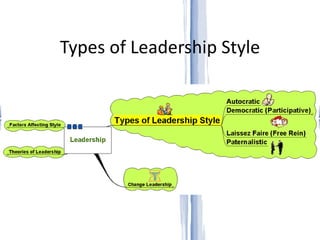
Types of Leadership Style
Types of Leadership Style Autocratic: Leader makes decisions without reference to anyone else High degree of dependency on the leader Can create de-motivation and alienation  of staff May be valuable in some types of business where decisions need to be made quickly and decisively
Types of Leadership Style Democratic: Encourages decision making  from different perspectives – leadership may be emphasised throughout  the organisation Consultative:  process of consultation before decisions are taken Persuasive:  Leader takes decision and seeks to persuade others that the decision  is correct
Types of Leadership Style Democratic: May help motivation and involvement Workers feel ownership of the firm and its ideas Improves the sharing of ideas  and experiences within the business Can delay decision making
Types of Leadership Style Laissez-Faire: ‘ Let it be’ – the leadership responsibilities  are shared by all Can be very useful in businesses  where creative ideas are important Can be highly motivational,  as people have control over their working life Can make coordination and decision making  time-consuming and lacking in overall direction Relies on good team work Relies on good interpersonal relations
Types of Leadership Style Paternalistic: Leader acts as a ‘father figure’ Paternalistic leader makes decision but may consult Believes in the need to support staff
Douglas McGregor Theory X and Theory Y In 1957, Douglas McGregor (1906-1964), a famous American psychologist, published his article "The Human Side of Enterprise" in which he introduced what came to be called the new humanism, Theory X and Theory Y.
Theory X and Theory Y  Theory X and Theory Y Theory X and Theory Y are two sets of assumptions about human nature and behavior that are related to the practice of management.  Theory X:   Representing a negative view of human nature that assumes people generally are naturally irresponsible for their work and require close supervision to do jobs. Theory Y:  Indicating a positive view of human nature that assumes people are generally hard-working, creative and responsible for exercising self-control over their jobs.
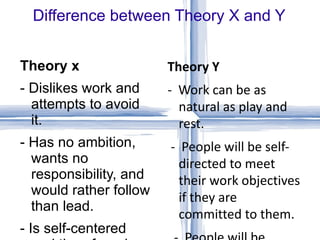
Difference between Theory X and Y Theory x - Dislikes work and attempts to avoid it. - Has no ambition, wants no responsibility, and would rather follow than lead. - Is self-centered and therefore does not care about organizational goals. - Resists change. - Is gullible and not particularly intelligent Theory Y -  Work can be as natural as play and rest. -  People will be self-directed to meet their work objectives if they are committed to them. -  People will be committed to their objectives if rewards are in place that address higher needs such as self-fulfillment. - Under these conditions, people will seek responsibility. - Most people can handle responsibility because creativity and ingenuity are common in the population
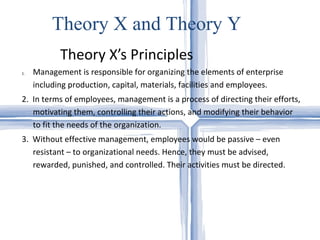
Theory X’s Principles Theory X and Theory Y Management is responsible for organizing the elements of enterprise including production, capital, materials, facilities and employees.  2.  In terms of employees, management is a process of directing their efforts, motivating them, controlling their actions, and modifying their behavior to fit the needs of the organization.  3.  Without effective management, employees would be passive – even resistant – to organizational needs. Hence, they must be advised, rewarded, punished, and controlled. Their activities must be directed.
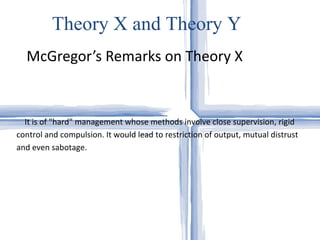
McGregor’s Remarks on Theory X Theory X and Theory Y It is of "hard" management whose methods involve close supervision, rigid control and compulsion. It would lead to restriction of output, mutual distrust and even sabotage.
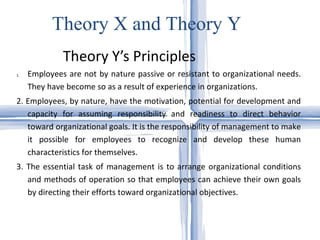
Theory Y’s Principles Theory X and Theory Y Employees are not by nature passive or resistant to organizational needs. They have become so as a result of experience in organizations.  2. Employees, by nature, have the motivation, potential for development and capacity for assuming responsibility and readiness to direct behavior toward organizational goals. It is the responsibility of management to make it possible for employees to recognize and develop these human characteristics for themselves. 3. The essential task of management is to arrange organizational conditions and methods of operation so that employees can achieve their own goals by directing their efforts toward organizational objectives.
McGregor’s Remarks on Theory Y Theory X and Theory Y It is of "soft" management whose methods as tolerance and need satisfaction. It can lead to more effective management of employees in the organization.
McGregor’s Suggestions to Perform Theory Y Management should have employees’ higher level needs met in the workplace.  2. Close supervision and the threat of punishment are not the proper means for encouraging employees to exercise productive efforts.  3. Some opportunities should be provided such as allowing employees to make decisions, redesigning jobs to make them more challenging or emphasizing on good working relations. Theory X and Theory Y
Effects on Management  Practice of Theory X and Theory Y Theory X:  1. Managers’ leadership styles are autocratic and the communication flow is downward from managers to the employees. This may cause resistance from employees.  2. The upper setting of objectives gets little or no participation from employees.  3. It results in outside, control, with the manager acting as a performance judge who focuses generally on the past.
Effects on Management  Practice of Theory X and Theory Y Theory Y: 1. It may lead to cooperative objectives designed with input from both employees and managers, resulting in a stronger responsibility by employees for accomplishing the shared objectives.  It encourages leadership styles to be more participative and allows employees to seek responsibility for achievement of goals. Theory Y’s leadership is likely to improve communication flow, especially in the upward direction.  It  leads to control processes based on employees’ self-control. The manager is more likely to act as an instructor rather than a judge who focuses on how performance can be improved in the future rather than on who is responsible for past performance.
Criticism of Theory Y Practice of Theory X and Theory Y Rather than concern for employees, Theory Y style managers are simply engaged in an attractive form of management.  Sometimes, managers better match work tasks to basic human motivation through participative management, job enlargement and other programs based on Theory Y.  Actually, managers still focused on measures of productivity rather than employees’ interests.  It is a patronizing plan for bringing increased productivity from employees. Unless employees shared in the economic benefits of their increased productivity, they are just fooled into working harder for the same pay.
Theory X and Theory Y in the 21st Century  Practice of Theory X and Theory Y McGregor’s works on Theory X and Theory Y have had a great impact on management ideology and practice. They have been included in most basic management books. These books are still facing people of management today.  As for the practice of management, the workplace of the 21st century, which emphasizes on self-managed work teams and other forms of worker involvement programs, generally goes with the principles of Theory Y.
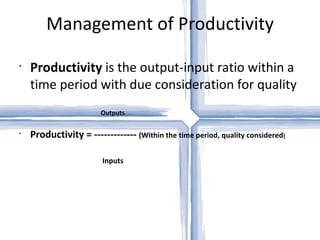
Management of Productivity Productivity  is the output-input ratio within a time period with due consideration for quality Outputs Productivity = -------------  (Within the time period, quality considered ) Inputs
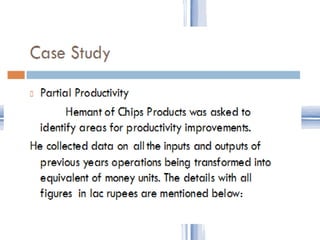
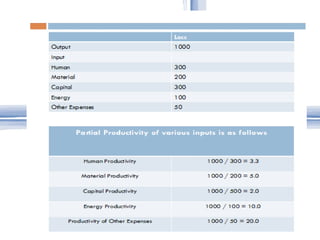
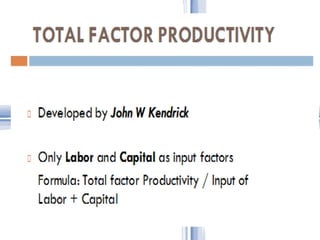
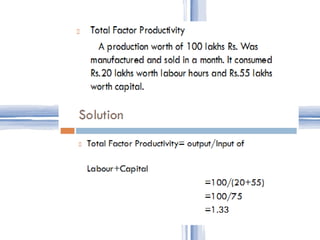
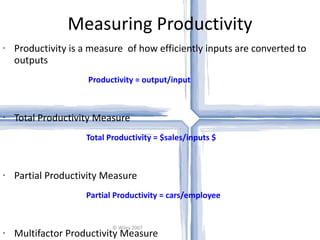
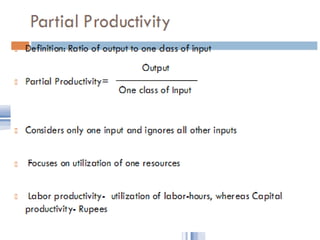
Measuring Productivity Productivity is a measure  of how efficiently inputs are converted to outputs   Productivity = output/input Total Productivity Measure  Total Productivity = $sales/inputs $ Partial Productivity Measure     Partial Productivity = cars/employee Multifactor Productivity Measure    Multi-factor Productivity = sales/total $costs © Wiley 2007


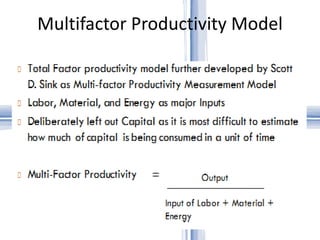
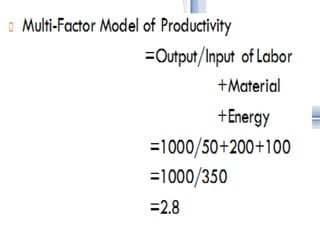
Multifactor Productivity Model


Productivity and the Service Sector Measuring service sector productivity is a unique challenge Traditional measures focus on tangible outcomes Service industries primarily produce intangible outcomes Measuring intangibles is challenging
Creativity Based Techniques Brain Storming Nominal group techniques
Learning Curve A  learning curve  is a graphical representation of the changing rate of learning (in the average person) for a given activity or tool. Typically, the increase in retention of information is sharpest after the initial attempts, and then gradually evens out, meaning that less and less new information is retained after each repetition
Module: 05 Controlling Meaning and importance Steps in controlling Essentials of a sound control system Methods of establishing control
Meaning of Controlling “ Management control is the process by which managers assure that resources are obtained and used effectively in the accomplishment of an organization’s objectives”.
Characteristics of Controlling Managerial Function Forward Looking Continuous activity Control is related to planning Essence of control is action
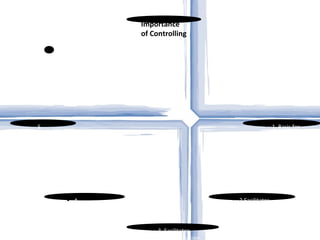
Importance of Controlling 1. Basis for Future action 2.Facilitates Decision-making 3. Facilitates Decentralization 4. Facilitates Coordination 5. Improves Efficiency 6.
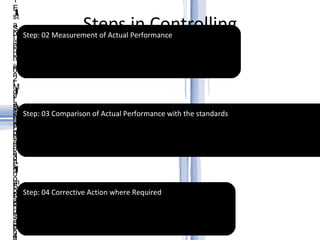
Steps in Controlling Step: 01 Establishment of standards Step: 01 Establishment of standards Step: 02 Measurement of Actual Performance Step: 02 Measurement of Actual Performance Step: 03 Comparison of Actual Performance with the standards Step: 03 Comparison of Actual Performance with the standards Step: 04 Corrective Action where Required Step: 04 Corrective Action where Required
Characteristics of a Sound Control System Suitable Simple Selective Sound and Economical Flexible Forward-looking Reasonable Objective Responsibility for failure Acceptable
Types of Control Feedback Control - It is a post mortem examination of events, the purpose of which is to improve performance Concurrent Control - Control that consists of monitoring ongoing activities to ensure they are consistent with standards 3.  Forward Control - It is the intelligent anticipation of problems and their timely prevention, rather than after-the-fact reaction
Overcoming Resistance to Control Employee Participation Justifiable Controls Precise and Understandable Standards Realistic Standards Timely communication of findings Accurate Findings Assuring support Positive reinforcement
Module: 06 Total Quality Management
Module Coverage Importance & relevance in the context of globalization of Indian economy Techniques used to inculcate the quality approach in an organization role of organizational behaviour-Quality Standards-ISO 9000/14000, SQC ERP MRP/MRP II (Brief introduction) 
Why TQM? Ford Motor Company had operating losses of $3.3 billion between 1980 and 1982.  Xerox market share dropped from 93% in 1971 to 40% in 1981. Attention to quality was seen as a way to combat the competition.
TQM: A “Buzzword” Losing Popularity For many companies, the term TQM is associated with corporate programs (mid 1980s  early 1990s) aimed at implementing employee teams and statistical process control. Unfortunately, many companies were dissatisfied with the perceived results of these programs, concluding TQM does not work. Question: Why were they dissatisfied?   Were they justified?
TQM Total Quality Management Total - made up of the whole Quality - degree of excellence a product or service provides Management - act, art or manner of planning, controlling, directing,…. Therefore, TQM is the art of managing the whole to achieve excellence .
What does TQM mean? Total Quality Management Total Quality Management means that the organization's culture is defined by and supports the constant attainment of customer satisfaction through an integrated system of tools, techniques, and training.  This involves the continuous improvement of organizational processes, resulting in high quality products and services.
What’s the goal of TQM? Total Quality Management “ Do the right things  right  the first time, every time.”
Another way to put it Total Quality Management At it’s simplest, TQM is all managers leading and facilitating all contributors in everyone’s two main objectives: (1)  total client satisfaction  through quality products and services; and (2)  continuous improvements  to  processes, systems, people, suppliers, partners, products, and services.
Productivity and TQM Total Quality Management Traditional view: Quality cannot be improved without significant losses in productivity. TQM view: Improved quality leads to improved productivity.
Basic Tenets of TQM Total Quality Management 1.  The customer makes the ultimate determination of quality. 2.  Top management must provide leadership and support for all quality initiatives. 3.  Preventing variability is the key to producing high quality. 4.  Quality goals are a moving target, thereby requiring a commitment toward continuous improvement. 5.  Improving quality  requires the establishment of effective metrics. We must speak with data and facts not just opinions.
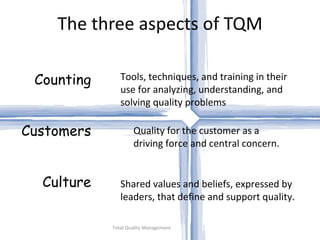
The three aspects of TQM Total Quality Management Counting Customers Culture Tools, techniques, and training in their use for analyzing, understanding, and solving quality problems Quality for the customer as a  driving force and central concern. Shared values and beliefs, expressed by leaders, that define and support quality.
Total Quality Management and Continuous Improvement Total Quality Management TQM is the management process used to make continuous improvements to all functions. TQM represents an ongoing, continuous commitment to improvement. The foundation of total quality is a management philosophy that supports meeting customer requirements through continuous improvement.
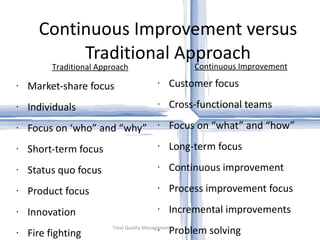
Continuous Improvement versus Traditional Approach Market-share focus Individuals Focus on ‘who” and “why” Short-term focus Status quo focus Product focus Innovation Fire fighting Customer focus Cross-functional teams Focus on “what” and “how” Long-term focus Continuous improvement Process improvement focus Incremental improvements Problem solving Total Quality Management Traditional Approach Continuous Improvement
Quality Throughout Total Quality Management “ A Customer’s impression of quality begins with the initial contact with the company and continues through the life of the product.” Customers look to the total package - sales, service during the sale, packaging, deliver, and service after the sale. Quality extends to how the receptionist answers the phone, how managers treat subordinates, how courteous sales and repair  people are, and how the product is serviced after the sale. “ All departments of the company must strive to improve the quality of their operations.”
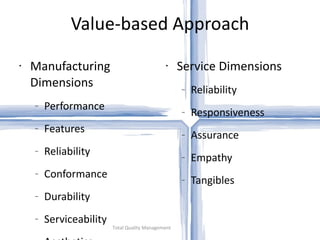
Value-based Approach Manufacturing Dimensions Performance Features Reliability Conformance Durability Serviceability Aesthetics Perceived quality Service Dimensions Reliability Responsiveness Assurance Empathy Tangibles Total Quality Management
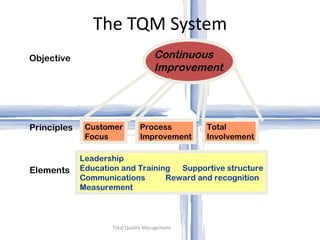
The TQM System Total Quality Management Customer Focus Process Improvement Total Involvement Leadership Education and Training  Supportive structure Communications  Reward and recognition Measurement Continuous Improvement Objective Principles Elements
MODUEL: 07 ENTREPRENEURSHIP
Module Coverage Introduction - the entrepreneur; Definitions Emergence of entrepreneurial class; Characteristics of entrepreneur. Leadership; Risk taking; Decision-making and business planning. Self-actualization Management of conflicts, stress & time, Psychology of winning Entrepreneurial Development Programmes (EDP)- their role, relevance, and achievements- EDP & Strategic Management    
Meaning of Entrepreneurship An entrepreneur is a person who has possession of a new enterprise, venture or idea and assumes significant accountability for the inherent risks and the outcome. The term is originally a loanword from French and was first defined by the Irish economist  Richard Cantillon . Risk taking and Innovation are keys word in entrepreneurship
Who is  an Intrapreneur? A person within a large corporation who takes direct responsibility for turning an idea into a profitable finished product through assertive risk-taking and innovation A Person who has all the abilities of an entrepreneur but works for an organization
Why do people take up entrepreneurial challenge Opportunity Profit Independence challenge
Barriers to Entrepreneurship Lack of a viable lack of market knowledge Lack of technical skills Lack of capital Lack of business know-how Complacency – lack of motivation Social stigma PEST
The Myths of Entrepreneurship Myth 1: Entrepreneurs Are Doers, Not   Thinkers Myth 2: Entrepreneurs Are Born, Not Made Myth 3: Entrepreneurs Are Always Inventors Myth 4: Entrepreneurs Are Academic and   Social Misfits Myth 5: Entrepreneurs Must Fit the “Profile” Myth 6: All Entrepreneurs Need Is Money
The Myths of Entrepreneurship Myth 7: All Entrepreneurs Need Is Luck Myth 8: Ignorance Is Bliss For Entrepreneurs Myth 9: Entrepreneurs Seek Success But   Experience High Failure Rates Myth 10: Entrepreneurs Are Extreme Risk   Takers (Gamblers)
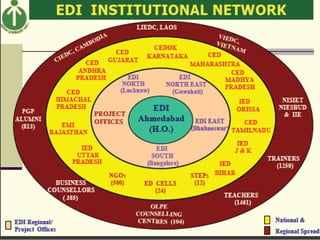
Institutions in Aid of Entrepreneurship Development Management Development Institute  (MDI ) Entrepreneurship Development Institute of India  (EDII) The National Institute for Entrepreneurship and Small Business Development  (NIESBUD) Science and Technology Entrepreneurship Parks  (STEPS) Small Industrial Development Bank of India  (SIDBI) Science and Technology Parks XISS   (Ranchi) Role of development and commercial banks District Industries Centre  (DIC) Industrial Estates IIE Guwahati`
Academic Programs Post Graduate Programme in Management, PGPM National Management Programme, NMP Part-Time Post Graduate Programme in Management Fellow Programme in Management, FPM  Post Graduate Programme in Human Resource Management, PGP- HRM  Executive Fellow Program In Management School of Energy Management  Post Graduate Programme in Public Policy and Management Post Graduate programme in International Management


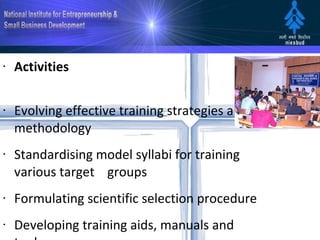
Activities Evolving effective training strategies and methodology Standardising model syllabi for training various target    groups Formulating scientific selection procedure  Developing training aids, manuals and tools Facilitating and supporting Central / State/ Other    agencies in organising entrepreneurship development    programmes  Conducting training programmes for promoters, trainers    and enterpreneurs   Undertaking research and exchange experiences globally in development and growth of    entrepreneurship. The Institute is actively involved in creating a climate conducive to    emergence of entrepreneurship
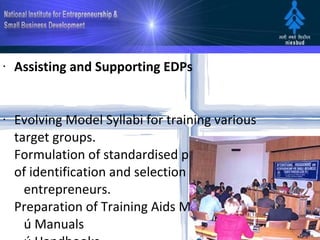
Assisting and Supporting EDPs Evolving Model Syllabi for training various target groups.  Formulation of standardised procedures of identification and selection of potential    entrepreneurs.  Preparation of Training Aids Materials     ú Manuals     ú Handbooks     ú Video Films     ú Lesson Plans     ú Learning Text     ú Cases     
Small Industries Development Organization (SIDO) New Delhi ACTIVITIES Advising the Govt. in policy matters concerning small scale sector. Providing techno-economic and managerial consultancy, common facilities and extension services.  Providing facilities for technology up-gradation, modernization quality improvement & infrastructure. Human resources development through training and skill up-gradation.    Providing economic information services. Maintaining close liaison and vital linkage with the Central Ministries, Planning Commission, Financial Institutions, State Govts. & similar other developmental organizations/agencies related to the promotion and development of SSI Sector.   Evolving and coordinating policies for development of ancillaries.
Services Marketing Technology and Training Exporting International Trade Fair NSIC Exhibition
Academic Program Post Graduate  Diploma in Personnel Management Post Graduate  Diploma in Rural Development Post Graduate  Diploma in Information Management Post Graduate  Diploma in Business Management
Services Assistance / Consultancy to Prospective Entrepreneurs.  Assistance / Consultancy to existing Micro and Small Enterprises . Preparation / Upgradation of District Industrial Potential Surveys Preparation of Project Reports / Project Profiles.  Entrepreneurship Development Programmes Motivation Campaigns. Project Appraisal for Bank / Financial Institutions.  Management Development Programmes. Skill Development Programmes Awareness Programmes on Energy Conservation / Pollution Control. Quality Improvement & Technology up gradation.  Export Promotion.  Linkage with State Govt.  Market Surveys.  Marketing Support through NSIC Enlistment by giving Technical Inspection Report.  Registration of Micro and Small Enterprises under Ozone Depleting Substances (Regulation & Control) Rules, 2000. Revival of Sick Micro and Small Enterprises
Small Industries Service Institutes (SISIs) Are set up to provide consultancy and training to small entrepreneurs – both existing and prospective There are 28 SISIs and 30 branch SISIs set up in the state capital and other places all over the country
Functions of SISIs Interface between central & state Govt.  Render technical support services.  Conduct E.D.P's.  Initiate Promotional Programmes.
Assistance in following areas by SISI  Economic consultancy/information/ EDP consultancy.  Trade and market information.  Project profiles.  State industrial potential survey.  District industrial potential survey.  Modernization and implant studies.  Workshop facilities.  Training in various trade/activities.


Buisness management

  • 1.
  • 2.
    Subject Coverage Managementand Principles Planning Organizing Directing Controlling Total Quality Management Entrepreneurship
  • 3.
    Module: 01 Managementand Principles
  • 4.
    Module Coverage Meaning,nature / characteristics Scope and functional areas of management Management as a science, art or profession Management & Administration Management Process Management Principles Evolution of-System Approach to management in detail (in domestic & international context) planning, organizing, staffing, Directing, coordination, controlling and innovation (creativity)
  • 5.
    Definition Of Management“ Management is the art of getting things done through others” – M ary Parker Follett “ Management is the art of getting things done though and with people in formally organized groups” – Harold Koontz “ Management is the process of optimizing human, material and financial contributions for the achievement of organizational goals” - John A Pearce & R B Robinson
  • 6.
  • 7.
    Objectives of ManagementProper utilization of resources Improving performance Mobilizing best talent Planning for the future
  • 8.
    Nature/Characteristics of Management- Multidisciplinary - It is a group activity - Goal oriented - Management is a factor of production - Universal in character - Social Process - System of authority - Dynamic function - Art as well as science - It is a profession
  • 9.
    Scope of ManagementActivities - Planning - Staffing - Coordinating - Organisation - Directing - controlling Operations - Production/Operations Management - Financial Management - Marketing Management - Personnel Management - Office Management - Management of Information system
  • 10.
    Functions of Management1. Planning 2. Organizing 3. Coordinating 4. Staffing 5. Directing 6. Controlling
  • 11.
    Functions of Management1. Planning What to do? When to do? How to do? Who is to do? 2. Organizing - To identify, classify and assign activities - Delegate authority and fix responsibility - Coordinate relationship
  • 12.
    Functions of Management3. Staffing Manpower planning Recruitment Selection and training Placement, development Promotion Transfer, appraisal Employee remuneratio 4. Directing Management in action It involves: leadership, communication, motivation Supervision
  • 13.
    Functions of Management5. Coordinating - Orderly arrangement of goods, - Effort to provide unity of action in the pursuit of common objectives 6. Controlling -Establishing standards -Measuring actual performance -Comparing actual with standard -Finding variances -Taking corrective action
  • 14.
  • 15.
    Difference Administration Management Nature of work It is concerned about the determination of objectives and major policies of an organization. It puts into action the policies and plans laid down by the administration. Type of function It is a determinative function. It is an executive function. Scope It takes major decisions of an enterprise as a whole. It takes decisions within the framework set by the administration. Level of authority It is a top-level activity. It is a middle level activity.
  • 16.
    Basis of Difference Administration Management Nature of status It consists of owners who invest capital in and receive profits from an enterprise. It is a group of managerial personnel who use their specialized knowledge to fulfill the objectives of an enterprise. Nature of usage It is popular with government, military, educational, and religious organizations. It is used in business enterprises. Decision making Its decisions are influenced by public opinion, government policies, social, and religious factors. Its decisions are influenced by the values, opinions, and beliefs of the managers. Main functions Planning and organizing functions are involved in it. Motivating and controlling functions are involved in it. Abilities It needs administrative rather than technical abilities. It requires technical activities.
  • 17.
  • 18.
    1. Divisionof work There is an efficient result in the operational level when tasks are distributed to qualified and competent workers or when people .
  • 19.
    2. Authority Withformal authority managers have the right to command and gives order to their subordinates
  • 20.
    3. Discipline Members in any organization have to respect the rules and agreements governing it Respect and obedience to rules is embodied in the conduct of good life and discipline
  • 21.
    4. Unity ofCommand Employees must receive instruction only from one person. Reporting to more than one manager results to conflicts in instruction and confusion of authority
  • 22.
    5. Unity ofDirection Operations within any organization having the same objective must be directed by only one manager using one plan in a department For example there should not be two or more supervisors each having different policy to follow.
  • 23.
    6. Subordination ofthe Individual Interest to General interest Individual interest must be subordinate to general interest when there is conflict between the two The agreement between the employers and the employees should be fair and there should be constant vigilance and supervision
  • 24.
    7. Remuneration Compensationfor the work done should be fair to the employees and the employers
  • 25.
    8. Centralization Wehave this approach by decreasing the role of subordinates in decision making Managers should retain their final responsibility, while at the same time give their subordinates enough authority to do their jobs properly
  • 26.
    9. Scalar ChainThe line of authority in any organization turns in the order of rank from top management to the lowest level of the enterprise
  • 27.
    10. Order Eithermaterial or human resources should be in the right place at the right time. People should be in the jobs or positions they are suited to.
  • 28.
    11. Equity Equityis combination of justice and kindness. Equity in treatment and behaviour is liked by everyone and it brings loyalty in the organisation This brings cordial relation between the management and labour
  • 29.
    12. Stability ofStaff Employees work better if job security and career progress are assured to them A high employee turnover rate will effect the organization
  • 30.
    13. Initiative Managersshould encourage their employees for taking initiative with in limits of authority and discipline Initiative increases the zeal and energy on the part of human beings Fayols describes initiative as one of the keenest satisfactions for an intelligent man to experience
  • 31.
    14. Esprit decorps Teamwork is fundamentally important to an organization Work teams and extensive face to face verbal communication encourages team work
  • 32.
  • 33.
    The Systems Approach2– System Defined A set of interrelated and interdependent parts arranged in a manner that produces a unified whole. Basic Types of Systems Closed systems Are not influenced by and do not interact with their environment (all system input and output is internal). Open systems Dynamically interact to their environments by taking in inputs and transforming them into outputs that are distributed into their environments.
  • 34.
    The Organization asan Open System 2–
  • 35.
    Implications of theSystems Approach 2– Coordination of the organization’s parts is essential for proper functioning of the entire organization. Decisions and actions taken in one area of the organization will have an effect in other areas of the organization. Organizations are not self-contained and, therefore, must adapt to changes in their external environment.
  • 36.
  • 37.
    Module Coverage Natureand Importance and purpose of Planning Planning process Objectives, Types of plans Nature and Hierarchy of Objectives Management by Objectives Management by Exceptions Management by Moving around Decision making, importance and steps
  • 38.
    Meaning of PlanningA plan is a forecast for accomplishment. It is a predetermined course of action. It is today's projection for tomorrow's activity. In other words, to plan is to produce a scheme for future action, to bring about specified results at a specified cost, in a specified period of time.
  • 39.
    Features of PlanningPlanning has a number of characteristics: Planning is goal-oriented Planning is a primary function Planning is all-pervasive Planning is a mental exercise Planning is a continuous process Planning involves choice Planning is forward looking Planning is flexible Planning is an integrated process Planning includes efficiency and effectiveness dimensions
  • 40.
    Steps in PlanningProcess Establishing objectives Developing premises Evaluating alternatives and selection Formulating derivative plans Securing cooperation and participation Providing for follow-up
  • 41.
    Importance of PlanningPlanning helps an organisation in the following ways: Planning provides direction Planning provides a unifying framework Planning is economical Planning reduces the risks of uncertainty Planning facilitates decision making Planning encourages innovation and creativity Planning improves morale Planning facilities control
  • 42.
    Principles of PlanningPrinciple of contribution to objectives Principle of primacy of planning Principle of pervasiveness of planning Principle of flexibility Principle of periodicity Principle of planning premises Principle of limiting factor
  • 43.
    Limitations of PlanningThe limitations of planning can be examined under the following headings: Rigidity Costly and time consuming Employee resistance False sense of security Managerial deficiencies Planning prevents innovation External Limitations Difficult to predict Projected too far into the future Environmental turbulence Emergency situations
  • 44.
    The Essentials ofPlanning (cont’d) Types of Planning Strategic planning: determining how to pursue long-term goals with available resources. Intermediate planning: determining subunits’ contribution with allocated resources. Operational planning: determining how to accomplish specific tasks with available resources.
  • 45.
    Figure 5.2 Typesof Planning
  • 46.
    Other Forms of Planning 1. Long-Range Planning - Short-Range Planning 2. Formal and Informal Planning 3. Strategic, Tactic and Operational Planning 4. Proactive and Reactive Planning 5. Functional and Corporate Planning
  • 47.
    The Planning ProcessGOAL SETTING Identification and formulation of objectives DEVELOPING PLANS Choices between alternative plans IMPLEMENTATION Execution of the plan Reactive Planning Revision of goals and plans
  • 48.
    What Is anObjective? “ objective are goals, aims or purposes that organisation wish over varying periods of time”
  • 49.
    Management by Objectives(MBO)— 10— Management by Objectives (MBO) A philosophy of management, a planning and controlling technique, and an employee involvement program in which managers ask workers to join them in deciding what their goals should be.
  • 50.
    Management by objectivesas an integrated planning and control framework.
  • 51.
    Essential Steps forMBO Set Goals The most difficult step . Concrete Specific target and timeframe Assign responsibility Develop Action Plan Course of action For both workgroups and individuals Review Progress Periodicity? Course corrections Appraise Overall Performance. How are we doing? Do we need to restate our goals?
  • 52.
    Essential Steps forMBO Set Goals The most difficult step. Develop Action Plan For both workgroups and individuals. Review Progress/ Take corrective action Periodic during the year. Appraise Overall Performance. Review Annual Goals.
  • 53.
    Management By ExceptionsAdministrative policy of focusing on those events deviating from an established standard. Management by exception practices are established where it has been determined that only those events that deviate from a standard are significant.
  • 54.
    Management by walkingaround Management method emphasizing the importance of interpersonal contact. The objective of MBWA is to achieve harmony in an organization between management and employees through face-to-face contact as well as to keep abreast of current operational developments.
  • 55.
    Decision Making Adecision is a choice made from available alternatives. Decision-making is the process by which individuals select a course of action among several alternatives, to produce a desired result. Decision making is the selection based on some criteria from two or more possible alternatives – George Terrry
  • 56.
    Characteristics of DecisionMaking Goal-oriented Alternatives Analytical-intellectual Dynamic process Pervasive function Continuous activity Commitment of time, effort and money Human and social process Integral part of planning
  • 57.
    Steps involved in Decision Making 1. Defining the Problem 2. Analysis of Problem 3. Alternative Course of Action 4. Evaluation of Alternatives 5. Experience 6. Experimentation 7. Taking Decision and Follow up
  • 58.
  • 59.
    Module Coverage Natureand purpose of organization, Principles of organization Types of organization – Formal and Informal- Centralization Vs decentralization of authority and responsibility Span of Control – Organizational Behaviour – nature and significance
  • 60.
    Meaning of OrganizationA group of people united by a common purpose. An entity, an ongoing business unit engaged in utilizing resources to create a result. A process by which employees, facilities and tasks are related to each other, with a view to achieve specific goals.
  • 61.
    Principles of Organization1. Principle of Objective 2. Principle of Specialization 3. Principle of Co-ordination 4. Principle of Authority and Responsibility 5. Principle of Definition 6. Span of Control 7. Principle of Balance 8. Principle of Continuity 9. Principle of Uniformity 10. Principle of Unity of Command 11. Principle of Exception 12. Principle of Simplicity 13. Principle of Efficiency 14. Scalar Chain
  • 62.
    Formal Organization refersto the collection of work groups that have been consciously designed by senior management to maximize efficiency and achieve organizational goals
  • 63.
    5/6/2003 Organizational StructureLaura Hofman Miquel, Hanna Barst, Jörg Petzold formal organization public relations job evaluation safety
  • 64.
    Informal organization refers to the network of relationships that spontaneously establish themselves between members of the organization on the basis of their common interests and friendships.
  • 65.
    5/6/2003 Organizational StructureLaura Hofman Miquel, Hanna Barst, Jörg Petzold informal organization
  • 66.
    The formal andinformal organization   Formal organization Informal organization A structure     (a) origin planned spontaneous (b) rational rational emotional (c) characteristics stable dynamic   B position terminology job role   C goals profitability or service to society member satisfaction D charting organizational chart sociogram  
  • 67.
    Centralization/Decentralization Centralization is that in which Authority and responsibility are tightly held by upper levels of the organization and are not delegated. Decentralization actually refers to the degree to which authority is delegated to lower levels. In decentralization, a great deal of authority is delegated and more decisions are made at lower levels.
  • 68.
    Centralization and decentralization Centralization and decentralization refer to the degree to which authority is delegated in a business. Complete centralization means that employees have no authority to make decisions. Complete decentralization (delegation) means employees have all the authority to make decisions. Centralization Decentralization
  • 69.
    Delegating Work AssignmentsCentralization: retains decision-making at the top of the management hierarchy Decentralization: locates decision-making at lower levels © PhotoDisc
  • 70.
    Centralization Decentralization Advantages 1. Tight control 2. Standardization of Procedures and systems 3. Strong leadership 4. Improved communication 5 Facilitates evaluation Advantages: 1. Better motivate 2.Reducing senior managers’ burden 3. Quick decisions 4. Facilitates diversification 5. Motivation of subordinates 6. Sense of competition 7. Division of risk 8. Effective control and supervision 9. Benefiting the middle managers
  • 71.
    Disadvantages 1. Lessparticipation 2. incomplete decisions 3. Destroys individual initiatives 4. Overburden on few 5. Slows down the operations 6. Distance from customers 7. No scope for specialization Disadvantages: 1. Risk of losing control 2. Hard to make decisions as a whole 3. Lack of coordination 4. Difficulty in control 5. Costly 6. Lack of able managers Centralization Decentralization
  • 72.
    Span of Control- It means “The number of organizational members who report to a manager” Types of Span of Control Wide span of control means one manager supervises many members Narrow span of control means one manager supervises a small number of members
  • 73.
    Factors influencing theSpan of Control The capacity and ability of the executive Competence and training of subordinates Nature of work Time available for supervision Degree of decentralization and extent of delegation Effectiveness of communication system Quality of planning Degree of physical dispersion Assistance of experts Control mechanism Dynamism or rate of change Need for balance
  • 74.
  • 75.
    Module Coverage Meaningand nature of directing Leadership styles Theory X and Y; Management of productivity-an overview-Concept & application in manufacturing & service industries application in different areas Measurement of productivity, partial, multifactor & total factor models – Creativity Based Techniques -– Brainstorming. Whole brain thinking, Nominal Group techniques, Use in creative problem solving with practical applications. Learning Curves -– Concept of learning curve, its applicability, barriers to its application
  • 76.
    Meaning of DirectingDirecting is the interpersonal aspect of managing in which subordinates are led to understand and contribute effectively and efficiently to the attainment of enterprise’s objectives
  • 77.
    Nature of DirectingIt is a dynamic function It initiates action It provides necessary link between various managerial functions It is a universal function It is concerned with human relationships
  • 78.
    Importance of DirectionInitiates action Improves efficiency Ensures co-ordination Helpful in implementing changes Provides stability Motivation supervision
  • 79.
  • 80.
    Types of LeadershipStyle Autocratic: Leader makes decisions without reference to anyone else High degree of dependency on the leader Can create de-motivation and alienation of staff May be valuable in some types of business where decisions need to be made quickly and decisively
  • 81.
    Types of LeadershipStyle Democratic: Encourages decision making from different perspectives – leadership may be emphasised throughout the organisation Consultative: process of consultation before decisions are taken Persuasive: Leader takes decision and seeks to persuade others that the decision is correct
  • 82.
    Types of LeadershipStyle Democratic: May help motivation and involvement Workers feel ownership of the firm and its ideas Improves the sharing of ideas and experiences within the business Can delay decision making
  • 83.
    Types of LeadershipStyle Laissez-Faire: ‘ Let it be’ – the leadership responsibilities are shared by all Can be very useful in businesses where creative ideas are important Can be highly motivational, as people have control over their working life Can make coordination and decision making time-consuming and lacking in overall direction Relies on good team work Relies on good interpersonal relations
  • 84.
    Types of LeadershipStyle Paternalistic: Leader acts as a ‘father figure’ Paternalistic leader makes decision but may consult Believes in the need to support staff
  • 85.
    Douglas McGregor TheoryX and Theory Y In 1957, Douglas McGregor (1906-1964), a famous American psychologist, published his article "The Human Side of Enterprise" in which he introduced what came to be called the new humanism, Theory X and Theory Y.
  • 86.
    Theory X andTheory Y Theory X and Theory Y Theory X and Theory Y are two sets of assumptions about human nature and behavior that are related to the practice of management. Theory X: Representing a negative view of human nature that assumes people generally are naturally irresponsible for their work and require close supervision to do jobs. Theory Y: Indicating a positive view of human nature that assumes people are generally hard-working, creative and responsible for exercising self-control over their jobs.
  • 87.
    Difference between TheoryX and Y Theory x - Dislikes work and attempts to avoid it. - Has no ambition, wants no responsibility, and would rather follow than lead. - Is self-centered and therefore does not care about organizational goals. - Resists change. - Is gullible and not particularly intelligent Theory Y - Work can be as natural as play and rest. - People will be self-directed to meet their work objectives if they are committed to them. - People will be committed to their objectives if rewards are in place that address higher needs such as self-fulfillment. - Under these conditions, people will seek responsibility. - Most people can handle responsibility because creativity and ingenuity are common in the population
  • 88.
    Theory X’s PrinciplesTheory X and Theory Y Management is responsible for organizing the elements of enterprise including production, capital, materials, facilities and employees. 2. In terms of employees, management is a process of directing their efforts, motivating them, controlling their actions, and modifying their behavior to fit the needs of the organization. 3. Without effective management, employees would be passive – even resistant – to organizational needs. Hence, they must be advised, rewarded, punished, and controlled. Their activities must be directed.
  • 89.
    McGregor’s Remarks onTheory X Theory X and Theory Y It is of "hard" management whose methods involve close supervision, rigid control and compulsion. It would lead to restriction of output, mutual distrust and even sabotage.
  • 90.
    Theory Y’s PrinciplesTheory X and Theory Y Employees are not by nature passive or resistant to organizational needs. They have become so as a result of experience in organizations. 2. Employees, by nature, have the motivation, potential for development and capacity for assuming responsibility and readiness to direct behavior toward organizational goals. It is the responsibility of management to make it possible for employees to recognize and develop these human characteristics for themselves. 3. The essential task of management is to arrange organizational conditions and methods of operation so that employees can achieve their own goals by directing their efforts toward organizational objectives.
  • 91.
    McGregor’s Remarks onTheory Y Theory X and Theory Y It is of "soft" management whose methods as tolerance and need satisfaction. It can lead to more effective management of employees in the organization.
  • 92.
    McGregor’s Suggestions toPerform Theory Y Management should have employees’ higher level needs met in the workplace. 2. Close supervision and the threat of punishment are not the proper means for encouraging employees to exercise productive efforts. 3. Some opportunities should be provided such as allowing employees to make decisions, redesigning jobs to make them more challenging or emphasizing on good working relations. Theory X and Theory Y
  • 93.
    Effects on Management Practice of Theory X and Theory Y Theory X: 1. Managers’ leadership styles are autocratic and the communication flow is downward from managers to the employees. This may cause resistance from employees. 2. The upper setting of objectives gets little or no participation from employees. 3. It results in outside, control, with the manager acting as a performance judge who focuses generally on the past.
  • 94.
    Effects on Management Practice of Theory X and Theory Y Theory Y: 1. It may lead to cooperative objectives designed with input from both employees and managers, resulting in a stronger responsibility by employees for accomplishing the shared objectives. It encourages leadership styles to be more participative and allows employees to seek responsibility for achievement of goals. Theory Y’s leadership is likely to improve communication flow, especially in the upward direction. It leads to control processes based on employees’ self-control. The manager is more likely to act as an instructor rather than a judge who focuses on how performance can be improved in the future rather than on who is responsible for past performance.
  • 95.
    Criticism of TheoryY Practice of Theory X and Theory Y Rather than concern for employees, Theory Y style managers are simply engaged in an attractive form of management. Sometimes, managers better match work tasks to basic human motivation through participative management, job enlargement and other programs based on Theory Y. Actually, managers still focused on measures of productivity rather than employees’ interests. It is a patronizing plan for bringing increased productivity from employees. Unless employees shared in the economic benefits of their increased productivity, they are just fooled into working harder for the same pay.
  • 96.
    Theory X andTheory Y in the 21st Century Practice of Theory X and Theory Y McGregor’s works on Theory X and Theory Y have had a great impact on management ideology and practice. They have been included in most basic management books. These books are still facing people of management today. As for the practice of management, the workplace of the 21st century, which emphasizes on self-managed work teams and other forms of worker involvement programs, generally goes with the principles of Theory Y.
  • 97.
    Management of ProductivityProductivity is the output-input ratio within a time period with due consideration for quality Outputs Productivity = ------------- (Within the time period, quality considered ) Inputs
  • 98.
    Measuring Productivity Productivityis a measure of how efficiently inputs are converted to outputs Productivity = output/input Total Productivity Measure Total Productivity = $sales/inputs $ Partial Productivity Measure Partial Productivity = cars/employee Multifactor Productivity Measure Multi-factor Productivity = sales/total $costs © Wiley 2007
  • 99.
  • 100.
  • 101.
  • 102.
  • 103.
  • 104.
  • 105.
  • 106.
    Productivity and theService Sector Measuring service sector productivity is a unique challenge Traditional measures focus on tangible outcomes Service industries primarily produce intangible outcomes Measuring intangibles is challenging
  • 107.
    Creativity Based TechniquesBrain Storming Nominal group techniques
  • 108.
    Learning Curve A learning curve is a graphical representation of the changing rate of learning (in the average person) for a given activity or tool. Typically, the increase in retention of information is sharpest after the initial attempts, and then gradually evens out, meaning that less and less new information is retained after each repetition
  • 109.
    Module: 05 ControllingMeaning and importance Steps in controlling Essentials of a sound control system Methods of establishing control
  • 110.
    Meaning of Controlling“ Management control is the process by which managers assure that resources are obtained and used effectively in the accomplishment of an organization’s objectives”.
  • 111.
    Characteristics of ControllingManagerial Function Forward Looking Continuous activity Control is related to planning Essence of control is action
  • 112.
    Importance of Controlling1. Basis for Future action 2.Facilitates Decision-making 3. Facilitates Decentralization 4. Facilitates Coordination 5. Improves Efficiency 6.
  • 113.
    Steps in ControllingStep: 01 Establishment of standards Step: 01 Establishment of standards Step: 02 Measurement of Actual Performance Step: 02 Measurement of Actual Performance Step: 03 Comparison of Actual Performance with the standards Step: 03 Comparison of Actual Performance with the standards Step: 04 Corrective Action where Required Step: 04 Corrective Action where Required
  • 114.
    Characteristics of aSound Control System Suitable Simple Selective Sound and Economical Flexible Forward-looking Reasonable Objective Responsibility for failure Acceptable
  • 115.
    Types of ControlFeedback Control - It is a post mortem examination of events, the purpose of which is to improve performance Concurrent Control - Control that consists of monitoring ongoing activities to ensure they are consistent with standards 3. Forward Control - It is the intelligent anticipation of problems and their timely prevention, rather than after-the-fact reaction
  • 116.
    Overcoming Resistance toControl Employee Participation Justifiable Controls Precise and Understandable Standards Realistic Standards Timely communication of findings Accurate Findings Assuring support Positive reinforcement
  • 117.
    Module: 06 TotalQuality Management
  • 118.
    Module Coverage Importance& relevance in the context of globalization of Indian economy Techniques used to inculcate the quality approach in an organization role of organizational behaviour-Quality Standards-ISO 9000/14000, SQC ERP MRP/MRP II (Brief introduction) 
  • 119.
    Why TQM? FordMotor Company had operating losses of $3.3 billion between 1980 and 1982. Xerox market share dropped from 93% in 1971 to 40% in 1981. Attention to quality was seen as a way to combat the competition.
  • 120.
    TQM: A “Buzzword”Losing Popularity For many companies, the term TQM is associated with corporate programs (mid 1980s early 1990s) aimed at implementing employee teams and statistical process control. Unfortunately, many companies were dissatisfied with the perceived results of these programs, concluding TQM does not work. Question: Why were they dissatisfied? Were they justified?
  • 121.
    TQM Total QualityManagement Total - made up of the whole Quality - degree of excellence a product or service provides Management - act, art or manner of planning, controlling, directing,…. Therefore, TQM is the art of managing the whole to achieve excellence .
  • 122.
    What does TQMmean? Total Quality Management Total Quality Management means that the organization's culture is defined by and supports the constant attainment of customer satisfaction through an integrated system of tools, techniques, and training. This involves the continuous improvement of organizational processes, resulting in high quality products and services.
  • 123.
    What’s the goalof TQM? Total Quality Management “ Do the right things right the first time, every time.”
  • 124.
    Another way toput it Total Quality Management At it’s simplest, TQM is all managers leading and facilitating all contributors in everyone’s two main objectives: (1) total client satisfaction through quality products and services; and (2) continuous improvements to processes, systems, people, suppliers, partners, products, and services.
  • 125.
    Productivity and TQMTotal Quality Management Traditional view: Quality cannot be improved without significant losses in productivity. TQM view: Improved quality leads to improved productivity.
  • 126.
    Basic Tenets ofTQM Total Quality Management 1. The customer makes the ultimate determination of quality. 2. Top management must provide leadership and support for all quality initiatives. 3. Preventing variability is the key to producing high quality. 4. Quality goals are a moving target, thereby requiring a commitment toward continuous improvement. 5. Improving quality requires the establishment of effective metrics. We must speak with data and facts not just opinions.
  • 127.
    The three aspectsof TQM Total Quality Management Counting Customers Culture Tools, techniques, and training in their use for analyzing, understanding, and solving quality problems Quality for the customer as a driving force and central concern. Shared values and beliefs, expressed by leaders, that define and support quality.
  • 128.
    Total Quality Managementand Continuous Improvement Total Quality Management TQM is the management process used to make continuous improvements to all functions. TQM represents an ongoing, continuous commitment to improvement. The foundation of total quality is a management philosophy that supports meeting customer requirements through continuous improvement.
  • 129.
    Continuous Improvement versusTraditional Approach Market-share focus Individuals Focus on ‘who” and “why” Short-term focus Status quo focus Product focus Innovation Fire fighting Customer focus Cross-functional teams Focus on “what” and “how” Long-term focus Continuous improvement Process improvement focus Incremental improvements Problem solving Total Quality Management Traditional Approach Continuous Improvement
  • 130.
    Quality Throughout TotalQuality Management “ A Customer’s impression of quality begins with the initial contact with the company and continues through the life of the product.” Customers look to the total package - sales, service during the sale, packaging, deliver, and service after the sale. Quality extends to how the receptionist answers the phone, how managers treat subordinates, how courteous sales and repair people are, and how the product is serviced after the sale. “ All departments of the company must strive to improve the quality of their operations.”
  • 131.
    Value-based Approach ManufacturingDimensions Performance Features Reliability Conformance Durability Serviceability Aesthetics Perceived quality Service Dimensions Reliability Responsiveness Assurance Empathy Tangibles Total Quality Management
  • 132.
    The TQM SystemTotal Quality Management Customer Focus Process Improvement Total Involvement Leadership Education and Training Supportive structure Communications Reward and recognition Measurement Continuous Improvement Objective Principles Elements
  • 133.
  • 134.
    Module Coverage Introduction- the entrepreneur; Definitions Emergence of entrepreneurial class; Characteristics of entrepreneur. Leadership; Risk taking; Decision-making and business planning. Self-actualization Management of conflicts, stress & time, Psychology of winning Entrepreneurial Development Programmes (EDP)- their role, relevance, and achievements- EDP & Strategic Management    
  • 135.
    Meaning of EntrepreneurshipAn entrepreneur is a person who has possession of a new enterprise, venture or idea and assumes significant accountability for the inherent risks and the outcome. The term is originally a loanword from French and was first defined by the Irish economist Richard Cantillon . Risk taking and Innovation are keys word in entrepreneurship
  • 136.
    Who is an Intrapreneur? A person within a large corporation who takes direct responsibility for turning an idea into a profitable finished product through assertive risk-taking and innovation A Person who has all the abilities of an entrepreneur but works for an organization
  • 137.
    Why do peopletake up entrepreneurial challenge Opportunity Profit Independence challenge
  • 138.
    Barriers to EntrepreneurshipLack of a viable lack of market knowledge Lack of technical skills Lack of capital Lack of business know-how Complacency – lack of motivation Social stigma PEST
  • 139.
    The Myths ofEntrepreneurship Myth 1: Entrepreneurs Are Doers, Not Thinkers Myth 2: Entrepreneurs Are Born, Not Made Myth 3: Entrepreneurs Are Always Inventors Myth 4: Entrepreneurs Are Academic and Social Misfits Myth 5: Entrepreneurs Must Fit the “Profile” Myth 6: All Entrepreneurs Need Is Money
  • 140.
    The Myths ofEntrepreneurship Myth 7: All Entrepreneurs Need Is Luck Myth 8: Ignorance Is Bliss For Entrepreneurs Myth 9: Entrepreneurs Seek Success But Experience High Failure Rates Myth 10: Entrepreneurs Are Extreme Risk Takers (Gamblers)
  • 141.
    Institutions in Aidof Entrepreneurship Development Management Development Institute (MDI ) Entrepreneurship Development Institute of India (EDII) The National Institute for Entrepreneurship and Small Business Development (NIESBUD) Science and Technology Entrepreneurship Parks (STEPS) Small Industrial Development Bank of India (SIDBI) Science and Technology Parks XISS  (Ranchi) Role of development and commercial banks District Industries Centre (DIC) Industrial Estates IIE Guwahati`
  • 142.
    Academic Programs PostGraduate Programme in Management, PGPM National Management Programme, NMP Part-Time Post Graduate Programme in Management Fellow Programme in Management, FPM Post Graduate Programme in Human Resource Management, PGP- HRM Executive Fellow Program In Management School of Energy Management Post Graduate Programme in Public Policy and Management Post Graduate programme in International Management
  • 143.
  • 144.
  • 145.
  • 146.
  • 147.
  • 148.
  • 149.
  • 150.
  • 151.
  • 152.
  • 153.
  • 154.
    Activities Evolving effectivetraining strategies and methodology Standardising model syllabi for training various target    groups Formulating scientific selection procedure Developing training aids, manuals and tools Facilitating and supporting Central / State/ Other    agencies in organising entrepreneurship development    programmes Conducting training programmes for promoters, trainers    and enterpreneurs   Undertaking research and exchange experiences globally in development and growth of    entrepreneurship. The Institute is actively involved in creating a climate conducive to    emergence of entrepreneurship
  • 155.
    Assisting and SupportingEDPs Evolving Model Syllabi for training various target groups. Formulation of standardised procedures of identification and selection of potential    entrepreneurs. Preparation of Training Aids Materials    ú Manuals    ú Handbooks    ú Video Films    ú Lesson Plans    ú Learning Text    ú Cases    
  • 156.
    Small Industries DevelopmentOrganization (SIDO) New Delhi ACTIVITIES Advising the Govt. in policy matters concerning small scale sector. Providing techno-economic and managerial consultancy, common facilities and extension services. Providing facilities for technology up-gradation, modernization quality improvement & infrastructure. Human resources development through training and skill up-gradation.   Providing economic information services. Maintaining close liaison and vital linkage with the Central Ministries, Planning Commission, Financial Institutions, State Govts. & similar other developmental organizations/agencies related to the promotion and development of SSI Sector.   Evolving and coordinating policies for development of ancillaries.
  • 157.
    Services Marketing Technologyand Training Exporting International Trade Fair NSIC Exhibition
  • 158.
    Academic Program PostGraduate Diploma in Personnel Management Post Graduate Diploma in Rural Development Post Graduate Diploma in Information Management Post Graduate Diploma in Business Management
  • 159.
    Services Assistance /Consultancy to Prospective Entrepreneurs. Assistance / Consultancy to existing Micro and Small Enterprises . Preparation / Upgradation of District Industrial Potential Surveys Preparation of Project Reports / Project Profiles. Entrepreneurship Development Programmes Motivation Campaigns. Project Appraisal for Bank / Financial Institutions. Management Development Programmes. Skill Development Programmes Awareness Programmes on Energy Conservation / Pollution Control. Quality Improvement & Technology up gradation. Export Promotion. Linkage with State Govt. Market Surveys. Marketing Support through NSIC Enlistment by giving Technical Inspection Report. Registration of Micro and Small Enterprises under Ozone Depleting Substances (Regulation & Control) Rules, 2000. Revival of Sick Micro and Small Enterprises
  • 160.
    Small Industries ServiceInstitutes (SISIs) Are set up to provide consultancy and training to small entrepreneurs – both existing and prospective There are 28 SISIs and 30 branch SISIs set up in the state capital and other places all over the country
  • 161.
    Functions of SISIsInterface between central & state Govt. Render technical support services. Conduct E.D.P's. Initiate Promotional Programmes.
  • 162.
    Assistance in followingareas by SISI Economic consultancy/information/ EDP consultancy. Trade and market information. Project profiles. State industrial potential survey. District industrial potential survey. Modernization and implant studies. Workshop facilities. Training in various trade/activities.
  • 163.
  • 164.
  • 165.
  • 166.
  • 167.
  • 168.
  • 169.

Editor's Notes

  • #53 These four major activities must occur for MBO to be successful. MBO seems to me like it would work well for a goal oriented organization.